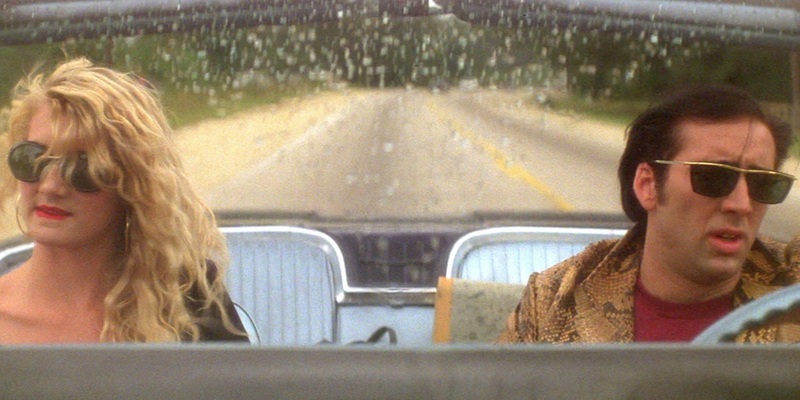
Sailor Ripley and Lula Fortune (Nicolas Cage & Laura Dern) are young, spirited, and very much in love. When a man (Gregg Dandridge) approaches Sailor at a classy function and accuses him of trying to sleep with Lula’s mother Marietta (Diane Ladd) and tries to kill him, Sailor defends himself and brutally kills the guy, and is sentenced to two years in prison for his trouble. Upon his release, he and Lula set out on a road trip, much to the chagrin of Marietta, who sends a selection of assailants out to put a stop to their escapades.
The exploration of my David Lynch blind spots continues with Wild At Heart! I’m counting it as a blind spot even though I’m certain I’ve seen it all before, mainly because I remembered absolutely nothing about it beyond the top 3 cast members being in it. I’m pretty sure my previous watch was during that mis-spent time when I tried to cram as many essential films in as possible, without actually paying a great deal of attention to them or taking anything in.
It’s been a few months since I’ve tackled a Lynch work, and I think I may have fallen out of the required headspace a little, as this just didn’t sit well with me. I think I just found this world to be a thoroughly unpleasant place to spend any amount of time in, and I kind of hated every character, even the ones I assume I’m supposed to be rooting for. Whilst it’s clear the characters of Sailor and Lula are destined to be together and I wish them every happiness, I’d like that happiness to occur far away from me. It would be kind to describe them as passionate people, but in reality I found Sailor to be a violent, impulsive person, far too quick to provoke and meting out nonproportional responses to any perceived slight. Meanwhile Lula insists upon striving out for a more independent life, but seems unable to function on her own as she obsesses over pursuing a Wizard of Oz fantasy regardless of the repugnant world she inhabits. I find it impossible to root for someone who refuses to clean up their own vomit for several days, letting it taint a hotel room with a rancorous odour and a swarm of flies. Granted, compared to almost everyone else in the film they’re shining lights of golden purity, but that’s only because the others are, without exception, utterly vile.

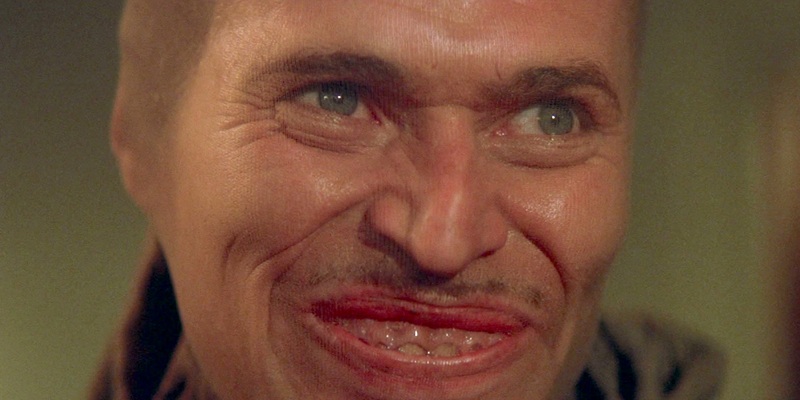
Chief amongst these are Diane Ladd’s occasionally lipstick-covered Marietta, whose farcical soap opera acting somehow garnered an Oscar nomination, and Willem Dafoe’s Bobby Peru, the personification of bad vibes and seedy evil. Imagine a cross between John Waters and Hannibal Lecter, with teeth somehow even more offputting than I could ever have imagined. Dafoe is only in around a quarter of the film, but he walks away with the whole thing, thanks in part to the incredibly arresting manner in which he leaves the film. The rest of the cast is resplendent with Lynch regulars (Sherilyn Fenn, Sheryl Lee, David Patrick Kelly, Jack Nance) mostly playing one or two scene oddballs who add some colour to the already kaleidoscopic world in scenes that feel like were left on the cutting room floor of Twin Peaks or Blue Velvet, without really adding much here. Jack Nance debating the philosophy of a hypothetical dog was fun, but then Dafoe slunk into the scene and all else was immediately forgotten.
At least part of my lack of enjoyment was my own fault, as what little I knew of this film included that there was some kind of connection to The Wizard of Oz. As it turns out, that connection was Lula longing for an Oz-like existence, along with way too many references, from characters being seen in visions as the Wicked Witch of the West or Glinda, to utter strangers name-dropping Toto, not, as I had assumed, a twisted retelling of the story. I spent much of the run-time trying to map parallel characters – Sherilyn Fenn’s dazed and addled car crash victim put me in mind of the scarecrow looking for a brain, and for the tin man there have been few characters more in need of a heart than Bobby Peru – but this evidently was a fruitless task, as the overall message I drew was that Lula needs to get over her desire for her world to be anything like Dorothy’s.
Speaking of parallels, I cannot believe I spent a year recording a podcast breaking down Con Air scene by scene with no knowledge that this film, released 7 years earlier than Simon West’s masterpiece, also features scenes in which Nicolas Cage is incarcerated for killing a man in self defence, is in prison reading a letter acknowledging his upcoming release date, and once released meets his young child for the first time, presenting them with a toy stuffed animal. Incredible. Those two and Raising Arizona should be presented as part of a Nick Cage plays a criminal triple bill (closing with Con Air, easily the best of all three). Oh, and as great as Dafoe’s prosthetic teeth were, Cage’s false nose at the end was terrible, being closer in colour to his hideous snakeskin jacket than his actual skin.
I’m hoping the rest of Lynch’s work that I’ve yet to see is more up my street, but I’m not holding my breath. For my liking this had too many repeated flashbacks, often only a second or two long, and way too much of an obsession with sex (every sex scene gave me flashbacks to the early, visceral, post-rape sequence, which was unpleasant every single time). I appreciated some of the Lynch-y touches – a hotel staffed entirely by old men on crutches, Crispin Glover playing Lula’s Christmas-obsesses cousin with cockroaches in his underwear – and a defiant phone hang up not being enough of a conversation close, so a drink is thrown over a photograph as well, but this isn’t a world I’ll be returning to anytime soon.
Choose Life 6/10
 Life Vs Film