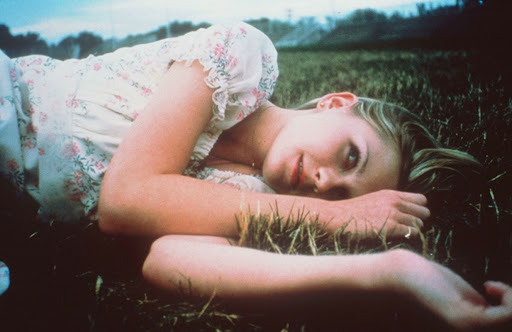
 Completely unintentionally, this was the second film in a row I watched where a young girl burns her own record collection (after Heavenly Creatures), and also the second in not too long a time in which Kirsten Dunst has sex in a field (after Melancholia a few months ago). With a title like The Virgin Suicides, I wasn’t exactly looking forward to watching this film, as it seemed like it was going to be joining the ranks of those thoroughly depressing films I’d been trying to avoid lately, and the fact that it was directed by Sofia Coppola, whose Lost in Translation I wasn’t overly fond of the last time I watched it, and who I still haven’t completely forgiven for The Godfather Part III, made me even less excited. Plus, its a story of the multiple suicides of a clan of teenage sisters, which always leads to a laugh riot in my books.
The film has been shot with an air of beauty and nostalgia – opening with an upbeat yet mellow soundtrack of a bright sunny days, the light dappling through the trees of a suburban Michigan town – but this is immediately contrasted to the stark sterile blue of Cecilia lying in a bathtub, being carted away by the paramedics. This jarring emotional toggle switch occurs a couple more times throughout the picture, and each time it is effective. The narration, by one of the boys waiting outside each day just to catch a glimpse of the girls, is largely unemotional and distanced from events, as though bored of a story told many times before.
From what I know the 1970s was recreated well, particularly in the fashions and vile interior design. Every shot was reminiscent of an old photograph, saturated and hazy, almost sepia and fading at the edges. Unusually, a lot of the scenes didn’t play out as I originally expected, even more of a surprise when you consider they have such standard high school movie tropes as a prom, featuring parents enthusiastic at their daughters’ dates, fumbled first dances and peach schnappes under the podium (“Babes love it.”) The script is at times comic, and occasionally blackly so, with my favourite moment being when, after awaking in the hospital, her doctor tells Cecilia she shouldn’t have tried to kill herself because she’s “not even old enough to know how bad life gets,” which is a pretty terrible way of convincing someone not to try and kill themselves again, but her response is perfect, “You’ve never been a 13-year old girl.”
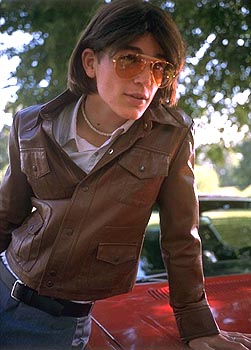 I suppose I should mention Josh Hartnett, who appears as the local dreamboat, Trip Fontaine, adored by students, parents and teachers alike, all except Dunst’s Lux, which only makes him want her more. Hartnett is his usual self, and I’m not too much of a fan (his only good films in my opinion are Sin City, The Faculty and Black Hawk Down, which surprise surprise don’t feature him all too heavily), and his abominable curtains-style haircut almost ruined the film for me. It was nice to see him playing such a prick though. Hayden Christensen is also in there somewhere, which is never a good thing.
So, whilst it’s not really going to cheer you up after a long day’s work, this is still a very well made and easily appreciated film, far better than I was expecting from Coppola. The ending in particular left me reeling for days afterwards.
Choose film 8/10
 Life Vs Film
I agree with your review; this is a subtly powerful film that has a staying power. Your use of 'hazy' is spot-on. Speaking of Lost in Translation, I saw that movie super late at night when I was very tired. Apparently that put me in an emotionally fragile state, because the end of that film had me sobbing uncontrollably.
You must be looking forward to crossing it off the 1001 List then! I'm looking forward to seeing it again, I feel it deserves a fair reappraisal, plus Bill Murray = gold in my book.
I agree that Dunst does a good job in this. When I was watching this I knew from the title that some or all of the sisters were not long for this world, though, so I never ended up making an emotional connection with them. Add to this we see them from the boys' perspective, and they are also not connected to them in a way to really understand them. Unfortunately, all of this just left me with knowing where the film was going, but not really caring that much about the characters.
Somehow I managed to forget that the sisters were going to kill themselves, even though it's not only spelled out in the opening narration, but in the goddamn title of the film. I can see how that would affect the connection to the girls, but I felt Dunst did so well that she bridged this gap.
Pingback: Sofia CoppolMay in Review | French Toast Sunday