Transformers

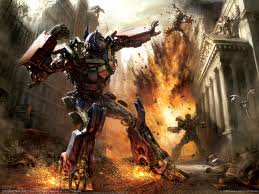
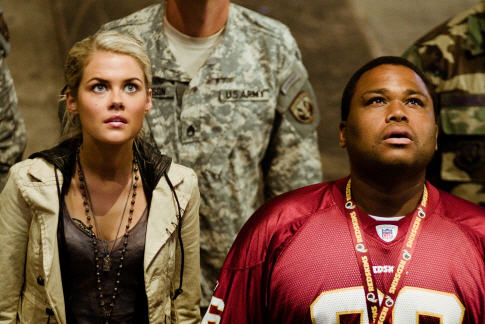
Part 2 in my Shia LaBoeuf: the Scourge of Cinema double-bill sees him taking on giant, transforming robot aliens as he attempts to save the world using a weird little cube, and cop off with Megan Fox. I’ve got no historical connection to the Tranformers franchise, as I neither saw the cartoon series or the animated feature from the 80s, and I’ve never played with any of the toys as a child. So unlike many people, I feel that so far my childhood has been unmolested by Michael Bay, something I was afraid I’d no longer be spared from with his intentions to paint his own brand of ridiculousness onto the Teenage Mutant Ninja Turtles, which I think now has been fortunately abandoned.I first saw the film in cinemas five years ago, when I was barely 20. At that point, I must have been just on the outside cusp of the film’s target audience, as I thought it was amazing. At that point in my life, Michael Bay was something of a favourite director of mine – I even liked Pearl Harbor – and a film that followed cars transforming into robots and beating the scrap out of each other, interspersed with eardrum-bursting explosions, comic cameos and gratuitous shots of Megan Fox bending over an engine at sunset was of course going to do nothing but good to my barely-older-than-teenage mind. Now, however, I see the film for the hollow, disorganised, puerile mess that it truly is.Granted, I’m no longer the film’s target audience, but this is my review, so I’m giving my opinions. This film is stupid. I’m on board for a story about robots from outer space that can somehow transform into cars, planes and, um, a stereo, but unfortunately most of this film is about Shia LaBeouf’s Sam Witwicky, a typical the-only-character-LaBeouf-can-play annoying, dumb every-kid stereotype with embarrassing parents, mediocre grades, stupid friends, a crappy car and a complete and utter lack of charm and charisma. As always, LaBeouf plays an annoying tit rather well, as you’d expect from having had so much practise. It transpires that Sam’s great-grandfather was an Arctic explorer who discovered the allspark – the movie’s maguffin that is capable of creating new transformers – and Sam holds the key to it’s whereabouts, because somehow a map has been engraved into his ancestor”s spectacles. Ludicrous. Two warring tribes of robot aliens – the human-loving Autobots, led by Optimus Prime (voiced by series original Peter Cullen), and the world-conquering Decepticons, led by Megatron (a wasted Hugo Weaving) – somehow learn that Sam has the glasses, and trace his location using eBay. Of course. Along for the ride is Megan Fox’s Mikaela, the girl of Sam’s dreams who is clearly from such a broken home that her family is unable to replace the clothes she clearly grew out of some years ago.There’s also a couple of sub-plots involving the squad of marines – a Michael Bay trademark – who initially encounter a Decepticon attack, and attempts by the government to decode a message recorded from the bots. Each of these strands involves barely fleshed out caricatures instead of actual characters – the marine who sporadically speaks in Spanish even though no-one else understands him, the immature ‘world’s greatest hacker’ with his irritating dance-gaming friend – and does anyone else remember when Jon Voight was a respected actor, and not reduced to offering dry exposition as the Secretary of Defense? The government strand featured one of my biggest pet peeves in films. The film focuses on a group of hackers. This group is predominantly made up of guys who look like hackers – they’re overweight, scruffy, and generally appear socially awkward. And of course the one who’s better than all of them is played by Rachael Taylor, who looks like a supermodel. There is no girl in the world who looks like that and knows how to hack. I’m aware that of all the things in the film that don’t make sense, this is relatively minor, but it’s something that has always annoyed me.
This kind of films lives or dies by the CGI, and I’ll be the first to admit that it’s damn impressive. There are some sequences that look absolutely bad-ass, most notably the opening Scorpiok attack, and a massive-scale battle between both sides at the end. Starscream, the Decepticon who is able to transform into a jet, has the coolest moments, especially when he transforms in mid-flight and swings on a bridge during a strike on the Hoover dam, so in those respects the film has some enjoyable moments. The problem is that in a film for which the entire draw is robots hitting each other, there’s just not enough of it. At one point, the robots are in the middle of a catastrophic fight, yet we are left watching Voight and the hackers searching for some microphones and using morse code.

There were a lot more attempts at juvenile comedy than I remembered from my earlier viewing, and very few of them were gratefully received. At one point, a diminutive robot capable of transforming into a machine attempts to walk nonchalantly passed some people looking for it, and it tries to cover it’s face whilst walking! This is not comedy, nor is it clever, it;s just stupid. There are many more scenes like this – an Autobot ‘lubricating’ (peeing) on John Turtorro’s government agent, Sam’s asinine chihuahua Mojo, everything LaBeouf does – and the only comedic scenes that really do the job are those involving Bernie Mac as a car salesman, and Kevin Dunn and Judy White as Sam’s all-too-familiar parents.

If the idea of giant metallic creatures from space beating each other up has you foaming at the mouth with excitement – and at times this is a category I’d class myself in – then you’ll probably like about half this film. If you’ve recently had a lobotomy or are a prepubescent male, then you’ll probably like the other half. If not, just leave it alone.

Choose life 5/10

The Dark Knight Rises

Just to let you know, like the rest of the world, I have seen The Dark Knight Rises. I saw it opening night, over two weeks ago, but haven’t written a review yet for two reasons: 1, I haven’t had time, and 2, I didn’t really have anything to say that everyone else hasn’t already said. So, I’m not going to review it yet. What I am going to do is wait until it comes out on DVD, buy it, watch it again, and then review it. Simple. Hopefully by then everyone will be over the inundation of Batman reviews. In the meantime, here’s my quick thoughts on the film:

Continue reading

Guaranteed Happiness: Wall-E

Welcome to the first post in my new semi-regular feature, Guaranteed Happiness. I’ve discovered that a lot of the films I’ve watched recently haven’t necessarily dealt with very happy subjects, and this has been getting me down a bit. Now and then, I’d quite like to watch a happy film, or one that’s uplifting and ensures that I’ll have a big stupid grin on my face for at least 80% of it, and definitely at the end. After all, I’d much rather write about a film I’m passionate about, and I tend to have more to say about films that make me smile than those that make me suicidal. Praise should be aimed squarely between the shoulders of my girlfriend then, for sticking on Pixar’s gem Wall-E when I was in a decidedly cranky mood a little while ago. The aim was for me to sit down and write some posts, which to be honest I was in no mood to do after a fairly crappy day at work and having to shell out over a considerable amount of cash to fix my bike, yet as soon as the film began all thoughts of blogging and even glancing at my laptop screen were out the window.So, why do I love Wall-E? The simple answer is robots. It’ll come as no surprise to regular readers that a film featuring robots (or dinosaurs, time travel or Stephen Tobolowsky) will immediately be watched with heightened levels of glee. And the fact that it’s made by Pixar, a company that has made some of my favourite films to date, and is where I’d be willing to sell several members of my immediate family to work at, then so much the better.This is my favourite Pixar film, which is definitely saying something. I adore the Toy Story trilogy (especially, predictably, Rex), but there’s something about Wall-E‘s simplicity, its pared down scope and focus on telling a straightforward story in new, interesting, and above all, beautiful ways.

The plot is basic: in the not-too-distant future, the human race has polluted and destroyed the world so much that life has become unsustainable, and the only hope lies in the Axiom, a titanic spaceship resplendent with every luxurious convenience to fulfil any desire. Earth has been abandoned and left to the robots, who spend the next few hundred years tidying the place up. Wall-E, our intrepid hero, is the last surviving ‘bot, and he spends his days making and stacking little cubes of garbage into towering skyscrapers of trash, accompanied by his only friend, a cockroach. One day, a ship descends from the heavens, carrying EVE, a futuristic, high tech reconnaissance droid, and Wall-E is instantly smitten.

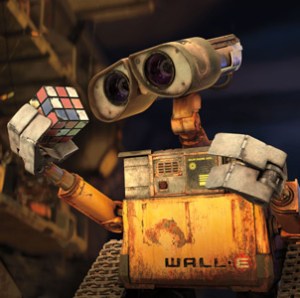
The tale of a schlubby, down-on-his-luck guy falling in love with an out-of-his-league wonder girl is hardly new, but as far as I know this is the first time it’s been told almost entirely wordlessly, and about mechanical beings. A certain amount of disbelief needs to be suspended to watch the film – the robots seem to have far more personality than they should have been implanted with in the factory – but this results in one of the most well-rounded characters in all of Pixar’s history. Wall-E (which stands for Waste Allocated Load Lifter – Earth Class, something I know from memory) has a love for all things quirky, unusual or fascinating, be it a Rubik’s cube, egg whisk or an old VHS of Hello Dolly!, and watching him investigate the functions of each item – wearing a bra like sunglasses, accidentally erupting a fire extinguisher – are a joy to behold. As are his attempts to woo the evidently disinterest EVE (whose acronym would be a spoiler). The couple’s dates are more moving and say far more than any scene of dialogue could.

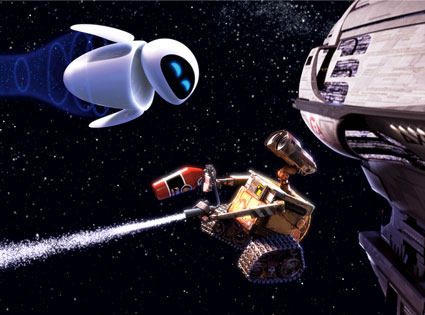
It’s almost impossible to narrow the film down to my favourite scene, but I’d probably say EVE and Wall-E’s space flight. It’s nothing short of a work of art, as the two bots fly a merry courtship dance around one another, set to Thomas Newman’s beautiful score. In fact, every scene between just those two, all almost entirely devoid of dialogue, are so very easily lost in. Their relationship feels natural and real, and if anything the films is at a detriment as the plot moves away from Earth, and the story looks past our central couple.

There’s a few messages hidden not too deeply in the film – stop fucking up the Earth, grow your own food, get off your arse and exercise – but to be fair these are all fairly good messages, when compared to the standard Disney fare of wait for a handsome prince to come and rescue you. Wall-E’s messages are ones I personally agree with (“even if I don’t necessarily live by them,” he says, patting the spare tyre around his midriff) so I don’t really mind such unsubtle preaching in a film, especially one as entertaining as this.

I’ve made no secret of the fact that I’d have loved nothing more than to have been part of the character design team on this film. Wall-E himself has been so carefully thought out with regard to how he works and fits together. I may have appreciated this more than most, being a mechanical engineer by trade, but I think everyone should be impressed by the level of detail. Apparently the design team at Pixar meticulously analysed various machines, working out which ones were ‘male’ and which were ‘female’, and what characteristics defined these genders. Wall-E has clearly been inspired by more clunkier, mechanical machinery, as seen in factories and assembly lines, whilst the sleek, white plastic of EVE is straight out of an Apple store.

As you’ve probably realised, I love this film. The Wall-E poster, a giant pair of his eyes looking inquisitively out of the frame, justifiably hangs in in my lounge, yet I think it almost qualifies as one of the ‘other’ Pixar films that isn’t about toys, fish or superheroes. From the small details – sci-fi queen Sigourney Weaver voicing the Axiom’s tannoy – to the fully realised plot and the brilliance of casting Ben Burtt, the voice of R2D2, as Wall-E, I cannot fault this film in the least, and nor would I want to. And I’d still be trying to get Randy Newman’s closing credits song out of my head if it wasn’t so bloody good.

Choose film 10/10

Memento

Christopher Nolan’s first major picture (after 1998’s Following, which is interesting but a tad too confusing, and really for completists only) is at first glance nothing but a gimmick, using a reverse-narrative to tell the detective noir of Guy Pearce’s Leonard Shelby as he hunts for the man who raped and killed his wife whilst suffering with a rare condition that prevents him from making new memories. However it turns out that telling the story backwards, scene by scene and with an expositionary telephone conversation spliced in between, is the only way to give the story justice.
Famously, there is an easter egg on the Memento DVD that plays the film in chronological order, and I’ve discovered that in that orientation the film just doesn’t work. It’s not just because the last few seconds of every scene are replayed again moments later at the start of the next one (surely that wouldn’t have taken much to edit out?) but it’s also because the film is completely lacking in tension or pacing when that way round. Which just goes to show that Nolan was able to use a plot technique to it’s fullest advantage, which in the hands of a lesser director could have proved disastrous.
Pearce is excellent in an unforgiving role, especially given that Leonard has no character arc longer than a scene. He’s always been a brilliant actor, and often hides his Brad Pitt-esque looks behind obscuring facial furniture or heavy make-up – see Ed Exley’s glasses in L.A. Confidential, or large amounts of Play-doh in Prometheus – and here is no exception, with Shelby’s body plastered with tattoos and a shock of peroxide blonde hair to distract from those razor-sharp cheekbones. Pearce is ably supported by Carrie-Anne Moss and Joe Pantoliano as Natalie and Teddy, people who may or may not be out to help Leonard on his quest.We discover elements of the story as Leonard does, and the true meaning of almost every scene is altered by the one that immediately precedes/follows it. Surprisingly, a scene can hold just as many surprises, and just as much tension, if you know how it ends but not how it begins. You can’t help but feel sorry for Leonard, in a situation that would drive most of us insane – as long as we could remember the insanity long enough – and his life would be hard enough without everyone screwing with him. Even the clerk at his motel (Batman Begins‘ Mark Boone Junior) charges him for two different rooms, and doesn’t even hide it from Leonard, as there’s no chance he’ll remember.

There’s more comedic moments than you might remember, and some darkly so, for example the conversation where Leonard reveals to Natalie that the last thing he remembers is his wife. She says that’s sweet, before Leonard concludes “…dying.” I probably shouldn’t have, but this got a start of laughter from me.

I remember that my first viewing of this movie was ruined when I borrowed it from a housemate some years ago. He basically told me the ending, and that the film was crap, but I watched it anyway and remained intrigued and fascinated by how the plot would tie together – which it does nicely. Rest assured I never took that housemates movie advice again.

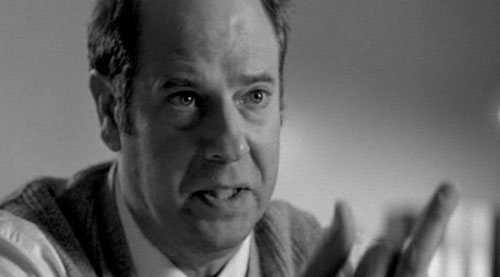
If Stephen Tobolowsky is in a film, then I’m legally obliged to mention him in a review, and here he crops up in grainy, black and white flashback as Sammy Jankis, a case Leonard looked into as an insurance claims investigator before his memory loss. Jankis suffered from a similar condition as Leonard, and Tobolowsky’s wonderfully big blank face is perfect for the look of someone not recognising anything new in the world around him, and his bursts of anger at annoyance – at an elctro-shock test and not understanding TV shows – is also great.

The story, written by Christopher Nolan’s brother Jonathan, is well thought out and takes into account the minutiae of Leonard’s predicament. Such a high concept (though scientifically possible) film could have left many annoyances at skipped over details, loose plot strands or inconsistencies, but by the end/beginning no such problems are left.

Choose film 9/10

A Nightmare on Elm Street

I can only imagine Hallowe’en parties in 1984, but I’m guessing quite a lot of people were dressed up in a battered fedora, red and green striped sweater, poorly applied ‘burned’ make-up and a glove with cardboard blades glued on, for if anything has endured from Wes Craven’s multiple-sequel spawner, it’s Robert Englund’s nightmare-stalker Freddy Krueger.

If it’s true that a horror movie lives or dies (generally by running upstairs instead of out the front door) by it’s killer, then there’s no surprise that this franchise is still going. I haven’t seen the 2010 reboot and I’ve only heard bad things, but I’m intrigued to see Jackie Earle Haley’s take on the former child murder released from prison on a technicality but burned alive by the parents of Elm Street. Krueger is an icon from horror history, up there with Michael Myers, Jason Voorhees and the Guy in the Scream mask, making up the B-team behind the likes of Frankenstein, Dracula and the Wolfman. For Krueger, you see, is unstoppable. He’s risen from the dead to take the children of those that murdered him, but he does his killing in the one place he cannot be caught; the children’s dreams. This is a genius conceit, but also the film’s biggest let down.
If you want to terrify your audience and instill in them genuine fright once they have stopped the film and gone about their daily lives, you scare them with something ordinary. A situation they themselves will find themselves in on a regular basis. Hitchcock did it in Psycho with having a shower. Craven did it with going to sleep. There’s nothing you can do about it, eventually you’ll have to go to sleep; quite often it happens without you even planning to. And once your head is resting gently on your pillow, all you can think about is that maniacal laugh echoing around the walls. That tapping at the window, surely that’s just the branch of a tree blowing in the wind, it couldn’t possibly be the knifed glove of the man out to rip you to shreds? When asleep you’re at your most vulnerable. It can happen anywhere – at home, school, prison, hospital, and there’s no way to defend yourself (short of Inception-style techniques, crossover anyone?) and Craven knows this. In his world, a glass of warm milk is as deadly as any conventional weapon.
But the fact that Freddy exists in dreams, can defy physics by being everywhere at once and can take on any form he chooses to terrify you the most, makes him almost less scary. There’s a sense of inevitability. Much like in Ring, once you watch the tape, you’re going to die. There’s not a whole lot you can do about it. You can’t kill Freddy in a dream, you can’t stay awake forever, there’s really only one possible outcome. Yes, in this film and the ever diminishing sequels they find loopholes to temporarily get around the issue, but I’ve always found these to be annoyances and cop outs from the original story. I’d forgotten the ending of this film when I saw it, and I was almost incredibly annoyed at the backdoor excuse they try to use.
It’s a good, solid horror film, and is much more effective if you never, ever watch the sequels. Whilst they have some inventive kills (hearing aid? genius) and increase the comedy quotient, Freddy becomes a watered down pantomime villain, whose incessant survival becomes more grating the more films you watch. But here his terrorising of four teens (including a 21-year old Johnny Depp in his movie debut) is played largely for tension and scares, though there’s a few lull-in-the-score moments that are clear setups for something to jump out and grab our virginal heroine Nancy (Heather Langenkamp).
There are moments of black comedy – a cop telling a paramedic “you don’t need a stretched, you need a mop,” and the kills are satisfyingly gory. Nancy looking in the mirror got a laugh out of me, as at the time of the film’s release Langenkamp was, you guessed it, 20 years old. The image of Krueger’s hand emerging from between the legs of a girl asleep in the bath is more than a little terrifying.
Choose film 6/10

Prometheus

Don’t ask me how, but I managed to get a ticket to the Cast & Crew Premiere of Prometheus at the Empire Cinema in London’s Leicester Square last night. Though it was disappointing not to see director Ridley Scott or the cast, who are probably saving themselves for tomorrow’s red carpet Premiere (a part of me was hoping I’d get to sit next to Charlize Theron, you can probably guess which part), the experience of going to see a film with nothing but film fans and people who respect the art, in a stunning cinema, was amazing, even if there was a bit of a post-movie crowd crushing to retrieve handed-in phones afterwards. Plus, I saw it three days before the rest of the general public, which makes me feel special. 
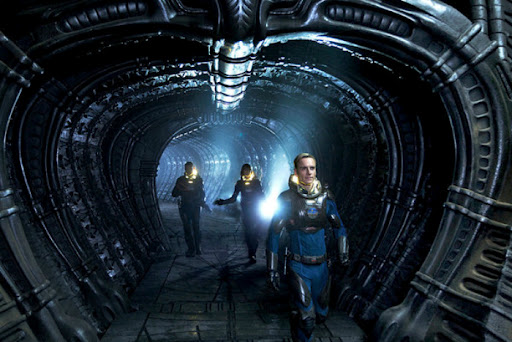
 In 2089 a group of scientists, led by Shaw and Holloway (Noomi Rapace and Logan Marshall-Green) discover ancient cave paintings on the Isle of Skye depicting giant humanoids reaching up to 6 orbs in the sky. The drawing matches others found all over the world, and point towards a distant planet that may hold some key to the origins of mankind. Four years later, the scientists arrive at the planet LV223 as part of a 17-man crew aboard the Peter Weyland-funded ship Prometheus. Once there, the crew find traces of alien life, but are the answers they receive the ones they were hoping for?

Unforgiven

The first part of my double bill of Clint-Eastwood-directing-himself-and-Morgan-Freeman-in-a-supporting-role sees the American icon define the genre that not only made him the prolific star he is, but that he has almost singlehandedly kept alive since it’s surge in popularity in the 60s and 70s; the western.
Unforgiven sees Eastwood as William Munny, a former hardened killer reformed by the love of a good women and the birth of his two children. With his wife dead and their herd of pigs stricken with fever, Munny accepts the offer from young upstart The Schofield Kid (Jaimz Woolvett) to kill two ruffians who cut up a whore after she laughed at one of them having a small penis. They team up with Munny’s former partner Ned Logan (Morgan Freeman) and head out to the town of Big Whiskey, lorded over by Gene Hackman’s occasionally violent ‘Little’ Bill Daggett, where other hired killers, including Richard Harris’ English Bob, are also heading to claim the bounty.
Eastwood’s Munny isn’t your typical western hero. In fact, no character in this can ever be truly classed as heroic. Munny has what could politely be called a sordid past, and his desperation to honour his late wife by not succumbing to his younger urges is evident. A self proclaimed no good son of a bitch, Munny is a shadow of his former self, unable to shoot straight or even mount a horse. Freeman’s Ned has a woman at home, yet has no qualms about visiting the whorehouse in town, Schofield has his own secrets and Bob is an outright liar, gambler and killer. At times it seems that Little Bill, supposedly the villain of the piece, is possibly the most moral character here, opting not to kill the prostitute abusers in favour of fining them horses instead, with the sins he commits in the present are nothing compared to those done by Munny in the past, and his intentions are only to keep his town free from guns and violence, except from his own. I found it odd though that nothing was made of Freeman’s race, as he and his partner are the only non-white characters in the film, yet there are no even passing references when the townsfolk describe him. I’ve just realised I’m annoyed that Morgan Freeman wasn’t racially abused in a film.
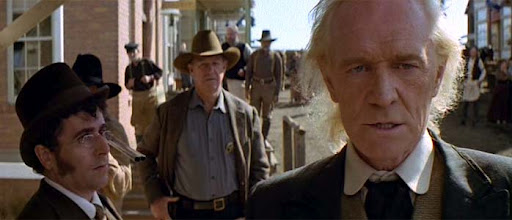
The script, which did the rounds in Hollywood for 20 years before Eastwood picked it up, is pocked with sharp humour and great lines (“If I see you again, I’m just gonna start shooting and consider it self defence.”) and works not just as a study and disassembly of the westerns that came before it, but as a damn good, prime example of one itself. Harris’ English Bob has his own biographer (Saul Rubinek), whose role is to take Bob’s stories and lyricise them a little; in essence creating the cowboy myths and legends that make up the staples of the genre. It’s a film about shattered dreams and fallen heroes – the actors as much as the characters – as it’s not often you see Eastwood rolling around in pig shit, Morgan Freeman asking someone if they sleep with prostitutes or just use their hand or Lex Luthor beating the crap out of Dumbledore. It’s clear that Munny could quite easily be any one of Eastwood’s previous stoic, bitter, hard as nails cowboys who’d let themselves go for a few years.
The film deals with the seriousness of death and murder, with no post-kill smart alec quips. One characters defiant “I’ll see you in Hell, Willaim Munny,” is met only with a considered, matter of fact “Yeah.” It’s almost as prolific as The Good, The Bad and The Ugly and Once Upon A Time in the West, and definitely ranks in the top 5 westerns.
Choose film 9/10

Seven

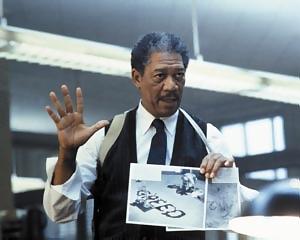
A buddy cop movie with a seasoned old hand so close to retirement they’re already scraping his name off the door and his hotshot, firebrand young replacement, this couldn’t be further from another Lethal Weapon. Yes, one’s a family man and the other’s a loner, one is prone to anger and the other a methodical, careful detective clearly too old for this shit, but where Richard Donner’s 80’s staple is an entertaining, action-packed romp, this is something much darker.After a disturbingly evocative opening credits sequence enriched with depth and meaning on repeated viewings, we meet Morgan Freeman’s detective Somerset, picking up his last case, a sickeningly masterful serial killer with a penchant for the seven deadly sins, the same day as Brad Pitt’s Detective Mills arrives to replace him. That’s as much setup as there is, as we follow the mismatched detectives from crime scene to crime scene, via their headquarters and areas of research, with Somerset whiling a night away poring over books in the library, whilst Mills take a brief glance at the Cliff notes.

The script is dotted with well balanced moments of humour – Somerset having dinner with Mills and his wife Tracey (Gwyneth Paltrow) – and some deep black humour: “this guy’s sat in his own piss and shit; if he wasn’t dead he’d’ve stood up by now,” plus R. Lee Ermey’s belligerent, furious Police Captain (“This is not even my desk” is one of my favourite film quotes, ever).

Crucially, we see none of the killer’s murders onscreen, merely their gruesome aftermaths. It’s not as gory as you might remember, but it evokes imagery and feelings that some may find disturbing, not least what happens to Leland Orser’s character, who probably has the worst memories of those who survive. It could be argues that this is a precursor to the Saw franchise, punishing those that seem to deserve it in creative, torturous ways, but at least here we are saved the nightmarish spectacles of witnessing the deaths.

At times the film feels a bit predictable, like a police procedural itself, but whenever this is about to happen the plot shifts direction, taking an unexpected twist to shake things up again. The colour palette of muted greys and browns, interspersed with deep reds amongst the incessant torrential downpour of the nameless city only adds to the feelings of despair.

There’s small roles for John C. McGinley and Richard Schiff in there as well, a nice surprise for me in the opening credits, but unfortunately at times the acting, especially Pitt during the final scenes, leaves something to be desired. The ending has become the stuff of legend, but I won’t reveal it just in case, save that Pitt’s gurning and crying are a bit over the top and take you out of the scene. This is another one of those films where knowing your actors may ruin the film too, as recognising a voice could cause annoyances later on, but not too badly.

Overall this is director David Fincher’s defining film (better than Fight Club in my opinion, though it’s been a while). The gritty tone is perfectly realised through every medium possible, the plot is gripping, the twists hold up and, though far from an enjoyable experience, it remains worthwhile.

Choose film 10/10

Avengers Assemble

Ugh, typing that name made me feel so dirty. Avengers Assemble. Ugh. There was nothing wrong with just The Avengers, no-one was going to go in expecting umbrellas, bowler hats and catsuits, and even if they had been, they’d have got something better anyway. Plus, ‘Assemble’ is possibly the least exciting word to ever appear in a movie title since The Adjustment Bureau.
Now chances are this isn’t the first Avengers review you’ve read, hell chances are this isn’t even the first Avengers review you’ve read that starts off by telling you it’s not the first Avengers review you’ve read, seeing as this is one of those movies (let’s not kid ourselves by calling it a film, this is for entertainment purposes only) seemingly designed to be discussed at length on the Internet. We’ve sat through 4 years of 5 prequels, and for literally years the Internet has been lying in wait to rip apart this inevitable car crash of a movie. Which makes it something of a surprise that not only is it not bad, it’s bloody good.
No-one saw this coming. They said it couldn’t be done. I agreed. The last few Avengers prequels hadn’t been great, especially Iron Man 2 and Captain America (I don’t know what everyone has against Thor, I thought Kenneth Branagh did a good job with a lesser-known character) and I firmly believed that throwing six superheroes at one another in the same film was going to look like something Hulk had sat on. The only things it had going for it were a stellar cast and a solid director in Joss Whedon, of whom I’m unashamedly a fanboy (other than I’ve never seen an episode of Buffy or Angel). Whedon is known for handling rambling, ensemble casts (Firefly) and has always managed to balance action with snappy dialogue, drama with romance and a hefty dollop of comedy, but I didn’t think there was a great enough female presence here to draw his attention, with Black Widow as the only main girl. So, going in, my hopes were high but my expectations primed for mediocrity, so it’s a pleasure to say that I honestly can’t think of many ways the film could have been handled better.
Essentially, this is an origin movie. What’s unusual is that most of the main characters have already had at least one movie of their own, mostly origin stories, so what we have here is the beginnings of a culmination of pre-established characters. You don’t necessarily need to have seen all of the other films before watching this one, but I think it’d help, as the plot is partially set-up within Iron Man 2, Thor and Captain America, in terms of the basis of the Avengers, the bad guy and the maguffin. I saw this with my girlfriend, who hadn’t seen Thor but had all the rest, and she didn’t need much explaining to her other than that Thor’s devious brother Loki isn’t played by Michael Fassbender, but is instead the brilliant Tom Hiddleston, who performs ably as the primarily sole lead bad guy against an entire team of heroes.
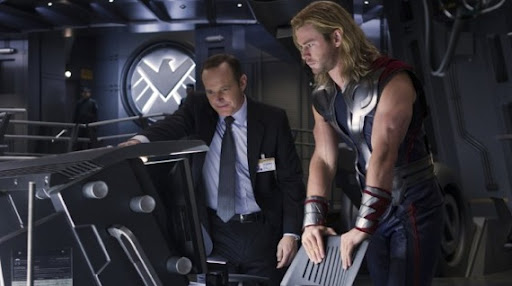
It would have been very easy, and very foolish, to have made this Iron Man & Co, seeing as Robert Downey Jr.’s Tony Stark is undoubtedly the most enigmatic and entertaining character on screen, yet wisely Whedon scaled down the potential for the Stark Show into giving him just as much time on screen as everyone else. There is no lead character here, everyone gets their moments, no-one is our entry point into the team and there appears to be no jostling for the limelight. In fact, the first people we meet are the agents of S.H.I.E.L.D., Samuel L. Jackson’s Nick Fury, Cobie Smulders’ Maria Hill and the ever dependable Clark Gregg’s Coulson (“Phil? His first name is Agent.”). These guys, along with existing Avengers members Black Widow (Scarlet Johansson) and Hawkeye (Jeremy Renner) then set about recruiting the rest of the team from across the world (and a little bit further, in Thor’s case).
Once recruited, the plot revolves around a Transformers-esque power cube known as the Tesseract that Loki has obtained, and intends to use to rule the Earth. Yadda-yadda-ya, it’s not all that important, and isn’t what you’re here to see. No, we’re here to watch some superheroes fight, bicker, argue and smash. I’ve heard arguments that there isn’t quite enough action in this 142-minute movie to satisfy, but I found the dialogue scenes to be just as entertaining. As expected, the superheroes, all previously alphas in their own movies, don’t initially gel together all that easily, and Iron Man keeps the insults flying at his comrades (Thor is referred to as “Shakespeare in the park,” Captain America is ribbed for being an old man). It’s clear this isn’t just friendly banter.
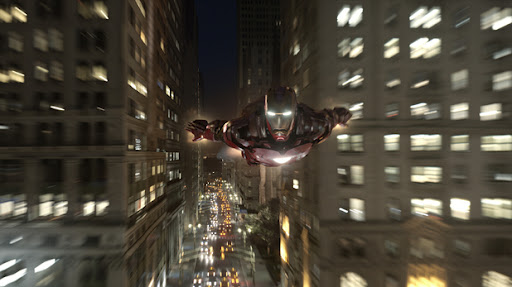
When the action scenes do come along, including one mid-way through worthy of any summer tentpole finale, they will have you marvelling at everything. And the actual finale, involving a mass brawl around New York City, features an incredible tracking shot that finds all the Avengers showing off the only way they know how, that I can only fault by being not long enough. Granted, with such a large cast there are occasional incidents of characters appearing to be forgotten or sidelined temporarily whilst the others are front and centre, but this isn’t too noticeable at the time, and doesn’t distract from the action.
Unlike his previous films, here the Hulk is neither under nor overused, and is easily one of the best aspects of the movie. Mark Ruffalo, taking the giant green reins from Edward Norton, delivers possibly the greatest Hulk yet, portraying Dr. Bruce Banner as an amiable everyman only too aware of the situation he’s in. He’s rewarded with some of the best, and funniest moments from the film, not least his one-on-one meeting with Loki.
Whedon seems unable to let a few trademarks go, though discussing them could be delving a little too deep into spoiler territory, but look out for a couple of cameos from his other projects, as well as appearances from Gwyneth Paltrow, Paul Bettany and Stellan Skarsgard all reprising roles from the prequels. Natalie Portman, however, is conspicuous only by her absence. Bizarrely, the likes of Powers Boothe, Harry Dean Stanton and Jenny Agutter also crop up in tiny roles.
Some moments seem entirely shot for trailers, and I was a bit annoyed that my knowledge of Marvel’s upcoming slate and a couple of shots from the trailers ensured that some of the would-be tense moments were obviously going to be resolved (albeit awesomely), but that’s my fault for watching trailers. There is a scene to wait for after the credits, but unless you’re a fan of the comic books there’s really no point, as I had no idea what the scene was about when it appeared until I delved around the web once home. All-in-all, I’ve very little to fault about the film, other than the incessant use of ass-level shots as characters walks away from the camera. I’m genuinely tempted to go and watch it again at the cinema, something to this day I’ve never done before, and I’m not the least bit annoyed that talks are already being made about an Avengers sequel.
Choose film 9/10

Mad Max 2 The Road Warrior

If the recent UK petrol strikes had gone on a little longer, chances are we’d have seen something not too dissimilar to the events here, in George Miller’s 1981 sequel to 1979’s Mad Max. Mel Gibson reprises his role of Australian cop Max Rockatansky, but the world he lives in is now a barren, chaotic land left ravaged by a worldwide war, leaving the survivors desperate for any fuel they can find.
Max and his dog roam the landscape looking for gasoline, eventually hearing about an enormous stash not too far away, and so with the guidance of a deranged nutcase with a flying machine (“It’s my snake, I trained it and I’m gonna eat it.”), set out to find it, but alas the compound within which the gasoline is kept is not only heavily guarded, but is also being laid siege to by a ruthless gang of miscreants.
Whilst this is certainly an improvement on the original movie, there are still a lot of things here that don’t make sense. For starters, the motivation for every character is to end up with more fuel, yet all seem to expend an awful lot more than they need to in order to get any. Whole fleets of cars and motorbikes are sent out on scouting missions, showboating and jumping as they go, and even the compound uses a bus as a gate. If fuel is so very precious, why are they all so eager to waste it?
The costume design has progressed from the previous film, and now the rebel gang has an even greater passion for leather, bondage and ass-less chaps than Max himself. The depiction of a lawless, structureless society is well done – one of the gang’s cars is a cop car, suggesting that it’s not just the general population that has lost it’s mind – and Max readily eats cold dog food, straight from the tin. There’s better characters too, including a feral kid with a deadly boomerang (played by the brilliantly named Emil Minty), and there’s some decent action and chase sequences. The epic finale, with the gang attempting to seize a petrol tanker trying to travel 2,000 miles to paradise, does get a little samey after a while, but is impressive nonetheless. The arm-mounted crossbow though is probably the least threatening weapon I’ve ever seen.
Fortunately, Mad Max 3: Beyond Thunderdome isn’t on the list, but this one is deserving of it’s place. It’s by no means the greatest dystopian future survival movie, but it’s still an enjoyable watch, and certainly has it’s moments.
Choose film 7/10