Zodiac

Amidst the 4th of July celebrations in California in 1969, two young romantics drive out to a secluded spot the locals refer to as Lover’s Lane. The mood is of anticipation; anything could happen as the other kids drive away, our lovestruck pair left alone. There’s a spark of romance, playful glances, touches, the gentle ribbing of one another as they become closer. And then they’re shot in cold blood and left for dead with no word of explanation by an unseen killer. This murder, along with the many that follow it, dramatically changes the lives of many people, but our focus here is a select three; Mark Ruffalo’s cop, Robert Downey Jr’s journalist and Jake Gyllenhall’s cartoonist, as they each set out to catch the killer. Their motives are different – Ruffalo’s David Toschi wants justice, RDJ’s Paul Avery is out to further his career and Gyllenhall’s Robert Graysmith is obsessed with the puzzles the killer sends to the local papers, but all three will suffer in terms of careers, personal lives and sanity at the hands of this killer.
Based on the real life Zodiac killer (the influence of the Scorpio killer in Dirty Harry, here namechecked when Toschi can’t sit through a showing), the case remained unsolved when the lead suspect died some years ago, and it’s this sense of inconclusiveness that runs throughout the film – you know there will not be a satisfactory ending. Plaudits should be laden for the realism of the film – not since All the President’s Men has so much paperwork been completed – but unfortunately the dreary, depressing side of catching a killer rubs begins to rub off onto the film during its overlong running time. Director David Fincher (Benjamin Button, Seven) is usually so adept at keeping interest, even when Morgan Freeman went to a library, but here not even a cast including Elias Koteas, Philip Baker Hall, Brian Cox, Anthony Edwards, John Carroll Lynch, Adam Goldberg and Clea Duvall can raise this above tedium. There’s a good film in here somewhere, and a good edit could bring it out. More Downey Jr. and Brian Cox couldn’t hurt though, they’re the best parts of the film and are criminally underused.

Choose life 7/10

Topsy-Turvy

Mike Leigh’s depiction of acclaimed stage show writer and composer Gilbert & Sullivan (Jim Broadbent & Allan Corduner) creating their most famous production, the Mikado, is extremely well performed by all involved, especially the two leads and Timothy Spall as one of several preening thespians. The background is littered with know-the-face British actors (Andy Serkis, Dexter Fletcher, Mark Benton etc.) and the costumes and set design are spectacular. Unfortunately, the film is far too long, and too much time has been given over to the musical numbers, with at least ten being shown throughout the film. A much tighter script, focusing more on the backstage goings-on and less on the show itself, could have led to a bona-fide British classic about two of our most notable showmen.

Choose life 7/10

Sweet Smell of Success

I hate disappointment, yet the further into the List I delve, the more used to it I become. Sweet Smell of Success is a film I’ve had sat on my DVD shelf for over a year now (since even before the List entered and devoured my sad excuse for a life), and I’ve been waiting for a chance to watch it. Appearing on 3 lists and this month featured as Empire magazine’s monthly Masterpiece, my hopes were set to high. I knew two things: the film was endlessly quotable (a character in Diner does nothing but quote the script) and it features arguably career-best performances from leads Tony Curtis and Burt Lancaster. Whilst I cannot deny these points, I must take umbrage with the film for being far too dense. Even now I only have a vague idea as to what took place – Curtis’ ambitious yet downtrodden press agent Sidney Falco teamed up/sparred with Lancaster’s ruthless columnist J. J. Hunsecker in an effort to prevent a relationship between Hunsecker’s sister and a young jazz musician, so the Falco can get more column inches in Hunsecker’s paper. Much of the script is quotable (“You’re dead son, get yourself buried)”, but there is so much of it many of the best lines are lost. Doubtless this film will improve with repeat viewings, and if so my score shall be upgraded, but for a one-watch it doesn’t hold up. The score has also received a lot of plaudits, yet I found it really did not fit to the film – a barroom conversation sounds more like a frantic car chase. Here’s hoping the next viewing is more enjoyable.
Choose life 6/10

Fantastic Planet

On an alien planet, a race of gigantic meditating blue-skinned, red-eyes creatures known as Draags keep humanlike Oms as pets. To the Draags, Oms are no bigger than beetles, and are treated as playthings or pests, with the many wild Oms being routinely killed every three cycles (15 years) to prevent an uprising.

The world these creatures inhabit is, quite frankly, insane, inspired by both Stefan Wul’s novel and a large dose of narcotics, and has been created with a simplistic Python-esque animation style, with a heady dash of Dali thrown in for good measure.
It’s interesting to see that real-world parallels have been drawn, with the two races facing issues familiar to those of us on Earth – warring tribes, religion vs. science, giant flying anteaters – but why do those goddamn horny continental Europeans have to make everything about sex? Look out for the overly-phallic rockets late in the film.
Some plot points are dismissed too easily without realising their full potential; the magnetic homing collar, for instance, the scales are inconsistent, too much emphasis was put on creating a surreal landscape over an engaging plot and some scenes are far too trippy – the meditation involving wall and ceiling probes transforming the Draags colours and bodies – yet perhaps to an outsider our world would seem equally as bizarre.
Choose life 6/10

In the Realm of the Senses

Starting this film, one of my first thoughts was that the acting, camerawork and effects are excellent, as it really looks like those people are having sex. Then some small children started throwing snowballs at a homeless man’s penis, a man abruptly fingers his maid from behind, we see the homeless man playing with himself trying to get an erection whilst staring at a naked vagina, followed by an extreme close-up of a woman giving a man a blow job. After she had to wipe off her chin, I turned the TV off and sent the film back to LoveFilm, as this is a porn film. There’s no two ways about it, this is a film where people have sex, on camera, for real, and yet the good people Octopus Books decided to include it in their 1001 list, describing it as elegant and a true manifestation of passion (though seeing as it apparently ends with a man being strangled then castrated, I have a somewhat different view of passion). From the 15 minutes I was able to sit through (doing my best not to look at the screen for much of that) there didn’t appear to be a lot of plot to hold the film together, and a minute did not pass without nudity or a sexual act, yet at no point was the film even remotely erotic, remaining steadfastly in the uncomfortable and nauseating camps. Maybe some people could argue this is art. But for me it is porn, and I do not watch porn. And no, there is no picture to accompany this review.

Choose life 1/10

Salt of the Earth

“The only major American independent feature made by communists.” Good for them, well done, pats on the back all round. Now go away. Noted critic Pauline Kael rightly declared the film as propaganda upon its release, and I wholeheartedly agree, with the film depicting an uprising of Mexicans working in a fictional New Mexico mine. By all means they should fight for equal rights with the white workers, and their women should fight against the men against the rampant sexism, but the acting is terrible (from a largely unprofessional cast, so what did they expect?) and literally nothing unexpected takes place throughout the entire film. Every box is ticked in the story-of-a-strike category, and the topic is something more fitting to a setting in which a deeper, more personal film takes place (see Billy Elliot).
Choose life 4/10

Mediterranee

This is not a film, but is merely cinema for the sake of art, as three unconnected mediums – a semi-poetic, philosophical narration, a hauntingly evocative soundtrack and a collection of unconnected, repeated images and videos are played out for 45 minutes. Ruins, statues, machinery, oceans, gardens, a girl on an operating table, a man rowing a boat full of junk and tracking shots of hallways are all included, and none of them have a point. I’m also getting rather of tired of watching animals killed on films, what with this, Strike, In This World and Land Without Bread (to be reviewed) all featuring slaughter of some kind. Please stop it.
Choose life 2/10

Strike

Eisenstein’s back! Hurrah, I’d almost missed him. And not only has he found his way back to the List, but this time it’s with his first ever film, 1924’s Strike, a tale of – you guessed it – a strike at a Russian metalworks factory. Tired of long days for little pay and even less respect, and after one of their colleagues kills himself after being fired for a theft he not only didn’t commit, but reported, the workers go on strike. The 1920s image quality and an overuse of shadows makes it hard to tell one character from another in many instances, but there is a creative use of editing – Eisenstein’s trademark, cutting to hard-hitting imagery or between the rich and poor, here showing the wealthy fat cats stuffed in tuxedos swilling brandy and puffing on cigars whilst the workers protest. Also, an early trick of subtitles rearranging and merging into the picture is well received, as are photographs coming to life as though printed in the Daily Prophet.
Alas, some scenes are difficult to follow, though there is much less Russian history on show here than in Sergei’s later pictures, so well done for that old boy, but overall the direction is too heavy handed.
Choose life 4/10

A Christmas Story

I’ve been listening to a lot of podcasts recently. A friend of mine turned me onto the Adam Carolla Show, essentially a man complaining about rich white guy problems on a daily basis, but with great guests and an excellent sense of humour. From this, I’ve branched out to several others, some film related, of which I can recommend Doug Loves Movies, the Film Vault and How Did This Get Made. A regular guest on the Adam Carolla Show is Larry Miller, whose distinctly bald head you may recall from Pretty Woman, 10 Things I Hate About You, Kiss Kiss Bang Bang and about a million other films you’ve seen and gone “Hey, it’s that guy. He’s funny” and then promptly forgotten all about. He has his own podcast, This Week with Larry Miller, in which he, in a very good natured, old fashioned and entertaining way, tells tales of his life in LA, diverting constantly on such subjects as Kim Kardashian, hotdogs and anything else he may have thought of that week. Since I’ve started listening, he has mentioned rather frequently a little film called A Christmas Story. If, like myself, you live on the more cultured side of the Atlantic, chances are you’ve never heard of this film, yet across the pond in the States it seems to be something of a festive phenomenon, its viewing a mandatory tradition for all families involving children or anyone who’s been one, so had it not been on the List I’m sure I would still have sought it out, if only to see what all the fuss is about.
It turns out that this is another of those cases where the event in question has been so over-inflated in my mind before taking place that it just couldn’t live up to expectations. Miller’s near constant praise for the film set my sights at the sky, expecting to file it alongside It’s A Wonderful Life, Die Hard and National Lampoon’s Christmas Vacation as my Yuletide movie go-to, but alas I remain thoroughly disappointed.
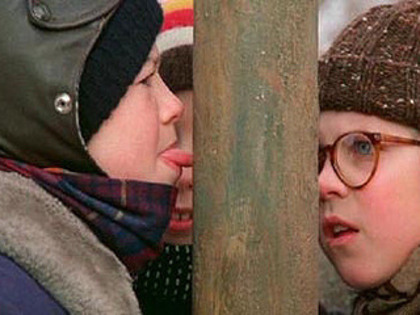
A Christmas Story follows 9 year old Ralphie (Peter Billingsley) on his quest to receive a Red Ryder BB gun for Christmas, but is confounded at every turn by his parents, his teacher and a shopping mall Santa with the repeated warning that he’ll shoot his eye out. There are kid-friendly fantasy scenes where Ralphie saves his family with the aid of the gun – vanquished foes have ‘X’s drawn on their eyelids – and Ralphie and his family deal with the usual child issues – run-ins with bullies, the first swear in front of a parent, the disappointment of a toy arriving in the mail, as well as some genuinely original moments – the frozen tongue on a flagpole –  but it’s all just a bit too twee. There’s no sense of drama, no tension. Only children would understand the sense of urgency Ralphie feels at having to have that gun. Anyone older knows he wouldn’t remember it 2 months down the line, so there’s no real problem if he doesn’t get it. The ending is trite, but the narration, by an adult Ralphie, is well used and executed, but there is definitely a reason this hasn’t caught on over here in the UK.
Choose life 6/10

I Walked with a Zombie

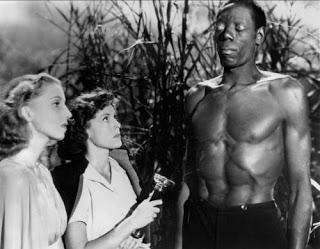
Have you ever been really disappointed by the title of a film? I’m talking about films like Monster’s Ball, Elephant and Free Willy, films that, when you hear the name without knowing the plot, your mind heads off in completely the wrong direction. I was very disappointed when I found out the Tyrannosaur from the title of Paddy Considine’s recent film was an abusive drunk rather than a giant carnivorous lizard rampaging around a London estate. And so it is with I Walked with a Zombie, less a heart-pulling romance of a woman falling for the reanimated corpse of the man she loved, more a nurse caring for a patient who cannot feel, talk or think, but obeys simple commands and can walk around. Continue reading