Spiderman 1 & 2

Never has a film been more squarely aimed at the nerds and outsiders of the world (OK, maybe Revenge of the Nerds), the guys with the smarts but not the brawn, good looks, athletic bodies and hot girlfriends. Fortunately, this description neatly encapsulates the majority of the superhero genre’s existing fanbase.
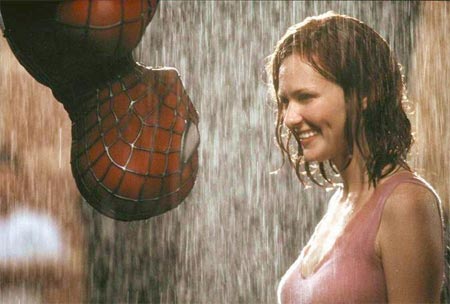
Tobey Maguire is Peter Parker, the afore-mentioned science nerd with a prolonged crush on Kirsten Dunst’s girl-next-door MJ, but lacking the confidence, wealth, strength and social standing required to do anything about it. After being bitten by a radioactive spider during a class field trip, he acquires some of the spider’s abilities, including wall crawling, mild precognition, shooting webs from his wrists, a vastly improved body and the ability to dangle from the ceiling into your mouth while you sleep. In real life, spider’s shoot the webs from an aperture closer to their posterior. This would have made for a much stranger film, I feel.  Unfortunately, Parker’s transformation occurs around the same time as Parker’s lazy rich kid best friend Harry’s businessman father trials a new super serum on himself, with predictably disastrous results, transforming him into a suped-up madman, terrorising the city in the form of fan favourite villain the Green Goblin.

Speed

100th film! Although really I’d have preferred it to have been the 50th, seeing as it’s about a bus, rigged with a bomb that activates once the bus reaches 50 miles per hour, detonating should the buses speed drop below 50. The planter of the bomb is Dennis Hopper’s vengeful psychotic ex-cop Howard Payne, angry at Keanu Reeves and Jeff Daniels’ foiling of his first elevator-based hostage situation and eager for a paycheck he feels he’s been cheated. But you don’t care about the motive or who’s behind it, as Payne tells Reeves’ Jack Traven, “Your concern is the bus.” Whenever the film detracts from this central conceit, be it following the non bus bound cops trying to track down Payne or Hopper himself watching the action unfold on the ever present media, the pacing immediately slackens, so enticing is the central plot.

Total Recall

I‘m not really a fan of Dick (prolific 60’s science fiction writer Philip K. Dick, of course). I’ve never made it through Blade Runner without falling asleep, admired A Scanner Darkly purely for its innovative visual style and, though I’ve read several of his novels, I find his spontaneous approach to plotting unsatisfying, but I appreciate his visionary concepts and radical yet plausible predictions of the progression of then-modern culture.
Total Recall is based on one of his short stories, We Can Remember It for You Wholesale. In the year 2048, technology has advanced to allow people to be implanted with memories of lives and vacations they otherwise could never experience. Arnold Schwarzenegger’s frustrated Doug Quaid undergoes such a treatment, only for something to go wrong. He awakes to discover the memory he requested may well be of a life that’s already his, but pleasingly this is left slightly open-ended come the conclusion of the film. There are some memorable touches, including robotic taxis, a confrontation behind a giant x-ray, the infamous triple-breasted hooker and a mutant creature growing on a man’s chest, but the overcomplicated plotting, featuring too many twists, betrayals and switched allegiances, leaves the movie far too close to one of Dick’s own novels for my liking, and the cars look as though they were rendered on a PlayStation. That being said, Michael Ironside is gloriously unhinged as bad guy Rictor.
Choose life 6/10

Saturday Night and Sunday Morning

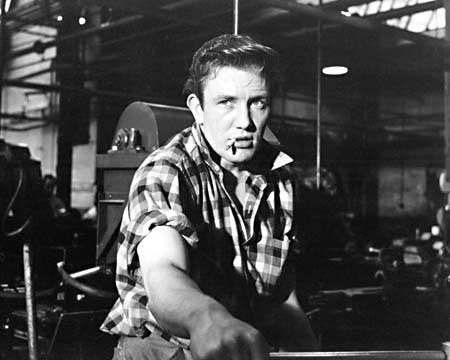
A kind  of working class Alfie, this tells the story of twenty-something factory worker Arthur Seaton, spending his weekends getting fall-down drunk, chasing women and sleeping with a stiff co-workers bored wife. Seaton is played with an animal intensity by Albert Finney in a breakout role, captivatingly bitter and indignant (check out the primal glare he gives his opponent in an early drinking contest), but some of the supporting cast are terrible, notable Shirley Anne Field as Arthur’s latest fancy Doreen. Predictably plotted and having aged terribly (One character dreams of “a new house, with a bathroom and everything!”) this is notable for Finney’s portrayal of a man confined by his own sense of self, but little else.

Choose life 5/10

Grease

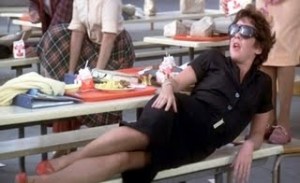
Back when high school films were about the popular kids, before the likes of American Pie and the Breakfast Club introduced the world to the less mainstream aspects of the educational sub-groups, Grease tells the story of a unexpectedly elongated summer romance threatening the street cred of a popular guy amongst his friends, themselves involved in a fairly tame turf war with a rival gang. As with most musicals, there isn’t enough plot to fill a film if you removed the musical numbers, but most of the cast are perfect (specifically Stockard Channing (Abbey Bartlet!) as bad girl Rizzo and Didi Conn as the more timid Frenchie), and the songs are pretty catchy, most notably Grease Lightning, but the overall message is incredibly dated. Apparently, the best way to keep a guy is to change everything about yourself to exactly how he wants to be, your clothes, appearance, personality, everything. Oh, and the final drive-into-the-sky shot is possibly the cheesiest moment ever committed to film.
Choose life 5/10

Local Hero

I really wanted to like this more than I did, as Peter Riegert’s Mac is sent from a Texas oil company to smooth over a land deal in Scotland, only to become captivated by the polar opposite way of life and the gaggle of eccentric locals (an African priest, web-footed diver, drunk Russian fisherman and devious, opportunistic landlord/lawyer), but alas I found the whole affair to be rather slow. Burt Lancaster steals the show as Mac’s astronomy obsessed eccentric boss Happer, and a young Peter Capaldi is a million miles away from the Thick of It’s Malcolm Tucker, all nervous laughter and gangling run (surely inspiration for Toy Story’s Woody and his flailing lope), and they did well not depicting the locals as completely ridiculous and twee, but there’s not a lot to really recommend about the film. The business meeting at the start being held in whispers after the manager falls asleep did make me chuckle, and the fickleness of a bosses decision making process hit a chord with my own experiences, so there’s something at least.
Choose life 5/10

Breathless

I’m doing this list for several reasons. Firstly, I want to broaden my cinematic horizons, watching those films I’ve often read about being legendary and must-see, yet never gotten around to actually watching. Secondly, I want to revisit some truly incredible films I’ve not seen recently, or perhaps haven’t watched well enough at this point. Thirdly, I’m shamelessly showcasing my admittedly phenomenal writing talents, to allow the literary world to recoil in shock and awe, ultimately paying me a princely sum for stringing sentences together. Finally, I want to give a second chance to films from the first reason that I have seen previously, but didn’t necessarily ‘get’. And so it is with a heavy heart that I approached Breathless (A Bout de Souffle). I first watched this about 3 years ago, when I first dabbled with Lovefilm. Admittedly, I only half-watched the film (a cardinal sin, especially if a movie is subtitled), but I found it silly, boring, and featuring a deeply unlikable lead character in Jean-Paul Belmondo’s sexist, arrogant, pretentious Michel Poiccard, on the run from the police after stealing a car and shooting a policeman, heading to Paris to collect some money and a girl to take with him to Rome. Regrettably, I found myself agreeing with my earlier judgement, as Poiccard proves continually a chauvinistic and rude kleptomaniac, consistently blaming others and never accepting his fate as being a product of his own irrationally actions. Quotations from his dialogue are probably supposed to be profound and thought-provoking, but under closer scrutiny mean nothing (“I want to become immortal, and then die”). Add to this editing tics such as wholly unnecessary (and nonsensical in the context of the scenes) jump cuts and occasions where characters seem to directly address the camera, then the film shows it is in fact largely over-rated. And I’m sure the main character closing his own eyelids after his inevitable brush with justice is supposed to be cool, in the end it’s just stupid.
Choose life 3/10

Babe

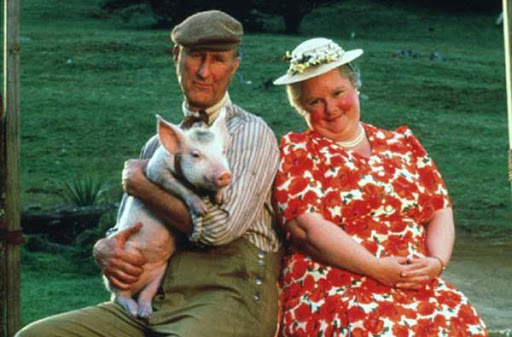
The film that made James Cromwell a perfect secret bad guy (see L.A. Confidential) and converting many meat eaters into vegetarians after seeing the consequences of the odd sausage roll, Babe tells the story of a pig, won by a farmer at a country fair, who learns to become a sheep-pig after being adopted by the farmers dogs. As a child, I remember greatly enjoying this film, especially the exploits of clumsy, prophetic duck Ferdinand who has aspirations of becoming a rooster to prevent being cooked in an orange sauce, but now I just find the whole thing tiresome. Especially the mice. What is the deal with the singing mice? I’m guessing they were probably used to introduce the various chapters in Rudyard Kipling’s book, but having them occasionally pop up and sing the chapter title, even though it’s written on the screen directly above them, just seems silly, and I’m sure they’re too small in comparison to the rest of the animals. If they were the inspiration behind the recent films of Alvin and the Chipmunks then woe betide anyone with a hand in bringing them onto the screen.
Choose life 5/10

Peking Opera Blues

Following the various pursuits of three women in 1920’s China, Peking Opera Blues (Do Ma Daan) occasionally gets lost in its own labyrinthine plotting. The daughter of a general has joined a rebel organisation out to overthrown him by obtaining secret documents hidden within his safe. A female jewel thief on the run from the authorities tries desperately to reclaim her stolen loot from inside an opera house. The daughter of said opera house’s owner, an aspiring actress and acrobat, attempts to infiltrate the all male performance cast, much to her father’s distress, as having a female performer would ruin his business. These three plot strands are interwoven, with each girl playing a part in the other’s quest, but the repetitive forming of new plans, then immediately failing to follow them becomes jarring after a while, as does the lack of communication towards the audience – what is in the document everyone is so desperate to obtain? Why has the general’s daughter defected? Why are all the actors such screeching idiots?
At times the film borders on farce, with performers seemingly able to leap entire storeys, and audience members all moving in time during an unexpected gunfight, but the breakneck pacing, incomplete subtitles and looping plot structure let the film down.
Choose life 5/10

Decalogue

This isn’t fair. Dekalog is not a film, it is a television series. Originally made for Polish TV in 1987, Dekalog is a set of ten hour long episodes, each based, occasionally so loosely that the basis is unrecognisable, on each of the ten commandments. I’m sorry, but to qualify being featured in a book called 1001 Movies You Must See Before You Die, I think one of the predominant criteria should be that you are in fact a movie. If the conditions are so lax as to allow this television series, why not others? Band of Brothers was pretty damn good, as was Firefly. Arrested Development revolutionised the modern sitcom, I Love Lucy infamously first utilised the multi-camera setup and the Cosby Show was the first to star a famous stand-up comedian. Hell, why not all 86 episodes of the Sopranos or 156 of the West Wing?