Scream

It says something about the sheer volume of horror movies made in the 70s, 80s and 90s that in 1996 Wes Craven, himself creator of such classics as A Nightmare on Elm Street and the Hills Have Eyes, was able to create a film almost entirely about other horror movies, whilst still existing as a genre-defining horror-comedy along the way. Namechecking the likes of his own works (whilst having a dig at the sequels he wasn’t directly involved with) as well as Halloween, Friday the 13th, the Exorcist, Basic Instinct, Frankenstein, Prom Night, the Howling, Evil Dead, Hellraiser, Clerks, Psycho, Carrie, I Spit on Your Grave, the Texas Chainsaw Massacre and the Silence of the Lambs to name but a few, the script revels in its horror knowledge, with one character, Jamie Kennedy’s Randy, working in a video store (remember them?) and dictating the rules of surviving a horror movie (don’t have sex, never drink or take drugs, never say “I’ll be right back”).

Scream was one of the first horror movies I ever saw, and rewatching it now brings a much greater level of enjoyment and understanding, for now I’ve seen most of the films it references as a masked killer stalks the inhabitants of Woodsboro, one year after the mother of Sydney Prescott (Neve Campbell), a high school student, was raped and murdered. Hilariously, most of the characters refer to the serial killer as though it were a horror movie (“there’s a formula, a very simple formula – everybody’s a suspect!) and the script is full of other little notes that you’ll enjoy this a great deal more if you like films in general.

Typically with all franchises, the sequels deteriorate in quality, but it’s clear this was set up as a franchise from the beginning, with Sydney predicting Tori Spelling would play her if they made the story into a movie (as happens in Scream 2’s film within a film, Stab), and Liev Schreiber’s role of convicted killer Cotton Weary beefed up a great deal for part 2. This is exactly the horror film needed to reinvigorate the once tired genre; a horror film made for people who love horror films, by people who love horror films, about people who love horror films.
Choose film 8/10

The Sting

When small time conman Johnny Hooker (Robert Redford) accidentally steals $11,000 from racket running mob boss Doyle Lonnegan (Robert Shaw), he finds himself on the run after his partner is killed. Skipping town, Hooker teams up with long con artist Henry Gondorff (Paul Newman) to exact revenge. This reteaming of the stars and director (George Roy Hill) of Butch Cassidy and the Sundance Kid doesn’t quite reach the heady heights of the original, though a lot of attention has been paid to recreate a 1930s feel, from an old-fashioned opening logo, character introductions and hand-drawn chapter cards to everything being tinged with a sepia hue. 

I used to be a big fan of Hustle, so the route the plot takes was no surprise to me, with only one moment really catching me out. This let down the film in my expectations, and though the acting is solid, all involved have done better, most notably Shaw in Jaws and the Taking of Pelham One Two Three. Still, it’s a lot better than most other heist movies, it’s just a shame that watching them all ruined this one for me.

Choose film 7/10

As Good As It Gets

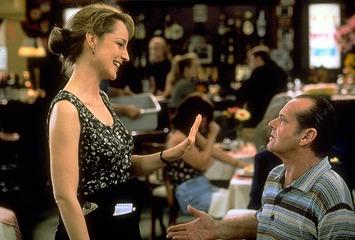
Jack Nicholson is on fine form here as OCD-afflicted writer Melvin Udall, the least likely man ever to be described as a people person. He spends his days eating at his favourite cafe, being attended by his favourite waitress Carol (Helen Hunt good but not great, though she won the leading actress Oscar in what appears to have been a slow year) and annoying everyone else he comes across, most notably his gay artist neighbour Simon (the always reliable Greg Kinnear), whose dog we find Melvin depositing in the garbage disposal chute at the opening of the film. There’s barely a minority that isn’t critiqued in some way; Cuba Gooding Jr. is described as being the colour of “thick molasses,” the Jews dinging at Melvin’s table (Taub and Cuddy from House!) are informed that their appetites aren’t as big as their noses and, my personal favourite and a line I try to use as often as I can in everyday life, when asked how he writes female characters so well, Melvin replies “I think of a man, and I take away reason and accountability.” Genius.

Whilst focussing on Melvin, easily the more entertaining character, this is essentially a triple character study, with the second half of the film following Melvin, Carol and Simon on a road trip to visit Simon’s parents. The supporting characters loss is noticeable, but more than one eye is kept on the comedy even in the more dramatic or sentimental scenes. If this is as good as it gets, I’m fine with that.

Choose film 8/10

Night and Fog

Why are so many of these films so goddamned depressing? And why are there two Holocaust documentaries on the same list? Surely Shoah covered enough in over 9 hours that a poxy little 30 minute doc isn’t going to add any more? Why is nobody satisfied until I see so many horrific images I can’t sleep at night? There is no possible situation where I could want to watch Nazis cramming 100 people to a train carriage, depriving them of water and light for days before bringing them to concentration camps where they are tortured and executed via experimental methods. I don’t want to see the skeletal role calls, or the results of eating the diuretic soup provided, the fingernail scratches in the solid concrete walls and ceilings of the gas chambers, meaning people were clamouring over the bodies of their friends to find a way out. Mountains of dead bodies, retained glasses and hair woven into cloth and sold by the kilo. I cannot possibly recommend watching a film that explains how they tried to make fertiliser from the skeletons and stretched out skin to draw pictures on. The image of baskets full of severed heads will stay with me for a long time, as will bulldozing the corpses into a pit. I implore you; do not watch this film unless you believe the Holocaust to be a myth. If you ever want to sleep again, do not watch this film.

Choose life 1/10

Casablanca

I’ve finally watched Casablanca! After Gone with the Wind and Singin’ in the Rain I’ll finally be able to call myself a film fan. Don’t worry, they’re on the list, and GWTW is on my DVD shelf, so watch this space. There are many films – these three included – that are held with such high regard in the cinematic community – nay, the world – that one cannot possibly expect to leave the film having had expectations met and a smile on the face, so I went in expecting nothing but misquoted famous lines, romantic clinches and a bitter sense of disappointment, yet when those closing credits rolled the sense of elation tingling up my spine cannot be exaggerated. What we have here is more than a film, it’s a landmark in history.

Humphrey Bogart is of course Rick, owner of Rick’s Cafe American in Casablanca, French Morocco around the outbreak of World War 2. Bogey set the template for cynics on screen, sticking his neck out for nobody but those that will help him along. Rarely is there a moment when he isn’t drinking, smoking or both. The story involves a concentration camp escapee and secret documents containing a letter of transit allowing a safe departure from the town, but what you’re really here for is the script. Everyone knows the classics, “Here’s looking at you kid” “all the gin joints…” and “we’ll always have Paris” (“play it again, Sam” is never actually uttered) but the lesser known phrases are just as good, if not better: “I have given him the best, knowing he is German and would take it anyway” “this gun is pointed right at your head”/”that is my least vulnerable spot”.

Long scenes make the film seem longer than it is (for a classic it is surprisingly sleight at only 102 minutes) and Ingrid Bergman wears a distractingly terrible blouse for much of the film, but if yuo haven’t seen this film, I urge you to do so soon.I think I’ll go watch it again.

Choose film 9/10

A Serious Man

After the timid reception met by the star-studded Burn After Reading (fun but empty, worth a go if you’re after something light with a dark side), I feel the Coen brothers attempted to recreate some past glories by having a pop at making another Lebowski, but instead succeeded in making the most Jewish film in the world. As a non-Jew (I’m a non-everything, in case you’re wondering. All I can do is offend others) I am among those that, after watching this film, looked around and said “what were they saying?” as quite a lot happens that I’m sure will be familiar to those more acquainted with the Jewish faith and the Yiddish language. The rest is decipherable, but I can’t help feeling that I’m missing something.

Michael Stuhlbarg is Larry Gopnik, a physics professor who, through no fault of his own, is living a life that won’t stop collapsing. His son is having problems at school as he leads up to his Bar Mitzvah. His wife is leaving him for an older, fatter, balder man, who keeps calling Larry so they can hug it out. Larry’s brother Arthur (A Bug’s Life and Spin City’s Richard Kind, the closest the film has to a known star as well as the Big Bang Theory’s Simon Helberg) is possibly autistic, definitely annoying, and sleeping on the sofa. A failing South Korean student is attempting to bribe his way into passing, the school board is receiving calls encouraging them not to give Larry tenure and his neighbours are stealing his lawn. Every step Larry takes is another one towards the total destruction of his existence, and watching swings between hilarious and painful.

I’m sure I’d have preferred the film had a glossary been issued in the DVD case, and if I hadn’t been concerned with the relation the opening scene, in which a husband and wife are visited by a man who may or may not be the possessed corpse of a deceased friend, and to be fair I’m still wondering. The script has its moments (“it’s just mathematics, you can’t arrest someone for mathematics”) but alas this is among the Coen’s more obscure efforts.

Choose life 7/10

Zodiac

Amidst the 4th of July celebrations in California in 1969, two young romantics drive out to a secluded spot the locals refer to as Lover’s Lane. The mood is of anticipation; anything could happen as the other kids drive away, our lovestruck pair left alone. There’s a spark of romance, playful glances, touches, the gentle ribbing of one another as they become closer. And then they’re shot in cold blood and left for dead with no word of explanation by an unseen killer. This murder, along with the many that follow it, dramatically changes the lives of many people, but our focus here is a select three; Mark Ruffalo’s cop, Robert Downey Jr’s journalist and Jake Gyllenhall’s cartoonist, as they each set out to catch the killer. Their motives are different – Ruffalo’s David Toschi wants justice, RDJ’s Paul Avery is out to further his career and Gyllenhall’s Robert Graysmith is obsessed with the puzzles the killer sends to the local papers, but all three will suffer in terms of careers, personal lives and sanity at the hands of this killer.
Based on the real life Zodiac killer (the influence of the Scorpio killer in Dirty Harry, here namechecked when Toschi can’t sit through a showing), the case remained unsolved when the lead suspect died some years ago, and it’s this sense of inconclusiveness that runs throughout the film – you know there will not be a satisfactory ending. Plaudits should be laden for the realism of the film – not since All the President’s Men has so much paperwork been completed – but unfortunately the dreary, depressing side of catching a killer rubs begins to rub off onto the film during its overlong running time. Director David Fincher (Benjamin Button, Seven) is usually so adept at keeping interest, even when Morgan Freeman went to a library, but here not even a cast including Elias Koteas, Philip Baker Hall, Brian Cox, Anthony Edwards, John Carroll Lynch, Adam Goldberg and Clea Duvall can raise this above tedium. There’s a good film in here somewhere, and a good edit could bring it out. More Downey Jr. and Brian Cox couldn’t hurt though, they’re the best parts of the film and are criminally underused.

Choose life 7/10

Topsy-Turvy

Mike Leigh’s depiction of acclaimed stage show writer and composer Gilbert & Sullivan (Jim Broadbent & Allan Corduner) creating their most famous production, the Mikado, is extremely well performed by all involved, especially the two leads and Timothy Spall as one of several preening thespians. The background is littered with know-the-face British actors (Andy Serkis, Dexter Fletcher, Mark Benton etc.) and the costumes and set design are spectacular. Unfortunately, the film is far too long, and too much time has been given over to the musical numbers, with at least ten being shown throughout the film. A much tighter script, focusing more on the backstage goings-on and less on the show itself, could have led to a bona-fide British classic about two of our most notable showmen.

Choose life 7/10

Fargo

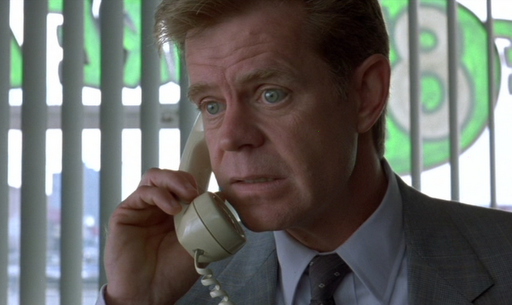
Snivelling, double-talking car salesman Jerry Jundegaard (William H. Macy, Oscar nommed but somehow losing to Cuba Gooding Jr.) has a plan. He needs money. His father-in-law Wade (Harve Presnell) has money, but hates Jerry. So Jerry hires two thugs (Steve Buscemi and Peter Stormare) to kidnap his wife and demand a ransom, of which Jerry will keep half. What could go wrong? Well, quite a lot it turns out, especially if everyone involved is an idiot and you’re being directed by the Coen brothers. The men’s escapades are chaotic, unstructured and are all heading off in different directions until, at the 32 minute mark, heavily pregnant Sheriff Marge Gunderson shows up to set them in order. Frances McDormand deservedly won an Oscar for her portrayal, nailing that wonderful sing-song North Dakota accent “Yah, you betcha” and, once full of eggs, keeping a straight face whilst clearing up the handbasket Hell’s clearly fallen out of around her. 

Few films as short as this (98 minutes) have room to divulge us with background lives – a meeting with an old school friend, conversations about stamps – whilst still keeping the action moving briskly. Every line is considered and real, every character feels genuine, and this is the greatest proof you can find against the argument that the Coens can only write caricatures. Often underrated, this film can never be over-seen, and no-one can call themselves a film fan unless they’ve both seen it, and loved it. The title of this blog was very nearly called Your Accomplice in the Wood Chipper, and a car boot opening has never made me laugh before.
Choose film 10/10

In comfort we trust

On a weekend trip visiting the girlfriend in Bury St Edmunds, we decided to step out to the cinema to see the Best Exotic Marigold Hotel (keeping a recent tradition of film titles seemingly designed to be hard to remember, hello Martha Marcy May Marlene). The film was OK, a tad long and seemed to forget about some of its characters when what little plot it had did not require them, but the experience is worth proclaiming about because of the venue. We went not to an Odeon, a Cineworld or an Empire, but to a Picturehouse, something I haven’t done for a while. We arrived a little late, after a last minute snack dash, so the only remaining sets of two seats were fairly near the front, but we didn’t mind because they were on sofas. Not hard-backed, squeeze yourself in wooden benches, but full-on sofas, with leg room and cushions, separate cup holders and everything. No fighting for the arm rest with your neighbour, no hunching up to fit in a ridiculously narrow corridor whilst simultaneously ducking down to ensure the person behind can see (I’m 6′ 3″, though the chairs at my local Odeon seem designed more for those 4′ 5″ and under). Just sit back, relax, stretch out a little and enjoy. And these weren’t even premier seats, just standard, used to encourage patrons to sit nearer the front of the screen, and I’d strongly recommend other cinemas to employ them too. One of the main reasons I don’t go to the cinema that often – other than the exponentially increasing ticket prices – is because the seats are so damn uncomfortable, and I’m fairly sure I’d go at least once a week if I knew I wouldn’t be shifting and squirming throughout the film, else it really is more worthwhile just to wait for the DVD.