Once Upon A Time In China

It’s probably not a good thing that the only Jet Li movies I’d seen prior to this film are his most American ones – Lethal Weapon 4, Unleashed, The Mummy 3 and The Expendables, so his notoriety as a master of martial arts has been more than a little lost on me, as though he gets to show his stuff in most of these films, they aren’t built around him and he is far from the star. There are several other Li films on the List, including Hero and Enter the Dragon, and I hope that they aren’t as much of a mess as this one.

Li plays Master Wong Fei-Hung, who is put in charge of organising the local non-military men into a local militia to defend China if they are attacked whilst the army is busy elsewhere. This initial premise is soon skipped to see Wong and his rag-tag band of one-note misfits – the fat one, the big-toothed one – become involved in a hectic plot involving a mob-run protection racket and the westernisation of China, as the English influence is felt through weaponry, religion, clothing and cutlery.
The film’s saving graces are the cast and the action. Li proves himself as the martial arts legend he is regarded as, and the various fighting scenes are, mostly, memorable and entertaining. One near the end, a one-on-one fought almost entirely on long, weak ladders, is particularly good, and has a nice payoff too. The moment with Li and the bullet took it a bit far for me, as did the occasional uses of wire-fu to allow characters to jump an awful lot further than they should. These artists are capable of great things with their limbs alone, so whenever stage effects are used to enhance them I’m always taken out of the film, as it shows the stars as mere mortals like the rest of us.
There is far more comedy here than I was expecting too, on an almost farcical level, and many times the scenes seem to be set-up for a fight or a larger, recurring joke that never happens. A scene where a character finds himself with an arm and a leg needlessly plastered could have led to a fight scenes where the casts were used both as his hindrance and advantage, but alas he just runs off and it’s never mentioned again. Similarly, a photograph posing culminating in a burst of flame that ends up roasting a pet bird could have been used later to vanquish an attacker with an unexpected fireball, but again no.
The moments of culture clash comedy – Wong encountering a fork – are nice, but there isn’t much here that’s new, and by the end (the film is well over 2 hours) even the action has gotten almost boring.
Choose life 5/10

Through A Glass Darkly

I rarely watch a film I literally know nothing about, and I must say it’s an unsettling experience. I’ve witnessed people walking up to a cinema and asking “What’s playing today?” in shock and awe. “How can these people not know about the film they’re going to see? Who are these people? Have they left the house just to see any film, rather than planning, sometimes weeks in advance, to go and see a specific film?” are often thoughts that run around my head and occasionally out of my mouth as the clerk at Odeon reels off a list of the current blockbusters and horrors  for the third time to a pair of elderly women in front of me in the queue, clearly looking for something starring Clark Gable. On occasion, and as happened recently with Time Regained, I will pause a movie I know nothing about some way into it, to have a quick check online or in the 1001 book, to give me some idea of what I’m supposed to be watching. If I do this, it’s not generally a good sign, as a) I’m as yet unsure of what the film is about, and b) I’m clearly bored. This was not an option with Ingmar Bergman’s Through A Glass Darkly though, for I watched it streaming via LoveFilm, and I find that if I pause it for more than a quick toilet break, the damn thing refuses to load unless it plays from the beginning, so I had to sit it out and find out what I was watching afterwards.


We open with four people swimming gleefully towards a deserted island. Amongst them is Karin (Harriet Andersson), who suffers from some kind of mental illness that she doesn’t know is incurable, but her father David (Gunnar Bjornstrand) and husband/doctor Martin (Max von Sydow), both also present, do. David is a writer of novels, who has been away recently and plans to leave again after finishing his current book. Also along for the trip is Karin’s 17 year old younger brother Minus (Lars Passgard). These four make up the only characters in the film, which takes place entirely on and around the island, yet the film never really feels claustrophobic, just a little muddled.

Karin’s illness leaves her with no desires to sleep with her husband, yet she has acute hearing, leaving her to wander around the house late at night (pretty much no-one ever sleeps in this film) and at one point she seems to reach an intense state of ecstasy whilst alone and unprovoked.

All four people have fairly strained relationships with one another, especially the children with their father, who is self centred and has a robotic detachment of emotion towards his daughter’s potentially fatal condition, so much so that he is morbidly interested in documenting her deterioration. His son Minus feels especially distant, feeling that he is completely unable to talk to his father.

Frustratingly, the film offers only the minimal amount of closure, as Karin’s condition worsens to critical levels. I’m always impressed when directors overcome extreme limitations – usually set by themselves – for example here with the restricted location and cast quartet, but I feel that a great deal more could have been done. Director Ingmar Bergman has many films on the List, and this is only the second one I’ve watched. Winter Light disappointed me a little, but this was a definite improvement. Bergman seems to be one of the most notable directors of all time List-wise, and regularly comes up on many people’s greatest lists, so I’m looking forward to seeing some of his better works in the future.

Choose life 5/10

Invictus

South Africa, May 1994. Nelson Mandela (Morgan Freeman) was released from prison 4 years ago, and has just been elected as the country’s president. Amidst a nation-wide racial clash, Mandela believes that the key to a united country could lie within the national rugby team, the Springboks, and their captain Francois Pienaar (Matt Damon).
Mandela’s plan, it seems, is for the Springboks – a team so despised by the black population that they instinctively root for whoever is playing against them, and who hadn’t been doing terribly well before Mandela got involved – to win the Rugby World Cup in less than a year’s time, though experts believe they’ll get no further than the quarter finals at best. The Springboks, with only one black player and a uniform of apartheid’s green and gold, find themselves in a position where their president wants them to be cheered on by the entire mixed nation, so embark on a PR campaign involving playing and teaching rugby to the poor black kids from the slums of the country. Going in, I thought his plan would have been to create a team comprised of 50% blacks and whites, thereby creating animosity as to whether the players were recruited for their skill or the colour of their skin, but in effect his plan was… nothing. Other than some inspirational speeches, standard marketing techniques, a slightly more intense training regime and an admirable cause, the aim seems to be just to will the team to win. Much like Million Dollar Baby, I could have done with some more time spent on the reasons behind the success, not simply showing it.

The subplot involving Mandela’s begrudgingly mixed race security team being forced to work together, eventually bonding over the rugby matches, was well played if predictable, but ably showed the success of the president’s plans. I’d have liked more time spent on Mandela as a person, maybe depicting his rise from prisoner to presidential candidate in an extremely racist country, as opposed to skipping through it in an all-too-brief opening montage. The man behind the title is hinted at – his broken family, way with the ladies and fondness for afternoon tea – but such a prolific, historical figures surely deserves a full biopic that doesn’t spend half it’s time on the rugby field. But then Eastwood’s recent biopic, J. Edgar, has received largely negative reviews, so there could be a reason for why he didn’t do the same here.
The closest the film comes to spectacle is in the rugby matches, and I’m no sports fan. Every modicum of emotion that can be wrought from the game has been, but those unfamiliar with it’s intricacies (I’m only just out of this category) could believe it to be simply about mid-pitch wrestling matches and kicking a ball between two posts.
Morgan Freeman has been trying to play Mandela for years, eventually getting the project off the ground with his Million Dollar Baby/Unforgiven director Clint Eastwood. He does a great job with the accent and the performance, but his casting was such an obvious choice that it dullens the impact. There is no-one else that could have portrayed the character better, and its doubtful that were someone else casting the film they’d’ve asked anyone else. If Freeman weren’t involved, the project probably never would have gone anywhere, and perhaps that’s how it should have been. Damon is good too, and it shows the notoriety of Eastwood as a director that Damon, one of the most outright and capable leading men working in Hollywood today, is willing to take a supporting role just to work with him.
Some plot points are clearly superfluous – much attention is put on Chester, the Springbok’s only black player, injuring his hamstring so he is unable to play a couple of matches – and far too much time is spent on the less interesting sports aspects over the far more captivating figurehead at the heart of the story.
Choose life 5/10

Bridesmaids

As usual, I’m a little late to the party with this review. I’ve heard a lot of good things about Bridesmaids, and as usual the great deal of hype has built up my expectations, so I’d anticipated a comedy that proved something I’ve always had my doubts about; that women could be just as funny as men. I don’t mean to be misogynistic, I’m just terribly good at it, but I’ve always preferred male comedians to female, and you’ve got to admit that there’s a hell of a lot more of them. Plus, my girlfriend (who also isn’t funny) watched this film last year and said she didn’t enjoy it, which is usually a sign that I would.
Many comparisons have been made to this being a female Hangover, which if anything lowered my expectations, as I found that film to be only mildly entertaining upon first viewing and more than a little puerile and nauseating on the second, and let’s not even discuss the sequel (word of advice, don’t make the mistake I did and watch it with your grandparents). There are similarities between the two films – they both feature a predominantly same-sex cast, are both revolved around wedding parties and at one point in Bridesmaids there’s even a trip to Vegas, and in my opinion Bridesmaids is just as good, and also just as bad.
Our heroine here is Kristen Wiig’s Annie, a baker whose life has hit several stumbling blocks, leaving her self-started career floundering as she shares an apartment with Gil (Matt Lucas) and his freeloading, dimwitted sister Brynn (Rebel Wilson). Annie’s best friend Lillian (Maya Rudolph) gets engaged, and Annie is her Maid of Honour, so cue ensuing hilarity as Annie attempts to wrangle the rest of the bridal party – Lillian’s cousin Rita, colleague Becca, future sister-in-law Megan and fiance’s boss’ wife Helen – through dress fitting, bridal shower, hen party and wedding, all while trying to stop her own life from continually spiralling downward.
The humour, and this being a comedy this should be the most important aspect, is well intentioned and has potential, but the scenes are almost always taken beyond the point at which they stopped being funny and started being awkward and uncomfortable to watch. Curb Your Enthusiasm is possibly the greatest example of humour that is almost cringeworthy but always funny, but here it never quite hits the mark. Take the speeches for example. At Lillian’s engagement party, Annie is asked to give a speech, only to be upstaged on ever account by Rose Byrne’s rich bitch Helen, who is desperate to steal the Maid of Honour title from Annie. This scene goes on for a good few rounds too many, and by the time Helen starts speaking perfect Thai, only for Annie to counter with broken Spanish I was checking my watch and rolling my eyes.
Much praise too has been lauded upon Melissa McCarthy, who plays Lillian’s future sister-in-law Megan trying too hard to do an impression of Zack Galifianakis in The Hangover. I’m still reeling from the fact she was nominated for an Oscar for her performance here and, whilst she is occasionally funny, many of her lines miss the mark.
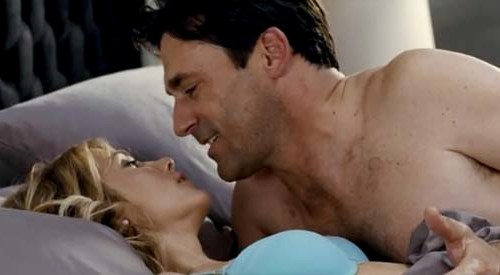
My misogyny may be seeping through again when I state that the best parts of this film are easily the men. The IT Crowd‘s Chris O’Dowd is a cop with whom Annie starts a faltering relationship, and John Hamm is the fuck-buddy she already has. Whenever these two are on screen, especially Hamm, we get some of the sweeter and downright hilarious moments from the film, with Hamm’s deliriously coarse womaniser outright telling Annie he only wants her for sex when he complains that she stayed the night. Kristen Wiig is OK, but she does a lot better in bit parts and supporting roles. She stole several scenes in the likes of Adventureland, Paul and Knocked Up, but again that was with the help of much funnier men, in the likes of Bill Hader, Simon Pegg and Alan Tudyk.
It also doesn’t help that this film can’t decide whether it wants to be a slightly off-kilter rom-com or a zany gross-out comedy, and ends up being a messy mashup of the two, so we end up with scenes involving copious amounts of bodily fluids, as well as a genuinely heart warming first-date gesture from O’Dowd’s Officer Rhodes.
The film isn’t terrible, there are some funny moments (the dress fitting is a highlight, as is Annie’s confrontation with a young girl in the jewellery shop she works for) and the core messages are true and conveyed well, but it’s nowhere near as funny as it needs to be, and those bridal shower party favours are incredible inconsiderate.
Choose life 5/10

Cowboys and Aliens

Apologies again for the lack of recent posts. I’ve been in hospital again for the past few days (where I managed to watch this film but do little else). All being well my extended medical excursions are now complete, and I can get back to watching films and writing posts. Hopefully there’ll be a steady slew of posts over the next week or so, as there’s about twenty from the List that I’ve watched recently and haven’t reviewed yet. Right, back to today’s feature:

With a title like Cowboys & Aliens, a certain level of expectation is accrued before watching. Along with approximately equal parts ranch hands and space travellers; their respective genres of horse opera and sci-fi melded neatly together, there surely must be a hefty dollop of fun, because the premise is more than a little ridiculous. Yes, it’s just as plausible as any other alien invasion flick, for why necessarily would beings from another planet arrive in present day, but the very notion of cowboys on horseback, with lassos and pistols, taking on intergalactic creatures capable of space travel and ray guns is just insane. So whilst I’d heard mediocre reviews elsewhere of this film, I at least expected to be entertained and amused throughout.

Chances are, this would have had a better chance of happening with a different cast. Though the film’s marketing and other reviewers have revelled in the idea of Bond and Indy together again (The Last Crusade famously saw Sean Connery, the one true Bond, playing Indiana Jones’ father) what director Jon Favreau doesn’t seem to realise is that an older, eye-twinkle-free Harrison Ford and a stoic, seldom talking Daniel Craig just aren’t funny, and have next to no chemistry together.

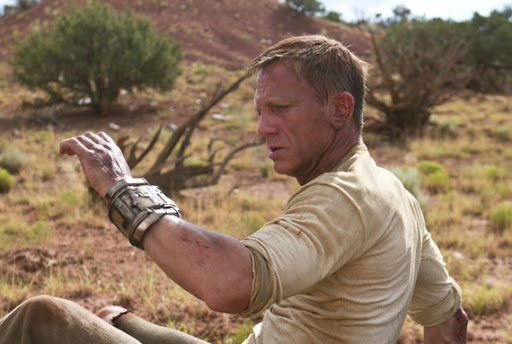
Craig’s Jake Lonergan awakes in the desert with nought but a photograph of a lady, a strange wound on his side and an even stranger chunky bracelet clamped to his arm. He can’t remember his name or anything else, so after seeing to a trio of miscreants, he heads into the nearby town of Absolution, terrorised by Ford’s bitter cattle baron Dolarhyde. The first half hour or so is easily the best in the film, setting up what looks like an interesting traditional western – albeit significantly more polished and brighter than others made recently, and even once the aliens attack, in a gripping sky-lasso sequence, it stays on the rails. Afterwards however, once every named character has either been snatched by the creatures or sets out after them, it loses it’s way.

Lonergan and Dolarhyde’s posse – for it is they that lead the hunt – is made up of some nameless alien-fodder, and is joined by a rag-tag bunch of townsfolk, including Sam Rockwell’s meek doctor-come-bartender and Olivia Wilde’s mysterious stranger. Wilde and Craig look entirely out of place in the Old West, their piercing eyes, clear skin and complete lack of cragginess juxtaposing with the entirety of the rest of the cast, including the likes of Ford, Keith Carradine and Clancy Brown, who appear to have been born to wear a stetson and chaps.

The best characters are easily Rockwell’s doc and Paul Dano’s Percy, Dolarhyde’s obnoxious son, so it’s puzzling just why they were sidelined quite so much. Had they been the central pairing, this could have been a far greater, more entertaining and interesting picture. The aliens, too, were disappointing. Their design isn’t anything overly creative – other than a chest cavity that opens up to reveal two small arms for delicate work – and they had a confusing blend of advanced weaponry and primitive pounce-and-flail combat techniques. They also had absolutely no characterisation, and quite frankly the notion that they invaded to steal gold is beyond ridiculous, and was the point at which I gave up on the film.

It’s my own fault for going in with high hopes after reading middling reviews, but I feel this is a great concept that was floundered on the wrong cast. Favreau as a director seemed a perfect choice, but he forgot to bring the funny. Yes, Craig’s impassiveness did cause humour at times, mainly when he caused people pain, but all-in-all this was a missed opportunity for a great film.

Choose life 5/10

Satantango

Aisha’s away for the weekend and I’ve got no other plans, the hotbed of social activity that I am, so I’ve made the most of a fairly sunny weekend by staying in and watching the longest film left on the list, Satantango. At 7 ½ hours long, it rounds out the top 5 longest films (though technically two are TV series and one is an eleven-part serial) on the List, which between them have taken up over 48 hours of my life that I’m never getting back. I doubt it’ll come as a surprise to many, but of the 14 films over four hours in length of the List, all of them are from Europe, and only one is in English (Kenneth Branagh’s Hamlet). More than half of them are French. America doesn’t start to get a look in until Sergio Leone’s Once Upon A Time in America (227 minutes), but it’s got a lot around the 3-hour mark instead. Also, of the 4-hour-plus films, three of them are Holocaust-related documentaries. Yay.
So, Satantango. I’m going to try and make this review be not entirely about the length of the film, but it is bloody long. And needlessly so. Many of the sequences involve nothing happening – the first 9 minutes follows cows wandering around in the mud, later a child walks purposefully towards the camera for what seems an eternity – so that whenever a conversation occurs – other than some sporadic narration, dialogue doesn’t kick in for about 15 minutes – it comes as a shock.
The film sees the inhabitants of a run-down Hungarian village. The villagers have a large sum of money they wish to share out, but some want to leave with more than their fair share, whilst others wish to wait for a man believed dead to arrive, with the possibility of making even more money with his help. This is only the central structure of the plot, for there are several detractions, but no real motives or details are ever expanded upon. We see the same events through different viewpoints, at one point witnessing a drunken dancing session (at least 10 minutes long) from the perspective of a young child outside the window, and then later we’re shown it again, longer this time, but from inside the room. This new vantage point offers nothing new, and just serves to make me wish to never hear an accordion ever again, for the same short tune segment is repeated over and over and over again for the entirety of the dance.
This is, however, a great achievement in terms of direction and cinematography. Much of the film takes place in long, unbroken shots, the aforementioned dancing, for example, which at times are truly breathtaking, and others thoroughly unimpressive due to the lack of anything happening onscreen (it’s a completely unbroken shot! Of someone sat down!).
Though I was never bored, and I was also far from entertained or engaged. The large gaps of nothingness allowed my mind to wander and expand upon what I was watching, and also gave me time to jot down the improvements I’m intending to make to the site over the next few weeks. It did, however, feel like an arduous watch, something I had to work at to pay attention, and after seven hours I’d hoped for a satisfying conclusion to make it all worthwhile, a reward for the patience and sacrifice of time, but alas I was left wanting.
Choose life 5/10

A.I.: Artifical Intelligence

Kubrick’s visionary ideas, social commentaries and moral dilemmas don’t quite gel with Spielberg’s family oriented sentimentality in this disjointed and overlong offering, conceived and planned by the former but implemented by the latter after his death in 1999.

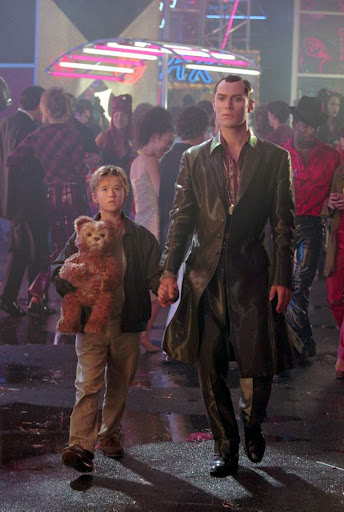
Now, I love me some robots. Whether they’re compacting waste into trash skyscrapers, travelling through time to save Sarah Connor or trying to kill Will Smith, you show me a film with robots in and I’ll watch the Hell out of it (though I’ve never actually seen the 20th Century Fox film Robots starring Ewan McGregor and Robin Williams, just never came around). There’s a robot clock watching me from atop a bookcase in the lounge, robot cushions on the sofa and a robot cookie jar whose head seems to rotate around and look at me wherever I am. But the key characteristic that joins these all together, is that they all look like robots, which is where A.I. looses my interest, for here they look like people. Yes, I know that’s the point. Haley Joel Osment’s mini-mecha David has been created to fill the hole left when his new parent’s son goes into a coma, and Jude Law’s robo-gigolo Joe (that’s fun to say) would be downright weird if he didn’t look a lot like a human, but that’s not what I want to see in a film about mechanical men. It isn’t until over half way through the film that we see some older models and exposed innards, and even then it’s far too briefly.

Osment is good, too good, as the automated child, and occasionally he passes for human, but for the most part he’s in full-tilt terrifyingly creepy mode, following his ‘mother’ Monica (Frances O’Connor) around the house all day, standing and watching her until she justifiably locks him in a cupboard. The first 45 minutes could quite easily be the start of a horror film, so disturbing is David: “I can never go to sleep, but I can lay quietly and not make a peep.” Nothing he does is endearing or even likable, but then I’ve always felt this way about children, but still the brief amount of time it takes for Monica to bond with this mechanised horror is jarring, especially given there seems to be no real scenario that draws them together. Also, David is only programmed to ‘love’ one parent, and his new ‘father’ Henry (Sam Robards) seems devoid of emotions, either for his comatose son or the new replacement, so that fits together nicely.

The movie is comprised of a series of episodes that, once passed, are all but forgotten. The story could have been interesting, and the world has potential for a more enthralling film within it, especially in the city scenes, and the brutal Flesh Fairs, where rogue ‘bots are hunted and tortured to a baying crowd’s delight, but over an hour of watching David desperately wanting to be a real boy becomes terminally dull. The future technology and gadgetry is generally good, subtle yet insightful, although the cars look a bit silly. And the ending is polarising, I found it terrible and unsatisfying, whilst Aisha thought that, whilst it seemed tacked on and unnecessary, it was still very moving.


Choose life 5/10

Collateral

Michael Mann takes a break from shootouts and dogged cops hunting master criminals in favour of a more laidback, narrative-driven movie about Jamie Foxx’s ambitious yet stunted taxi driver Max carries his fares around the neon-lit streets of L.A. That is, until he picks up Tom Cruise’s hitman Vincent, and Max’s night, and his dreams, are thrown into turmoil as the body count rises.
Cruise seems like an odd choice to play a fairly villainous guys, but he proves spot-on, retaining his usual casual charm but with a steely glint and wolfish menace to go with his salt and pepper hair, leaving Foxx to submit lie in his shadow.
The script relies too much on luck and coincidence, and leaves some pretty gaping plot holes you could drive a cab through, plus those paying attention should see that there’s really only one way the film can end, with a last act twist clearly signposted in seemingly throwaway lines. The writer even resorts to a low cell phone signal and battery as a means of moving the plot along; generally the laziest idea anyone could use.
The film evokes memories of much better films – Leon’s hitman, Taxi Driver, The French Connection’s subway stand-off, every buddy movie ever made – reminding you that there’s little original here. So whilst it’s watchable, it’s by no means worthy of a place on the list, and was wisely cut from the 1001 book some years ago.
Choose life 5/10

Unlisted: Chocolat

That’s right, some weeks I don’t go to the cinema or watch a new DVD release, I’ve got a fairly large and ever-increasing stack of non-List DVDs I either haven’t seen before or haven’t really watched properly (I have films on in the background a lot, especially when I was at university) and this regular feature gives me some motivation to get through them.
Just in time for Easter, and after a messy, sticky but god damn delicious bout of chocolate egg making, we sat down to watch Chocolat, a film that’s been on my radar ever since it was discussed with much vigour in the disappointing Paul Rudd vehicle I Love You, Man, as his character’s favourite film. Just like when I rushed out to watch Point Break on Danny Butterman’s recommendation (I’ve been known to enjoy Bad Boys 2) I was more than a little disappointed, as I went in with higher hopes than I probably should.
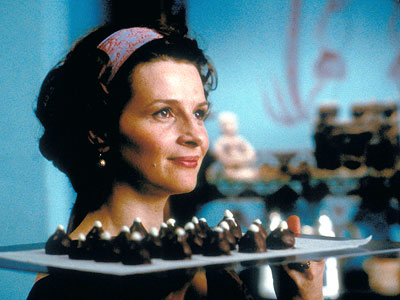
Chocolat sees Juliette Binoche’s master chocolatier opening up a cocoa boutique in a sleepy little French village, just at the start of lent. The villagers initially shun her temptations, before gradually growing to accept them and their delicious ways, assisted by her worldly knowledge, kind soul and the fact that some of her products act as an extreme aphrodisiac, an aspect that was severely underused, and could have led to a much more light hearted and entertaining piece, as at one point it seemed to be heading towards.
Overall, the tone was far too unbalanced; whimsical at times and overly serious at others, and the myriad of diversions – Alfred Molina’s stern mayor attempting to My Fair Lady Peter Stormare’s abusive barman, Binoche’s unfulfilling fling with sailing drifter Johnny Depp – leave the palate tempted but wanting for more depth. The outer shell is sweet and smooth, but alas where a rich praline centre should be there is nought but a hollow cavity. Everything looks delicious though, and I picked up a few tips for my own chocolate making.
Choose life 5/10

Alice

Lewis Carroll’s Alice in Wonderland is already pretty mental, so when I read that this version by Czechoslovakian director Jan Svankmajer was “memorably bizarre,” I strapped myself in for a rollercoaster of ridiculousness, and I was not left wanting.
A terrifying stuffed rabbit – animated via stop motion – bites through its restraints with eyes bulging like a cartoon, dons gloves, coat and a hat, checks its pocket watch and escaped through the drawer of a writing desk that is only a little bit like a raven. Oh, and the rabbit has ripped a gash in its chest that continually leaks sawdust like an open wound. The young Alice (Kristyna Kohoutova) follows the rabbit along a carpet of set squares and rulers and down an elevator past jars of drawing pins in chutney and various animal skulls with eyeballs.
I won’t ruin all the insanity, though there is plenty here to suffice, but rest assured some of the regular Alice beats are present – the shrinking potion and growing cake, the caterpillar, the Mad Hatter’s tea party and the King and Queen of Heart’s, but the question begs to be asked that, if everything in between the main points has been dramatically changed, why not just make a different story altogether? Plus, it takes far too long for Alice to get to Wonderland (if that’s what they’re still calling it). Imagine if Frodo didn’t leave the Shire until near the end of the Two Towers, or Harry didn’t get to Hogwarts until two hours into the Philosopher’s Stone, yet the books remained the same.
If I’d seen this as a child, chances are I’d still wake up screaming. From the burrowing inflatable sock-worms, the carnivorous animal skeletons reminiscent of Toy Story’s franken-toys, baguettes sprouting nails, living steaks, Alice crying enough to flood a room and a swimming rat hammering a campfire into Alice’s head, this is nightmarish to the highest degree. Also, who the hell is in charge of screwing on the doorknobs in this world, because they’re doing a terrible job.
Choose life 5/10