The Usual Suspects

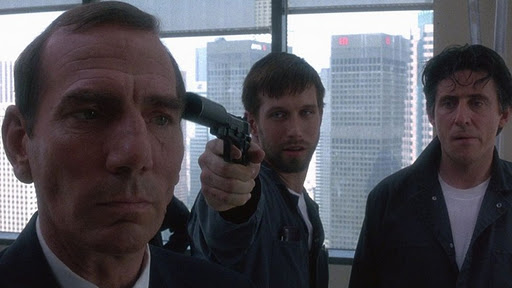
 Is it OK to ruin the Usual Suspects yet? Doesn’t anyone who cares who the ending already? Its 16 years old! Is it not another Sixth Sense or Empire Strikes Back, where the big reveal has either been witnessed firsthand or spoiled by someone else? Miraculously, my film watching companion had not seen or heard the ending to Bryan Singer’s sophomore film, and he’d have throttled me had I revealed it (Marcos hates spoilers, and will punch you in the head) so no, it would seem there are some out there yet to discover the fate of the five criminals bought in for a line-up, nor do they know the identity of their tormentor, the mythical Keyser Soze, so I’ll try and tread carefully. The cons in question – Stephen Baldwin, Kevin Pollak, Gabriel Byrne, Benicio del Toro and a career-launching, Oscar winning Kevin Spacey – have been brought together on a bogus line-up, and use their time in incarceration to plan a robbery, bus is it all a part of a bigger plan?
Told in flashback by Spacey’s weaselly over talkative ‘Verbal’ Kint, the tale begins with the death of Byrne’s Keaton, a crooked cop gone straight and the closest the gang has to a leader, after what appears to be a drug deal gone wrong. Chazz Palminteri, the cop to whom Kint tells his story, has his own theories as to what went wrong, but his opinions, and those of the viewer, get in the way of seeing the truth, ably assisted by Christopher McQuarrie’s deservedly Oscar winning ever twisting screenplay.
The cast are exceptional, particularly the scene stealing del Toro and Pete Postlethwaite at stoic lawyer Kobayashi, but it is the fine balance between tightly plotted twists and turns and sporadic bursts of action and violence that plants this firmly on the choose film list, regardless of whether you know the ending.
Choose film 9/10
Shoah

Without a doubt this 9 hour documentary about the holocaust, comprising entirely of original material with no archive footage, is worthy of a place on the list. Director Claude Lanzmann spent years interviewing historians, builders of the concentration camps, train drivers, camp survivors and even Nazi officials who ran the camps, and spent almost 5 years editing the hundreds of hours down to a four disc set. Viewing is a sobering experience, the very definition of hard to watch, but such insight of so important an event needs to be heard, with a barber tasked with shaving the Jews before they were gassed commenting that “people burn very well.” Yes, it could be shorter, as there is some repetition to hammer home the points, but anyone who felt they were only told a small portion of a much larger story in school history classes should consider this essential viewing.
Choose film 8/10

Candyman

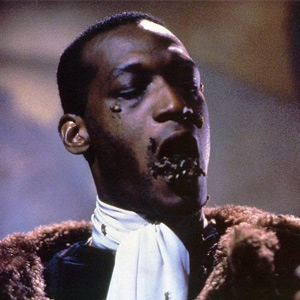
If someone told you that if you looked in a mirror and said the word “Candyman” five times, that a man with a hook for a hand would appear behind you and kill you, what would you do? If the answer is call them an idiot and defriend them on Facebook, congratulations you’re not in a horror movie. Here, of course, the myth is discussed and inevitably activated, with disturbing and horrifying results. Virginia Madsen (remember her?) plays our doomed heroine Helen Lyle, married to university lecturer Xander Berkeley and writing a thesis on local mythology, focusing on the Candyman, an educated son of a slave whose hand was sawn off by hooligans in the late 19th century, before he was smeared with honey, stung to death by bees and burned in a giant pyre. His legend lives on with the residents of Cabrini Green – the area where his ashes were scattered, blaming him for unsolved murders.
A  lot is left unclear in the film – possibly clarified in the sequels, I didn’t like it enough to find out, and there is much debate throughout as to whether Candyman, memorably embodied by the imposing Tony Todd, whose breathy voice, sinister smile and nightmarish stare were made for horror films, is real, whether Helen is going insane or if her husband is framing her to keep her out of the way while he gets his leg over a hot young student, something never really explained, and even by the end all three are still a possibility. There is plenty of gratuitous and unnecessary nudity and some horrible imagery – graffiti from smeared excrement – but the unclear nature of Candyman’s powers, origin, intent or motive and the lacking of anything inherently scary makes this a pointless watch.
Choose life 4/10

Braveheart

A young Scottish boy in the 13th Century is mentally scarred by the sight of dozens of his kinsmen slain and hanged. He is too young to fight the English, for it is those villainous scoundrels that are to blame, and when his father and brother do not return from battle he is sent to live with his scarred uncle Argyle (Brian Cox). Taught to use his brain before his sword, he grows up to become Mel Gibson, returns to his home village and falls in love, only for those Anglo-Saxon bastards to kill her too. Understandably, this sends Gibson’s William Wallace into a bit of a tizzy, so he sets about raising an army to thwart the tea-drinking tossers and their leader, evil Edward I. I’m no historian, but to say the film is blinkered by a love for the Celts is no exaggeration, with us Englanders shown creating laws where it is fine for us to sleep with a Scotsman’s wife on her wedding night, and banning the kilt-wearing types from brandishing so much as a stick. I’m not saying this didn’t happen, and I’m not going to burn any calories finding out, but I’m going to assume that something from the mind from Gibson can be taken with a rather hefty pinch of salt.
That being said, Gibbo gives good as the rabble rouser, hinting at the madness (and mullet) of Lethal Weapon, with an imposing presence and questionable accent. Much too can be said of Gibson the director and producer – roles for which he took home the Best Director and Best Picture Oscars in 1996. With an eye for locations and an ear for mixing the comic with the tragic, this is a well balanced film. Some of the fights and chases feel a little clunky, and the many brutal deaths – throats slit, fence post impalings, gouged eyes and mutilated horses – seem a tad gratuitous at times.
Choose film 7/10

Fish Tank

Just another Kidulthood? Not so fast. Where Noel Clarke’s debut was all teen speak, yoof culture and multi-stranded east London ghetto-cool, Andrea Arnold’s second film, after her Oscar winning 2003 short Wasp and Cannes’ Grand Prize of the Jury awarded debut Red Road tells of a 15 year old girls attempt to make something of herself, with people coming at her from all sides.
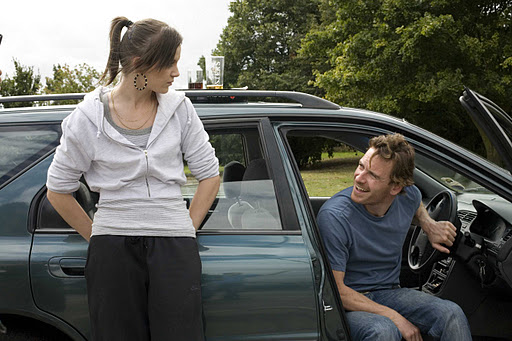
Katie Jarvis plays Mia, picking fights and sneaking away from her neglectful mother and foul mouthed little sister (“cuntface”) to score cider and practice dancing in an abandoned flat in her tower block home. Her life is nothing but insults, confrontations and disencouragement from her family and her peers, until her mother starts dating Michael Fassbender’s Connor, a positive influence with a steady job and encouraging guidance, helping Mia to take her dancing onto the next step (pun intended). With some very strong language, unexpected dark turns and a scene where we watch a girl squat and pee on the floor this is at times a difficult watch, and its overall message, that role models are not what they seem and all dreams will be crushed in obvious ways, is a little hard to take. Best watched as a double feature with Little Miss Sunshine for their exactly polar opposite climactic scenes.
Choose film 6/10

Paranormal Activity

First off, don’t make the same mistake I did, watching the film alone, at night, in bed, in the dark, for this is the exact setting for most of this found-footage horror. Katie and Micah (Katie Featherston and Micah Sloat) are a young couple in a new home. Since childhood Katie has been plagued by bizarre nocturnal occurrences, which have begun to get worse since moving, so Micah sets up a video camera to try and record whoever is behind them. Much of the film takes place with a stationery camera, set at the foot of the couple’s bed as they sleep, with occasional noises and doors slamming being the worst that happens (if you’re frightened of something coming into your room at night, why not at least sleep with the door shut?). This means that the final scenes, where shit starts to get real, are all the more powerful and traumatic. Whilst not terribly frightening, the slow build and believable characters reacting in plausible ways (initially Micah is more concerned with filming the events than helping Katie stop them) make this at times quite unsettling. They should have used a different location though, as the massive three bedroom house, with luxury kitchen, double lounge and swimming pool is not believable accommodation for such a young couple.
Choose film 6/10

The Thing

Arguably surpassing Howard Hawk’s 50s sci-fi classic the Thing from Another World (a feat unlikely to be achieved by the imminent Mary Elizabeth Winstead starring prequel, confusingly also named ‘The Thing’), John Carpenter’s Thing deserves its place on the list for Rob Bottin’s effects work, occasionally assisted by the legend that is Stan Winston.
Defiantly demanding that the titular creature – a life form able to imitate any living thing it comes across – not just be a man in a suit, we are treated to all manner of beasties, from an arm-munching human torso to spider-legged scuttling heads with eyeballs on stalks, as well as the nightmare inducing stages in their transformations. In a post CGI era these effects still hold ground with today’s effects houses, showing at times animatronic models can be better and more memorable than a bunch of pixels.
Carpenter has always been a master of cranking up tension through the roof, and the secluded Antarctic research base here provides the perfect scenario, with its all-male inhabitants already at each other’s throats from cabin fever. Usually with these kind of monster attacks a small group thrillers it can be easy to see who at least a few of the early victims will be, but here the equal screen time, characterisation and importance to the plot, as well as a few well-placed red herrings, mean that anyone trying to second guess the script will pursue a fruitless endeavour.
Ennio Morricone’s atmospheric score and some sharp dialogue add to the sense of claustrophobia and breakdown of relationships, and there’s an interesting spoiler if you speak Norwegian, when the basic plot is outlined at the initial meeting of some researchers at the beginning of the film.
Choose film 10/10

There’s Something About Mary/Dumb & Dumber

Say what you will about directing brothers Peter & Bobby Farrelly (Kingpin, Me, Myself & Irene, Shallow Hal, Stuck on You, Hall Pass), but at times their combination of prat-falls, worst case scenarios, extreme gross-out humour and stellar casts of ensemble comic actors can occasionally work out well, with these two films being pick of the bunch. The humour may go a tad too far for some) laxatives, urine drinking, masturbation and an excruciating penis-in-zipper-moment), but by ensuring their actors play the roles straight, and staying just the right side of plausibility make sure these films serve their intended purpose, as light-hearted comedy. If anything, it’s the small moments that make these films excel, be it a disc-sanding pedicure in Dumb & Dumber or the infamous spunked-up hair-do in Mary, as well as simple yet spot-on puns and wordplay (“a rapist wit”), and the casting is such that the central actors could not be replaced without seriously jeopardising the characters they play. So yes, the Farrellys have made some duffers in their time, but they’re worth enduring if occasionally they crap out gold like this.
There’s Something About Mary Choose film 7/10
Dumb & Dumber Choose film 8/10

Titanic

Now bear with me here, but I do actually really like Titanic. This may all stem from a fascination with the tragedy as a child, but its also in part due to James Cameron’s direction of a film too easily written off as a soppy romance that just happens to be set aboard the most famous nautical disaster of all time, other than Speed 2: Cruise Control. What Cameron does is take 1958s A Night to Remember, the foremost Titanic film pre-1997, and add characters you genuinely care about; DiCaprio’s steerage class ragamuffin and Winslet’s pressured poor little rich girl, as well as a sense of spectacle unavailable to film makers in the pre-CGI movie making era. There is a clear divide in the film – and eventually in the ship too – around the half way mark, once the inevitable iceberg has viciously assaulted the great ship and departed without exchanging insurance details, where the gender that the film panders to switches. Initially, the tale of an across-the-tracks romance between the leads and comparisons of their expertly realised respective classes, culminating in a steamy encounter in a car in storage is squarely aimed at the female half of the audience, but as soon as the Atlantic ocean decides it wants to come aboard and everything starts taking place on an ever increasing incline, the ensuing carnage, death and destruction should appeal to any man with a penchant for disaster movies.
Weaving fact (Kathy Bates’ ‘unsinkable’ Molly Brown) with fiction (Apparently one reason the iceberg wasn’t spotted until it was too late was due to Jack and Rose sharing a passionate snog on deck) it isn’t difficult to understand why this was the Biggest Film of All Time™ until Jimbo’s latest azure-tinged epic.
Negative points? At 3 hours it’s a bit of a trek, and the multiple villains (there’s at least four, not counting the iceberg) are all a bit too one-note to be believable, even though one, Jonathan Hyde’s weaselly marketing man Bruce Ismay, is based on a real person. There are also a few too many shout-at-the –screen moments of stupidity on behalf of the leads escape attempts – surely Rose would have realised Jack would have a better chance of survival on his own, if she has got on a lifeboat. That being said, there isn’t enough to detract from the quality of the film, with the characters and story never being overshadowed by the stellar effects work.
Choose film 8/10

Easy Rider

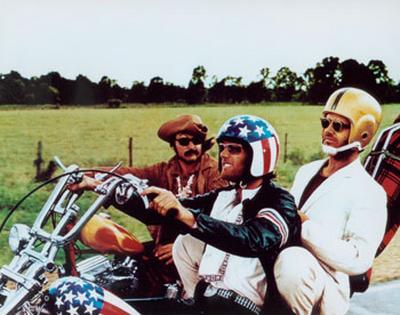
Starring, directed, written and produced by Dennis Hopper and Peter Fonda, there is every possibility that this film perfectly encapsulates the end of the 60s in America incredibly well, but alas today its relevance is far less. The two stars set out on a drug fueled road trip, casting aside their watches and heading across the American South in search of the true spirit of America, and unfortunately they find it everywhere they go.
Being a child of the 80s and 90s, I’ve only known drugs to be illegal, harmful, detrimental to your wellbeing and generally a bad idea (Trainspotting and Requiem for a Dream were important parts of my youth), so to see their being used with such wild abandon is almost infuriating from an arguably more informed position (arguably because I know more about the effects, but nothing about the experience itself). I can only assume the intense and bizarre results of an acid trip are shown correctly, and if so then this films effect on me is probably the opposite of that intended, I don’t ever want to take drugs or experience such a level of disorientation,
Jack Nicholson makes an all too brief appearance as drunken lawyer George Hanson, owning knowledge of the finest whorehouse in the South, but even he cannot resurrect this aimless love letter to the free love era from the doldrums, though a stark and unforgettable ending is very well implemented.
Choose life 6/10