The Blues Brothers

No, you’re not seeing things. Hell has not frozen over, a pig did not just fly past the window and Paul W. S. Anderson did not just make a good film, I have written a post. I honestly cannot explain why I haven’t written anything for the past 2 months (2 months? Sheesh, sorry), but rest assured I have been steadily watching films, I’ve handwritten a bunch of posts and just haven’t gotten round to typing them up, so hopefully over the next few weeks I’ll catch up with the 60-odd films you’re all dying to read about.
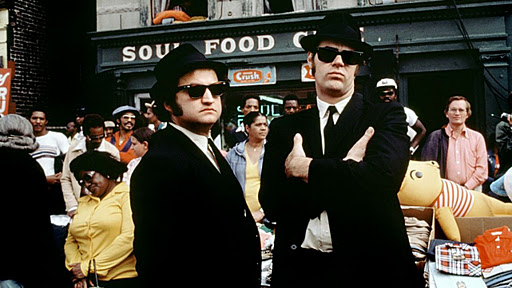
So, here we go. The Blues Brothers, a 9-piece rhythm and blues band fronted by brothers ‘Joliet’ Jake and Elwood Blues (John Belushi and Dan Aykroyd) started life as a sketch on American comedy show Saturday Night Live, who’ve had something of a chequered history with sketch to screen adaptations. For every Wayne’s World there’s an It’s Pat, Coneheads or A Night at the Roxbury, but it all kicked off with the Brothers Blue, an undeniable stone cold classic, with a supremely quotable script, dead-on performances and more cameos than Belushi’s eaten hot dinners. Everybody from Aretha Franklin, Ray Charles and John Lee Hooker shows up to belt out a number whilst Jake and Elwood set out on a mission from Gahd to get their band back together and raise the $5,000 dollars required to save the orphanage they grew up in. On the way they are hunted by the police, led by John Candy’s plaid-clad detective, rival band the Good Ol’ Boys, a group of Illinois Nazis, the army and Carrie Fisher’s flame thrower toting vengeful ex. With so much going on it would be understandable for the central stars to stick to their sketched personas, but both give it their all, especially Belushi, whose absence couldn’t be replaced by the trio of John Goodman, Joe Morton and a little kid when the ill-advised Blues Brothers 2000 rolled around. Above all, the film never loses its sense of fun, even with a two-hour plus run time unpopular with traditional comedies. A high level of farce – the brothers are remarkably blasé about the level of destruction around them, at one point strolling away unharmed from an exploding building –  helps to retain the silliness, and the soundtrack deserves a place in everyone’s music collection.
Choose film 9/10

The Thing

Arguably surpassing Howard Hawk’s 50s sci-fi classic the Thing from Another World (a feat unlikely to be achieved by the imminent Mary Elizabeth Winstead starring prequel, confusingly also named ‘The Thing’), John Carpenter’s Thing deserves its place on the list for Rob Bottin’s effects work, occasionally assisted by the legend that is Stan Winston.
Defiantly demanding that the titular creature – a life form able to imitate any living thing it comes across – not just be a man in a suit, we are treated to all manner of beasties, from an arm-munching human torso to spider-legged scuttling heads with eyeballs on stalks, as well as the nightmare inducing stages in their transformations. In a post CGI era these effects still hold ground with today’s effects houses, showing at times animatronic models can be better and more memorable than a bunch of pixels.
Carpenter has always been a master of cranking up tension through the roof, and the secluded Antarctic research base here provides the perfect scenario, with its all-male inhabitants already at each other’s throats from cabin fever. Usually with these kind of monster attacks a small group thrillers it can be easy to see who at least a few of the early victims will be, but here the equal screen time, characterisation and importance to the plot, as well as a few well-placed red herrings, mean that anyone trying to second guess the script will pursue a fruitless endeavour.
Ennio Morricone’s atmospheric score and some sharp dialogue add to the sense of claustrophobia and breakdown of relationships, and there’s an interesting spoiler if you speak Norwegian, when the basic plot is outlined at the initial meeting of some researchers at the beginning of the film.
Choose film 10/10

There’s Something About Mary/Dumb & Dumber

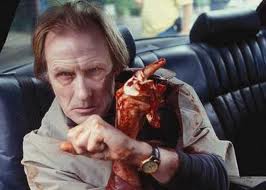
Say what you will about directing brothers Peter & Bobby Farrelly (Kingpin, Me, Myself & Irene, Shallow Hal, Stuck on You, Hall Pass), but at times their combination of prat-falls, worst case scenarios, extreme gross-out humour and stellar casts of ensemble comic actors can occasionally work out well, with these two films being pick of the bunch. The humour may go a tad too far for some) laxatives, urine drinking, masturbation and an excruciating penis-in-zipper-moment), but by ensuring their actors play the roles straight, and staying just the right side of plausibility make sure these films serve their intended purpose, as light-hearted comedy. If anything, it’s the small moments that make these films excel, be it a disc-sanding pedicure in Dumb & Dumber or the infamous spunked-up hair-do in Mary, as well as simple yet spot-on puns and wordplay (“a rapist wit”), and the casting is such that the central actors could not be replaced without seriously jeopardising the characters they play. So yes, the Farrellys have made some duffers in their time, but they’re worth enduring if occasionally they crap out gold like this.
There’s Something About Mary Choose film 7/10
Dumb & Dumber Choose film 8/10

Titanic

Now bear with me here, but I do actually really like Titanic. This may all stem from a fascination with the tragedy as a child, but its also in part due to James Cameron’s direction of a film too easily written off as a soppy romance that just happens to be set aboard the most famous nautical disaster of all time, other than Speed 2: Cruise Control. What Cameron does is take 1958s A Night to Remember, the foremost Titanic film pre-1997, and add characters you genuinely care about; DiCaprio’s steerage class ragamuffin and Winslet’s pressured poor little rich girl, as well as a sense of spectacle unavailable to film makers in the pre-CGI movie making era. There is a clear divide in the film – and eventually in the ship too – around the half way mark, once the inevitable iceberg has viciously assaulted the great ship and departed without exchanging insurance details, where the gender that the film panders to switches. Initially, the tale of an across-the-tracks romance between the leads and comparisons of their expertly realised respective classes, culminating in a steamy encounter in a car in storage is squarely aimed at the female half of the audience, but as soon as the Atlantic ocean decides it wants to come aboard and everything starts taking place on an ever increasing incline, the ensuing carnage, death and destruction should appeal to any man with a penchant for disaster movies.
Weaving fact (Kathy Bates’ ‘unsinkable’ Molly Brown) with fiction (Apparently one reason the iceberg wasn’t spotted until it was too late was due to Jack and Rose sharing a passionate snog on deck) it isn’t difficult to understand why this was the Biggest Film of All Time™ until Jimbo’s latest azure-tinged epic.
Negative points? At 3 hours it’s a bit of a trek, and the multiple villains (there’s at least four, not counting the iceberg) are all a bit too one-note to be believable, even though one, Jonathan Hyde’s weaselly marketing man Bruce Ismay, is based on a real person. There are also a few too many shout-at-the –screen moments of stupidity on behalf of the leads escape attempts – surely Rose would have realised Jack would have a better chance of survival on his own, if she has got on a lifeboat. That being said, there isn’t enough to detract from the quality of the film, with the characters and story never being overshadowed by the stellar effects work.
Choose film 8/10

Monsters

Holding the prestigious position of most recent film on the list, having been awarded a 5-star rating from Empire magazine mere months before this cinematic odyssey began, Monsters is also one of the greatest examples of economic film making. Shooting on the fly with a skeleton crew and adding all effects afterwards himself, director Gareth Edwards (currently remaking Godzilla, hopefully with a better sense of scale continuity than Roland Emmerich, and without Matthew Broderick) has crafted a film equal parts Cloverfield, District 9 and any rom-com road trip you can think of. The plot is straightforward, Scoot McNairy’s cynical photojournalist Andrew must transport spoilt bosses daughter Sam (Whitney Able) back home across Central America. The hitch? Aliens landed in Mexico 6 years ago, and the area is now classified an infected zone, with only a few days before sea and air travel will be shut off for six months. Until the beautiful, unforgettable climax the titular creatures are barely seen, glimpsed in children’s cartoons, signs and graffiti, yet these giant bioluminescent jellyfish-like beings are more memorable than the central couple. Though not awful, the two leads are hardly required to stretch their talents, being a couple in real life whose marriage caused Edwards to miss a premiere of the film. As with all rom-coms, with or without building sized aliens, the two begin at odds with one another, but grudgingly grow to like each other through forced exposure, tequila, and redressing a bandage by firelight. Using a genuine couple heightens the realism of the relationship, so come the conclusion you hope they work something out between them.
Choose film 7/10

Buster Keaton

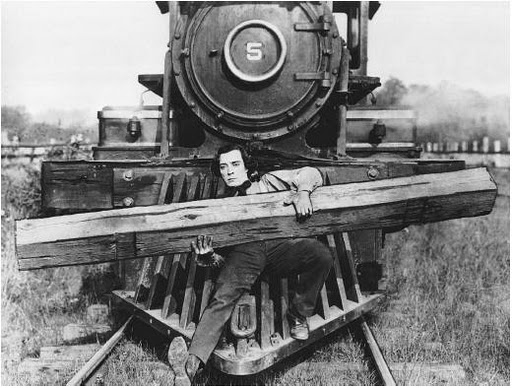
 I went on a bit of a Buster Keaton spree here, courtesy of LoveFilm’s watch online feature, allowing me to watch all of his films from the list – five in total – almost in one go. Ranging from 45 to 107 minutes in length, all are of course silent and black and white – the latest was made in 1928 after all, but to a film they are all exceptional, but I couldn’t help picking up on some recurring themes. Of the five, four involved a damsel in distress scenario, where Keaton’s diminutive heroic figure is the only one able to save her. Four predominantly feature trains, three offer a high speed pursuit, three have major plotlines revolving around an across the tracks romance, three use the theme of inheritance in some way and all five feature peril involving water, be it a dam, waterfall, water tower, boat or flood.
The best of the bunch are the General, depicting Keaton’s southern train engineer singlehandedly invading the North to rescue his girl and his beloved train, and Sherlock Jr., where a cinema employee dreams of being a famous detective. The General offers much in the way of action and physical comedy, as Keaton climbs over and sits on the front of a moving train engine. It’s Keaton’s most famous film, and rightly so, as his straight-faced fool tries so desperately and earnestly to do the right thing that he cannot help but be hilarious, staggering from one mishap to the next, rescuing the girl from the enemy only to be confronted by a bear. Throughout the films Keaton takes a cartoonish view to violence – getting limbs caught in a bear trap is less of an inconvenience than when it happens in the likes of Straw Dogs or Severance, but this only adds to the fun – it wouldn’t be very entertaining for the characters to be rushed to hospital every few minutes.
Seven Chances is at the disadvantage of having been made into the Bachelor, starring Chris O’Donnell in 1999. The remake does nothing but detract from the quality of the original film, as both use almost entirely the same plot – a man must marry before a given date, or be denied a rich relative’s vast inheritance – yet Keaton does it much more successfully with little messing around or unnecessary mucking about with now perfunctory rom-com tropes.
Our Hospitality plays on the Romeo and Juliet tale of warring families with besotted children, but takes it in an inspired new direction when Keaton’s Willie McKay attends a dinner hosted by the family of his new love, only to discover they are the Canfields, with whom the McKays have feuded for many years, and who are responsible for killing Willie’s father. The new spin is that, although the Canfields desperately want to kill Willie, their family code of honour prevents them from doing so whilst he is a guest in their house, so Willie does his best to remain there indefinitely.
Finally, Steamboat Bill Jr. sees Keaton sent to work in Boston with his steamboat captain father, but the beret clad, ukulele playing, moustachioed diminutive Keaton is not what his father was expecting. Somewhat predictably, Keaton’s Bill Jr. is eventually required to save the day, making his father see him in a whole new light, but along the way some incredible stunts, including the infamous house front falling on Keaton during a storm that could have killed him had it gone wrong, make this a worthwhile watch all the same.
The General – Choose film – 9/10
Seven Chances – Choose film – 8/10
Our Hospitality – Choose film – 7/10
Steamboat Bill Jr. – Choose film – 6/10
Sherlock Jr. – Choose film – 9/10

Avatar

So, you’ve created a new way to make films; filling a large indoor space (dubbed The Volume) with cameras, covering your actors’ bodies with hundreds of motion capturing dots, films a scene then changing the actors to aliens and the warehouse to a jungle afterward on a computer, but you can’t think of a decent story to set it round. So what do you do? If you’re James Cameron, director of such cinematic milestones as Terminator 1 & 2, Aliens and Titanic, then you steal. From everything. There isn’t an original moment in Avatar, with Platoon, Star Wars, Lord of the Rings, Halo, Cameron’s own Aliens and, most notably, Dances with Wolves all receiving enough ‘loving homage’ to keep copyright lawyers in business for years to come. In the hands of a lesser director, or without the shiny new technology and 3D CGI gimmickry available this film would have been lost amid the also-ran film flotilla of 2009, but effects overcame plotting to elevate the film above its rightful place.
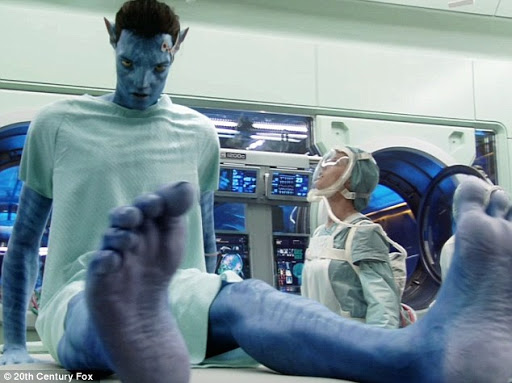
Sam Worthington plays Jake Sully, a US marine (with Worthington’s trademark unshakeable Australian accent) paralysed from the waist down, who volunteers to take the place of his recently deceased scientist brother in a mission to infiltrate the alien race of the Na’vi, 9ft tall lanky blue cat people with 4ft long rope-like tails and long black ponytails with USBs on the end. Jake is able to control a scientifically grown ‘avatar’ that responds to his body when wired up in a big plastic pod.
The maguffin of the plot is that the Na’vi live in a giant tree, under which is a vast source of a precious fuel known as unobtainium. You get the feeling they were supposed to rename that at some point but forgot, or Cameron came up with it and no-one had the guts to tell him it sounded stupid. Stephen Lang’s scarred Colonel Quaritch and Giovanni Ribisi’s corporate suit Parker want Jake to get the aliens to move, whilst Sigourney Weaver’s scientist and fellow avatar occupier Dr. Grace Augustine wants to learn more about the Na’vi way of life. When Jake is accepted into the alien tribe, he is torn between these two warring factions, as well as his own developing feelings for tribe member Neytiri (Zoe Saldana), and a simpler way of life that greatly appeals to him.
Breaking us into the sci-fi world gently, first showing us men, soldiers, scientists, then the avatars floating in their booths, 3D holograms and a few active avatars, we are then transplanted to the fully realised, completely created yet seamless and immersive fantasy world of Na’vi home planet Pandora, with vibrant, unusually active foliage and a wide variety of lifeforms perhaps a little too familiar to be believable as entirely alien. With 6-limbed bat-lemurs, giant hammerhead rhinos, vicious panther/dilophosaurus, wild oil-black dogs, helicopter lizards and of course giant freaking dragons, it’s not just the Earth film back catalogue from which Cameron has borrowed.
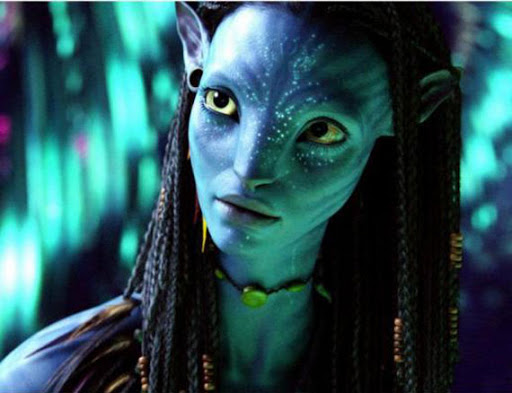
There was uproar when Saldana’s Neytiri wasn’t considered for an Oscar due to it being hidden behind a computer generated mask (yet Al Pacino was nominated for his latex-obscured turn in Dick Tracy, and John Hurt won for his in the Elephant Man), but there is no doubt she should have been considered for her fiery, animalistic turn as the fierce warrioress, her initial aggression towards Jake’s ‘dreamwalker’ gradually melting to pride, friendship and affection, ultimately leading to some freaky blue alien sex that was traumatising and completely unnecessary. As ever Worthington puts in a blank canvas of a role, although this is arguably what is required of his jarhead moron, leaving him ready to be imprinted upon by Quaritch, Augustine of Neytiri.
For those concerned with a new spin on Titanic’s across the tracks romance dominating the film fear not, as there is more than just romance breaking through language barriers and a less-than-subtle environmental message. The final half hour battle between the soldiers and the Na’vi, including aerial assaults and a reversal of Aliens’ giant mech battle, rivals any war film, and is worth the entry fee alone. Be sure to stop watching before Leona Lewis’ ear-gougingly awful credits song though.
Choose film 6/10

Kick-Ass

Just as Dave Lizewski (Aaron Johnson) cannot understand why no-one has tried to become a superhero in Matthew Vaughn’s first American film (after Layer Cake and Stardust in the UK, before X-Men First Class), so too it is difficult to understand why no-one has made a film about someone trying to become a superhero. It’s such a forehead-slappingly simple premise that you assume someone else must have already done it. Of course, since then the likes of Defendor (starring Woody Harrelson) and Super (with Rainn Wilson) have put their spin on the idea, and received less critical acclaim and box office revenue in return, as they have failed to match the level of absurdity, shock or brilliance of Kick-Ass, based on Mark Millar and John Romita Jr.’s excellent graphic novel. And, they don’t have a 10-year old girl calling a room full of drug dealers cunts and being shot in the chest by her doting father.
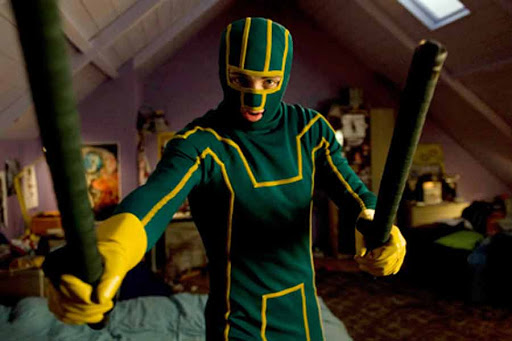
Using a scuba suit, rubber gloves, self-taught nunchuck skills and the inability to pain and a partially metal skeleton gained from wildly overestimating his ability to take down some thugs, Dave transforms into Kick-Ass, soon becoming an Internet sensation after being caught on a cameraphone helping a victim of a gang crime.
Meanwhile, Big Daddy (Nicolas Cage, channelling original Batman Adam West with a kiddy-fiddler moustache) and daughter Hit Girl (Chloe Moretz) already exist as superheroes, albeit far more covertly than Kick-Ass, and are trying to take down crime kingpin Frank D’Amico (Mark Strong), whose nerdy son Chris (Christopher Mintz-Plasse) goes to school with Dave, and thinks he can help his Dad by becoming Kick-Ass’ sidekick, Red Mist.
Whilst very much an origin story, this neatly sidesteps being bogged down in exposition and training montages with the already established Big Daddy, whose backstory is succinctly covered in a well-played comic book style. The standout though is Moretz, clearly having clocked some serious training in both combat and knife skills, despatching the aforementioned gang of hoodlums with all manner of weaponry; stabbing, shooting and dismembering as though an everyday occurrence, although there’s a fair chance that for her it actually is. There is some truly amazing music to kill people to as well, with Joan Jett’s Bad Reputation being a particular favourite.
Choose film 7/10

Shaun of the Dead/Hot Fuzz

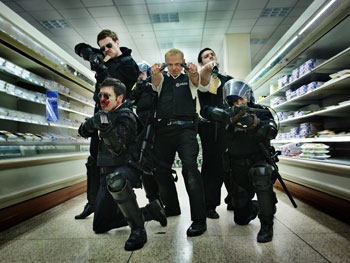
How does one create two of the best loved British comedies of recent years? Initially it seemed purely to involve director Edgar Wright and stars Simon Pegg and Nick Frost, but recently Wright’s foray across the pond, Scott Pilgrim vs. the World, was well reviewed but barely seen, whereas the Pegg/Frost scripted Paul drew huge crowds but lacklustre reviews. No, the secret it would seem is to keep this trio together, with Wright and Pegg on scripting duties, Pegg in the lead role and Frost as his incompetent sidekick. Pepper the rest of the cast with the cream of British acting and comedy, including Jim Broadbent, Timothy Dalton, Peter Serafinowicz and Dylan Moran, with Bill Nighy and Martin Freeman appearing in both films. Also, there must be cameos you can miss even without blinking – in Hot Fuzz, Cate Blanchett plays Pegg’s ex-girlfriend behind a decontamination mask and Lord of the Rings director Peter Jackson is the Santa who stabs him through the hand- but crucially, the film must remain thoroughly British.
For this is the true secret of these films. Whereas other great British filmmakers seem to shy away from their country of origin (Danny Boyle, Ridley Scott, Alfred Hitchcock) opting instead to embrace the more commercial stylings of Hollywood, Wright and co. make sure that if you cut the film in half, it reads Made in England all the way through. From the settings – the zombie-infested streets of London or the sleepy rural village of Sandford, to the cast, sense of humour and the solution to any problem (“I dunno… pub?”) there have never been comedies this British since Kind Hearts and Coronets.
 It is also difficult to pin down what kind of a comedy the films are, as they feature equal quantities of character driven sitcom (Shaun’s vying affections for girlfriend Liz and best mate Ed), genre pastiche (there are more references in both films than could ever be listed), social commentary (upon discovering a zombie, Ed and Shaun first assume she is drunk), outlandish set pieces (battering a zombie with pool cues to Queen’s Don’t Stop Me Now) and subtle farce (The foam housing of twin pistols either side of a thermos in a pensioners bag). This cornucopia of comedic styles means that, if you didn’t like the last joke, it’s OK as another will be along shortly.
The most important aspect though seems to be to make sure there are repeated, quotable lines, whose meanings change throughout the course of the film (“He’s not my Dad,” “You’ve got red on you.”) or off-hand or unintentional predictions that inevitably come true. Of the two films, Fuzz rates a little lower due to a bout of Return of the King syndrome, with more explosive endings than are strictly necessary. Shaun also offers more rewarding repeat viewings, with many lines not landing their full impact without prior knowledge of the rest of the film.
Shaun of the Dead Choose film 9/10
Hot Fuzz Choose film 8/10

The Red Balloon

A woman went out walking one day and discovered a snake’s egg on the path. She took the egg home and cared for it until it hatched, when she kept the snake as a pet. She doted on the snake for years, attending to its every need and treating it better than any snake had been treated before. Then, one day, the snake bit the woman, and with her dying breath she asked the snake “Why?” and the snake replied “Bitch, you knew I was a snake.”
It is this sense of inevitability and apprehension that fills the Red Balloon, as beautiful and well crafted as it is, that almost ruins the short about a boy who befriends a bright red balloon, but finds owning it proves problematic when all the other children want it as well. Yet however destined the ending may seem, it is the journey up to it, and indeed the repercussions that make the film so endearing, at times unexpectedly hilarious and beautifully heartwarming, especially the moment the balloon encounters an equally bright and vivid blue inflatable friend of a young girl. The ending, too, is truly uplifting.
Choose film 9/10