Spiderman 1 & 2

Never has a film been more squarely aimed at the nerds and outsiders of the world (OK, maybe Revenge of the Nerds), the guys with the smarts but not the brawn, good looks, athletic bodies and hot girlfriends. Fortunately, this description neatly encapsulates the majority of the superhero genre’s existing fanbase.
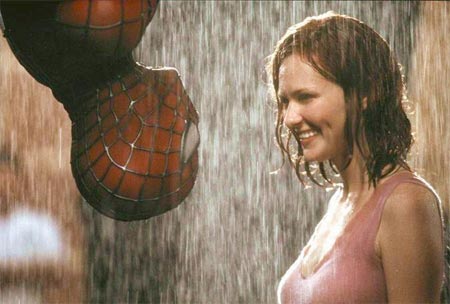
Tobey Maguire is Peter Parker, the afore-mentioned science nerd with a prolonged crush on Kirsten Dunst’s girl-next-door MJ, but lacking the confidence, wealth, strength and social standing required to do anything about it. After being bitten by a radioactive spider during a class field trip, he acquires some of the spider’s abilities, including wall crawling, mild precognition, shooting webs from his wrists, a vastly improved body and the ability to dangle from the ceiling into your mouth while you sleep. In real life, spider’s shoot the webs from an aperture closer to their posterior. This would have made for a much stranger film, I feel.  Unfortunately, Parker’s transformation occurs around the same time as Parker’s lazy rich kid best friend Harry’s businessman father trials a new super serum on himself, with predictably disastrous results, transforming him into a suped-up madman, terrorising the city in the form of fan favourite villain the Green Goblin.

4 Months, 3 Weeks & 2 Days

I’ve finally offered myself up to the Gods of Lovefilm, kneeling at their alter and pledging my sacrifice of hard-earned readies and how am I rewarded? With a Romanian abortion film. Brilliant. Shot with an unflinching, rarely moving style, after the initial tracking shot around a dormitory in search of Kent cigarettes and black market Tic-Tacs, this shows the totalitarian regime of Romania in the late 80s, where abortions were banned for women under the age of 40 who hadn’t already had four or more children. The three main characters; the timid, fearful, naive and unexpectedly pregnant Gabita, her capable and confident roommate Otilia and the man found to perform the illegal termination, the callous, barbaric yet business-like Mr. Bebe are all played admirably, but some of the shots and topics discussed – the proper disposal method of an aborted foetus, whole or chopped, don’t always make for entertaining viewing.
Choose film 8/10

The Silence of the Lambs

It’s easy to forget just how impressive Silence of the Lambs is as a film; receiving the ‘Big 5’ Oscars (Actor, Actress, Picture, Director, Screenplay) back in 1992, an accolade since rusted by the diminishing returns of the sequels/prequel. When remembered, the image brought to mind is of a motionless Anthony Hopkins stood eerily in the centre of a jail cell, awaiting Jodie Foster’s FBI student Clarice Starling, the conversations that ensue regarding Hopkins’ incarcerated Hannibal Lecter assisting the FBI with psychological analysis of an active serial killer, and certainly Hopkins’ aggressive, manic yet restricted delivery of oft-quoted and even more so parodied dialogue. Admittedly Hopkins turn, equal parts refined and ruthless, educated and insane, psycho-analytical and psychopathic, is remarkable, before Ridley Scott’s Hannibal turned him into some kind of dandy rogue (albeit one who feeds Ray Liotta his own brain), but it is so overpowering that it overshadows the rest of the film, feeling his absence whenever he’s not on screen, staring directly into the soul of the viewer. Not to diminish the rest of the production, with Jodie Foster being another highlight, her twig-like rookie about a foot shorter than all the other male recruits, all of whom have no problem checking her out as she walks by, seeing her not as an equal, but simply as a girl. Ted Levine (Monk, Heat) is also incredible as the killer Buffalo Bill, keeping his victims alive in a well before skinning them to make himself a suit. Criminally he was not even considered for a supporting actor nomination, yet his portrayal is arguably more chilling than Hopkins’, delving deep into a twisted, scarred psyche and throwing the shattered remains at the screen. The third reel reveals, both examples of fine editing and cinematography, also deserve mentioning, keeping you guessing long after you thought you knew what was happening.
Choose film 8/10

A Room with a View

Featuring an unexpected amount of penises for a period film (or any other for that matter), this tells the story of Helena Bonham Carter’s upper class Lucy Honeychurch, who finds herself having to choose between two suitors; her betrothed, oily, irritatingly snobbish Cecil (Daniel Day-Lewis, over enunciating to grating effect) and Julian Sands’ playful, liberated yet of a lower social standing George. Obviously Lucy will choose the less pretentious and by all means friendlier George, overcoming the general repression of the times (a break-up is ended with a simple handshake), but the supporting cast makes this a worthwhile watch, from Maggie Smith’s unobtrusive Aunt Charlotte, Dame Judi Dench’s romance novelist, Simon Callow as the local vicar (and owner of one of the aforementioned phalluses) and Denholm Elliot as George’s forward thinking father. With so much talent surrounding them, it’s no wonder Bonham Carter and Sands struggle to shine, proving themselves to be merely audience ciphers.

Choose film 6/10

Leon

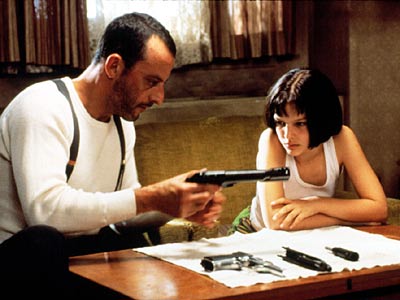
After the murder of her uncaring parents and innocent four year old brother at the hands of a pill-popping, Beethoven loving Gary Oldman, Natalie Portman’s 12-year old Matilda is taken in by her stoic, lonesome ’cleaner’ (a hitman to you and I) Leon. Leon’s skills as a contract killer are evidently impressive, shown early on by his one-man takedown of a drug dealer and his crew, disappearing into the shadows like the breath of a ninja, yet his skills as a human being and fully functioning member of society are less so, eking out a solitary existence with his milk laden fridge and beloved yucca plant. The introduction of Matilda into his life changes everything, as she requests training to avenge her brother’s death, in exchange becoming Leon’s assistant and tutor in reading and writing. Director Luc Besson shows a style and directorial flair seen previously in Nikita (where Jean Reno’s character first briefly appeared) as more recently in the decidedly more Hollywood-ised the Fifth Element (again featuring an intense, cackling turn from Oldman in villainous form).
Choose film 6/10

No Country for Old Men

In this most bleak and convoluted offering from the Coen brothers you rarely witness a characters ultimate destiny, although they are hinted at enough to make a fair assumption. Josh Brolin’s Llewelyn Moss, a welder out hunting deer in south west Texas, stumbles upon a botched drug deal and, finding a suitcase full of money, goes immediately to the authorities before returning home to his wife and living a largely uneventful life. No, of course not, he legs it, instigating a game of cat and mouse with Javier Barden’s Anton Chigurh, a ruthless, near robotic hitman with an unusual and extreme set of morals, himself pursued by Tommy Lee Jones’ small town sheriff Ed Tom Bell. Featuring a stellar supporting cast including Woody Harrelson, Stephen Root and Kelly Macdonald, some incredible scenery, lensed by Oscar winning regular Coen cinematographer Roger Deakins and highly memorable dialogue lifted directly from Cormac McCarthy’s seminal novel of the same name, this is a truly inspirational and unique film. Bardem in particular completely embodies his character, becoming one of the most iconic villains to grace our screens in modern times. Brolin however strikes me as an actor from the ranks of Shia LaBoeuf and Sam Worthington, snapped up and promoted by big name directors without having the talent to back up the expectations, flooding the cinemas with frankly mediocre acting ability.
Choose film 8/10

Strictly Ballroom

You don’t really need anyone to tell you this is a Baz Luhrmann film. Focussing on a stage-set pastime (ballroom dancing) with fantastically over the top characters and a very Australian film, this is distinctive Luhrmann through and through. Focussing on a ballroom dancing prodigy (Paul Mercurio, though you’ll swear blind its Guy Pearce), shunned from the ballroom world after using his own moves in a competition, left with only a dowdy aspiring dancer as a partner he must re-infiltrate the dancing competition to regain his place. Ignore the sequinned backdrop, this is a genuinely hilarious movie, if only for the ridiculous levels of devotion the characters have for their hobby.
Choose film 7/10

One Flew Over the Cuckoo’s Nest

Jack Nicholson, in an arguably career best (so far) performance, is R.P. McMurphy, hopes to complete a short prison sentence without resorting to hard labour, and therefore pleads insanity and is transferred to a psychiatric hospital run by the steely Nurse Ratched (Louise Fletcher).  Ratched’s treatment methods, including humiliation and a mind-numbing daily routine appall McMurphy, as he realises the other patients are more focused on their fear of her than of functioning in the outside world. Although the main two performances are excellent, both winning well deserved Oscars, the film remains memorable more for the supporting cast that makes up the other inmates. Each has a specific and instantly recognisable personality, be it Brad Dourif’s stutteringly naive suicide risk Billy, Danny DeVito’s childlike Martini or Christopher Lloyd’s crazed loose cannon Taber, used whenever anyone is required to awake to a surprise situation, as Lloyd owns the greatest instant ‘what the Hell’ face on the planet.

The film is remarkable, not only for the acting but also the depths to which the story plunges, with an ending both horrific and genuinely surprising. Throughout the film it is obvious that McMurphy will be discovered as a fraud (something never actually stated during the film), and will of course be sent back to prison where he belongs (the sentence he is attempting to avoid is the statutory rape of a 15-year old girl), but the fate in store for him is far worse than could possibly be imagined. It also features possibly the most elaborate plan to have sex ever, hijacking a busload of patients, commandeering a boat and teaching said loons how to fish.

Choose film 9/10

The Life and Death of Colonel Blimp

Character driven and with a meandering, unhurried pace, this is most definitely not the war epic I had always assumed it to be. Following Roger Livesey’s Clive Candy over a forty year period as he climbs the ranks of the British army, insulting the entire German movement during the Boer War, retiring twice, forming a firm bond with a German officer and three separate relationships, all portrayed by Deborah Kerr. Livesey is excellent, adeptly showing the difficulties Candy faces trying to impose his old school sportsmanship and honourable values on the more modern ideology of total warfare. Admittedly, I would have liked more battle scenes, but this is more than made up for with the absurd comedy of the technicalities and formality of a duel, and the inclusion of Dad’s Army’s Frazer, a young John Laurie.

Choose film 7/10

Lebanon

A novel concept, portraying war experiences from almost entirely inside a cramped, battered tank, pays off in what should be considered a worthy addition to films about modern warfare. Telling the tale of four Israeli soldiers, a driver, gunman, shell loader and their superior officer, receiving orders only through the radio or brief appearance from their CO and only viewing the outside world through the tank’s turret crosshairs or small, dirty windows, many comparisons have been made to Das Boot (itself shot inside a German submarine, and also appearing on the list). The cast all perform admirably under obviously restrictive conditions, and the camerawork is amazing, each movement of the turret along a jerky linear path, accompanied by the whirr and crunch of the gears, and for such a claustrophobic, poorly illuminated setting it is still always clear what is happening and to whom.
Continue reading