Champagne

There are some films that are just difficult to like, mainly because the lead is so detestable. Recent examples I’ve seen include Napoleon Dynamite, Vagabond and Transformers, and Champagne joins that far from hallowed list, although this time I feel that the lead, Betty Balfour’s simply named The Girl, is meant to be unlikable as she’s a spoilt little brat who only comes to realise she can be a good person when her father (Gordon Harker, Hitchcock alumnus from The Ring and The Farmer’s Wife) loses all his money and she is forced to take care of him.


The Girl, who at one point is referred to as Betty, so I’ll call her as such, is the kind of poor little rich girl who is accustomed to the world bending to suit her every whim. When Jean Bradin’s ‘The Boy’, her lover, is on a cruise liner from America to France, she commandeers a plane to land in the sea nearby, knowing a rescue boat will be sent out to save her and bring her aboard, and she doesn’t even thank the men who come to her aid. Whilst aboard said boat, she also catches the eye of the wealthy yet clearly sinister (he has a moustache and everything) ‘The Man’ (Ferdinand von Alten), and the two men then spend the rest of the film making awkward looks at one another as their affections for Betty wax and wane with such rapidity I’m surprised neither of them has whiplash. 

The overall story is fairly simple: Betty has done far too little with her life to justify the amount of her father’s money she is spending. When he comes to France to tell her he’s lost everything and they are ruined, she takes care of him in a tiny apartment, cleaning and cooking abysmally for him, but she learns to be a better person because of it. Except that she doesn’t, and the decisions she makes after this point are only made out of spite or for her own personal gain, so I can’t really see what the overall message is. The last minute reveals, of which there are a couple too many, are all fairly well signposted too, so didn’t come as much of a surprise, except for the final shots which added another layer of intrigue and deception into the mix, as to a character’s true intentions, which were basically the intentions we assumed he had before an earlier reveal, making that reveal a little bit pointless anyway.

If it all sounds confusing, it only slightly is, but there’s not a lot of point trying to wrap your head around it as this is definitely a lesser Hitchcock (as I fear most of his silents are going to be), so personally I’m not going to recommend it. Some of the messages and parallels are handled with too heavy a hand – Betty gets a job as a flower-girl at a swanky club where she looks longingly at the wealthy clientele, but still feels the need to underline that she used to pay to go to places like that, and now they pay her, which was pretty much the whole point of those scenes, so didn’t really need to be explained quite so succinctly. 

There are some nice moments of comedy – Betty giving her flowers out to the band because her boss told her to give them to men wearing eveningwear – meaning of course only the customers – but elsewhere it often goes too far, for example when she tries to make the bed by dragging the mattress over her father who is doing push-ups nearby. Before losing the money her fashion taste is also diabolical, with her dresses being far too elaborate and are frankly horrible, though that could be a product of the times more than anything, and I’ve never been too up on even today’s styles, so what do I know?

There’s good use of a swaying camera and actors to mimic seasickness – though I wouldn’t be too surprised to see Hitchcock utilising a swaying set instead – after all he built the entire apartment block from Rear Window inside a soundstage – but though the swaying wasn’t convincing it was at least a good touch. The early lifeboat rescue however looks like it was performed on a set previously used for a school play – even in 1928 – and I’m fairly sure in the first couple of takes the plane probably fell over.

Overall, not a lot to recommend here. A simple story unnecessarily overcomplicated and with terrible effects.

Choose life 3/10

The Great St. Louis Bank Robbery

The second film in my travels through Steve McQueen’s career is actually his fifth movie, as I’ve yet to come in contact with a copy of Girl on the Run, Never Love a Stranger or The Blob, and is the second film in which he plays the lead (after The Blob, which I really want to see am annoyed I can’t find).

Here, McQueen plays George Fowler, a man in need of some funds to pay his way through college after being kicked out years ago. He accepts the job of driver for a bank robbery being conducted by his friend Gino (David Clarke) and two others, John and Willie (Crahan Denton and James Dukas), neither of whom trust George, as he’s lived a clean life and hasn’t even been to prison. Meanwhile, George meets up with Gino’s sister Ann (Molly McCarthy), an old flame of his, and complications arise when she works out the real reason George is in town.


Or rather, they don’t. I fully intend to spoil certain aspects of this film that I don’t recommend watching, so I’d advise the spoiler-wary to either skip to the end of the review or stop reading, but regardless you shouldn’t watch the film. You see, my first issue with the film was that halfway through the film there is a pivotal moment in the plot where, having discovered George and Gino are planning to rob a bank, Ann writes on the side of said bank that they are going to be robbed. Understandably, John and Willie are none too pleased about this and, upon discovering Ann is the culprit, kill her. Yet, after this happens, there are no further ramifications on the actual heist of the bank receiving a warning. So in effect Ann is killed for really no reason, as her actions had zero impact on anything that happened.

Secondly, in the film’s opening there is a brief intro stating that the parts of police officers have been performed by the real officers during the real life robbery upon which this story is based, however the police have yet to show up anywhere in the film even before the heist has begun, so it is obvious that something is going to go wrong, the alarm will go off and the police will arrive, else there’d have been no point to the intro. Also, it’s quite clear why the policemen have opted for careers in law enforcement rather than a more thespian path, as though only a couple get actual lines, they are all delivered rather forcefully.

Not that the rest of the cast fares much better, as even McQueen has his wooden moments, and the various conversations within the film, especially those between George and Ann, all feel stilted and awkward, even when they aren’t supposed to be. It’s no great surprise to find that McCarthy hasn’t really done much since. 

My main problem though? The story is dull. Now normally I love a good heist flick. There’s something about the meticulous planning of a con, the recruiting of the team, pulling it off, working around unforeseen obstacles and either seeing the criminals being brought to justice or fleeing with the loot that I find fascinating and immensely watchable, be it the star-studded, glossy likes of the Ocean’s trilogy or Inside Man, or something a bit more noir-y and stripped back like Rififi. Dog Day Afternoon, The Taking of Pelham 123, Out of Sight – these are all amazing films that I don’t hear talked about nearly as often as I feel that I should. And The Great St. Louis Bank Robbery is deservedly not amongst this hallowed list, because it’s just dull.

The robbery itself is completely straightforward, with no clever tricks or any kind of skill involved. The plan is simply to go in, rob the bank and leave before the cops arrive. There’s about as much of a plan as Gale and Evelle had in Raising Arizona, yet this is after a solid 75 minutes of planning shown on screen, that actually took place over at least five days during the film. And the great thing is that nothing goes wrong – the alarm is triggered, as the thieves had expected, but the cops arrived sooner than anticipated, descending into a hail of gunfire. Other than the last minute shoot-out and McQueen going insane, there’s little of any worth that I think I’ll remember. McQueen’s final scenes are worth mentioning in that they are the only time I’ve seen so far where he has played anything other than a by-the-numbers hero character. When he finds himself alone in the bank with the hostages and a gun, he breaks down and goes a bit loopy, which was interesting to watch, but was unconvincing because it’s Steve McQueen, and he just doesn’t do that.

One interesting part of the film was that it showed how a good, clean man – in this case George – can become embroiled in the seedier underbelly of a nation, and how if he’s not careful he could quite easily become stuck within it forever.

Also, when the film opens they wisely removed the ‘Great’ from the title, as neither the film nor the factual account are anything even close to resembling great. And is it too much to ask for a little note at the end saying what happened to those that survived?

So, this isn’t a great film, mainly because the story is boring – the heist doesn’t even begin until 15 minutes before the end – the acting is poor, the soundtrack has been taken from a fairground ghost train and pretty much the whole thing is in shadow and impossible to make out.

Choose life 2/10

Napoleon Dynamite

I watched and reviewed this film – begrudgingly – for the recent So You Think You Can Review tournament, the only downside to the competition. Here is my less-than-praising review of the film.

It’s been a long time since I saw this film upon its initial release back in 2004, and I swear the film has changed an awful lot in those brief 8 years, as the last time I watched it I’m sure it was a comedy. In fact, what we have here is a character study of a mentally ill teenager from a broken home, who has grown up the best he could in a world that clearly has no place for him, and that he seems to want to be no part of.
Continue reading

Mother and Son

This is another of those films that I knew absolutely nothing about before watching – even the language or year it was made (Russian, 1997). Sometimes, this strategy works – see Silver Lode – but other times, like now for example, I wind up confused and ill at ease with my surroundings. I think this is the kind of film you need to be in a specific mood for watching, where you’re more open and receptive to what is a deeply emotional and solemn journey taken by two people who barely speak to one another because there’s just nothing to say, and when they do it doesn’t always make a lot of sense. Not, as was the case with me, fitting it in early on a Saturday morning before heading out for a picnic and a day of shopping.


Mother and Son, somewhat bluntly, is about a mother and, you guessed it, her son (Gudrun Geyer and Aleksei Ananishnov). She is evidently not well, and he spends his days looking after her in a secluded, ramshackle cottage. They are the only two people who appear on the screen throughout the film (other than a distant hiker walking up a hill at one point that I’m fairly sure was missed in the edit), and it is clear that they are the only person in each others life. The story doesn’t have much of a plot, although there is an ending, it simply details  the son caring for, and carrying around, his mother, and the hardships they go through. She is unable to walk, with even being carried for a short period wearing her out enough to fall asleep on a park bench. The most energetic action available to her is straining to raise a handle to tousle her son’s hair whilst he reads postcards to her.

The cinematography choices in the film are bold, in that the picture is often skewed, stretched and distorted, which often makes the backgrounds difficult to establish. A storm that builds whilst the mother’s condition worsens is clearly a smudge on the camera lens, and the soundtrack is predominantly howling winds and inaudible whispers, with the occasional quiet hymn or subtle orchestra to fill the void. On several occasions I though the DVD had stopped, as the actors will freeze in place, not making a sound for what seems like hours (but is probably only a few seconds). One such example is the aforementioned park nap, when the son heads back to the house to retrieve the postcards, the camera remains with the mother, in real time, whilst she lays there sleeping, for a good few minutes. It felt very much like an experimental student film where they hadn’t quite worked out how to use the camera or edit properly, let alone use a script.

A couple of moments lost me completely in terms of making sense. At one point, the mother’s pain becomes too much for her and she feebly repeats “Get me out” to her son, who replies with the mantra “Yourself” over and over again, until she finally announces “You got me out.” Later, when the mother is particularly depressed, the son simply tells her “Don’t die then. Who’s making you die?” Her reply? A passionate “You! You!” This made me think that, seeing as the son is the predominant instigator in all the travelling that occurs in the movie (“Well, let’s go” he says at least twice), that perhaps he was trying to aid his mother in her shuffle from the mortal coil, so he could be free of the burden and move on with his life, though I fear this gives a deeper insight into my own relationship than perhaps I intended.

 The reversal of the parent/child characters and relationship was an interesting dynamic, up to the point where when he prepared a drink for her I was expecting him to test the liquid’s temperature on his forearm before giving it to her. The notion that the son will have to go through all the hardship the mother has, as we discover late into the film (I don’t mind giving spoilers for films where nothing much really happens) leads me to believe that whatever it is that ails her is most likely to be genetic, but that perhaps the son will have no-one to care for him as he does for his mother.

Don’t get me wrong, I’m sure that director Aleksandr Sokurov was not aiming to make a film that could be described as entertaining, but those are the kinds of films I prefer watching, so I can’t really recommend watching this film. Even at a scant 68 minutes long I found myself willing the mother to pass away – peacefully, of course, I don’t want any further suffering – and if possible could she find a way to take her son with her? 

Choose life 3/10

Vagabond

A farmer finds a woman frozen to death in a ditch one morning, her face blue and her body curled up and contorted, and appearing to the police as if she has been swimming in a vat of wine. Nobody knows where she came from, but the narrator of this film, director Agnes Varda, provides a series of mock-interviews and flashbacks through which the last few months of the girl’s life are shown, primarily through the eyes of the many and various people she encountered along the way.


This is not my kind of film. I haven’t seen a lot of French new wave, but what I have I’ve not been much of a fan of. There’s always too much gratuitous nudity and too little plot, and they without fail all suffer from a severe case of style over substance. Varda, a new wave graduate, ticks off this checklist with flair and aplomb in this rather tedious and pointless affair.

The girl’s name is Mona Bergeron (Sandrine Bonnaire), a woman who chose to throw away her life amidst civilisation because she was tired of being bossed around at work, and instead wanders the land in search of the next packet of cigarettes. Mona is deeply unlikable and does herself no favours in terms of looking for help. She has no qualms whatsoever about leeching off the kindness of strangers, be it for housing, care or sustenance, and I’m fairly sure the phrase “Thank you” has never once departed from her lips. Uncouth and unclean, with an odour you can almost smell through the DVD, it is a wonder anyone has ever stopped to help. At one point, a man spontaneously buys her a sandwich when she looks longingly at his, after which she never even looks at the guy again, let alone talks to or thanks. 

This film succeeded in making me increasingly annoyed at this person who, even when offered the chance to start a new life for herself, retaining her freedom and living out one of her dreams, she still shows no signs of wanting to and is inevitably kicked out and sent on her way. By the end, I wasn’t exactly happy about the direction she was taking, but I didn’t mind too much either. There are some people the world is probably better without.

I approved of the fact that everyone who Mona encountered saw her differently. She is described as a hippy, a dreamer, a dropout, a cautionary tale, a drinking buddy and an object of desire – though how anyone finds her attractive is beyond me, I’m nothing but repulsed by every inch of her. One girl, Yolande, a caretaker for an elderly woman, only briefly catches a glimpse of Mona as she lays in the arms of a random boy – who is the kind of insufferable twit who wears a locked padlock as a necklace, to which he has purposefully thrown away the key to. Yolande sees this vision of undying love and seems to base the rest of her life on it, as she re-evaluates her own romance-free relationship with her partner, completely oblivious of the fact that not two days later Mona has left her man and headed on her way, never to see him again. Apparently she only liked him for his weed.

As you’ve probably ascertained, this is a film I’m unlikely to ever re-visit. It’s meandering, directionless style and horrendously unlikable lead are enough to put anyone off, and the random nature of it’s subplots – at one point using a spontaneous electrocution to move the ‘plot’ along – is occasionally jarring but always tedious.

Choose life 3/10

Combat Academy

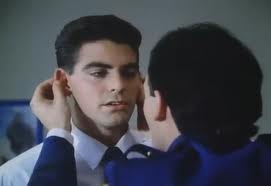
George Clooney strikes again. Looking up his C.V., I’ve got at most four more films I have immediate access to until I get to one that’s even half decent (From Dusk Till Dawn), and that’s skipping six I can’t find yet! My god his early career was appalling. And then straight after Dusk I’ve got the one-two double punch of One Fine Day and Batman and Robin. I am really beginning to regret this decision, but its too late now.

Anyway, Combat Academy. In case you hadn’t guessed from the title and the 1986 release date, this is an attempt at a rip-off of the hugely popular Police Academy, down to copying the poster style and title typography, but this time set around a military school. However, the key area they failed to take inspiration from is in the use of colourful, quirky characters, engaging yet entertaining performances, and the inclusion of actual jokes. There’s even a commanding officer with a tank-bound pet. They can’t even blame it on coincidence either, as director Neal Israel was on script duty for Police Academy.


Two high school pranksters, Perry and Max (Wallace Langham and Keith Gordon) are kicked out of school on the first day back from summer vacation, and are sentenced to spending a year at Kirkwood Military Academy, due to having 238 separate acts of hijinks each on their permanent records. Two hundred and thirty eight. I’m pretty sure some point before the 50th time he found a herd of pigs in the library their headmaster would have instilled some discipline, contacted the authorities or just flat out killed the little shits. Anyway, the kids’ parents are disappointed in their kids (Perry’s dad is John Ratzenberger! Hell yes!) and don’t mind too much to see them be sent off to learn a few lessons in obedience, but the guys themselves are less than happy with the situation. However, seeing as Max at least is one of the least likable leads I’ve ever watched in a film, I had to agree with the parents. Max is a dick. Plain and simple. He incessantly causes havoc around himself purely for kicks, and doesn’t give a moment’s thought to repercussions to himself or those around him, particularly the stuttering, nervous Perry whom he drags down with him wherever he goes. And Keith Gordon is certainly no Steve Guttenberg, and his overuse of obnoxious, predictable and hokey one-liners just makes him all the more detestable. Perry on the other hand is somewhat likable, but is such a wet fish that he fails to register.

The two rub their commanding officers, George Clooney and Kevin Haley, up the wrong way early on, but by this point I’d stopped paying too much attention to the meagre plot – there’s a thief in the academy, some visiting Russian cadets, Perry falls in love and Max is trying to pull a Mahoney and get himself kicked out – and focused instead on the terrible performances on display here, particularly from Kevin Haley, who is possibly the most wooden an actor I’ve ever seen. It doesn’t help that he’s partnered up with Clooney for several scenes, but still. In fact, none of the actors seems to be in the same film as one another, at least in the sense that for the entire 96 minute runtime there isn’t a drop of chemistry between any of them, including the two leads who have apparently been best friends for over a decade.

The closest the film comes to a comical character is in the academy’s science teacher Col. Long (Richard Moll), who aims for eccentric but overshoots to certifiable. Amongst the rest of the cast, look out for Danny Nucci (Titanic‘s Fabrizzio), Elya Baskin (Spiderman‘s landlord) and Sherman Hemsley (George Jefferson). Of the leads, Keith Gordon went on to become a TV director, working on the likes of Dexter and House, whilst Wallace Langham played Kirby, the guy who signed in the Hooper family at the pageant in Little Miss Sunshine.

Elsewhere, the film suffers from an outrageous 80s soundtrack and the worst effects shot in any film, ever, when Max attempts to show off some kind of stunt during a paintball match that probably was supposed to involve him throwing his gun high in the air and catching it again, but which he clearly fumbled so they used the footage of him throwing it, then played it backwards for 2 seconds to make it look as though he caught the gun again. Did director Neal Israel, who directed the Tom Hanks classic Bachelor Party, really think he was going to get away with that? Not on my watch, bucko.

There are plenty of missed opportunities for comedy to be mined too. Firstly, the pranks the pair pull are all either incredibly tired or have no resounding effect on anything – lockers explode whilst people standing nearby remain oblivious, and switching the signs on the restrooms is just hokey, pre-teen nonsense. 
So, is there any reason at all to watch this film? If so, I can’t think of it. It is entirely devoid of anything approaching humour, features some very heavy handling of moral issues – Clooney’s Major Biff Woods (yes, that’s his name) just wants to please his Daddy – suffers from a hastily tied up resolution via an out of character rousing speech, hideous acting and completely and utterly fails to be comparable to even Police Academy 7: Mission to Moscow.

Choose life, 1/10

Broken Blossoms

“This strangely beautiful silent film from D.W. Griffith is also one of his more grim efforts; an indictment of child abuse and the violence of western society.” – So reads the LoveFilm blurb for this 1919 silent picture, and should justify why it took me a little while to get around to watching: it sounds bloody depressing. More so, in fact, than it turned out to be, as the horrendous racism, when seen from a modern perspective, overshadowed the more soul-crushing elements of the plot.
Continue reading

A Kid in King Arthur’s Court

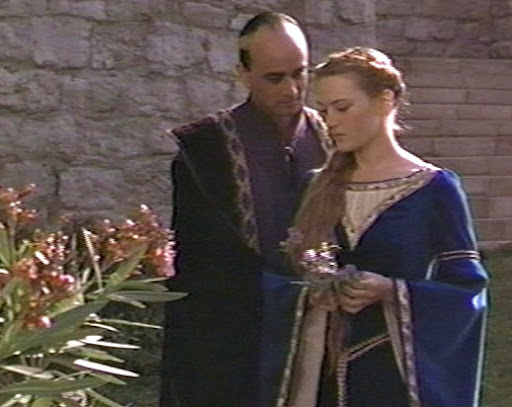
It seems I didn’t quite think through the strategy of watching the entire careers of various prestigious film-makers. Who’d have thought that, before they became renowned and laden with numerous awards, actors would take any roles going to pay the rent, regardless of the claptrap they may be. And so it is with A Kid in King Arthur’s Court, the family-friendly second entry on Kate Winslet’s CV, and what I hope will be the worst, although seeing as I’ve still got The Holiday to watch at some point, this may not be the case.
Continue reading

Somebody Up There Likes Me

After a couple of small TV roles and an uncredited appearance in 1953’s Girl On the Run (I haven’t found it yet, but I will) Steve McQueen’s second film role, again uncredited, was in this Paul Newman boxing film that I’d previously never heard of and can kind of understand why. It’s not that it’s a terrible film, it’s just thoroughly underwhelming, and tells a familiar story in a genre that has since far superseded it. To start with, it’s a boxing movie where the lead character is Italian and called Rocky Barbella (Newman). If that’s not a coincidence I’ll be shocked.

Rocko ‘Rocky’ Barbella (later Braziano) is a street hoodlum son of a former boxer. As a kid, his Dad Mick (Harold J. Stone) embarrassed Rocky in front of his friends whilst he tried to teach him how to box, and ten years later his layabout father has clearly had a prominent effect on Rocky, as he’s on the lam from the cops, and refuses to either get a job or an education. Things don’t work out too well for the lad, and he gets himself in trouble and locked away for a few years and, upon his release, is immediately conscripted to fight in World War 2. During this time, he discovers an aptitude for fighting, and is able to mould it into a boxing career, which comes in useful when he needs to raise a little money later on.
I can’t really pick out much that was terrible about this film, but nor can I find many reasons to recommend it. Newman was good (other than sounding like Jackie Gleason), but had yet to reach his shining greatness (he is definitely a front-running candidate for a future Film-Makers run, even if I have to watch Cars again) and there were some shots that I loved, particularly a receding tracking shot as Rocky makes his way through a busy market, but this happens near the start of the film, and I kept my hopes up for more cinematography of this calibre but sadly was left wanting. As well as being reminiscent of many boxing films that have been released since (not a fault of this film, but certainly not a reason to watch it either) there were some plot points eerily similar to another Newman classic, Cool Hand Luke, most noticeably his incarceration into a chain gang, during which he has a life-changing fist fight.
There were a couple of obvious gaffs – at one point a man knocks on a very wooden-sounding tent – but otherwise the script was generally entertaining (when offered a cup for a boxing match, Rocky declines and says he’ll drink out of the bottle). Some beats seemed a little extreme – a prison guard pulling a gun when an inmate doesn’t move his towel, a judge awarding Rocky with a prison sentence of indeterminate length – but these could be a product of the time the film was made and set. I loved the scene where Rocky’s manager (Everett Sloane) was telling him his love life (with his sister’s friend Adrian, sorry Norma, Pier Angeli) was making him too happy and healthy to be a boxer.
McQueen plays one of Rocky’s gang early on in the film, and his trademark doing-something-in-the-background-eve-when-he’s-not-supposed-to-be is evident even here. I was expecting him to show up again later in the film, when Rocky revisits his old town and meets up with other ruffian Romolo (Sal Mineo), but alas he only got a few scenes at the start, and didn’t have too much to do in them, but it’s only his second film so it’s OK.
I felt the film seemed to drag near the end, even though it skipped through the dense plot pretty quickly and remained under two hours long. I definitely felt like they couldn’t think of a name (or last line) for the film, and someone saw the title of Perry Como’s song, which coincidentally plays over the credits, and thought they may as well use it for this. It didn’t really fit, going by the amount of bad luck Rocky endured throughout most of his life, but it didn’t jar too much either. For all I could tell Newman was convincing in his boxing scenes, and fans of his won’t be disappointed, but unless you’re a completist like me, or have a particular fixation with boxing movies, there’s not much else here to keep you engaged.
Choose life 6/10

Return to Horror High

Given the cinematic journey I’ve chosen to peruse, I don’t often get to watch truly terrible films. Sure, there are some on the 1001 List that I’m not necessarily a fan of, but they tend to have some kind of artistic merit or historical value that justifies their position. I also tend to make an effort to avoid films I think are likely to be awful, as I probably won’t enjoy them, and there are so many other films I’m sure will be better. I think the last awful film I reviewed was Big Trouble in Little China, and that was only because Empire readers inexplicably voted it the 430th greatest film of all time, despite it having almost no redeeming features whatsoever. It was refreshing then, as I begin my exploration through George Clooney’s career, to go out with a mate, have a few drinks, plays some Call of Duty and settle in to watch this goddawful slice of tripe.
The plot is reminiscent of Scream 3; a film crew is shooting a horror movie based on the killings that occurred in a school some years earlier. To add to the realism, they are shooting the film on the site of the school, and some of the parts are being played by the people involved in the actual event. A few days later, a police investigation is being undertaken as almost everyone involved in the film has been found dead outside the school, except for the writer, who is recounting the tale to two police officers. This scenario has potential to be a half-decent horror flick, I mean I’ve heard a lot worse, but alas this is not the case, as what little plot there is deteriorates into a hashed up mess fairly early on.Clooney, for he is the reason I’m watching this, has a miniscule role as an actor eager to break his contract early so he can start filming on a TV series.He succeeds in leaving his role, only to be killed moments later, in one of those moments where the intensifying score clearly signposts exactly what will happen. You know, when they’re walking down a dark corridor, and the ominous music only plays when they’re slowly making their way forward, then the music stops when they do. To be honest, it’s probably for the best that Clooney died when he did in this film, his hair is atrocious.

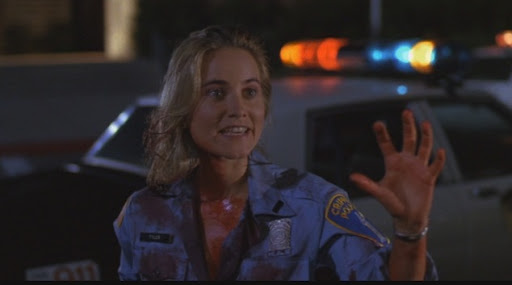
As far as I can tell the rest of the cast is of little note – hardly surprising when you look at the acting on show – with the exception of Maureen McCormick, whose turn as a cop that becomes alarmingly aroused by dismembered body parts proves to be all the more bizarre when you discover she played Marcia Brady on The Brady Bunch. Now I’ve never seen that show for two reasons: a, I’ve always lived in the UK, where I’m fairly sure it’s never been aired, and b, I’m under the age of 35, but I’m fairly sure Marcia never came on to her superior officer after discovering a severed arm, or clawed seductively at her blood-splattered breasts whilst she retold her exploits involving sliding down a gruesome hallway.

My main problem with the film was the plot, especially the last ten minutes, which features not one but two of the worst twists I’ve ever seen. The first, involving a Mission Impossible-style removable face mask, is ridiculous enough, but the second is of such sweeping idiocy that it beggars belief, and doesn’t withstand even a second’s worth of examination. Up until that point I had forgiven most of the film’s other flaws – of which there are many – on the basis of the director’s lack of experience (this is his only film credit) and budgetary reasons (although great films have been made for far less than this film cost), but the film’s ending is just so ridiculously inane that it turned me off the rest of the film completely.

So what else is wrong with it? Well, it uses the age old filming-a-scene-but-not-telling-us-they’re-filming-a-scene schtick at least three times, and the it’s-all-a-dream thing once, there’s a sex scene illuminated by someone welding something quite far away from the first floor window of the room in which the coitus is occurring, no-one actually finds the bodies mounting up, yet people are clearly scared of a suspected killer they have no reason to suspect, and there’s one of the worst uses of a Schwarzanegger-esque one-liner I’ve ever seen (“Class dismissed.”)

On the plus side, the script the script does have some gems, including a conversation about explosive breasts (“There will be no exploding tit shot!”) and possibly the greatest worst special efect I’ve ever seen in a shot of an axe beheading someone in silhouette through a frosted glass door, with the axe swinging down, followed wiftly by a clearly fake head being thrown far too enthusiastically up in the air. Needless to say, my friend and I were in stitches at this, and it received a good few rewinds before we were done. If I knew how to embed mpegs you’d be watching this for the rest of the day.

So, all in, this is one of the worst films I’ve ever seen. At times it wanders into so-bad-its-good territory, but for the most part it’s just terrible. I will not be returning to Horror High any time soon.

Choose life 2/10