Candyman

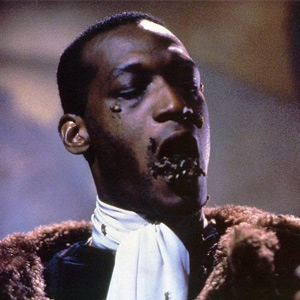
If someone told you that if you looked in a mirror and said the word “Candyman” five times, that a man with a hook for a hand would appear behind you and kill you, what would you do? If the answer is call them an idiot and defriend them on Facebook, congratulations you’re not in a horror movie. Here, of course, the myth is discussed and inevitably activated, with disturbing and horrifying results. Virginia Madsen (remember her?) plays our doomed heroine Helen Lyle, married to university lecturer Xander Berkeley and writing a thesis on local mythology, focusing on the Candyman, an educated son of a slave whose hand was sawn off by hooligans in the late 19th century, before he was smeared with honey, stung to death by bees and burned in a giant pyre. His legend lives on with the residents of Cabrini Green – the area where his ashes were scattered, blaming him for unsolved murders.
A  lot is left unclear in the film – possibly clarified in the sequels, I didn’t like it enough to find out, and there is much debate throughout as to whether Candyman, memorably embodied by the imposing Tony Todd, whose breathy voice, sinister smile and nightmarish stare were made for horror films, is real, whether Helen is going insane or if her husband is framing her to keep her out of the way while he gets his leg over a hot young student, something never really explained, and even by the end all three are still a possibility. There is plenty of gratuitous and unnecessary nudity and some horrible imagery – graffiti from smeared excrement – but the unclear nature of Candyman’s powers, origin, intent or motive and the lacking of anything inherently scary makes this a pointless watch.
Choose life 4/10

Paranormal Activity

First off, don’t make the same mistake I did, watching the film alone, at night, in bed, in the dark, for this is the exact setting for most of this found-footage horror. Katie and Micah (Katie Featherston and Micah Sloat) are a young couple in a new home. Since childhood Katie has been plagued by bizarre nocturnal occurrences, which have begun to get worse since moving, so Micah sets up a video camera to try and record whoever is behind them. Much of the film takes place with a stationery camera, set at the foot of the couple’s bed as they sleep, with occasional noises and doors slamming being the worst that happens (if you’re frightened of something coming into your room at night, why not at least sleep with the door shut?). This means that the final scenes, where shit starts to get real, are all the more powerful and traumatic. Whilst not terribly frightening, the slow build and believable characters reacting in plausible ways (initially Micah is more concerned with filming the events than helping Katie stop them) make this at times quite unsettling. They should have used a different location though, as the massive three bedroom house, with luxury kitchen, double lounge and swimming pool is not believable accommodation for such a young couple.
Choose film 6/10

Easy Rider

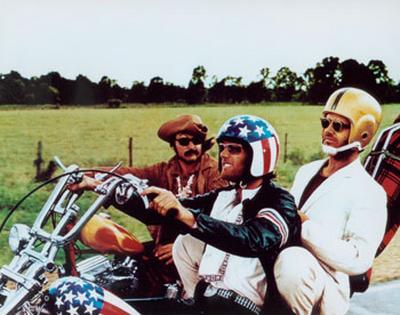
Starring, directed, written and produced by Dennis Hopper and Peter Fonda, there is every possibility that this film perfectly encapsulates the end of the 60s in America incredibly well, but alas today its relevance is far less. The two stars set out on a drug fueled road trip, casting aside their watches and heading across the American South in search of the true spirit of America, and unfortunately they find it everywhere they go.
Being a child of the 80s and 90s, I’ve only known drugs to be illegal, harmful, detrimental to your wellbeing and generally a bad idea (Trainspotting and Requiem for a Dream were important parts of my youth), so to see their being used with such wild abandon is almost infuriating from an arguably more informed position (arguably because I know more about the effects, but nothing about the experience itself). I can only assume the intense and bizarre results of an acid trip are shown correctly, and if so then this films effect on me is probably the opposite of that intended, I don’t ever want to take drugs or experience such a level of disorientation,
Jack Nicholson makes an all too brief appearance as drunken lawyer George Hanson, owning knowledge of the finest whorehouse in the South, but even he cannot resurrect this aimless love letter to the free love era from the doldrums, though a stark and unforgettable ending is very well implemented.
Choose life 6/10

Shallow Grave

When their new flatmate is found dead in his room with a suitcase full of money under his bed, best friends Juliet (Kerry Fox), David (Christopher Eccleston) and Alex (Ewan McGregor) decide to keep the money and bury the body in the woods, in the eponymous less than permanent resting place, only to find there are others on the trail of the recently deceased. Danny Boyle’s debut picture shows promise for both the director and his young leads, but the plot is too straightforward and loses its way during one of the trio’s mid film meltdown, and the ending isn’t as clever as it needs to be. The blackly comic tone (“You’re a doctor, you kill people every day”) and some interesting and imaginative shots –a robbery from the point of view of a cash machine – almost make this worthwhile, but it is only really noteworthy as a stepping stone from which Boyle would go on to become one of the better British filmmakers of recent years.
Choose life 6/10

Heimat

A 15 ½ hour German film about life in a village from 1919 to 1982? Bring it on. Following the Simon family in the village in the Hunsruck in West Germany, this eleven part film, although technically I think this belongs on a TV series list, starts at the end of the first world war as Paul Simon, son of Katharina and Mathias, brother of Eduard and Pauline, soon to be husband of Maria and father to Anton and Ernst, returns home, and plays through the lives of this family, along with their various partners, offspring and neighbours, over the course of the following 63 years. The scope of this piece is hugely ambitious, with over 100 speaking parts, but the episodic nature works well, with even a recap at the start of each segment.
A large portion of the film is understandably given over to world war 2, from its outbreak, duration and aftermath, and much is shown from different viewpoints – the home guard, bomb defusal, Hitler youth, and an impressively impartial viewpoint is given to it. However, a lot of the plotting is of a soap opera standard, with love triangles and children growing up in ways unhoped for by their parents. Also focus, is lost once the spotlight moves from village stalwart Maria to her children, although this could be a deliberate way of showing the village – from which Maria has barely left her entire life, is also losing focus, splitting in different directions as per the varying lifestyles of her children.
Yes, this is ridiculously long. Ridiculously. We’re talking over 20 episodes of 24 here, over six discs, so if you’re gogin to watch this in one go, don’t invite me round. But if split over a few evenings, in much the same way as a normal TV series, this is definitely worth a look, even if some plot points are clearly signposted, and it gets a bit silly at the end when a main character dies and meets everyone they’ve met who has died before. Apparently, if you are blind when you die, in Heaven you’re invisible.
Choose film 6/10

Shine

Though onscreen for less than half the film, Geoffrey Rush won the 1997 best actor Oscar for his portrayal of the adult David Helfgott, a real life pianist barely known outside of his native Australia.
As a child, the young Helfgott (Noah Taylor) suffered an overbearing, paradoxical father who could never be proud of his son until he was a renowned concert pianist, yet refused to allow him the tutoring to achieve it. This pressure strains David’s personal life – a promising young romance is quashed at its initial meeting by his father’s interruption – eventually causing David to develop mental illness, not helped by trying to learn a particularly tricky Rachmaninoff.
All the performances are exceptional, particularly Rush mumbling and stuttering at lightning speed, occasionally unintelligible, revelling in the small moments of joy, be they from the discovery of a vacant piano in a restaurant or trampolining wearing nothing but sunblock and a billowing overcoat. The great John Gielgud crops up as the encouraging, kindly, cravat wearing tutor David so rightly deserves, but the tale cannot escape the cliché of the tormented artist, becoming better at his craft the greater the trauma he endures. Also the ending is too uplifting and fairytale, regardless of whether it is based on fact or not.
Choose Life 5/10

Big Trouble in Little China

What on Earth is this film doing on the list? It seems enough people voted for it to become the 430th greatest film of all time in Empire’s 2008 poll, but it has nothing going for it. The plot is sketchy, full of holes and relies too much on coincidence, the sets are shoddy and in danger of falling over, the effects are terrible and the script even worse (“Are you ready, Jack?” “I was born ready.”)
The story, as much as there is one, concerns opinionated but dumb brute Jack Burton (Kurt Russell), truck driver of the Pork Chop Express. After meeting up with an old friend in San Francisco’s Chinatown district, he loses his truck and his friend’s fiancé is kidnapped by a mysterious, yet ridiculous, magical Chinese cult.  Burton is, unquestionably, a bit of a dick, only helping to look for her in the hope of finding his truck, and getting the money his friend owes him. They spend the rest of the film looking for her, with the help of Kim Cattrall’s friendly neighbourhood lawyer, who just happens to be in league with a reporter writing an article about the magic. The mythology is inconsistent (as are the characters’ fighting abilities from one scene to the next) and bizarre, and the bad guys look too ridiculous to be taken seriously, flying through the air shooting lightning from their hands, wearing giant comedy lampshades on their heads.
The final confrontation is disappointingly brief, and the freaky ball of floating eyes and Chewbacca/orang-utan/rejected muppet hybrid are unsettling, not to mention almost entirely superfluous to the plot. Maybe, after enough alcohol and a dangerously undercooked kebab this could slip into so-bad-it’s-good territory, but otherwise avoid at all costs.
Choose life 2/10

Muriel’s Wedding

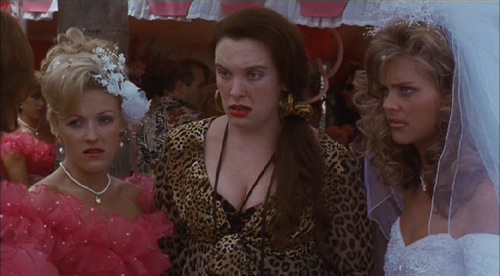
Muriel’s Wedding seems unsure of what it wants to be. At times it follows standard rom-com tropes; an eccentric family, a first date going awry involving a burst bean bag, a pet bird thrown through a window and an unexpected trip to the hospital. At other times it seems to want to be a character piece, with Toni Colette’s compulsive liar and Abba obsessed Muriel setting her sights on getting married, regardless of who the groom is and how she feels about him, running away from her ashamed domineering family to start a new life (with a new name; Mariel) after a chance encounter with an old school friend (Rachel Nichols), whilst elsewhere it could be described as a tragedy, as Mariel becomes more and more desperate to fulfil her dream, whilst seeming to bring bad luck to all she comes into contact with.
Colette fully loses herself within the overweight, unfashionable, possibly mentally ill Muriel, in her first major role, but the too frequent switches in tone, from light comedy to tragedy, are too jarring, the characters too thin and the comic situations not entertaining enough to make this worthwhile.
Choose life 4/10

Wallace and Gromit: the Curse of the Were-Rabbit

I’ve mentioned before in the review for Chicken Run that British animation company Aardman do enjoy filling their films with parodies, puns and homages, with this picture proving no exception. From faithful pooch Gromit having a degree from Dogwarts university, power tools made by Botch and scenes stolen from the likes of King Kong and An American Werewolf in London, the gags come thick and fast, unashamedly crowbarring in references to other rabbit-related movies (a shop called Harvey’s, Bright Eyes playing on the radio).
However, endless jokes are not enough, as the predictable (if enjoyably surreal) story of a man (Wallace, voiced as ever by the dependable Peter Sallis) and a rabbit swapping physicalities and personality traits after a bout of brainwashing goes wrong leaves too many loose ends and plays plot points signposted in neon letters as twists and shock reveals. A game British cast (Helena Bonham Carter as vegetable mimicking Lady Tottington, Ralph Fiennes as the blunderbuss wielding diminutive Victor) are solid, but not quite enough to warrant repeat viewings.
Choose life 5/10

Dirty Harry

Would this film have had such a cultural impact without Clint Eastwood’s performance as the eponymous San Francisco detective ‘Dirty’ Harry Callahan? Probably not, as Eastwood’s depiction of one of cinema’s most legendary and hardest badasses is the only thing worth watching in this picture. After the infamous early scene, where Harry foils a robbery using only a .44 Magnum and one of the most quoted lines in the history of people saying something someone else said first, the action peters out, leaving a fairly standard, character driven police procedural, as Callahan attempts to solve the case of the Scorpio killer, loosely based on the real life Zodiac killer recently seen in David Fincher’s film of the same name.
The film rises a little when it detracts from the central plot – the dealing with an attempted suicide is a particular highlight, but is Eastwood’s performance and a decent script enough to watch this movie? Will I choose life, or film? Can’t tell myself in all this excitement.
Choose life 5/10