The Wicker Man

Devout Christian police officer Sergeant Howie (Edward Woodward) receives an anonymous letter telling him that a young girl, 12 year old Rowan Morrison, went missing a year ago and hasn’t been seen since. Armed only with the letter, a photo and his unbreakable religious beliefs, Howie sets out to the secluded island of Summerisle, where he is met by hostility from the locals, who do not approve of a mainlander on their soil, and all deny any knowledge of Rowan’s existence. As Howie investigates further, he is met by obstructions at every turn, and discovers the islands inhabitant’s rituals and ideology may have a more sinister cause for Rowan’s disappearance than the policeman could ever have imagined.

First things first, I’ve not seen the 2006 Nicolas Cage remake, so I can’t really discuss that film here, which is fine, because this post isn’t about that film, it’s about the 1973 original. I have seen a few of Cage’s clips online, and I was glad to see that at no point did Edward Woodward (who, by the way, has the greatest name ever, I can’t stop saying it) explode into a torrent of “How’d it get burned?!?”, have a cage of bees strapped to his head, or perform a running punch whilst dressed as a bear. I had, however, seen this version before, but I now realise it was a heavily edited-for-TV cut, as although I watched it some years ago, I cannot remember nearly as much of the frankly disturbing goings-on that occurred in this film.

Even though it is essentially about a cult, and it’s seen through the eyes of an outsider, there is a lot of this film that’s difficult to fully come to terms with, particularly the downright infuriating manner in which the children of the island are taught. For example, with their forthcoming May Day celebrations, the lessons focus on the maypole, and how it symbolises the penis. Strips of flesh are hung by gravestones, one of which reads ‘Protected by the Ejaculation of Serpents’. Oh, and graveyards are apparently appropriate places to breastfeed children. The children are also encouraged to sing, which I’ve got no problem with, unless the lyrics contain such gems as “On that bed, there was a girl. And on that girl, there was a man. And from that man, there was a seed. And from that seed, there was a boy.” Bear in mind these children are all pre-teen, maybe even by a fair few years in some cases. 

Oh yes, the singing. I’ve decided that if I ever revisit my Top 5 Films That Should Be Musicals, this film is a prime candidate for the sub-list of ones that already pretty much are ones. There are far more songs here than I had expected, and their diversity was something of a surprise. You’ve got a group of naked women prancing around a stone circle singing about pregnancy, and elsewhere there’s an impressively impromptu pub-wide rendition of The Landlord’s Daughter, which must have taken rather a lot of choreographing, seeing as no-one steps on anyone else’s lines. Britt Ekland, who plays Willow, the aforementioned innkeeper’s spawn, even gets her own solo (though I think she was dubbed by someone). Her song, creatively named Willow’s Song on the soundtrack, plays out like a pornographic music video, as Ekland, naked of course, sings directly to the camera as she gyrates ferociously around her room, slapping herself and beating on the wall in an effort to entice the neighbouring Howie to come and attend to her. Understandably, this is one of the more memorable of the film’s scenes, but the breaking of the fourth wall was distracting, and it felt like it went on for far too long.

I very much approved of how we as the audience are kept as much in the dark as Howie is as he goes about his quest, only realising something’s up when he does, at which point of course it’s too late. Woodward also does a good job with Howie’s character, establishing a hero who is something of a dick, and definitely not a people person. I don’t want to get into a debate about religion (in short, it’s not for me), but I’m glad that I’ve never met someone who is quite so steadfast in their beliefs as Howie, who is utterly appalled when he discovers the island education system doesn’t contain anything to do with the teachings of Jesus, as the only religion he even acknowledges the existence of is Christianity, proving he is possibly just as obsessed or bigotted as the islanders themselves.


Even with so many distubing aspects – the thought of the beetle slowly crawling around the desk until it strangles itself still upsets me a little – I can’t help but appreciate this film as being a thoroughly engaging mystery, with an enrapturing plot that, even though I had an inkling of a memory as to what the ending was, I couldn’t wait to see pan out to find out exactly what was going on. Also, Christopher Lee is generally brilliant in anything, here appearing as the charming Lord Summerisle. I’d have appreciated a little less music and a lot less insanity, but I’m still very pleased to have seen it again. Oh, and I’m fairly sure the Salmon of Knowledge was from a lost Monty Python sketch.

Choose film 7/10

Skyfall

A hard drive containing the identities of MI6 undercover agents is at risk of going missing, so James Bond (Daniel Craig) is trying to catch the thief in Istanbul, with the assistance of field agent Eve (Naomie Harris). When Bond is shot and presumed dead, his superior, M (Judi Dench), takes the blame, but when Bond returns from the grave, he must track down the files to save not only his country, but his boss.
Continue reading

The Shining

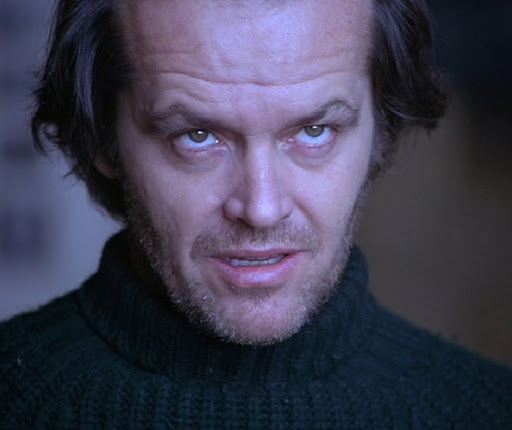
Jack Torrance (Jack Nicholson) is a writer suffering from writer’s block. He takes a job as an off-season caretaker at the Overlook Hotel, deep in the Colorado Rockies, where he will stay for five months with just his wife Wendy (Shelley Duvall) and their son, Jake (Danny Lloyd). Whilst at the hotel, all three members of the Torrance family experience otherworldly visions that slowly send Jack insane. Meanwhile, Danny’s ‘gift’ of the shining – the ability to see and hear things that haven’t happened yet or that happened a long time ago – grows stronger.

The Shining is widely regarded as a terrifying film, one of the best horror films made in the past 40 years, but to me it holds a deeper terror, not just because it’s the first truly scary film I can remember watching (and being far too young to watch it when I did). You see, I’ve seen The Shining twice, and both times I’ve watched it have been shrouded in a very real death of someone I know. The first time I saw it my best friend’s brother’s best friend was found dead the next morning. This time, I was interrupted about halfway through the film with a phone call from a friend, informing me that a mutual friend of ours, who neither of us had seen for a while, had been killed in a motorcycle crash. Basically, this is possibly the scariest film I know of, because I can never watch it again for fear of someone I know dying. This adds a whole new dimension to a film that’s scary enough to begin with.

On the surface, there isn’t a lot of traditionally scary elements to The Shining, especially not by modern horror standards. Instead, there’s more of an increasing sense of unease and mental disturbance as Jack descends into the horrors of his own mind, assisted by the various terrifying images thrown up by the hotel. Like the young twin girls Danny sees around the hotel, the elevator erupting with an ocean of blood, or the beautiful naked woman in room 237, who becomes a scabbed and putrid hag in Jack’s arms. And of course there’s the questionable shot of the man in a business suit, probably receiving a favour from a man dressed as a bear, that I’m sure his wife and kids would not be too happy to find out about.

As horror films go, this is impressively effective without having to resort to cheap jump-scares or a monstrous killer on the loose. I’m not often scared by films, but this one has left me a little off ever since, and not just for the personal reasons mentioned earlier. I’m a big fan of how the original protagonist – Jack – eventually becomes the antagonist once perspective focuses more on Jake and Wendy. If I were to pick a fault though, it might be that there’s a few too many elements taking place simultaneously. Firstly, the hotel was apparently built on an Indian burial ground, thereby adding an explanation to the ghostly goings on. This should have been enough, but there’s also Danny’s psychic abilities, which he shares with the hotel’s chef, Dick Hallorann (Scatman Cruthers), who has the most absurd pictures on his bedroom wall. Then there’s the mysterious suicide of the former caretaker, who killed himself with a shotgun after axing his family in the winter of 1970. And Danny’s finger is his imaginary friend, Tony, who talks to him and tells him what to do. Personally, I think Jack would have gone insane with just the intense writer’s block and having to be locked up with Shelley Duvall and an insane child for 5 months.

The film is pretty much perfectly cast, and Nicholson gives one of the most defining performances of his career. He shows real potential here for his future role as the Joker in Batman, especially once the madness sets in and his maniacal grin and eyebrows take over his face. Elsewhere his prominent brow and bright, glaring eyes are well used to strike fear into all who watch. Duvall is well cast too, though this isn’t a compliment as I think her character is supposed to be supremely annoying, and she succeeds in spades. It’s not often that you root for the axe-wielding psychopath over the innocent damsel in distress in a film, but I have absolutely no qualms about doing so here. 

This being a Kubrick film, it’s a given that a certain amount of flair has been utilised in the cinematography. The most famous example, and my personal favourite, is the long tracking shot following Danny as he wheels around the hotel on his tricycle. Infamously the camera was turned upside down to get it closer to the ground, offering a lower-than-child’s-eye perspective that really adds to the sense of dread, as does the incessant squeaking of the wheels as Danny follows an impossibly labyrinthine path around the hotel, a theme that recurs throughout the film.

The film is rife with too many unanswered questions and unquestioned answers, but due to Kubrick’s meticulous nature these can be assumed as being deliberate, present not only to infuriate the audience, but to keep them discussing the film forever more. Add to this some great quotable lines (“I’m not gonna hurt you, I’m just gonna bash your brains in.”), some of the most famous scenes in cinema (“Heeeeeeere’s Johnny!”), stellar performances, stunning visuals and a truly haunting score, and you’ve got not just a great horror film, but a great film in any genre. It’s just a shame I can’t watch it ever again.

Choose film 9/10

North By Northwest

This is the last review I’ve got left unposted from the recent reviewing competition at the Lamb, I hope you enjoy it.Is it really possible for North by Northwest to live up to its hype? It’s rare to find a Top Films list deprived of its inclusion, it features scenes that have become the stuff of legend, that also tend to top Best Scene lists, and it’s one of the greatest movies ever made by one of the greatest directors who ever lived.

If you haven’t seen it yet, then I strongly advise you to stop reading anything about it and go and watch it now, for North by Northwest is truly a tremendous film that is best enjoyed with as little outside knowledge as possible. When Cary Grant’s Roger O. Thornhill quips shortly after being kidnapped into the back of a car, “Don’t tell me where we’re going, surprise me,” this is not merely Hitchcock’s intentions for Thornhill, but for all of us watching as well.

There’s really no weak link in the film. From the opening Saul Bass title sequence, utilising the receding parallel lines of a Madison Avenue skyscraper’s windows to perch the credits atop as they rush off into the distance, down to the ever so cheeky closing train tunnel metaphor, every second oozes entertainment. Alfred Hitchcock’s longest film, and his fourth and final with fellow English-born collaborator Cary Grant, is also his most unashamedly fun. There are many people who have an issue with some of the more fantastical elements of the plot – to be fair, a cropduster is hardly the most effective method of assassination – but these people are preventing themselves from what is a truly thrilling experience. And after all, who is watching Hitchcock for realism? The master has always admitted that, whilst some films are a slice of life, his tend to be a slice of cake, and this one has the richest, creamiest filling, not to mention icing, a cherry and some rainbow-coloured sprinkles to boot.
Cary Grant is on his finest, suavest form as New York ad man Roger O. Thornhill, stepping straight from Mad Men into a classic Hitchcock mistaken identity caper. Thornhill is an egotistical chauvinist, totally in control of his superficial advertising world, yet within Grant’s capable hands he remains not simply likable, but enviable. Who wouldn’t want to fill out a suit like that, and have such a wide and successful array of quips and zingers at their disposal? For though he is constantly befuddled and bemused by the adventure he has innocently become swept along in, there is no circumstance that leaves him wanting for a one-liner. Here, Grant perfects the art of the stern expression and the furrowed brow, eternally caught between confusion and frustration, with merely a hint of excitement as his journey takes him across America in the effort to clear his name of a wrongfully accused murder. The role was originally offered to Hitch’s other great collaborator, James Stewart, after the two did such sterling work on Vertigo together, but as soon as Grant became available Stewart was dropped, in favour of a man Hitch believed would not be dwarfed by the extraordinary events going on around him. Whilst Stewart has often been remarkable in his everyman roles, it’s fair to say that Thornhill would not have been the right fit for him.
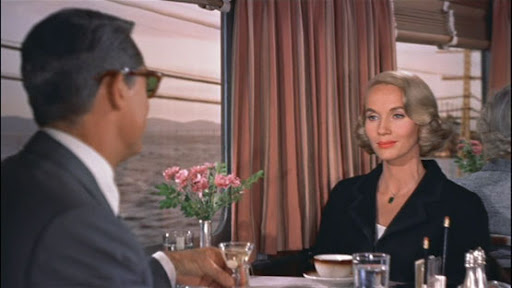
Such a masculine protagonist would be lost without a suitably feminine love interest, and Eva Marie Saint fits that job nicely as Eve Kendall, a typically beautiful Hitchcock blonde whose porcelain doll exterior hides her ability to use sex like some people do a flyswatter, and she holds her own against the likes of Psycho’s Janet Leigh, Rear Window’s Grace Kelly and Vertigo’s Kim Novak as she dabbles in some of the most forward repartee since Bacall taught Bogart how to whistle. Hitch always preferred the more beautiful but subtly sexy female leads, as he took great pleasure in uncovering their more alluring qualities than he would have with the more self-promoting individuals like Monroe. As with all of Hitchcock’s birds (pun intended) Saint is meticulously and beautifully dressed in every scene. Legend has it that the great director paid her wardrobe so much attention that Grant petulantly demanded advice on what he should be wearing, and was simply told to “Dress like Cary Grant.”
Released three years before Dr. No, this film clearly set the template for almost every Bond movie. With its dashing, smooth talking hero with an easily recognisable voice, the woman who falls for him within seconds of meeting, a villain’s lair in an impressive yet remote location (here James Mason’s Vandamm lives in a condo atop Mount Rushmore), an evil sidekick (Martin Landau, with a severe case of Henchman’s Eyebrow) and a fast-paced, stunt-riddled adventure taking in major cities around the world (or at least central and north-east USA). Thornhill even has the ability to make perfect strangers throw themselves at him; just wait for the reaction from the woman in his neighbouring hospital room. It’s no surprise to learn that Grant himself was an original candidate for what was to eventually become Sean Connery’s Bond.
Even from the trailer, this is one of the most comical of Hitchcock’s endeavours. Speaking directly to the audience, Hitch himself appears, advising the viewers on how to take the perfect vacation without leaving the cinema, keeping his tongue firmly planted in his cheek throughout (“You don’t find a tasteful murder on every guided tour, do you?”). It’s on Youtube, go check it out. Ernest Lehman’s Oscar-nominated script (tragically losing out to Pillow Talk) is full of far too many quotable lines to give justice to here, but it contains more than enough for even three films. My personal favourite? Saint declaring she’s a big girl, followed by Grant’s perfectly timed, effortless rebuttal of “and in all the right places.” The police station phone call is yet another example of solid gold. Occasionally the steady slew of insinuations and double entendres becomes a little cringeworthy, especially when Grant tells Saint he likes her flavour, but that’s a rare misstep for a script that otherwise never puts a foot wrong. There’s far too much excellence on hand to make you forget these, and the film will never fail to raise a smile with every viewing.
It isn’t just the dialogue though; the scenes without any discussions are often just as amazing, if not more so. Early on, after being forcibly imbibed with the best part of a bottle of bourbon, Thornhill is unleashed behind the wheel of a car, in an attempt to instigate his demise. Upon realising what’s going on he awakes in a drunken stupor and does his utmost to keep his car on the increasingly blurred and merging roads in front of him. Grant makes for an amusingly intense drunk, persistently blinking, squinting and staring bug-eyed at the cars he races past, made all the more dramatic by Bernard Herrmann’s  stupendously engaging score. Of course, there’s also the hallowed cropduster chase, as Thornhill, having been lured to the middle of nowhere to meet the man he’s been accused of being, finds himself battling the more painful end of a plane’s propeller. One of the few scenes not set to music – to better emphasise the relentless whirring of the plane and the lack of assistance Thornhill is likely to receive with the matter at hand – the scene is worth watching as a standalone segment. Equal parts exhilarating, terrifying and fun, it’s made all the more hilarious for the entire time Grant dives through dirt and hides amongst crops he is wearing his increasingly worn yet perfectly tailored grey flannel suit, clean shaven and with immaculate hair.
Hitchcock’s regular cinematographer, Robert Burks, excels himself in a manner that by this film is surely only to be expected. The shot of Thornhill fleeing the UN building to a waiting cab is stunning, captured from high above and angled down the side of a skyscraper, a shot I’d happily have framed on my wall, and the revealing shot of a gun hidden in a purse is sly enough to almost go unnoticed, but is sure to pay off later. Hitch ticks off almost all of his standard tropes – a wrongfully accused man on the run, maternal issues (Jessie Royce Landis, who plays Thornhill’s mother, was in real life only 8 years older than Grant), spies, deception, train journeys, height-based peril, an all-but-unnecessary MacGuffin (a statue full of microfilm), bumbling policemen, a tense finale set atop a famous landmark and, of course, an icy blonde. All that’s missing is a self-deprecating scene in a cinema.
When compared to modern day blockbusters, this picture more than holds up. Its unstoppable, kinetic nature will keep fans of both classic cinema and present day fare glued to the screen and on the edge of their seats for the entire 136 minute runtime. Filled with glamour, wit, excitement and big scenes on a large canvas, there’s something here to please everyone, as long as they like really great films. Does it live up to the hype? Yes, and more so.
Choose film 10/10

Top Gun

There are some films out there that seem to be universally adored, so much so that were someone to come along and start slagging them off they’d automatically be written off as hipsterring, pretending not to like something incredibly popular to appear cool or ironic. Now, I’m fairly sure I’m not a hipster, even though I ride a bike and own a scarf (that I very rarely wear, and even then when its freezing), but I just can’t get behind Top Gun, a film that as far as I can tell everyone else seems to generally love.
It does have some very enjoyable aspects, most notably the score, with Kenny Loggins’ Danger Zone being a clear favourite, the script is full of zingers (“Your ego is writing cheques your body can’t cash.”) and a brilliant cast all on top form, but it can’t get around just how boring most of the film is. Now, this may have something to do with my opinion on aircraft. Every year for at least the past four years, Bournemouth (the town I live in) has held an air festival down on the beach. I live less than ten minutes walk away from said beach, yet I do not join the literally thousands of people who flock to this event on an annual basis. That doesn’t sound too surprising, until you discover that other patrons to this event include many of my close friends, colleagues, and of course my parents. This year was the second time I’ve actually headed away from the city during the long weekend, just to escape the planes and their incessant noise. I’m fine flying in planes, and generally find the flights to be one of the more enjoyable aspects of holidays (I get to sit and watch films for six hours straight!?!?!?!), but I really don’t care about watching planes fly, how they work, what model they are etc. And unfortunately, that plays a large part in Top Gun, a film about the top 1% of Navy pilots being trained to be the best that they can be.
It’s clear during the making of the film that two different markets were established – men and women – and a very broad sense of their tastes was estimated. Two different films were then thrown together to attempt to please both groups, and so it is that we have a film about jet fighter pilots in which half the time is spent on an insipid romance plot between Tom Cruise’s cocky pilot Lt. Pete ‘Maverick’ Mitchell and one of his civilian teachers, Kelly McGillis’ Charlie. It doesn’t really help that both halves of the film don’t fit together well, and are for the most part dull. The flying scenes, especially the training exercises, are devoid of either tension or excitement, and the romance is surprisingly more cheesey than the half-naked, oiled up volleyball scene set to Playing With The Boys. Each scene type goes on far too long as well. I can’t imagine the plane-heads remaining fully engaged through the love scenes, and likewise the romance junkies are unlikely to really care about the flying bits.

So why does it have such a reputation? Well, there’s enough to keep your attention on a Friday night post-pub outing, full of kebabs and an impending hangover, and of course there’s Tom Cruise. After sliding across the floor in a shirt and socks in Risky Business, this is probably the early defining movie for Cruise, and none more so than his seducing of Charlie by serenading her, with the help of an entire bar, to The Righteous Brothers’ You’ve Lost That Lovin’ Feeling. I’ve always questioned the choice of this song, as it’s supposed to be a song everyone in the bar knows the words to, yet I’ve never heard it outside of this film. Maybe it’s more popular in the States. This could also be the film that turned a lot of the public opinion against Cruise (not me personally, I’ve got no issues with the guy), as Maverick is an immensely arrogant, cocky dick, but he plays it so well. Anthony Edwards is also great as Maverick’s married-with-kids partner Goose (he’s married to Meg Ryan?!?), but the film is completely stolen by Val Kilmer, who manages to out-cockiness Cruise as rival pilot Iceman.

This is one of the few films that I think could be possibly improved with the use of 3D, normally something I’m deeply opposed to, but I think an added sense of depth perception could help clarify and enliven the aerial combat scenes, which otherwise feel flat and lifeless. I hate to say it, but this feels almost more like a Michael Bay film than a Tony Scott one, and if it wasn’t for the acting and the soundtrack, there’d be no reason to watch it whatsoever.

Choose life 5/10

Guaranteed Happiness: Kiss Kiss Bang Bang

Kiss Kiss Bang Bang is a film I’ve loved since the fist time I watched it, and always proves to be an enjoyable experience, yet I fear that from now on I won’t enjoy it any more, because I will have horrific, Vietnam-style flashbacks to my latest viewing, or rather the repercussions from it. You see, I volunteered to appear on The Lamb‘s weekly podcast, The Lambcast, for their Movie Of The Month segment, and I was overjoyed to discover that said movie was Kiss Kiss Bang Bang. Granted, I may have voted 7 or 8 times for it and hoped that one of the primaries would drop out so I could discuss such a great film with some similarly-minded individuals, so I can’t say I was overly surprised when it won. However, this was my first ever podcast (recorded last Sunday), and I was so horrifically bad in it that I’m not sure I’ll ever be able to enjoy said film again. The episode has now dropped, and is available on iTunes (search Lambcast in podcasts) or via this link. I urge you to listen to it more for the scintillating discussion between Dan Heaton, Justin Gott, Kristen Lopez and Nick Jobe  than for my dismal contribution, however if I’ve ever wronged you in the past (a list longer than I’d like), then you may also enjoy the podcast, for different reasons. If you could just ignore my horribly grating, nasally drone whenever it aggravates your eardrums and pretend instead it was just a four-way chat then I’d appreciate it.
Maybe it was because I’m a first timer and everyone else there seemed far more experienced at it than I, probably because they are and some of them regularly hold podcasts of their own, or maybe it’s that I’m genuinely not very good at talking about films with real live actual people without using a keyboard (it doesn’t happen very often), but I’d like to issue an apology to Dan, Justin, Kristen and Nick for lowering the quality of the podcast, and for relentlessly interrupting and talking over them when I had nothing very interesting to say. I was nervous, and it’s never been more abundantly clear that when talking about films, I truly do not know what I’m talking about. Also, I hate public speaking, so signing up for a podcast was probably a pretty dumb thing to do. Don’t worry, I won’t do it again.
Continue reading

Casino Royale

With the imminent release of Daniel Craig’s third outing as James Bond, Sam Mendes’ Skyfall (UK release October 26th), it seems like the perfect time to cross the film ranked 56th greatest film of all time by Empire readers a few years ago, Craig’s first Bond outing, Casino Royale.

Now, if you ask me, #56 is pretty high up, especially when you consider that Goldfinger, my favourite Bond movie, is 110 places lower at #166, and no other Bond movies made it onto that list (You Only Live Twice appears in the Empire 5-star 500). Even if you take into account Casino Royale’s proximity to the release of the list, made just two years later, it’s still pretty damn high. Apparently, it’s better than Lawrence of Arabia, Annie Hall, 12 Angry Men, The Great Escape and literally hundreds of other films that, in my opinion, are far superior. But then I didn’t compile the list (though I did vote on it, and not for this film), so who am I to voice the opinions of others?

Before I continue my now-trademark tirade of negative comments, I should probably point out that this is a very good film. It served as a much needed shot in the arm for a franchise left face down and drowning on a CGI-wave of Pierce Brosnan’s swarm and Madonna’s atrocious Die Another Day theme song. In a post-Bourne world it established itself as a gritty reboot, taking Bond away from the ludicrous gadgets and back to the basics of hand-to-hand scrapping in a public bathroom, whilst still retaining the sheer spectacle of fighting on top of not one crane but two. Every aspect of classic Bond is present, from the impossibly slinky and easily-bedded women to a nefarious villain with a silly name and mild physical deformity (Mads Mikkelsen’s Le Chiffre, with a scarred eye that weeps bloody, and asthma to boot). Yet everything feels a bit more real, a bit dirtier and scuffed around the edges. And this description is none more fitting than of Craig’s Bond himself. Yes, he looks impeccable whether wearing an immaculately tailored dinner jacket or a pair of swimming trunks that apparently make my girlfriend’s mother go all weak at every possible joint, and he’s always got a quip ready in his back pocket, but this is a Bond with flaws and imperfections, all to aware that the men he is up against may be more than his match.

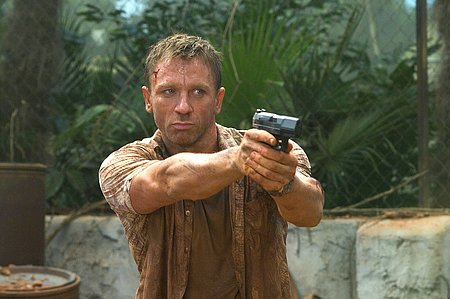
Take the early scene in Uganda, for example. Here, Bond must chase down and apprehend a suspect to obtain the passcode on his mobile phone, yet unfortunately said miscreant (Sebastien Foucan) is rather adept at long-distance sprinting, free-running and jumping off things that are ridiculously high up. Whilst he bounds around without a care in the world, remaining relatively scratch free, Bond is always a fair way behind, getting progressively beaten up and always opting for the easier route – hopping into a JCB digger or shoulder-barging through a wall rather than leaping through an uncomfortably small window. Here is a Bond who doesn’t need to show off when no-one is looking, he just wants to get the job done, and at whatever cost.

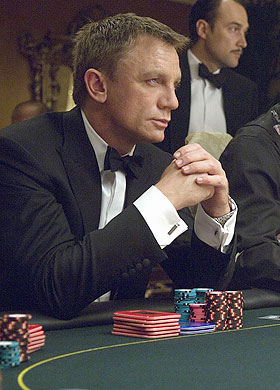
I’ve always had a bit of an issue with Bond films. I’ll gladly watch any of them, even Quantum of Solace if there’s nothing else on, but the plots are usually a bit labyrinthine for me, which is only to be expected if they want to make each film different. I’m not quite sure of the main motivations in Casino Royale, but I’m fairly sure it’s got something to do with the stock market, although the basic point is that Bond infiltrates an extremely high stakes poker game with a $150,000,000 pot, in order to prevent Le Chiffre from winning it and doing something bad with the proceeds. Everything else is fairly superfluous. I’ve read elsewhere that setting most of a Bond film around a poker table is nothing short of sacrilege, but I found those parts to be fraught with tension and often interspersed with enough action to suffice, even if the film made poker out to be a game that only deals in the most improbable card hands ever. There’s a nice running commentary provided by Bond’s accomplices, Vesper Lynd and Mathis (Eva Green & Giancarlo Giannini), but I didn’t think it was that necessary to have so much exposition, considering how dumbed-down the game was.

There were some very memorable set pieces, with the cold open of Bond achieving his double-0 status and the parkour escapade being particular high-lights, though I also enjoyed the stairway scuffle later in the film, showing how Bond had improved his jumping-and-punching skills from earlier. The testicular-torture scene may have gone a little too far, but it was well-handled and didn’t make me feel as squeamish as it could have done, and it’s more than compensated for by the various little moments of humour, and the record number of car rolls a little earlier. 

I approved of the expansion upon the relationship between Bond and M (Judi Dench), whose involvement in this franchise has cemented her presence as something of a British icon, and the rumours that this repartee has been increased ever further in Skyfall excites me no end. Bond is always at his best when bouncing off a superior – best seen with Desmond Llewelyn’s Q, and his utter, barefaced cheek clashes perfectly with Dench’s no-nonsense style. 

Though the last act may drag a little – the film clocks in at 138 minutes – the pace is fairly consistent throughout. There’s a lot here for Bond fans – more in-jokes than I remembered – and plenty for newcomers too. It may not be my favourite Bond film, but it definitely breaks the top 10, and maybe even the top 5.

Choose film 7/10

Battle Royale

There are some films where you hear about the concept and think “Yes, this will be a truly amazing film.” Battle Royale is such a film, with the premise being a class of 42 schoolkids are kidnapped, dropped onto an island and given weaponry and basic provisions. They are told that they have three days to kill all of their fellow classmates until only one survives, and if they fail, they’ll all be killed. Sounds pretty awesome, right? Well that’s what I thought the first time I watched it too, about 5 years ago, and since then I’d kind of forgotten a lot of it, and thought to myself that surely that film but have been amazing, because how can you go wrong with a concept like that? There’s endless possibility for inventive deaths and character drama, what with these kids now having to kill their best friends or even their boyfriends and girlfriends, but unfortunately there were perhaps some reasons as to why I’d forgotten it.

For you see, Battle Royale is nowhere near as much fun as it should be. No, wait, that’s an unfair statement. The premise is excellent, far better than most other films, and it is handled well, but it fails to deliver on the promise of a gruesome kill-fest that I’d not necessarily been hoping for, but had at least thought I’d be delivered. So basically my problem is that though I didn’t want an incredibly gory film, I thought I was going to get one, but didn’t. I think the problem here may well lie within me, and not the film. Oh, and don’t expect many comparisons to The Hunger Games – a film with a similar yet far from identical conceit – as I’ve neither seen the film nor read the book.
The film’s scope is very ambitious, especially when you consider there are essentially 44 ‘main’ characters – the 42 school children (including two ‘exchange students’ – we’ll get to them later), their teacher and the man in charge of running the program. Obviously, quite a few of these people don’t make it very far into the film, and even fewer are left at the end, but even so I felt there was possibly too much going on than could be comfortably contained within a 2-hour film. I understand that the book goes into far more detail – as books tend to do – so I’ve added it to my Amazon wishlist, and if someone were to get it for me for Christmas, that would be fine. I felt that an adaptation may have been better suited to a television series, or by cutting down the cast considerably – as I understand it, The Hunger Games only has 24 participants – as that would have allowed far greater depth for most of the characters. As it stands, only a handful are given much in the way of any history, and only perhaps three or four could have something generously described as a character.The film is peppered with flashbacks to the kids’ lives before being selected for the battle, but rarely did this add very much, especially when said flashback consists almost entirely of a slow motion basketball game, presumably the only time when all of the characters were ever in the same room, considering the amount of truancy apparently on display. The only person who benefits from a little history is Mitsuko (Ko Shibasaki), a ruthless, determined killer whose hatred for people – and a certain area of men in particular – pays off in a particularly brutal and wince-inducing scene late on.Too many subplots with great potential fizzled out without really going anywhere, in particular those regarding the tech-nerds attempting to bring the system down, the inclusion of never-used death zones and the motivation behind one of the ‘exchange students’, the deranged, suit-wearing Kazuo (Masanobu Ando). Kazuo appears to be something of an interesting character – I don’t think he utters a word throughout the film – yet no reasons are provided for even why he volunteered to take part. I can understand this though, as he is one of the three predominant ‘bad guys’ (along with Mitsuko and Kitano (Takeshi Kitano), the former teacher running the game), and sometimes not providing an antagonist’s back story can make them a more powerful presence in a film. For example, Hannibal Lecter was far more imposing when his past was only hinted at in The Silence of the Lambs etc, but less so after everything was more or less explained in Hannibal Rising.

The ending felt in parts rushed and glossed over – some areas aren’t really explained – and drawn out in others. There’s also a moment of farce and ridiculousness when a character just gets up and walks around after being shot which is never even partially explained, and as to the reasoning behind the inclusion of several flashback sequences after the film has ended, most of which had already been seen anyway, is beyond me. The two main leads, Shuya and Noriko (Tatsuya Fujiwara and Aki Maeda) felt bland and underdeveloped, especially in the case of Noriko, who doesn’t really get to do anything in the film other than be protected by those around her.

There were some great moments, especially the lighthouse scene, showing the real consequences of friends turning on one another in an environment of complete guilt and paranoia, and the initial briefing scene, in which the over enthusiastic instructional video offers some brilliant comedy, but overall this felt far too rushed, which is a real shame, as this could have been truly amazing.

Choose life 6/10

Tinker Tailor Soldier Spy

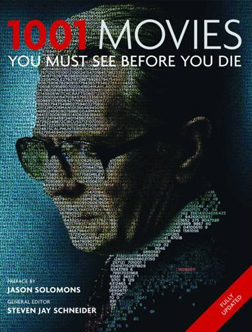
Seeing as the cover of the next edition of the 1001 Movies You Must See Before You Die has been announced (the book is due to be released next month), I thought it’d be a good time to review the film on said cover, as it’s a certainty to become a member of the hallowed list in the imminent future. So, without further ado, I present Tinker Tailor Soldier Spy, a film that I was very surprised to see on the cover, as personally I don’t think I’d have included it in the book at all, giving the cover space instead to probably The Artist, even if the Tinker Tailor poster is better.


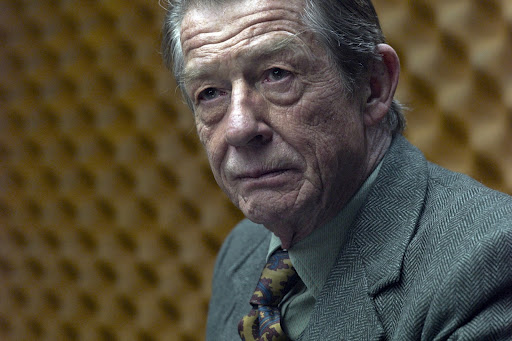
It’s only fitting that such a muddled up film should have a relatively incoherent review, so I’m going to jump in randomly and start with the cast. It’s pretty goddamn incredible that such a stellar cast, comprising of some of the best British actors from varying generations working today, could be assembled for one film. You’ve got the likes of John Hurt amongst the more senior players, Toby Jones, Colin Firth, Mark Strong, Ciarin Hinds and Kathy Burke as the seasoned actors as well as up-and-comers like Benedict Cumberbatch and Tom Hardy, not to mention bit roles for Stephen Graham, Roger Lloyd-Pack and Christian McKay. And, of course, Gary Oldman. It just goes to show the strength of the source material that such a great cast, and director Tomas Alfredson, straight from his similarly bravura Let The Right One In, would flock to it. Even Colin Firth was willing to take what is essentially a tangential role after just having won a Best Acting Oscar for The King’s Speech.

It takes a brilliant actor to not only attempt to replace the likes of Alec Guinness, James Mason and Dunholm Elliot – all of whom have played the character of George Smiley before – but to in fact outshine them as arguably the definitive screen version of Smiley. Oldman is magnificent in a pared down, stripped back performance almost entirely devoid of movement, yet the cogs behind his eyes are just about audibly whirring away as he sits and watched, drinking everything in and analysing the situation. Smiley rarely utters a word or makes an extraneous movement – his first utterance is a good 16 minutes in, after having appeared in several scenes already. He shines even beneath the massive glasses and dour overcoat that would envelop a lesser actor.

Remarkably, Tinker Tailor marks Oldman’s first ever Oscar nomination, for Best Actor, naturally, which he justifiably lost to Jean Dujardin for the aforementioned The Artist, but I believe Oldman came a close second. I myself was shocked to find he’s never even be nominated, but when you look back through his body of work there aren’t many roles that you could argue he should have been awarded for. Perhaps Sid and Nancy, but that wasn’t terribly well received I think, and doesn’t really fit in with the kinds of films that the Oscar board tend to take notice of, and in everything else he’s either been the bad guy – rarely awarded by the academy (at least until The Dark Knight) – or performs well in a small role, lost amongst an ensemble cast of similar abilities to himself – see True Romance, Harry Potter and Batman. You’ve also got to take into account some of the more questionable roles in his career – playing a dwarf in Tiptoes anyone? So it’s nice to think that, with so many outlandish, extravagant roles under his belt – The Fifth Element, Leon – it is Oldman’s most quiet, restrained and subdued performance that earned him the Oscar nod.

 I’m not even going to try and explain the plot of this film as, after having watched it and read John Le Carre’s book upon which it is rigidly based I could still only pin point the major issues. Basically, Smiley has been brought back into The Circus – the nickname for the British Intelligence – to try and find a mole from within a small group of higher ups – a group that used to contain him. His boss is/was John Hurt’s Control, and the suspects are the shifty Toby Estergase (David Dencik, a Swedish actor I’ve not come across before, but who played different roles in the two versions of The Girl with the Dragon Tattoo, and is suitably engaging here), the suave, womanising Bill Haydon (Colin Firth), “poison dwarf” head honcho Percy Alleline (Toby Jones) and his right-hand man Roy Bland (Ciarin Hinds). We are also shown, in parallel, the story of field agent Jim Prideaux (Mark Strong, in a rare and disorientating non-bad-guy role), whose shooting on assignment may have caused the suspicion back at headquarters. Assisting Smiley is Peter Guillam (Benedict Cumberbatch), a trustworthy up-and-comer with a way with the ladies, and Tom Hardy plays Ricki Tarr, the unreliable young firebrand whom Smiley introduced to the industry, and who may hold the key to the mystery.

Everyone is perfectly cast, and there isn’t a weak link amongst them. Similarly, the mood of the film is spot-on, and there is never so much as a red or a green on screen at any point, everything is in varying shades of grey, brown and taupe, from the sky to the clothes, the walls to the cars. The entire thing may as well have been shot in sepia, as it’s apparently been set in a time before colour was invented. The many conversations throughout mostly take places in dusty, dingy rooms yellowing with tobacco. It’s unusual for a film that some of the flashback sequences are actually more vibrant and brightly lit than those set in the film’s present, which could be read as an indication that perhaps those sunnier days were better for everyone involved, with less conspiracies and deception. Or at least, less in the current direction.

So, why did I have such a problem with this film? Well, mainly it’s because it’s so damn confusing. I understand that that’s entirely the point, and that some elements of the plot – when which bits are set in relation to others – are only roughly clarified towards the end to aide this sense of confuddlement, but even having read the book I still couldn’t tell what everyone was doing and why. This could also be because I didn’t really care. None of the characters are particularly likable, with the possible exception of Guillam and Prideaux at times, and even knowing who the final reveals didn’t help me very much. That’s something to praise, I suppose, that knowing the ending doesn’t lessen my appreciation for the film, but that’s a little bit of damning with faint praise if you ask me.

The most fun thing I found about this film is playing ‘Spot the Harry Potter Actor’ during it (Can anyone beat my six?). Though the performances are all impeccable and the atmosphere is both what was aimed for and what it should be, I cannot recommend this film on the basis that I didn’t enjoy it, and I’m still not sure what it was about – yet I don’t really mind.

Choose life 8/10

Guaranteed Happiness: Amelie

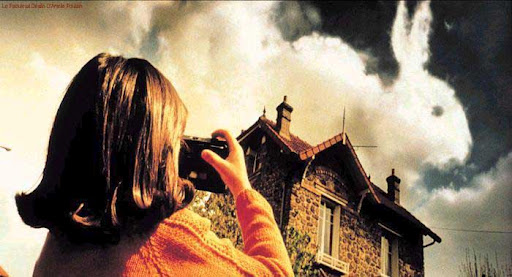
As I mentioned recently, I came 2nd in the Lamb’s So You Think You Can Review tournament. This was one of the films I reviewed for that competition, but as it was on the List as well I figureed I’d use it here too. All praise recycling!In 1997, after having made two successful, distinctly stylised French films with his co-director Marc Caro, Jean-Pierre Jeunet popped over to Hollywood to make Alien: Resurrection, a film widely regarded as one of the worst sequels ever to appear on the big screen. You’d have to go a long way to find someone who liked it, and I’d suggest you don’t start with me. Upon returning to his home town of Paris, Jeunet found himself seeing the once-familiar city with fresh eyes, and set out to make a film that would reflect the magic and beauty he had rediscovered. That film is Amélie.

Telling the story of Amélie Poulain (Audrey Tautou), a girl with an overactive imagination but an undernourished heart who develops a taste for bringing happiness into the lives of the people around her, this isa delightful, light-hearted chocolate-box fantasy romance that only occasionally threatens to choke you on its saccharine sweetness. Amélie herself is a wonderful creation, despite her less-than-wonderful upbringing. She was raised by a military physician father (Rufus) and schoolmistress mother (Lorella Cravotta). Her only physical contact with another life form was the annual check-up provided by her father. Such unaccustomed moments of intimacy caused her heart to beat faster, which her Dad diagnosed as being a heart defect, so kept his daughter at home, away from the other children. This, along with a suicidal goldfish and a childhood tragedy, gave Amélie a unique perspective on life that she would carry on into adulthood, where she works as a waitress in a corner cafe in Montmartre alongside its rogues’ gallery of eccentric staff and clientele.
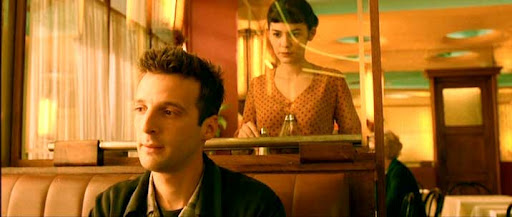
A chance reaction to the death of Princess Diana leads Amélie to discover a treasure trove left by her apartment’s previous inhabitants, so she sets about planning to return the childhood trinkets. She revels in the feeling of harmony she gets from helping others, be they strangers or regular players within her life – though she isn’t close enough to anyone to really call them a friend. Along the way she crosses paths with Nino Quincampoix (Mattieu Kassovitz, director of the seminal La Haine), and finds herself falling in love with this fellow outcast who skips in time to her own offbeat pace, yet her life so far – devoid of affection, interaction and intimacy – ensures that theirs will not be the smoothest of romantic relationships.
From the opening credits – featuring a young Amélie (Flora Guiet) engaging in a variety of nostalgia-inducing childhood antics including peeling dried glue from her fingers and making her hand into a puppet – it is clear this film is a genuine heart-warmer, yet imbued with a tinge of sadness. For all of Amélie’s boundless levels of enjoyment, you can’t help but notice that as a child she was always alone. The film delights in making the ordinary extraordinary, for example by looking at the events occurring simultaneously with Amélie’s birth – a fly being run over, two wine glasses dancing on a wind-buoying tablecloth, a man erasing his deceased friend’s name from his phonebook. Alone, these individual events are almost mundane, but together they contain every aspect of life, from the tender to the tragic.
Though it was released six years before the term was coined, this film displays a unique perspective on the manic pixie dream girl mythology, as we see the film almost entirely from the point of view of said fantastical creature. In more traditional films, the character of Amélie would be the love interest in Nino’s story, and not the other way around, and she’d be played by Zooey Deschanel. If anything, he is a typical leading man archetype, an eccentric loner, working a job he hates to fund an obscure passion project, just waiting for the girl of his dreams to stumble into his life and turn it upside down, yet thankfully this is not his story, he is the supporting player and it is with his influence that Amélie finds her life being disrupted, just as she disrupts those around her.
Tautou is absolutely perfect as the eponymous mirth-maker. Gifted with the role of a title character and appearing in almost every scene yet with barely any dialogue, Tautou manages to express every emotion going through her exceptionally beautiful brown eyes, body language and face framed with a Louise Brooks bob. Interestingly, the role was originally written with Emily Watson in mind, but I think even she would have struggled to match Tautou’s blend of purity, yearning and a rare, beguiling charm. Be it when she is skimming stones, cracking a crème brulee or suppressing laughter during an early attempt at intercourse, Tautou is exquisite in the role she will probably always be best known for. Her delivery of the line “I am nobody’s little weasel” almost brings me to tears.
As usual with any Jeunet picture, the cinematography is beautiful. The colour scheme is heavily influenced by Brazilian artist Juarez Machado, particularly the use of rich browns, oranges and reds for the interior shots. A glowing orange outline will reveal a hidden key, or a glowing heart, and Jeunet’s elaborate camerawork lovingly follows faces, feet and hands as they go about their day, picking up stones and placing them in pockets for future skimming sessions. Some have shunned Jeunet’s debris-free vision of Paris, devoid of litter, ethnic diversity and graffiti, but at heart this is a whimsical fairytale, seen through the filter of its titular pixie’s naive, twee imagination, within which the harshest crimes are committed verbally, and easily remedied with Amélie’s own brand of karmic vengeance. In this world, garden gnomes can travel the world, lamps have nocturnal discussions with photographs of dogs and beggars refuse to accept money on a Sunday, as they are taking the day off.
Though the overarching narrative is one of romance, it is the comedy of the film that really shines through, predominantly from the cast of quirky characters that litter the screen, most of whom are played by actors from other Jeunet works. Be it the bathroom encounter of the hypochondriac Georgette (Isabelle Nanty) and the embittered Joseph (Dominique Pinon), the comeuppance of the bullish greengrocer Collignon (Urbain Cancelier) or a mistaken phonecall to an adult store during which our heroine is informed that “Fur pie doesn’t sell,” the comedic moments are many and varied. Yann Tiersen’s accordion-rich score is ever-so-French (I’m listening to it as I write, my feet have yet to stop tapping) and the occasional use of offbeat instrumentation such as a typewriter and bicycle chains further increases the levels of whimsy, as if that were even possible.
In my opinion, the best kind of film is one that leaves the viewer wanting to be a better person, and that is certainly the case here. The morals of Amélie are clear: be kind to others, be yourself, and enjoy the little things.
Choose film 10/10