The Virgin Suicides

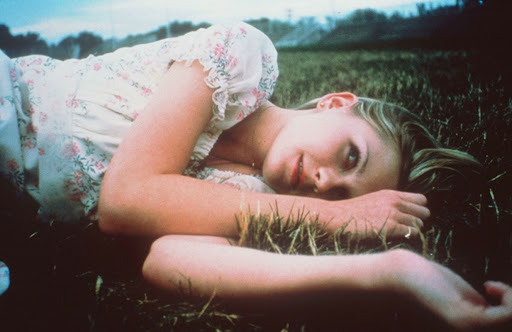
Completely unintentionally, this was the second film in a row I watched where a young girl burns her own record collection (after Heavenly Creatures), and also the second in not too long a time in which Kirsten Dunst has sex in a field (after Melancholia a few months ago). With a title like The Virgin Suicides, I wasn’t exactly looking forward to watching this film, as it seemed like it was going to be joining the ranks of those thoroughly depressing films I’d been trying to avoid lately, and the fact that it was directed by Sofia Coppola, whose Lost in Translation I wasn’t overly fond of the last time I watched it, and who I still haven’t completely forgiven for The Godfather Part III, made me even less excited. Plus, its a story of the multiple suicides of a clan of teenage sisters, which always leads to a laugh riot in my books.

The girls in question are the Lisbons, five sisters aged 13 to 17, who are kept under the watchful eyes of their strictly religious parents, Kathleen Turner and James Woods. The girls are largely kept under lock and key, only allowed out to go to school, where they are lusted over by the local boys, as that which you cannot have will always be that which you want the most. Cecilia (Hannah Hall, Forrest Gump‘s young Jenny), the youngest girl at just thirteen years old, attempts to kill herself in the bathtub. After she survives and recovers, her parents throw a party for the girls and some of the local boys, during which Cecilia excuses herself, goes upstairs and jumps out of the window, impaling herself upon the railings in their front garden. Hey, I warned you, this ain’t the happiest of films. The death of their youngest sibling seems to have little effect upon the sisters, though their parents ratchet up the levels of over-protectiveness, coming to a head when eventually the girls are taken completely out of school, never being let out of their parents’ sight.Kirsten Dunst is a revelation in this film, and I’m not normally her biggest fan. She displays a confidence on screen that’s almost otherworldly. At the time of making this film, aged just seventeen (though playing the second-youngest Lisbon, 14-year old Lux) she had appeared in no less than fourteen films, including Jumanji, Interview with the Vampire and Small Soldiers, and her level of experience is clear as she is this picture’s main focus. Even as the youngest, after Cecilia’s demise, Lux appears more world-weary and equipped with a greater level of confidence and intelligence than her oldest sisters (Chelse Swain, A. J. Cook and Leslie Hayman), so much so that the sisters all seem to merge together in a largely forgettable blur. The adults are all impressive, particularly Woods in an unusually repressed role, but be prepared to be taken out of the film when Danny DeVito pops in for one scene as the psychiatrist Cecilia is sent to after her first suicide attempt.

The film has been shot with an air of beauty and nostalgia –  opening with an upbeat yet mellow soundtrack of a bright sunny days, the light dappling through the trees of a suburban Michigan town – but this is immediately contrasted to the stark sterile blue of Cecilia lying in a bathtub, being carted away by the paramedics. This jarring emotional toggle switch occurs a couple more times throughout the picture, and each time it is effective. The narration, by one of the boys waiting outside each day just to catch a glimpse of the girls, is largely unemotional and distanced from events, as though bored of a story told many times before.

From what I know the 1970s was recreated well, particularly in the fashions and vile interior design. Every shot was reminiscent of an old photograph, saturated and hazy, almost sepia and fading at the edges. Unusually, a lot of the scenes didn’t play out as I originally expected, even more of a surprise when you consider they have such standard high school movie tropes as a prom, featuring parents enthusiastic at their daughters’ dates, fumbled first dances and peach schnappes under the podium (“Babes love it.”) The script is at times comic, and occasionally blackly so, with my favourite moment being when, after awaking in the hospital, her doctor tells Cecilia she shouldn’t have tried to kill herself because she’s “not even old enough to know how bad life gets,” which is a pretty terrible way of convincing someone not to try and kill themselves again, but her response is perfect, “You’ve never been a 13-year old girl.”
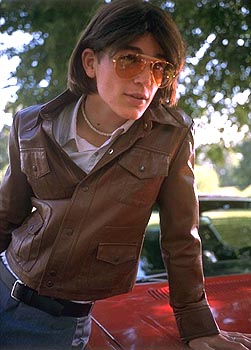
I suppose I should mention Josh Hartnett, who appears as the local dreamboat, Trip Fontaine, adored by students, parents and teachers alike, all except Dunst’s Lux, which only makes him want her more. Hartnett is his usual self, and I’m not too much of a fan (his only good films in my opinion are Sin City, The Faculty and Black Hawk Down, which surprise surprise don’t feature him all too heavily), and his abominable curtains-style haircut almost ruined the film for me. It was nice to see him playing such a prick though. Hayden Christensen is also in there somewhere, which is never a good thing.

So, whilst it’s not really going to cheer you up after a long day’s work, this is still a very well made and easily appreciated film, far better than I was expecting from Coppola. The ending in particular left me reeling for days afterwards.

Choose film 8/10
Transformers

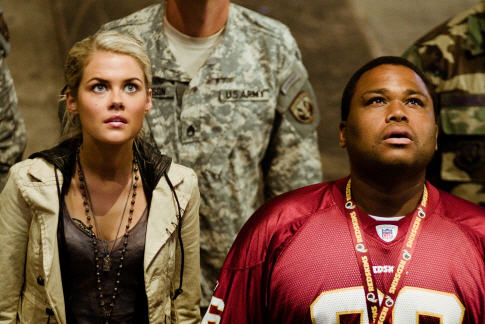
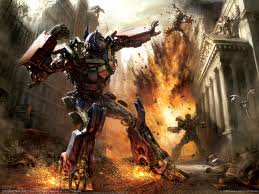
Part 2 in my Shia LaBoeuf: the Scourge of Cinema double-bill sees him taking on giant, transforming robot aliens as he attempts to save the world using a weird little cube, and cop off with Megan Fox. I’ve got no historical connection to the Tranformers franchise, as I neither saw the cartoon series or the animated feature from the 80s, and I’ve never played with any of the toys as a child. So unlike many people, I feel that so far my childhood has been unmolested by Michael Bay, something I was afraid I’d no longer be spared from with his intentions to paint his own brand of ridiculousness onto the Teenage Mutant Ninja Turtles, which I think now has been fortunately abandoned.I first saw the film in cinemas five years ago, when I was barely 20. At that point, I must have been just on the outside cusp of the film’s target audience, as I thought it was amazing. At that point in my life, Michael Bay was something of a favourite director of mine – I even liked Pearl Harbor – and a film that followed cars transforming into robots and beating the scrap out of each other, interspersed with eardrum-bursting explosions, comic cameos and gratuitous shots of Megan Fox bending over an engine at sunset was of course going to do nothing but good to my barely-older-than-teenage mind. Now, however, I see the film for the hollow, disorganised, puerile mess that it truly is.Granted, I’m no longer the film’s target audience, but this is my review, so I’m giving my opinions. This film is stupid. I’m on board for a story about robots from outer space that can somehow transform into cars, planes and, um, a stereo, but unfortunately most of this film is about Shia LaBeouf’s Sam Witwicky, a typical the-only-character-LaBeouf-can-play annoying, dumb every-kid stereotype with embarrassing parents, mediocre grades, stupid friends, a crappy car and a complete and utter lack of charm and charisma. As always, LaBeouf plays an annoying tit rather well, as you’d expect from having had so much practise. It transpires that Sam’s great-grandfather was an Arctic explorer who discovered the allspark – the movie’s maguffin that is capable of creating new transformers – and Sam holds the key to it’s whereabouts, because somehow a map has been engraved into his ancestor”s spectacles. Ludicrous. Two warring tribes of robot aliens – the human-loving Autobots, led by Optimus Prime (voiced by series original Peter Cullen), and the world-conquering Decepticons, led by Megatron (a wasted Hugo Weaving) – somehow learn that Sam has the glasses, and trace his location using eBay. Of course. Along for the ride is Megan Fox’s Mikaela, the girl of Sam’s dreams who is clearly from such a broken home that her family is unable to replace the clothes she clearly grew out of some years ago.There’s also a couple of sub-plots involving the squad of marines – a Michael Bay trademark – who initially encounter a Decepticon attack, and attempts by the government to decode a message recorded from the bots. Each of these strands involves barely fleshed out caricatures instead of actual characters – the marine who sporadically speaks in Spanish even though no-one else understands him, the immature ‘world’s greatest hacker’ with his irritating dance-gaming friend – and does anyone else remember when Jon Voight was a respected actor, and not reduced to offering dry exposition as the Secretary of Defense? The government strand featured one of my biggest pet peeves in films. The film focuses on a group of hackers. This group is predominantly made up of guys who look like hackers – they’re overweight, scruffy, and generally appear socially awkward. And of course the one who’s better than all of them is played by Rachael Taylor, who looks like a supermodel. There is no girl in the world who looks like that and knows how to hack. I’m aware that of all the things in the film that don’t make sense, this is relatively minor, but it’s something that has always annoyed me.

This kind of films lives or dies by the CGI, and I’ll be the first to admit that it’s damn impressive. There are some sequences that look absolutely bad-ass, most notably the opening Scorpiok attack, and a massive-scale battle between both sides at the end. Starscream, the Decepticon who is able to transform into a jet, has the coolest moments, especially when he transforms in mid-flight and swings on a bridge during a strike on the Hoover dam, so in those respects the film has some enjoyable moments. The problem is that in a film for which the entire draw is robots hitting each other, there’s just not enough of it. At one point, the robots are in the middle of a catastrophic fight, yet we are left watching Voight and the hackers searching for some microphones and using morse code.

There were a lot more attempts at juvenile comedy than I remembered from my earlier viewing, and very few of them were gratefully received. At one point, a diminutive robot capable of transforming into a machine attempts to walk nonchalantly passed some people looking for it, and it tries to cover it’s face whilst walking! This is not comedy, nor is it clever, it;s just stupid. There are many more scenes like this – an Autobot ‘lubricating’ (peeing) on John Turtorro’s government agent, Sam’s asinine chihuahua Mojo, everything LaBeouf does – and the only comedic scenes that really do the job are those involving Bernie Mac as a car salesman, and Kevin Dunn and Judy White as Sam’s all-too-familiar parents.

If the idea of giant metallic creatures from space beating each other up has you foaming at the mouth with excitement – and at times this is a category I’d class myself in – then you’ll probably like about half this film. If you’ve recently had a lobotomy or are a prepubescent male, then you’ll probably like the other half. If not, just leave it alone.

Choose life 5/10

Indiana Jones and the Kingdom of the Crystal Skull

Yep, the questionably necessary fourth Indiana Jones instalment is on the List. And if anyone has any problem with that (like me, for example) then the only place to point the finger of blame is at the public, as the List it appears on is the one voted for by Empire readers. Granted, the film came out in 2008, the year the poll was taken, so many readers who may have only ever seen 10 films would have been forced to put it in their top 10. This also explains the inclusion of Transformers and Juno on the same list, and it’s pretty much assured that if the poll were taken again, these films would be unlikely to retain their positions. But the important thing is that the film is on there, and I had to watch it.

When I first saw the film in the cinema, on the weekend it was released, I didn’t actually think it was that terrible. Hell, if anything I enjoyed it, and left the theatre happy and fulfilled. Granted, it was certainly no Raiders of the Lost Ark, or even The Last Crusade, but it was a damn sight more fun than The Temple of Doom. I was somewhat shocked to discover that these feelings were not necessarily shared by the rest of the world, but now, after a couple more viewings, I have realised my mistake.
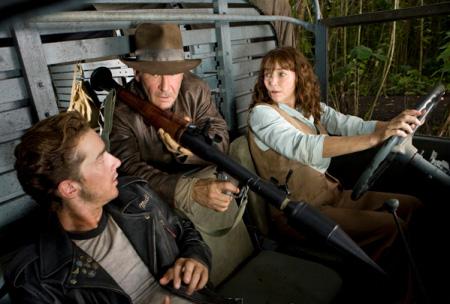
For me, the film has four main problems, all of which I’m sure have been covered many times before, but not by me. Firstly, the movie seems to be completely devoid of a strong narrative path. It’s more like a bunch of scenes that the writers thought would look cool, all strung together without really flowing into one another. On their own, or within a more cohesive plot, some of them would work fine. Case in point: the opening, in which Indy (Harrison Ford) and his ally Mac (Ray Winstone) are taken to the warehouse at the end of Raiders in search of a sporadically magnetic alien skull, is in itself a pretty entertaining scene, and a great way to start off the film. The use of Indiana’s instantly recognisable profile (when he’s wearing the hat, anyway) is well implemented, and the eventual chase through the warehouse is frenetic and action-packed, even if Ford no longer looks like he’s quite as capable of offing army thugs as he used to be. After this scene, we go straight into the now infamous fridge-nuke catastrophe, a scene which has no place in any film, let alone directly after a really fun, if a little silly, opening action sequence. This problem occurs again later, when some pages from a low-budget 80s B-movie are accidentally stapled in, when out hero finds himself in quicksand, a genre staple that I’m fairly sure has been made illegal.

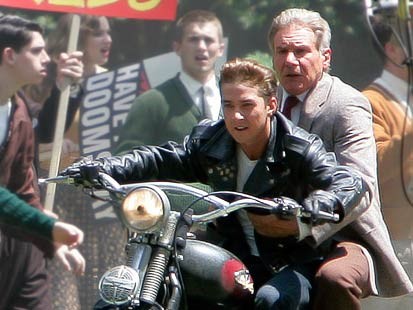
The second problem, and this is a big one, is Shia LaBoeuf. The man is a scourge to cinema. Every film he touches becomes a travesty. Seriously, look down the guy’s resume and you’ll find some of the worst reviewed films of the past few years: the Transformers sequels, Charlie’s Angels 2, Dumb and Dumberer. If he’s the sidekick or plays only a small part in the film, he’s the worst character or in the worst part (I, Robot, Constantine, Bobby) and yet, he still makes movies. In fact, he’s soon to appear in Lawless, in which I can only imagine Tom Hardy will overshadow him in every way possible as the two play brothers. Honestly, the film is going to put LaBeouf up against Gary Oldman! Though I sincerely hope that Shia’s performance in Lawless blows me away, insomuch as he wins an academy award for it, I highly doubt this will be the case, and it may even ruin that film, that I’m otherwise looking forward to, for me. In Crystal Skull, LaBeouf plays Mutt Williams. If you’re a fan of the Indy franchise, it should come as no surprise that (SPOILER) Mutt is Indy’s son, mainly because Indiana is famously named after his own father’s dog, and Mutt is of course another term for a canine. From his costume, it’s clear LaBeouf is foolishly attempting to emulate Marlon Brando from The Wild One, which he pulls off to absolutely no effect, and if anything it’s a reminder of just how terrible LaBeouf is. The fact that there were rumours suggesting this film would see the handing over of the reigns from Ford to LaBeouf to continue the saga still give me nightmares to this day. I’m almost tempted to announce Mutt as being more annoying than Short Round. Almost.

The Mutt/Indy connection brings me on to my third issue. Crystal Skull tries far too hard to be a member of the Indiana Jones family. I’ve got nothing against a sequel making subtle references to it’s predecessors, offering knowing nods and winks to fans, but here there is far too much time spent to this effect. Whilst Karen Allen, returning as Raiders’ love interest Marion Ravenwood, Mutt’s mother, is a nice touch and offers a believable romance with Indy that you are willing to at times root for, there were all too many moments and scenes that felt like the film-makers were just trying too hard to make it an Indy film. Unfortunately, they only succeeded in making it seem more like the parodies of the Indiana films that filled the gap during it’s 21-year hiatus. This felt far more like National Treasure 3 or The Mummy 4 than an Indy film.
Finally, there’s just too many characters and subplots fighting for screen time. Jim Broadbent filled in for the sadly departed Denholm Elliot as Indy’s fellow university staff member, and John Hurt was a nice inclusion as a crazy old former colleague, but both felt very sidelined, as did Ray Winstone, who should have been pretty integral to the plot. Sadly, they, and Cate Blanchett’s questionably accented Ukrainian skull-hunter were at times almost forgotten in favour of Jones’ relationships with Marion and Mutt.
There were ways that the film could have been fixed. Raiders and Crusade proved that Indy doesn’t need a sidekick, and Temple proved that he shouldn’t have one, so nixing Mutt is pretty much a given. At least 2 scenes should have been cut, as the film feels like it runs at half an hour longer than it’s two hour runtime. I’d suggest the fridge and the diner scene with Mutt. Keep Marion, but make her be in love with John Hurt’s Oxley or Winstone’s Mac, to give Indy a bit of rivalry, and change that goddamn ending. About five minutes before the end of the film, when I first saw it in cinemas I burst out with raucous laughter at how ridiculous the climax was, and this time around it felt even more ludicrous.All that being said, it’s not exactly a horrible film, there are some entertaining sequences – I really enjoyed the jungle-set car chase, up until Mutt starts swinging with the CGI monkeys for no reason whatsoever – and it’s always thrilling to see Harrison Ford wearing a fedora, even if its not the only thing looking a bit dusty these days. I always used to defend the film for being good, just not when compared to the rest of the franchise, but I now know that even if you take it on it’s own, it still really isn’t worth it.

Choose life 5/10

Guaranteed Happiness: Wall-E

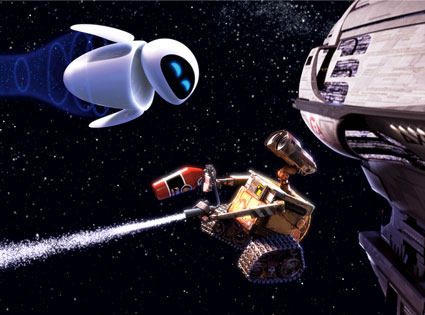
Welcome to the first post in my new semi-regular feature, Guaranteed Happiness. I’ve discovered that a lot of the films I’ve watched recently haven’t necessarily dealt with very happy subjects, and this has been getting me down a bit. Now and then, I’d quite like to watch a happy film, or one that’s uplifting and ensures that I’ll have a big stupid grin on my face for at least 80% of it, and definitely at the end. After all, I’d much rather write about a film I’m passionate about, and I tend to have more to say about films that make me smile than those that make me suicidal. Praise should be aimed squarely between the shoulders of my girlfriend then, for sticking on Pixar’s gem Wall-E when I was in a decidedly cranky mood a little while ago. The aim was for me to sit down and write some posts, which to be honest I was in no mood to do after a fairly crappy day at work and having to shell out over a considerable amount of cash to fix my bike, yet as soon as the film began all thoughts of blogging and even glancing at my laptop screen were out the window.So, why do I love Wall-E? The simple answer is robots. It’ll come as no surprise to regular readers that a film featuring robots (or dinosaurs, time travel or Stephen Tobolowsky) will immediately be watched with heightened levels of glee. And the fact that it’s made by Pixar, a company that has made some of my favourite films to date, and is where I’d be willing to sell several members of my immediate family to work at, then so much the better.This is my favourite Pixar film, which is definitely saying something. I adore the Toy Story trilogy (especially, predictably, Rex), but there’s something about Wall-E‘s simplicity, its pared down scope and focus on telling a straightforward story in new, interesting, and above all, beautiful ways.

The plot is basic: in the not-too-distant future, the human race has polluted and destroyed the world so much that life has become unsustainable, and the only hope lies in the Axiom, a titanic spaceship resplendent with every luxurious convenience to fulfil any desire. Earth has been abandoned and left to the robots, who spend the next few hundred years tidying the place up. Wall-E, our intrepid hero, is the last surviving ‘bot, and he spends his days making and stacking little cubes of garbage into towering skyscrapers of trash, accompanied by his only friend, a cockroach. One day, a ship descends from the heavens, carrying EVE, a futuristic, high tech reconnaissance droid, and Wall-E is instantly smitten.

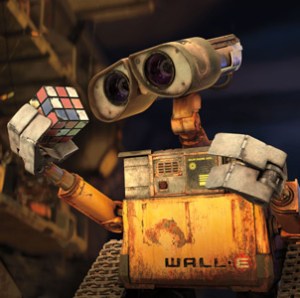
The tale of a schlubby, down-on-his-luck guy falling in love with an out-of-his-league wonder girl is hardly new, but as far as I know this is the first time it’s been told almost entirely wordlessly, and about mechanical beings. A certain amount of disbelief needs to be suspended to watch the film – the robots seem to have far more personality than they should have been implanted with in the factory – but this results in one of the most well-rounded characters in all of Pixar’s history. Wall-E (which stands for Waste Allocated Load Lifter – Earth Class, something I know from memory) has a love for all things quirky, unusual or fascinating, be it a Rubik’s cube, egg whisk or an old VHS of Hello Dolly!, and watching him investigate the functions of each item – wearing a bra like sunglasses, accidentally erupting a fire extinguisher – are a joy to behold. As are his attempts to woo the evidently disinterest EVE (whose acronym would be a spoiler). The couple’s dates are more moving and say far more than any scene of dialogue could.

It’s almost impossible to narrow the film down to my favourite scene, but I’d probably say EVE and Wall-E’s space flight. It’s nothing short of a work of art, as the two bots fly a merry courtship dance around one another, set to Thomas Newman’s beautiful score. In fact, every scene between just those two, all almost entirely devoid of dialogue, are so very easily lost in. Their relationship feels natural and real, and if anything the films is at a detriment as the plot moves away from Earth, and the story looks past our central couple.

There’s a few messages hidden not too deeply in the film – stop fucking up the Earth, grow your own food, get off your arse and exercise – but to be fair these are all fairly good messages, when compared to the standard Disney fare of wait for a handsome prince to come and rescue you. Wall-E’s messages are ones I personally agree with (“even if I don’t necessarily live by them,” he says, patting the spare tyre around his midriff) so I don’t really mind such unsubtle preaching in a film, especially one as entertaining as this.

I’ve made no secret of the fact that I’d have loved nothing more than to have been part of the character design team on this film. Wall-E himself has been so carefully thought out with regard to how he works and fits together. I may have appreciated this more than most, being a mechanical engineer by trade, but I think everyone should be impressed by the level of detail. Apparently the design team at Pixar meticulously analysed various machines, working out which ones were ‘male’ and which were ‘female’, and what characteristics defined these genders. Wall-E has clearly been inspired by more clunkier, mechanical machinery, as seen in factories and assembly lines, whilst the sleek, white plastic of EVE is straight out of an Apple store.

As you’ve probably realised, I love this film. The Wall-E poster, a giant pair of his eyes looking inquisitively out of the frame, justifiably hangs in in my lounge, yet I think it almost qualifies as one of the ‘other’ Pixar films that isn’t about toys, fish or superheroes. From the small details – sci-fi queen Sigourney Weaver voicing the Axiom’s tannoy – to the fully realised plot and the brilliance of casting Ben Burtt, the voice of R2D2, as Wall-E, I cannot fault this film in the least, and nor would I want to. And I’d still be trying to get Randy Newman’s closing credits song out of my head if it wasn’t so bloody good.

Choose film 10/10

Memento

Christopher Nolan’s first major picture (after 1998’s Following, which is interesting but a tad too confusing, and really for completists only) is at first glance nothing but a gimmick, using a reverse-narrative to tell the detective noir of Guy Pearce’s Leonard Shelby as he hunts for the man who raped and killed his wife whilst suffering with a rare condition that prevents him from making new memories. However it turns out that telling the story backwards, scene by scene and with an expositionary telephone conversation spliced in between, is the only way to give the story justice.
Famously, there is an easter egg on the Memento DVD that plays the film in chronological order, and I’ve discovered that in that orientation the film just doesn’t work. It’s not just because the last few seconds of every scene are replayed again moments later at the start of the next one (surely that wouldn’t have taken much to edit out?) but it’s also because the film is completely lacking in tension or pacing when that way round. Which just goes to show that Nolan was able to use a plot technique to it’s fullest advantage, which in the hands of a lesser director could have proved disastrous.
Pearce is excellent in an unforgiving role, especially given that Leonard has no character arc longer than a scene. He’s always been a brilliant actor, and often hides his Brad Pitt-esque looks behind obscuring facial furniture or heavy make-up – see Ed Exley’s glasses in L.A. Confidential, or large amounts of Play-doh in Prometheus – and here is no exception, with Shelby’s body plastered with tattoos and a shock of peroxide blonde hair to distract from those razor-sharp cheekbones. Pearce is ably supported by Carrie-Anne Moss and Joe Pantoliano as Natalie and Teddy, people who may or may not be out to help Leonard on his quest.We discover elements of the story as Leonard does, and the true meaning of almost every scene is altered by the one that immediately precedes/follows it. Surprisingly, a scene can hold just as many surprises, and just as much tension, if you know how it ends but not how it begins. You can’t help but feel sorry for Leonard, in a situation that would drive most of us insane – as long as we could remember the insanity long enough – and his life would be hard enough without everyone screwing with him. Even the clerk at his motel (Batman Begins‘ Mark Boone Junior) charges him for two different rooms, and doesn’t even hide it from Leonard, as there’s no chance he’ll remember.

There’s more comedic moments than you might remember, and some darkly so, for example the conversation where Leonard reveals to Natalie that the last thing he remembers is his wife. She says that’s sweet, before Leonard concludes “…dying.” I probably shouldn’t have, but this got a start of laughter from me.

I remember that my first viewing of this movie was ruined when I borrowed it from a housemate some years ago. He basically told me the ending, and that the film was crap, but I watched it anyway and remained intrigued and fascinated by how the plot would tie together – which it does nicely. Rest assured I never took that housemates movie advice again.

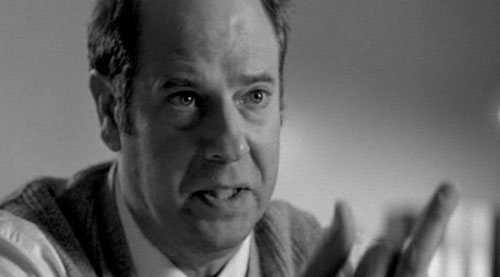
If Stephen Tobolowsky is in a film, then I’m legally obliged to mention him in a review, and here he crops up in grainy, black and white flashback as Sammy Jankis, a case Leonard looked into as an insurance claims investigator before his memory loss. Jankis suffered from a similar condition as Leonard, and Tobolowsky’s wonderfully big blank face is perfect for the look of someone not recognising anything new in the world around him, and his bursts of anger at annoyance – at an elctro-shock test and not understanding TV shows – is also great.

The story, written by Christopher Nolan’s brother Jonathan, is well thought out and takes into account the minutiae of Leonard’s predicament. Such a high concept (though scientifically possible) film could have left many annoyances at skipped over details, loose plot strands or inconsistencies, but by the end/beginning no such problems are left.

Choose film 9/10

Seven Brides For Seven Brothers

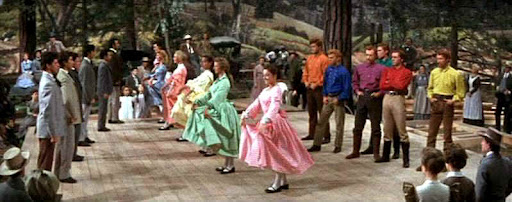
I’m not normally a huge fan of classic musicals. I quite liked West Side Story, but couldn’t abide The Sound Of Music, so my hopes weren’ exactly high for this 1954 classic of which I knew very little, other than there were presumably at least fourteen characters. I’m relieved to tell you that not only did I not find this film terrible, I frickin’ loved it.Set in 1850’s Oregon, the film predominantly follows Adam Pontipee, the eldest of seven brothers (duh) who all live away from society in a secluded shack, as woodsmen. Whilst visiting town to trade, Adam sets out to find a wife, and somewhat surprisingly the local cook Milly agrees to take the position, and they marry as soon as she finished her chores, before heading back to his house. Once home, Milly discovers the rest of her new husband’s clan, whom he’d neglected to tell her about before, and soon finds herself playing Snow White for these seven giants, doing all the cooking and cleaning in their initially disgusting hovel. When the other boys decide they too would like a wife, Milly steps in to see if she can teach them to be gentlemen.

The plot is, frankly, ridiculous, and full of so full of sexism its funny. Adam (Howard Keel) is chauvinistic, slovenly and completely tactless (“What do I need manners for? Already got me a wife.”) and he has absolutely no qualms about essentially conning a woman into being a slave for him and his six siblings. His proposal to Milly (Jane Powell) will probably go down in history as the most romantic in cinematic history. Sidling up to Milly whilst she milks a cow he proclaims “Ain’t got a woman, how ’bout it?” Clearly, back in the 1850s romance was far from dead.

Unusually for a musical, I actually approved of the music, and even the dancing. Some of the songs weren’t terribly memorable, but others are still stuck in my head, most notably “Bless Yore Beautiful Hide” (again with the romance), “Goin’ Courtin'” and “sobbin’ Women.” The dancing too is very impressive, probably because most of the eponymous brides and brothers are professional dancers. The barn-raising sequence is great even though it’s very long, with the brothers competing for the affections of the locals girls against the men that brought them there. A prime opportunity was missed for some colour-coordinated dancing though. Some of the later axe-dancing is a little silly, but it does fit in with the overall tone of the film.

The plot is based on Stephen Vincent Benet’s short story The Sobbin’ Women, itself influenced by the Roman legend of The Rape of the Sabine Women (back then rape meant abduct, this film isn’t that dark). The script takes some interesting turns and has a great, if a little predictable, ending. The brides being just as willing to resort to fisticuffs as the men was a nice touch.

At times the film gets a bit sombre, when various groups become lovesick and lonely, but there’s always an upbeat musical number not too far away, and unlike most classic musicals, this one isn’t unbearably long. I’d quite like to see a remake, with an allstar ensemble cast in the lead fourteen roles, but I get the feeling it would be terrible.

Choose film 7/10

Sophie’s Choice

The unfortunately named Stingo (Peter MacNicol) moves from his southern home to be a writer in New York. He rents a room in a house, and so finds himself firm friends with a neighbouring couple, Sophie and Nathan (Meryl Streep & Kevin Kline). Sophie and Nathan have a tumultuous relationship, as she has a tragic past and he has issues of his own, and slowly Stingo learns of their history, and the hardships Sophie has had to endure.
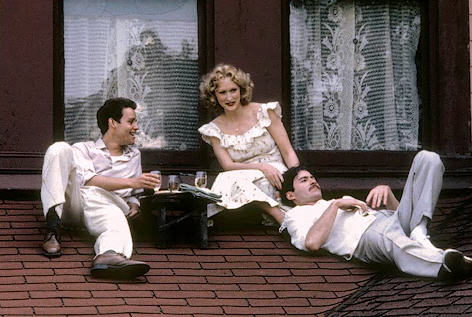
In the world, there are happy films. They are stories about underdogs overcoming adversaries, battling against hoards of naysayers as they set out to win the court case/football game/heart of the cheerleader. The kinds of films where, upon finishing, you punch the air and yell something, just to join in the triumphant atmosphere. And then there’s Sophie’s Choice. Watching this film is like receiving one punch to the gut after another, rounded out with a swift thwack to the head with a two-by-four. It’s like watching Schindler’s List whilst listening to country music and drinking a glass of orphan’s tears. If you have a big grin plastered over your face after watching the film, I’m guessing you wouldn’t have been out of place in the Hitler Youth back in the 1940’s. The happiest parts of this film occur between the three leads as they enjoy a life of carefree wonder, visiting Coney Island dressed in period garb, but even these moments have the rug pulled out from them eventually.

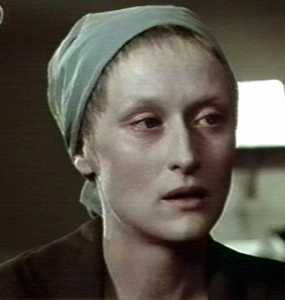
As with many films on this list, I have a history with this movie. I’d heard it was good, so I borrowed a copy from my Grandad – a copy he’d got free from a Sunday newspaper and never intended to watch, yet he still required it returned after I watched it. Free DVDs don’t tend to have much in the way of DVD extras, up to and including DVD menus. In fact, most will just play straight out, without you needing to touch a button. In fact, I’ve watched one before that didn’t even have chapters. I tried to skip back to catch a line I’d missed, and ended up back at the start of the film, and had to fast-forward to the scene again. What a time we’re living in. Anyway, Sophie’s Choice was such a film that had no extras, just a big old ‘PLAY’ button. I’d heard that, for Streep’s Oscar-wining performance she’d learnt Polish and German for the role, which was not something I’d given a second thought to until, over halfway through this 2 1/2 hour film, there’s the first of a few flashback sequences of Streep’s Sophie in WW2-era Germany, and the DVD had no subtitles, leaving me to attempt to watch and understand what are probably the more famous and pivotal scenes of the film, without the aid of knowing what anybody was saying. To the actor’s credit, for the most part I think I understood it, but still. I’ve known someone to go through a similar situation with Vicky Cristina Barcelona, but that was their fault for watching an illegal download.There are some actors who have a very famous role that they simply cannot overcome for some people, or in this case a role they’ve only played once but that has been seen many times. For me, Peter MacNicol will always, and only, be Dr. Janosz Poha from Ghostbusters 2. The mild-mannered southern writer Stingo doesn’t stand much of a chance against Janosz, seeing as he’s given very little characterisation here, but then this isn’t his film, he’s a cypher through which we get to know Sophie. This film belongs entirely to Meryl Streep, whose performance is just as good as it’s ever been suggested. No superlative can be left unused when describing the levels she goes to, mentally, physically and linguistically, to completely transform herself into the concentration camp surviving Sophie. Her accent is spot-on, and you completely forget you’re watching Meryl Streep. If it weren’t for Kline and MacNicol sharing the screen with her, I’d occasionally have sworn it was a documentary. I’m guessing that Julie Andrews, Jessica Lange, Sissy Spacek and Debra Winger, the other Leading Actress Oscar nominees that year, didn’t even bother showing up to the ceremony. Not only did she learn Polish and German, but Streep goes so far as to convince that they are her first languages, as she trips and stumbles her way through near-broken English, whilst during her flashbacks of the camps she looks to be several days passed Death’s door with her pallid skin, sunken eyes, roughly shaved head and frail, skeletal frame. This performance should be mentioned in the same breath as DeNiro in Raging Bull. It’s hardly a surprise that the rest of the cast pale in comparison.

It’s a shame then that her performance is the only outstanding part of the film. I had an understanding of the meaning of the title before watching, so assumed it would play a large focus in the film, but it is only at the climax that we see the pivotal scene, and it’s very nearly glossed over. We get a sense of the ramifications and the how it has made Sophie who she is today, but it eventually turns out that the choice she made would have made absolutely no difference anyway. As a story detailing the personal effects of concentration camps and World War 2 this is compelling, yet there are too many detours to detract from the story in an attempt to lighten the mood – Stingo’s date with the nymphomaniac Leslie Lapidus (Greta Turken). There are some nice comparisons between the camp prisoners and the guards – an officer’s daughter complains about the lack of a heated swimming pool.

The film also falls into two of my bigger pet peeve pits, in that a 28-year old MacNicol, who looks about 35, is playing a 22 year old, and at a couple of times there are phone conversations where the person on the other end is almost inaudible, but not quite, so some volume control had to be undertaken.

Despite possibly the greatest acting performance ever, this film is unfortunately let down by an incredibly depressing plot and an unsatisfying ending. There’s no doubt it’ll stick with you for a long time, but I highly doubt you’ll ever want to watch it again.

Choose life 7/10

Sense and Sensibility

 Lord Dashwood (Tom Wilkinson) passes away and, unable to split his vast estate between his two families, his wife and three daughters are ousted from their palatial mansion by their half-brother John (James Fleet) and his vile wife Fanny (Harriet Walter), and are forced to considerably downsize their opulent lifestyles. Hope, it seems, arrives in the forms of Fanny’s reserved brother Edward (Hugh Grant) and the dashing Mr. Willoughby (Greg Wise), who each take a shining to two of the Dashwood sisters (Emma Thompson and Kate Winslet).

Continue reading

A Nightmare on Elm Street

I can only imagine Hallowe’en parties in 1984, but I’m guessing quite a lot of people were dressed up in a battered fedora, red and green striped sweater, poorly applied ‘burned’ make-up and a glove with cardboard blades glued on, for if anything has endured from Wes Craven’s multiple-sequel spawner, it’s Robert Englund’s nightmare-stalker Freddy Krueger.

If it’s true that a horror movie lives or dies (generally by running upstairs instead of out the front door) by it’s killer, then there’s no surprise that this franchise is still going. I haven’t seen the 2010 reboot and I’ve only heard bad things, but I’m intrigued to see Jackie Earle Haley’s take on the former child murder released from prison on a technicality but burned alive by the parents of Elm Street. Krueger is an icon from horror history, up there with Michael Myers, Jason Voorhees and the Guy in the Scream mask, making up the B-team behind the likes of Frankenstein, Dracula and the Wolfman. For Krueger, you see, is unstoppable. He’s risen from the dead to take the children of those that murdered him, but he does his killing in the one place he cannot be caught; the children’s dreams. This is a genius conceit, but also the film’s biggest let down.
If you want to terrify your audience and instill in them genuine fright once they have stopped the film and gone about their daily lives, you scare them with something ordinary. A situation they themselves will find themselves in on a regular basis. Hitchcock did it in Psycho with having a shower. Craven did it with going to sleep. There’s nothing you can do about it, eventually you’ll have to go to sleep; quite often it happens without you even planning to. And once your head is resting gently on your pillow, all you can think about is that maniacal laugh echoing around the walls. That tapping at the window, surely that’s just the branch of a tree blowing in the wind, it couldn’t possibly be the knifed glove of the man out to rip you to shreds? When asleep you’re at your most vulnerable. It can happen anywhere – at home, school, prison, hospital, and there’s no way to defend yourself (short of Inception-style techniques, crossover anyone?) and Craven knows this. In his world, a glass of warm milk is as deadly as any conventional weapon.
But the fact that Freddy exists in dreams, can defy physics by being everywhere at once and can take on any form he chooses to terrify you the most, makes him almost less scary. There’s a sense of inevitability. Much like in Ring, once you watch the tape, you’re going to die. There’s not a whole lot you can do about it. You can’t kill Freddy in a dream, you can’t stay awake forever, there’s really only one possible outcome. Yes, in this film and the ever diminishing sequels they find loopholes to temporarily get around the issue, but I’ve always found these to be annoyances and cop outs from the original story. I’d forgotten the ending of this film when I saw it, and I was almost incredibly annoyed at the backdoor excuse they try to use.
It’s a good, solid horror film, and is much more effective if you never, ever watch the sequels. Whilst they have some inventive kills (hearing aid? genius) and increase the comedy quotient, Freddy becomes a watered down pantomime villain, whose incessant survival becomes more grating the more films you watch. But here his terrorising of four teens (including a 21-year old Johnny Depp in his movie debut) is played largely for tension and scares, though there’s a few lull-in-the-score moments that are clear setups for something to jump out and grab our virginal heroine Nancy (Heather Langenkamp).
There are moments of black comedy – a cop telling a paramedic “you don’t need a stretched, you need a mop,” and the kills are satisfyingly gory. Nancy looking in the mirror got a laugh out of me, as at the time of the film’s release Langenkamp was, you guessed it, 20 years old. The image of Krueger’s hand emerging from between the legs of a girl asleep in the bath is more than a little terrifying.
Choose film 6/10

Unforgiven

The first part of my double bill of Clint-Eastwood-directing-himself-and-Morgan-Freeman-in-a-supporting-role sees the American icon define the genre that not only made him the prolific star he is, but that he has almost singlehandedly kept alive since it’s surge in popularity in the 60s and 70s; the western.
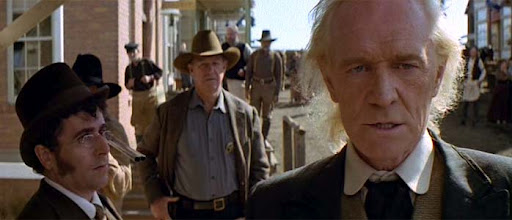
Unforgiven sees Eastwood as William Munny, a former hardened killer reformed by the love of a good women and the birth of his two children. With his wife dead and their herd of pigs stricken with fever, Munny accepts the offer from young upstart The Schofield Kid (Jaimz Woolvett) to kill two ruffians who cut up a whore after she laughed at one of them having a small penis. They team up with Munny’s former partner Ned Logan (Morgan Freeman) and head out to the town of Big Whiskey, lorded over by Gene Hackman’s occasionally violent ‘Little’ Bill Daggett, where other hired killers, including Richard Harris’ English Bob, are also heading to claim the bounty.
Eastwood’s Munny isn’t your typical western hero. In fact, no character in this can ever be truly classed as heroic. Munny has what could politely be called a sordid past, and his desperation to honour his late wife by not succumbing to his younger urges is evident. A self proclaimed no good son of a bitch, Munny is a shadow of his former self, unable to shoot straight or even mount a horse. Freeman’s Ned has a woman at home, yet has no qualms about visiting the whorehouse in town, Schofield has his own secrets and Bob is an outright liar, gambler and killer. At times it seems that Little Bill, supposedly the villain of the piece, is possibly the most moral character here, opting not to kill the prostitute abusers in favour of fining them horses instead, with the sins he commits in the present are nothing compared to those done by Munny in the past, and his intentions are only to keep his town free from guns and violence, except from his own. I found it odd though that nothing was made of Freeman’s race, as he and his partner are the only non-white characters in the film, yet there are no even passing references when the townsfolk describe him. I’ve just realised I’m annoyed that Morgan Freeman wasn’t racially abused in a film.
The script, which did the rounds in Hollywood for 20 years before Eastwood picked it up, is pocked with sharp humour and great lines (“If I see you again, I’m just gonna start shooting and consider it self defence.”) and works not just as a study and disassembly of the westerns that came before it, but as a damn good, prime example of one itself. Harris’ English Bob has his own biographer (Saul Rubinek), whose role is to take Bob’s stories and lyricise them a little; in essence creating the cowboy myths and legends that make up the staples of the genre. It’s a film about shattered dreams and fallen heroes – the actors as much as the characters – as it’s not often you see Eastwood rolling around in pig shit, Morgan Freeman asking someone if they sleep with prostitutes or just use their hand or Lex Luthor beating the crap out of Dumbledore. It’s clear that Munny could quite easily be any one of Eastwood’s previous stoic, bitter, hard as nails cowboys who’d let themselves go for a few years.
The film deals with the seriousness of death and murder, with no post-kill smart alec quips. One characters defiant “I’ll see you in Hell, Willaim Munny,” is met only with a considered, matter of fact “Yeah.” It’s almost as prolific as The Good, The Bad and The Ugly and Once Upon A Time in the West, and definitely ranks in the top 5 westerns.
Choose film 9/10