Speed

100th film! Although really I’d have preferred it to have been the 50th, seeing as it’s about a bus, rigged with a bomb that activates once the bus reaches 50 miles per hour, detonating should the buses speed drop below 50. The planter of the bomb is Dennis Hopper’s vengeful psychotic ex-cop Howard Payne, angry at Keanu Reeves and Jeff Daniels’ foiling of his first elevator-based hostage situation and eager for a paycheck he feels he’s been cheated. But you don’t care about the motive or who’s behind it, as Payne tells Reeves’ Jack Traven, “Your concern is the bus.” Whenever the film detracts from this central conceit, be it following the non bus bound cops trying to track down Payne or Hopper himself watching the action unfold on the ever present media, the pacing immediately slackens, so enticing is the central plot.

The Silence of the Lambs

It’s easy to forget just how impressive Silence of the Lambs is as a film; receiving the ‘Big 5’ Oscars (Actor, Actress, Picture, Director, Screenplay) back in 1992, an accolade since rusted by the diminishing returns of the sequels/prequel. When remembered, the image brought to mind is of a motionless Anthony Hopkins stood eerily in the centre of a jail cell, awaiting Jodie Foster’s FBI student Clarice Starling, the conversations that ensue regarding Hopkins’ incarcerated Hannibal Lecter assisting the FBI with psychological analysis of an active serial killer, and certainly Hopkins’ aggressive, manic yet restricted delivery of oft-quoted and even more so parodied dialogue. Admittedly Hopkins turn, equal parts refined and ruthless, educated and insane, psycho-analytical and psychopathic, is remarkable, before Ridley Scott’s Hannibal turned him into some kind of dandy rogue (albeit one who feeds Ray Liotta his own brain), but it is so overpowering that it overshadows the rest of the film, feeling his absence whenever he’s not on screen, staring directly into the soul of the viewer. Not to diminish the rest of the production, with Jodie Foster being another highlight, her twig-like rookie about a foot shorter than all the other male recruits, all of whom have no problem checking her out as she walks by, seeing her not as an equal, but simply as a girl. Ted Levine (Monk, Heat) is also incredible as the killer Buffalo Bill, keeping his victims alive in a well before skinning them to make himself a suit. Criminally he was not even considered for a supporting actor nomination, yet his portrayal is arguably more chilling than Hopkins’, delving deep into a twisted, scarred psyche and throwing the shattered remains at the screen. The third reel reveals, both examples of fine editing and cinematography, also deserve mentioning, keeping you guessing long after you thought you knew what was happening.
Choose film 8/10

Leon

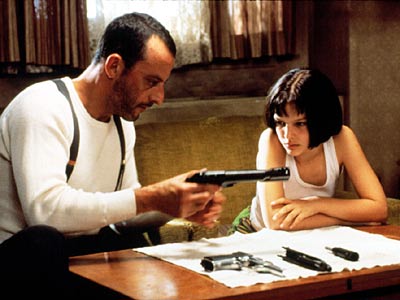
After the murder of her uncaring parents and innocent four year old brother at the hands of a pill-popping, Beethoven loving Gary Oldman, Natalie Portman’s 12-year old Matilda is taken in by her stoic, lonesome ’cleaner’ (a hitman to you and I) Leon. Leon’s skills as a contract killer are evidently impressive, shown early on by his one-man takedown of a drug dealer and his crew, disappearing into the shadows like the breath of a ninja, yet his skills as a human being and fully functioning member of society are less so, eking out a solitary existence with his milk laden fridge and beloved yucca plant. The introduction of Matilda into his life changes everything, as she requests training to avenge her brother’s death, in exchange becoming Leon’s assistant and tutor in reading and writing. Director Luc Besson shows a style and directorial flair seen previously in Nikita (where Jean Reno’s character first briefly appeared) as more recently in the decidedly more Hollywood-ised the Fifth Element (again featuring an intense, cackling turn from Oldman in villainous form).
Choose film 6/10

No Country for Old Men

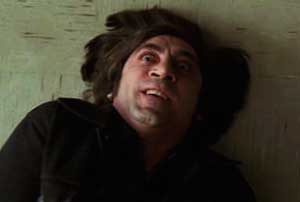
In this most bleak and convoluted offering from the Coen brothers you rarely witness a characters ultimate destiny, although they are hinted at enough to make a fair assumption. Josh Brolin’s Llewelyn Moss, a welder out hunting deer in south west Texas, stumbles upon a botched drug deal and, finding a suitcase full of money, goes immediately to the authorities before returning home to his wife and living a largely uneventful life. No, of course not, he legs it, instigating a game of cat and mouse with Javier Barden’s Anton Chigurh, a ruthless, near robotic hitman with an unusual and extreme set of morals, himself pursued by Tommy Lee Jones’ small town sheriff Ed Tom Bell. Featuring a stellar supporting cast including Woody Harrelson, Stephen Root and Kelly Macdonald, some incredible scenery, lensed by Oscar winning regular Coen cinematographer Roger Deakins and highly memorable dialogue lifted directly from Cormac McCarthy’s seminal novel of the same name, this is a truly inspirational and unique film. Bardem in particular completely embodies his character, becoming one of the most iconic villains to grace our screens in modern times. Brolin however strikes me as an actor from the ranks of Shia LaBoeuf and Sam Worthington, snapped up and promoted by big name directors without having the talent to back up the expectations, flooding the cinemas with frankly mediocre acting ability.
Choose film 8/10

One Flew Over the Cuckoo’s Nest

Jack Nicholson, in an arguably career best (so far) performance, is R.P. McMurphy, hopes to complete a short prison sentence without resorting to hard labour, and therefore pleads insanity and is transferred to a psychiatric hospital run by the steely Nurse Ratched (Louise Fletcher).  Ratched’s treatment methods, including humiliation and a mind-numbing daily routine appall McMurphy, as he realises the other patients are more focused on their fear of her than of functioning in the outside world. Although the main two performances are excellent, both winning well deserved Oscars, the film remains memorable more for the supporting cast that makes up the other inmates. Each has a specific and instantly recognisable personality, be it Brad Dourif’s stutteringly naive suicide risk Billy, Danny DeVito’s childlike Martini or Christopher Lloyd’s crazed loose cannon Taber, used whenever anyone is required to awake to a surprise situation, as Lloyd owns the greatest instant ‘what the Hell’ face on the planet.

The film is remarkable, not only for the acting but also the depths to which the story plunges, with an ending both horrific and genuinely surprising. Throughout the film it is obvious that McMurphy will be discovered as a fraud (something never actually stated during the film), and will of course be sent back to prison where he belongs (the sentence he is attempting to avoid is the statutory rape of a 15-year old girl), but the fate in store for him is far worse than could possibly be imagined. It also features possibly the most elaborate plan to have sex ever, hijacking a busload of patients, commandeering a boat and teaching said loons how to fish.

Choose film 9/10

The Life and Death of Colonel Blimp

Character driven and with a meandering, unhurried pace, this is most definitely not the war epic I had always assumed it to be. Following Roger Livesey’s Clive Candy over a forty year period as he climbs the ranks of the British army, insulting the entire German movement during the Boer War, retiring twice, forming a firm bond with a German officer and three separate relationships, all portrayed by Deborah Kerr. Livesey is excellent, adeptly showing the difficulties Candy faces trying to impose his old school sportsmanship and honourable values on the more modern ideology of total warfare. Admittedly, I would have liked more battle scenes, but this is more than made up for with the absurd comedy of the technicalities and formality of a duel, and the inclusion of Dad’s Army’s Frazer, a young John Laurie.

Choose film 7/10

Grease

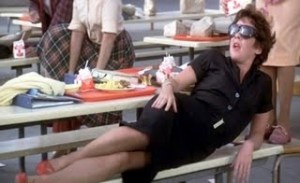
Back when high school films were about the popular kids, before the likes of American Pie and the Breakfast Club introduced the world to the less mainstream aspects of the educational sub-groups, Grease tells the story of a unexpectedly elongated summer romance threatening the street cred of a popular guy amongst his friends, themselves involved in a fairly tame turf war with a rival gang. As with most musicals, there isn’t enough plot to fill a film if you removed the musical numbers, but most of the cast are perfect (specifically Stockard Channing (Abbey Bartlet!) as bad girl Rizzo and Didi Conn as the more timid Frenchie), and the songs are pretty catchy, most notably Grease Lightning, but the overall message is incredibly dated. Apparently, the best way to keep a guy is to change everything about yourself to exactly how he wants to be, your clothes, appearance, personality, everything. Oh, and the final drive-into-the-sky shot is possibly the cheesiest moment ever committed to film.
Choose life 5/10

Local Hero

I really wanted to like this more than I did, as Peter Riegert’s Mac is sent from a Texas oil company to smooth over a land deal in Scotland, only to become captivated by the polar opposite way of life and the gaggle of eccentric locals (an African priest, web-footed diver, drunk Russian fisherman and devious, opportunistic landlord/lawyer), but alas I found the whole affair to be rather slow. Burt Lancaster steals the show as Mac’s astronomy obsessed eccentric boss Happer, and a young Peter Capaldi is a million miles away from the Thick of It’s Malcolm Tucker, all nervous laughter and gangling run (surely inspiration for Toy Story’s Woody and his flailing lope), and they did well not depicting the locals as completely ridiculous and twee, but there’s not a lot to really recommend about the film. The business meeting at the start being held in whispers after the manager falls asleep did make me chuckle, and the fickleness of a bosses decision making process hit a chord with my own experiences, so there’s something at least.
Choose life 5/10

Breathless

I’m doing this list for several reasons. Firstly, I want to broaden my cinematic horizons, watching those films I’ve often read about being legendary and must-see, yet never gotten around to actually watching. Secondly, I want to revisit some truly incredible films I’ve not seen recently, or perhaps haven’t watched well enough at this point. Thirdly, I’m shamelessly showcasing my admittedly phenomenal writing talents, to allow the literary world to recoil in shock and awe, ultimately paying me a princely sum for stringing sentences together. Finally, I want to give a second chance to films from the first reason that I have seen previously, but didn’t necessarily ‘get’. And so it is with a heavy heart that I approached Breathless (A Bout de Souffle). I first watched this about 3 years ago, when I first dabbled with Lovefilm. Admittedly, I only half-watched the film (a cardinal sin, especially if a movie is subtitled), but I found it silly, boring, and featuring a deeply unlikable lead character in Jean-Paul Belmondo’s sexist, arrogant, pretentious Michel Poiccard, on the run from the police after stealing a car and shooting a policeman, heading to Paris to collect some money and a girl to take with him to Rome. Regrettably, I found myself agreeing with my earlier judgement, as Poiccard proves continually a chauvinistic and rude kleptomaniac, consistently blaming others and never accepting his fate as being a product of his own irrationally actions. Quotations from his dialogue are probably supposed to be profound and thought-provoking, but under closer scrutiny mean nothing (“I want to become immortal, and then die”). Add to this editing tics such as wholly unnecessary (and nonsensical in the context of the scenes) jump cuts and occasions where characters seem to directly address the camera, then the film shows it is in fact largely over-rated. And I’m sure the main character closing his own eyelids after his inevitable brush with justice is supposed to be cool, in the end it’s just stupid.
Choose life 3/10


Butch Cassidy and the Sundance Kid

They actually got Robert Redford to run along the top of a moving train. How amazing is that? Yes I’m sure these days there are some actors willing to do their own stunts (and by stunts, they are probably referring to such extreme activities as riding a horse) but running along a moving train? Redford probably needs a wheelbarrow with him at all times to carry those balls of his in. It’s this devil-may-care, balls to the wall sensibility that shines through in Butch and Sundance, throwing in any number of cinematic tricks and keeping what stuck, from showing a road trip taking in destinations including New York and South America entirely in photographic stills, to probably the most famous and iconic freeze-frame ending in history. It is this, combined with Redford and Paul Newman’s co-dependent relationship and easy banter, even in the tightest of situations, that makes the film still a genre classic to this day.
Choose film 9/10