Boudu Saved From Drowning

A kindly, respectable yet adulterous bookshop owner sees a homeless man jump from a bridge and rushes to his aid, jumping into the river fully clothed to save him (though many other younger and less plump people are on the scene before he is) and subsequently takes the tramp in, giving him clothing, food and a bed for the night. This kicks off an unusual love square between the tramp, the bookshop owner, his wife and their maid, with the ruse and uncouth hobo causing disruption in the lives of those around him. Michel Simon is perfect as Boudu, but the plot is derailed by lottery-pivoted hokum and a scene where Boudu insults, frightens and possibly rapes the bookshop owner’s wife is glossed over, though she does seem to enjoy it.
Choose life 5/10

First Blood

The first time I watched this franchise kickstarter, as I’m sure was the case with most people who saw it after the release of the sequels, I was expecting a film more like Rambo 2-4, Stallone’s version of Red Dawn or Commando, charging around winning the Vietnam war singlehandedly, damming rivers with the sheer volume of machine gun shell casings left in his wake. But instead, First Blood follows Sly’s Vietnam vet John Rambo who, upon discovering he is the last surviving member of his crew, is run out of town by Brian Dennehy’s judgemental cop who doesn’t like the look of him. Refusing to leave, the cops – all of whom are either crooked, sadistic or offensively ginger – take him in and beat him around a bit, causing Rambo to snap and run off into the wood suffering ‘Nam flashbacks, with the cops hot on his tail and eager for revenge.
Seen from a different viewpoint, it would be easy to retell this as a horror film from the perspective of the police, with a plucky young David Caruso as the potential hero, as the small town police are taken out one by one by a sack cloth tunic wearing lunatic and an array of ingenious yet brutal traps, but this is Stallone’s show, and he puts in a committed, almost wordless performance.
Choose film 7/10

Beau Travail

Opening with a foreign cover of Holly Valance’s seminal pop masterpiece Kiss Kiss and apparently based on Herman Melville’s Billy Budd, Beau Travail is the Nytol of cinema. Twenty minutes after pressing play you’ll feel your eyelids become heavy, the world around you will slowly blur and you’ll sink back into your chair like a beanbag full of marshmallows, for this is a film in which nothing coherent really happens.
Narrated by French Foreign Legion Chief Master Seargeant Galoup (Denis Lavant), we follow the mundane day-to-day activities of the troops; washing, ironing perfect creases into their uniforms, getting a haircut, silently performing training exercises and occasionally enjoying a bout of aggressive hugging. The film has a half-remembered, dreamlike quality, and director Claire Denis has an eye for colour and lighting, but the lack of story makes it hard to care.
Choose life 3/10

A Canterbury Tale

If I’ve never heard of the film I’m watching, I usually assume it’s from the 1001 or 5-star lists, as though I’ve heard of a lot of films, these lists are peppered with some pretty obscure titles, so I was surprised to find this 1944 British film to be sitting at number 176 on Empire’s reader-voted top 500 and nowhere else.

Writing/directing/producing duo Powell & Pressburger, of the previously reviewed the Red Shoes and Black Narcissus, here tell the story of an earnest and open-minded American soldier alighting from his train a stop early in the small Kent town of Chillingham during World War 2. With the next train not scheduled that day, he hangs around and assists the locals in the search for a man terrorising the female residents by pouring glue in their hair.
There is some nice back-and-forth dialogue, and interesting ruminations on the famous Pilgrim’s Road, blacksmithing, church organs and UK/US comparisons, but also a lot of “Say, what’s that over there?” mundanity. The creative use of lighting is interesting, with a face and body all in darkness with only the eyes illuminated, but the ending is too twee and nicely tied up for my liking.
Choose life 6/10

The Artist

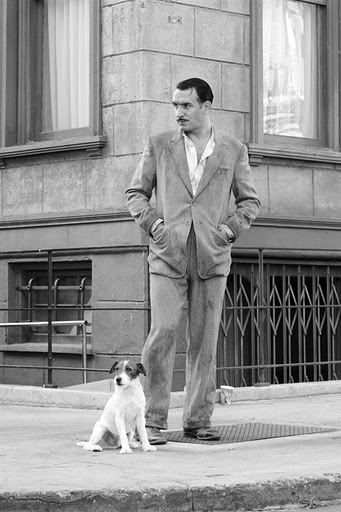
That’s right! I’ve been to the cinema twice in 5 days! Haven’t done that since I was single! Anyway, I managed to convince Aisha to come with me to see the Artist, the modern made silent film about the birth of the ‘talkies’, currently bothering awards ceremonies and set to win big at the Oscars next month. The film was excellent; it didn’t overplay the silent gimmick, even using it for some well timed and perfectly executed comic beats, and the performances were flawless, especially from leads Jean Dujardin and Berenice Bejo, and the adorable dog Uggie.
The plot was a tad predictable, concerning Dujardin’s silent movie star losing his way amid the encroaching sound-laden future, whilst Bejo’s struggling extra finds spoken dialogue could lead to a promising career, but then the plots of silent movies often were, especially by today’s standards, where 99% of stories are entirely made from previous pictures. The supporting cast of well known or know-the-face actors, including John Goodman, James Cromwell, Missi Pyle and Malcolm MacDowell, was a little off putting, as many had wordless roles I was waiting to crop up again, but other than that this was a near perfect film that’s my current frontrunner for best picture.

Choose film 9/10
 

Dog Day Afternoon

Based on a true story, Sidney Lumet’s tale of two inept criminals (Al Pacino and John Cazale reuniting after the Godfather 1 & 2) whose attempted robbery of a Brooklyn bank descends into chaos once the police, the media and the general public get wind of their plans. Pacino gives arguably one of his best performances – without resorting to ‘shouty Al’ – as he struggles to handle a situation completely out of his control, that is only ever going to become more so, and it’s refreshing to see a heist film with a couple of average Joes doing the robbing, as unlike Ocean’s Eleven or Inside Man, these guys have no plan, no masks, hell they even use their real names. Lumet excels when restricted to small locations (see 12 Angry Men), and here is no different, with almost the entire film taking place in and around the bank, as Pacino’s Sonny becomes a hit with the crowds gathering around the crime scene. Heading straight into the plot – Lumet rarely bothers with much initial back story – the direction is tight and entirely to the point, as every scene helps to progress the story further, or reveals a character detail previously unknown. There are some nice comedic touches – a bank teller hostage receives a call from her husband, asking what time she thinks she will be finished there, and when Sonny asks Cazale’s borderline psychotic Sal what country he wants to flee to, Sal replies “Wyoming,” and look out for Lance Henrikssen as FBI agent Murphy in one of his first film roles.

Choose film 8/10

War Horse

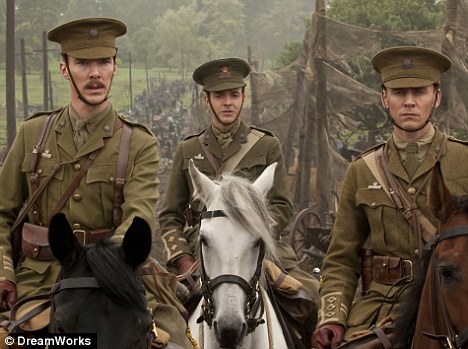
Went to see War Horse last night, and to be honest I wasn’t expecting that much, a kind of Au Hasard Balthazar combined with a WWI Band of Brothers, following the exploits of a boy and his horse as they navigate the major events of the first world war trying to find one another. But what I found was an uplifting, beautifully shot old fashioned film that was far more entertaining than I could have hoped.
Though at times the plot gave way for nosebags of sentimentality (this is a Spielberg film, after all), and few of the characters are onscreen enough to leave a resounding impression, though their parts of the story are some of the most touching (hello, Tom Hiddleston, Benedict Cumberbatch, Toby Kebbell and Eddie Marsan) every second of footage used is shot so perfectly, by Spielberg’s regular director of photography Janusz Kamisnki, who will surely receive an Oscar nod, if not a statue. The most beautiful moments are those in a far from beautiful setting, with Joey, the horse, jumping over and through trenches on No Man’s Land, only to be ensnared in barbed wire, or a sunset-backlit ride up a distant hill, and the sheer scale of some scenes, with hundreds of extras running from trenches or preparing for war. John Williams’ sweeping score is good but forgettable, and this is hardly one of Spielberg’s best (it isn’t quite the Saving Private Equine I was hoping for), with perhaps not quite enough time focussed on those fighting the war (it’s a good 45 minutes or so before the horse and boy, played by OK newcomer Jeremy Irvine, are separated), this is still a very entertaining watch. I think it’s better if you don’t really care about horses, as I enjoyed it immensely, but my horse-obsessed girlfriend spent at least a quarter of the two and a half hour run time watching through her fingers, so desperate was she not to see anything bad happen to a horse. It’s also remarkable that they made a film whose central character is a horse, yet at no point did I think it would be better if the horse could talk, or had an internal dialogue, even when he makes friends with another horse.
Choose film 7/10
Henry V

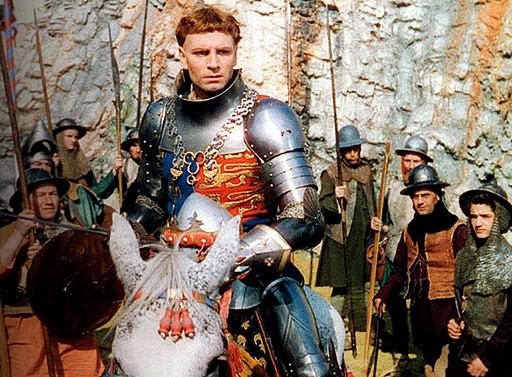
Before going in I thought I’d be completely lost in this, having not seen Henry I-IV, but I think the films must be standalone stories or something. This adaptation of Shakespeare’s royal epic (which I haven’t read, yet, and am not overly inspired to do so now) stars, and was directed by, Sir Lawrence Olivier, and uses the novel concept of being set on a stage at the Globe, complete with a heckling audience and backstage costume changes. Whilst certainly an interesting idea, this distances us from the film, in the same way as a laugh track would from a terrible sitcom, constantly reminding you that you’re watching a film. The conceit is wisely dropped for the central acts, freeing up the action for larger sets, sweeping camera movement, horses and battles. The rousing speeches are highlights, but the whole affair is dry and slow.

Choose life 5/10

King of New York

Christopher Walken landed a rare starring role in Abel Ferrara’s 1990 thriller as NY crime lord Frank White, recently released from prison and patrolling the rain lashed, neon-lit underbelly of his city. With the aid of his crew, Frank sets out to fix the city that has fallen apart in his absence, whilst retaining his criminal status, something cops Wesley Snipes and David Caruso rather object to. Also featuring Lawrence Fishburne, casting a shadow over everyone else’s performance as Walken’s right hand man and overall manic chicken-eatin’ mother fucker Jimmy Jump, and small roles from Steve Buscemi and Lost’s Harold Perrineau, if anything this film focuses too much on the policemen, and would have benefitted greatly from more Walken (as indeed could every film). He is the titular king, the film is his story, yet he seems to be a lesser character in it, though he is the most interesting as he disposes of the competition that have been running his city into the ground, and walks coolly and calmly away from a kill. I don’t think the ending did him justice either.

Choose life 6/10

Frankenstein/Bride of Frankenstein

Although at times laughable now, back in 1931 James Whale’s adaptation of Mary Shelley’s classic horror may well have been truly terrifying. Everybody knows the story; a mad scientist and his hunchbacked assistant rob some graves and, with the aid of a handy lightning bolt, create life in a giant, shambling monster, who eventually escapes his castle prison and is hunted down by a screaming mob with pitchforks and torches. This sense of inevitability is what lets the film down, and the limited effects available 70 years ago makes the film pale in comparison to however you can picture it in your imagination. Boris Karloff (replaced with a large ‘?’ in the opening credits for maximum levels of mystery) is brilliant as the monster, displaying childlike innocence in a giant, rigid, wordless performance that sees him throwing a young girl into a river to see if she’ll float, yet remains the victim in this tale.
The sequel picks up at the exact end of the first film, but is not encumbered by knowledge of the plot, or at least not for me, as all I knew was that at some point a female monster was created with a big black Marge Simpson hairdo with a white streak through it. The film uses a nice reminding device – the story is being told by original author Mary Shelley to her husband ad Lord Byron – which although takes you out of the film, adequately reminds of the climax of the previous picture. There are some cringe worthy scenes, most notably a blind man teaching the monster how to speak reminiscent of the worst scene of Terminator 2, with John Connor teaching Arnie how to be cool. The bizarre scene where Dr. Frankenstein’s former mentor Dr. Pretorius reveals the miniature people he has created in jars, including a king, a queen and a mermaid, is just insane, and Pretorius himself is a perfect combination of Doc Brown and Grand Moff Tarkin.
Frankenstein: Choose life 5/10
Bride of Frankenstein: Choose life 4/10