Sweet Smell of Success

I hate disappointment, yet the further into the List I delve, the more used to it I become. Sweet Smell of Success is a film I’ve had sat on my DVD shelf for over a year now (since even before the List entered and devoured my sad excuse for a life), and I’ve been waiting for a chance to watch it. Appearing on 3 lists and this month featured as Empire magazine’s monthly Masterpiece, my hopes were set to high. I knew two things: the film was endlessly quotable (a character in Diner does nothing but quote the script) and it features arguably career-best performances from leads Tony Curtis and Burt Lancaster. Whilst I cannot deny these points, I must take umbrage with the film for being far too dense. Even now I only have a vague idea as to what took place – Curtis’ ambitious yet downtrodden press agent Sidney Falco teamed up/sparred with Lancaster’s ruthless columnist J. J. Hunsecker in an effort to prevent a relationship between Hunsecker’s sister and a young jazz musician, so the Falco can get more column inches in Hunsecker’s paper. Much of the script is quotable (“You’re dead son, get yourself buried)”, but there is so much of it many of the best lines are lost. Doubtless this film will improve with repeat viewings, and if so my score shall be upgraded, but for a one-watch it doesn’t hold up. The score has also received a lot of plaudits, yet I found it really did not fit to the film – a barroom conversation sounds more like a frantic car chase. Here’s hoping the next viewing is more enjoyable.

Choose life 6/10

Fantastic Planet

On an alien planet, a race of gigantic meditating blue-skinned, red-eyes creatures known as Draags keep humanlike Oms as pets. To the Draags, Oms are no bigger than beetles, and are treated as playthings or pests, with the many wild Oms being routinely killed every three cycles (15 years) to prevent an uprising.

The world these creatures inhabit is, quite frankly, insane, inspired by both Stefan Wul’s novel and a large dose of narcotics, and has been created with a simplistic Python-esque animation style, with a heady dash of Dali thrown in for good measure.
It’s interesting to see that real-world parallels have been drawn, with the two races facing issues familiar to those of us on Earth – warring tribes, religion vs. science, giant flying anteaters – but why do those goddamn horny continental Europeans have to make everything about sex? Look out for the overly-phallic rockets late in the film.
Some plot points are dismissed too easily without realising their full potential; the magnetic homing collar, for instance, the scales are inconsistent, too much emphasis was put on creating a surreal landscape over an engaging plot and some scenes are far too trippy – the meditation involving wall and ceiling probes transforming the Draags colours and bodies – yet perhaps to an outsider our world would seem equally as bizarre.
Choose life 6/10

In the Realm of the Senses

Starting this film, one of my first thoughts was that the acting, camerawork and effects are excellent, as it really looks like those people are having sex. Then some small children started throwing snowballs at a homeless man’s penis, a man abruptly fingers his maid from behind, we see the homeless man playing with himself trying to get an erection whilst staring at a naked vagina, followed by an extreme close-up of a woman giving a man a blow job. After she had to wipe off her chin, I turned the TV off and sent the film back to LoveFilm, as this is a porn film. There’s no two ways about it, this is a film where people have sex, on camera, for real, and yet the good people Octopus Books decided to include it in their 1001 list, describing it as elegant and a true manifestation of passion (though seeing as it apparently ends with a man being strangled then castrated, I have a somewhat different view of passion). From the 15 minutes I was able to sit through (doing my best not to look at the screen for much of that) there didn’t appear to be a lot of plot to hold the film together, and a minute did not pass without nudity or a sexual act, yet at no point was the film even remotely erotic, remaining steadfastly in the uncomfortable and nauseating camps. Maybe some people could argue this is art. But for me it is porn, and I do not watch porn. And no, there is no picture to accompany this review.

Choose life 1/10

Requiem for a Dream

DON’T DO DRUGS. There you go, just saved you an hour and three quarters. Except that’s just the thing, although this film can be summed up in just three little words, it’s still an exceptional piece, just thoroughly depressing and cautionary. Easily the reason I’ve never so much as even picked up a joint, this film should be mandatory viewing in schools and rehab centres the world over, with every step taken by the four leads taking them further down a spiral they really don’t want to see the end of. Firstly, there’s Jared Leto’s slacker Harry, living day-to-day by repeatedly stealing and selling his doting mother’s television with best friend Tyrone (Marlon Wayans, surprisingly good) in order to buy drugs. Harry’s girlfriend Marion (Jennifer Connelly) is a promising fashion designer, but occasionally must turn tricks when money runs low, and Harry’s mother Sara (Ellen Burstyn, Julia Roberts has your Oscar) lives alone, glued to her television, unable to deal with the direction her son has taken.

The film is at times incredibly hard to watch (double-ended dildo, anyone?) but when you do it’s nothing short of a cinematic goldmine, with director Darren Aronofsky’s editing and Clint Mansell’s spot-on score fitting the addiction-addled characters lives perfectly. Fish-eye lenses, split-screen, sped-up/slow-down footage and cameras strapped to actors focussed on their faces as they flee from the mess they’re in are all used perfectly. Compare this to Happy Together, where these same devices were used just for the sake of it, to show the director could, and you can really see how relevant they are here. Also, compare the editing, especially that of drug hits; rapid shots of syringes depressing and eyes dilating, with similar edits in Edgar Wright’s Shaun of the Dead. The two use very similar techniques, but with wildly different effects.
I felt the three youngsters should have been scrawnier and more blemished than they were, with Wayans and Leto especially being far too muscular than I’d expected a junkie to be. The storytelling though is excellent, with actions truly speaking louder than words, most shots consisting of close-ups or POV.
I had a couple of “Hey, it’s him” moments: Crash’s Keith David is a lecherous ‘party’ host, Spiderman’s Dylan Baker a Southern doctor and Office Space’s Ajay Naidu is Sara’s mailman. Also, Christopher McDonald needs some recognition for playing almost the same sleazy TV scumbag he played in Quiz Show.
Choose film 9/10

Sabotage

This early Hitchcock sees him dealing with familiar themes – espionage, deception, blackly comic beats and playful cinematic references – as a cinema owner (Oskar Homolka) acts as a terrorist agent in London unbeknownst to his wife (Sylvia Sidney) and her young brother, whilst Scotland Yard’s detective sergeant Spencer (John Loder) poses as the local greengrocer in an effort to catch the saboteur. The relatively slight length – a brief 76 mins – is still padded with background lines and squabbles, as Hitch unusually detracts from his otherwise straightforward plot. The greatest sequence involves the young Stevie (Desmond Tester) unwittingly transporting a bomb across town, only to be held up by a toothpaste salesman, a bus conductor and heavy traffic, with tension mounted with wordless cuts between the bomb, the boy, the obstacles in his way and every clock in the vicinity. The acting is top notch too, with more said in Homolka’s eyes than any line of dialogue.
Choose film 6/10

Salt of the Earth

“The only major American independent feature made by communists.” Good for them, well done, pats on the back all round. Now go away. Noted critic Pauline Kael rightly declared the film as propaganda upon its release, and I wholeheartedly agree, with the film depicting an uprising of Mexicans working in a fictional New Mexico mine. By all means they should fight for equal rights with the white workers, and their women should fight against the men against the rampant sexism, but the acting is terrible (from a largely unprofessional cast, so what did they expect?) and literally nothing unexpected takes place throughout the entire film. Every box is ticked in the story-of-a-strike category, and the topic is something more fitting to a setting in which a deeper, more personal film takes place (see Billy Elliot).
Choose life 4/10

Mediterranee

This is not a film, but is merely cinema for the sake of art, as three unconnected mediums – a semi-poetic, philosophical narration, a hauntingly evocative soundtrack and a collection of unconnected, repeated images and videos are played out for 45 minutes. Ruins, statues, machinery, oceans, gardens, a girl on an operating table, a man rowing a boat full of junk and tracking shots of hallways are all included, and none of them have a point. I’m also getting rather of tired of watching animals killed on films, what with this, Strike, In This World and Land Without Bread (to be reviewed) all featuring slaughter of some kind. Please stop it.
Choose life 2/10

Strike

Eisenstein’s back! Hurrah, I’d almost missed him. And not only has he found his way back to the List, but this time it’s with his first ever film, 1924’s Strike, a tale of – you guessed it – a strike at a Russian metalworks factory. Tired of long days for little pay and even less respect, and after one of their colleagues kills himself after being fired for a theft he not only didn’t commit, but reported, the workers go on strike. The 1920s image quality and an overuse of shadows makes it hard to tell one character from another in many instances, but there is a creative use of editing – Eisenstein’s trademark, cutting to hard-hitting imagery or between the rich and poor, here showing the wealthy fat cats stuffed in tuxedos swilling brandy and puffing on cigars whilst the workers protest. Also, an early trick of subtitles rearranging and merging into the picture is well received, as are photographs coming to life as though printed in the Daily Prophet.
Alas, some scenes are difficult to follow, though there is much less Russian history on show here than in Sergei’s later pictures, so well done for that old boy, but overall the direction is too heavy handed.
Choose life 4/10

Walkabout

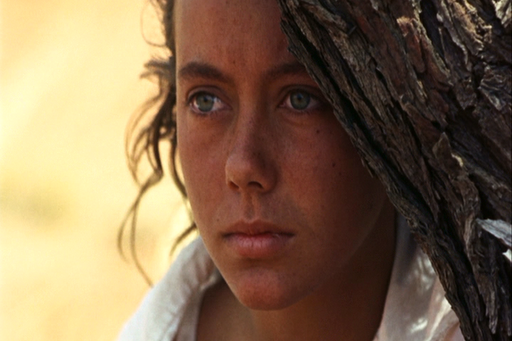
I love a good blindside. I can really appreciate when a scene is built up and plays out fairly expectedly, then at the drop of a hat something crazy drops out of the blue and completely changes the direction the film was heading. Safe to say, at some point in Walkabout this happens. I won’t say when or what, but I was pleasantly surprised by the way this film turned out, as two British children, including Jenny Agutter, a long way from the Railway Children, head out into the Australian outback with their father for a picnic. The film contains beautiful images of scenery and wildlife worthy of Attenborough, though Agutter’s skinny dipping scene is a little unnecessary – standing up in shallow water and giving a full turn, floating gracefully along on her back before putting on her tight white blouse, sopping wet against her pale, smooth skin… excuse me a moment.
 …sorry about that, got myself a bit distracted there. Anyway, this is a great little film, directed by Nicolas Roeg (Don’t Look Now, Performance), with some thought provoking editing (cutting between a kangaroo being slaughtered and a butcher cutting up chicken), occasionally lewd comedy (all the men at a research base looking up the skirt and down the top of their attractive colleague) and only a rambling nature and slightly unsatisfactory conclusion letting it down.
Choose film 7/10

Jaws

Der-dum. Derr-dm. Derrr-dn. Derrrr-dn. Der-dn. Derr-de der-de de-de de-de de-dn-de-de-de-de!
Two notes. The most memorable two notes in history, signalling to the world that a skinny dipper won’t be home for dinner.  Composer John Williams, here winning his second of five Oscars – so far – and whom celebrated his 80th birthday last Wednesday, used these two notes to produce a primitive, devastatingly simple theme tune more recognisable than any other in cinema. Would Jaws have had such an effect without the tune? Probably, but it might not be quite so memorable.
Some credit should be given to the director too. A 26-year old working on only his second feature after the mild success of The Sugarland Express and his direct-to-TV man vs. truck classic Duel, cocky young upstart Steven Spielberg was eager to prove his worth. After purchasing the rights to Peter Benchley’s novel, what followed was one of the most famously arduous shoots ever experienced until Apocalypse Now. The actors hated each other. Boats almost sank or repeatedly drifted unwanted into shot. The pissed off Martha’s Vineyard locals incessantly badgered the crew, it all cost too much and took too long, with reshoots needed to make it just right (some scenes were reshot in the editor’s swimming pool). And of course, the shark didn’t work. The eyes looked weird, the jaws wouldn’t close, the thing wouldn’t float or just didn’t work full stop. Everything had to be geared around that giant mechanical fish. But in a way, all these obstacles came together to add to the whole. The three leads – Roy Scheider’s chief of police Brody, Robert Shaw’s salty sea dog Qunit and Richard Dreyfuss’ techie oceanographer Hooper are supposed to distrust each other, so a mutual dislike between the actors could only heighten that. Continued reshoots allowed shots to be perfected. And a malfunctioning shark meant they couldn’t show the monster, allowing audiences imaginations – always able to outdo any Hollywood special effects – to add in the gnashing teeth, piercing eyes and circling fins where needed. The film set the template for every blockbuster and mainstream monster horror since – only the best creature features save the big reveals to the end.
Whilst there is much to thank Mr. Spielberg for with regard to Jaws’ impact, there are some downsides too. Jaws was released nationwide in over 400 screens – unheard of in its day. Everyone involved assumed it would flop, so they prayed for a fair to middling opening weekend with which to gain back the millions lost in the making. Instead, they found the weekly grosses did nothing but rise, so a complete market saturation became the norm for all summer blockbusters, most notably Star Wars two years later. So nowadays you can blame the tentpole summer pictures – the floods of superheroes and giant robots beating the crap out of each other – at least partially on Jaws.
Not everything good came from the bad or accidental though. The script and staging is impeccable, with one notable scene – the three leads in the galley of Quint’s boat the Orca – passes from tension, to camaraderie, through heavy emotion, back to a sense of fun and then intense action, all without any sense of confusion or feeling rushed. There is some great blindsiding; assuring you something obvious is going to happen, before smacking you in the face with the exact opposite, and even the little moments – the ominous clicking of an unwinding fishing line under Quint’s steely gaze, Hooper’s boyish glee at the menagerie of jawbones hanging in Quint’s shack – all register with great impact.
Choose film 10/10