Man Of Steel

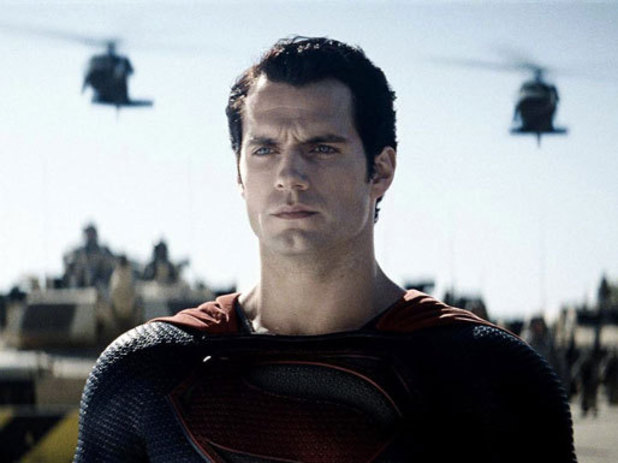
On the planet Krypton, the elders have disrupted the planet’s core and caused it to begin to erupt. Everyone on the planet is doomed, except for a small, barely explained plot contrivance that allows one newborn baby to be launched in a pod and sent to another planet that will be hospitable to him, but where the atmosphere and density are different enough to provide him with extraordinary powers. Krypton explodes, but the baby arrives safely on Earth, where he lives his life as a loner, the last of his kind, until General Zod, an exiled Kryptonian soldier, and his crew discovers the baby – now a man named Clark – on Earth. Look, it’s fucking Superman, alright? You know what happens. Alien baby, adopted by Ma and Pa Kent, Dad dies, kid can fly, run really damn fast, x-ray laser vision, falls in love, glowing green rock, Daily Planet, threat against the planet, saves the world. Yadda yadda yadda.
henry-cavill-man-of-steel
Continue reading

Flushed Away

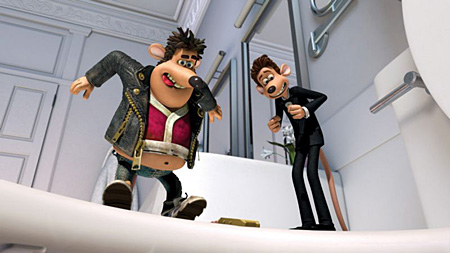
flushed-away-3_1162513793Pampered pet rat Roddy St. James (Hugh Jackman) may appear to live the life of luxury with his lavish Kensington home, gargantuan television and high class lifestyle, but his existence is lonely, and he craves companionship. When his owners leave him for a few days, his world is rocked by the arrival of loutish hooligan sewer rat Sid (Shane Richie), who takes over the house and ridicules Roddy’s way of life. Roddy’s plan to evict Sid – via the toilet bubble bath – goes awry, and results in Roddy being flushed instead, leaving him lost in the vast underworld of London’s sewage system, where he becomes intricated with Kate Winslet’s tomboyish Rita and a plot involving a royal ruby, a computer cable belt and a mysterious plot concocted by sewer mafia boss The Toad (Ian McKellen).

Continue reading

Kate Winslet: Naturist

Kate Winslet, it seems, is more than just a disembodied pair of breasts that sporadically unveil themselves at inopportune moments in movies. Apparently there is a voice associated with those mammaries (and therefore, one assumes, a mouth, tongue, trachea and who knows how many other body parts too), and it is a voice that has become familiar to the public at large. It was only natural then that the lady in question would use said voice within films, as is the case here with two semi-documentary dramas that focus heavily on nature: The Fox And The Child and Pride. After all, it’s no secret that voice acting is a great deal easier than full-body acting, as there’s no hours of make-up, preparation of scenes and lighting or extravagant costumes to put on (or take off, as the case may be). Unfortunately, the appeal of an easy job can cause a lull in judgement in choosing said work, as is the case with both of these films. Continue reading

The Skin Game

Mr. Hornblower (Edmund Gwenn) has just purchased a rented house from Mr. Hillcrist, under the circumstance that the former does not evict the long-standing tenants of the house, the Jacksons (Herbert Ross and Dora Gregory). However, as soon as Hornblower has bought the place the Jacksons find themselves homeless, which starts a familial war, or ‘skin game’ between the two families.

Finding Neverland

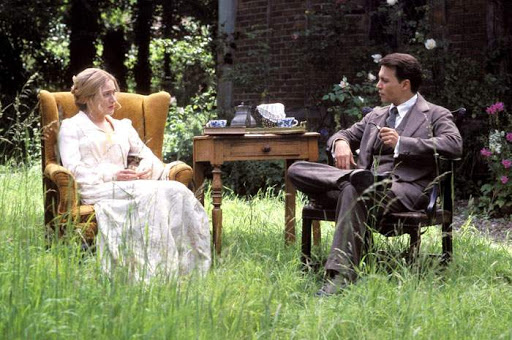
London, 1903. Acclaimed playwright J. M. Barrie (Johnny Depp) has just written a play, Little Mary, but unfortunately it hasn’t done too well. When his maid cuts the review from his newspaper, Barrie spies Sylvia Llewelyn Davies (Kate Winslet) and her four young boys playing in the park and soon begins spending a great deal of time with them. He finds their exploits to be inspirational, and indeed they inspire within him the idea to write a new play, one that children can enjoy as well as adults, about a boy who never grows up.
Continue reading

Zero Dark Thirty

After the events of September 11th 2001, the priority of the CIA understandably became apprehending Osama Bin Laden, the leader of the terrorist group behind the attacks. CIA operative Maya (Jessica Chastain) joins a team involved with this, whose initial job is the interrogation of potential leads by any means necessary, but she soon becomes more involved with the bigger picture, and ultimately becomes the only person absolutely certain of the whereabouts of Bin Laden, culminating in a U.S. Navy Seal attack on the house he is believed to be staying in, some twelve years after the search began.

The Life of David Gale

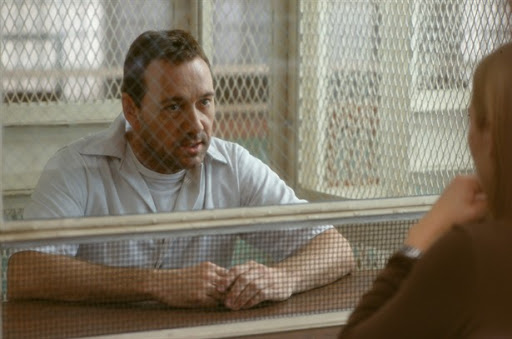
David Gale (Kevin Spacey) used to have it all. He was the Head of Philosophy at Austin University, an acclaimed writer with a wife and son (with some dinosaur pyjamas I’m more than slightly jealous of), co-director of Death Watch a group against the death penalty, and he had the moral standing to turn down the advances of a nubile young student out for an easy A (Rhona Mitra). Now, however, he’s in jail, about to be condemned with the very punishment he’s spent his life protesting against, having been convicted of the rape and murder of his friend, colleague and fellow protester, Constance Harroway (Laura Linney). Three days before his scheduled execution, Gale requests three interviews with ambitious yet unfortunately named magazine journalist Bitsey Bloom (Kate Winslet), to whom he tells his story in the hope that she will believe him, and discover whoever is behind his supposed framing for the crime he says he didn’t commit.

Continue reading

Pather Panchali

The story of a very poor family struggling to make ends meet in a Bengali village in the 1920s. Harihar (Kanu Bannerjee) must cope with looking after an elderly relative, kleptomaniacal daughter, carefree infant son and her clueless husband as he does his best to provide for a family that never seems to catch any breaks.


There are many films in the 1001 list that, when watching, I can’t really see why they’ve been included, and it isn’t until afterwards (or during, if it’s really boring) when I read up on the film a little, that I discover there is some cultural significance or historical context within which the film can usually be appreciated as an achievement, but not necessarily enjoyed. Such is the case with Pather Panchali, for as I now know it is the first film of director Satyajit Ray, who would go on to direct various other films also included within the 1001 book: The Music Room, Aparajito and The World of Apu, with the latter two completing the Apu Trilogy, begun with this film. Pather Panchali also marks the first independent Indian film to garner international acclaim, so that at least answers the question of why it was in here.

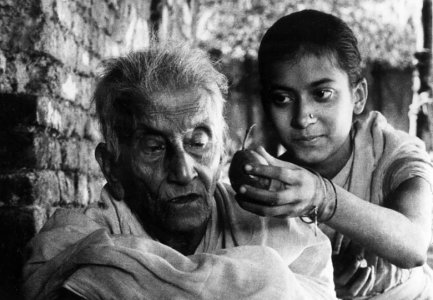
So what was wrong with it? Well, nothing really, it just didn’t really feature a great deal in terms of plot or anything to engage my attention. Its just a rather plodding depiction of an Indian family’s life, and the sporadic ups amidst mostly downs that they endure. There are some nice moments – the joy cracking across the wizened face of the elderly relative when Harihar’s daughter Durga gives her a guava stolen from the neighbour’s orchard, Durga and her younger brother Apu encountering a train – but once again I’m getting rather tired of watching depressing films. As such, I really don’t have that much to discuss about the film.

The most annoying aspect of this film is that its the start of a trilogy, all of which appear on the 1001 list (and the Empire 5-star 500 List, for reasons that will hopefully become clear once I’ve seen the rest of the trilogy). Before watching, all I knew about Pather Panchali was that it was the start of this trilogy, titled the Apu Trilogy, so I was expecting it to be about someone called Apu. Therefore, once he was born, I expected him to be the central figure of the story, but was surprised when he was kept mostly to the sidelines. I’m sure he’ll become more prominent in the later films, but I’ll try not to anticipate that, just in case he doesn’t and I become even more disappointed later. Aparajito and The World of Apu are the next two films in my LoveFilm queue, so I should be getting to them fairly soon, as long as I can bring myself to actually watch them.

In short, I’m chalking this film up alongside the likes of The Jazz Singer, Battleship Potemkin and Olympia as being a historical moment in cinema, but one that I’m not keen to repeat, and definitely cannot recommend.

Choose life 5/10

3-Iron

Tae-suk (Hyun-Kyoon Lee) has no home, few belongings and leaves no mark on the world. Essentially, he has no life, but why would he need one, when he can borrow other people’s for a few days at a time? Leaving pizza menus taped to the front doors of houses and apartments, he establishes who is away for a while, breaks in and makes himself quite literally at home, making a quick exit before the inhabitants come home. But in his latest domestic intrusion, Tae-suk neglected to ensure the house was empty, as abused housewife Sun-hwa (Seung-yeon Lee) is still home, and when she discovers him he flees, but he returns to find her husband not being overly kind to her. Tae-suk lures him outside and pelts him with golf balls, prompting Sun-hwa to run away with Tae-suk, joining him on his adventures.

I’m guessing that the main reason this film was included amongst the hallowed ranks of the 1001 Movies book is due to it’s sense of poetry, and the fact that the two leads barely even utter a sound for the entirety of the film, but the main reason that the film is no longer a part of the book is because it’s all inherently stupid, with far too many plot issues than I can justifiably overlook, and which ruined the film for me.

Let’s start with the obvious. Tae-suk’s plan is to stick takeaway menus to people’s front doors in the morning, and then come back in the evening to see which one’s have been removed. If a menu is still in place, he assumes that the occupant’s are away for a while. Has he never heard of anyone working late? Or popping out for a drink after work, maybe going for a meal, nipping to the shops or even seeing a film at the cinema? And even if the inhabitants are on holiday, he has no idea how far into it they are, other than on the rare occasion that someone’s outgoing voicemail message announces their return date. For all he knows, they’re due back that evening. It’s not the most well thought out of schemes. Also, he puts an enormous amount of faith in sticky tape. I don’t know about you, but I find the stuff to be wildly ineffective in terms of it’s adhesive power, even when not exposed to the elements. And what’s with the woman who was terrified of the missing photo in an apartment she’s never been in before? The ending, too, is ludicrous, and though the final shot is beautiful and pignant, it doesn’t hold up when even the slightest amount of logic is applied, for example, are there no mirrors in the house? But even though the resolution is downright silly, it was still oddly poetic and smile-inducing, in spite of just how ridiculous it was.

Basically, for the most part I found this film infuriating, so much so that it’s quiet beauty and simplicity was almost lost on me, so great was my annoyance level. There was a real sense of inevitability to many of the scenes – I was waiting for the drilled golf ball to come loose, and for the breaking and entering to all go horribly wrong as soon as the elements were established – and even at a scant 88 minutes I was regularly checking the clock. The prison-set scenes were nice, but unless I’m really missing something blatant, I just didn’t get this film. Whilst I appreciated the unspoken romance between the two characters – some things are easier said through looks than words – and the performances cannot be criticised in either case, I just can’t get behind a film with such irritating issues.

Choose life 5/10

Murder!

A member of a travelling theatre company has been murdered in the lounge of the guesthouse in which she is staying, with only a fellow company-member, a discarded poker and an absence of brandy nearby. The trial is quickly over, with the jury swung by the overwhelming evidence pointing towards the defendant’s guilt, but after the verdict has been cast and death has been sentenced, one of the jury members begins to have doubts over their decision.

12 Angry Men is one of my favourite films, and Alfred Hitchcock is one of my favourite directors, so when I discovered this film, I was half expecting to find Hitchcock’s version of 12 Angry Men would rapidly be topping my favourite films list. Alas, this is not the film I’d hoped for, as in fact the jury and trial scenes take up a very small portion of this film, with most of the focus instead going to the investigation held by Sir John Menier (Herbert Marshall), one of the jury members who also has strong connections to the theatre business, in which both the deceased and defendant were employed. Once I was past my initial disappointment, I settled down to watch what turned out to be a fairly standard, by-the-numbers procedural picture, whose only difference from the norm was the general lack of police, detectives or journalists doing the crime-solving.

Before the trial the film has quite a comedic tone, which is odd, seeing as it’s immediately after a murder. The very opening involves two of the theatre company’s members, Mr. and Mrs. Markham (Edward Chapman and Phyllis Konstam) attempting to uncover the source of the recent scream from down the road, only to be prevented from doing so by a window refusing to remain open whilst their heads are protruding from it. A policeman trying to ascertain the events of the evening finds his work cut out for him when he attempts to question the theatre company during a performance, so must fit his interrogations between the sound effects and actors heading on and off stage. Once the trial begins the comedy is still around, but it’s much sparser and broader, for example the dim-witted juror.

The main problem with this film is the story, which although having been based on the play Enter Sir John by Clemence Dane and Helen Simpson, seems to have been written hurriedly and not thought through all that well. It may be due to the large number of whodunnits that I’ve seen, but I’d sussed the plot fairly early on after a piece of evidence the cast seemed fairly unimportant, but clearly left the whole thing wrapped up. Also, the whole thing seems to rely upon the fact that sticking one’s fingers into one’s ears and shutting one’s eyes can prevent a person from sensing absolutely anything that happens directly around them. Sir John’s method of achieving a confession from his assumed culprit is also frankly ridiculous, but does at least comply with his being a theatre producer.

The poor audio of the film didn’t increase my enjoyment of the film either, and the various scenes of characters talking over one another didn’t help either. The most egregious case of this was a fairly superfluous scene of Sir John receiving a cup of tea in bed from his landlady. Their entire conversation could have been vitally integral to the plot, however I didn’t catch a word of it due to her detestable brood of children harassing John and running around screaming. I get enough of that just listening to my neighbours two kids through the wall, thank you very much. The overzealous, unfitting score didn’t help either. What finished everything off was the final shot, which was only recently defeated for audacity and sense of ego by Tarantino in Inglourious Basterds.

Hitchcock may well have a fascination with murder and intrigue, but he also likes to focus on the aftermath of the deed, rather than the actual offence itself, as he also does in Rope and The Trouble With Harry. Unfortunately it didn’t pay off here as much of it did in those other pictures, so I’m afraid I can’t really recommend this film.

Choose life 5/10