Buster Keaton

 I went on a bit of a Buster Keaton spree here, courtesy of LoveFilm’s watch online feature, allowing me to watch all of his films from the list – five in total – almost in one go. Ranging from 45 to 107 minutes in length, all are of course silent and black and white – the latest was made in 1928 after all, but to a film they are all exceptional, but I couldn’t help picking up on some recurring themes. Of the five, four involved a damsel in distress scenario, where Keaton’s diminutive heroic figure is the only one able to save her. Four predominantly feature trains, three offer a high speed pursuit, three have major plotlines revolving around an across the tracks romance, three use the theme of inheritance in some way and all five feature peril involving water, be it a dam, waterfall, water tower, boat or flood.
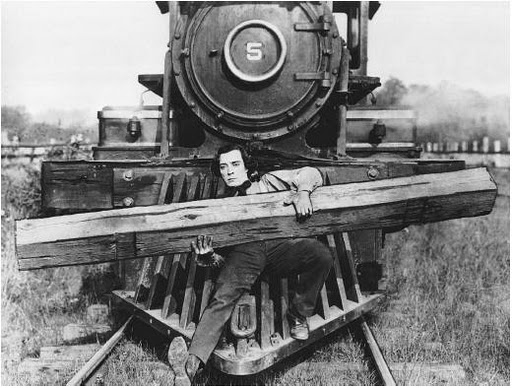
The best of the bunch are the General, depicting Keaton’s southern train engineer singlehandedly invading the North to rescue his girl and his beloved train, and Sherlock Jr., where a cinema employee dreams of being a famous detective. The General offers much in the way of action and physical comedy, as Keaton climbs over and sits on the front of a moving train engine. It’s Keaton’s most famous film, and rightly so, as his straight-faced fool tries so desperately and earnestly to do the right thing that he cannot help but be hilarious, staggering from one mishap to the next, rescuing the girl from the enemy only to be confronted by a bear. Throughout the films Keaton takes a cartoonish view to violence – getting limbs caught in a bear trap is less of an inconvenience than when it happens in the likes of Straw Dogs or Severance, but this only adds to the fun – it wouldn’t be very entertaining for the characters to be rushed to hospital every few minutes.
Seven Chances is at the disadvantage of having been made into the Bachelor, starring Chris O’Donnell in 1999. The remake does nothing but detract from the quality of the original film, as both use almost entirely the same plot – a man must marry before a given date, or be denied a rich relative’s vast inheritance – yet Keaton does it much more successfully with little messing around or unnecessary mucking about with now perfunctory rom-com tropes.
Our Hospitality plays on the Romeo and Juliet tale of warring families with besotted children, but takes it in an inspired new direction when Keaton’s Willie McKay attends a dinner hosted by the family of his new love, only to discover they are the Canfields, with whom the McKays have feuded for many years, and who are responsible for killing Willie’s father. The new spin is that, although the Canfields desperately want to kill Willie, their family code of honour prevents them from doing so whilst he is a guest in their house, so Willie does his best to remain there indefinitely.
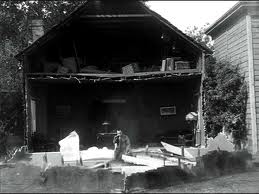
Finally, Steamboat Bill Jr. sees Keaton sent to work in Boston with his steamboat captain father, but the beret clad, ukulele playing, moustachioed diminutive Keaton is not what his father was expecting. Somewhat predictably, Keaton’s Bill Jr. is eventually required to save the day, making his father see him in a whole new light, but along the way some incredible stunts, including the infamous house front falling on Keaton during a storm that could have killed him had it gone wrong, make this a worthwhile watch all the same.
The General – Choose film – 9/10
Seven Chances – Choose film – 8/10
Our Hospitality – Choose film – 7/10
Steamboat Bill Jr. – Choose film – 6/10
Sherlock Jr. – Choose film – 9/10
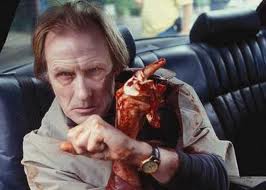
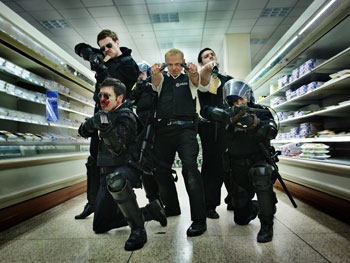
Shaun of the Dead/Hot Fuzz

How does one create two of the best loved British comedies of recent years? Initially it seemed purely to involve director Edgar Wright and stars Simon Pegg and Nick Frost, but recently Wright’s foray across the pond, Scott Pilgrim vs. the World, was well reviewed but barely seen, whereas the Pegg/Frost scripted Paul drew huge crowds but lacklustre reviews. No, the secret it would seem is to keep this trio together, with Wright and Pegg on scripting duties, Pegg in the lead role and Frost as his incompetent sidekick. Pepper the rest of the cast with the cream of British acting and comedy, including Jim Broadbent, Timothy Dalton, Peter Serafinowicz and Dylan Moran, with Bill Nighy and Martin Freeman appearing in both films. Also, there must be cameos you can miss even without blinking – in Hot Fuzz, Cate Blanchett plays Pegg’s ex-girlfriend behind a decontamination mask and Lord of the Rings director Peter Jackson is the Santa who stabs him through the hand- but crucially, the film must remain thoroughly British.
For this is the true secret of these films. Whereas other great British filmmakers seem to shy away from their country of origin (Danny Boyle, Ridley Scott, Alfred Hitchcock) opting instead to embrace the more commercial stylings of Hollywood, Wright and co. make sure that if you cut the film in half, it reads Made in England all the way through. From the settings – the zombie-infested streets of London or the sleepy rural village of Sandford, to the cast, sense of humour and the solution to any problem (“I dunno… pub?”) there have never been comedies this British since Kind Hearts and Coronets.
 It is also difficult to pin down what kind of a comedy the films are, as they feature equal quantities of character driven sitcom (Shaun’s vying affections for girlfriend Liz and best mate Ed), genre pastiche (there are more references in both films than could ever be listed), social commentary (upon discovering a zombie, Ed and Shaun first assume she is drunk), outlandish set pieces (battering a zombie with pool cues to Queen’s Don’t Stop Me Now) and subtle farce (The foam housing of twin pistols either side of a thermos in a pensioners bag). This cornucopia of comedic styles means that, if you didn’t like the last joke, it’s OK as another will be along shortly.
The most important aspect though seems to be to make sure there are repeated, quotable lines, whose meanings change throughout the course of the film (“He’s not my Dad,” “You’ve got red on you.”) or off-hand or unintentional predictions that inevitably come true. Of the two films, Fuzz rates a little lower due to a bout of Return of the King syndrome, with more explosive endings than are strictly necessary. Shaun also offers more rewarding repeat viewings, with many lines not landing their full impact without prior knowledge of the rest of the film.
Shaun of the Dead Choose film 9/10
Hot Fuzz Choose film 8/10

Annie Hall

Woody Allen famously has a tendency to write himself into most, if not all, of his scripts. It is usually difficult to distinguish where Allen ends and his characters begin, and this is none more so than with Alvy Singer, Allen’s neurotic obsessive from this, arguably his greatest and funniest film. It is this ability to use himself, or at least a variation of himself, as his protagonist that has allowed Allen to create such a well rounded, nuanced persona. One wonders if he hasn’t been living life as this character since birth, honing the pessimism, the paranoia and awkwardness, so now all he needs to do is put the ‘character’ into a slightly heightened situation, and a natural comedy will emerge.
Not that character is the only weaponry in Allen’s arsenal. The script is hysterical yet droll enough to quote in everyday life (“we can walk to the curb from here”), the performances perfect, particularly Diane Keaton as the eponymous Hall, both Singer’s ideal partner and greatest foe, and the film is peppered with fourth wall breaking with moments of originality, from a narration that admits it may be exaggerating to direct-to-camera conversations and asides.
Thee almost sketch-like format of the film, flitting backwards and forwards in Hall and Singer’s relationship, suits Allen well, as he is a filmmaker of varying styles and techniques, so he is able to showcase this without jarring the rest of the film, such as when he used split-screen to compare different family meals, or stopping random people in the street for relationship advice.
Oh, and the woman waiting with Singer at the end of the film, out of focus and silent in the distance for a matter of seconds? None other than Sigourney Weaver.
Choose film 8/10

The Cat Concerto

I had a revelation watching this 1946 Tom and Jerry short on Youtube. For years, watching these cartons as a child, I had always thought of Jerry, the mouse, as the hero, and Tom, the cat, as the bad guy. I think this is largely to do more with my own personal deep hatred of cats (I won’t go into it) than any context of the cartoons, but watching this (and subsequently Mice Follies, a personal favourite), my groundbreaking, life changing epiphany is this: Jerry’s a jerk. Seriously, the mouse is a dick. Think about it, Tom is playing a piano solo in a large, important concert, but his playing awakens Jerry, who has chosen the piano as an optimal sleeping venue. Yes, that’s right; he’s sleeping in a piano. You know; a musical instrument? Something designed to make noise and do nothing else? And upon being woken up he has the audacity to be pissed off, and sets out to sabotage the rest of Tom’s performance.
Utilising physical comedy, slapstick (the troublesome cummerbund) and surreal inflections (Tom’s extendable finger able to reach the extra high notes), this is beautifully choreographed, tightly controlled comic perfection that never misses a note.
Choose film 8/10

Into the Wild

Christopher McCandless (Emile Hirsch) has a very promising future ahead of him. Considering Harvard Law school after graduating from college, with a healthy savings fund and parents willing to buy him a new car, he’s set to make a name for himself in middle class middle America.
But alas, this is not the life he wishes to lead, refusing to make the same mistakes his parents made – marrying the high school sweetheart, living in an unhappy, abusive marriage for the sake of appearances – he gives his savings to charity, dumps his car, burns his ID and cash and changes his name to Alexander Supertramp, pledging to live life alone, “no watch, no maps, in the wild.”
Told through letters to his sister, accounts from those he met along the way and excerpts from his own diary, this true story, directed by Sean Penn, is at times joyous, tense and heartbreaking. There isn’t a weak link in the cast, but the standouts are easily William Hurt and Marcia Gay Harden as the confused parents left behind as their ideal son wanders for years with no communication, not even a letter goodbye.
Penn at times drifts too far into Terrence Malick territory (Malick previously directed Penn in the Thin Red Line), with elegiacal shots of admittedly beautiful scenery, poetic, philosophical pontificating and a meandering style, flitting between Alex’s journey across America and his time spent living in an abandoned ‘Magic’ bus he finds in Alaska, but the story and performances pull it through. You get the feeling the journey is exactly how Alex had hoped, finding the people he would have preferred knowing when growing up; the parental fellow travellers Jan and Rainey (Catherine Keener & Brian Dierker), girlfriend (Kristen Stewart), boss (Vince Vaughn), friends (the semi-nudist random Swedes) and kind hearted, lovably cantankerous grandfather (Hal Holbrook). The soundtrack is amazing too.
Choose film 8/10

The Bourne Trilogy

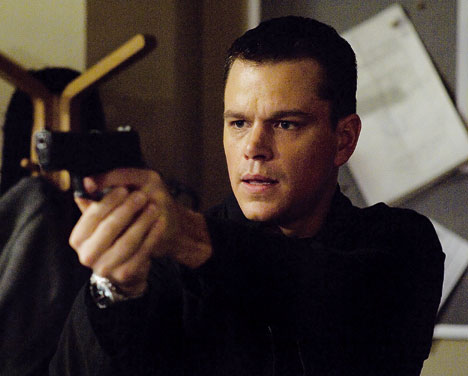
Back in 2002, the espionage genre must have felt a little like Matt Damon’s Jason Bourne at the start of this trilogy, floating unconscious in the Mediterranean Sea with a bullet in the back after the abysmal CGI tsunami of Die Another Day and the shallow, clichéd hotchpotch of Mission Impossible 2, although they may have envied Bourne’s lack of memory. Thank the heavens then for the metaphorical fishing vessel of star Damon, director Doug Liman and writer Tony Gilroy for bringing this energetic affair to the screen, both setting up Damon as a bona fide action star and throwing the gauntlet at the feet of Bond and Ethan Hunt to step it up a gear (both of whom willingly accepting the challenge with Casino Royale’s gritty realism and MI3’s intelligent action).

Batman Begins

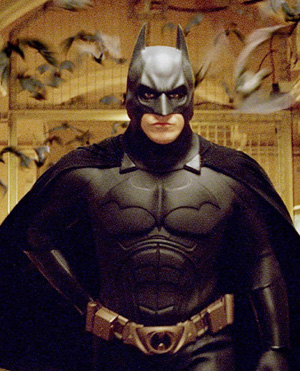
As the title suggests, this predominantly covers Batman’s origin story, from the death of his parents after he becomes scared at the theatre, through his training by Liam Neeson’s Ducard, his development of a crime-fighting persona and his confrontation with his former mentor in a city ridden with toxin-crazed criminals and madmen. This is arguably the most realistic, or at least vaguely plausible comic book movie ever made, with the only real superpowers on display being a gas that makes people insane and a ridiculously vast fortune to funs Bruce Wayne’s double lifestyle. Granted, the secret passage in Wayne Manor is operated by hitting a coded sequence of piano keys, but this can be forgiven, and is at least a variation from the classic sliding of a secret book on a shelf.
Continue reading

4 Months, 3 Weeks & 2 Days

I’ve finally offered myself up to the Gods of Lovefilm, kneeling at their alter and pledging my sacrifice of hard-earned readies and how am I rewarded? With a Romanian abortion film. Brilliant. Shot with an unflinching, rarely moving style, after the initial tracking shot around a dormitory in search of Kent cigarettes and black market Tic-Tacs, this shows the totalitarian regime of Romania in the late 80s, where abortions were banned for women under the age of 40 who hadn’t already had four or more children. The three main characters; the timid, fearful, naive and unexpectedly pregnant Gabita, her capable and confident roommate Otilia and the man found to perform the illegal termination, the callous, barbaric yet business-like Mr. Bebe are all played admirably, but some of the shots and topics discussed – the proper disposal method of an aborted foetus, whole or chopped, don’t always make for entertaining viewing.
Choose film 8/10

The Silence of the Lambs

It’s easy to forget just how impressive Silence of the Lambs is as a film; receiving the ‘Big 5’ Oscars (Actor, Actress, Picture, Director, Screenplay) back in 1992, an accolade since rusted by the diminishing returns of the sequels/prequel. When remembered, the image brought to mind is of a motionless Anthony Hopkins stood eerily in the centre of a jail cell, awaiting Jodie Foster’s FBI student Clarice Starling, the conversations that ensue regarding Hopkins’ incarcerated Hannibal Lecter assisting the FBI with psychological analysis of an active serial killer, and certainly Hopkins’ aggressive, manic yet restricted delivery of oft-quoted and even more so parodied dialogue. Admittedly Hopkins turn, equal parts refined and ruthless, educated and insane, psycho-analytical and psychopathic, is remarkable, before Ridley Scott’s Hannibal turned him into some kind of dandy rogue (albeit one who feeds Ray Liotta his own brain), but it is so overpowering that it overshadows the rest of the film, feeling his absence whenever he’s not on screen, staring directly into the soul of the viewer. Not to diminish the rest of the production, with Jodie Foster being another highlight, her twig-like rookie about a foot shorter than all the other male recruits, all of whom have no problem checking her out as she walks by, seeing her not as an equal, but simply as a girl. Ted Levine (Monk, Heat) is also incredible as the killer Buffalo Bill, keeping his victims alive in a well before skinning them to make himself a suit. Criminally he was not even considered for a supporting actor nomination, yet his portrayal is arguably more chilling than Hopkins’, delving deep into a twisted, scarred psyche and throwing the shattered remains at the screen. The third reel reveals, both examples of fine editing and cinematography, also deserve mentioning, keeping you guessing long after you thought you knew what was happening.
Choose film 8/10

No Country for Old Men

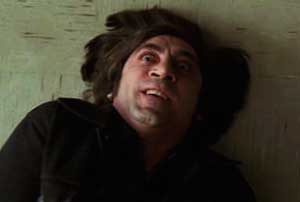
In this most bleak and convoluted offering from the Coen brothers you rarely witness a characters ultimate destiny, although they are hinted at enough to make a fair assumption. Josh Brolin’s Llewelyn Moss, a welder out hunting deer in south west Texas, stumbles upon a botched drug deal and, finding a suitcase full of money, goes immediately to the authorities before returning home to his wife and living a largely uneventful life. No, of course not, he legs it, instigating a game of cat and mouse with Javier Barden’s Anton Chigurh, a ruthless, near robotic hitman with an unusual and extreme set of morals, himself pursued by Tommy Lee Jones’ small town sheriff Ed Tom Bell. Featuring a stellar supporting cast including Woody Harrelson, Stephen Root and Kelly Macdonald, some incredible scenery, lensed by Oscar winning regular Coen cinematographer Roger Deakins and highly memorable dialogue lifted directly from Cormac McCarthy’s seminal novel of the same name, this is a truly inspirational and unique film. Bardem in particular completely embodies his character, becoming one of the most iconic villains to grace our screens in modern times. Brolin however strikes me as an actor from the ranks of Shia LaBoeuf and Sam Worthington, snapped up and promoted by big name directors without having the talent to back up the expectations, flooding the cinemas with frankly mediocre acting ability.
Choose film 8/10