The Graduate

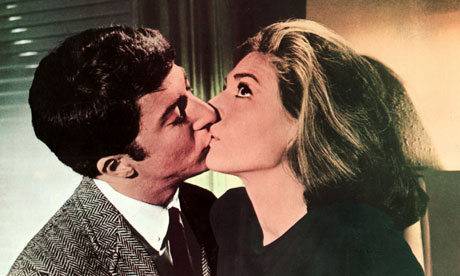
Ben Braddock (Dustin Hoffman) has returned home from university a star scholar, with his parents and all their friends keen to voice their high hopes for him and his future, but Ben is more uncertain with what he wants to do. Amidst this despondency, Ben finds himself the reluctant object of the affections of Mrs. Robinson (Anne Bancroft), the wife of his father’s business partner, and the pair begin a secret and sordid affair, which becomes complicated when Mrs. Robinson’s husband (Murray Hamilton) has plans to set Ben up with his daughter Elaine (Katharine Ross), obviously against the wishes of Mrs. Robinson.


This is one of those films that has become famous for a few significant moments that have become integral to pop culture. Moments like Anne Bancroft trying to seduce Dustin Hoffman, him framed in a doorway behind her strategically cocked legs in the foreground, or the ending, which gives way to one of my favourite final scenes in cinema (featuring the second time I’ve seen a crucifix being used as a weapon in recent times, after Liam Neeson cracked skulls with his in Gangs of New York). The first time I watched this film, as I’m discovering is the case with so many films, I didn’t understand it that much or in fact take any of it in, and the true meaning of the ending was lost on me. This time around I’m pretty sure I got it. Maybe I’m the right age now. Maybe it’s because I’ve now finished my studies and, only a few years ago, was briefly adrift in an ocean of directions I didn’t want to pursue. Or maybe it’s because I’ve seen (500) Days Of Summer, in which the ending is discussed and potentially ruined for anyone who hadn’t seen it or couldn’t remember it (like me, for example).

That’s the problem with such a culturally significant film; it’s been discussed and dissected not just on film blogs such as this one (and probably a few better ones too), but in many other areas of pop culture. The more famous sequences have been riffed on in the likes of
Starter For Ten, American Pie and several times in The Simpsons, whereas the overall plot can be heard in The Player (in which a sequel is pitched, set 25 years later), and in Rumor Has It (which I’ve not seen, but my knowledge of the plot led me to expect certain scenes in The Graduate that never actually came about). Fortunately, even though the basics of the plot have been in the public eye for some time now, there are a great many more charms which this film can rely upon.

Firstly, the acting. I’m starting to think that Dustin Hoffman could well be one of the most under-rated actors of his generation. Now, I know that he’s received two leading actor Oscars from seven nominations (the first of which came from this very film), but he’s always seemed overshadowed by the likes of Al Pacino and Robert DeNiro from actors of that age. It hasn’t been helped by his far-from-stellar later work, but then Pacino and DeNiro are hardly innocent of that either. You can pretty much guarantee Hoffman will be the focus of a future Film-Makers series. In The Graduate, Hoffman takes a character who should be sympathetic and runs in the opposite direction, making him quite unlikable; someone who’s been handed everything but couldn’t care less. The true genius of the performance shines when Ben is at his most nervous. His subconscious, subtle nod when Mrs. Robinson asks if he knew she was an alcoholic;
his unintentional little whinny and half-swallow whenever he’s put upon the spot or caught off guard. You completely believe, despite the ten year age difference between Hoffman and the character he was playing, that he could be this bright young scholar, the former big man on campus, who now finds himself in the submissive role of a relationship he has no control of. Anne Bancroft is also noteworthy as the woman Ben was completely unprepared for. She retains a steely demeanour, forever in control of every situation she is in, usually because she pulled the strings to instigate it in the first place. 


The cinematography and editing were surprisingly good too – surprisingly because I didn’t remember them being very memorable the first time around. The brilliant opening, following Ben as he glides down an airport’s moving walkway, has been shamelessly ripped off by Tarantino in Jackie Brown, but it’s the cuts that really impressed me. Whether it’s Ben getting dressed as he leaves the swimming pool and walks through a doorway cutting to him walking into a hotel room and being undressed by Mrs. Robinson, or his mounting a lilo cutting seamlessly to mounting her on a bed. The editing from In The Heat Of The Night must have been superb to have beaten this at the Oscars.


The main detracting factor is the soundtrack. I was pleasantly surprised when Simon and Garfunkel’s The Sound Of Silence opened the film, for it’s a song I’m happy to listen to. However, they perform the entirety of the soundtrack, which unfortunately is comprised of only about three of their songs, repeated over and over again, and I became truly sick of it all the second time Scarborough Fair was played in the space of a couple of minutes. I don’t normally mind the haunting, melancholic feel of their songs, but after too long I felt like I was drowning in cold syrup. The main problem is that they always sound bored of singing their own songs, and I’m certainly now bored of hearing them.


There were a couple of uncomfortable moments, but they were played out masterfully, particularly the initial encounter between Benjamin and Mrs. Robinson, who have known each other all of his life, just not in that present light. After giving her a lift home in his shiny new graduate-present car, Ben is requested to accompany Mrs. Robinson indoors, as she is frightened of entering an empty, dark house alone. He is plied with alcohol and music and led upstairs, torn between intense awkwardness and the desire to be polite and not offend his parents’ close friend. Just as you think things cannot possibly become any more excrutiating for Benjamin, after Mrs. Robinson has all but thrown her naked form at him, of course Mr. Robinson comes home and encourages young Ben to enjoy himself that summer, making sure he has a few flings. This is an embarrassing situation far beyond anything you will find on Curb Your Enthusiasm.


The script is also wonderful, and any film that can feature the lines “You’re the most attractive of all my parents’ friends” and “I don’t love your wife, I love your daughter sir,” can do no wrong by me.

Choose film 9/10

Brief Encounter

Laura and Alec (Celia Johnson and Trevor Howard) meet every Thursday in town – he after work, and she to do the weekly grocery shopping. At first their regular meetings are nothing more than a newfound friendship, but it is not long before they fall for one another. The problem is, Alec will soon be leaving to work in Africa. Oh, and they’re both married, with families at home.


It’s a simple story, and therein lies the beauty. There’s no surprise ending, no unforeseen third act plot contrivance – in fact, the ending of the couple’s relationship is the first thing we see, but it isn’t until the end that we realise quite how devastating it is, as the events leading up to their separation are told chronologically through flashback, from their meeting when Alec assists Laura when she gets soot in her eye, through shared meals and cinema-goings, culminating in their final moments together, probably forever, in this day before social media and the ease of communicating with someone half the world away. 

Our focus is on Laura and Alec, and in a way there is nothing in this film but them. Their families are largely only hinted at, other than Laura’s dull husband Fred, but even with only mild insinuation and a well-implemented voiceover from Laura we are offered as much background information as we need to realise their situation and motivations. Neither were looking for someone else, and both believed they were content with the lives they were leading. Everything would have been perfectly fine if they’d just never met one another, but fate is a cruel mistress, and the couple’s momentary enjoyment cannot possibly last, and the sadness comes from their clear understanding of this fact.

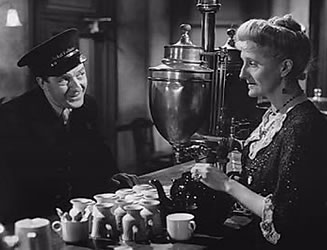
There are other marginal characters – the tempestuous relationship between the cafe owner and train conductor (who walks across the train tracks! It’s like a different world!) – but they are merely background, and serve to frame this story, rather than add to it. In fact, without their inclusion I got the feeling that Laura and Alec’s story would have struggled to breach feature-length, coming in at only 86 minutes. This length felt perfect for the story though. There’s nothing I could add, and nothing I’d take away, and if anything were to be added, it would be in the form of excess background – perhaps a love interest for Beryl, the tea room assistant, but there’s no need for it, and it’d just be padding.

I’m fairly sure this is the most British film ever made, and it’s popularity is probably the main reason behind the English stereotype of the stiff upper lip and clipped manner of speech that has become synonymous with my fellow Englishmen. The amount of scenes that involve the drinking of tea (something of which I’m fairly proud I’ve never done) are almost farcical, and everyone speaks as though they were born not with just a silver spoon in their mouth, but half the cutlery drawer rammed down their oesophagus. It’s this typically British sense of repressed feelings and not letting your guard down that really makes this film, as we see our two leads, particularly Laura, struggling to maintain their steely facades whilst underneath their hearts are being torn apart my these circumstances beyond their control. You can’t let these things be public knowledge, it’s just not how we do things around here.

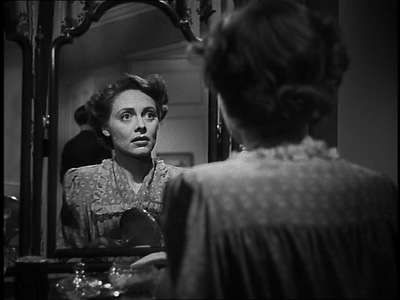
There are many moments of intense emotion and poignancy, but if I had to pick one, it would be the traumatised look Laura gives herself in the mirror after the first time she lies to her husband, followed by the internalised “It’s awfully easy to lie when you know that you’re trusted implicitly.” She knows that there is nothing more wrong than what she is currently doing, but that she has no choice to do it anyway, and is just going to have to live with herself. By today’s standards the romance is almost laughably timid – the most that happens between the two leads is the occasional kiss – but the reactions and implications from these events are just as bad to our leads as if they’d been knocking boots five days a week for several months, if not more so.

This is one of the first films I’ve fully appreciated that doesn’t have a lot going for it in terms of action, humour or a happy ending that makes me feel all warm inside. Instead, this is heartfelt, emotional film-making, that shows just how much can be done with very little.

Choose film 9/10

Skyfall

A hard drive containing the identities of MI6 undercover agents is at risk of going missing, so James Bond (Daniel Craig) is trying to catch the thief in Istanbul, with the assistance of field agent Eve (Naomie Harris). When Bond is shot and presumed dead, his superior, M (Judi Dench), takes the blame, but when Bond returns from the grave, he must track down the files to save not only his country, but his boss.
Continue reading

Hugo

Hugo Cabret (Asa Butterfield, one of the kids from Nanny McPhee and the Big Bang) lives inside the clockwork at a train station in 1930s Paris. He spends his days maintaining and fixing the clocks, stealing only the pastries and milk that he needs to survive and avoiding the child-hunting station inspector (Sacha Baron Cohen). A run-in with station shop-worker Georges (Sir Ben Kinglsey) results in Hugo having to work for the toymaker, all the while building a bond between Jugo and Georges god-daughter, Isabelle (Chloe Grace Moretz). 

On the surface, this doesn’t appear to be a typical Martin Scorses project. For starters, it’s a kid’s film, not something you’d generally associate with the director of Goodfellas, Mean Streets and Taxi Driver. There’s nary a gangster to be found, nor a grisly death or vicious killer. Hell, it’s not even set anywhere near New York. But once you get past the halfway point of the film, and the story switches from that of a young boy trying to eke out an existence on his own to a tale about the history of the beginnings of cinema, it becomes clear just what Scorsese saw in this story. It’s no secret that the great director is a passionate man, especially when it comes to the medium of movies, so seeing an opportunity to make a film dedicated to films themselves would have been an opportunity he jumped at. Fortunately, it helps that it’s a captivating story, filled with vibrant characters and plenty of heart, without too much schmaltz. Wihtout the secondary cinematic storyline, this would have felt far more like a Spielberg picture than a Scorsese.
I didn’t have the opportunity to see this film in 3D, but I get the feeling that if you are able to, you should give it a shot. This may come as a surprise to many of you, given my usual stance on the current trend of shamelessly, and often needlessly, opting to add a third dimension to films that really don’t benefit from it, but there are many scenes here where it would probably not only have fit, but benefitted the viewing experience. 3D works best when there’s lots of little things flying in the air, for example the dandelion-thing scene in Avatar, or the lantern scene in Tangled, and in Hugo we get at least two opportunities for this, first with snow and then later with flying pieces of paper, both of which I’m sure would have looked fantastic in 3D. There’s also a lot of forced deep perspective and carefully considered samera angles, making this possibly the first film I’ve seen where the 3D was probably justified.

There’s great camerawork elsewhere too, particularly in a Goodfellas-esque extended tracking shot through the inner-workings of the train station that is positively mesmerising. It’s clear that almost every shot has been digitally enhanced to make it look older and more French – the colour scheme is rich and everything has a sepia tone, seemingly even the air. At times this felt a bit too stylised, and often took me out of the film with how fake everything looked, but it’s nowhere near as bad as many of the films that use so much CGI that they may as well be videogames. 

The kids aren’t bad, but they are overshadowed the tremendous supporting cast, including the likes of Jude Law, Ray Winstone, Christopher Lee, Emily Mortimer and Richard Griffiths in relatively miniscule parts around the train station (I was half expecting them to break into a rendition of ‘Who Will Buy?’ from Oliver). Kingsley is superb in a role that requires moments of seriousness, compassion, pity and wonder, but Sacha Baron Cohen does have a tendency to over-act now and then, presumably a result of his more comedic past. He is by no means bad, but reigning his performance in a little, to be less of a caricature, would have been better in my eyes.

I think the people that will get the most out of this movie are film fans, especially those with an interest in the beginnings of cinema. Fortunately I am such a person, and I also appreciated Michael Stuhlbarg’s character, as one of history’s first film nerds. There are many references to classic early and silent films like La Voyage Dans La Lune, L’arrivee and Safety Last, featuring the classic image of Harold Lloyd dangling from the clock face, eventually recreated by young Hugo himself, and I was engrossed at the details of how effects were created before more traditional editing processes were invented, with actors remaining frozen in place whilst explosive charges were set around them. The old technology and equipment was fascinating to me too, appealing not only to my love of cinema but my mechanical background, with a hand-cranked projector required to watch something now available on YouTube.

Scorsese has created that most marvellous of films, a successful, inventive children’s picture, that just happens to have an informative and educational semi-biopic of one of cinema’s founders wrapped up inside it. It’s beautiful, engrossing, perfectly cast and just plain delightful. And there’s a robot!

Choose film 9/10

The Shining

Jack Torrance (Jack Nicholson) is a writer suffering from writer’s block. He takes a job as an off-season caretaker at the Overlook Hotel, deep in the Colorado Rockies, where he will stay for five months with just his wife Wendy (Shelley Duvall) and their son, Jake (Danny Lloyd). Whilst at the hotel, all three members of the Torrance family experience otherworldly visions that slowly send Jack insane. Meanwhile, Danny’s ‘gift’ of the shining – the ability to see and hear things that haven’t happened yet or that happened a long time ago – grows stronger.

The Shining is widely regarded as a terrifying film, one of the best horror films made in the past 40 years, but to me it holds a deeper terror, not just because it’s the first truly scary film I can remember watching (and being far too young to watch it when I did). You see, I’ve seen The Shining twice, and both times I’ve watched it have been shrouded in a very real death of someone I know. The first time I saw it my best friend’s brother’s best friend was found dead the next morning. This time, I was interrupted about halfway through the film with a phone call from a friend, informing me that a mutual friend of ours, who neither of us had seen for a while, had been killed in a motorcycle crash. Basically, this is possibly the scariest film I know of, because I can never watch it again for fear of someone I know dying. This adds a whole new dimension to a film that’s scary enough to begin with.

On the surface, there isn’t a lot of traditionally scary elements to The Shining, especially not by modern horror standards. Instead, there’s more of an increasing sense of unease and mental disturbance as Jack descends into the horrors of his own mind, assisted by the various terrifying images thrown up by the hotel. Like the young twin girls Danny sees around the hotel, the elevator erupting with an ocean of blood, or the beautiful naked woman in room 237, who becomes a scabbed and putrid hag in Jack’s arms. And of course there’s the questionable shot of the man in a business suit, probably receiving a favour from a man dressed as a bear, that I’m sure his wife and kids would not be too happy to find out about.

As horror films go, this is impressively effective without having to resort to cheap jump-scares or a monstrous killer on the loose. I’m not often scared by films, but this one has left me a little off ever since, and not just for the personal reasons mentioned earlier. I’m a big fan of how the original protagonist – Jack – eventually becomes the antagonist once perspective focuses more on Jake and Wendy. If I were to pick a fault though, it might be that there’s a few too many elements taking place simultaneously. Firstly, the hotel was apparently built on an Indian burial ground, thereby adding an explanation to the ghostly goings on. This should have been enough, but there’s also Danny’s psychic abilities, which he shares with the hotel’s chef, Dick Hallorann (Scatman Cruthers), who has the most absurd pictures on his bedroom wall. Then there’s the mysterious suicide of the former caretaker, who killed himself with a shotgun after axing his family in the winter of 1970. And Danny’s finger is his imaginary friend, Tony, who talks to him and tells him what to do. Personally, I think Jack would have gone insane with just the intense writer’s block and having to be locked up with Shelley Duvall and an insane child for 5 months.

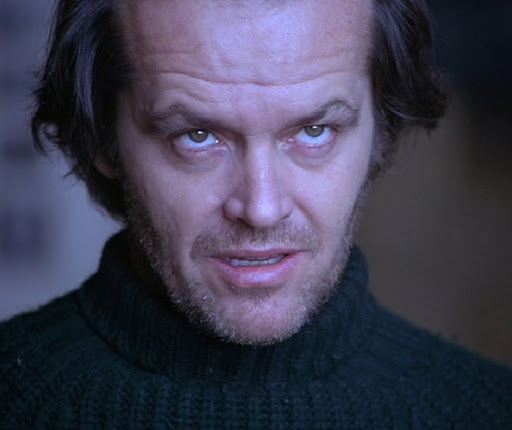
The film is pretty much perfectly cast, and Nicholson gives one of the most defining performances of his career. He shows real potential here for his future role as the Joker in Batman, especially once the madness sets in and his maniacal grin and eyebrows take over his face. Elsewhere his prominent brow and bright, glaring eyes are well used to strike fear into all who watch. Duvall is well cast too, though this isn’t a compliment as I think her character is supposed to be supremely annoying, and she succeeds in spades. It’s not often that you root for the axe-wielding psychopath over the innocent damsel in distress in a film, but I have absolutely no qualms about doing so here. 

This being a Kubrick film, it’s a given that a certain amount of flair has been utilised in the cinematography. The most famous example, and my personal favourite, is the long tracking shot following Danny as he wheels around the hotel on his tricycle. Infamously the camera was turned upside down to get it closer to the ground, offering a lower-than-child’s-eye perspective that really adds to the sense of dread, as does the incessant squeaking of the wheels as Danny follows an impossibly labyrinthine path around the hotel, a theme that recurs throughout the film.

The film is rife with too many unanswered questions and unquestioned answers, but due to Kubrick’s meticulous nature these can be assumed as being deliberate, present not only to infuriate the audience, but to keep them discussing the film forever more. Add to this some great quotable lines (“I’m not gonna hurt you, I’m just gonna bash your brains in.”), some of the most famous scenes in cinema (“Heeeeeeere’s Johnny!”), stellar performances, stunning visuals and a truly haunting score, and you’ve got not just a great horror film, but a great film in any genre. It’s just a shame I can’t watch it ever again.

Choose film 9/10

Looper

Regular readers will know I’ve had a tumultuous relationship with Looper, the third film from writer/director Rian Johnson. I loved Brick, and even wrote a post expressing my excitement and fears for the upcoming film, but alas when I went to see the film the first time around I passed out half an hour in, for reasons as yet undetermined. There’s an entire team of doctors and medical students currently scratching each others heads just trying to work out what – or rather, how many things – are wrong with me. But failing to fully see the film first time around gave me an opportunity to see The Brothers Bloom, Johnson’s second film, before watching the rest of his third. I have now managed to successfully see the entire film, in one sitting, having paid for a total of four cinema tickets (me + girlfriend first time around, me + friend second time around, Aisha didn’t want to see it again). And, personally, I think it was worth it.
Continue reading

Guaranteed Happiness: Amelie

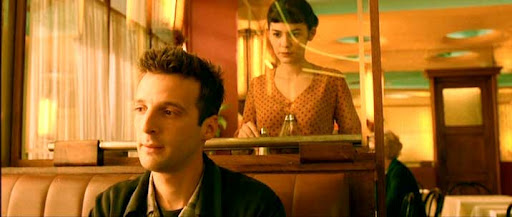
As I mentioned recently, I came 2nd in the Lamb’s So You Think You Can Review tournament. This was one of the films I reviewed for that competition, but as it was on the List as well I figureed I’d use it here too. All praise recycling!In 1997, after having made two successful, distinctly stylised French films with his co-director Marc Caro, Jean-Pierre Jeunet popped over to Hollywood to make Alien: Resurrection, a film widely regarded as one of the worst sequels ever to appear on the big screen. You’d have to go a long way to find someone who liked it, and I’d suggest you don’t start with me. Upon returning to his home town of Paris, Jeunet found himself seeing the once-familiar city with fresh eyes, and set out to make a film that would reflect the magic and beauty he had rediscovered. That film is Amélie.

Telling the story of Amélie Poulain (Audrey Tautou), a girl with an overactive imagination but an undernourished heart who develops a taste for bringing happiness into the lives of the people around her, this isa delightful, light-hearted chocolate-box fantasy romance that only occasionally threatens to choke you on its saccharine sweetness. Amélie herself is a wonderful creation, despite her less-than-wonderful upbringing. She was raised by a military physician father (Rufus) and schoolmistress mother (Lorella Cravotta). Her only physical contact with another life form was the annual check-up provided by her father. Such unaccustomed moments of intimacy caused her heart to beat faster, which her Dad diagnosed as being a heart defect, so kept his daughter at home, away from the other children. This, along with a suicidal goldfish and a childhood tragedy, gave Amélie a unique perspective on life that she would carry on into adulthood, where she works as a waitress in a corner cafe in Montmartre alongside its rogues’ gallery of eccentric staff and clientele.
A chance reaction to the death of Princess Diana leads Amélie to discover a treasure trove left by her apartment’s previous inhabitants, so she sets about planning to return the childhood trinkets. She revels in the feeling of harmony she gets from helping others, be they strangers or regular players within her life – though she isn’t close enough to anyone to really call them a friend. Along the way she crosses paths with Nino Quincampoix (Mattieu Kassovitz, director of the seminal La Haine), and finds herself falling in love with this fellow outcast who skips in time to her own offbeat pace, yet her life so far – devoid of affection, interaction and intimacy – ensures that theirs will not be the smoothest of romantic relationships.
From the opening credits – featuring a young Amélie (Flora Guiet) engaging in a variety of nostalgia-inducing childhood antics including peeling dried glue from her fingers and making her hand into a puppet – it is clear this film is a genuine heart-warmer, yet imbued with a tinge of sadness. For all of Amélie’s boundless levels of enjoyment, you can’t help but notice that as a child she was always alone. The film delights in making the ordinary extraordinary, for example by looking at the events occurring simultaneously with Amélie’s birth – a fly being run over, two wine glasses dancing on a wind-buoying tablecloth, a man erasing his deceased friend’s name from his phonebook. Alone, these individual events are almost mundane, but together they contain every aspect of life, from the tender to the tragic.
Though it was released six years before the term was coined, this film displays a unique perspective on the manic pixie dream girl mythology, as we see the film almost entirely from the point of view of said fantastical creature. In more traditional films, the character of Amélie would be the love interest in Nino’s story, and not the other way around, and she’d be played by Zooey Deschanel. If anything, he is a typical leading man archetype, an eccentric loner, working a job he hates to fund an obscure passion project, just waiting for the girl of his dreams to stumble into his life and turn it upside down, yet thankfully this is not his story, he is the supporting player and it is with his influence that Amélie finds her life being disrupted, just as she disrupts those around her.
Tautou is absolutely perfect as the eponymous mirth-maker. Gifted with the role of a title character and appearing in almost every scene yet with barely any dialogue, Tautou manages to express every emotion going through her exceptionally beautiful brown eyes, body language and face framed with a Louise Brooks bob. Interestingly, the role was originally written with Emily Watson in mind, but I think even she would have struggled to match Tautou’s blend of purity, yearning and a rare, beguiling charm. Be it when she is skimming stones, cracking a crème brulee or suppressing laughter during an early attempt at intercourse, Tautou is exquisite in the role she will probably always be best known for. Her delivery of the line “I am nobody’s little weasel” almost brings me to tears.
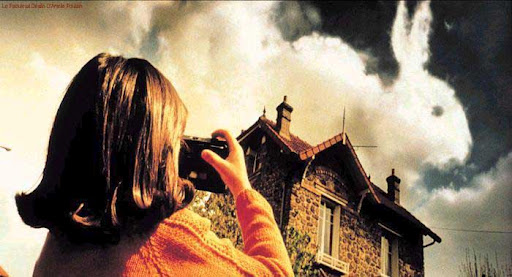
As usual with any Jeunet picture, the cinematography is beautiful. The colour scheme is heavily influenced by Brazilian artist Juarez Machado, particularly the use of rich browns, oranges and reds for the interior shots. A glowing orange outline will reveal a hidden key, or a glowing heart, and Jeunet’s elaborate camerawork lovingly follows faces, feet and hands as they go about their day, picking up stones and placing them in pockets for future skimming sessions. Some have shunned Jeunet’s debris-free vision of Paris, devoid of litter, ethnic diversity and graffiti, but at heart this is a whimsical fairytale, seen through the filter of its titular pixie’s naive, twee imagination, within which the harshest crimes are committed verbally, and easily remedied with Amélie’s own brand of karmic vengeance. In this world, garden gnomes can travel the world, lamps have nocturnal discussions with photographs of dogs and beggars refuse to accept money on a Sunday, as they are taking the day off.
Though the overarching narrative is one of romance, it is the comedy of the film that really shines through, predominantly from the cast of quirky characters that litter the screen, most of whom are played by actors from other Jeunet works. Be it the bathroom encounter of the hypochondriac Georgette (Isabelle Nanty) and the embittered Joseph (Dominique Pinon), the comeuppance of the bullish greengrocer Collignon (Urbain Cancelier) or a mistaken phonecall to an adult store during which our heroine is informed that “Fur pie doesn’t sell,” the comedic moments are many and varied. Yann Tiersen’s accordion-rich score is ever-so-French (I’m listening to it as I write, my feet have yet to stop tapping) and the occasional use of offbeat instrumentation such as a typewriter and bicycle chains further increases the levels of whimsy, as if that were even possible.
In my opinion, the best kind of film is one that leaves the viewer wanting to be a better person, and that is certainly the case here. The morals of Amélie are clear: be kind to others, be yourself, and enjoy the little things.
Choose film 10/10

Memento

Christopher Nolan’s first major picture (after 1998’s Following, which is interesting but a tad too confusing, and really for completists only) is at first glance nothing but a gimmick, using a reverse-narrative to tell the detective noir of Guy Pearce’s Leonard Shelby as he hunts for the man who raped and killed his wife whilst suffering with a rare condition that prevents him from making new memories. However it turns out that telling the story backwards, scene by scene and with an expositionary telephone conversation spliced in between, is the only way to give the story justice.
Famously, there is an easter egg on the Memento DVD that plays the film in chronological order, and I’ve discovered that in that orientation the film just doesn’t work. It’s not just because the last few seconds of every scene are replayed again moments later at the start of the next one (surely that wouldn’t have taken much to edit out?) but it’s also because the film is completely lacking in tension or pacing when that way round. Which just goes to show that Nolan was able to use a plot technique to it’s fullest advantage, which in the hands of a lesser director could have proved disastrous.
Pearce is excellent in an unforgiving role, especially given that Leonard has no character arc longer than a scene. He’s always been a brilliant actor, and often hides his Brad Pitt-esque looks behind obscuring facial furniture or heavy make-up – see Ed Exley’s glasses in L.A. Confidential, or large amounts of Play-doh in Prometheus – and here is no exception, with Shelby’s body plastered with tattoos and a shock of peroxide blonde hair to distract from those razor-sharp cheekbones. Pearce is ably supported by Carrie-Anne Moss and Joe Pantoliano as Natalie and Teddy, people who may or may not be out to help Leonard on his quest.We discover elements of the story as Leonard does, and the true meaning of almost every scene is altered by the one that immediately precedes/follows it. Surprisingly, a scene can hold just as many surprises, and just as much tension, if you know how it ends but not how it begins. You can’t help but feel sorry for Leonard, in a situation that would drive most of us insane – as long as we could remember the insanity long enough – and his life would be hard enough without everyone screwing with him. Even the clerk at his motel (Batman Begins‘ Mark Boone Junior) charges him for two different rooms, and doesn’t even hide it from Leonard, as there’s no chance he’ll remember.

There’s more comedic moments than you might remember, and some darkly so, for example the conversation where Leonard reveals to Natalie that the last thing he remembers is his wife. She says that’s sweet, before Leonard concludes “…dying.” I probably shouldn’t have, but this got a start of laughter from me.

I remember that my first viewing of this movie was ruined when I borrowed it from a housemate some years ago. He basically told me the ending, and that the film was crap, but I watched it anyway and remained intrigued and fascinated by how the plot would tie together – which it does nicely. Rest assured I never took that housemates movie advice again.

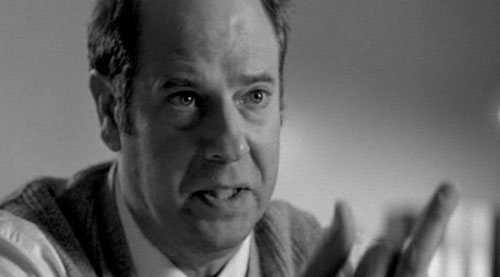
If Stephen Tobolowsky is in a film, then I’m legally obliged to mention him in a review, and here he crops up in grainy, black and white flashback as Sammy Jankis, a case Leonard looked into as an insurance claims investigator before his memory loss. Jankis suffered from a similar condition as Leonard, and Tobolowsky’s wonderfully big blank face is perfect for the look of someone not recognising anything new in the world around him, and his bursts of anger at annoyance – at an elctro-shock test and not understanding TV shows – is also great.

The story, written by Christopher Nolan’s brother Jonathan, is well thought out and takes into account the minutiae of Leonard’s predicament. Such a high concept (though scientifically possible) film could have left many annoyances at skipped over details, loose plot strands or inconsistencies, but by the end/beginning no such problems are left.

Choose film 9/10

Unforgiven

The first part of my double bill of Clint-Eastwood-directing-himself-and-Morgan-Freeman-in-a-supporting-role sees the American icon define the genre that not only made him the prolific star he is, but that he has almost singlehandedly kept alive since it’s surge in popularity in the 60s and 70s; the western.
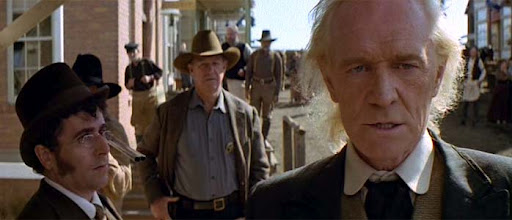
Unforgiven sees Eastwood as William Munny, a former hardened killer reformed by the love of a good women and the birth of his two children. With his wife dead and their herd of pigs stricken with fever, Munny accepts the offer from young upstart The Schofield Kid (Jaimz Woolvett) to kill two ruffians who cut up a whore after she laughed at one of them having a small penis. They team up with Munny’s former partner Ned Logan (Morgan Freeman) and head out to the town of Big Whiskey, lorded over by Gene Hackman’s occasionally violent ‘Little’ Bill Daggett, where other hired killers, including Richard Harris’ English Bob, are also heading to claim the bounty.
Eastwood’s Munny isn’t your typical western hero. In fact, no character in this can ever be truly classed as heroic. Munny has what could politely be called a sordid past, and his desperation to honour his late wife by not succumbing to his younger urges is evident. A self proclaimed no good son of a bitch, Munny is a shadow of his former self, unable to shoot straight or even mount a horse. Freeman’s Ned has a woman at home, yet has no qualms about visiting the whorehouse in town, Schofield has his own secrets and Bob is an outright liar, gambler and killer. At times it seems that Little Bill, supposedly the villain of the piece, is possibly the most moral character here, opting not to kill the prostitute abusers in favour of fining them horses instead, with the sins he commits in the present are nothing compared to those done by Munny in the past, and his intentions are only to keep his town free from guns and violence, except from his own. I found it odd though that nothing was made of Freeman’s race, as he and his partner are the only non-white characters in the film, yet there are no even passing references when the townsfolk describe him. I’ve just realised I’m annoyed that Morgan Freeman wasn’t racially abused in a film.
The script, which did the rounds in Hollywood for 20 years before Eastwood picked it up, is pocked with sharp humour and great lines (“If I see you again, I’m just gonna start shooting and consider it self defence.”) and works not just as a study and disassembly of the westerns that came before it, but as a damn good, prime example of one itself. Harris’ English Bob has his own biographer (Saul Rubinek), whose role is to take Bob’s stories and lyricise them a little; in essence creating the cowboy myths and legends that make up the staples of the genre. It’s a film about shattered dreams and fallen heroes – the actors as much as the characters – as it’s not often you see Eastwood rolling around in pig shit, Morgan Freeman asking someone if they sleep with prostitutes or just use their hand or Lex Luthor beating the crap out of Dumbledore. It’s clear that Munny could quite easily be any one of Eastwood’s previous stoic, bitter, hard as nails cowboys who’d let themselves go for a few years.
The film deals with the seriousness of death and murder, with no post-kill smart alec quips. One characters defiant “I’ll see you in Hell, Willaim Munny,” is met only with a considered, matter of fact “Yeah.” It’s almost as prolific as The Good, The Bad and The Ugly and Once Upon A Time in the West, and definitely ranks in the top 5 westerns.
Choose film 9/10

Avengers Assemble

Ugh, typing that name made me feel so dirty. Avengers Assemble. Ugh. There was nothing wrong with just The Avengers, no-one was going to go in expecting umbrellas, bowler hats and catsuits, and even if they had been, they’d have got something better anyway. Plus, ‘Assemble’ is possibly the least exciting word to ever appear in a movie title since The Adjustment Bureau.
Now chances are this isn’t the first Avengers review you’ve read, hell chances are this isn’t even the first Avengers review you’ve read that starts off by telling you it’s not the first Avengers review you’ve read, seeing as this is one of those movies (let’s not kid ourselves by calling it a film, this is for entertainment purposes only) seemingly designed to be discussed at length on the Internet. We’ve sat through 4 years of 5 prequels, and for literally years the Internet has been lying in wait to rip apart this inevitable car crash of a movie. Which makes it something of a surprise that not only is it not bad, it’s bloody good.
No-one saw this coming. They said it couldn’t be done. I agreed. The last few Avengers prequels hadn’t been great, especially Iron Man 2 and Captain America (I don’t know what everyone has against Thor, I thought Kenneth Branagh did a good job with a lesser-known character) and I firmly believed that throwing six superheroes at one another in the same film was going to look like something Hulk had sat on. The only things it had going for it were a stellar cast and a solid director in Joss Whedon, of whom I’m unashamedly a fanboy (other than I’ve never seen an episode of Buffy or Angel). Whedon is known for handling rambling, ensemble casts (Firefly) and has always managed to balance action with snappy dialogue, drama with romance and a hefty dollop of comedy, but I didn’t think there was a great enough female presence here to draw his attention, with Black Widow as the only main girl. So, going in, my hopes were high but my expectations primed for mediocrity, so it’s a pleasure to say that I honestly can’t think of many ways the film could have been handled better.
Essentially, this is an origin movie. What’s unusual is that most of the main characters have already had at least one movie of their own, mostly origin stories, so what we have here is the beginnings of a culmination of pre-established characters. You don’t necessarily need to have seen all of the other films before watching this one, but I think it’d help, as the plot is partially set-up within Iron Man 2, Thor and Captain America, in terms of the basis of the Avengers, the bad guy and the maguffin. I saw this with my girlfriend, who hadn’t seen Thor but had all the rest, and she didn’t need much explaining to her other than that Thor’s devious brother Loki isn’t played by Michael Fassbender, but is instead the brilliant Tom Hiddleston, who performs ably as the primarily sole lead bad guy against an entire team of heroes.
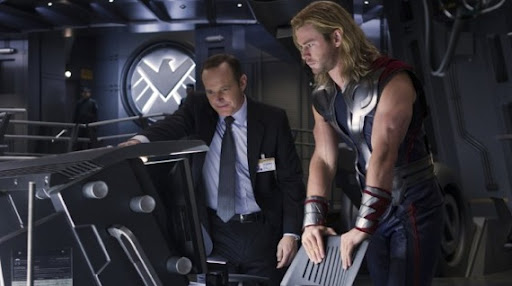
It would have been very easy, and very foolish, to have made this Iron Man & Co, seeing as Robert Downey Jr.’s Tony Stark is undoubtedly the most enigmatic and entertaining character on screen, yet wisely Whedon scaled down the potential for the Stark Show into giving him just as much time on screen as everyone else. There is no lead character here, everyone gets their moments, no-one is our entry point into the team and there appears to be no jostling for the limelight. In fact, the first people we meet are the agents of S.H.I.E.L.D., Samuel L. Jackson’s Nick Fury, Cobie Smulders’ Maria Hill and the ever dependable Clark Gregg’s Coulson (“Phil? His first name is Agent.”). These guys, along with existing Avengers members Black Widow (Scarlet Johansson) and Hawkeye (Jeremy Renner) then set about recruiting the rest of the team from across the world (and a little bit further, in Thor’s case).
Once recruited, the plot revolves around a Transformers-esque power cube known as the Tesseract that Loki has obtained, and intends to use to rule the Earth. Yadda-yadda-ya, it’s not all that important, and isn’t what you’re here to see. No, we’re here to watch some superheroes fight, bicker, argue and smash. I’ve heard arguments that there isn’t quite enough action in this 142-minute movie to satisfy, but I found the dialogue scenes to be just as entertaining. As expected, the superheroes, all previously alphas in their own movies, don’t initially gel together all that easily, and Iron Man keeps the insults flying at his comrades (Thor is referred to as “Shakespeare in the park,” Captain America is ribbed for being an old man). It’s clear this isn’t just friendly banter.
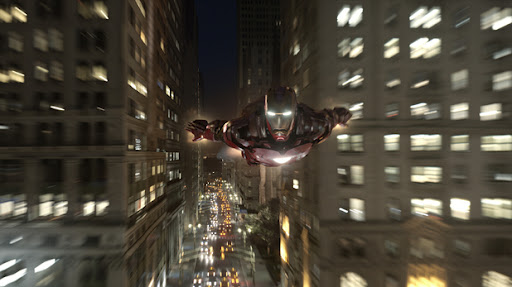
When the action scenes do come along, including one mid-way through worthy of any summer tentpole finale, they will have you marvelling at everything. And the actual finale, involving a mass brawl around New York City, features an incredible tracking shot that finds all the Avengers showing off the only way they know how, that I can only fault by being not long enough. Granted, with such a large cast there are occasional incidents of characters appearing to be forgotten or sidelined temporarily whilst the others are front and centre, but this isn’t too noticeable at the time, and doesn’t distract from the action.
Unlike his previous films, here the Hulk is neither under nor overused, and is easily one of the best aspects of the movie. Mark Ruffalo, taking the giant green reins from Edward Norton, delivers possibly the greatest Hulk yet, portraying Dr. Bruce Banner as an amiable everyman only too aware of the situation he’s in. He’s rewarded with some of the best, and funniest moments from the film, not least his one-on-one meeting with Loki.
Whedon seems unable to let a few trademarks go, though discussing them could be delving a little too deep into spoiler territory, but look out for a couple of cameos from his other projects, as well as appearances from Gwyneth Paltrow, Paul Bettany and Stellan Skarsgard all reprising roles from the prequels. Natalie Portman, however, is conspicuous only by her absence. Bizarrely, the likes of Powers Boothe, Harry Dean Stanton and Jenny Agutter also crop up in tiny roles.
Some moments seem entirely shot for trailers, and I was a bit annoyed that my knowledge of Marvel’s upcoming slate and a couple of shots from the trailers ensured that some of the would-be tense moments were obviously going to be resolved (albeit awesomely), but that’s my fault for watching trailers. There is a scene to wait for after the credits, but unless you’re a fan of the comic books there’s really no point, as I had no idea what the scene was about when it appeared until I delved around the web once home. All-in-all, I’ve very little to fault about the film, other than the incessant use of ass-level shots as characters walks away from the camera. I’m genuinely tempted to go and watch it again at the cinema, something to this day I’ve never done before, and I’m not the least bit annoyed that talks are already being made about an Avengers sequel.
Choose film 9/10