Monsters

Holding the prestigious position of most recent film on the list, having been awarded a 5-star rating from Empire magazine mere months before this cinematic odyssey began, Monsters is also one of the greatest examples of economic film making. Shooting on the fly with a skeleton crew and adding all effects afterwards himself, director Gareth Edwards (currently remaking Godzilla, hopefully with a better sense of scale continuity than Roland Emmerich, and without Matthew Broderick) has crafted a film equal parts Cloverfield, District 9 and any rom-com road trip you can think of. The plot is straightforward, Scoot McNairy’s cynical photojournalist Andrew must transport spoilt bosses daughter Sam (Whitney Able) back home across Central America. The hitch? Aliens landed in Mexico 6 years ago, and the area is now classified an infected zone, with only a few days before sea and air travel will be shut off for six months. Until the beautiful, unforgettable climax the titular creatures are barely seen, glimpsed in children’s cartoons, signs and graffiti, yet these giant bioluminescent jellyfish-like beings are more memorable than the central couple. Though not awful, the two leads are hardly required to stretch their talents, being a couple in real life whose marriage caused Edwards to miss a premiere of the film. As with all rom-coms, with or without building sized aliens, the two begin at odds with one another, but grudgingly grow to like each other through forced exposure, tequila, and redressing a bandage by firelight. Using a genuine couple heightens the realism of the relationship, so come the conclusion you hope they work something out between them.
Choose film 7/10

Buster Keaton

 I went on a bit of a Buster Keaton spree here, courtesy of LoveFilm’s watch online feature, allowing me to watch all of his films from the list – five in total – almost in one go. Ranging from 45 to 107 minutes in length, all are of course silent and black and white – the latest was made in 1928 after all, but to a film they are all exceptional, but I couldn’t help picking up on some recurring themes. Of the five, four involved a damsel in distress scenario, where Keaton’s diminutive heroic figure is the only one able to save her. Four predominantly feature trains, three offer a high speed pursuit, three have major plotlines revolving around an across the tracks romance, three use the theme of inheritance in some way and all five feature peril involving water, be it a dam, waterfall, water tower, boat or flood.
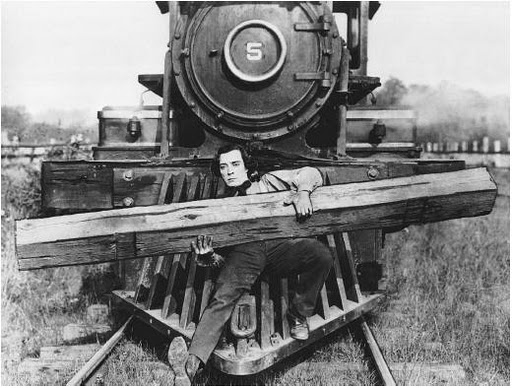
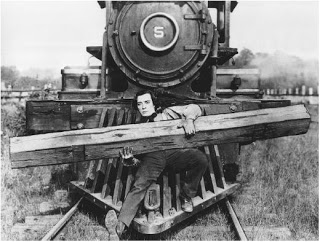
The best of the bunch are the General, depicting Keaton’s southern train engineer singlehandedly invading the North to rescue his girl and his beloved train, and Sherlock Jr., where a cinema employee dreams of being a famous detective. The General offers much in the way of action and physical comedy, as Keaton climbs over and sits on the front of a moving train engine. It’s Keaton’s most famous film, and rightly so, as his straight-faced fool tries so desperately and earnestly to do the right thing that he cannot help but be hilarious, staggering from one mishap to the next, rescuing the girl from the enemy only to be confronted by a bear. Throughout the films Keaton takes a cartoonish view to violence – getting limbs caught in a bear trap is less of an inconvenience than when it happens in the likes of Straw Dogs or Severance, but this only adds to the fun – it wouldn’t be very entertaining for the characters to be rushed to hospital every few minutes.
Seven Chances is at the disadvantage of having been made into the Bachelor, starring Chris O’Donnell in 1999. The remake does nothing but detract from the quality of the original film, as both use almost entirely the same plot – a man must marry before a given date, or be denied a rich relative’s vast inheritance – yet Keaton does it much more successfully with little messing around or unnecessary mucking about with now perfunctory rom-com tropes.
Our Hospitality plays on the Romeo and Juliet tale of warring families with besotted children, but takes it in an inspired new direction when Keaton’s Willie McKay attends a dinner hosted by the family of his new love, only to discover they are the Canfields, with whom the McKays have feuded for many years, and who are responsible for killing Willie’s father. The new spin is that, although the Canfields desperately want to kill Willie, their family code of honour prevents them from doing so whilst he is a guest in their house, so Willie does his best to remain there indefinitely.
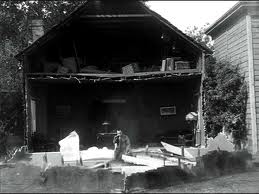
Finally, Steamboat Bill Jr. sees Keaton sent to work in Boston with his steamboat captain father, but the beret clad, ukulele playing, moustachioed diminutive Keaton is not what his father was expecting. Somewhat predictably, Keaton’s Bill Jr. is eventually required to save the day, making his father see him in a whole new light, but along the way some incredible stunts, including the infamous house front falling on Keaton during a storm that could have killed him had it gone wrong, make this a worthwhile watch all the same.
The General – Choose film – 9/10
Seven Chances – Choose film – 8/10
Our Hospitality – Choose film – 7/10
Steamboat Bill Jr. – Choose film – 6/10
Sherlock Jr. – Choose film – 9/10

Shine

Though onscreen for less than half the film, Geoffrey Rush won the 1997 best actor Oscar for his portrayal of the adult David Helfgott, a real life pianist barely known outside of his native Australia.
As a child, the young Helfgott (Noah Taylor) suffered an overbearing, paradoxical father who could never be proud of his son until he was a renowned concert pianist, yet refused to allow him the tutoring to achieve it. This pressure strains David’s personal life – a promising young romance is quashed at its initial meeting by his father’s interruption – eventually causing David to develop mental illness, not helped by trying to learn a particularly tricky Rachmaninoff.
All the performances are exceptional, particularly Rush mumbling and stuttering at lightning speed, occasionally unintelligible, revelling in the small moments of joy, be they from the discovery of a vacant piano in a restaurant or trampolining wearing nothing but sunblock and a billowing overcoat. The great John Gielgud crops up as the encouraging, kindly, cravat wearing tutor David so rightly deserves, but the tale cannot escape the cliché of the tormented artist, becoming better at his craft the greater the trauma he endures. Also the ending is too uplifting and fairytale, regardless of whether it is based on fact or not.
Choose Life 5/10

Muriel’s Wedding

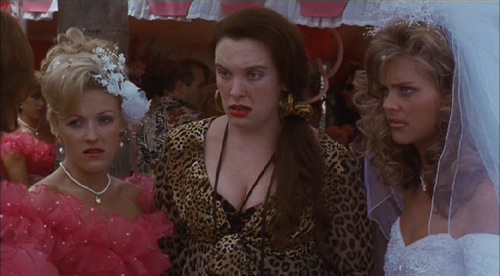
Muriel’s Wedding seems unsure of what it wants to be. At times it follows standard rom-com tropes; an eccentric family, a first date going awry involving a burst bean bag, a pet bird thrown through a window and an unexpected trip to the hospital. At other times it seems to want to be a character piece, with Toni Colette’s compulsive liar and Abba obsessed Muriel setting her sights on getting married, regardless of who the groom is and how she feels about him, running away from her ashamed domineering family to start a new life (with a new name; Mariel) after a chance encounter with an old school friend (Rachel Nichols), whilst elsewhere it could be described as a tragedy, as Mariel becomes more and more desperate to fulfil her dream, whilst seeming to bring bad luck to all she comes into contact with.
Colette fully loses herself within the overweight, unfashionable, possibly mentally ill Muriel, in her first major role, but the too frequent switches in tone, from light comedy to tragedy, are too jarring, the characters too thin and the comic situations not entertaining enough to make this worthwhile.
Choose life 4/10

Avatar

So, you’ve created a new way to make films; filling a large indoor space (dubbed The Volume) with cameras, covering your actors’ bodies with hundreds of motion capturing dots, films a scene then changing the actors to aliens and the warehouse to a jungle afterward on a computer, but you can’t think of a decent story to set it round. So what do you do? If you’re James Cameron, director of such cinematic milestones as Terminator 1 & 2, Aliens and Titanic, then you steal. From everything. There isn’t an original moment in Avatar, with Platoon, Star Wars, Lord of the Rings, Halo, Cameron’s own Aliens and, most notably, Dances with Wolves all receiving enough ‘loving homage’ to keep copyright lawyers in business for years to come. In the hands of a lesser director, or without the shiny new technology and 3D CGI gimmickry available this film would have been lost amid the also-ran film flotilla of 2009, but effects overcame plotting to elevate the film above its rightful place.
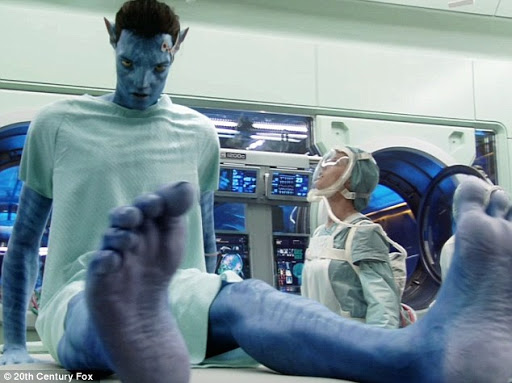
Sam Worthington plays Jake Sully, a US marine (with Worthington’s trademark unshakeable Australian accent) paralysed from the waist down, who volunteers to take the place of his recently deceased scientist brother in a mission to infiltrate the alien race of the Na’vi, 9ft tall lanky blue cat people with 4ft long rope-like tails and long black ponytails with USBs on the end. Jake is able to control a scientifically grown ‘avatar’ that responds to his body when wired up in a big plastic pod.
The maguffin of the plot is that the Na’vi live in a giant tree, under which is a vast source of a precious fuel known as unobtainium. You get the feeling they were supposed to rename that at some point but forgot, or Cameron came up with it and no-one had the guts to tell him it sounded stupid. Stephen Lang’s scarred Colonel Quaritch and Giovanni Ribisi’s corporate suit Parker want Jake to get the aliens to move, whilst Sigourney Weaver’s scientist and fellow avatar occupier Dr. Grace Augustine wants to learn more about the Na’vi way of life. When Jake is accepted into the alien tribe, he is torn between these two warring factions, as well as his own developing feelings for tribe member Neytiri (Zoe Saldana), and a simpler way of life that greatly appeals to him.
Breaking us into the sci-fi world gently, first showing us men, soldiers, scientists, then the avatars floating in their booths, 3D holograms and a few active avatars, we are then transplanted to the fully realised, completely created yet seamless and immersive fantasy world of Na’vi home planet Pandora, with vibrant, unusually active foliage and a wide variety of lifeforms perhaps a little too familiar to be believable as entirely alien. With 6-limbed bat-lemurs, giant hammerhead rhinos, vicious panther/dilophosaurus, wild oil-black dogs, helicopter lizards and of course giant freaking dragons, it’s not just the Earth film back catalogue from which Cameron has borrowed.
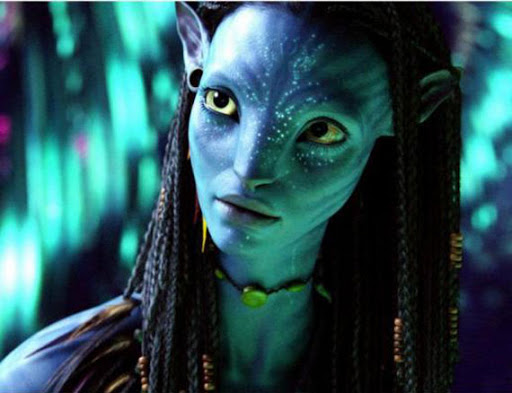
There was uproar when Saldana’s Neytiri wasn’t considered for an Oscar due to it being hidden behind a computer generated mask (yet Al Pacino was nominated for his latex-obscured turn in Dick Tracy, and John Hurt won for his in the Elephant Man), but there is no doubt she should have been considered for her fiery, animalistic turn as the fierce warrioress, her initial aggression towards Jake’s ‘dreamwalker’ gradually melting to pride, friendship and affection, ultimately leading to some freaky blue alien sex that was traumatising and completely unnecessary. As ever Worthington puts in a blank canvas of a role, although this is arguably what is required of his jarhead moron, leaving him ready to be imprinted upon by Quaritch, Augustine of Neytiri.
For those concerned with a new spin on Titanic’s across the tracks romance dominating the film fear not, as there is more than just romance breaking through language barriers and a less-than-subtle environmental message. The final half hour battle between the soldiers and the Na’vi, including aerial assaults and a reversal of Aliens’ giant mech battle, rivals any war film, and is worth the entry fee alone. Be sure to stop watching before Leona Lewis’ ear-gougingly awful credits song though.
Choose film 6/10

Dirty Harry

Would this film have had such a cultural impact without Clint Eastwood’s performance as the eponymous San Francisco detective ‘Dirty’ Harry Callahan? Probably not, as Eastwood’s depiction of one of cinema’s most legendary and hardest badasses is the only thing worth watching in this picture. After the infamous early scene, where Harry foils a robbery using only a .44 Magnum and one of the most quoted lines in the history of people saying something someone else said first, the action peters out, leaving a fairly standard, character driven police procedural, as Callahan attempts to solve the case of the Scorpio killer, loosely based on the real life Zodiac killer recently seen in David Fincher’s film of the same name.
The film rises a little when it detracts from the central plot – the dealing with an attempted suicide is a particular highlight, but is Eastwood’s performance and a decent script enough to watch this movie? Will I choose life, or film? Can’t tell myself in all this excitement.
Choose life 5/10

Dangerous Liaisons

John Malkovich: object of desire? Talk about playing against type. As the Vicomte Sebastien de Valmont in 18th Century France, he is challenged by the Marquise Isabelle de Merteuil (Glenn Close) to deflower Uma Thurman’s virginal bride-to-be Cecile. Deeming the task too easy, he instead chooses to bed Michelle Pfeiffer’s Madame de Tourvel, a virtuous, devout, happily married woman staying with the Vicomte’s aunt. The Marquise then drafts in Keanu Reeves’ Danceny to woo Cecile instead. If the plot sounds familiar, it’s because it was adapted more recently (and poorly) in the modern-set Cruel Intentions, which succeeded in dumbing down the many deceits and allegiances in the plot, but retains the deeply unlikable protagonists, too rich for their own good and revelling in destroying the lives of those around them.
More erotic than most period dramas, with necklines set to plunging and cleavages set to stun, this sees more bedhopping than a season of Desperate Housewives. Malkovich is on excellent form as the callous, vain and calculating lothario, deemed “conspicuously charming” and Close walks the line between on/off romance and hardnosed bitch, but every time Keanu opens his mouth you get the feeling Bill and Ted got their time travelling phone booth stuck in the reign of Louis XV, so thick and distracting is the slacker dude lilt he so desperately tries to hide.
Choose life 5/10

L’Atalante/Zero de Conduite

French director Jean Vigo died at the age of 29, having made just four films (these two, A Propos de Nice and Taris). Undoubtedly Vigo’s untimely demise is a tragedy, but I disagree with the level of promise and potential he apparently showed, as these two films are dull, uninspiring and possessing of paper thin plots.
L’Atalante sees a young couple, Jean and Juliette, get married and set sail on a boat with their captain, Pere Jules, his cats and his cabin boy. After time, Juliette wants to settle down in the city and Jean wants to keep sailing, so he abandons her in port, leaving without her. There is little characterisation of any of the main players, so there is little to care about as to whether the couple resolve their differences or not, other than it will hopefully bring about the end of the film. Only the games of draughts between a desperately cheating Jules and a depressed Jean adding a dash of fun to the proceedings.
Zero de Conduite is even worse plot-wise, following a group of school children planning a rebellion during their school’s upcoming commemoration day. The film is interesting for showing an outdated education system – the house master sleeps in the same room as the students in his charge, making them stand at the foot of his bed for the night as punishment, but it’s hard to feel any sense of joy at the successful rebellion when the full extent of it is flying a Jolly Roger and instigating a pillow fight.
L’Atalante Choose life 3/10
Zero de Conduite Choose life 2/10

Annie Hall

Woody Allen famously has a tendency to write himself into most, if not all, of his scripts. It is usually difficult to distinguish where Allen ends and his characters begin, and this is none more so than with Alvy Singer, Allen’s neurotic obsessive from this, arguably his greatest and funniest film. It is this ability to use himself, or at least a variation of himself, as his protagonist that has allowed Allen to create such a well rounded, nuanced persona. One wonders if he hasn’t been living life as this character since birth, honing the pessimism, the paranoia and awkwardness, so now all he needs to do is put the ‘character’ into a slightly heightened situation, and a natural comedy will emerge.
Not that character is the only weaponry in Allen’s arsenal. The script is hysterical yet droll enough to quote in everyday life (“we can walk to the curb from here”), the performances perfect, particularly Diane Keaton as the eponymous Hall, both Singer’s ideal partner and greatest foe, and the film is peppered with fourth wall breaking with moments of originality, from a narration that admits it may be exaggerating to direct-to-camera conversations and asides.
Thee almost sketch-like format of the film, flitting backwards and forwards in Hall and Singer’s relationship, suits Allen well, as he is a filmmaker of varying styles and techniques, so he is able to showcase this without jarring the rest of the film, such as when he used split-screen to compare different family meals, or stopping random people in the street for relationship advice.
Oh, and the woman waiting with Singer at the end of the film, out of focus and silent in the distance for a matter of seconds? None other than Sigourney Weaver.
Choose film 8/10

Heat

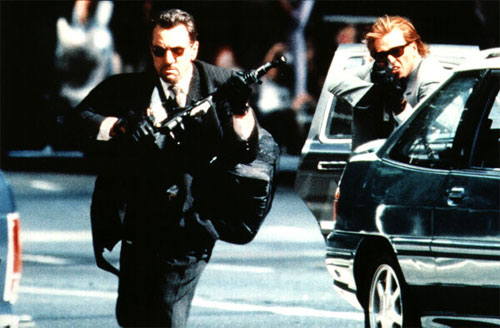
Most crime films tend to pick a side early on, focusing on a ‘means to an end’ band of criminals thieving because they have to, or a team of patriotic, all-American supercops able to match their never-ending machine gun clips with a limitless supply of one liners, but Michael Mann’s Heat, a remake of his own 1989 made for TV movie L.A. Takedown, takes a different path, giving Robert De Niro’s gang of seasoned thieved and Al Pacino’s police squad equal screen time, equal motivation and similar levels of compassion, so you get to decide who you want to win. Though the two main characters; De Niro’s master thief Neil McCauley and Pacino’s dogged detective Vincent Hanna are sworn enemies, they are still two sides of the same coin, separated by their own opinions of the law, but brought together by a deep mutual respect. Neither one is the villain of the film, there are more than enough scumbags among the supporting player to take that role, yet neither is necessarily the hero, although in the end it’s Pacino who grabs the most heroic moments.
Surrounded by an incredible ensemble cast (deep breath: Val Kilmer, Tom Sizemore, Danny Trejo, Dennis Haysbert, Natalie Portman, Xander Berkeley, Hank Azaria, Jon Voight, Jeremy Piven, Mykelti Williamson, William Fichtner, Tom Noonan, Ted Levine, Ashley Judd), some perfectly choreographed set pieces (the opening truck heist and mid film bank robbery/street shootout) and ability to show the effect their chosen lifestyles has had on these characters and their personal lives, or lack thereof, this is a tremendous film, even if it does give in to the occasional cliché, but these can be forgiven for the fact that they use weapons that actually, from time to time, need reloading.
Choose film 9/10