Fargo

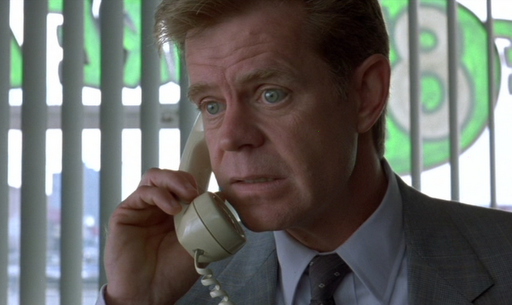
Snivelling, double-talking car salesman Jerry Jundegaard (William H. Macy, Oscar nommed but somehow losing to Cuba Gooding Jr.) has a plan. He needs money. His father-in-law Wade (Harve Presnell) has money, but hates Jerry. So Jerry hires two thugs (Steve Buscemi and Peter Stormare) to kidnap his wife and demand a ransom, of which Jerry will keep half. What could go wrong? Well, quite a lot it turns out, especially if everyone involved is an idiot and you’re being directed by the Coen brothers. The men’s escapades are chaotic, unstructured and are all heading off in different directions until, at the 32 minute mark, heavily pregnant Sheriff Marge Gunderson shows up to set them in order. Frances McDormand deservedly won an Oscar for her portrayal, nailing that wonderful sing-song North Dakota accent “Yah, you betcha” and, once full of eggs, keeping a straight face whilst clearing up the handbasket Hell’s clearly fallen out of around her. 

Few films as short as this (98 minutes) have room to divulge us with background lives – a meeting with an old school friend, conversations about stamps – whilst still keeping the action moving briskly. Every line is considered and real, every character feels genuine, and this is the greatest proof you can find against the argument that the Coens can only write caricatures. Often underrated, this film can never be over-seen, and no-one can call themselves a film fan unless they’ve both seen it, and loved it. The title of this blog was very nearly called Your Accomplice in the Wood Chipper, and a car boot opening has never made me laugh before.
Choose film 10/10

Jaws

Der-dum. Derr-dm. Derrr-dn. Derrrr-dn. Der-dn. Derr-de der-de de-de de-de de-dn-de-de-de-de!
Two notes. The most memorable two notes in history, signalling to the world that a skinny dipper won’t be home for dinner.  Composer John Williams, here winning his second of five Oscars – so far – and whom celebrated his 80th birthday last Wednesday, used these two notes to produce a primitive, devastatingly simple theme tune more recognisable than any other in cinema. Would Jaws have had such an effect without the tune? Probably, but it might not be quite so memorable.
Some credit should be given to the director too. A 26-year old working on only his second feature after the mild success of The Sugarland Express and his direct-to-TV man vs. truck classic Duel, cocky young upstart Steven Spielberg was eager to prove his worth. After purchasing the rights to Peter Benchley’s novel, what followed was one of the most famously arduous shoots ever experienced until Apocalypse Now. The actors hated each other. Boats almost sank or repeatedly drifted unwanted into shot. The pissed off Martha’s Vineyard locals incessantly badgered the crew, it all cost too much and took too long, with reshoots needed to make it just right (some scenes were reshot in the editor’s swimming pool). And of course, the shark didn’t work. The eyes looked weird, the jaws wouldn’t close, the thing wouldn’t float or just didn’t work full stop. Everything had to be geared around that giant mechanical fish. But in a way, all these obstacles came together to add to the whole. The three leads – Roy Scheider’s chief of police Brody, Robert Shaw’s salty sea dog Qunit and Richard Dreyfuss’ techie oceanographer Hooper are supposed to distrust each other, so a mutual dislike between the actors could only heighten that. Continued reshoots allowed shots to be perfected. And a malfunctioning shark meant they couldn’t show the monster, allowing audiences imaginations – always able to outdo any Hollywood special effects – to add in the gnashing teeth, piercing eyes and circling fins where needed. The film set the template for every blockbuster and mainstream monster horror since – only the best creature features save the big reveals to the end.
Whilst there is much to thank Mr. Spielberg for with regard to Jaws’ impact, there are some downsides too. Jaws was released nationwide in over 400 screens – unheard of in its day. Everyone involved assumed it would flop, so they prayed for a fair to middling opening weekend with which to gain back the millions lost in the making. Instead, they found the weekly grosses did nothing but rise, so a complete market saturation became the norm for all summer blockbusters, most notably Star Wars two years later. So nowadays you can blame the tentpole summer pictures – the floods of superheroes and giant robots beating the crap out of each other – at least partially on Jaws.
Not everything good came from the bad or accidental though. The script and staging is impeccable, with one notable scene – the three leads in the galley of Quint’s boat the Orca – passes from tension, to camaraderie, through heavy emotion, back to a sense of fun and then intense action, all without any sense of confusion or feeling rushed. There is some great blindsiding; assuring you something obvious is going to happen, before smacking you in the face with the exact opposite, and even the little moments – the ominous clicking of an unwinding fishing line under Quint’s steely gaze, Hooper’s boyish glee at the menagerie of jawbones hanging in Quint’s shack – all register with great impact.
Choose film 10/10
Cinematic Cure for the Common Cold

I have a cold, it’s quite possibly going to kill me. We’re not talking about some run-of-the-mill everyday man-flu here, this is like if Gwyneth Paltrow in Contagion screwed the monkey from Outbreak, then sneezed all over my Fruit & Fibre. My nose has become a sewer pipe for an over-producing factory of snot. And because of this ‘case of the sniffles’ (my mum’s words) I took a day off work (the first in living memory, save last year’s truck meets bike debacle) and whilst off I thought I’d endeavour to find the best kind of film to watch when you’re ill, and cross a few off the list whilst I was at it.

First off, discount anything subtitled or 3D, you feel bad enough already, having to wear glasses or read isn’t going to make you feel any better. Amelie is a great feel- good film, but if your head feels like wool almost anything in English is going to be a better choice. The same can be said for anything too obscure. David Lynch, Luis Bunuel, Lars von Trier, sit back down. Terry Gilliam is just about acceptable, as most of his work tends to have a light-hearted edge to it, but the others are going to look especially trippy, depending on your medicine cocktail of choice. Probably best not to watch Brazil though.

I’ve followed five schools of thought here: 1. Watch a western. Real men working hard for a living, fighting, killing and sexing up whores like real men should do might just inspire you to man up and show those germs who’s boss. If you’re a girl substitute this for some period Jane Austen nonsense. Being ill in olden times was not deemed proper. 2. Watch a horror, in an attempt to scare yourself so much you forget you’re ill, or possibly scare the illness away. I’m not a doctor, but I think this is medically possible. 3. Watch a depressing film. Seeing people worse off than you should make you feel better about the situation, in a “yes I may be ill, but at least I haven’t been buried alive” kind of way. 4. Watch a kids film, definitely animated, preferably Pixar. Lighthearted, simple to follow and always has a happy ending, this is a traditional antidote to any problem I come across. 5. Die Hard. John McClane has never found a problem he can’t shoot through, and you’re namby-pamby congested sinuses aren’t about to stop his track record. Plus, it’s festive, and I’m not waiting another 11 months before I can watch it again.
1: Our western of choice is Red River, primarily because LoveFilm delivered it through my door the day before the sick day. This is a proper western, with John Wayne and everything. He plays Thomas Dunson, whose woman is killed by Indians and, instead of seeking revenge like any other John Wayne character, sets out to start a cattle herd with his best friend Groot and a young boy with a cow. The boy grows up to be Montgomery Clift fourteen years later, and the three men must head a cattle drive of 10,000 bovine 1,000 miles in 100 days. It’s the kind of film where as soon as a kindhearted, friendly young farm hand expresses his intentions of spending his share of the pay for the drive on a pair of shoes for his beloved young wife, in the very next scene he is trampled to death in a stampede. Wayne gives one of his best performances as one of his most layered characters, and the film soon becomes less about the drive and more about the fate of Dunson and Clift’s Matthew Garth, as the two have different beliefs as to the correct destination for the drive, how to get there and how the men working under them should be treated. It’s a little long for the story it tells – in the third act diverting to assist a wagon train set upon by Indians just to add a romantic edge to the story, developing the script into a sub-screwball comedy, and I was a little disappointed by the surprisingly upbeat ending. That said, it was a good watch for a sick day, kept me engrossed and I genuinely cared about the characters come the close.

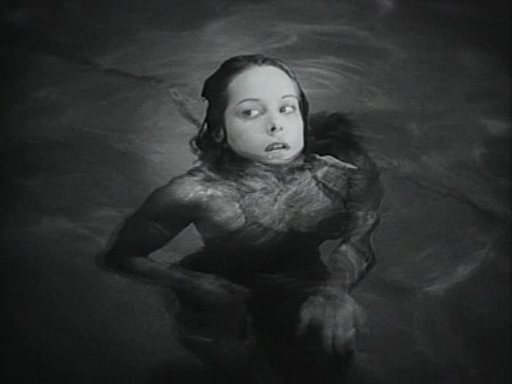
2: BBC iPlayer very kindly showed 1940s classic horror films Cat People and its sequel, the Curse of the Cat People recently, and having not got around to them yet, this was a perfect opportunity. Both films follow the life of Oliver, a 30-something New Yorker, who has apparently never been unhappy before, who falls in love with and marries a beautiful woman and has another, equally beautiful, intelligent and kind woman in love with him. Am I supposed to care about this guy or wish him dead? Anyway, the blurb for the film told me that Irena, the woman he falls for, is haunted by a past which threatens those around her with death and destruction. Couple this with a title like Cat People and I’m expecting either at some point she’s going to turn into a more feline werewolf than is traditionally expected, one side of her family are freakish upright-walking cat/human hybrids, anyone she loves will turn into a cat or at some point 50-foot long cats will drop from the sky and crush everyone she’s met. Disappointingly the first option is chosen, and the limited effects available in 1942 prevent a Rick Baker-esque transformation from being shown. There was an annoying lack of horror in both this and the sequel, which shows Oliver a few years older with a 6 year old outcast daughter, who is given a magic ring with which she wishes for a friend, only for that friend to be the spirit of a figure from Oliver’s past. Only a couple of scenes across the two films offer the slightest amount of tension and none are even the slightest bit scary, so I’m afraid cold theory number two remains untested. The characters are underwritten or superfluous, particularly the sequel’s Jamaican houseservant Edward, whose chief role is to spout dialogue the audience has already assumed or flat out knows, and I’ve have preferred more attention to have been spent on how stupid the woman is who, when she believes herself to be cornered by an attacker, jumps into a brightly lit swimming pool and splashes around for a bit.

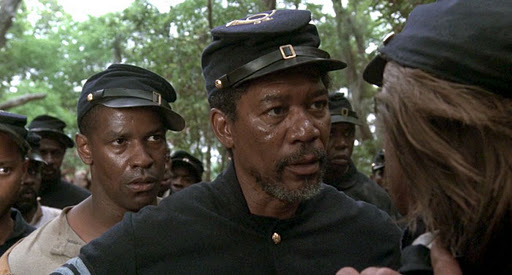
3: If you’re going to watch a depressing film, it has to be a true story, as no-one has ever made something up that’s worse than something you hear on the evening news. And so is the case with Glory, Edward Zwick’s tale of the first all black infantry regiment of the Federal Army during the US Civil War. It says something about late 80s/90s Hollywood that the only way we could be shown a story about black people is through the eyes of the white man brought in to lead them (Matthew Broderick). The movie is rife with clichés (the four privates we focus on all have memorable and recognisable character traits, and all share the same tent, including Morgan Freeman’s kindly old hand and Denzel Washington’s Oscar winning portrayal of the angry, rebellious ra1bble-rouser Trip) and guilty of using Matthew Broderick in a serious role, and too often dwells on sentimentality. It’s also an enraging film, watching the racism against the men denied uniforms and shoes because they are not believed to ever be used for warfare. As for good for illness, the schadenfreude aspect did make me feel a little better, but the severity of how much these guys had to go through just made me feel worse.

4: Here we go, the last Pixar film to be crossed off the list (A Bug’s Life, Cars and Up didn’t make it I’m afraid) tends to be one of the least remembered, though that may change once next year’s prequel Monsters University hits cinemas. This is the best kind of Pixar film, one set in a slight variation of the real world, showing a side of it previously unseen, yet whose origins exist as mythology in our world, in this case that there’s a monster hiding in your closet. The studio – the most consistently outstanding studio working today – takes this concept and forms not just a plot but an entire world around it, with the monsters working for a corporation collecting children’s screams to be used as power for their city. Somehow, who knows how, they manage to make two of these child-terrifying employees our heroes; Mike and Sully voiced perfectly by Billy Crystal and John Goodman), who must face the everyday woes of paperwork and fuel shortages like the rest of us office-ridden schmucks. I’ve mentioned it before, but the key to Pixar’s success is in the details. Mike uses a giant contact lens to cover the single eye that takes up most of his body, sprays on Wet Dog odourant before a date and takes his snake-haired girlfriend to the acclaimed restaurant Harryhausen’s. That, and top notch voice work from a cast including Steve Buscemi as dastardly reptile Randall, James Coburn as Monsters Inc. CEO Henry J. Waternoose and Yoda himself Frank Oz as Randall’s sidekick Fungus. Perfect viewing if infected or not.

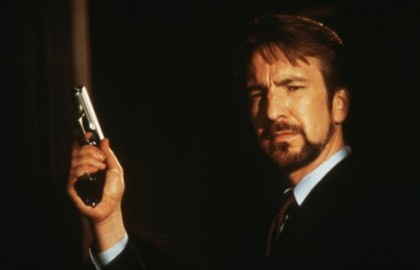
5: Ah, Die Hard. You revolutionised the world of action movies, encouraging studio execs all over Hollywood to green light Die Hard… in a submarine, on a bus, in space concepts left right and centre. You gave us Bruce Willis as a believable action hero without the need for bulging biceps and legs like tree trunks (he even name-checks Stallone and Schwarzenegger in the script). And you gave us Alan Rickman’s greatest role until Galaxy Quest as the refined, immaculately attired thief Hans Gruber (I don’t count Snape as a new character, as he’s basically Gruber with a cloak). The film is note perfect and barely puts a foot wrong, though some characters are broad stereotypes, especially the members of Gruber’s crew, and McClane’s wife’s sleazy co-worker Ellis, so much of a bastard whenever he’s onscreen you root for the terrorists. I tend to put this on as a background film when doing other things, but this is incredibly counter-productive, as I invariably end up engrossed as soon as McClane throws a corpse out of window and I join in with a “Welcome to the party pal!” This was definitely the film that made me feel the greatest, or was at least the one I watched with the moost narcotics inside me, so I’m going to conclude that the best film to watch when you’re ill is one you never forwards, backwards and thrown off a building. If it’s a seminal 80s action movie, so much the better, just make sure it’s one of your favourites. If only a cold were curable by making fists with your toes on carpet.
Red River – Choose film 6/10
Cat People – Choose life 4/10
Curse of the Cat People – Choose life 3/10
Glory – Choose life 6/10
Monsters Inc. – Choose film 8/10
Die Hard – Choose film 10/10

The Thing

Arguably surpassing Howard Hawk’s 50s sci-fi classic the Thing from Another World (a feat unlikely to be achieved by the imminent Mary Elizabeth Winstead starring prequel, confusingly also named ‘The Thing’), John Carpenter’s Thing deserves its place on the list for Rob Bottin’s effects work, occasionally assisted by the legend that is Stan Winston.
Defiantly demanding that the titular creature – a life form able to imitate any living thing it comes across – not just be a man in a suit, we are treated to all manner of beasties, from an arm-munching human torso to spider-legged scuttling heads with eyeballs on stalks, as well as the nightmare inducing stages in their transformations. In a post CGI era these effects still hold ground with today’s effects houses, showing at times animatronic models can be better and more memorable than a bunch of pixels.
Carpenter has always been a master of cranking up tension through the roof, and the secluded Antarctic research base here provides the perfect scenario, with its all-male inhabitants already at each other’s throats from cabin fever. Usually with these kind of monster attacks a small group thrillers it can be easy to see who at least a few of the early victims will be, but here the equal screen time, characterisation and importance to the plot, as well as a few well-placed red herrings, mean that anyone trying to second guess the script will pursue a fruitless endeavour.
Ennio Morricone’s atmospheric score and some sharp dialogue add to the sense of claustrophobia and breakdown of relationships, and there’s an interesting spoiler if you speak Norwegian, when the basic plot is outlined at the initial meeting of some researchers at the beginning of the film.
Choose film 10/10

Lord of the Rings Trilogy

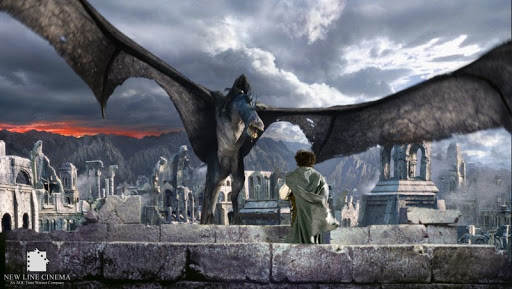
This 1001 book is starting to piss me off. Not only did it count a whole goddamn TV series as one film (slyly writing the length of one hour long episode instead of the full 10-hour marathon) but now it’s counted Peter Jackson’s Lord of the Rings trilogy as one film. This is less annoying, as all three films appear on all of the other lists used, but think, two other films could have been removed to make up the numbers. Maybe two of the crap films I’ve already watched. Thanks book editors, thanks very much. I watched Olympia and the Spider’s Stratagem for nothing. Bastards.
Continue reading

Pixar Day

Had a bit of an accident this morning, got knocked off my bike on the way to work. I’m fine, but my bike’s wrecked, and I was confined to the sofa for the day, and couldn’t think of a better way to cheer myself up than watching nothing but Pixar films, and all off the list!
Continue reading

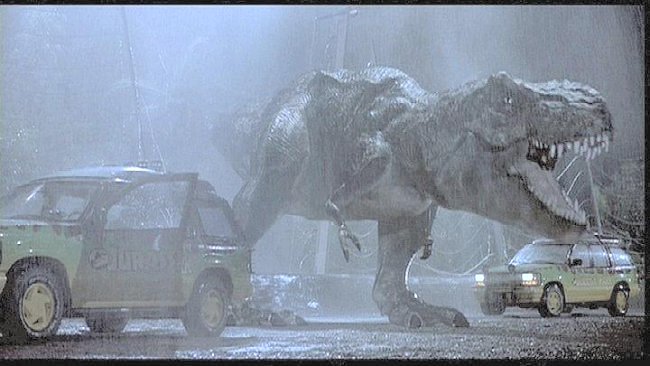
Jurassic Park

Last week some friends and I started a Movie Night, an event that will hopefully become a regular occurrence, and should allow me to keep crossing off films, whilst also achieve something approaching a social life. We kicked off the soon-to-be tradition with a film that means a great deal to me, Jurassic Park. I have previously waxed lyrical about the virtues of this cinematic landmark, or rather the shortcomings of the third film in the series, but I’ll try not to repeat myself too much.
 
The plot, and I really hope that none of you need to know this, although one of the attendees at the movie night admitted ashamedly that this was his first ever viewing of Jurassic Park, concerns a group of people traveling to an island where an eccentric (you can’t be mad if you’re rich) scientist (Richard Attenborough) has discovered a way of cloning dinosaurs from DNA found in mosquitoes frozen in amber. Inevitably, not all goes to plan, and there’s much merriment to be had in the dinos vs. people aftermath.
 
Jurassic Park is a masterclass in efficient film-making, showing a lot with a little. This is shown early on, when an early velociraptor encounter is terrifying, yet only a couple of close-ups of the raptors eyes are seen. Shaking leaves, haunting sound effects and shots from the dinosaurs own point-of-view are enough to believe the presence of this creature. When shown, the Stan Winston-created dinosaur models and ILM-rendered CGI are on the whole impeccable and, even though they are obviously fake (obvious for lack of plausibility, not quality) the illusion is so well realised that you almost believe.
 
As with most Spielberg classics, the key is in casting ordinary, relatable characters in extraordinary situations. In this case, Sam Neill’s Dr. Alan Grant has a well rounded persona, a palaeontologist stuck firmly in the past, unable to touch a computer without breaking it and loathing children. Just watch him trying to let go of Lex’s hand after he helps her up, or how he probably scars a child for life with his raptor story at the start of the film. He is ably supported by Attenborough’s scientist and Laura Dern as a paleobotanist, as well as Jeff Goldblum’s excellent interpretation of rock-star chaotician Dr. Ian Malcolm, although I never really understood why he was invited onto the island. Wayne Knight’s Newman-esque bad guy (does he play anyone else? But then why should he, he’s so good at it) is also a joy to behold, especially his childlike glee at the Bond-style gadgetry he’s provided with to steal dinosaur embryos, causing the chaos that ensues.
 
We’re introduced to the dinosaurs gently, first meeting the gentle herbivores and baby dinosaurs, before building up to the more threatening velociraptors and tyrannosaurus rex. The plot is largely dealt with in the first half of the film, leading for the remainder to be made up of unforgettable set pieces, such as the electric fence, or raptor encounter in the kitchen. Greatest of all though must be the introduction of the T-rex. I don’t think I’ve ever seen ripples forming in a glass of water since without being concerned there is a giant dinosaur about to attack me.
 
It’s not just a monster disaster movie though, as there are genuinely hilarious moments of comedy (the blink and you’ll miss it rear view mirror gag is comic perfection), and the scenes are pitched perfectly, with the T-rex car chase immediately calmed by a gentler encounter with a herd of brachiosaurs. All in all, this is an example of movie perfection, and I look forward to enjoying it many more times in the future.


Choose film 10/10

Toy Story Trilogy

Today’s volatile weather conditions allowed for a productive afternoon film-wise, as a planned bike ride along the beaches of Bournemouth was cut short by sporadic torrential downpours, meaning I crossed a trilogy off the list; Toy Story 1-3.

Watching the original Toy Story, the first feature-length motion picture created entirely using computer animation, always send me back to my childhood, aged 8 years old, sat in the cinema watching in wide-eyed wonder as the pixels were brought to life before me, with my Dad sound asleep in the next seat. It’s one of my earliest film-related memories (my earliest cinema experience that I know of was the Lion King, but that’s another post).
Continue reading