Hamlet

There are some films on the List that I’ve no idea when I’ll get to them. These films fall into three categories – the ones I absolutely adore but have no clue how I’ll even start writing about them, the ones I desperately do not want to watch (but am too much of an anal completist to ignore) and the really long ones. This four-hour-plus cut of Hamlet obviously falls into the latter, but fortunately for me, my girlfriend opted for Kate Winslet as her Film-Maker of choice, and seeing as I’ve reached that point in Winslet’s career in which she appeared in Hamlet as Ophelia, I can cross off Kenneth Branagh’s opus from the Empire 5-Star 500. As for the unspeakable films I don’t want to see, whenever LoveFilm drop Salo through my letterbox it shall not be a good day, though I could pull an In The Realm Of The Senses and bottle it when I’ve taken as much as I can stand.
Continue reading

Departures

Once again I find myself writing under the influence of various prescription narcotics as I recover from my latest malady, so please accept the usual apologies for any slurred typing or off kilter ramblings. Well, any more than usual, anyway.

Departures is a film I feel I should have heard more about. I don’t stay abreast of foreign features as much as I’d like, but I feel that whenever any that are widely deemed great come along, then the chances are that I’ve at least heard of them, yet ‘s slow, personal, moving story of an unemployed cellist discovering self confidence in the most unlikeliest of places has completely passed me by, despite winning the Best Foreign Language Oscar in 2009, beating out the likes of Waltz With Bashir, The Baader Meinhof Complex and The Class, all of which I’ve heard of and two of which I’ve seen. I can’t really explain why I’ve not heard of it, though I’m certain it was never released in any cinemas near me, hardly surprising, considering how many screens were booked up for Twilight: New Moon, released one week previously.

The aforementioned cellist is Daigo Kobayashi (Masahiro Motoki), a possible relation to Pete Postlethwaite’s character in the Usual Suspects. His Tokyo orchestra plays for more-than-half empty audiences, so the owner dissolves the group and Daigo, lacking the self confidence the seek employment elsewhere, sells his cello and moves back with his wife, Mika (Ryoko Hirosue) to the house his mother left him when she passed away. Daigo’s search for employment leads him to a vague newspaper advertisement and a nondescript building. Without even fully realising the job he has unwittingly applied for, Daigo is hired. The career path he has just found himself travelling along? Preparing the dead for their funerals.

Now to me, this job doesn’t sound quite as disgusting as is made out in the film, as similarly to Daigo I’ve never seen a corpse or even a coffin. Yet Daigo’s initial reaction is shame and repulsion – he tells his wife that his job is doing ‘ceremonies’ which, although technically correct, is probably not what she was thinking. His first encounter with a member of the deceased results in a trip to the baths probably longer than advised (though in all fairness the corpse in question had been left to fester for two weeks, and there were maggots crawling around on the nearby plates of food), and when the people around him begin to realise the nature of his profession, he is soon told to get a ‘proper’ job, or be shamed forever. I don’t think it’s racist to say that this may have something to do with the greater focus on dignity and shame in the Japanese culture, in fact I consider it an admirable quality, and one that we could indeed use more of in the West, but I find the extreme nature of the reactions Daigo’s career choice receives to be more exaggerated than I was expecting.

The film is beautifully shot, and though I’ve only seen one of his films. I can see a clear influence from Yasujiro Ozu, especially in the limited camera movements, with most of the scenes imbued with a quiet stillness, shot with the same level of calmness and precision with which Daigo attends to his clients. Although music played a large part in the film, I cannot for the life of me remember it having a great effect upon me, which I find especially surprising considering the amount of praise other reviews have lauded upon that aspect. From what I can remember, the occasional cello performances were beautiful, but I’m afraid my personal knowledge of classical music is far from extensive, so the overall effect was a little lost on me. It did add to the serene nature of the film though.

I’ve been known to at times criticise a film for being too slow, but here I felt the more lethargic pace was very fitting, and I rarely felt the need to glance at my watch even at 130 minutes long. However, there are only so many scenes of someone breaking into tears at a funeral that I can take, and seeing as the film takes place at a lot of different ceremonies, this took up a larger portion of the film than was strictly necessary. 

Plot-wise, there were a couple of elements that I was certain were going to result in an annoying third-act twist, but I’m grateful this wasn’t the case, and the story played out entirely straight, yet wasn’t necessarily predictable. There was a great deal more comedy than expected – Daigo’s first ceremony, and the role he plays on his first day of the job in a marketing video – which definitely helped to alleviate what would have otherwise been a very sombre affair.

Though initially I had put off watching this film, for fear of an overly morbid subject matter, I was left not necessarily bounding with joy, but satisfied, and content.

Choose film 8/10

Yojimbo

Another film I reviewed for the recent So You Think You Can Review tournament over at the Lamb that’s also on the List.

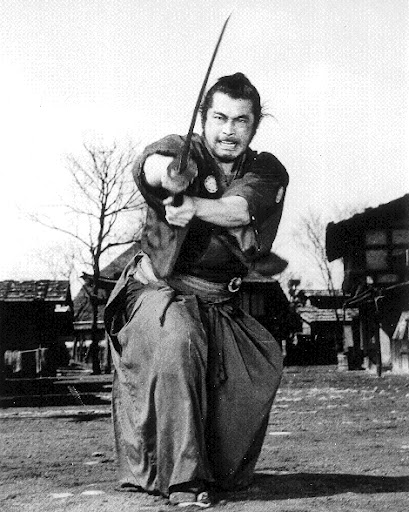
Akira Kurosawa has never denied the fact that he was heavily influenced by the western genre, citing John Ford, amongst others, as something of an idol. It’s fitting then that at least two of the Japanese director’s most prominent works, this and Seven Samurai, would go on to be remade, unofficially yet almost shot-for-shot in Yojimbo’s case, as two of the definitive classics of the western genre. Though I’ve seen Seven Samurai once before, and The Magnificent Seven and Sergio Leone’s Dollars trilogy a fistful of times each, this was my first viewing of Kurosawa’s classic. Yojimbo sees a lone, nameless samurai wander into a town divided by two warring gangs. Seeing an opportunity to rectify the situation, and possibly pocket a little something along the way, the ronin stays in town and pits the two rival factions against one another.

The solitary sword swinger is Toshiro Mifune, with whom Kurosawa had a similar relationship as Ford did with John Wayne, working together on 16 pictures in total. Upon his arrival into the one-road town, the samurai – who later calls himself Kuwabatake Sanjiro (meaning Mulberry Thirty), though he freely admits this is a sudonym – hires himself out to both gang lords. Neither the henpecked, frustrated Seibei nor his foe and former right hand man Ushi-tora outright trust this professional blade-for-hire, yet his opponent accepting the fighter’s offer would guarantee their victory. When everything seems to be going according to Sanjiro’s plans, with the two tribes threatening to wipe one another out, complications arise with the arrival of Ushi-tora’s brother Unosuke, brandishing a pistol.
The gun clearly poses quite a threat to our heroic samurai, as now the skill has been removed from the kill. Previously, Sanjiro had no great challenge within the town – other than maybe the lumbering giant with the comically oversized mallet – but now Unosuke, despite his arrogance, ridiculous posturing and insistence on carrying the gun inside his kimono – looking like he’s wearing a sling and hiding a pot belly – has taken the upper hand. No longer is the killer simply the smarter, faster, more skilled competitor; now it is the man with his finger on the trigger.
Throughout the film, Sanjiro’s motives are never clarified. Is he out for payment? Justice? Peace? Or is he simply seeking entertainment, something he clearly achieves as the two clans fight for his allegiance and to pay for his sake. His allegiance changes as often as the direction of the wind, and one of the most memorable scenes occurs as Sanjiro opts out of a confrontation he himself instigated, yet had no intention of taking part in. Instead, he heads atop a vantage point to watch as the two gangs reluctantly face off against one another, faux-lunging and backing away until only a few feet apart. Were it not for the arrival of a town inspector checking up on them, it’s likely this stalemate could have lasted forever.
Inspired by two of Dashiell Hammett’s film noirs, Red Harvest and The Glass Key, the film has a far greater comedic tone than I was expecting. Be it the odd-couple relationship between the tavern keeper and the persistently noisy coffin maker next door (the only townsperson making a profit from the constant fighting), the boorish stupidity of Ushi-tora’s other brother Inokichi as he struggles to work out that four dead enemies is better than two dead allies, or the belittling wife of his rival, there is much here to gain amusement from. Even serious moments, such as Sanjiro overhearing a plot to double cross and murder him, are juxtaposed by the man waggling both tongue and eyebrow at the young harem girls eavesdropping with him.
The film’s western influence isn’t merely seen in its lone ‘gun’-man story. From wide shots with a character stood alone in the distance, to high noon showdowns with gangs positioned at either end of a one-road town, it seems every shot, character and plot point is a loving homage to the director’s favourite genre. The wind even rustles leaves around in place of rolling tumbleweeds. Exposition is handled swiftly and elegantly via the tavern keeper who takes the samurai in and feeds him, regardless of his lack of funds. Sliding screen panels transform what would otherwise be a static, uneventful dialogue scene into an almost comic-book like affair, with each window shifting aside to reveal the disparate groups at either end of the town. The sliding panel is a recurring theme throughout the film, with many shots taking place inside buildings looking out, and later using the more traditional screen-wipe edit.
If I had to pick some minor flaws with the film, I’d mention that the all-too-brief combat scenes don’t quite live up to their pulse-quickening build ups, and that some of the more minor characters come off as little more than caricatures, instead of fully rounded individuals, but this is nit-picking more than anything else. I’d also heard that there were some intense and gory bursts of violence, and although there are certainly small explosions of slice’n’dice fury, fortunately they weren’t as gruesome as I was led to believe – and of course my expectations are no fault of the film’s.
For the most part the acting is stellar, particularly from Mifune, who plays the wandering samurai with a confident swagger, a sly smirk and an imposing stance. Every inch the typical lone ‘gunslinger’, Mifune is incomparable as the professional killer, his only master the fate that led him to the village; via the direction a falling stick pointed towards. Like a coiled spring, he is able to dish out far more than you might expect, and though it is clearly signposted by the rousing score and natural progression of the scenes, his swordsmanship often comes as much of a shock to us as those on the more uncomfortable end of his blade. Upon first entering the town, the man is greeted by a small dog scampering past, clutching a severed human hand in its mouth. At a sight like this, any other man would have had the sense to turn tail and flee, but Sanjiro – with a look of hilarious incredulity creeping across his face – nonetheless ventures on, possibly in search of the one-armed man this appendage-gnawing mutt has left behind.
The final showdown – because it’s a western, so there has to be a final showdown – has a setup shot of such simple elegance it’d be beautiful, were it not for the haggard, near-dead old man trussed up and dangling at the front of the frame. The ability to pan the camera around the decrepit victim, always keeping him in frame whilst progressing the scene, is a masterful stroke, assisted by Mifune’s Sanjiro stalking ever-closer towards the finale – a ten against one fight to the death – as a tornado of dust swirls up around him. What follows, alas, fails to match that establishing shot for artistry and effect, and also features an almost ridiculously drawn out death, but is nonetheless riveting and satisfying.
Whilst it’s not quite as good as Kurosawa’s other great remade eastern-western, Seven Samurai, Yojimbo is at least shorter, making it the perfect choice for a samurai fix if you’ve got two hours rather than three and a half.
Choose film 8/10
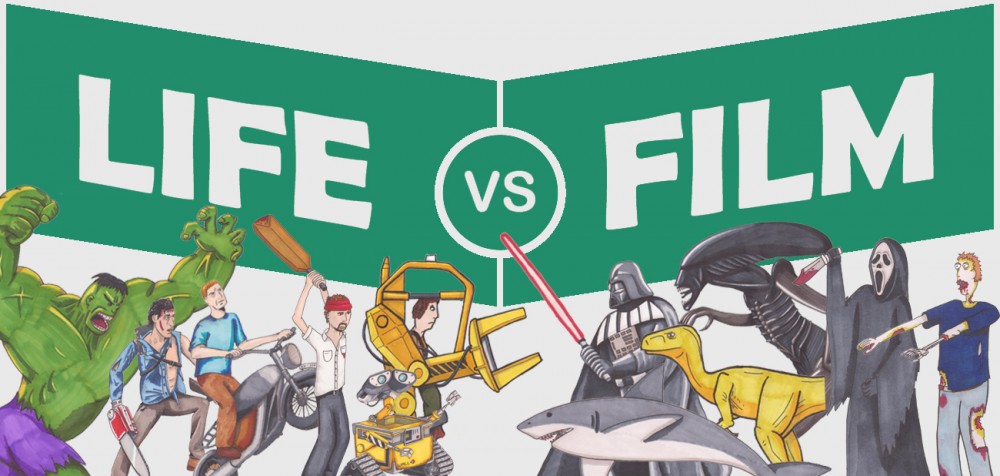
Guaranteed Happiness: Amelie

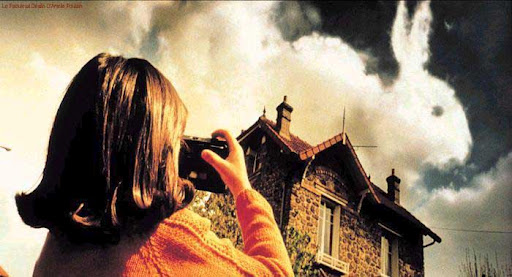
As I mentioned recently, I came 2nd in the Lamb’s So You Think You Can Review tournament. This was one of the films I reviewed for that competition, but as it was on the List as well I figureed I’d use it here too. All praise recycling!In 1997, after having made two successful, distinctly stylised French films with his co-director Marc Caro, Jean-Pierre Jeunet popped over to Hollywood to make Alien: Resurrection, a film widely regarded as one of the worst sequels ever to appear on the big screen. You’d have to go a long way to find someone who liked it, and I’d suggest you don’t start with me. Upon returning to his home town of Paris, Jeunet found himself seeing the once-familiar city with fresh eyes, and set out to make a film that would reflect the magic and beauty he had rediscovered. That film is Amélie.

Telling the story of Amélie Poulain (Audrey Tautou), a girl with an overactive imagination but an undernourished heart who develops a taste for bringing happiness into the lives of the people around her, this isa delightful, light-hearted chocolate-box fantasy romance that only occasionally threatens to choke you on its saccharine sweetness. Amélie herself is a wonderful creation, despite her less-than-wonderful upbringing. She was raised by a military physician father (Rufus) and schoolmistress mother (Lorella Cravotta). Her only physical contact with another life form was the annual check-up provided by her father. Such unaccustomed moments of intimacy caused her heart to beat faster, which her Dad diagnosed as being a heart defect, so kept his daughter at home, away from the other children. This, along with a suicidal goldfish and a childhood tragedy, gave Amélie a unique perspective on life that she would carry on into adulthood, where she works as a waitress in a corner cafe in Montmartre alongside its rogues’ gallery of eccentric staff and clientele.
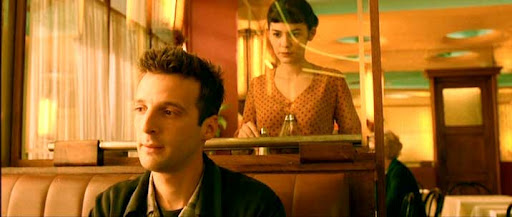
A chance reaction to the death of Princess Diana leads Amélie to discover a treasure trove left by her apartment’s previous inhabitants, so she sets about planning to return the childhood trinkets. She revels in the feeling of harmony she gets from helping others, be they strangers or regular players within her life – though she isn’t close enough to anyone to really call them a friend. Along the way she crosses paths with Nino Quincampoix (Mattieu Kassovitz, director of the seminal La Haine), and finds herself falling in love with this fellow outcast who skips in time to her own offbeat pace, yet her life so far – devoid of affection, interaction and intimacy – ensures that theirs will not be the smoothest of romantic relationships.
From the opening credits – featuring a young Amélie (Flora Guiet) engaging in a variety of nostalgia-inducing childhood antics including peeling dried glue from her fingers and making her hand into a puppet – it is clear this film is a genuine heart-warmer, yet imbued with a tinge of sadness. For all of Amélie’s boundless levels of enjoyment, you can’t help but notice that as a child she was always alone. The film delights in making the ordinary extraordinary, for example by looking at the events occurring simultaneously with Amélie’s birth – a fly being run over, two wine glasses dancing on a wind-buoying tablecloth, a man erasing his deceased friend’s name from his phonebook. Alone, these individual events are almost mundane, but together they contain every aspect of life, from the tender to the tragic.
Though it was released six years before the term was coined, this film displays a unique perspective on the manic pixie dream girl mythology, as we see the film almost entirely from the point of view of said fantastical creature. In more traditional films, the character of Amélie would be the love interest in Nino’s story, and not the other way around, and she’d be played by Zooey Deschanel. If anything, he is a typical leading man archetype, an eccentric loner, working a job he hates to fund an obscure passion project, just waiting for the girl of his dreams to stumble into his life and turn it upside down, yet thankfully this is not his story, he is the supporting player and it is with his influence that Amélie finds her life being disrupted, just as she disrupts those around her.
Tautou is absolutely perfect as the eponymous mirth-maker. Gifted with the role of a title character and appearing in almost every scene yet with barely any dialogue, Tautou manages to express every emotion going through her exceptionally beautiful brown eyes, body language and face framed with a Louise Brooks bob. Interestingly, the role was originally written with Emily Watson in mind, but I think even she would have struggled to match Tautou’s blend of purity, yearning and a rare, beguiling charm. Be it when she is skimming stones, cracking a crème brulee or suppressing laughter during an early attempt at intercourse, Tautou is exquisite in the role she will probably always be best known for. Her delivery of the line “I am nobody’s little weasel” almost brings me to tears.
As usual with any Jeunet picture, the cinematography is beautiful. The colour scheme is heavily influenced by Brazilian artist Juarez Machado, particularly the use of rich browns, oranges and reds for the interior shots. A glowing orange outline will reveal a hidden key, or a glowing heart, and Jeunet’s elaborate camerawork lovingly follows faces, feet and hands as they go about their day, picking up stones and placing them in pockets for future skimming sessions. Some have shunned Jeunet’s debris-free vision of Paris, devoid of litter, ethnic diversity and graffiti, but at heart this is a whimsical fairytale, seen through the filter of its titular pixie’s naive, twee imagination, within which the harshest crimes are committed verbally, and easily remedied with Amélie’s own brand of karmic vengeance. In this world, garden gnomes can travel the world, lamps have nocturnal discussions with photographs of dogs and beggars refuse to accept money on a Sunday, as they are taking the day off.
Though the overarching narrative is one of romance, it is the comedy of the film that really shines through, predominantly from the cast of quirky characters that litter the screen, most of whom are played by actors from other Jeunet works. Be it the bathroom encounter of the hypochondriac Georgette (Isabelle Nanty) and the embittered Joseph (Dominique Pinon), the comeuppance of the bullish greengrocer Collignon (Urbain Cancelier) or a mistaken phonecall to an adult store during which our heroine is informed that “Fur pie doesn’t sell,” the comedic moments are many and varied. Yann Tiersen’s accordion-rich score is ever-so-French (I’m listening to it as I write, my feet have yet to stop tapping) and the occasional use of offbeat instrumentation such as a typewriter and bicycle chains further increases the levels of whimsy, as if that were even possible.
In my opinion, the best kind of film is one that leaves the viewer wanting to be a better person, and that is certainly the case here. The morals of Amélie are clear: be kind to others, be yourself, and enjoy the little things.
Choose film 10/10

Blood Simple

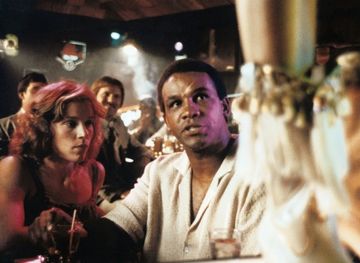
Blood Simple, the directorial/writing debut of the Coen brothers Joel and Ethan, is a sticky, sweaty, clammy picture about deceit and confusion, set in the heart of Texas. Marty (Dan Hedaya) runs a bar, and is the boss of Ray (John Getz) and Meurice (Samm-Art Williams). Distrustful of his wife Abby (Frances McDormand), Dan has hired private investigator Loren Visser (M. Emmet Walsh) to look into what she does with her time. It transpires that Abby is sleeping with Ray, so Marty hires Loren to kill them both whilst he is away on a fishing trip. What with this being a Coen film, things don’t necessarily go to plan, but it is the direction the events took, and the motives involved that I found both interesting and compelling.

Tonally, this is probably most similar to Fargo or No Country For Old Men amongst the Coens’ oeuvre. There’s not a great deal of humour surrounding the violence and devious plotting going on, and the location of Texas adds a great deal to the setting, just as Minnesota did for Fargo and Texas again for No Country. I found this lack of comedy to be a bit jarring – there are some moments of Coen-esque quirkiness certainly, and a couple of jokes in the script, but for the most part this is played dead seriously. The brothers can do serious very well, but personally I prefer their lighter efforts.
Had I not known this was a Coen film (and had it not starred Frances McDormand) then I don’t think I’d have immediately associated it with them. If anything, the structure of the narrative felt far too linear and ordinary, with the exception of perhaps missing an opening and closing scene most directors would have felt obliged to leave in. We’re fed the plot in dribs and drabs, discovering who each of the characters is and their relationships to one another just a couple of minutes after we need to.
Though he isn’t necessarily amongst the lead trio of the film, I would class Walsh’s performance as the greatest in the movie. His Visser is the human embodiment of a lizard, a slimy, oily gumshoe with a malicious streak and a rasping laugh that still haunts my dreams. He plays the part so well that I can’t believe I haven’t come across the actor in much else. For my sins I only really know him from Wild Wild West (he was the train driver). Can anyone recommend any of his other work?
I loved the musical choices in the film, especially Ray mopping up blood to the sounds of The Four Tops’ It’s the Same Old Song, an almost Tarantino-like retro song choice. The camerawork too was at times inspired; the marriage of lighting and camera movement revealing Visser’s cigarette lighter on a table, and the oppressive close shots inside the bar intensifying the humid atmosphere.
I can’t imagine this film cost very much to make – the biggest set pieces involve a car and a shovel, and a gun, knife and a window – yet it’s easily as gripping as many other big budget blockbusters. It reminded me of the likes of Glengarry Glen Ross or Reservoir Dogs, neither one which involves a lot of spectacle, but they have great characters and dialogue, which really is in my opinion more important. I’d have liked a last shot of Meurice – one of the coolest characters in film, check out his bar-top shuffle – but other than that the ending was pretty well contained and executed. Whilst by no means the Coens’ best, this is still definitely worth a watch.
Choose film 8/10

Guaranteed Happiness: Wall-E

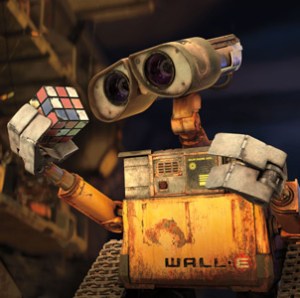
Welcome to the first post in my new semi-regular feature, Guaranteed Happiness. I’ve discovered that a lot of the films I’ve watched recently haven’t necessarily dealt with very happy subjects, and this has been getting me down a bit. Now and then, I’d quite like to watch a happy film, or one that’s uplifting and ensures that I’ll have a big stupid grin on my face for at least 80% of it, and definitely at the end. After all, I’d much rather write about a film I’m passionate about, and I tend to have more to say about films that make me smile than those that make me suicidal. Praise should be aimed squarely between the shoulders of my girlfriend then, for sticking on Pixar’s gem Wall-E when I was in a decidedly cranky mood a little while ago. The aim was for me to sit down and write some posts, which to be honest I was in no mood to do after a fairly crappy day at work and having to shell out over a considerable amount of cash to fix my bike, yet as soon as the film began all thoughts of blogging and even glancing at my laptop screen were out the window.So, why do I love Wall-E? The simple answer is robots. It’ll come as no surprise to regular readers that a film featuring robots (or dinosaurs, time travel or Stephen Tobolowsky) will immediately be watched with heightened levels of glee. And the fact that it’s made by Pixar, a company that has made some of my favourite films to date, and is where I’d be willing to sell several members of my immediate family to work at, then so much the better.This is my favourite Pixar film, which is definitely saying something. I adore the Toy Story trilogy (especially, predictably, Rex), but there’s something about Wall-E‘s simplicity, its pared down scope and focus on telling a straightforward story in new, interesting, and above all, beautiful ways.

The plot is basic: in the not-too-distant future, the human race has polluted and destroyed the world so much that life has become unsustainable, and the only hope lies in the Axiom, a titanic spaceship resplendent with every luxurious convenience to fulfil any desire. Earth has been abandoned and left to the robots, who spend the next few hundred years tidying the place up. Wall-E, our intrepid hero, is the last surviving ‘bot, and he spends his days making and stacking little cubes of garbage into towering skyscrapers of trash, accompanied by his only friend, a cockroach. One day, a ship descends from the heavens, carrying EVE, a futuristic, high tech reconnaissance droid, and Wall-E is instantly smitten.

The tale of a schlubby, down-on-his-luck guy falling in love with an out-of-his-league wonder girl is hardly new, but as far as I know this is the first time it’s been told almost entirely wordlessly, and about mechanical beings. A certain amount of disbelief needs to be suspended to watch the film – the robots seem to have far more personality than they should have been implanted with in the factory – but this results in one of the most well-rounded characters in all of Pixar’s history. Wall-E (which stands for Waste Allocated Load Lifter – Earth Class, something I know from memory) has a love for all things quirky, unusual or fascinating, be it a Rubik’s cube, egg whisk or an old VHS of Hello Dolly!, and watching him investigate the functions of each item – wearing a bra like sunglasses, accidentally erupting a fire extinguisher – are a joy to behold. As are his attempts to woo the evidently disinterest EVE (whose acronym would be a spoiler). The couple’s dates are more moving and say far more than any scene of dialogue could.

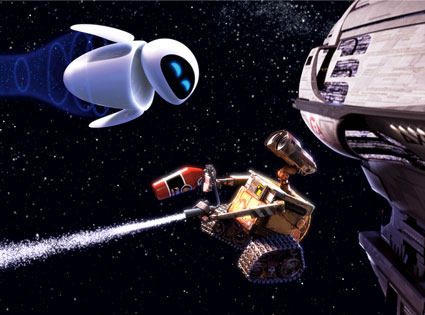
It’s almost impossible to narrow the film down to my favourite scene, but I’d probably say EVE and Wall-E’s space flight. It’s nothing short of a work of art, as the two bots fly a merry courtship dance around one another, set to Thomas Newman’s beautiful score. In fact, every scene between just those two, all almost entirely devoid of dialogue, are so very easily lost in. Their relationship feels natural and real, and if anything the films is at a detriment as the plot moves away from Earth, and the story looks past our central couple.

There’s a few messages hidden not too deeply in the film – stop fucking up the Earth, grow your own food, get off your arse and exercise – but to be fair these are all fairly good messages, when compared to the standard Disney fare of wait for a handsome prince to come and rescue you. Wall-E’s messages are ones I personally agree with (“even if I don’t necessarily live by them,” he says, patting the spare tyre around his midriff) so I don’t really mind such unsubtle preaching in a film, especially one as entertaining as this.

I’ve made no secret of the fact that I’d have loved nothing more than to have been part of the character design team on this film. Wall-E himself has been so carefully thought out with regard to how he works and fits together. I may have appreciated this more than most, being a mechanical engineer by trade, but I think everyone should be impressed by the level of detail. Apparently the design team at Pixar meticulously analysed various machines, working out which ones were ‘male’ and which were ‘female’, and what characteristics defined these genders. Wall-E has clearly been inspired by more clunkier, mechanical machinery, as seen in factories and assembly lines, whilst the sleek, white plastic of EVE is straight out of an Apple store.

As you’ve probably realised, I love this film. The Wall-E poster, a giant pair of his eyes looking inquisitively out of the frame, justifiably hangs in in my lounge, yet I think it almost qualifies as one of the ‘other’ Pixar films that isn’t about toys, fish or superheroes. From the small details – sci-fi queen Sigourney Weaver voicing the Axiom’s tannoy – to the fully realised plot and the brilliance of casting Ben Burtt, the voice of R2D2, as Wall-E, I cannot fault this film in the least, and nor would I want to. And I’d still be trying to get Randy Newman’s closing credits song out of my head if it wasn’t so bloody good.

Choose film 10/10

Born on the Fourth of July

Does anyone else find it funny that Tom Cruise, whose birthday is the third of July, starred in a film called Born on the Fourth of July? No? Just me then.
Olive Stone is one of those film makers that I don’t really get. I’m not that much of a Platoon fan, nor can I say I have any affiliation with Wall Street. Natural Born Killers has it’s moments, and I can’t remember a single scene of Any Given Sunday, though I saw it less than 2 years ago. Other than that, I haven’t seen anything he’s made, though my hopes are up for JFK, whenever I eventually get around to seeing it. Born on the Fourth of July seems like a typical Stone movie, in that it comes deeply ingrained with a message (war is hell and will mess you up), and though at first glance it may seem patriotic, if you look a little deeper it’s really a chance for Stone to voice his own personal feelings about his country.
Tom Cruise is Ron Kovic,who growing up in 1950’s Long Island idolised the war heroes in the Independence Day parades. He looked past the wheelchair, crutches and missing limbs, seeing only the glory and patriotism of being a hero. Kovic spent his school years working hard and being committed to being the best, and after his wrestling attempts didn’t quite work out, he responded positively to a presentation from the US Marine Corps, and signs up with a few buddies, including Stephen Baldwin.The scenes of Kovic’s childhood are shot with a hazy, wholesome, rose-tinted nostalgia, and his family, especially his mother, are all very supportive of Ron’s decision to head to Vietnam and fight for his country, and die there if he has to. The era is well realised – particularly though the soundtrack, as Ron’s brother learns Bob Dylan on the guitar – and the TV broadcasts, with Kennedy’s “What you can do” speech seemingly speaking directly to Kovic.

After signing up and heading to war, the action skips straight over boot camp and the green-horn period – Stone covered all that in Platoon three years earlier – and drops us straight into the now Sergeant Kovic’s Second tour of Vietnam in 1967. These sequences are atmospheric and well-realised, but they’re less impressive than almost any other war film. It’s a good thing then that this film isn’t really aiming to show an accurate, visceral depiction of warfare, instead focusing on the disillusionment of volunteers, the effects that warfare can have on those who fight it, and the disconnect between the soldiers and the families they’ve left behind. For when Ron is discharged – in a wheelchair, with the promise that he’ll never use his legs again (though his main concern is being able to use what is between those legs) – he discovers that his brother doesn’t believe in the war, and his friends that stayed home became prosperous and affluent, whilst he had everything taken away from him.

The cats is full of familiar faces from anyone who’s watched Platoon – alongside Tom Berenger’s Marine recruiter is Willem Dafoe’s similarly paralysed veteran, and John C. McGinley turns up for a very small role (as do Wayne Knight and Tom Sizemore).

The film takes a very long time (145 minutes) to put across some fairly simple ideas. The first 90 minutes are thoroughly predictable, and there were very few surprises in the last hour either. Tom Cruise isn’t bad in the role, but as ever he always does better when he isn’t front and centre (Magnolia, Tropic Thunder), and I couldn’t shake the feeling that he was desperately pursuing an Oscar. Though he was nominated, it’s no surprise that it went instead to Daniel Day-Lewis for My Left Foot, and I’d still have been happy had it gone to fellow nominees Robin Williams or Morgan Freeman, for Dead Poet’s Society or Driving Miss Daisy, instead of Cruise.

It’s worth watching if you’re a Stone or Cruise completist, but there’s little new here, and what there is still won’t surprise, or impress you.

Choose life 5/10

A Night to Remember

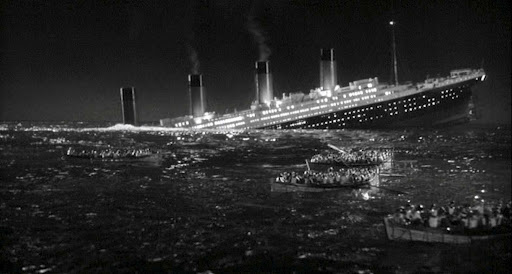
You’re probably wondering how long it’s going to take me, in this review, to mention a certain other film from 1997, directed by James Cameron, that follows a similar plot to this film, and I’ll tell you that it’ll take exactly 48 words for me to mention Titanic. If you’ve never seen A Night to Remember, but are a fan of Titanic (as indeed you should be, for it is a much better film than it’s cool to admit), then you need to start paying more credit towards Night‘s director Roy Ward Baker, for it is from his 1958 picture that Cameron stole most of his film.

Now I’m not saying Cameron stole everything, for if there’s one thing Night is missing, it’s main characters to follow through the events. Instead we follow various groups of people – Second Officer Lightoller (Kenneth More), some steerage passengers, a young 1st class couple (Honor Blackman!) – throughout the night of April 14th, 1912. This lack of focusing on a few people leaves you caring for the characters less, in the same way you didn’t care that much when Fabrizzio got hit with the funnel, here its no bother when the same fate is met by other people we’ve been following. This gives Night a more procedural, re-enactment-like tone, not helped by the generally unmoving performances that leave you cold and distant.Had I never seen Titanic, chances are I’d have been far more impressed with this film, but the remake (that’s essentially what it is) has shown that almost every shot can be composed and recorded at least a little better. The fact that it was made almost 40 years later helped drastically, as the technology did not yet exist to encompass the full scope of Cameron’s vision, but the fact that it does now has left Night a little obsolete.

I found myself mentally checking off every scene that Cameron stole – the steerage dance number, lavish 1st class dining scene, the soot-caked stokers escaping the closing doors in the engine rooms, playing football with ice on the deck, the dining cart gently rolling down an increasingly listing dining room, the steward appalled at the passengers damaging White Star Line property, the musicians disbanding then reforming to play as the boat sinks. The drunken chef even looks the same, and the shot of Murdoch turning his head away in shame, unable to stand watching the boat sink from his wrongfully claimed lifeboat seat is identical! I understand that a lot of these scenes help to set the atmosphere aboard the boat and couldn’t really be avoided, but Cameron should either have admitted he was remaking, paid some form of acknowledgement to the previous film, or at least changed the shot compositions. Mr. Andrews, the boat’s designer, even at one point gives a young couple – who may as well be called Jack and Rose – details on how to survive whilst he’s stood next to the clock on the mantelpiece, and the ‘unsinkable’ Molly Brown, here played by Tucker McGuire but more famously by Kathy Bates in Titanic, vehemently demands that her lifeboat turn around to help drowning survivors.

Based on the book by Walter Lord, and using the real-life experiences of survivors, the film paints an effective picture of the differences between the classes – made particularly clear when some steerage passengers attempt to flee the waters, but recoil in shock at the extent of the upper class facilities. After some initial scene-setting and the launch of the boat, we pick up the action on the night of the 14th, as the supposedly unsinkable liner receives warnings of ice in the area. As opposed to after 90 minutes, the immortal line of “Iceberg, dead ahead” is heard after just half an hour. After the boat has struck and a 300-foot long gash has been haphazardly carved into the hull, events play out largely in real time, and a great deal of time is spent on the engine rooms and the crew’s efforts to contact the nearest boats, of which the Carpathia, a good 58 miles and 4 hours away, is the only one to respond. There are some nice examples of the typical British stiff upper lip – a man putting on a brave face as he waves goodbye to the wife and children he knows he’ll never see again – but there are all in all far too many scenes of the crew trying to convince disbelieving passengers of the seriousness of the situation, to the point where I got so annoyed with some of the passengers that I hoped they’d stay on the boat and attempt to sit it out.

Whilst occasionally moving – the lifeboats forced to listen to the screams of the drowning – there is little reason to watch this now Titanic has made it redundant. In it’s day it was probably a much better film, but alas now it has been surpassed.Choose life 7/10

Nosferatu: A Symphony of Terror

There are at least six variations on the Dracula myth on the List, and probably hundreds that aren’t. I’m ashamed to admit that the only other vampire movies I’d seen prior to this (other than Les Vampires, which doesn’t really count) are a half watched Bram Stoker’s Dracula, and Twilight, which I did not choose to watch and am still trying to scrub from my retinas. And yet, though my life has been surprisingly devoid of vampire fiction (I’ve never even seen an episode of Buffy, or an instalment of the Underworld or Blade films), I’m still well versed in the vampire mythology, as indeed is everyone else. It seems one is almost born knowing that vampire’s transform into bats, suck your blood and can be vanquished with a stake in the heart, exposure to sunlight or too much garlic on their pizza.

This version is one of the earliest vampire films, having been released in 1922 and directed by German silent director F. W. Murnau. It follows the traditional Dracula beats (though the vampire is named Count Orlok as this is an unofficial retelling), and stars Max Schreck as the titular creature of the night.
Jonathan Hutter (Gustav von Wangerheim), a clerk from the town of Bremen in Germany, travels to Transylvania (ominous thunder roll) to complete some legal paperwork with the mysterious Count Orlok, who wishes to buy a house in Bremen. Though there are many clues as to what is in store for Hutter, including terrified locals speaking of nocturnal spirits and his creepy, Orlok-controlled boss hinting that the journey will cause him pain and cost him blood, Hutter merrily laughs everything off as ludicrous superstition and hokum, until he arrives at the castle and meets the Count, who keeps unusual sleeping hours and sleeps in a coffin in the basement.
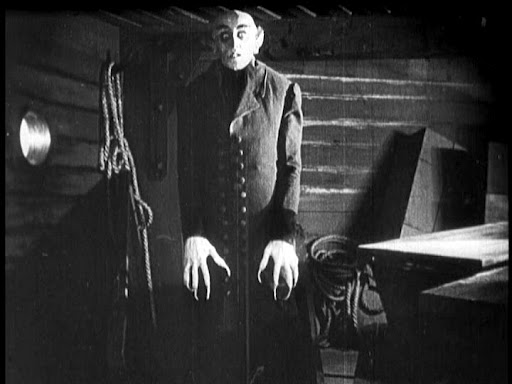
Most of this film is predictable if you know the traditional Dracula legend, but what makes it truly memorable is Schreck’s performance. His distinctive appearance – all pale skin, pointed ears, giant eyebrows over sunken eyes and clawed hands on arms stuck firmly to his sides – sticks in the mind, and his presence is greatly missed whenever he’s off screen. Scenes of Orlok’s stark shadow descending on a prone figure, or his body, stiff as a board, rising from a coffin, stick firmly in the memory, and at the end of the film, when he is staring, unmoving, from a window, is genuinely disconcerting and more than a little terrifying.
It’s unfortunate then that the score for the film is more than a little insane. It kicks off with a cartoonish plinky-plonk tune over the supposedly doom-laden title cards detailing “Nosferatu! That name alone can chill the blood!”, and later the score goes crazy when Hutter is merely reading a book. Also some scenes are let down by a distinct lack of quality in the print. I understand that the film was made 90 years ago, but the scene in which Hutter is discovering bite marks on his neck is ruined by the fact that the bite marks are not even slightly visible on his bright white skin.
The ending is a little hurried, though by that time I was starting to get bored anyway. I was also surprised by how little the character of Van Helsing had to do with the plot, as I’d always thought he was pretty integral to the story, yet he turns up from nowhere halfway through as an expert on vampires in nature.
All in all, this is a good example of an early telling of a classic horror, that unfortunately has become very dated since its release. I’m sure that one of the more recent versions on the list – 1931’s Bela Lugosi starring Dracula or the 1958 Hammer version starring Christopher Lee – will be much better.
Choose life 6/10

A Nightmare on Elm Street

I can only imagine Hallowe’en parties in 1984, but I’m guessing quite a lot of people were dressed up in a battered fedora, red and green striped sweater, poorly applied ‘burned’ make-up and a glove with cardboard blades glued on, for if anything has endured from Wes Craven’s multiple-sequel spawner, it’s Robert Englund’s nightmare-stalker Freddy Krueger.

If it’s true that a horror movie lives or dies (generally by running upstairs instead of out the front door) by it’s killer, then there’s no surprise that this franchise is still going. I haven’t seen the 2010 reboot and I’ve only heard bad things, but I’m intrigued to see Jackie Earle Haley’s take on the former child murder released from prison on a technicality but burned alive by the parents of Elm Street. Krueger is an icon from horror history, up there with Michael Myers, Jason Voorhees and the Guy in the Scream mask, making up the B-team behind the likes of Frankenstein, Dracula and the Wolfman. For Krueger, you see, is unstoppable. He’s risen from the dead to take the children of those that murdered him, but he does his killing in the one place he cannot be caught; the children’s dreams. This is a genius conceit, but also the film’s biggest let down.
If you want to terrify your audience and instill in them genuine fright once they have stopped the film and gone about their daily lives, you scare them with something ordinary. A situation they themselves will find themselves in on a regular basis. Hitchcock did it in Psycho with having a shower. Craven did it with going to sleep. There’s nothing you can do about it, eventually you’ll have to go to sleep; quite often it happens without you even planning to. And once your head is resting gently on your pillow, all you can think about is that maniacal laugh echoing around the walls. That tapping at the window, surely that’s just the branch of a tree blowing in the wind, it couldn’t possibly be the knifed glove of the man out to rip you to shreds? When asleep you’re at your most vulnerable. It can happen anywhere – at home, school, prison, hospital, and there’s no way to defend yourself (short of Inception-style techniques, crossover anyone?) and Craven knows this. In his world, a glass of warm milk is as deadly as any conventional weapon.
But the fact that Freddy exists in dreams, can defy physics by being everywhere at once and can take on any form he chooses to terrify you the most, makes him almost less scary. There’s a sense of inevitability. Much like in Ring, once you watch the tape, you’re going to die. There’s not a whole lot you can do about it. You can’t kill Freddy in a dream, you can’t stay awake forever, there’s really only one possible outcome. Yes, in this film and the ever diminishing sequels they find loopholes to temporarily get around the issue, but I’ve always found these to be annoyances and cop outs from the original story. I’d forgotten the ending of this film when I saw it, and I was almost incredibly annoyed at the backdoor excuse they try to use.
It’s a good, solid horror film, and is much more effective if you never, ever watch the sequels. Whilst they have some inventive kills (hearing aid? genius) and increase the comedy quotient, Freddy becomes a watered down pantomime villain, whose incessant survival becomes more grating the more films you watch. But here his terrorising of four teens (including a 21-year old Johnny Depp in his movie debut) is played largely for tension and scares, though there’s a few lull-in-the-score moments that are clear setups for something to jump out and grab our virginal heroine Nancy (Heather Langenkamp).
There are moments of black comedy – a cop telling a paramedic “you don’t need a stretched, you need a mop,” and the kills are satisfyingly gory. Nancy looking in the mirror got a laugh out of me, as at the time of the film’s release Langenkamp was, you guessed it, 20 years old. The image of Krueger’s hand emerging from between the legs of a girl asleep in the bath is more than a little terrifying.
Choose film 6/10