The Brothers Bloom

There is one benefit to my passing out during Looper last weekend, I’ve now managed to see director Rian Johnson’s second feature before seeing all of his third. It’s streaming on LoveFilm at the moment, so if you’re a member, go forth and watch it now, post haste. All being well, I’ll be seeing Looper before this time next week, and next Sunday should see my review.

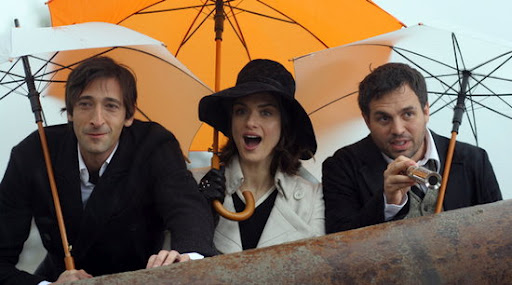
The Brothers Bloom seems on the surface to be far more straightforward than the high-school-noir Brick and time-travel-brain-twister Looper, but in reality its just as subversive as those two. Mark Ruffalo and Adrien Brody are brothers Stephen and Bloom, two con men who have been running scams since their early teens. Stephen (Ruffalo) is the brains of the outfit, and Bloom (Brody) always takes the leading role in the con. Roughly twenty five years after their first con, Bloom wants to quit, but Stephen ropes him in to one last job, conning Rachel Weisz’s ludicrously wealthy yet decidedly eccentric heiress Penelope from some money she’d probably never miss. Along with their near-mute accomplice Bang Bang (Rinko Kikuchi), the brothers set out to dupe Penelope from her riches, but who exactly is the victim in this game?
Continue reading

Casino Royale

With the imminent release of Daniel Craig’s third outing as James Bond, Sam Mendes’ Skyfall (UK release October 26th), it seems like the perfect time to cross the film ranked 56th greatest film of all time by Empire readers a few years ago, Craig’s first Bond outing, Casino Royale.

Now, if you ask me, #56 is pretty high up, especially when you consider that Goldfinger, my favourite Bond movie, is 110 places lower at #166, and no other Bond movies made it onto that list (You Only Live Twice appears in the Empire 5-star 500). Even if you take into account Casino Royale’s proximity to the release of the list, made just two years later, it’s still pretty damn high. Apparently, it’s better than Lawrence of Arabia, Annie Hall, 12 Angry Men, The Great Escape and literally hundreds of other films that, in my opinion, are far superior. But then I didn’t compile the list (though I did vote on it, and not for this film), so who am I to voice the opinions of others?

Before I continue my now-trademark tirade of negative comments, I should probably point out that this is a very good film. It served as a much needed shot in the arm for a franchise left face down and drowning on a CGI-wave of Pierce Brosnan’s swarm and Madonna’s atrocious Die Another Day theme song. In a post-Bourne world it established itself as a gritty reboot, taking Bond away from the ludicrous gadgets and back to the basics of hand-to-hand scrapping in a public bathroom, whilst still retaining the sheer spectacle of fighting on top of not one crane but two. Every aspect of classic Bond is present, from the impossibly slinky and easily-bedded women to a nefarious villain with a silly name and mild physical deformity (Mads Mikkelsen’s Le Chiffre, with a scarred eye that weeps bloody, and asthma to boot). Yet everything feels a bit more real, a bit dirtier and scuffed around the edges. And this description is none more fitting than of Craig’s Bond himself. Yes, he looks impeccable whether wearing an immaculately tailored dinner jacket or a pair of swimming trunks that apparently make my girlfriend’s mother go all weak at every possible joint, and he’s always got a quip ready in his back pocket, but this is a Bond with flaws and imperfections, all to aware that the men he is up against may be more than his match.

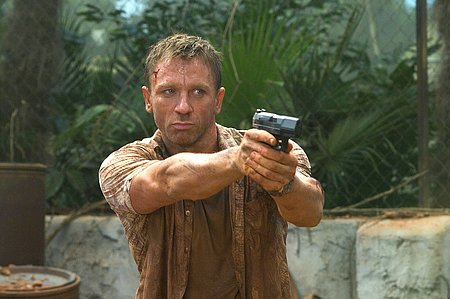
Take the early scene in Uganda, for example. Here, Bond must chase down and apprehend a suspect to obtain the passcode on his mobile phone, yet unfortunately said miscreant (Sebastien Foucan) is rather adept at long-distance sprinting, free-running and jumping off things that are ridiculously high up. Whilst he bounds around without a care in the world, remaining relatively scratch free, Bond is always a fair way behind, getting progressively beaten up and always opting for the easier route – hopping into a JCB digger or shoulder-barging through a wall rather than leaping through an uncomfortably small window. Here is a Bond who doesn’t need to show off when no-one is looking, he just wants to get the job done, and at whatever cost.

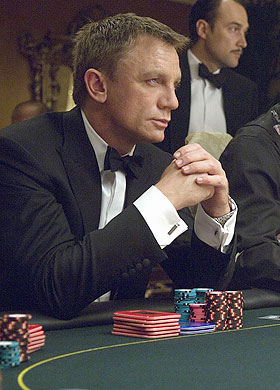
I’ve always had a bit of an issue with Bond films. I’ll gladly watch any of them, even Quantum of Solace if there’s nothing else on, but the plots are usually a bit labyrinthine for me, which is only to be expected if they want to make each film different. I’m not quite sure of the main motivations in Casino Royale, but I’m fairly sure it’s got something to do with the stock market, although the basic point is that Bond infiltrates an extremely high stakes poker game with a $150,000,000 pot, in order to prevent Le Chiffre from winning it and doing something bad with the proceeds. Everything else is fairly superfluous. I’ve read elsewhere that setting most of a Bond film around a poker table is nothing short of sacrilege, but I found those parts to be fraught with tension and often interspersed with enough action to suffice, even if the film made poker out to be a game that only deals in the most improbable card hands ever. There’s a nice running commentary provided by Bond’s accomplices, Vesper Lynd and Mathis (Eva Green & Giancarlo Giannini), but I didn’t think it was that necessary to have so much exposition, considering how dumbed-down the game was.

There were some very memorable set pieces, with the cold open of Bond achieving his double-0 status and the parkour escapade being particular high-lights, though I also enjoyed the stairway scuffle later in the film, showing how Bond had improved his jumping-and-punching skills from earlier. The testicular-torture scene may have gone a little too far, but it was well-handled and didn’t make me feel as squeamish as it could have done, and it’s more than compensated for by the various little moments of humour, and the record number of car rolls a little earlier. 

I approved of the expansion upon the relationship between Bond and M (Judi Dench), whose involvement in this franchise has cemented her presence as something of a British icon, and the rumours that this repartee has been increased ever further in Skyfall excites me no end. Bond is always at his best when bouncing off a superior – best seen with Desmond Llewelyn’s Q, and his utter, barefaced cheek clashes perfectly with Dench’s no-nonsense style. 

Though the last act may drag a little – the film clocks in at 138 minutes – the pace is fairly consistent throughout. There’s a lot here for Bond fans – more in-jokes than I remembered – and plenty for newcomers too. It may not be my favourite Bond film, but it definitely breaks the top 10, and maybe even the top 5.

Choose film 7/10

The Manxman

Pete Quillam (Carl Brisson from The Ring) is a penniless fisherman. His best friend, Philip Christian (Malcolm Keen), is a hot-shot lawyer. The two have been inseparable since birth, being raised as essentially brothers despite their wildly different lifestyles. They’ve even found a way to combine their various career paths, with Philip pushing through a petition that will prevent steam trawlers from encroaching on the fishermen’s haul, but when they meet Kate Cregeen (Anny Ondra), the barmaid daughter of the local pub The Manx Fairy, they both instantly fall for her. Pete, the more headstrong and forward of the pair, is the first to make a move, so the loyal Philip hides his feelings for the sake of his pal. But when Pete heads to Africa to make his fortune to win over Kate’s father (Randle Ayrton), things get complicated when Philip is asked to look after Kate in his absence. 

You cannot imagine how shocked I was to discover that this film has an almost identical central plot to Michael Bay’s Pearl Harbor. I was in no way expecting any similarities between a film made by Alfred Hitchcock and what many believe to be the worst film made by one of the worst blockbuster makers working today, but plot-wise they are pretty much spot on, so I managed to guess almost every element that happened within the first hour of the story. It’s interesting that the love story in Pearl Harbor – a triangle between Ben Affleck and Josh Hartnett’s Army Air Corps pilots and Kate Beckinsale’s nurse – was widely regarded to be the most superfluous and tedious aspect of that film, but here it is the primary – and often sole – focus, and it is handled far more deftly and in depth in Hitchcock’s 80 minutes than Bay’s 3 hours. This is probably because no-one goes to see a Michael Bay film for a tepid, mopey love story, especially when said film is about one of the most momentous events in the history of international warfare that’s literally made from explosions, so those of us who found ourselves having to wade through the hours of treacle to find nowhere near enough shiny fireworks to keep us entertained for even half the film’s length were of course disappointed – a feeling I’ve since become familiar with from Bay’s output. How exactly did this review of a 1929 Hitchcock silent film become me slandering Bay’s 2001 nadir? The two weren’t even made in the same century!

Anyway, The Manxman. The most interesting thing I found about this film was that at the start, the story seemed to be entirely about Philip, and the woes he would endure withholding his unrequited love for the promised bride of his best mate. The story is mostly told from his point of view, which is generally the case of the hero, yet as the plot progresses and the three points of the love triangle become further entangled with one another, it becomes clear that he is not the hero of his own story, but the villain, or at least the antagonist, of Pete’s. Though Philip and Kate never intend to do anything untoward against Pete, they still effectively destroy his life by doing what they believe is right at the time. Pete, meanwhile, is nothing but a lovable, earnest oaf, whose only crimes are an obliviousness to his friends clear affections for a girl, and his shame at believing himself not wealthy enough to be an acceptable husband or son-in-law.

There are no decisions made throughout that can really be judged against, as everyone always acted with the best possible intentions – initially at least – which makes it very easy to empathise with and feel sorry for almost everyone involved, and at times it’s all a bit of a downer. There’s some elements of Cyrano de Bergerac in there as well – Pete asks Philip to put in a good word for him with Kate and her father, because he has a way of making things sound better.

In terms of Hitchcock-ness, there wasn’t anything that stood out thematically or cinematically, although I did like the use of Kate’s diary entries and the way she referred to Philip – Mr. Christian, Phillip and finally Phil – to indicate her growing affection for him and the increasing closeness between the two. That was a nice touch. Also, the climax was delectably tangled, even if it was clear how everything was going to unravel.

Choose film 7/10

Clueless

Is this the most 90s movie ever? If not, it must certainly crack the top 10, for though it is based on a novel written 180 years earlier, everything about Clueless, from the slang, the opinions and most vehemently the fashions positively scream 1990s. Upon release, this may have been topical and timely, but now it severely dates the film, and is mostly comical. Although saying that, there is a chance that it may have been funny at the time (I can’t remember, I was 8 in 1995), as I can’t imagine any time period in which a two-piece yellow plaid suit jacket and skirt were ever in fashion, even amongst teenage girls.

Clueless sees Cher (Alicia Silverstone) as one of the most popular girls in her high school, who seems to have no problems of her own so sets about fixing those of everyone around her, focusing primarily on matchmaking her friends. When new girl Tai (Brittany Murphy) arrives, Cher sees the uncoordinated outcast as a project, and decides to transform Tai into a clone of herself. Meanwhile, Cher’ philosophical environmentalist step-brother Josh (Paul Rudd, effortlessly likable) is helping out Cher’s widowed father (Dan Hedaya) at his law firm.

It’s becoming almost a tradition for me to be reviewing films based on famous literature without ever really knowing much about the source material, and this is no exception, for I’m still yet to read any of Jane Austen’s work, including Emma. That being said, apparently it is only a loose adaptation (I can’t imagine Austen pre-empting Cher’s computerised wardrobe selector), so not having read Emma shouldn’t have affected my viewing anyway, especially seeing as it took so long for people to realise the connection when the film came out anyway.

Silverstone is a delight in this film, playing someone who could so easily be almost detestable, living a life of luxury she’s done nothing to deserve but still feeling the need to whine incessantly in a piercing, nasally tone, yet in Silverstone’s hands you can not only empathise, but occasionally pity her poor-little-rish-girl ways. The film is led by her narration, and contains some of the least self-aware yet funniest lines of the film: “Getting off the freeway makes you realise how important love is.” For Cher is just that kind of person, oblivious. As an 18-year old she assumes she knows everything about everything, there is no problem she cannot solve and no situation that cannot be argued out of, but her journey through this film causes her to re-evaluate her opinions of not only herself, but her friends and family too.

The slang and colloquialisms are brilliant too. Good looking guys are ‘Baldwins’, women are ‘Bettys’ and Cher’s house, built in 1972, is somehow deemed ‘classic.’ Every offhand comment or snide remark is so topical that I found the film to be educational by googling what they said – apparently there was a guy called Paulie Shore who made terrible films, and Mark Wahlberg used to be in a band. Who knew?

I can’t help thinking there’s something missing from Clueless. Although it has the morals and meanings of traditional rom-coms, and has enough rom and com to keep most people entertained, including me, I’m left empty and wanting more. It’s a perfectly serviceable slice of light entertainment, but there are better examples, both prior and since, so I’m not entirely sure why it’s on the 1001 List. It’s one of the few films that I genuinely challenge it’s presence – as far as I can tell it’s of no significant cultural importance, isn’t phenomenally good and didn’t win any awards, generally the three criteria for a List position. As mentioned, the acting is good, the story and characters are engaging and the soundtrack is phenomenal, but there’s an endless number of films you could say that about that aren’t present.

As modern day high school set classic adaptations go, I still prefer 10 Things I Hate About You, If only for the one-two combo of Joseph ‘Joggle’ Gordon-Levitt and Heath Ledger, along with the adults featuring Alison Janney, Daryl Mitchell and Larry Miller (although Clueless does have Wallace Shawn, which goes a long way too). Clueless isn’t bad, and at times it’s funny, poignant and captivating, but afterwards I didn’t feel like my life had been improved in any way, so make of that what you will.

Choose film 6/10

Man on Wire

Another film I reviewed for the So You Think You Can Review tournament at the Lamb, this also sees the start of my attempting to review at least one documentary a month for this site.I’ve had the debate many times with various people as to whether a documentary can really be considered as a film. This usually happens when I use the phrase “I watched a great film last night; it was a documentary about…” The conversation’s other participant invariably glazes over at the ‘D’ word, as how could anything compiled entirely from archive footage and talking-head interviews be seen as entertaining? After all, there’s the danger they might actually learn something. I feel that if there was ever going to be a documentary that could sway the naysayers, then that film is Man on Wire. Even though it is very much a true story, told by those involved with the aid of photographs, footage and re-enactments, this tale of a man attempting to infiltrate the World Trade Centre and walk a tightrope between the towers is compelling, nail-biting stuff, and for the most part feels like a work of fiction.
Continue reading

Winchester ’73

The first things I have to say about this film are that it features one of the earliest credits for Tony Curtis, and that Rock Hudson is buried in the cast, and he plays an Indian. Right, now that’s out of the way, let’s talk about the film.

I like this kind of film. Now, that statement’s not much good to you without knowing what kind of film it is, but regardless of that I like it anyway. It’s the kind of film where several smaller stories are all tied together through coincidence, or an object being passed from one to another, as is the case here. There are some exceptions – I wasn’t wild about Au Hasard Balthazar or Babel – but these types of collective narratives, like Magnolia, Short Cuts, Crash and Traffic, usually appeal to me, and having a great ensemble cast never hurts either. Here, the element that ties the stories together is a rifle.

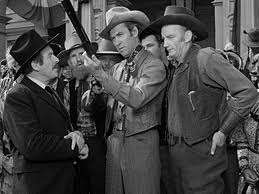
Our introduction to the eponymous weapon is through James Stewart’s Lin McAdam, a cowboy on the trail of Dutch Henry Brown (Stephen McNally), a dangerous man with whom the two share a bitter past. When Lin rocks up in the town of Dodge City, presided over by Will Geer’s Wyatt Earp, he finds Dutch has entered into a shooting competition to win the rifle, so enters as well, mainly to stop his foe from winning the gun that won the West. After the competition, which also sees lookalikes of Davy Crockett and Colonel Sanders, so feels a bit like a western parody, the gun is passed from one person to the next, either by honest trade or dishonest force, and not always with it’s ammunition present. We follow the gun through the film until a fairly obvious and clearly signposted finale, where Lin eventually catches up to the on-the-run Dutch.

This film felt incredibly stagey and unnatural, so I rarely felt engrossed with the movie. For example, there’s an indoor scuffle early on that in which, mid-fight, someone draws the blinds to make the fight look more dramatic. Granted, this was also to try and hide the fisticuffs from those outside the window, but seeing as they were on the first storey I don’t think there was too much danger of that, and it’s clear it was done entirely to increase the dramatic tension. Also, a moment where Shelley Winters, who is great as the film’s predominant female presence, is sat tossing a coin up and down is just waiting for someone to come along and catch it mid-throw, and it just appears as if that’s the very reason shes sat there throwing it in the first place, which is just silly.

Stewart is good in the lead role, and he must have gotten on well with director Anthony Mann, as this is the first of 8 collaborations the pair shared, including The Naked Spur and The Man From Laramie, both of which also appear on the List. Some of the supporting cast are terrible though, particularly every bartender in the film, and there’s a moment where a man tries to hit on the girl whose fiance he just shot, which is bad form in my books.

If, like me, you love the sound of a bullet’s ricochet, then you’ll adore the final showdown, however I feel that there isn’t much here to hold the attention of people who don’t really like westerns. Now, I quite like them, so I thought the film was pretty good, though more could definitely have been done with the central premise, and the film peaks too early with the opening shooting competition. 

Choose film 6/10

Departures

Once again I find myself writing under the influence of various prescription narcotics as I recover from my latest malady, so please accept the usual apologies for any slurred typing or off kilter ramblings. Well, any more than usual, anyway.

Departures is a film I feel I should have heard more about. I don’t stay abreast of foreign features as much as I’d like, but I feel that whenever any that are widely deemed great come along, then the chances are that I’ve at least heard of them, yet ‘s slow, personal, moving story of an unemployed cellist discovering self confidence in the most unlikeliest of places has completely passed me by, despite winning the Best Foreign Language Oscar in 2009, beating out the likes of Waltz With Bashir, The Baader Meinhof Complex and The Class, all of which I’ve heard of and two of which I’ve seen. I can’t really explain why I’ve not heard of it, though I’m certain it was never released in any cinemas near me, hardly surprising, considering how many screens were booked up for Twilight: New Moon, released one week previously.

The aforementioned cellist is Daigo Kobayashi (Masahiro Motoki), a possible relation to Pete Postlethwaite’s character in the Usual Suspects. His Tokyo orchestra plays for more-than-half empty audiences, so the owner dissolves the group and Daigo, lacking the self confidence the seek employment elsewhere, sells his cello and moves back with his wife, Mika (Ryoko Hirosue) to the house his mother left him when she passed away. Daigo’s search for employment leads him to a vague newspaper advertisement and a nondescript building. Without even fully realising the job he has unwittingly applied for, Daigo is hired. The career path he has just found himself travelling along? Preparing the dead for their funerals.

Now to me, this job doesn’t sound quite as disgusting as is made out in the film, as similarly to Daigo I’ve never seen a corpse or even a coffin. Yet Daigo’s initial reaction is shame and repulsion – he tells his wife that his job is doing ‘ceremonies’ which, although technically correct, is probably not what she was thinking. His first encounter with a member of the deceased results in a trip to the baths probably longer than advised (though in all fairness the corpse in question had been left to fester for two weeks, and there were maggots crawling around on the nearby plates of food), and when the people around him begin to realise the nature of his profession, he is soon told to get a ‘proper’ job, or be shamed forever. I don’t think it’s racist to say that this may have something to do with the greater focus on dignity and shame in the Japanese culture, in fact I consider it an admirable quality, and one that we could indeed use more of in the West, but I find the extreme nature of the reactions Daigo’s career choice receives to be more exaggerated than I was expecting.

The film is beautifully shot, and though I’ve only seen one of his films. I can see a clear influence from Yasujiro Ozu, especially in the limited camera movements, with most of the scenes imbued with a quiet stillness, shot with the same level of calmness and precision with which Daigo attends to his clients. Although music played a large part in the film, I cannot for the life of me remember it having a great effect upon me, which I find especially surprising considering the amount of praise other reviews have lauded upon that aspect. From what I can remember, the occasional cello performances were beautiful, but I’m afraid my personal knowledge of classical music is far from extensive, so the overall effect was a little lost on me. It did add to the serene nature of the film though.

I’ve been known to at times criticise a film for being too slow, but here I felt the more lethargic pace was very fitting, and I rarely felt the need to glance at my watch even at 130 minutes long. However, there are only so many scenes of someone breaking into tears at a funeral that I can take, and seeing as the film takes place at a lot of different ceremonies, this took up a larger portion of the film than was strictly necessary. 

Plot-wise, there were a couple of elements that I was certain were going to result in an annoying third-act twist, but I’m grateful this wasn’t the case, and the story played out entirely straight, yet wasn’t necessarily predictable. There was a great deal more comedy than expected – Daigo’s first ceremony, and the role he plays on his first day of the job in a marketing video – which definitely helped to alleviate what would have otherwise been a very sombre affair.

Though initially I had put off watching this film, for fear of an overly morbid subject matter, I was left not necessarily bounding with joy, but satisfied, and content.

Choose film 8/10

Yojimbo

Another film I reviewed for the recent So You Think You Can Review tournament over at the Lamb that’s also on the List.

Akira Kurosawa has never denied the fact that he was heavily influenced by the western genre, citing John Ford, amongst others, as something of an idol. It’s fitting then that at least two of the Japanese director’s most prominent works, this and Seven Samurai, would go on to be remade, unofficially yet almost shot-for-shot in Yojimbo’s case, as two of the definitive classics of the western genre. Though I’ve seen Seven Samurai once before, and The Magnificent Seven and Sergio Leone’s Dollars trilogy a fistful of times each, this was my first viewing of Kurosawa’s classic. Yojimbo sees a lone, nameless samurai wander into a town divided by two warring gangs. Seeing an opportunity to rectify the situation, and possibly pocket a little something along the way, the ronin stays in town and pits the two rival factions against one another.

The solitary sword swinger is Toshiro Mifune, with whom Kurosawa had a similar relationship as Ford did with John Wayne, working together on 16 pictures in total. Upon his arrival into the one-road town, the samurai – who later calls himself Kuwabatake Sanjiro (meaning Mulberry Thirty), though he freely admits this is a sudonym – hires himself out to both gang lords. Neither the henpecked, frustrated Seibei nor his foe and former right hand man Ushi-tora outright trust this professional blade-for-hire, yet his opponent accepting the fighter’s offer would guarantee their victory. When everything seems to be going according to Sanjiro’s plans, with the two tribes threatening to wipe one another out, complications arise with the arrival of Ushi-tora’s brother Unosuke, brandishing a pistol.
The gun clearly poses quite a threat to our heroic samurai, as now the skill has been removed from the kill. Previously, Sanjiro had no great challenge within the town – other than maybe the lumbering giant with the comically oversized mallet – but now Unosuke, despite his arrogance, ridiculous posturing and insistence on carrying the gun inside his kimono – looking like he’s wearing a sling and hiding a pot belly – has taken the upper hand. No longer is the killer simply the smarter, faster, more skilled competitor; now it is the man with his finger on the trigger.
Throughout the film, Sanjiro’s motives are never clarified. Is he out for payment? Justice? Peace? Or is he simply seeking entertainment, something he clearly achieves as the two clans fight for his allegiance and to pay for his sake. His allegiance changes as often as the direction of the wind, and one of the most memorable scenes occurs as Sanjiro opts out of a confrontation he himself instigated, yet had no intention of taking part in. Instead, he heads atop a vantage point to watch as the two gangs reluctantly face off against one another, faux-lunging and backing away until only a few feet apart. Were it not for the arrival of a town inspector checking up on them, it’s likely this stalemate could have lasted forever.
Inspired by two of Dashiell Hammett’s film noirs, Red Harvest and The Glass Key, the film has a far greater comedic tone than I was expecting. Be it the odd-couple relationship between the tavern keeper and the persistently noisy coffin maker next door (the only townsperson making a profit from the constant fighting), the boorish stupidity of Ushi-tora’s other brother Inokichi as he struggles to work out that four dead enemies is better than two dead allies, or the belittling wife of his rival, there is much here to gain amusement from. Even serious moments, such as Sanjiro overhearing a plot to double cross and murder him, are juxtaposed by the man waggling both tongue and eyebrow at the young harem girls eavesdropping with him.
The film’s western influence isn’t merely seen in its lone ‘gun’-man story. From wide shots with a character stood alone in the distance, to high noon showdowns with gangs positioned at either end of a one-road town, it seems every shot, character and plot point is a loving homage to the director’s favourite genre. The wind even rustles leaves around in place of rolling tumbleweeds. Exposition is handled swiftly and elegantly via the tavern keeper who takes the samurai in and feeds him, regardless of his lack of funds. Sliding screen panels transform what would otherwise be a static, uneventful dialogue scene into an almost comic-book like affair, with each window shifting aside to reveal the disparate groups at either end of the town. The sliding panel is a recurring theme throughout the film, with many shots taking place inside buildings looking out, and later using the more traditional screen-wipe edit.
If I had to pick some minor flaws with the film, I’d mention that the all-too-brief combat scenes don’t quite live up to their pulse-quickening build ups, and that some of the more minor characters come off as little more than caricatures, instead of fully rounded individuals, but this is nit-picking more than anything else. I’d also heard that there were some intense and gory bursts of violence, and although there are certainly small explosions of slice’n’dice fury, fortunately they weren’t as gruesome as I was led to believe – and of course my expectations are no fault of the film’s.
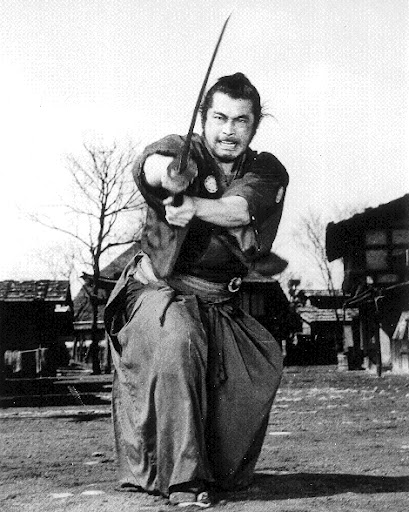
For the most part the acting is stellar, particularly from Mifune, who plays the wandering samurai with a confident swagger, a sly smirk and an imposing stance. Every inch the typical lone ‘gunslinger’, Mifune is incomparable as the professional killer, his only master the fate that led him to the village; via the direction a falling stick pointed towards. Like a coiled spring, he is able to dish out far more than you might expect, and though it is clearly signposted by the rousing score and natural progression of the scenes, his swordsmanship often comes as much of a shock to us as those on the more uncomfortable end of his blade. Upon first entering the town, the man is greeted by a small dog scampering past, clutching a severed human hand in its mouth. At a sight like this, any other man would have had the sense to turn tail and flee, but Sanjiro – with a look of hilarious incredulity creeping across his face – nonetheless ventures on, possibly in search of the one-armed man this appendage-gnawing mutt has left behind.
The final showdown – because it’s a western, so there has to be a final showdown – has a setup shot of such simple elegance it’d be beautiful, were it not for the haggard, near-dead old man trussed up and dangling at the front of the frame. The ability to pan the camera around the decrepit victim, always keeping him in frame whilst progressing the scene, is a masterful stroke, assisted by Mifune’s Sanjiro stalking ever-closer towards the finale – a ten against one fight to the death – as a tornado of dust swirls up around him. What follows, alas, fails to match that establishing shot for artistry and effect, and also features an almost ridiculously drawn out death, but is nonetheless riveting and satisfying.
Whilst it’s not quite as good as Kurosawa’s other great remade eastern-western, Seven Samurai, Yojimbo is at least shorter, making it the perfect choice for a samurai fix if you’ve got two hours rather than three and a half.
Choose film 8/10

Raising Arizona

It’s hard to imagine a sharper left turn taken by a director than from the Coen brother’s debut, Blood Simple, to their sophomore picture, Raising Arizona. Where Blood Simple was dark and mostly serious, Arizona is the closest a film has ever come to capturing a Tex Avery cartoon in live action – with the possible exception of some parts of The Mask.

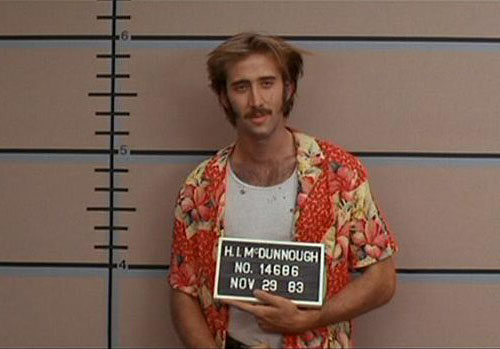
in the role that possibly best combines his often underrated acting ability, comedic potential and trademark brand of insanity, Nicolas Cage gives one of my favourite performances of his as H. I. McDunnough (‘Hi’ for short), a serial petty convict whose ineptitude at evading the law is only matched by his love for police photographer Ed (Holly Hunter). On at least the third time Hi is released from the prison where Ed works he proposes, and the two settle down for a life of happiness in a trailer park in Arizona. But all is not well in the McDunnough household. When Ed discovers she is unable to have children she falls apart, not helped by Hi’s criminal background leaving them unsuitable for adoption, so the only logical solution is, of course, to kidnap one of a famous batch of quintuplets born to a local unpainted furniture magnet, Nathan Arizona. To add to Hi’s woes, two of his former cellmates, Gale and Evelle Snoats (John Goodman and William Forsythe) escape from prison and attempt to crash on the couple’s sofa, Hi’s boss at the metalworks attempts to entice him into swinging, and there’s Leonard Smalls (Randall ‘Tex’ Cobb), a bounty hunter from Hell, on the path of the stolen baby.

This is a film with no intentions of meandering along at a gentle pace. The opening ten minutes or so, setting up the couple’s initial meetings, Hi’s triple incarcerations, their engagement and marriage, runs along at such a breakneck pace you’re liable to get whiplash once the credits roll and a more sedate step is taken. The change in speed is almost jarring, but is helped along with ample amounts of comedy and terrific, perfectly pitched performances, especially from Cage. His Hi, sporting a now standard ridiculous feathered hairdo, is a manic, OTT oddball with more Hawaiian shirts than sense. Hunter’s performance is good, but Ed doesn’t really get to do an awful lot other than reprimand Hi at every turn.


If the characters feel like exaggerated caricatures, then this is exactly the point. This film doesn’t take place in any kind of recognisable reality as much as it does in the heightened, prison-crazed mind of the lead. At times though I felt it went a little too far. The two escaped convicts are maybe a little too stupid – though often to hilarious results, as in their ill-planned bank robbery – and their incessant screaming throughout the entire film became beyond grating. No-one can yell like John Goodman. Leonard Smalls, on the other hand, wasn’t enough of a badass. I couldn’t quite put my finger on it, but I always felt that he was a guy pretending, Cobb never inhabited the role quite as fully as I’d have liked, so his presence was very much under felt. It’s a shame, as the Coens can do great work with the right actors in the antagonist roles – check out Javier Bardem as Anton Chigurh in No Country For Old Men, or Paul Newman’s Sidney J. Mussburger in The Hudsucker Proxy. Smalls should have been larger than life, and could have been the best part of the film, but remains sadly forgettable. Which in itself is impressive seeing as he is a guy who will happily grenade a fluffy bunny just for being alive.

The fight scenes are tremendously enjoyable, and really cement home the cartoonish nature of the film. Most of the characters involved would have received serious, possibly fatal injuries several times throughout the film – particularly Hi – yet they mostly just walk it off with little more than a plaster stuck to their face. And the film’s solitary death scene is so ridiculously over the top and insane that it is very much a moment of explosive comedy, regardless of whether you can see it coming or not.

I think that one of the overall messages from the film is that Hi and Ed, though they seem incredibly unsuitable to take on the task, are possibly the best parents of all the film’s characters. Of the various people who assume the role of the kidnapped baby’s guardian throughout the story, Hi and Ed are the only ones to not immediately name the baby after themselves. Granted, they name him after each  other instead, but at least they’re thinking about someone else, not just themselves.

Whilst this is in no way one of the best Coen brothers film, it is still hugely entertaining and definitely worth a watch, if only to see some classic comic Cage before he went off the rails.

Choose film 8/10

Guaranteed Happiness: Amelie

As I mentioned recently, I came 2nd in the Lamb’s So You Think You Can Review tournament. This was one of the films I reviewed for that competition, but as it was on the List as well I figureed I’d use it here too. All praise recycling!In 1997, after having made two successful, distinctly stylised French films with his co-director Marc Caro, Jean-Pierre Jeunet popped over to Hollywood to make Alien: Resurrection, a film widely regarded as one of the worst sequels ever to appear on the big screen. You’d have to go a long way to find someone who liked it, and I’d suggest you don’t start with me. Upon returning to his home town of Paris, Jeunet found himself seeing the once-familiar city with fresh eyes, and set out to make a film that would reflect the magic and beauty he had rediscovered. That film is Amélie.

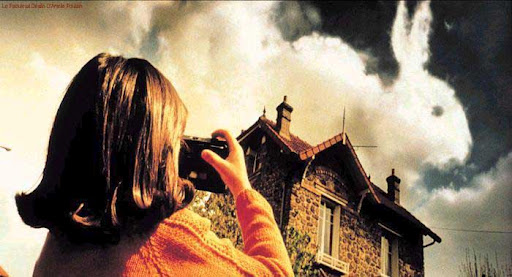
Telling the story of Amélie Poulain (Audrey Tautou), a girl with an overactive imagination but an undernourished heart who develops a taste for bringing happiness into the lives of the people around her, this isa delightful, light-hearted chocolate-box fantasy romance that only occasionally threatens to choke you on its saccharine sweetness. Amélie herself is a wonderful creation, despite her less-than-wonderful upbringing. She was raised by a military physician father (Rufus) and schoolmistress mother (Lorella Cravotta). Her only physical contact with another life form was the annual check-up provided by her father. Such unaccustomed moments of intimacy caused her heart to beat faster, which her Dad diagnosed as being a heart defect, so kept his daughter at home, away from the other children. This, along with a suicidal goldfish and a childhood tragedy, gave Amélie a unique perspective on life that she would carry on into adulthood, where she works as a waitress in a corner cafe in Montmartre alongside its rogues’ gallery of eccentric staff and clientele.
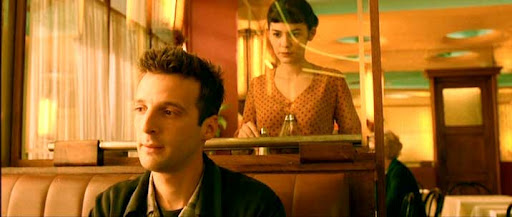
A chance reaction to the death of Princess Diana leads Amélie to discover a treasure trove left by her apartment’s previous inhabitants, so she sets about planning to return the childhood trinkets. She revels in the feeling of harmony she gets from helping others, be they strangers or regular players within her life – though she isn’t close enough to anyone to really call them a friend. Along the way she crosses paths with Nino Quincampoix (Mattieu Kassovitz, director of the seminal La Haine), and finds herself falling in love with this fellow outcast who skips in time to her own offbeat pace, yet her life so far – devoid of affection, interaction and intimacy – ensures that theirs will not be the smoothest of romantic relationships.
From the opening credits – featuring a young Amélie (Flora Guiet) engaging in a variety of nostalgia-inducing childhood antics including peeling dried glue from her fingers and making her hand into a puppet – it is clear this film is a genuine heart-warmer, yet imbued with a tinge of sadness. For all of Amélie’s boundless levels of enjoyment, you can’t help but notice that as a child she was always alone. The film delights in making the ordinary extraordinary, for example by looking at the events occurring simultaneously with Amélie’s birth – a fly being run over, two wine glasses dancing on a wind-buoying tablecloth, a man erasing his deceased friend’s name from his phonebook. Alone, these individual events are almost mundane, but together they contain every aspect of life, from the tender to the tragic.
Though it was released six years before the term was coined, this film displays a unique perspective on the manic pixie dream girl mythology, as we see the film almost entirely from the point of view of said fantastical creature. In more traditional films, the character of Amélie would be the love interest in Nino’s story, and not the other way around, and she’d be played by Zooey Deschanel. If anything, he is a typical leading man archetype, an eccentric loner, working a job he hates to fund an obscure passion project, just waiting for the girl of his dreams to stumble into his life and turn it upside down, yet thankfully this is not his story, he is the supporting player and it is with his influence that Amélie finds her life being disrupted, just as she disrupts those around her.
Tautou is absolutely perfect as the eponymous mirth-maker. Gifted with the role of a title character and appearing in almost every scene yet with barely any dialogue, Tautou manages to express every emotion going through her exceptionally beautiful brown eyes, body language and face framed with a Louise Brooks bob. Interestingly, the role was originally written with Emily Watson in mind, but I think even she would have struggled to match Tautou’s blend of purity, yearning and a rare, beguiling charm. Be it when she is skimming stones, cracking a crème brulee or suppressing laughter during an early attempt at intercourse, Tautou is exquisite in the role she will probably always be best known for. Her delivery of the line “I am nobody’s little weasel” almost brings me to tears.
As usual with any Jeunet picture, the cinematography is beautiful. The colour scheme is heavily influenced by Brazilian artist Juarez Machado, particularly the use of rich browns, oranges and reds for the interior shots. A glowing orange outline will reveal a hidden key, or a glowing heart, and Jeunet’s elaborate camerawork lovingly follows faces, feet and hands as they go about their day, picking up stones and placing them in pockets for future skimming sessions. Some have shunned Jeunet’s debris-free vision of Paris, devoid of litter, ethnic diversity and graffiti, but at heart this is a whimsical fairytale, seen through the filter of its titular pixie’s naive, twee imagination, within which the harshest crimes are committed verbally, and easily remedied with Amélie’s own brand of karmic vengeance. In this world, garden gnomes can travel the world, lamps have nocturnal discussions with photographs of dogs and beggars refuse to accept money on a Sunday, as they are taking the day off.
Though the overarching narrative is one of romance, it is the comedy of the film that really shines through, predominantly from the cast of quirky characters that litter the screen, most of whom are played by actors from other Jeunet works. Be it the bathroom encounter of the hypochondriac Georgette (Isabelle Nanty) and the embittered Joseph (Dominique Pinon), the comeuppance of the bullish greengrocer Collignon (Urbain Cancelier) or a mistaken phonecall to an adult store during which our heroine is informed that “Fur pie doesn’t sell,” the comedic moments are many and varied. Yann Tiersen’s accordion-rich score is ever-so-French (I’m listening to it as I write, my feet have yet to stop tapping) and the occasional use of offbeat instrumentation such as a typewriter and bicycle chains further increases the levels of whimsy, as if that were even possible.
In my opinion, the best kind of film is one that leaves the viewer wanting to be a better person, and that is certainly the case here. The morals of Amélie are clear: be kind to others, be yourself, and enjoy the little things.
Choose film 10/10