 I have a cold, it’s quite possibly going to kill me. We’re not talking about some run-of-the-mill everyday man-flu here, this is like if Gwyneth Paltrow in Contagion screwed the monkey from Outbreak, then sneezed all over my Fruit & Fibre. My nose has become a sewer pipe for an over-producing factory of snot. And because of this ‘case of the sniffles’ (my mum’s words) I took a day off work (the first in living memory, save last year’s truck meets bike debacle) and whilst off I thought I’d endeavour to find the best kind of film to watch when you’re ill, and cross a few off the list whilst I was at it.
First off, discount anything subtitled or 3D, you feel bad enough already, having to wear glasses or read isn’t going to make you feel any better. Amelie is a great feel- good film, but if your head feels like wool almost anything in English is going to be a better choice. The same can be said for anything too obscure. David Lynch, Luis Bunuel, Lars von Trier, sit back down. Terry Gilliam is just about acceptable, as most of his work tends to have a light-hearted edge to it, but the others are going to look especially trippy, depending on your medicine cocktail of choice. Probably best not to watch Brazil though.
I’ve followed five schools of thought here: 1. Watch a western. Real men working hard for a living, fighting, killing and sexing up whores like real men should do might just inspire you to man up and show those germs who’s boss. If you’re a girl substitute this for some period Jane Austen nonsense. Being ill in olden times was not deemed proper. 2. Watch a horror, in an attempt to scare yourself so much you forget you’re ill, or possibly scare the illness away. I’m not a doctor, but I think this is medically possible. 3. Watch a depressing film. Seeing people worse off than you should make you feel better about the situation, in a “yes I may be ill, but at least I haven’t been buried alive” kind of way. 4. Watch a kids film, definitely animated, preferably Pixar. Lighthearted, simple to follow and always has a happy ending, this is a traditional antidote to any problem I come across. 5. Die Hard. John McClane has never found a problem he can’t shoot through, and you’re namby-pamby congested sinuses aren’t about to stop his track record. Plus, it’s festive, and I’m not waiting another 11 months before I can watch it again.
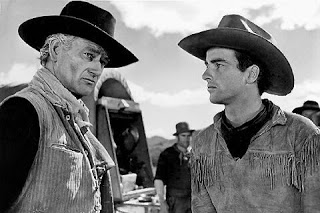 1: Our western of choice is Red River, primarily because LoveFilm delivered it through my door the day before the sick day. This is a proper western, with John Wayne and everything. He plays Thomas Dunson, whose woman is killed by Indians and, instead of seeking revenge like any other John Wayne character, sets out to start a cattle herd with his best friend Groot and a young boy with a cow. The boy grows up to be Montgomery Clift fourteen years later, and the three men must head a cattle drive of 10,000 bovine 1,000 miles in 100 days. It’s the kind of film where as soon as a kindhearted, friendly young farm hand expresses his intentions of spending his share of the pay for the drive on a pair of shoes for his beloved young wife, in the very next scene he is trampled to death in a stampede. Wayne gives one of his best performances as one of his most layered characters, and the film soon becomes less about the drive and more about the fate of Dunson and Clift’s Matthew Garth, as the two have different beliefs as to the correct destination for the drive, how to get there and how the men working under them should be treated. It’s a little long for the story it tells – in the third act diverting to assist a wagon train set upon by Indians just to add a romantic edge to the story, developing the script into a sub-screwball comedy, and I was a little disappointed by the surprisingly upbeat ending. That said, it was a good watch for a sick day, kept me engrossed and I genuinely cared about the characters come the close.
 2: BBC iPlayer very kindly showed 1940s classic horror films Cat People and its sequel, the Curse of the Cat People recently, and having not got around to them yet, this was a perfect opportunity. Both films follow the life of Oliver, a 30-something New Yorker, who has apparently never been unhappy before, who falls in love with and marries a beautiful woman and has another, equally beautiful, intelligent and kind woman in love with him. Am I supposed to care about this guy or wish him dead? Anyway, the blurb for the film told me that Irena, the woman he falls for, is haunted by a past which threatens those around her with death and destruction. Couple this with a title like Cat People and I’m expecting either at some point she’s going to turn into a more feline werewolf than is traditionally expected, one side of her family are freakish upright-walking cat/human hybrids, anyone she loves will turn into a cat or at some point 50-foot long cats will drop from the sky and crush everyone she’s met. Disappointingly the first option is chosen, and the limited effects available in 1942 prevent a Rick Baker-esque transformation from being shown. There was an annoying lack of horror in both this and the sequel, which shows Oliver a few years older with a 6 year old outcast daughter, who is given a magic ring with which she wishes for a friend, only for that friend to be the spirit of a figure from Oliver’s past. Only a couple of scenes across the two films offer the slightest amount of tension and none are even the slightest bit scary, so I’m afraid cold theory number two remains untested. The characters are underwritten or superfluous, particularly the sequel’s Jamaican houseservant Edward, whose chief role is to spout dialogue the audience has already assumed or flat out knows, and I’ve have preferred more attention to have been spent on how stupid the woman is who, when she believes herself to be cornered by an attacker, jumps into a brightly lit swimming pool and splashes around for a bit.
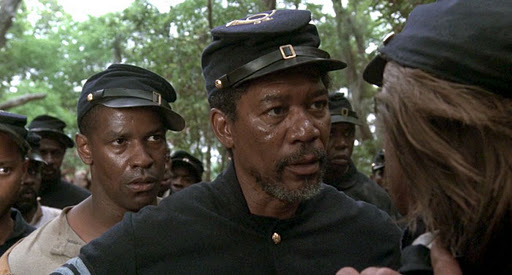
 3: If you’re going to watch a depressing film, it has to be a true story, as no-one has ever made something up that’s worse than something you hear on the evening news. And so is the case with Glory, Edward Zwick’s tale of the first all black infantry regiment of the Federal Army during the US Civil War. It says something about late 80s/90s Hollywood that the only way we could be shown a story about black people is through the eyes of the white man brought in to lead them (Matthew Broderick). The movie is rife with clichés (the four privates we focus on all have memorable and recognisable character traits, and all share the same tent, including Morgan Freeman’s kindly old hand and Denzel Washington’s Oscar winning portrayal of the angry, rebellious ra1bble-rouser Trip) and guilty of using Matthew Broderick in a serious role, and too often dwells on sentimentality. It’s also an enraging film, watching the racism against the men denied uniforms and shoes because they are not believed to ever be used for warfare. As for good for illness, the schadenfreude aspect did make me feel a little better, but the severity of how much these guys had to go through just made me feel worse.
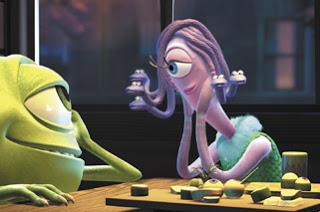 4: Here we go, the last Pixar film to be crossed off the list (A Bug’s Life, Cars and Up didn’t make it I’m afraid) tends to be one of the least remembered, though that may change once next year’s prequel Monsters University hits cinemas. This is the best kind of Pixar film, one set in a slight variation of the real world, showing a side of it previously unseen, yet whose origins exist as mythology in our world, in this case that there’s a monster hiding in your closet. The studio – the most consistently outstanding studio working today – takes this concept and forms not just a plot but an entire world around it, with the monsters working for a corporation collecting children’s screams to be used as power for their city. Somehow, who knows how, they manage to make two of these child-terrifying employees our heroes; Mike and Sully voiced perfectly by Billy Crystal and John Goodman), who must face the everyday woes of paperwork and fuel shortages like the rest of us office-ridden schmucks. I’ve mentioned it before, but the key to Pixar’s success is in the details. Mike uses a giant contact lens to cover the single eye that takes up most of his body, sprays on Wet Dog odourant before a date and takes his snake-haired girlfriend to the acclaimed restaurant Harryhausen’s. That, and top notch voice work from a cast including Steve Buscemi as dastardly reptile Randall, James Coburn as Monsters Inc. CEO Henry J. Waternoose and Yoda himself Frank Oz as Randall’s sidekick Fungus. Perfect viewing if infected or not.
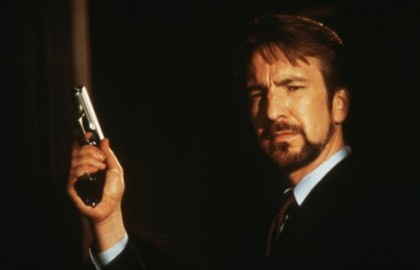
 5: Ah, Die Hard. You revolutionised the world of action movies, encouraging studio execs all over Hollywood to green light Die Hard… in a submarine, on a bus, in space concepts left right and centre. You gave us Bruce Willis as a believable action hero without the need for bulging biceps and legs like tree trunks (he even name-checks Stallone and Schwarzenegger in the script). And you gave us Alan Rickman’s greatest role until Galaxy Quest as the refined, immaculately attired thief Hans Gruber (I don’t count Snape as a new character, as he’s basically Gruber with a cloak). The film is note perfect and barely puts a foot wrong, though some characters are broad stereotypes, especially the members of Gruber’s crew, and McClane’s wife’s sleazy co-worker Ellis, so much of a bastard whenever he’s onscreen you root for the terrorists. I tend to put this on as a background film when doing other things, but this is incredibly counter-productive, as I invariably end up engrossed as soon as McClane throws a corpse out of window and I join in with a “Welcome to the party pal!” This was definitely the film that made me feel the greatest, or was at least the one I watched with the moost narcotics inside me, so I’m going to conclude that the best film to watch when you’re ill is one you never forwards, backwards and thrown off a building. If it’s a seminal 80s action movie, so much the better, just make sure it’s one of your favourites. If only a cold were curable by making fists with your toes on carpet.
Red River – Choose film 6/10
Cat People – Choose life 4/10
Curse of the Cat People – Choose life 3/10
Glory – Choose life 6/10
Monsters Inc. – Choose film 8/10
Die Hard – Choose film 10/10

 The first spoken word in this film is “garbage”. I wouldn’t go quite that far, but I don’t quite get the big deal of this piece. Centring around four main characters, Andie Macdowell’s prudent homemaker Ann, her promiscuous sister Cynthia (Laura San Giacomo), Ann’s lawyer husband John (Peter Gallagher) who is sleeping with both of them, and his old college friend Graham (James Spader), this plays out slowly and plainly, with plot points signposted miles in advance. Graham hasn’t seen John for 9 years, but has moved back into town and needs somewhere to stay temporarily, so crashes at theirs. He seems a little off, a little antisocial and distanced from the world, and when Ann goes to visit him in his new apartment, she discovers he has a ‘personal project’ that involves him videotaping women discussing their sexual experiences, and occasionally masturbating. It seems the only way the impotent Graham can become aroused is via a camera, hence this rather literal stockpiled wank bank. The film shows how powerful a camera can be, with the subjects being more willing to open up when staring into a lens than someone else’s face, and Spader’s performance is riveting and genuinely unsettling at times, but watching Macdowell trying to act is painful, and not enough unexpected occurs.







 Life Vs Film