Sophie’s Choice

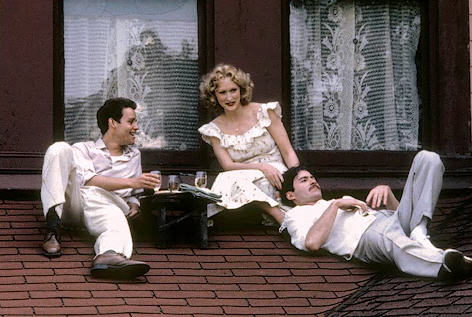
The unfortunately named Stingo (Peter MacNicol) moves from his southern home to be a writer in New York. He rents a room in a house, and so finds himself firm friends with a neighbouring couple, Sophie and Nathan (Meryl Streep & Kevin Kline). Sophie and Nathan have a tumultuous relationship, as she has a tragic past and he has issues of his own, and slowly Stingo learns of their history, and the hardships Sophie has had to endure.
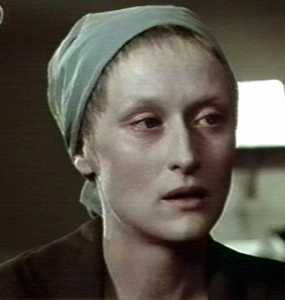
In the world, there are happy films. They are stories about underdogs overcoming adversaries, battling against hoards of naysayers as they set out to win the court case/football game/heart of the cheerleader. The kinds of films where, upon finishing, you punch the air and yell something, just to join in the triumphant atmosphere. And then there’s Sophie’s Choice. Watching this film is like receiving one punch to the gut after another, rounded out with a swift thwack to the head with a two-by-four. It’s like watching Schindler’s List whilst listening to country music and drinking a glass of orphan’s tears. If you have a big grin plastered over your face after watching the film, I’m guessing you wouldn’t have been out of place in the Hitler Youth back in the 1940’s. The happiest parts of this film occur between the three leads as they enjoy a life of carefree wonder, visiting Coney Island dressed in period garb, but even these moments have the rug pulled out from them eventually.

As with many films on this list, I have a history with this movie. I’d heard it was good, so I borrowed a copy from my Grandad – a copy he’d got free from a Sunday newspaper and never intended to watch, yet he still required it returned after I watched it. Free DVDs don’t tend to have much in the way of DVD extras, up to and including DVD menus. In fact, most will just play straight out, without you needing to touch a button. In fact, I’ve watched one before that didn’t even have chapters. I tried to skip back to catch a line I’d missed, and ended up back at the start of the film, and had to fast-forward to the scene again. What a time we’re living in. Anyway, Sophie’s Choice was such a film that had no extras, just a big old ‘PLAY’ button. I’d heard that, for Streep’s Oscar-wining performance she’d learnt Polish and German for the role, which was not something I’d given a second thought to until, over halfway through this 2 1/2 hour film, there’s the first of a few flashback sequences of Streep’s Sophie in WW2-era Germany, and the DVD had no subtitles, leaving me to attempt to watch and understand what are probably the more famous and pivotal scenes of the film, without the aid of knowing what anybody was saying. To the actor’s credit, for the most part I think I understood it, but still. I’ve known someone to go through a similar situation with Vicky Cristina Barcelona, but that was their fault for watching an illegal download.There are some actors who have a very famous role that they simply cannot overcome for some people, or in this case a role they’ve only played once but that has been seen many times. For me, Peter MacNicol will always, and only, be Dr. Janosz Poha from Ghostbusters 2. The mild-mannered southern writer Stingo doesn’t stand much of a chance against Janosz, seeing as he’s given very little characterisation here, but then this isn’t his film, he’s a cypher through which we get to know Sophie. This film belongs entirely to Meryl Streep, whose performance is just as good as it’s ever been suggested. No superlative can be left unused when describing the levels she goes to, mentally, physically and linguistically, to completely transform herself into the concentration camp surviving Sophie. Her accent is spot-on, and you completely forget you’re watching Meryl Streep. If it weren’t for Kline and MacNicol sharing the screen with her, I’d occasionally have sworn it was a documentary. I’m guessing that Julie Andrews, Jessica Lange, Sissy Spacek and Debra Winger, the other Leading Actress Oscar nominees that year, didn’t even bother showing up to the ceremony. Not only did she learn Polish and German, but Streep goes so far as to convince that they are her first languages, as she trips and stumbles her way through near-broken English, whilst during her flashbacks of the camps she looks to be several days passed Death’s door with her pallid skin, sunken eyes, roughly shaved head and frail, skeletal frame. This performance should be mentioned in the same breath as DeNiro in Raging Bull. It’s hardly a surprise that the rest of the cast pale in comparison.

It’s a shame then that her performance is the only outstanding part of the film. I had an understanding of the meaning of the title before watching, so assumed it would play a large focus in the film, but it is only at the climax that we see the pivotal scene, and it’s very nearly glossed over. We get a sense of the ramifications and the how it has made Sophie who she is today, but it eventually turns out that the choice she made would have made absolutely no difference anyway. As a story detailing the personal effects of concentration camps and World War 2 this is compelling, yet there are too many detours to detract from the story in an attempt to lighten the mood – Stingo’s date with the nymphomaniac Leslie Lapidus (Greta Turken). There are some nice comparisons between the camp prisoners and the guards – an officer’s daughter complains about the lack of a heated swimming pool.

The film also falls into two of my bigger pet peeve pits, in that a 28-year old MacNicol, who looks about 35, is playing a 22 year old, and at a couple of times there are phone conversations where the person on the other end is almost inaudible, but not quite, so some volume control had to be undertaken.

Despite possibly the greatest acting performance ever, this film is unfortunately let down by an incredibly depressing plot and an unsatisfying ending. There’s no doubt it’ll stick with you for a long time, but I highly doubt you’ll ever want to watch it again.

Choose life 7/10

Sense and Sensibility

 Lord Dashwood (Tom Wilkinson) passes away and, unable to split his vast estate between his two families, his wife and three daughters are ousted from their palatial mansion by their half-brother John (James Fleet) and his vile wife Fanny (Harriet Walter), and are forced to considerably downsize their opulent lifestyles. Hope, it seems, arrives in the forms of Fanny’s reserved brother Edward (Hugh Grant) and the dashing Mr. Willoughby (Greg Wise), who each take a shining to two of the Dashwood sisters (Emma Thompson and Kate Winslet).

Continue reading

The Ghost and Mrs. Muir

One of the most unusual romantic stories I’ve ever heard, Joseph L. Mankiewicz’s film sees the widowed Mrs. Lucy Muir (the achingly beautiful Gene Tierney) fleeing her haughty, oppressive in-laws and moving to the seaside with her daughter Anna (a young Natalie Wood) and their maid, Martha (Edna Best). Upon arriving at Whitecliff-by-the-Sea, Lucy seeks the assistance of estate agent Mr. Coombe (Robert Coote) in finding a suitable property. She is immediately taken by Gull Cottage, despite the disapproval of Coombe and the warning that no other resident has managed to stay there for even a night. This probably has something to do with Captain Gregg (Rex Harrison), the former owner who passed away there some time ago, and whose spirit still haunts the house. In spite of all this Lucy moves in, and she and the ghost of Gregg form an unusual bond.

This could quite easily have gone two ways. Firstly, it could have been a horror, as a family moving into a haunted house is the setup for countless creepy films, yet Lucy’s obstinate refusal to be even the least bit scared of a ghost prevents this territory from being breached. Secondly, it could have gone down the Casper/Beetlejuice route and become a saccharine-sweet, child-friendly and frankly silly comedy-romp as Gregg attempts to scare his latest houseguests away. Both of these options are occasionally dallied with – Lucy’s first encounter with Gregg is all candle-lit shadows, and there is some prank-pulling when Lucy’s in-laws come to visit and drag her back home, but for the most part the fact that Gregg is deceased is all but ignored. He acts more as a confidant and adviser to Lucy, becoming something of a catalyst to changing her life.
The casting is spot-on, and no more so than with Harrison. He is the epitome of a salty sea dog, with a rasping, salt-ravaged bark, though his overuse of nautical terms in day-to-day conversation becomes jarring after a while. Tierney is good, and George Sanders is wonderfully sleazy as a suave suitor wooed by Lucy’s beauty. Gregg is a brilliant creation – a man out of his time, especially when it comes to women. His dialogue is peppered with sexism, but it’s delivered in such a way that it’d be difficult to take offence: “You’re a woman, I suppose you can’t help it,” / “Help what?” / “Making a fool of yourself.” Though at times he does come off as more than a little creepy, even for a ghost, when he remarks that Lucy is not a bad looking women (“confoundedly attractive”) even when she’s asleep.
The relationship between Lucy and Gregg is well formed and evolves naturally, as she begins to pick up some of his coarse seahand terms that she previously disapproved of (in this world, “Blast” seems to be the worst word imaginable), and they find a way to make the best of their current situation. Like many films it does seem to imply that the only way a woman can make something of herself is if she receives the help of a man. After her husband dies, Lucy has been left just to live off his funds, and had she not encountered Gregg, all would have been lost had she not married some other man, but this notion could be a product of the times when the film was made (1947).
If I have one major flaw with the film, it’s that we’re never really made privy to the limitations and frustrations of being dead. At no point does anyone ask Gregg what it’s like to die or be dead, and there seems to be little he could do in life that he cannot do in death. He is not bound to his house, and can willingly interact with people and inanimate objects. In most instances it appears to be better to be deceased, as you are able to only appear to the people you wish to, leading to what I can assume would be much hilarity. The characters too seem unsure of Gregg’s abilities, as shown when Lucy feels embarrassed getting undressed in front of his portrait and covers it with a sheet.
 Also, many elements of the plot were quite predictable, but overall this is an original and well told story full of lightness and likable characters, even if the ending seems to forget that she was ever married.
Choose film 7/10

A Night to Remember

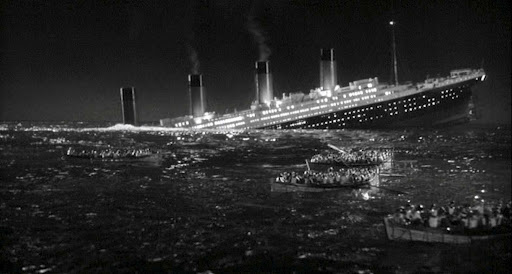
You’re probably wondering how long it’s going to take me, in this review, to mention a certain other film from 1997, directed by James Cameron, that follows a similar plot to this film, and I’ll tell you that it’ll take exactly 48 words for me to mention Titanic. If you’ve never seen A Night to Remember, but are a fan of Titanic (as indeed you should be, for it is a much better film than it’s cool to admit), then you need to start paying more credit towards Night‘s director Roy Ward Baker, for it is from his 1958 picture that Cameron stole most of his film.

Now I’m not saying Cameron stole everything, for if there’s one thing Night is missing, it’s main characters to follow through the events. Instead we follow various groups of people – Second Officer Lightoller (Kenneth More), some steerage passengers, a young 1st class couple (Honor Blackman!) – throughout the night of April 14th, 1912. This lack of focusing on a few people leaves you caring for the characters less, in the same way you didn’t care that much when Fabrizzio got hit with the funnel, here its no bother when the same fate is met by other people we’ve been following. This gives Night a more procedural, re-enactment-like tone, not helped by the generally unmoving performances that leave you cold and distant.Had I never seen Titanic, chances are I’d have been far more impressed with this film, but the remake (that’s essentially what it is) has shown that almost every shot can be composed and recorded at least a little better. The fact that it was made almost 40 years later helped drastically, as the technology did not yet exist to encompass the full scope of Cameron’s vision, but the fact that it does now has left Night a little obsolete.

I found myself mentally checking off every scene that Cameron stole – the steerage dance number, lavish 1st class dining scene, the soot-caked stokers escaping the closing doors in the engine rooms, playing football with ice on the deck, the dining cart gently rolling down an increasingly listing dining room, the steward appalled at the passengers damaging White Star Line property, the musicians disbanding then reforming to play as the boat sinks. The drunken chef even looks the same, and the shot of Murdoch turning his head away in shame, unable to stand watching the boat sink from his wrongfully claimed lifeboat seat is identical! I understand that a lot of these scenes help to set the atmosphere aboard the boat and couldn’t really be avoided, but Cameron should either have admitted he was remaking, paid some form of acknowledgement to the previous film, or at least changed the shot compositions. Mr. Andrews, the boat’s designer, even at one point gives a young couple – who may as well be called Jack and Rose – details on how to survive whilst he’s stood next to the clock on the mantelpiece, and the ‘unsinkable’ Molly Brown, here played by Tucker McGuire but more famously by Kathy Bates in Titanic, vehemently demands that her lifeboat turn around to help drowning survivors.

Based on the book by Walter Lord, and using the real-life experiences of survivors, the film paints an effective picture of the differences between the classes – made particularly clear when some steerage passengers attempt to flee the waters, but recoil in shock at the extent of the upper class facilities. After some initial scene-setting and the launch of the boat, we pick up the action on the night of the 14th, as the supposedly unsinkable liner receives warnings of ice in the area. As opposed to after 90 minutes, the immortal line of “Iceberg, dead ahead” is heard after just half an hour. After the boat has struck and a 300-foot long gash has been haphazardly carved into the hull, events play out largely in real time, and a great deal of time is spent on the engine rooms and the crew’s efforts to contact the nearest boats, of which the Carpathia, a good 58 miles and 4 hours away, is the only one to respond. There are some nice examples of the typical British stiff upper lip – a man putting on a brave face as he waves goodbye to the wife and children he knows he’ll never see again – but there are all in all far too many scenes of the crew trying to convince disbelieving passengers of the seriousness of the situation, to the point where I got so annoyed with some of the passengers that I hoped they’d stay on the boat and attempt to sit it out.

Whilst occasionally moving – the lifeboats forced to listen to the screams of the drowning – there is little reason to watch this now Titanic has made it redundant. In it’s day it was probably a much better film, but alas now it has been surpassed.Choose life 7/10

Once Upon A Time In China

It’s probably not a good thing that the only Jet Li movies I’d seen prior to this film are his most American ones – Lethal Weapon 4, Unleashed, The Mummy 3 and The Expendables, so his notoriety as a master of martial arts has been more than a little lost on me, as though he gets to show his stuff in most of these films, they aren’t built around him and he is far from the star. There are several other Li films on the List, including Hero and Enter the Dragon, and I hope that they aren’t as much of a mess as this one.

Li plays Master Wong Fei-Hung, who is put in charge of organising the local non-military men into a local militia to defend China if they are attacked whilst the army is busy elsewhere. This initial premise is soon skipped to see Wong and his rag-tag band of one-note misfits – the fat one, the big-toothed one – become involved in a hectic plot involving a mob-run protection racket and the westernisation of China, as the English influence is felt through weaponry, religion, clothing and cutlery.
The film’s saving graces are the cast and the action. Li proves himself as the martial arts legend he is regarded as, and the various fighting scenes are, mostly, memorable and entertaining. One near the end, a one-on-one fought almost entirely on long, weak ladders, is particularly good, and has a nice payoff too. The moment with Li and the bullet took it a bit far for me, as did the occasional uses of wire-fu to allow characters to jump an awful lot further than they should. These artists are capable of great things with their limbs alone, so whenever stage effects are used to enhance them I’m always taken out of the film, as it shows the stars as mere mortals like the rest of us.
There is far more comedy here than I was expecting too, on an almost farcical level, and many times the scenes seem to be set-up for a fight or a larger, recurring joke that never happens. A scene where a character finds himself with an arm and a leg needlessly plastered could have led to a fight scenes where the casts were used both as his hindrance and advantage, but alas he just runs off and it’s never mentioned again. Similarly, a photograph posing culminating in a burst of flame that ends up roasting a pet bird could have been used later to vanquish an attacker with an unexpected fireball, but again no.
The moments of culture clash comedy – Wong encountering a fork – are nice, but there isn’t much here that’s new, and by the end (the film is well over 2 hours) even the action has gotten almost boring.
Choose life 5/10

Nosferatu: A Symphony of Terror

There are at least six variations on the Dracula myth on the List, and probably hundreds that aren’t. I’m ashamed to admit that the only other vampire movies I’d seen prior to this (other than Les Vampires, which doesn’t really count) are a half watched Bram Stoker’s Dracula, and Twilight, which I did not choose to watch and am still trying to scrub from my retinas. And yet, though my life has been surprisingly devoid of vampire fiction (I’ve never even seen an episode of Buffy, or an instalment of the Underworld or Blade films), I’m still well versed in the vampire mythology, as indeed is everyone else. It seems one is almost born knowing that vampire’s transform into bats, suck your blood and can be vanquished with a stake in the heart, exposure to sunlight or too much garlic on their pizza.

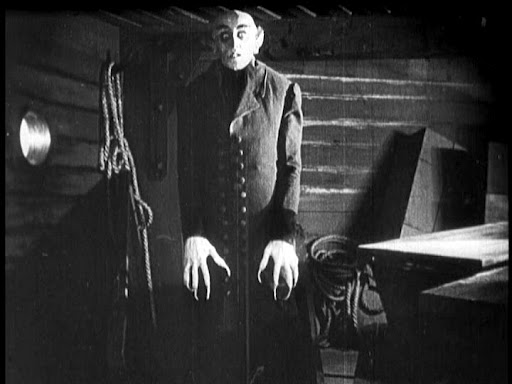
This version is one of the earliest vampire films, having been released in 1922 and directed by German silent director F. W. Murnau. It follows the traditional Dracula beats (though the vampire is named Count Orlok as this is an unofficial retelling), and stars Max Schreck as the titular creature of the night.
Jonathan Hutter (Gustav von Wangerheim), a clerk from the town of Bremen in Germany, travels to Transylvania (ominous thunder roll) to complete some legal paperwork with the mysterious Count Orlok, who wishes to buy a house in Bremen. Though there are many clues as to what is in store for Hutter, including terrified locals speaking of nocturnal spirits and his creepy, Orlok-controlled boss hinting that the journey will cause him pain and cost him blood, Hutter merrily laughs everything off as ludicrous superstition and hokum, until he arrives at the castle and meets the Count, who keeps unusual sleeping hours and sleeps in a coffin in the basement.
Most of this film is predictable if you know the traditional Dracula legend, but what makes it truly memorable is Schreck’s performance. His distinctive appearance – all pale skin, pointed ears, giant eyebrows over sunken eyes and clawed hands on arms stuck firmly to his sides – sticks in the mind, and his presence is greatly missed whenever he’s off screen. Scenes of Orlok’s stark shadow descending on a prone figure, or his body, stiff as a board, rising from a coffin, stick firmly in the memory, and at the end of the film, when he is staring, unmoving, from a window, is genuinely disconcerting and more than a little terrifying.
It’s unfortunate then that the score for the film is more than a little insane. It kicks off with a cartoonish plinky-plonk tune over the supposedly doom-laden title cards detailing “Nosferatu! That name alone can chill the blood!”, and later the score goes crazy when Hutter is merely reading a book. Also some scenes are let down by a distinct lack of quality in the print. I understand that the film was made 90 years ago, but the scene in which Hutter is discovering bite marks on his neck is ruined by the fact that the bite marks are not even slightly visible on his bright white skin.
The ending is a little hurried, though by that time I was starting to get bored anyway. I was also surprised by how little the character of Van Helsing had to do with the plot, as I’d always thought he was pretty integral to the story, yet he turns up from nowhere halfway through as an expert on vampires in nature.
All in all, this is a good example of an early telling of a classic horror, that unfortunately has become very dated since its release. I’m sure that one of the more recent versions on the list – 1931’s Bela Lugosi starring Dracula or the 1958 Hammer version starring Christopher Lee – will be much better.
Choose life 6/10

A Nightmare on Elm Street

I can only imagine Hallowe’en parties in 1984, but I’m guessing quite a lot of people were dressed up in a battered fedora, red and green striped sweater, poorly applied ‘burned’ make-up and a glove with cardboard blades glued on, for if anything has endured from Wes Craven’s multiple-sequel spawner, it’s Robert Englund’s nightmare-stalker Freddy Krueger.

If it’s true that a horror movie lives or dies (generally by running upstairs instead of out the front door) by it’s killer, then there’s no surprise that this franchise is still going. I haven’t seen the 2010 reboot and I’ve only heard bad things, but I’m intrigued to see Jackie Earle Haley’s take on the former child murder released from prison on a technicality but burned alive by the parents of Elm Street. Krueger is an icon from horror history, up there with Michael Myers, Jason Voorhees and the Guy in the Scream mask, making up the B-team behind the likes of Frankenstein, Dracula and the Wolfman. For Krueger, you see, is unstoppable. He’s risen from the dead to take the children of those that murdered him, but he does his killing in the one place he cannot be caught; the children’s dreams. This is a genius conceit, but also the film’s biggest let down.
If you want to terrify your audience and instill in them genuine fright once they have stopped the film and gone about their daily lives, you scare them with something ordinary. A situation they themselves will find themselves in on a regular basis. Hitchcock did it in Psycho with having a shower. Craven did it with going to sleep. There’s nothing you can do about it, eventually you’ll have to go to sleep; quite often it happens without you even planning to. And once your head is resting gently on your pillow, all you can think about is that maniacal laugh echoing around the walls. That tapping at the window, surely that’s just the branch of a tree blowing in the wind, it couldn’t possibly be the knifed glove of the man out to rip you to shreds? When asleep you’re at your most vulnerable. It can happen anywhere – at home, school, prison, hospital, and there’s no way to defend yourself (short of Inception-style techniques, crossover anyone?) and Craven knows this. In his world, a glass of warm milk is as deadly as any conventional weapon.
But the fact that Freddy exists in dreams, can defy physics by being everywhere at once and can take on any form he chooses to terrify you the most, makes him almost less scary. There’s a sense of inevitability. Much like in Ring, once you watch the tape, you’re going to die. There’s not a whole lot you can do about it. You can’t kill Freddy in a dream, you can’t stay awake forever, there’s really only one possible outcome. Yes, in this film and the ever diminishing sequels they find loopholes to temporarily get around the issue, but I’ve always found these to be annoyances and cop outs from the original story. I’d forgotten the ending of this film when I saw it, and I was almost incredibly annoyed at the backdoor excuse they try to use.
It’s a good, solid horror film, and is much more effective if you never, ever watch the sequels. Whilst they have some inventive kills (hearing aid? genius) and increase the comedy quotient, Freddy becomes a watered down pantomime villain, whose incessant survival becomes more grating the more films you watch. But here his terrorising of four teens (including a 21-year old Johnny Depp in his movie debut) is played largely for tension and scares, though there’s a few lull-in-the-score moments that are clear setups for something to jump out and grab our virginal heroine Nancy (Heather Langenkamp).
There are moments of black comedy – a cop telling a paramedic “you don’t need a stretched, you need a mop,” and the kills are satisfyingly gory. Nancy looking in the mirror got a laugh out of me, as at the time of the film’s release Langenkamp was, you guessed it, 20 years old. The image of Krueger’s hand emerging from between the legs of a girl asleep in the bath is more than a little terrifying.
Choose film 6/10

The Queen

Well it’s a bank holiday this weekend over here in Blighty, because our reigning monarch has succeeded in not dying for 60 years on the throne, and doesn’t deem any of her offspring worthy enough to take her crown whilst she has enough life in her hands to grip onto it, so what better way of celebrating than by watching The Queen?
Diana, Princess of Wales, divorced wife of the Queen Elizabeth II’s son Prince Charles and mother of her grandchildren Princes William and Harry, is killed in a car accident in August, 1997, causing uproar throughout the UK, not least for the royal family and the recently elected Prime Minister Tony Blair (Michael Sheen). In the aftermath, the royal family take a period of mourning in their Scottish residence, whilst Blair remains in London to almost take advantage of the situation.

First off, the performances in this film are mostly excellent. There was never any doubt that Helen Mirren would make a perfect choice as QE2 (the monarch, not the boat), and she gives a repressed, buttoned down portrayal of a woman few know personally. Sheen, too, is at his best when playing a real person (see also The Damned United, Frost Vs. Nixon, half of his CV) and James Cromwell is good as the Queen’s cantankerous husband Prince Philip. It is only really Alex Jennings as Charles who goes too far. The rest of the cast limit how much of an impersonation they are making of their subjects, whereas Jennings tries too hard to mimic Charles’ more exaggerated mannerisms and persona already expanded upon in the media, as though he’s performing a sketch show impression rather than showing just enough for us to know who he is.
This is the kind of film that lives and dies by it’s script. The West Wing covered a similar theme on a weekly basis, and succeeded not just because of the stellar cast and direction, but mainly due to Aaron Sorkin’s masterful way with words. Here we have a good cast and a slightly above average director in Stephen Frears (High Fidelity, Dangerous Liaisons), but the script is written by Peter Morgan, whose CV is littered with other mediocre biographies lifted only by acting talents (The Last King of Scotland). Had this film had a punchier script, with some rat-a-tat dialogue and an entertaining turn of phrase, it’d be a much better piece. As it is, the story isn’t terrible, but it is largely forgettable.
Being English, you’d think I’d be well versed in the goings on around such a recent major occurrence, even if I was only 10 at the time, but alas I’ve never known an awful lot about the events both before and after Diana’s death. Much that occurs in the film came as a surprise to me. I’d obviously heard of Diana, dubbed the People’s Princess by Blair, but knew very little of her exploits or the reasonings behind her tabloid headlines. I’ve never paid much attention to the royal family, to be honest. It’s not that I’m anti-monarchy, it’s just that I really don’t care about them. The most I’ve seen of the jubilee celebrations was some highlights I caught whilst channel surfing this evening, and were we not having family over to visit I’m sure I’d have been writing posts or watching something off the List, so would have missed it completely. This film has done little to nothing to increase my interest in the royals, though it has provided an insight behind the closed doors of their world.
The movie seems to take a fairly pro-Blair stance, as he seems to be the most considerate character in the film, especially when compared to his far more callous spin doctor Alastair Campbell (Mark Bazeley). The relationship between the Queen and Blair is nicely played out – she kicks off his first day in power by reminding him that he is her 10th Prime Minister, with the first one being Winston Churchill, so he has a fair amount to live up to. There are some nice comedic touches – in her death, Diana is still proving an annoyance to the royals, including the Queen Mother (Sylvia Syms, Helena Bonham Carter’s character in The King’s Speech), whose funeral arrangements Diana has pilfered. It’s very bizarre to see the Queen calling someone Mummy, and even more so to see this usually confident figure spending much of the film deliberating and worrying, as she finds herself in the middle of a major royal event with complete and utter media coverage.
Not much of the film has stayed with me after watching, other than Mirren performance, which is especially spot on during the Queen’s address. I’ve had a little royal history filled in for me, but it was never anything I really cared about anyway.
Choose life 6/10

Prometheus

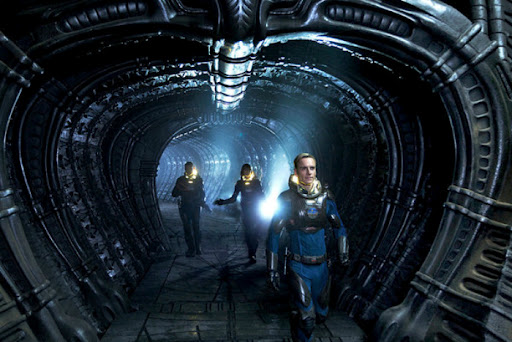
Don’t ask me how, but I managed to get a ticket to the Cast & Crew Premiere of Prometheus at the Empire Cinema in London’s Leicester Square last night. Though it was disappointing not to see director Ridley Scott or the cast, who are probably saving themselves for tomorrow’s red carpet Premiere (a part of me was hoping I’d get to sit next to Charlize Theron, you can probably guess which part), the experience of going to see a film with nothing but film fans and people who respect the art, in a stunning cinema, was amazing, even if there was a bit of a post-movie crowd crushing to retrieve handed-in phones afterwards. Plus, I saw it three days before the rest of the general public, which makes me feel special. 
 In 2089 a group of scientists, led by Shaw and Holloway (Noomi Rapace and Logan Marshall-Green) discover ancient cave paintings on the Isle of Skye depicting giant humanoids reaching up to 6 orbs in the sky. The drawing matches others found all over the world, and point towards a distant planet that may hold some key to the origins of mankind. Four years later, the scientists arrive at the planet LV223 as part of a 17-man crew aboard the Peter Weyland-funded ship Prometheus. Once there, the crew find traces of alien life, but are the answers they receive the ones they were hoping for?

Through A Glass Darkly

I rarely watch a film I literally know nothing about, and I must say it’s an unsettling experience. I’ve witnessed people walking up to a cinema and asking “What’s playing today?” in shock and awe. “How can these people not know about the film they’re going to see? Who are these people? Have they left the house just to see any film, rather than planning, sometimes weeks in advance, to go and see a specific film?” are often thoughts that run around my head and occasionally out of my mouth as the clerk at Odeon reels off a list of the current blockbusters and horrors  for the third time to a pair of elderly women in front of me in the queue, clearly looking for something starring Clark Gable. On occasion, and as happened recently with Time Regained, I will pause a movie I know nothing about some way into it, to have a quick check online or in the 1001 book, to give me some idea of what I’m supposed to be watching. If I do this, it’s not generally a good sign, as a) I’m as yet unsure of what the film is about, and b) I’m clearly bored. This was not an option with Ingmar Bergman’s Through A Glass Darkly though, for I watched it streaming via LoveFilm, and I find that if I pause it for more than a quick toilet break, the damn thing refuses to load unless it plays from the beginning, so I had to sit it out and find out what I was watching afterwards.


We open with four people swimming gleefully towards a deserted island. Amongst them is Karin (Harriet Andersson), who suffers from some kind of mental illness that she doesn’t know is incurable, but her father David (Gunnar Bjornstrand) and husband/doctor Martin (Max von Sydow), both also present, do. David is a writer of novels, who has been away recently and plans to leave again after finishing his current book. Also along for the trip is Karin’s 17 year old younger brother Minus (Lars Passgard). These four make up the only characters in the film, which takes place entirely on and around the island, yet the film never really feels claustrophobic, just a little muddled.

Karin’s illness leaves her with no desires to sleep with her husband, yet she has acute hearing, leaving her to wander around the house late at night (pretty much no-one ever sleeps in this film) and at one point she seems to reach an intense state of ecstasy whilst alone and unprovoked.

All four people have fairly strained relationships with one another, especially the children with their father, who is self centred and has a robotic detachment of emotion towards his daughter’s potentially fatal condition, so much so that he is morbidly interested in documenting her deterioration. His son Minus feels especially distant, feeling that he is completely unable to talk to his father.

Frustratingly, the film offers only the minimal amount of closure, as Karin’s condition worsens to critical levels. I’m always impressed when directors overcome extreme limitations – usually set by themselves – for example here with the restricted location and cast quartet, but I feel that a great deal more could have been done. Director Ingmar Bergman has many films on the List, and this is only the second one I’ve watched. Winter Light disappointed me a little, but this was a definite improvement. Bergman seems to be one of the most notable directors of all time List-wise, and regularly comes up on many people’s greatest lists, so I’m looking forward to seeing some of his better works in the future.

Choose life 5/10