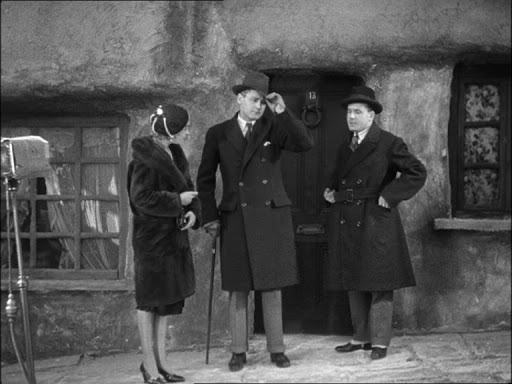
Brief Encounter

Laura and Alec (Celia Johnson and Trevor Howard) meet every Thursday in town – he after work, and she to do the weekly grocery shopping. At first their regular meetings are nothing more than a newfound friendship, but it is not long before they fall for one another. The problem is, Alec will soon be leaving to work in Africa. Oh, and they’re both married, with families at home.


It’s a simple story, and therein lies the beauty. There’s no surprise ending, no unforeseen third act plot contrivance – in fact, the ending of the couple’s relationship is the first thing we see, but it isn’t until the end that we realise quite how devastating it is, as the events leading up to their separation are told chronologically through flashback, from their meeting when Alec assists Laura when she gets soot in her eye, through shared meals and cinema-goings, culminating in their final moments together, probably forever, in this day before social media and the ease of communicating with someone half the world away. 

Our focus is on Laura and Alec, and in a way there is nothing in this film but them. Their families are largely only hinted at, other than Laura’s dull husband Fred, but even with only mild insinuation and a well-implemented voiceover from Laura we are offered as much background information as we need to realise their situation and motivations. Neither were looking for someone else, and both believed they were content with the lives they were leading. Everything would have been perfectly fine if they’d just never met one another, but fate is a cruel mistress, and the couple’s momentary enjoyment cannot possibly last, and the sadness comes from their clear understanding of this fact.
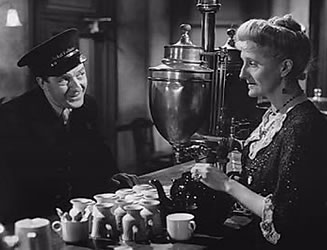
There are other marginal characters – the tempestuous relationship between the cafe owner and train conductor (who walks across the train tracks! It’s like a different world!) – but they are merely background, and serve to frame this story, rather than add to it. In fact, without their inclusion I got the feeling that Laura and Alec’s story would have struggled to breach feature-length, coming in at only 86 minutes. This length felt perfect for the story though. There’s nothing I could add, and nothing I’d take away, and if anything were to be added, it would be in the form of excess background – perhaps a love interest for Beryl, the tea room assistant, but there’s no need for it, and it’d just be padding.

I’m fairly sure this is the most British film ever made, and it’s popularity is probably the main reason behind the English stereotype of the stiff upper lip and clipped manner of speech that has become synonymous with my fellow Englishmen. The amount of scenes that involve the drinking of tea (something of which I’m fairly proud I’ve never done) are almost farcical, and everyone speaks as though they were born not with just a silver spoon in their mouth, but half the cutlery drawer rammed down their oesophagus. It’s this typically British sense of repressed feelings and not letting your guard down that really makes this film, as we see our two leads, particularly Laura, struggling to maintain their steely facades whilst underneath their hearts are being torn apart my these circumstances beyond their control. You can’t let these things be public knowledge, it’s just not how we do things around here.
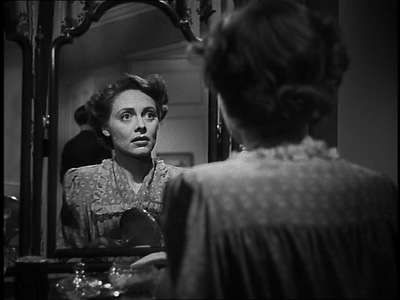
There are many moments of intense emotion and poignancy, but if I had to pick one, it would be the traumatised look Laura gives herself in the mirror after the first time she lies to her husband, followed by the internalised “It’s awfully easy to lie when you know that you’re trusted implicitly.” She knows that there is nothing more wrong than what she is currently doing, but that she has no choice to do it anyway, and is just going to have to live with herself. By today’s standards the romance is almost laughably timid – the most that happens between the two leads is the occasional kiss – but the reactions and implications from these events are just as bad to our leads as if they’d been knocking boots five days a week for several months, if not more so.

This is one of the first films I’ve fully appreciated that doesn’t have a lot going for it in terms of action, humour or a happy ending that makes me feel all warm inside. Instead, this is heartfelt, emotional film-making, that shows just how much can be done with very little.

Choose film 9/10

Murder!

A member of a travelling theatre company has been murdered in the lounge of the guesthouse in which she is staying, with only a fellow company-member, a discarded poker and an absence of brandy nearby. The trial is quickly over, with the jury swung by the overwhelming evidence pointing towards the defendant’s guilt, but after the verdict has been cast and death has been sentenced, one of the jury members begins to have doubts over their decision.

12 Angry Men is one of my favourite films, and Alfred Hitchcock is one of my favourite directors, so when I discovered this film, I was half expecting to find Hitchcock’s version of 12 Angry Men would rapidly be topping my favourite films list. Alas, this is not the film I’d hoped for, as in fact the jury and trial scenes take up a very small portion of this film, with most of the focus instead going to the investigation held by Sir John Menier (Herbert Marshall), one of the jury members who also has strong connections to the theatre business, in which both the deceased and defendant were employed. Once I was past my initial disappointment, I settled down to watch what turned out to be a fairly standard, by-the-numbers procedural picture, whose only difference from the norm was the general lack of police, detectives or journalists doing the crime-solving.

Before the trial the film has quite a comedic tone, which is odd, seeing as it’s immediately after a murder. The very opening involves two of the theatre company’s members, Mr. and Mrs. Markham (Edward Chapman and Phyllis Konstam) attempting to uncover the source of the recent scream from down the road, only to be prevented from doing so by a window refusing to remain open whilst their heads are protruding from it. A policeman trying to ascertain the events of the evening finds his work cut out for him when he attempts to question the theatre company during a performance, so must fit his interrogations between the sound effects and actors heading on and off stage. Once the trial begins the comedy is still around, but it’s much sparser and broader, for example the dim-witted juror.

The main problem with this film is the story, which although having been based on the play Enter Sir John by Clemence Dane and Helen Simpson, seems to have been written hurriedly and not thought through all that well. It may be due to the large number of whodunnits that I’ve seen, but I’d sussed the plot fairly early on after a piece of evidence the cast seemed fairly unimportant, but clearly left the whole thing wrapped up. Also, the whole thing seems to rely upon the fact that sticking one’s fingers into one’s ears and shutting one’s eyes can prevent a person from sensing absolutely anything that happens directly around them. Sir John’s method of achieving a confession from his assumed culprit is also frankly ridiculous, but does at least comply with his being a theatre producer.

The poor audio of the film didn’t increase my enjoyment of the film either, and the various scenes of characters talking over one another didn’t help either. The most egregious case of this was a fairly superfluous scene of Sir John receiving a cup of tea in bed from his landlady. Their entire conversation could have been vitally integral to the plot, however I didn’t catch a word of it due to her detestable brood of children harassing John and running around screaming. I get enough of that just listening to my neighbours two kids through the wall, thank you very much. The overzealous, unfitting score didn’t help either. What finished everything off was the final shot, which was only recently defeated for audacity and sense of ego by Tarantino in Inglourious Basterds.

Hitchcock may well have a fascination with murder and intrigue, but he also likes to focus on the aftermath of the deed, rather than the actual offence itself, as he also does in Rope and The Trouble With Harry. Unfortunately it didn’t pay off here as much of it did in those other pictures, so I’m afraid I can’t really recommend this film.

Choose life 5/10

Sullivan’s Travels

John Lloyd Sullivan (Joel McCrea) is a big time director of screwball Hollywood comedies, but wants to make something real. Something with a message. Something for the common man. The only problem is Sullivan has never experienced life amongst the common men, so he sets out, against the wishes of his producers, disguised as a hobo and with nothing but 10 cents in his pocket, to see how the other half survives.

I like films with good dialogue. If it’s been written by Aaron Sorkin or the Coen brothers, then chances are I’m a fan of it, so it may come as a surprise to discover that this is the first film I’ve seen from Preston Sturges, widely regarded as one of the finest writer/directors of screwball comedies. Although, to be fair, I’ve not seen other such screwball classics as His Girl Friday or Bringing Up Baby yet either (even though I’ve got both on DVD), so maybe it’s not too much of a surprise that I’ve yet to delve into Sturges’ work either. Now that I’ve seen a Preston Sturges film and know the kind of thing that I’m in for, I look forward to tracking down some of his other work, because this film is quite brilliant. And fortunately some of his other work – Unfaithfully Yours, The Lady Eve, The Palm Beach Story – are also on my various film lists, so all being well I’ll be getting to them soon.

Sullivan’s Travels also marks my first viewing of Veronica Lake, previously only known to me as the girl Kim Basinger supposedly looks like in L.A. Confidential. Here, in her first major role, she plays Sullivan’s travelling companion, charitably credited as ‘The Girl’. When she is supposed to, she looks great (she spends a portion of the film disguised as a fellow hobo), and her chemistry with McCrea is good, if not amazing. McCrea, too, is great, thoroughly convincing as the idealistic yet out of touch director, and the supporting cast all left something of a mark, even if many of them weren’t around for as long as I’d have liked, particularly the snooty, disapproving butlers. 

The first third of the film is certainly the best, and the most comedic, and provides the majority of the most quotable lines (“If they know what they like, they wouldn’t live in Pittsburgh.”), and the film takes a more preachy, dramatic turn once Sullivan sets out on his mission. This is a bit of a shame, as had the film retained the breakneck pace and quality of script as that opening half hour (no-one talks any slower than Steve Buscemi in Miller’s Crossing), this film would be a guaranteed 9/10 (I never award a 10/10 on a first viewing, that score has to be earned after many watches). As it is, the film remains very good, but the plot becomes annoyingly circular, as Sullivan seems unable to escape his own wealthy lifestyle, whether through his own fault or general circumstances. The final third becomes overwhelmingly message-y, when Sullivan learns that making comedies can actually be worthwhile (hence why Sturges dedicated this film to the mirth-makers of the world), and it’s all handled disappointingly heavily.

I think I went a bit negative there for a moment, because I really did like this film. The scene where Sullivan goes to the cinema was brilliant, showing that even back in the 1940s it was occasionally impossible to hear the film over the sounds of screaming children, rustling sweet packets and incessant chomping, crunching and the smacking of jowls. Some moments got a bit farcical – Sullivan attempting to outrun the entourage his producers supply him with by utilising a souped-up boxcar with a chalked-on speedometer, and the amount of people who fall into water throughout this film is simply ridiculous, but it never got too silly for me.

There were some issues with the pacing, as just as the story looked like it was all wrapped up, Sullivan heads out on a new adventure completely different to the rest of the film that felt out of place and a bit too serious, drifting too far from what should have been a straight comedy, that seemed to miss the very point that the film was making. 

If you are going to watch this film, and if you’re a fan of the older Hollywood pictures, then I suggest you do, I recommend at least once skipping the film back a chapter or two and watching the film on fast-forward, as listening to the already rapid dialogue even faster is downright hilarious. Small things, I know.

Choose film 7/10

Skyfall

A hard drive containing the identities of MI6 undercover agents is at risk of going missing, so James Bond (Daniel Craig) is trying to catch the thief in Istanbul, with the assistance of field agent Eve (Naomie Harris). When Bond is shot and presumed dead, his superior, M (Judi Dench), takes the blame, but when Bond returns from the grave, he must track down the files to save not only his country, but his boss.
Continue reading

Hugo

Hugo Cabret (Asa Butterfield, one of the kids from Nanny McPhee and the Big Bang) lives inside the clockwork at a train station in 1930s Paris. He spends his days maintaining and fixing the clocks, stealing only the pastries and milk that he needs to survive and avoiding the child-hunting station inspector (Sacha Baron Cohen). A run-in with station shop-worker Georges (Sir Ben Kinglsey) results in Hugo having to work for the toymaker, all the while building a bond between Jugo and Georges god-daughter, Isabelle (Chloe Grace Moretz). 

On the surface, this doesn’t appear to be a typical Martin Scorses project. For starters, it’s a kid’s film, not something you’d generally associate with the director of Goodfellas, Mean Streets and Taxi Driver. There’s nary a gangster to be found, nor a grisly death or vicious killer. Hell, it’s not even set anywhere near New York. But once you get past the halfway point of the film, and the story switches from that of a young boy trying to eke out an existence on his own to a tale about the history of the beginnings of cinema, it becomes clear just what Scorsese saw in this story. It’s no secret that the great director is a passionate man, especially when it comes to the medium of movies, so seeing an opportunity to make a film dedicated to films themselves would have been an opportunity he jumped at. Fortunately, it helps that it’s a captivating story, filled with vibrant characters and plenty of heart, without too much schmaltz. Wihtout the secondary cinematic storyline, this would have felt far more like a Spielberg picture than a Scorsese.
I didn’t have the opportunity to see this film in 3D, but I get the feeling that if you are able to, you should give it a shot. This may come as a surprise to many of you, given my usual stance on the current trend of shamelessly, and often needlessly, opting to add a third dimension to films that really don’t benefit from it, but there are many scenes here where it would probably not only have fit, but benefitted the viewing experience. 3D works best when there’s lots of little things flying in the air, for example the dandelion-thing scene in Avatar, or the lantern scene in Tangled, and in Hugo we get at least two opportunities for this, first with snow and then later with flying pieces of paper, both of which I’m sure would have looked fantastic in 3D. There’s also a lot of forced deep perspective and carefully considered samera angles, making this possibly the first film I’ve seen where the 3D was probably justified.

There’s great camerawork elsewhere too, particularly in a Goodfellas-esque extended tracking shot through the inner-workings of the train station that is positively mesmerising. It’s clear that almost every shot has been digitally enhanced to make it look older and more French – the colour scheme is rich and everything has a sepia tone, seemingly even the air. At times this felt a bit too stylised, and often took me out of the film with how fake everything looked, but it’s nowhere near as bad as many of the films that use so much CGI that they may as well be videogames. 

The kids aren’t bad, but they are overshadowed the tremendous supporting cast, including the likes of Jude Law, Ray Winstone, Christopher Lee, Emily Mortimer and Richard Griffiths in relatively miniscule parts around the train station (I was half expecting them to break into a rendition of ‘Who Will Buy?’ from Oliver). Kingsley is superb in a role that requires moments of seriousness, compassion, pity and wonder, but Sacha Baron Cohen does have a tendency to over-act now and then, presumably a result of his more comedic past. He is by no means bad, but reigning his performance in a little, to be less of a caricature, would have been better in my eyes.

I think the people that will get the most out of this movie are film fans, especially those with an interest in the beginnings of cinema. Fortunately I am such a person, and I also appreciated Michael Stuhlbarg’s character, as one of history’s first film nerds. There are many references to classic early and silent films like La Voyage Dans La Lune, L’arrivee and Safety Last, featuring the classic image of Harold Lloyd dangling from the clock face, eventually recreated by young Hugo himself, and I was engrossed at the details of how effects were created before more traditional editing processes were invented, with actors remaining frozen in place whilst explosive charges were set around them. The old technology and equipment was fascinating to me too, appealing not only to my love of cinema but my mechanical background, with a hand-cranked projector required to watch something now available on YouTube.

Scorsese has created that most marvellous of films, a successful, inventive children’s picture, that just happens to have an informative and educational semi-biopic of one of cinema’s founders wrapped up inside it. It’s beautiful, engrossing, perfectly cast and just plain delightful. And there’s a robot!

Choose film 9/10

Top 5… ‘Friends’ Movies

It’s David Schwimmer’s birthday today, and with the imminent release of the complete Friends boxset on Blu-Ray (available in the UK on November 12th), this seemed to be the perfect time to have a look through the filmographies of the six leads of that great show. That is, until I got severely depressed by just how bad most of the films they’d made were. So bad, in fact, that amongst six successful actors, I could barely find 20 films that I’d willingly sat down and watched. This was a tough list to find five good films from.5. Lost in Space
I’m fully aware that this is a terrible film, but it belongs on a list with the likes of Godzilla, Deep Blue Sea and The Day After Tomorrow as films that don’t really have a lot going for them other than being largely entertaining. Lost in Space features a fairly terrible performance from Matt LeBlanc as Major Don West, the captain of a spaceship transporting the Robinson family to a new colony in an attempt to begin the salvation of humanity, but of course problems arise, most notably a hoard of alien spiders that eat through the ship’s hull. Is there anything worth watching about the film? Yes. Gary Oldman is terrific as the evil Dr. Zachary Smith (and a slightly more spidery version later on). The rest of the Robinsons are OK too, particularly William Hurt as the father. And there’s a robot! Now, I’ve never seen the 60s TV show on which this is based, but I’m pretty sure that if they had implemented a weird sucker-fingered alien monkey, the CGI may have looked slightly better than in this film , made 30 years later.
Continue reading

November 2012 Update

Welcome to November everyone! Unfortunately, October was not as successful post-wise as September, as my write-a-post-a-day plan stumbled and fell, but I did managed to put up 18 reviews and 4 top 5s, so it wasn’t too bad I suppose.


List-wise, I reviewed Blackmail, The Shining, North By Northwest, Top Gun, Nosferatu: Phantom der Nacht, Gimme Shelter, Hamlet, The Magnificent Seven, Superman Returns, Casino Royale and Songs From The Second Floor.

That’s 6 from 1001, 6 from the Empire Top 500, 4 from the Empire 5-Star 500 and 2 from the Total Film Top 100. I’d hoped to cross off more from 1001, seeing as that’s the most I still have to go through, but hey ho.

As for my Film-Makers, I crossed off Kate Winslet’s Hamlet and Holy Smoke, Steve McQueen’s The Magnificent Seven and Hell Is For Heroes, Alfred Hitchcock’s The Manxman, Blackmail and North By Northwest, and George Clooney’s Red Surf. I’ve decided to hold fire on Clooney and the Coen brothers for now, so I’m not spinning too many plates simultaneously, but they’ll be the next people I go through once I’ve finished McQueen and Hitchcock.

Off the lists, I watched The Brothers Bloom and Looper, and saw Kiss Kiss Bang Bang for the episode of the Lambcast I appeared on.


And for my Top 100 films reviewed, Silver Lode, Mad Max, Harry Potter and the Prisoner of Azkaban, Babel, Ring, Iron Man 2, Good Morning, Vietnam were knocked off by Casino Royale, The Magnificent Seven, The Brothers Bloom, The Shining, Looper, Kiss Kiss Bang Bang and North By Northwest.