Mike Leigh’s depiction of acclaimed stage show writer and composer Gilbert & Sullivan (Jim Broadbent & Allan Corduner) creating their most famous production, the Mikado, is extremely well performed by all involved, especially the two leads and Timothy Spall as one of several preening thespians. The background is littered with know-the-face British actors (Andy Serkis, Dexter Fletcher, Mark Benton etc.) and the costumes and set design are spectacular. Unfortunately, the film is far too long, and too much time has been given over to the musical numbers, with at least ten being shown throughout the film. A much tighter script, focusing more on the backstage goings-on and less on the show itself, could have led to a bona-fide British classic about two of our most notable showmen.
Author Archives: jaycluitt
Fargo
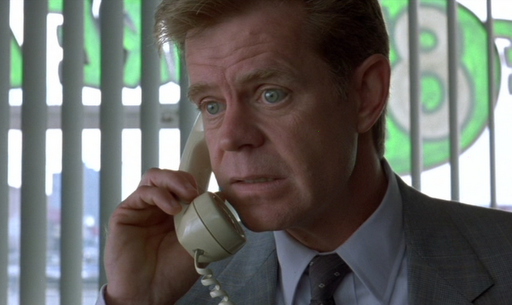
Snivelling, double-talking car salesman Jerry Jundegaard (William H. Macy, Oscar nommed but somehow losing to Cuba Gooding Jr.) has a plan. He needs money. His father-in-law Wade (Harve Presnell) has money, but hates Jerry. So Jerry hires two thugs (Steve Buscemi and Peter Stormare) to kidnap his wife and demand a ransom, of which Jerry will keep half. What could go wrong? Well, quite a lot it turns out, especially if everyone involved is an idiot and you’re being directed by the Coen brothers. The men’s escapades are chaotic, unstructured and are all heading off in different directions until, at the 32 minute mark, heavily pregnant Sheriff Marge Gunderson shows up to set them in order. Frances McDormand deservedly won an Oscar for her portrayal, nailing that wonderful sing-song North Dakota accent “Yah, you betcha” and, once full of eggs, keeping a straight face whilst clearing up the handbasket Hell’s clearly fallen out of around her. Few films as short as this (98 minutes) have room to divulge us with background lives – a meeting with an old school friend, conversations about stamps – whilst still keeping the action moving briskly. Every line is considered and real, every character feels genuine, and this is the greatest proof you can find against the argument that the Coens can only write caricatures. Often underrated, this film can never be over-seen, and no-one can call themselves a film fan unless they’ve both seen it, and loved it. The title of this blog was very nearly called Your Accomplice in the Wood Chipper, and a car boot opening has never made me laugh before.
In comfort we trust
On a weekend trip visiting the girlfriend in Bury St Edmunds, we decided to step out to the cinema to see the Best Exotic Marigold Hotel (keeping a recent tradition of film titles seemingly designed to be hard to remember, hello Martha Marcy May Marlene). The film was OK, a tad long and seemed to forget about some of its characters when what little plot it had did not require them, but the experience is worth proclaiming about because of the venue. We went not to an Odeon, a Cineworld or an Empire, but to a Picturehouse, something I haven’t done for a while. We arrived a little late, after a last minute snack dash, so the only remaining sets of two seats were fairly near the front, but we didn’t mind because they were on sofas. Not hard-backed, squeeze yourself in wooden benches, but full-on sofas, with leg room and cushions, separate cup holders and everything. No fighting for the arm rest with your neighbour, no hunching up to fit in a ridiculously narrow corridor whilst simultaneously ducking down to ensure the person behind can see (I’m 6′ 3″, though the chairs at my local Odeon seem designed more for those 4′ 5″ and under). Just sit back, relax, stretch out a little and enjoy. And these weren’t even premier seats, just standard, used to encourage patrons to sit nearer the front of the screen, and I’d strongly recommend other cinemas to employ them too. One of the main reasons I don’t go to the cinema that often – other than the exponentially increasing ticket prices – is because the seats are so damn uncomfortable, and I’m fairly sure I’d go at least once a week if I knew I wouldn’t be shifting and squirming throughout the film, else it really is more worthwhile just to wait for the DVD.
Sweet Smell of Success
I hate disappointment, yet the further into the List I delve, the more used to it I become. Sweet Smell of Success is a film I’ve had sat on my DVD shelf for over a year now (since even before the List entered and devoured my sad excuse for a life), and I’ve been waiting for a chance to watch it. Appearing on 3 lists and this month featured as Empire magazine’s monthly Masterpiece, my hopes were set to high. I knew two things: the film was endlessly quotable (a character in Diner does nothing but quote the script) and it features arguably career-best performances from leads Tony Curtis and Burt Lancaster. Whilst I cannot deny these points, I must take umbrage with the film for being far too dense. Even now I only have a vague idea as to what took place – Curtis’ ambitious yet downtrodden press agent Sidney Falco teamed up/sparred with Lancaster’s ruthless columnist J. J. Hunsecker in an effort to prevent a relationship between Hunsecker’s sister and a young jazz musician, so the Falco can get more column inches in Hunsecker’s paper. Much of the script is quotable (“You’re dead son, get yourself buried)”, but there is so much of it many of the best lines are lost. Doubtless this film will improve with repeat viewings, and if so my score shall be upgraded, but for a one-watch it doesn’t hold up. The score has also received a lot of plaudits, yet I found it really did not fit to the film – a barroom conversation sounds more like a frantic car chase. Here’s hoping the next viewing is more enjoyable.Fantastic Planet
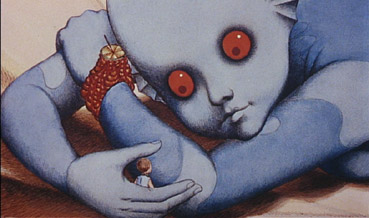
On an alien planet, a race of gigantic meditating blue-skinned, red-eyes creatures known as Draags keep humanlike Oms as pets. To the Draags, Oms are no bigger than beetles, and are treated as playthings or pests, with the many wild Oms being routinely killed every three cycles (15 years) to prevent an uprising.
In the Realm of the Senses
Starting this film, one of my first thoughts was that the acting, camerawork and effects are excellent, as it really looks like those people are having sex. Then some small children started throwing snowballs at a homeless man’s penis, a man abruptly fingers his maid from behind, we see the homeless man playing with himself trying to get an erection whilst staring at a naked vagina, followed by an extreme close-up of a woman giving a man a blow job. After she had to wipe off her chin, I turned the TV off and sent the film back to LoveFilm, as this is a porn film. There’s no two ways about it, this is a film where people have sex, on camera, for real, and yet the good people Octopus Books decided to include it in their 1001 list, describing it as elegant and a true manifestation of passion (though seeing as it apparently ends with a man being strangled then castrated, I have a somewhat different view of passion). From the 15 minutes I was able to sit through (doing my best not to look at the screen for much of that) there didn’t appear to be a lot of plot to hold the film together, and a minute did not pass without nudity or a sexual act, yet at no point was the film even remotely erotic, remaining steadfastly in the uncomfortable and nauseating camps. Maybe some people could argue this is art. But for me it is porn, and I do not watch porn. And no, there is no picture to accompany this review.
Requiem for a Dream
DON’T DO DRUGS. There you go, just saved you an hour and three quarters. Except that’s just the thing, although this film can be summed up in just three little words, it’s still an exceptional piece, just thoroughly depressing and cautionary. Easily the reason I’ve never so much as even picked up a joint, this film should be mandatory viewing in schools and rehab centres the world over, with every step taken by the four leads taking them further down a spiral they really don’t want to see the end of. Firstly, there’s Jared Leto’s slacker Harry, living day-to-day by repeatedly stealing and selling his doting mother’s television with best friend Tyrone (Marlon Wayans, surprisingly good) in order to buy drugs. Harry’s girlfriend Marion (Jennifer Connelly) is a promising fashion designer, but occasionally must turn tricks when money runs low, and Harry’s mother Sara (Ellen Burstyn, Julia Roberts has your Oscar) lives alone, glued to her television, unable to deal with the direction her son has taken.
The film is at times incredibly hard to watch (double-ended dildo, anyone?) but when you do it’s nothing short of a cinematic goldmine, with director Darren Aronofsky’s editing and Clint Mansell’s spot-on score fitting the addiction-addled characters lives perfectly. Fish-eye lenses, split-screen, sped-up/slow-down footage and cameras strapped to actors focussed on their faces as they flee from the mess they’re in are all used perfectly. Compare this to Happy Together, where these same devices were used just for the sake of it, to show the director could, and you can really see how relevant they are here. Also, compare the editing, especially that of drug hits; rapid shots of syringes depressing and eyes dilating, with similar edits in Edgar Wright’s Shaun of the Dead. The two use very similar techniques, but with wildly different effects.Sabotage
This early Hitchcock sees him dealing with familiar themes – espionage, deception, blackly comic beats and playful cinematic references – as a cinema owner (Oskar Homolka) acts as a terrorist agent in London unbeknownst to his wife (Sylvia Sidney) and her young brother, whilst Scotland Yard’s detective sergeant Spencer (John Loder) poses as the local greengrocer in an effort to catch the saboteur. The relatively slight length – a brief 76 mins – is still padded with background lines and squabbles, as Hitch unusually detracts from his otherwise straightforward plot. The greatest sequence involves the young Stevie (Desmond Tester) unwittingly transporting a bomb across town, only to be held up by a toothpaste salesman, a bus conductor and heavy traffic, with tension mounted with wordless cuts between the bomb, the boy, the obstacles in his way and every clock in the vicinity. The acting is top notch too, with more said in Homolka’s eyes than any line of dialogue.