Enigma

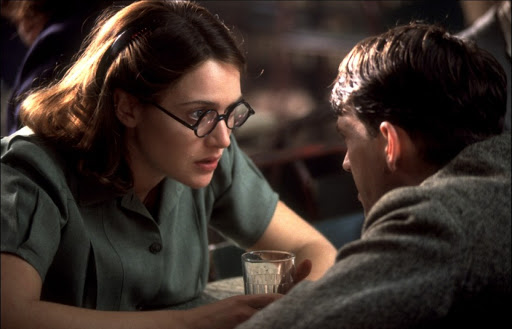
Bletchley Park, 60 miles outside London during the Second World War. The Germans have just changed the codes they use for their military communications, so the English bring in Tom Jericho (Dougray Scott), their former code breaking prodigy who was the only one able to crack the codes last time around. The problem is, Jericho went a little bit insane after some business involving his former lover Claire (Saffron Burrows), who has recently disappeared. On top of all this, there’s a rumour of a mole inside Bletchley Park, and when Tom investigates Claire’s disappearance with her room mate Hester (Kate Winslet), Tom finds incriminating evidence that could point towards Claire being the culprit, and he even finds himself under suspicion. Oh, and of course he’s working against the clock, as there’s a flotilla of US supply ships heading directly towards a cluster of German U-boats, and only his code-cracking skills can possible save them.
Continue reading

Superman Returns

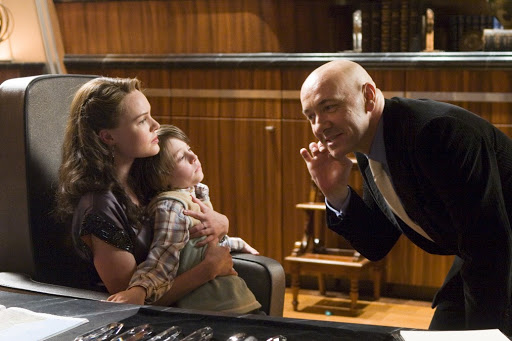
Superman, the last surviving alien from the planet Krypton with god-like powers, has left the city of Metropolis that he has protected for decades to return to the last known whereabouts of his destroyed planet. Upon discovering nothing to be found where his planet used to be, he returns back to Earth, and re-assumes his alter ego of Clark Kent, a mild-mannered journalist for The Daily Planet. He attempts to rebuild his relationship with Pulitzer-prize winning co-journo Lois Lane (Kate Bosworth), but is annoyed to discover that not only is she engaged to their boss’ nephew (James Marsden), but she has a son, Jason (Tristan Lake Leabu). Meanwhile, having recently been released from prison, Superman’s former nemesis Lex Luthor (Kevin Spacey) is busy hatching a plan involving crystals found in Supe’s mysterious Fortress of Solitude.

I’m not a fan of Superman. There, I said it. I remember half-watching the 1978 Christopher Reeve version when I was younger, but I can tell you literally nothing about it, and I remember watching Superman Returns a few years ago, but I couldn’t remember too much about that either, other than the shot of Bosworth’s Lois ascending in an elevator, Spacey’s Lex Luthor being near water at some point and the shot of Superman being shot in the eye that was in the trailers. To be fair, that viewing was overshadowed by a rather eventful mid-film pee break.
I remember the rest of the day clearly. It was pretty much the first time I’d tried Pick’n’Mix sweets (I was aged 19 I think), and all I’d consumed so far that day was strawberries with orange juice for breakfast, a couple of glasses of Coca Cola, and several fistfuls of Pick’n’Mix. My student days were not necessarily the healthiest of times. About halfway through the film, buoyed by the saccharine high of the tooth-rotting goodies  I’d consumed, I desperately need a wee. So i nipped to the loo, and mid-stream I passed out, and woke up face down on the toilet bowl. This is a very unusual place to regain consciousness, and needless to say, once I re-entered the lounge and joined my housemates watching the film, I didn’t take too much of the rest of the film in, hence why I remembered so little. I promise that I don’t make a habit of passing out during films, although later that day something similar occurred during an advert break in The Long Kiss Goodnight, this times resulting in my collapsing face-up (again mid-urination), still clutching the 2″ thick acrylic shower rail I’d previously been using to steady myself, that had now been sheared from the wall. Don’t worry, other than my recent Looper adventures, the only other time I’ve passed out was last year, again during a period of relieving myself, but was not halfway through a film. It did require the purchasing of a new toilet brush holder, as apparently the one we used to own wasn’t designed to withstand 15 stone of unconscious man falling onto it. 

Anyway, me fainting halfway through the first time I watched the film has nothing to do with whether I like it or not, I just enjoy retelling overly personal stories from my life that are at best tangentially related to the film I’m reviewing. No, what I don’t really like about Superman is that he’s just too powerful. His powers are seemingly beyond limit, with the only things he cannot do being the ones he hasn’t tried yet. He has flight, x-ray vision, super speed, strength, laser-eyes, time-travel, advanced hearing, super-whistling, fucking everything. And he only really has one weakness; Kryptonite; an extremely rare green rock. Which basically means that if people don’t know about this weakness, or there isn’t any of the super-scarce emerald stone around, there’s pretty much nothing in the way of Superman saving the day. I never really got into Smallville, even though I was pretty much slap-bang in the target demographic when it came out, and I can’t even get excited about next year’s Man Of Steel, even with Zack Snyder directing and Christopher Nolan producing. Needless to say, this film was going to have it’s work cut out if I was going to be impressed by the end of the viewing.
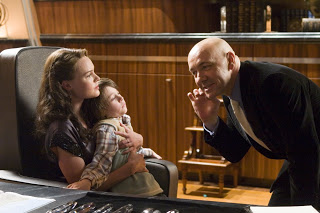
Initially I was intrigued by the film, as it has an interesting and somewhat eclectic cast. Kevin Spacey is perfect as Luthor, taking over from Gene Hackman. Spacey is his usual dependable self, and it at his best when in full-on bad guy mode, which is most certainly the case here. Elsewhere, Eva Marie Saint was a nice touch as Martha, Clarke’s adoptive mother, though disappointingly she doesn’t really get a lot to do, as is also the case with Frank Langella’s Perry White, Clarke and Lois’ boss. James Marsden once again plays a man caught on the cold side of a love triangle between the film’s hero and heroine (see also The X-Men trilogy, The Notebook, Enchanted), and Parker Posey is always a welcome addition to any cast, here playing Luthor’s sidekick/partner/main source of annoyance. Oh, and Kal Penn’s there too, but I’m fairly sure he never actually says anything, and [TINY SPOILER] is given a terrible cop out death with Luthor’s other two goons at the end [END OF TINY SPOILER].

Where the casting really falls down though is with the leads. Kate Bosworth, aged 23 when the film was released, looks far too young to play a Pulitzer Prize winning journalist, and seems dwarfed even by her own clothes. She also displays practically no likable qualities – she frequently dissolves into childish hissy-fits and strops whenever she (justifiably) doesn’t get her way. Brandon Routh, on the other hand, looks the part of both Superman and his public identity, but whenever he tries to act he appears to be made more of wood than the steel of his nickname. And in the many, many CGI shots of him flying or in danger, the film seems to become a late 90s video game, so terrible are the graphics. Most egregiously, the film’s final shot is one such diabolically bad render. Even in some of the non-CG shots Routh appears to have a plastic-like finish, possibly to make him look more similar to the computer generated bits.
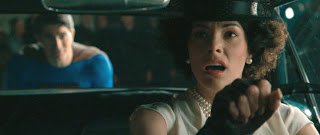
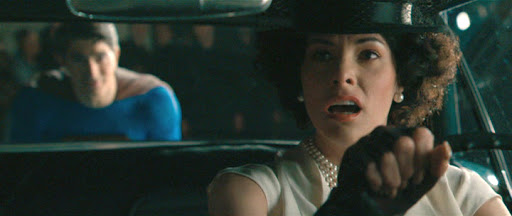
Another part that really bothered me was that the film is clearly set in modern times, with space shuttles, airplanes, videocameras etc. all being integral to the plot, but the architecture and fashions all seem to be stuck in the 1920s, up to the point of large sections seeming like they were shot in sepia. This is none more clear than in Parker Posey’s outfit in the car sequence. Adding the newspaper-room setting reminded me heavily of The Hudsucker Proxy, a film I liked a great deal more than this one, and which inspired me to suggest Jennifer Jason Leigh as Lois, although Amy Adams’ casting is possibly the only thing I approve of for the next film. I can see where director Bryan Singer was coming from with the mix of old and new styles, but it never really worked for me, and I found the whole thing very jarring. The overall plot was mostly just silly too, and various minor plotlines – the one involving Lois’ son for instance – felt unsatisfying and, at times, just plain stupid. The first 60% of the film seemed to drag too, as Lex’s plot is kept a mystery, and there doesn’t seem to be too much for Superman to really fight against. And part of the finale, in which lives hang in the balance of a fax machine’s volume, is not quite dated yet, but will be very soon. And who the hell puts a snooker table on a boat? Seriously.

There were some nice touches though. I approved of the little in-jokes for superhero fans (a news reporter mentions that they’ve received a message from Gotham), and the moment where Clarke pretends to be a bit confused and muddled to but Lois off the scent was good. The shoehorning-in of the “It’s a bird, it’s a plane…” line was clumsy, but still managed to raise a smile from me, even if it was accompanied with an eye-roll. The destruction of a model railway town may not sound like the grandest action set-piece in a film, but for me it was the highlight here, with it being shot in a similar fashion to a Roland Emmerich film. That one short sequence was more entertaining than the entirety of 2012, I can tell you.Elsewhere, some camerawork really disappointed me – a shot heading over a balcony and down, to focus on Lex reading a newspaper felt clunky and jerky – but this was more than made up for by the visually stunning space-set opening.

The viewing of the film was worth it to finally discover the origin of two Adam Carolla Show sound effects (“Wrong!” and “You’re losing your hair,” for fellow regular listeners), but sadly other than this point I was thoroughly underwhelmed by the whole thing. All being well, my low hopes for the upcoming Man of Steel may result in me being pleasantly surprise. Here’s hoping.

Choose life 4/10

Holy Smoke

Hurrah, another Jane Campion film. I can’t say I was much of a fan of The Piano, so I wasn’t much looking forward to this, the next available film featuring Kate Winslet (Hideous Kinky and Faeries are as yet out of my reach).

Winslet plays Ruth, a young Australian girl (with a distinctly English accent) who has travelled to India to find herself. As well as finding that, she discovers and becomes willingly entangled in a mass marriage/suicide cult, and her understandably concerned family would rather she just came home. After Ruth’s mother (Julie Hamilton) manages to persuade her daughter to come back to Sydney with her, utilising a fake illness for her father and a very real asthma attack for her mother, the family bring in P. J. Waters (Harvey Keitel), a professional ‘exit counsellor,’ an expert at convincing people to give up their new found cultish beliefs and return to their previous lives.
Continue reading

Return of the Killer Tomatoes

There are some films where it’s impossible to go in with a completely open mind. Whether it’s because it’s a sequel to a film you’ve seen a hundred times, it’s the work of a director or actor you’re very familiar with or you’ve been bombarded with a relentless marketing campaign, there are many factors that can influence your opinion of a film before you go and see it. And, of course, there’s the title. The one inescapable truth about this film is that it’s called Return of the Killer Tomatoes, and is therefore not going to be anything even close to highbrow or arthouse, and might just about scrape the underbelly of being entertaining.


Now, unlike the last no-budget comedy-horror flick featuring George Clooney and starting with the word ‘Return,’ this one is actually a sequel, to 1978’s Attack of the Killer Tomatoes, which I’m fairly sure doesn’t star anyone of note, so I’ve no intention of ever watching it. The 4.4/10 rating on IMDb doesn’t help either. Without doing any extra research (I’m on a deadline here, I need to go to sleep in an hour) I can tell from Return, in which they recap most of the plot and actually make a point of a viewer complaining about them recaping the original plot, that there was some kind of mysterious science plot in which monster tomatoes were created and vanquished using music. Something similar takes place in Return, but here the scientist (John Astin, I knew I recognised him, only just realised it’s from The Addams Family), Dr. Putrid T. Gangreen, is creating tomatoes that take on human form, any form, and he plans to take over the world by creating a tomato version of the president.

Since the first film’s plot, a whole new generation has grown up without knowing the glories of tomatoes, as they were outlawed by the government. There is a fairly healthy tomato racket on the black (or red) market, but the pizzeria in which our hero Chad Finletter (Anthony Starke) works makes pizzas by substituting the tomato sauce with raspberry jam or boysenberry, and accompany it with toppings ranging from gummy bears and peanut butter to something called the famous deep fried fish pizza, which sounds disgusting. Chad works as the delivery boy, and has the hots for Tara, the beautiful assistant/lover of Dr. Gangreen, but has never really been able to strike up the courage to talk to her. Also, she’s a tomato. That’s pretty clear from the start, seeing as she’s been created as the ‘perfect woman’ in every respect, apart from she hates music and bathes in fertiliser. Chad’s uncle Wilbur (J. Stephen Peace) owns the pizzeria (he’s the hero of the first film), and Chad’s room mate Matt (George Clooney) works there too, inbetween scams to have sex with every woman he comes across. 

In case you haven’t guessed, this film is pretty ridiculous. The plot is insane, the production value is non-existent and the acting equally scarce. There’s a creature called F. T. (which stands for either Furry Tomato or Freak Tomato) who is quite clearly a cuddly toy being wiggled by a stick or strings. But this all adds to the home-made feel, and in fact attention is brought to how terrible the film is by more meta than I can really handle. The film even begins by being shown in someone’s lounge (they initially start showing a film called Big Breasted Girls Go To The Beach And Take Their Tops Off, but thankfully this is stopped early on), and there are phone calls from viewers peppered through the film, and halfway through the camera pans out to find the director telling everyone they have to stop filming because they’ve run out of money. Ridiculously, there’s two more films in the Killer Tomatoes franchise; Killer Tomatoes Strike Back and Killer Tomatoes Eat France, both also directed by John de Bello and who appears as himself in at least Return, but I can safely say I won’t be seeing either of those films ever.

There were quite a few moments in the film that I can recommend though. Gangreen assistant, Igor (Steve Lundquist) is an aspiring news anchor who keeps on turning to the screen and saying things like “We’ll be right back, after this…” which I found to be consistently ridiculous enough to be entertaining, and the script contains such straight-faced gems as “I thought you were ketchup!” and “The girl of my dreams is a vegetable!” (at no point is the tomato correctly identified as a fruit). Some bits go a bit far into the stupid though – when Wilbur comes to the rescue, it’s dressed as a paratrooper with a deployed parachute that drags along the ground, along with a man permanently dressed in scuba gear who communicates with title cards even over the phone, and a severely overweight man in a Lone Ranger costume. 

It’s a very immature film that I would have doubtlessly enjoyed 10-15 years ago, but I’m proud to say I’m now too mature for it (when sober, at least). On a drunken Friday night with a group of mates it might be worth a punt, but seeing as I watched it at 7:00 am on Saturday morning it didn’t really hit the spot.

Choose life 4/10

The Ring (1927)

Although this wasn’t Hitchcock’s first film (he made at least five before this one, although at least one of those in deemed ‘lost’ [1926’s The Mountain Eagle] and another two unfinished [Number 13 and Always Tell Your Wife, from 1922 and 1923 respectively]) The Ring is the earliest one I can get my hands on at present, so my travels through the history of Hitch will have to begin here. Telling the story of an amateur boxer working at a carnival who gets a shot at the big time after he is scouted by a renowned heavyweight, The Ring almost knocked me out for being a Hitchcock film about one of the least Hitchcockian subjects, sport.
Carl Brisson is Jack ‘One Round’ Sander, who makes his living by challenging regular schmoes to a boxing match at a carnival. His fiance (Lillian Hall-Davis) chews gums as she works the ticket counter, and his friends are his assistants and announcer. One night, after dispatching the usual rag-tag band of hopefuls fairly promptly – one of whom defeats himself as he enters the ring – Jack meets his match against Bob Corby (Ian Hunter), who unbeknownst to Jack is an Australian heavyweight champion, and has already been making moves on his girl. After the fight, Bob claims his reward (a grand total of £2.00), and tells Jack he plans to give him his chance with the professionals. Bob and Jack’s fiance, and eventually his wife, become much closer as Jack becomes more successful, which leads to a love triangle developing between the three, coming to a head when Jack and Bob fight on another at the end of the film.

Had I not known this was a Hitchcock film, I would have been very surprised to discover the fact. Other than themes of deception and suspicion, this does not seem to fit within the rest of his work. Even the leading female is a brunette! Now I’m sure that Hitchcock obviously didn’t start out as a master film-maker – truly brilliant debut films are few and far between – but I had hoped for more than this, as this film is at best just mediocre. The plot is nothing special, and feels dragged out even at less than 90 minutes, and when you consider that the last 10+ minutes of this are a boxing match that feels like it lasts at least an hour, then the pacing is really quite a problem.

Hitchcock’s infamous mysogany and sexism is evident in places. Though she is essentially the third lead, Hall-Davis’ character is only ever referred to as ‘The Girl,’ even though her character has is called Millie. In both the opening credits and her introductory title card she is given that fairly vague, nondescript title. There is some interesting camerawork, especially early on in the initial fight, with the camera remaining stationery, pointed at Jack’s opponent’s corner of the ring, as the would-be fighter heads off screen to fight, only to be thrown back a second later, dishevelled and clearly defeated. However other than this and some occasional semi-dream sequences and video distortion to emulate rage, drunkeness and being knocked out, there isn’t much to take note of.

The title of ‘The Ring‘ most obviously refers to the boxing ring within which a fair amount of the film takes place, however it also refers to the wedding ring (this is possibly the first cinematic incarnation of a best man losing the ring), a bangle given to Millie by Bob, a forune-teller’s ring of cards and the circular nature of the plot, as the final scenes are very similar to the opening one, with Millie watching on as the two men fight it out. By the end, they are no longer just fighting for money and a title, but for honour, pride and the hand of the woman they both love.

I had one major gripe with the film. Throughout the story we are shown countless posters advertising boxing matches, upon which are the names of dozens of boxers. Yet of them all, Jack is the only one with a nickname. (Although at one point someone dates the movie a tad by referring to a boxer in a less than affectionate racial slur that I don’t care to repeat.) Surely at least one of the others would have a stage name, for the sake of realism? Also, look out for one of Bob’s assistants, who looks spot on like Jack Nance in Eraserhead.

Before watching this, I’d yet to see a Hitchcock film I hadn’t at least liked. I hope dearly that his learning curve was steep, and he got better very quickly.

Choose life 4/10

Troy

Regardless of whether you know the story of Homer’s Iliad, it’s a certainty that you know of the expressions Helen of Troy, Achilles’ Heel and The Trojan Horse. These plot points have become more than the legend of which they are a part, and have entered the modern lexicon as sayings and day-to-day phrases. They aren’t anything new, you know what is means and have heard them a million times before, and the same can be said for every aspect of this film.

Continue reading

Scream 4

I wrote in one of my first posts aaaaaaaaaaages ago that I was really looking forward to this film, as I loved Scream and Scream 2, and enjoyed Scream 3 enough to justify owning it, but when the reviews came out and Scream 4 was deemed something of a failure I became lukewarm to the idea, and have put off watching it until recently. I went in with fairly low expectations, which is probably the best approach to take if you want to enjoy this film.

The problem with the Scream franchise, and indeed with pretty much every horror series, is that it tells the same story every time. Yes, a new batch of barely-characterised nubile young hotties is brought in to be creatively slaughtered, and at least with these films the killer changes each time, but the motive always seems to be the same and it’s always someone you’re not supposed to expect, meaning you work out who the killer couldn’t possibly be, and then you’ve solved the mystery.
It’s not difficult to see why the surviving leads from the series, Neve Campbell, Courtney Cox and David Arquette, have returned, seeing as none of them has had a very successful venture since the last movie, and the likes of Emma Roberts, Hayden Panettiere, Rory Culkin and Adam Brody were probably only too willing to work with Wes Craven, the legend behind the original trilogy as well as A Nightmare On Elm Street, The Hills Have Eyes and The Last House On The Left.
The plot sees Sidney Prescott (Campbell), the key surviving victim from the series, as she returns back to her home town of Woodsboro 15 years after the original murders to promote her new book, where Dewey (Arquette) is now sheriff and married to Gale Weathers (Cox). At times it’s more than a little awkward to see Cox and Arquette working together after their divorce, as they’ve lost that spark of chemistry present in the earlier films. Coinciding with Sidney’s return, a new killer is murdering random victims, and seems to be doing so by following the rules set by modern horror multi-sequels. This time amongst the knife-fodder is Sidney’s niece Jill (Roberts) and her friends, as well as movie nerds and audience cyphers Charlie and Robbie (Culkin and Erik Knudsen).
Seeing as the antagonists murder weapon is a big knife, the kills here can never be all that inventive. It’s more a case of where the killer jumps out from and who is behind the mask more than how will everyone die (hint: by being stabbed). The film has now surpassed it’s previous level of satire and whip-smart semi-parody by becoming overly self-deprecating, with the multi-layered opening being a prime example of how silly it has become, and how little the film cares about the kind of emotional attachment the audience is willing to put into the characters and plot. The ending makes sense within the film’s universe, but only because it’s frightfully similar to that of the three films before it.
If you enjoyed the previous films, and heaven knows I did, then chances are you know what you’re getting yourself in for here, and won’t necessarily be disappointed. If, however, you’re looking for the series to get a kick start and head off in a new direction, you’ll find it sadly lacking. This was intended to start another trilogy, but somehow I don’t think that’s going to happen.
Choose life 4/10

Last Tango in Paris

This is one of those films that I’ve often heard mentioned, but never knew anything about, other than it had Marlon Brando wearing a long camel coat, and some degree of nudity. This is true on both counts, though ‘some’ could be something of an understatement, as barely a scene goes by without flesh being exposed, love being made or pleasure being administered by a character to themselves.
 
Our leads are Paul (Brando) and Jeanne (Maria Schneider, at the time a somewhat inexperienced actress). After several near-meetings and glimpses on the street and in a bar, she goes to rent an apartment that he has already entered. Without knowing one another’s names, or anything else, the two engage in a burst of passionate, impromptu sex, before embarking on a relationship centred around the apartment, despite troubles in their personal lives and an obvious age gap of at least twenty years.
 

The most annoying thing about this film is the dialogue, specifically Brando’s. He’s not known for his eloquence with enunciation, and here he excels himself with his mumbling. If it weren’t for the subtitles in some of his earlier scenes, I wouldn’t have known he was talking at all, and my constant need to keep readjusting the volume become tiresome after only a short while, and downright infuriating at the end, for almost everyone else speaks at a normal level (though Schneider has a go at mumbling too) and the score is at an average volume, but I had no desire to annoy my neighbours by keeping the sound at a raised level. This made for a very unpleasant viewing experience.
 
The script is scarred with hideous puns and double entendres (“What’s that for?” “Your happiness, and my hap-penis”) as well as enough crudity and sex scenes to make anyone blush. The scene where Paul rubs butter into Jeanne’s anus before raping her from behind is beyond uncomfortable (especially for her), as is the fact that she stays after the deed is done. Later, he seduces her by saying that he wants to get a pig, have the pig fuck her and vomit on her, then she eats the vomit and the pig dies whilst fucking her. I have no idea what that means, nor do I have any desire to, and in fact I’d have been happier had that been part of the dialogue I hadn’t heard.
 
The relationship between the leads is interesting, as it provides something segregated from their everyday, troubled lives, but it seems to bring about more problems than it solves. Schneider is shot attractively – the camera all but making love to her exposed thigh in an early shot in a phone booth – and the colour palette is full of sumptuous browns and ochres. Jeanne’s subplot involving her boyfriend making a semi-documentary film about their relationship was distracting and irritatingly confusing.
 
I wasn’t sure what I’d make of this film before going in, and I’m only slightly more sure of what happened during it now that it’s thankfully over. If Brando, who admittedly is excellent, hadn’t been in the film I doubt it’d be on the List, and the audio problems, lack of a fully structured plot and unnecessary diversions make this more annoying than entertaining.
 
Choose life 4/10

The Docks of New York

One of the last films to be made before the invention of the talkie, The Docks Of New York sees hulking, tattooed ship stoker Bill docking into port one night. He saves the suicidal Nell from drowning, steals her some dry clothes and, almost on a whim, marries her in the bar that night. The morning arrives with a stark clarity, as Bill intends to head back out to sea.
 
The plot is boring and predictable – there’s even a last ditch attempt to save the girl after she gets in trouble with the authorities over her new duds, but there’re some hilarious – though possibly unintentional – lines of dialogue: “I’ve sailed the seven seas, but I’ve never seen a craft as trim as yours” Bill tells his new bride-to-be.
 
Choose life 4/10

Bunuel Marathon

I’ve made no secret that I dislike the films of Spanish surrealist/Mexican politicist Luis Bunuel. I find his work arduous, unpleasantly illogical and disconcerting, so I thought it would be a good idea to remove the remainder from the list in quick succession, allowing for 8 films to be bundled together in another overlong post that no-one with a modicum of sense will ever read.

Our first is Belle de Jour, a senseless, semi-plotless effort typical of Bunuel, following Severine (the beautiful Catherine Deneuve) who behaves frigidly towards her husband of one year, but finds herself stepping out to work at a brothel without his knowing. What little plot there is is predictable – inevitably a lecherous friend of Severine’s husband visits the brothel and propositions her, with only Deneuve’s performance is worth watching. Mercifully, little intercourse is shown.
In the Discreet Charm of the Bourgeoisie, I was shocked to find an almost coherent story running throughout, as six upper crust respectable people – drug dealers, no less – struggle to all come together for a meal, but are denied the chance at every turn, be it from confused calendars, a dead restaurant manager, a bout of pre-lunch nooky, a shortage of tea and the unexpected arrival of a branch of the military. There is indeed a certain charm to the story, nicely balancing the ludicrous dining catastrophes with the concern that the drug pedallers are being tracked by terrorists, but alas all this is blown to bits with interruptions from a tragic Lieutenant, telling of how his mother’s ghost told him as a child to poison his father, or a dream he had meeting dead people on a street. The bishop is also an unnecessary distraction, and the Inception-like dream within a dream finale adds nothing but disappointment.

It’s Catherine Deneuve again, this time playing Tristana, a woman in mourning for her recently deceased mother, who goes to stay with the lecherous yet refined Don Lupe. He spouts bizarre philosophies (“a woman only stays honest with a broken leg – and at home!”) which begin to rub off on Tristana as he makes several advances towards her yet she does not seem to object. She makes a point of always choosing between two things, so it’s safe to assume she will eventually be called upon to choose between two men, and she suffers from the kinds of bizarre, unexplained dreams that are Bunuel’s bread and butter. There’s a fair stab at an actual plot, but bland or irrational characters, large periods of time passing with little acknowledgement and an unsatisfactory, inconclusive ending mars the film.

After an unexpected yet poorly edited explosive opening that had to be rewound to work out who it happened to, That Obscure Object of Desire heads downhill. Using an annoying and repeatedly referred to narrative device of a man telling his story to other passengers in his train carriage, we hear of the events that led up to him pouring water over a woman on the train platform. The other passengers continually tell the man that his story is fascinating and remarkable, but it is nothing of the sort, concerning a duplicitous young women employed as a maid by the man, who leaves when he shows her affection, and bear in mind that the positive adjectives used to compliment the man’s story were written by the same person who wrote the story he is telling, making them nothing more than egotistical propaganda.

Los Olvidados began positively, but I’m sure not in a way hoped by those involved in its production. Expecting a 95 minute film, the DVD clocked in at a much more tolerable 76 minutes, so I settled down with a grin on my face at the extra 19 minutes I could spend asleep that evening. Having just escaped from prison, young gang leader Jaibo rejoins a band of youths and sets them up to rob a blind busker. The plan fails and one of their number is stabbed, so later the gang pelt the busker with mud and stones, destroying his instruments. All the gang members look at least a little alike and are hard to distinguish from one another, and there are few genuinely likeable characters in the cast. One young hoodlum steals food from his own mother, but to be fair, when asked if she loves him, the mother replies “Why should I love him? I don’t even know who his father is.” The film shows a mildly interesting look at those trying to escape a life they’ve been born into, but not a lot happens, and when it does it isn’t terribly interesting.

Inconclusive and pointless, Viridiana sees a nun visiting her sick uncle, only to find she is eerily identical to her deceased aunt. Her uncle, Don Jaime, is willing to do anything to prevent Viridiana from returning to the nunnery, though drugging her and pretending to rape her is a little extreme, as is hanging himself when his plan fails. Believing herself to be deflowered and therefore unable to return to her calling, Viridiana brings in some homeless people to help out around her late uncle’s house – much to the chagrin of her uncle’s other relatives – and the previously homeless do a less than acceptable job of helping out. Long periods of silence make it easy to drift off, as does the boring story with little to retain interest.

To begin with in Land Without Bread, I thought the worst part of this half hour documentary about an obscure poverty-stricken Spanish village in 1932 was going to be the production values, with a poor quality transfer resplendent with cracks and scratches, terrible sound and mistakes in the subtitles, bit it turns out I was quite wrong. The film is horrific in its depiction of a town where the only water source is a muddy stream running through it, children’s parents steal the bread their offspring bring home from the school and almost everyone is diseased in some way – a 32 years old woman looks at least 55, with a revoltingly bulbous goitre on her neck. We see a child with inflamed gums, and two days later she is dead. The only milk available is from the goats that thrive on the barren, rocky landscape, and is reserved only for the very sick, and goats are only used for their meat when they die of natural causes. At this point the film takes a turn. We see a goat fall from the rocks to demonstrate the previous point, and also a donkey being stung to death when a bee hive it is carrying falls off. After watching the film, I later discovered both events, each ending in the very real death of an animal, were both staged, with Bunuel even smearing the donkey with honey. Words fail me for home disgusting this is. A group of dwarfs are filmed as though the focus of a nature documentary (“Some are dangerous. They flee from people or attack them with stones. They are found at nightfall as they return to their village. We found it very hard to film them.”) There are repeated shots of a dead baby. This is a thoroughly depressing film that does not broach the subject of why the village’s inhabitants remain there, and it’s only redeeming feature is making the viewer grateful for what they have.

And finally, The Young One. Racism runs rampantly throughout this tale of a black man fleeing the accused rape of a white woman, and discovering an island inhabited only by a young girl and her abusive guardian. It’s a fairly straightforward plot, with the accused criminal attempting to leave the island, but there are bizarre and inappropriate sexual overtones between the girl and both men, especially because she is clearly underage, though no-one, not even the girl herself, knows how old she is. There isn’t as much wrong with this film as in most of Bunuel’s, but also nothing really noteworthy.

Belle de Jour: Choose life 5/10
The Discreet Charm of the Bourgeoisie: Choose life 6/10
Tristana: Choose life 4/10
That Obscure Object of Desire: Choose life 3/10
Los Olvidados: Choose life 5/10
Viridiana: Choose life 4/10
Land Without Bread: Choose life 1/10
The Young One: Choose life 6/10