Bunuel Marathon

I’ve made no secret that I dislike the films of Spanish surrealist/Mexican politicist Luis Bunuel. I find his work arduous, unpleasantly illogical and disconcerting, so I thought it would be a good idea to remove the remainder from the list in quick succession, allowing for 8 films to be bundled together in another overlong post that no-one with a modicum of sense will ever read.

Our first is Belle de Jour, a senseless, semi-plotless effort typical of Bunuel, following Severine (the beautiful Catherine Deneuve) who behaves frigidly towards her husband of one year, but finds herself stepping out to work at a brothel without his knowing. What little plot there is is predictable – inevitably a lecherous friend of Severine’s husband visits the brothel and propositions her, with only Deneuve’s performance is worth watching. Mercifully, little intercourse is shown.
In the Discreet Charm of the Bourgeoisie, I was shocked to find an almost coherent story running throughout, as six upper crust respectable people – drug dealers, no less – struggle to all come together for a meal, but are denied the chance at every turn, be it from confused calendars, a dead restaurant manager, a bout of pre-lunch nooky, a shortage of tea and the unexpected arrival of a branch of the military. There is indeed a certain charm to the story, nicely balancing the ludicrous dining catastrophes with the concern that the drug pedallers are being tracked by terrorists, but alas all this is blown to bits with interruptions from a tragic Lieutenant, telling of how his mother’s ghost told him as a child to poison his father, or a dream he had meeting dead people on a street. The bishop is also an unnecessary distraction, and the Inception-like dream within a dream finale adds nothing but disappointment.

It’s Catherine Deneuve again, this time playing Tristana, a woman in mourning for her recently deceased mother, who goes to stay with the lecherous yet refined Don Lupe. He spouts bizarre philosophies (“a woman only stays honest with a broken leg – and at home!”) which begin to rub off on Tristana as he makes several advances towards her yet she does not seem to object. She makes a point of always choosing between two things, so it’s safe to assume she will eventually be called upon to choose between two men, and she suffers from the kinds of bizarre, unexplained dreams that are Bunuel’s bread and butter. There’s a fair stab at an actual plot, but bland or irrational characters, large periods of time passing with little acknowledgement and an unsatisfactory, inconclusive ending mars the film.

After an unexpected yet poorly edited explosive opening that had to be rewound to work out who it happened to, That Obscure Object of Desire heads downhill. Using an annoying and repeatedly referred to narrative device of a man telling his story to other passengers in his train carriage, we hear of the events that led up to him pouring water over a woman on the train platform. The other passengers continually tell the man that his story is fascinating and remarkable, but it is nothing of the sort, concerning a duplicitous young women employed as a maid by the man, who leaves when he shows her affection, and bear in mind that the positive adjectives used to compliment the man’s story were written by the same person who wrote the story he is telling, making them nothing more than egotistical propaganda.

Los Olvidados began positively, but I’m sure not in a way hoped by those involved in its production. Expecting a 95 minute film, the DVD clocked in at a much more tolerable 76 minutes, so I settled down with a grin on my face at the extra 19 minutes I could spend asleep that evening. Having just escaped from prison, young gang leader Jaibo rejoins a band of youths and sets them up to rob a blind busker. The plan fails and one of their number is stabbed, so later the gang pelt the busker with mud and stones, destroying his instruments. All the gang members look at least a little alike and are hard to distinguish from one another, and there are few genuinely likeable characters in the cast. One young hoodlum steals food from his own mother, but to be fair, when asked if she loves him, the mother replies “Why should I love him? I don’t even know who his father is.” The film shows a mildly interesting look at those trying to escape a life they’ve been born into, but not a lot happens, and when it does it isn’t terribly interesting.

Inconclusive and pointless, Viridiana sees a nun visiting her sick uncle, only to find she is eerily identical to her deceased aunt. Her uncle, Don Jaime, is willing to do anything to prevent Viridiana from returning to the nunnery, though drugging her and pretending to rape her is a little extreme, as is hanging himself when his plan fails. Believing herself to be deflowered and therefore unable to return to her calling, Viridiana brings in some homeless people to help out around her late uncle’s house – much to the chagrin of her uncle’s other relatives – and the previously homeless do a less than acceptable job of helping out. Long periods of silence make it easy to drift off, as does the boring story with little to retain interest.

To begin with in Land Without Bread, I thought the worst part of this half hour documentary about an obscure poverty-stricken Spanish village in 1932 was going to be the production values, with a poor quality transfer resplendent with cracks and scratches, terrible sound and mistakes in the subtitles, bit it turns out I was quite wrong. The film is horrific in its depiction of a town where the only water source is a muddy stream running through it, children’s parents steal the bread their offspring bring home from the school and almost everyone is diseased in some way – a 32 years old woman looks at least 55, with a revoltingly bulbous goitre on her neck. We see a child with inflamed gums, and two days later she is dead. The only milk available is from the goats that thrive on the barren, rocky landscape, and is reserved only for the very sick, and goats are only used for their meat when they die of natural causes. At this point the film takes a turn. We see a goat fall from the rocks to demonstrate the previous point, and also a donkey being stung to death when a bee hive it is carrying falls off. After watching the film, I later discovered both events, each ending in the very real death of an animal, were both staged, with Bunuel even smearing the donkey with honey. Words fail me for home disgusting this is. A group of dwarfs are filmed as though the focus of a nature documentary (“Some are dangerous. They flee from people or attack them with stones. They are found at nightfall as they return to their village. We found it very hard to film them.”) There are repeated shots of a dead baby. This is a thoroughly depressing film that does not broach the subject of why the village’s inhabitants remain there, and it’s only redeeming feature is making the viewer grateful for what they have.

And finally, The Young One. Racism runs rampantly throughout this tale of a black man fleeing the accused rape of a white woman, and discovering an island inhabited only by a young girl and her abusive guardian. It’s a fairly straightforward plot, with the accused criminal attempting to leave the island, but there are bizarre and inappropriate sexual overtones between the girl and both men, especially because she is clearly underage, though no-one, not even the girl herself, knows how old she is. There isn’t as much wrong with this film as in most of Bunuel’s, but also nothing really noteworthy.

Belle de Jour: Choose life 5/10
The Discreet Charm of the Bourgeoisie: Choose life 6/10
Tristana: Choose life 4/10
That Obscure Object of Desire: Choose life 3/10
Los Olvidados: Choose life 5/10
Viridiana: Choose life 4/10
Land Without Bread: Choose life 1/10
The Young One: Choose life 6/10

Pretty Woman

There’s an area in Bournemouth – where I’d currently hang my hat if I wore one – known as the local red light district, and unfortunately it’s on the road upon which I live. Let’s get one thing cleared up right now: sex workers do not look like Julia Roberts, and if they did, they probably wouldn’t be struggling for money, regardless of how much their flatmate spends on drugs.

Remarkably, Aisha had neither seen nor heard much about this chickiest of chick flicks, filling the role of romantic film of the decade between Dirty Dancing and the Notebook. And just like those two films, for anyone who doesn’t enjoy romantic movies, this film is terrible. Firstly, Roberts’ Vivian Ward is a horrendous role model. Not only is she a sex worker, by the end of the film it is clear she would have remained one forever were it not for Richard Gere’s ridiculously wealthy businessman Edward Lewis. The moral here kids is don’t worry, you’re life may turn to crap, but someday someone will come along, wave their magic credit card shaped wand and give you everything you’ve ever wanted. Essentially an, ahem, adult retelling of a fairy tale – Cinderella and Rapunzel are both namechecked – the film retains every sense of logic and reality of its inspirations.

It’s only saving graces are from the supporting cast – Jason Alexander as essentially a more successful George Costanza and the great Larry Miller as a preening store manager (“She has my [credit] card” “And we’ll help her use it, sir.”), but otherwise the story is one-note and the lead performances average at best, with the actors feeling very robotic and over-directed. And even worse, Aisha has now added it to her Amazon wish list.

Choose life 4/10

Salt of the Earth

“The only major American independent feature made by communists.” Good for them, well done, pats on the back all round. Now go away. Noted critic Pauline Kael rightly declared the film as propaganda upon its release, and I wholeheartedly agree, with the film depicting an uprising of Mexicans working in a fictional New Mexico mine. By all means they should fight for equal rights with the white workers, and their women should fight against the men against the rampant sexism, but the acting is terrible (from a largely unprofessional cast, so what did they expect?) and literally nothing unexpected takes place throughout the entire film. Every box is ticked in the story-of-a-strike category, and the topic is something more fitting to a setting in which a deeper, more personal film takes place (see Billy Elliot).
Choose life 4/10

Strike

Eisenstein’s back! Hurrah, I’d almost missed him. And not only has he found his way back to the List, but this time it’s with his first ever film, 1924’s Strike, a tale of – you guessed it – a strike at a Russian metalworks factory. Tired of long days for little pay and even less respect, and after one of their colleagues kills himself after being fired for a theft he not only didn’t commit, but reported, the workers go on strike. The 1920s image quality and an overuse of shadows makes it hard to tell one character from another in many instances, but there is a creative use of editing – Eisenstein’s trademark, cutting to hard-hitting imagery or between the rich and poor, here showing the wealthy fat cats stuffed in tuxedos swilling brandy and puffing on cigars whilst the workers protest. Also, an early trick of subtitles rearranging and merging into the picture is well received, as are photographs coming to life as though printed in the Daily Prophet.
Alas, some scenes are difficult to follow, though there is much less Russian history on show here than in Sergei’s later pictures, so well done for that old boy, but overall the direction is too heavy handed.
Choose life 4/10

Frankenstein/Bride of Frankenstein

Although at times laughable now, back in 1931 James Whale’s adaptation of Mary Shelley’s classic horror may well have been truly terrifying. Everybody knows the story; a mad scientist and his hunchbacked assistant rob some graves and, with the aid of a handy lightning bolt, create life in a giant, shambling monster, who eventually escapes his castle prison and is hunted down by a screaming mob with pitchforks and torches. This sense of inevitability is what lets the film down, and the limited effects available 70 years ago makes the film pale in comparison to however you can picture it in your imagination. Boris Karloff (replaced with a large ‘?’ in the opening credits for maximum levels of mystery) is brilliant as the monster, displaying childlike innocence in a giant, rigid, wordless performance that sees him throwing a young girl into a river to see if she’ll float, yet remains the victim in this tale.
The sequel picks up at the exact end of the first film, but is not encumbered by knowledge of the plot, or at least not for me, as all I knew was that at some point a female monster was created with a big black Marge Simpson hairdo with a white streak through it. The film uses a nice reminding device – the story is being told by original author Mary Shelley to her husband ad Lord Byron – which although takes you out of the film, adequately reminds of the climax of the previous picture. There are some cringe worthy scenes, most notably a blind man teaching the monster how to speak reminiscent of the worst scene of Terminator 2, with John Connor teaching Arnie how to be cool. The bizarre scene where Dr. Frankenstein’s former mentor Dr. Pretorius reveals the miniature people he has created in jars, including a king, a queen and a mermaid, is just insane, and Pretorius himself is a perfect combination of Doc Brown and Grand Moff Tarkin.
Frankenstein: Choose life 5/10
Bride of Frankenstein: Choose life 4/10

Friday Night Lights

I’ve heard before that this is one of the better sports movies and, though I know very little about American football (or women’s rugby, as I like to call it), the games shown here were well shot and captivating. But, a good sports movie is still just a sports movie, and is therefore about nothing. I didn’t play sport in school. I dabbled in cricket a little, very briefly played football but then gave up when I saw the little benefit that could be achieved with the maximum effort put in. So instead I studied hard, did my homework and did OK in school, and from there went to college and university on my academic qualities, got a job and now make a living. I’m not a natural genius, I worked hard to get what I have, so when a film tells me that these kids playing football aren’t the brightest, and their only way out of their backwards hick town is via throwing a bag of air across a line or between two posts or whatever the hell they do over there, I just have to sit back and try not to throw everything to hand at my TV. I don’t care how committed the rest of your town is to a game, and it is just a game after all, if you don’t have yourself a backup plan when you’re relying on not damaging that oh-so-fragile body of yours to secure you’re future, you’re even dumber than anyone could have predicted.

Anyway, rant over, as you can guess, I’m no sports guy, so good luck to this film. Billy Bob Thornton is the football coach to a high school football team in a town full of meat sacks that shuts down every Friday night come game time. Every man, woman and inbred child in this town has an opinion they’re only too willing to share as to how the game should be played, and generally a different one after to the event as to how it should have been played. Local radio shows take call-ins from fans, on suggesting that they’re “doing too much learnin’ in this school,” and the kids themselves are under more pressure than is healthy from all around, particularly in the case of Garrett Hedlund’s Don Billingsley, whose father was a star in his day, yet Don is playing third string (I think this is a bad thing). Meanwhile current star quarterback Boobie Miles enjoys a celebrity lifestyle and just has to show up to training, with all the plays centred on him, so guess which players going to receive an unrecoverable injury? This true story from director Peter Berg, helmer of least anticipated film of 2012 Battleship, follows the Permian Panthers, for that is their team name, from the play-offs to the final, and though the outcome of the final match isn’t inherently obvious, everything else in this film is.
Choose life 4/10

Cinematic Cure for the Common Cold

I have a cold, it’s quite possibly going to kill me. We’re not talking about some run-of-the-mill everyday man-flu here, this is like if Gwyneth Paltrow in Contagion screwed the monkey from Outbreak, then sneezed all over my Fruit & Fibre. My nose has become a sewer pipe for an over-producing factory of snot. And because of this ‘case of the sniffles’ (my mum’s words) I took a day off work (the first in living memory, save last year’s truck meets bike debacle) and whilst off I thought I’d endeavour to find the best kind of film to watch when you’re ill, and cross a few off the list whilst I was at it.

First off, discount anything subtitled or 3D, you feel bad enough already, having to wear glasses or read isn’t going to make you feel any better. Amelie is a great feel- good film, but if your head feels like wool almost anything in English is going to be a better choice. The same can be said for anything too obscure. David Lynch, Luis Bunuel, Lars von Trier, sit back down. Terry Gilliam is just about acceptable, as most of his work tends to have a light-hearted edge to it, but the others are going to look especially trippy, depending on your medicine cocktail of choice. Probably best not to watch Brazil though.

I’ve followed five schools of thought here: 1. Watch a western. Real men working hard for a living, fighting, killing and sexing up whores like real men should do might just inspire you to man up and show those germs who’s boss. If you’re a girl substitute this for some period Jane Austen nonsense. Being ill in olden times was not deemed proper. 2. Watch a horror, in an attempt to scare yourself so much you forget you’re ill, or possibly scare the illness away. I’m not a doctor, but I think this is medically possible. 3. Watch a depressing film. Seeing people worse off than you should make you feel better about the situation, in a “yes I may be ill, but at least I haven’t been buried alive” kind of way. 4. Watch a kids film, definitely animated, preferably Pixar. Lighthearted, simple to follow and always has a happy ending, this is a traditional antidote to any problem I come across. 5. Die Hard. John McClane has never found a problem he can’t shoot through, and you’re namby-pamby congested sinuses aren’t about to stop his track record. Plus, it’s festive, and I’m not waiting another 11 months before I can watch it again.
1: Our western of choice is Red River, primarily because LoveFilm delivered it through my door the day before the sick day. This is a proper western, with John Wayne and everything. He plays Thomas Dunson, whose woman is killed by Indians and, instead of seeking revenge like any other John Wayne character, sets out to start a cattle herd with his best friend Groot and a young boy with a cow. The boy grows up to be Montgomery Clift fourteen years later, and the three men must head a cattle drive of 10,000 bovine 1,000 miles in 100 days. It’s the kind of film where as soon as a kindhearted, friendly young farm hand expresses his intentions of spending his share of the pay for the drive on a pair of shoes for his beloved young wife, in the very next scene he is trampled to death in a stampede. Wayne gives one of his best performances as one of his most layered characters, and the film soon becomes less about the drive and more about the fate of Dunson and Clift’s Matthew Garth, as the two have different beliefs as to the correct destination for the drive, how to get there and how the men working under them should be treated. It’s a little long for the story it tells – in the third act diverting to assist a wagon train set upon by Indians just to add a romantic edge to the story, developing the script into a sub-screwball comedy, and I was a little disappointed by the surprisingly upbeat ending. That said, it was a good watch for a sick day, kept me engrossed and I genuinely cared about the characters come the close.

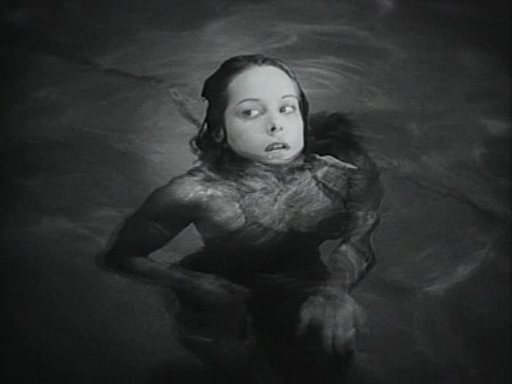
2: BBC iPlayer very kindly showed 1940s classic horror films Cat People and its sequel, the Curse of the Cat People recently, and having not got around to them yet, this was a perfect opportunity. Both films follow the life of Oliver, a 30-something New Yorker, who has apparently never been unhappy before, who falls in love with and marries a beautiful woman and has another, equally beautiful, intelligent and kind woman in love with him. Am I supposed to care about this guy or wish him dead? Anyway, the blurb for the film told me that Irena, the woman he falls for, is haunted by a past which threatens those around her with death and destruction. Couple this with a title like Cat People and I’m expecting either at some point she’s going to turn into a more feline werewolf than is traditionally expected, one side of her family are freakish upright-walking cat/human hybrids, anyone she loves will turn into a cat or at some point 50-foot long cats will drop from the sky and crush everyone she’s met. Disappointingly the first option is chosen, and the limited effects available in 1942 prevent a Rick Baker-esque transformation from being shown. There was an annoying lack of horror in both this and the sequel, which shows Oliver a few years older with a 6 year old outcast daughter, who is given a magic ring with which she wishes for a friend, only for that friend to be the spirit of a figure from Oliver’s past. Only a couple of scenes across the two films offer the slightest amount of tension and none are even the slightest bit scary, so I’m afraid cold theory number two remains untested. The characters are underwritten or superfluous, particularly the sequel’s Jamaican houseservant Edward, whose chief role is to spout dialogue the audience has already assumed or flat out knows, and I’ve have preferred more attention to have been spent on how stupid the woman is who, when she believes herself to be cornered by an attacker, jumps into a brightly lit swimming pool and splashes around for a bit.

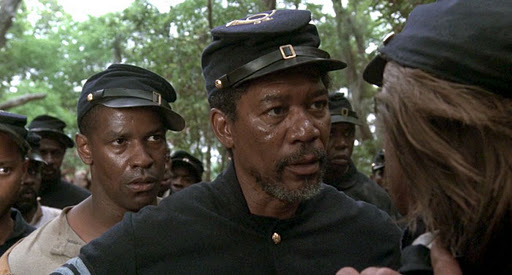
3: If you’re going to watch a depressing film, it has to be a true story, as no-one has ever made something up that’s worse than something you hear on the evening news. And so is the case with Glory, Edward Zwick’s tale of the first all black infantry regiment of the Federal Army during the US Civil War. It says something about late 80s/90s Hollywood that the only way we could be shown a story about black people is through the eyes of the white man brought in to lead them (Matthew Broderick). The movie is rife with clichés (the four privates we focus on all have memorable and recognisable character traits, and all share the same tent, including Morgan Freeman’s kindly old hand and Denzel Washington’s Oscar winning portrayal of the angry, rebellious ra1bble-rouser Trip) and guilty of using Matthew Broderick in a serious role, and too often dwells on sentimentality. It’s also an enraging film, watching the racism against the men denied uniforms and shoes because they are not believed to ever be used for warfare. As for good for illness, the schadenfreude aspect did make me feel a little better, but the severity of how much these guys had to go through just made me feel worse.

4: Here we go, the last Pixar film to be crossed off the list (A Bug’s Life, Cars and Up didn’t make it I’m afraid) tends to be one of the least remembered, though that may change once next year’s prequel Monsters University hits cinemas. This is the best kind of Pixar film, one set in a slight variation of the real world, showing a side of it previously unseen, yet whose origins exist as mythology in our world, in this case that there’s a monster hiding in your closet. The studio – the most consistently outstanding studio working today – takes this concept and forms not just a plot but an entire world around it, with the monsters working for a corporation collecting children’s screams to be used as power for their city. Somehow, who knows how, they manage to make two of these child-terrifying employees our heroes; Mike and Sully voiced perfectly by Billy Crystal and John Goodman), who must face the everyday woes of paperwork and fuel shortages like the rest of us office-ridden schmucks. I’ve mentioned it before, but the key to Pixar’s success is in the details. Mike uses a giant contact lens to cover the single eye that takes up most of his body, sprays on Wet Dog odourant before a date and takes his snake-haired girlfriend to the acclaimed restaurant Harryhausen’s. That, and top notch voice work from a cast including Steve Buscemi as dastardly reptile Randall, James Coburn as Monsters Inc. CEO Henry J. Waternoose and Yoda himself Frank Oz as Randall’s sidekick Fungus. Perfect viewing if infected or not.

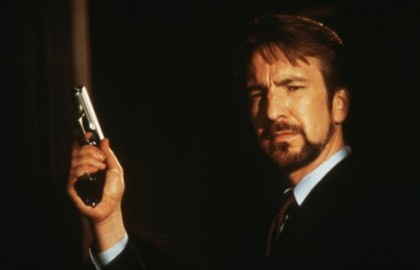
5: Ah, Die Hard. You revolutionised the world of action movies, encouraging studio execs all over Hollywood to green light Die Hard… in a submarine, on a bus, in space concepts left right and centre. You gave us Bruce Willis as a believable action hero without the need for bulging biceps and legs like tree trunks (he even name-checks Stallone and Schwarzenegger in the script). And you gave us Alan Rickman’s greatest role until Galaxy Quest as the refined, immaculately attired thief Hans Gruber (I don’t count Snape as a new character, as he’s basically Gruber with a cloak). The film is note perfect and barely puts a foot wrong, though some characters are broad stereotypes, especially the members of Gruber’s crew, and McClane’s wife’s sleazy co-worker Ellis, so much of a bastard whenever he’s onscreen you root for the terrorists. I tend to put this on as a background film when doing other things, but this is incredibly counter-productive, as I invariably end up engrossed as soon as McClane throws a corpse out of window and I join in with a “Welcome to the party pal!” This was definitely the film that made me feel the greatest, or was at least the one I watched with the moost narcotics inside me, so I’m going to conclude that the best film to watch when you’re ill is one you never forwards, backwards and thrown off a building. If it’s a seminal 80s action movie, so much the better, just make sure it’s one of your favourites. If only a cold were curable by making fists with your toes on carpet.
Red River – Choose film 6/10
Cat People – Choose life 4/10
Curse of the Cat People – Choose life 3/10
Glory – Choose life 6/10
Monsters Inc. – Choose film 8/10
Die Hard – Choose film 10/10

Ghost World

Enid and Rebecca (Thora Birch and Scarlett Johansson) have just graduated high school, and have no plans as to their future. They have no desire for college, careers or being members of society, are proud of their outcast status yet mock everyone else either for conforming to societies standards or differing from it. When they respond to a lonely guy’s missed connection in a newspaper, Birch’s Enid takes a shining to the shy, unassuming Seymour (Steve Buscemi). Enid is a destructive force, bringing down all those around her whilst she steadfastly refuses to grow up. Where consciously or not, everything she does prevents her life from progressing, be it dying her hair green before going apartment hunting with Rebecca or criticising the films at the cinema where she is hired. Understandably, everyone around her seems eager to develop their lives to a stage where she is no longer involved, be it her overly doting yet unattached father (Bob Balaban), her friends or Seymour, whom she helps to find a partner, only to be excluded from his life once three becomes a crowd. The movie fails the one-hour test; after 60 minutes I still didn’t care what happened to any of the characters, as watching Enid self-destructive cycle spin around again left me bored and disinterested. The only saving grace however is Buscemi, remaining just the right side of creepy, even with a horrendous side parting. His obsessed record collector struck a note with me, for if you replaced the music with books and DVDs, I’m fairly sure I’ll be him in 20 years should my girlfriend ever leave me.

Choose life 4/10

Wonder Boys

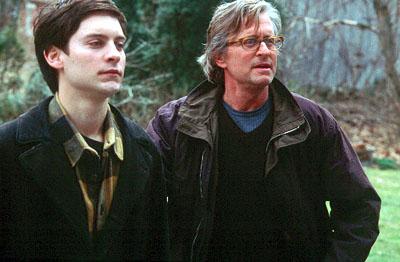
Always be wary when a DVD cover proclaims the feature it houses is an Oscar winner, yet follows this statement with an asterisk not revealed until the fineprint on the back of the box, for more than likely this will lead to a win for one of the lesser Oscars that, though probably well deserved and awarded to people who are very good at, and have worked very hard on what they do, does not make the associated film any good. And so it is with Wonder Boys, overly proud recipient of the Oscar for Best Original Song for Bob Dylan’s Things Have Changed, so worthy is it that I cannot even remember hearing it, when part of me was specifically listening out after discovering the win. Whilst Michael Douglas gives one of his best performances as the mild-mannered, scarf-wearing, adulterous English professor Grady Tripp, he is let down by a meandering plot involving a dead dog, a 7ft transvestite, a stolen dress and an epic manuscript, and a fairly average cast with Tobey Maguire it’s obvious weak link – impressive when Katie Holmes is also involved as a besotted student. Too much takes place without a reason – is Maguire’s James fascinated with celebrity deaths just because he is weird? – and the script is far from excellent (“I’m not gonna draw you a map, sometimes you need to do your own navigating.”)

Choose life 4/10

Candyman

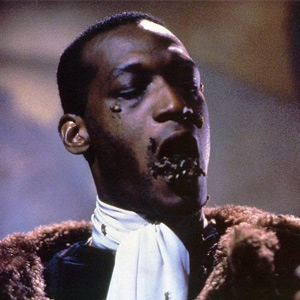
If someone told you that if you looked in a mirror and said the word “Candyman” five times, that a man with a hook for a hand would appear behind you and kill you, what would you do? If the answer is call them an idiot and defriend them on Facebook, congratulations you’re not in a horror movie. Here, of course, the myth is discussed and inevitably activated, with disturbing and horrifying results. Virginia Madsen (remember her?) plays our doomed heroine Helen Lyle, married to university lecturer Xander Berkeley and writing a thesis on local mythology, focusing on the Candyman, an educated son of a slave whose hand was sawn off by hooligans in the late 19th century, before he was smeared with honey, stung to death by bees and burned in a giant pyre. His legend lives on with the residents of Cabrini Green – the area where his ashes were scattered, blaming him for unsolved murders.
A  lot is left unclear in the film – possibly clarified in the sequels, I didn’t like it enough to find out, and there is much debate throughout as to whether Candyman, memorably embodied by the imposing Tony Todd, whose breathy voice, sinister smile and nightmarish stare were made for horror films, is real, whether Helen is going insane or if her husband is framing her to keep her out of the way while he gets his leg over a hot young student, something never really explained, and even by the end all three are still a possibility. There is plenty of gratuitous and unnecessary nudity and some horrible imagery – graffiti from smeared excrement – but the unclear nature of Candyman’s powers, origin, intent or motive and the lacking of anything inherently scary makes this a pointless watch.
Choose life 4/10