Candyman

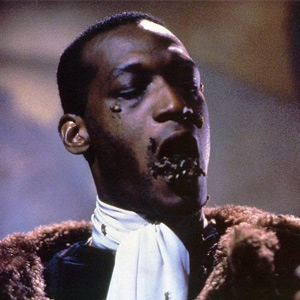
If someone told you that if you looked in a mirror and said the word “Candyman” five times, that a man with a hook for a hand would appear behind you and kill you, what would you do? If the answer is call them an idiot and defriend them on Facebook, congratulations you’re not in a horror movie. Here, of course, the myth is discussed and inevitably activated, with disturbing and horrifying results. Virginia Madsen (remember her?) plays our doomed heroine Helen Lyle, married to university lecturer Xander Berkeley and writing a thesis on local mythology, focusing on the Candyman, an educated son of a slave whose hand was sawn off by hooligans in the late 19th century, before he was smeared with honey, stung to death by bees and burned in a giant pyre. His legend lives on with the residents of Cabrini Green – the area where his ashes were scattered, blaming him for unsolved murders.
A  lot is left unclear in the film – possibly clarified in the sequels, I didn’t like it enough to find out, and there is much debate throughout as to whether Candyman, memorably embodied by the imposing Tony Todd, whose breathy voice, sinister smile and nightmarish stare were made for horror films, is real, whether Helen is going insane or if her husband is framing her to keep her out of the way while he gets his leg over a hot young student, something never really explained, and even by the end all three are still a possibility. There is plenty of gratuitous and unnecessary nudity and some horrible imagery – graffiti from smeared excrement – but the unclear nature of Candyman’s powers, origin, intent or motive and the lacking of anything inherently scary makes this a pointless watch.
Choose life 4/10
Muriel’s Wedding

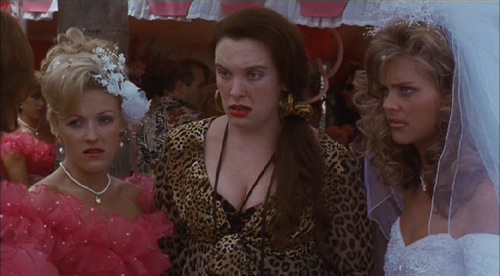
Muriel’s Wedding seems unsure of what it wants to be. At times it follows standard rom-com tropes; an eccentric family, a first date going awry involving a burst bean bag, a pet bird thrown through a window and an unexpected trip to the hospital. At other times it seems to want to be a character piece, with Toni Colette’s compulsive liar and Abba obsessed Muriel setting her sights on getting married, regardless of who the groom is and how she feels about him, running away from her ashamed domineering family to start a new life (with a new name; Mariel) after a chance encounter with an old school friend (Rachel Nichols), whilst elsewhere it could be described as a tragedy, as Mariel becomes more and more desperate to fulfil her dream, whilst seeming to bring bad luck to all she comes into contact with.
Colette fully loses herself within the overweight, unfashionable, possibly mentally ill Muriel, in her first major role, but the too frequent switches in tone, from light comedy to tragedy, are too jarring, the characters too thin and the comic situations not entertaining enough to make this worthwhile.
Choose life 4/10

Dances with Wolves

After unintentionally becoming a hero when his suicide attempt becomes a mass charge against the enemy, Lt. John J. Dunbar (a be-whiskered Kevin Costner) is given his choice of location in the Union army, opting for a small, broken down post miles from anywhere, in order to “see the frontier before it’s gone.” When he saves a white woman adopted by their tribe as a girl, the local Native Americans take a shine to him, as he attempts to educate them of a civilised world, whilst they in turn teach him of their ways.
The plotting is formulaic and the pace is stodgy. There are some good performances (Graham Greene and Rodney A. Grant as the two most forthcoming members of the Sioux tribe), but this feels too bogged down in a history and culture more important to the American people than anyone else. Unforgivably, Costner beat Scorsese to the Best Director Oscar for Goodfellas, and it is extremely difficult to understand why.
Choose life 4/10

All That Jazz

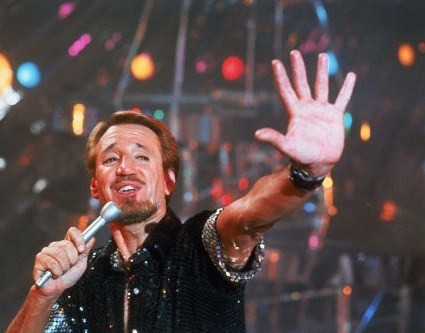
Anyone seeking a straightforward musical, like Grease or Chicago, as was expected by this reviewer, would do well to seek elsewhere. A semi-autobiographical tale from director/writer/choreographer Bob Fosse, this shows musical director/writer/choreographer/everything else Joe Gideon (Roy Scheider) as he discusses his life with angel of death Jessica Lange. There are occasional songs and dance numbers, and parts of his life are exaggerated and dramatised on stage. To use the description given to one of Gideon’s own performances (a very surprising sequence referred to as Erotic-Air), this film is “interesting, very interesting…unusual, very unusual.” It is difficult to decipher which parts are really from Gideon’s life and which are distorted and rewritten via his own limitless, unburdened imagination, from his own growing up in a burlesque house, being teased by barely clad women from an early age, to becoming a pill-popping, heavy smoking, heavy drinking perfectionist self-proclaimed liar who is “generous with his cock,” through to ruthlessly directing himself on his death bed. This ambitious, and possibly achieves what it set out to do, yet you leave the film unsatisfied, unsure of what you’ve seen and what to make of it.
Choose life 4/10

Decalogue

This isn’t fair. Dekalog is not a film, it is a television series. Originally made for Polish TV in 1987, Dekalog is a set of ten hour long episodes, each based, occasionally so loosely that the basis is unrecognisable, on each of the ten commandments. I’m sorry, but to qualify being featured in a book called 1001 Movies You Must See Before You Die, I think one of the predominant criteria should be that you are in fact a movie. If the conditions are so lax as to allow this television series, why not others? Band of Brothers was pretty damn good, as was Firefly. Arrested Development revolutionised the modern sitcom, I Love Lucy infamously first utilised the multi-camera setup and the Cosby Show was the first to star a famous stand-up comedian. Hell, why not all 86 episodes of the Sopranos or 156 of the West Wing?

The Red Shoes

I’ve read before that this is supposedly Martin Scorsese’s favourite film. I can’t remember why, and I’m still not sure now, but if he likes it then fair enough. The Red Shoes tells the story of Julian Craster and Victoria Page. He is a music student, given a job at the ballet orchestra after his professor steals his work for a show, and she is a promising ballerina, given a shot at the big time when a professional dancer leaves to get married. Predictably, the two end up working on the same show, the Ballet of the Red Shoes, he as composer and she as the star.  I’ve never been overly keen on dance, and I’ve never attended a ballet recital, so I can’t say I was necessarily engrossed in the backstage goings on, as the Machiavellian show director forbids the leading couple from seeing one another, but there was an interesting 20-minute wordless dream/dance sequence involving fairytale backgrounds and characters, and I liked the implication of a train passing using puffs of smoke, lights, sounds and actors following the ‘train’ with their eyes, but overall found the film was largely dull.
Choose life 4/10

Superbad

It’s never a good sign when the first joke from a so-called comedy film is a throwaway gag stolen from Clueless, two friends talking on the phone, the conversation ending seconds before one collects the other on the way to school. This kind of base level unoriginal humour, along with a very immature, puerile level of swearing and obsession with alcohol, girls and sex may well be indicative of teenage boys, but doesn’t make for entertaining viewing to those of us older than 15. Apparently Evan Goldberg and Seth Rogen wrote the script whilst still in school, and it shows.

Choose life 4/10

Au Hasard Balthazar

Au Hasard Balthazar is the kind of film that just couldn’t be made today, at least not with the same result. Today, it would most likely be made by Dreamworks, telling the tale of a morose animated donkey, voiced by Christopher Plummer, as he sets out an epic journey to be reunited with the family he’s worked for his entire life. Along the way, he learns lessons about friendship not judging by appearances, with the help of a lazy squirrel (Kathy Bates) a know-it-all platypus (Jemaine Clement) and a wise-cracking raccoon (Cuba Gooding Jr.).
As it is, Balthazar is a tale of the life of a donkey, from children’s plaything, through toiling away for various family’s, finding fame in a circus and finally, tragically, used for drug trafficking. It took me two attempts to watch this film, as after the first viewing I did not fully comprehend the cause of the mass adulation poured upon the picture, although I was quite tired and may have drifted off a couple of times, as it’s not necessarily the most captivating of films. That said, on the second viewing I more greatly understood the reasons for the various plot jumps, as for the most part the film is shot from the viewpoint, and therefore the understanding, of Balthazar himself, thereby it would not always be clear as to why some characters behave the way they do.Choose life 4/10

The Jazz Singer

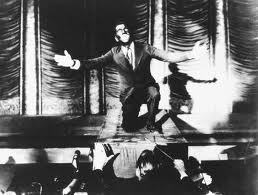
Today I watched the Jazz Singer, infamous for being the first film to use dialogue, or more accurately, singing, as this is a semi-musical, presumably to showcase the new sound technology of 1927, as I felt that the inclusion of full-length song performances detracted from the plot, of a young Jewish boy who runs away from home to become a jazz singer. I feel that this film was included in the 1001 Films to Watch Before You Die purely due to its significance in cinema history, of being the first ‘Talkie’, not because it is one of the ‘great’ films.

Choose life 4/10

Sideways/Les Vacances de M. Hulot

Cross off two more! I watched Sideways on Sunday, still loved it, but then I’ll watch anything with Paul Giamatti in, even Shoot ’em Up, and I’m looking forward to watching Cold Souls at some point in the future too, as well as Barney’s Version. Choose Film 7/10

Rented les Vacances de M. Hulot too. Wasn’t overly impressed if I’m honest, I found the lack of a driven narrative to be annoying, and that most of the occurrences were contrived merely to allow a few slightly humorous pratfalls. Plus, the character of Monsieur Hulot is a clear inspiration for Mr. Bean, the character that lessened Rowan Atkinson as a comedy genius in the public mindset, for which there is no possible forgiveness. Choose Life 4/10