The 39 Steps

Richard Hannay (Robert Donat), a Canadian man visiting London, thinks nothing of assisting a strange woman (Lucie Mannheim) to escape a theatre riot, especially when, after the melee, she requests he take her home with him. She seems rather odd, with an indistinguishable European accent and clearly fake name, hiding from the windows and the reflection of the mirror, scared of a ringing telephone, and it turns out she’s being pursued by a gunman over some business involving a secret being smuggled out of the country. Hannay of course is sceptical, until she winds up dead on his living room floor, a knife in her back and a map in her hand, with Scotland’s Alt-na-Shellach circled. Hannay suddenly finds himself in the frame for murder, and must flee up north if he hopes to clear his name and save the secrets.

Vertigo

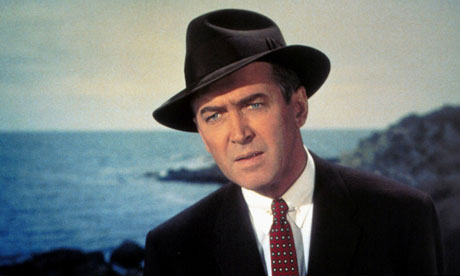
‘Scottie’ Ferguson (James Stewart) is a detective in San Fransisco who suffers from crippling vertigo, exacerbated by his most recent rooftop scuffle culminating in the death of a colleague and the escape of the perpetrator being pursued. He therefore retires, only to be called upon by an old college friend Gavin (Tom Helmore) who is concerned about his wife Madeleine (Kim Novak), who may or may not be occasionally under some form of supernatural possession from an ancestor who committed suicide at the same age Madeleine is now.
Continue reading

Psycho

On a bright December Friday afternoon, Marion Crane (Janet Leigh) returns to work after some afternoon delight with her similarly cash-strapped lover Sam (John Gavin). When her boss sends Marion to the bank to deposit a client’s $40,000 in cash, on a whim she hastily backs her bags and flees with the money, but draws the attention of a road cop during her escape. When darkness and an incessant downpour prove too much for Marion, she checks into the run down, deserted Bates Motel, where she meets motel manager Norman Bates (Anthony Perkins), a kind yet awkward young man, unfamiliar with pretty young women entering his life. Norman’s bedridden mother disproves of the presence of Marion, and refuses to let her into the house, but this is no concern of the girl’s as she still has to plan what to do with the money.
Continue reading

The Barbarian Invasions

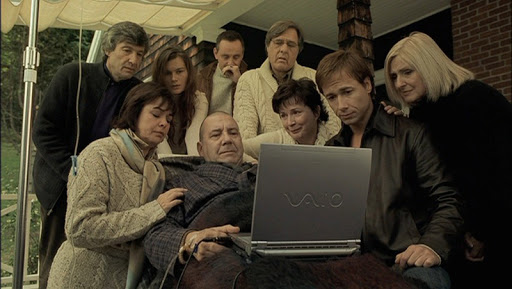
Remy (Remy Girard), a college professor with a womanising history, is mere days away from death. His wife (Dorothee Berryman), from whom he separated fifteen years ago when he refused to give up his philandering ways, summons their son, Sebastien (Stephane Rousseau) to see him. Sebastien and his father have never been close, with the son playing the father for destroying the family, and the father being disappointed his son never became a cultured intellectual, even though he is now a fantastically wealthy international businessman. Sebastien uses his fathers last days to reconnect with his old man, and make his remaining time happy, by contacting his father’s old friends, disrupting the Canadian health system to get him a better room, and making an arrangement with a heroine addict (Marie-Josee Croze) to make his father more comfortable before the inevitable happens.
Continue reading

Strangers on a Train

You know how the weirdo on the train always ends up sat next to you? The smelly guy, the raging drunk or the raving lunatic? Well any of these would be preferable to Bruno Antony (Robert Walker), a wealthy but evidently psychotic passenger sat across the aisle from Guy Haines (Farley Granger), a promising semi-professional tennis player with political aspirations. You see, Bruno has a plan for the perfect murder, or rather, murders, and wouldn’t you know it but he not only has someone in his life whom he’d like disposed of (his overbearing father, Jonathan Hale), but he also knows Guy is in a similar position with his separated wife, Miriam (Kasey Rogers). Bruno’s plan is for the two of them to swap murders, as that way there’d be no clear motive for their crimes, and whilst Guy forgets all about this after departing the train, Bruno evidently means to carry out his plot, and its not long before Miriam has been slain, and Bruno is hounding Guy to take care of his side of the deal.

Continue reading

Last Year at Marienbad

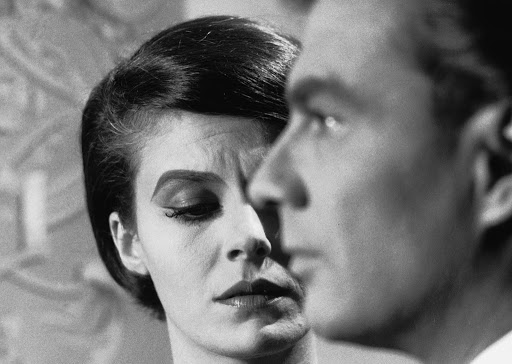
I don’t know where to begin. Normally in my opening paragraph I give a brief synopsis of the film, y’know, “an eccentric old man invites his grandchildren, some paleontologists, a chaotician and a lawyer to try out his new dinosaur-filled theme park” that kind of thing, but the trouble with Last Year at Marienbad is that there is nowhere near enough plot to even begin a paragraph. Essentially, there’s some kind of swanky soiree at a swish estate that I think is somewhere in the Czech Republic. At said event, there is a man (Giorgio Albertazzi) who is resolute that he met a woman (Delphine Seyrig) attending the party a year ago at Marienbad. Meanwhile the woman’s male friend (Sacha Pitoeff) plays a game with cards, matchsticks and dominos called Nim, at which he seems unbeatable. This plays out for 90-odd minutes, until the film ends, with no foreseeable additions to anything approaching a story.
Continue reading

Safe

Carol (Julianne Moore) is a bored housewife, sorry, homemaker, in the San Fernando Valley. Her husband Greg (Xander Berkeley) is a successful businessman, and the pair live in a lavish home with Greg’s son Rory (Chauncey Leopardi). Carol has many friends and an active social life, attending various parties and gym classes. There’s nothing wrong in Carol’s life, other than her new sofa being delivered in black rather than teal, yet she suddenly finds herself becoming ill, which she soon believes to be caused by the “chemicals” found in modern life. But is she suffering from a real sickness, or is it all in her head? Maybe moving to the secluded, desert-based Wrenwood Centre, a “chemical-free facility”, will result in a cure.

Continue reading

Citizen Kane

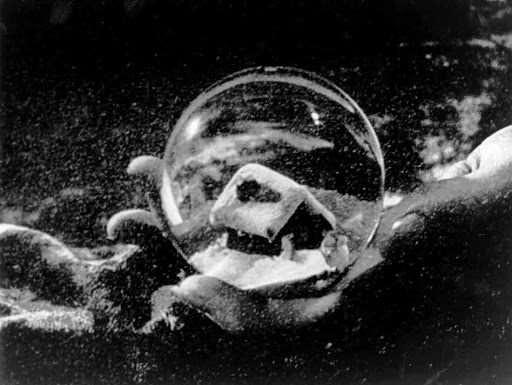
Charles Foster Kane (Orson Welles), an unimaginably wealthy publishing kingpin, drops his snowglobe and dies alone in his bed. His last dying word, “Rosebud,” sends the national newspaper journalists into a frenzy, all eager to discover it’s true meaning, in the hope of shedding some light onto the tycoon. Led by Jerry Thompson (William Alland), the reporters speak with Kane’s former wife, friends, employees, business partner and butler on their search for the truth. Could it be the name of a girl? A dog? A boat? Or just the rambling ravings of an insane old man?

Up until last year, Citizen Kane has topped Sight and Sound magazine’s Greatest Film Of All Time list, but was recently toppled by Vertigo. It’s been a little while since I’ve seen Hitchcock’s classic, so I can’t vouch for whether the change is correct or not, but I can say that I have no problem with Citizen Kane having been up there for quite so long. This film actually appears on all four of the lists I’m currently working through, and so great is its reputation that I can’t imagine a respected film list denying it a place. I mean, it spawned the prefix “It’s the Citizen Kane of…” as a way of saying a film is the greatest of a specific type. And heads up, this isn’t going to be the Citizen Kane of Citizen Kane reviews. So what makes it so important? Why is it revered by so many people? Will every paragraph in this review end in a question mark?

Continue reading

The Day The Earth Stood Still

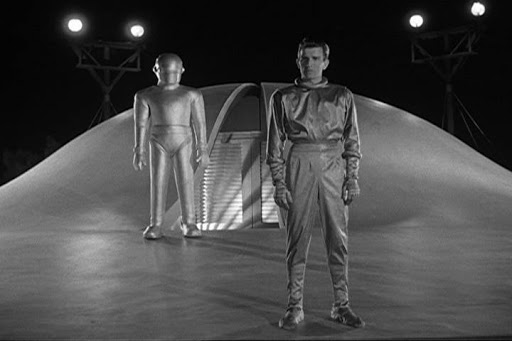
An alien ship lands in Washington D.C., and from it emerges Klaatu (Michael Rennie), a humanoid from a neighbouring planet, who brings with him a message he wishes to convey to the various leaders of Earth. When they squabble pettily over where the meeting should be held, Klaatu instead decides to meet with the general public, so he rents a room in a boarding house, under the name Mr. Carpenter. There he meets the other lodgers, including Helen (Patricia Neal) and her young space-obsessed son Bobby (Billy Gray), and eventually he meets with Professor Barnhardt (Sam Jaffe), a learned scientist, in the hopes of discovering something worthwhile about Earth and mankind. Oh, and one other thing. Klaatu has a giant, omnipotent robot guardian called Gort, who has an eye-laser capable of disintegrating anything.

As a nerd, I like my science fiction, but I’ve never obsessed over it. I’m a fan of Star Wars, but I’m not a super fan, and the only Star Trek-related media I’ve seen is J. J. Abrams recent film. To be honest, Firefly has always been more my cup of tea, and that’s only science fiction in that its set in space, and that’s a similar situation here. The actual science fiction elements of The Day The Earth Stood Still are mere background details for a large section of the film, as it becomes almost a fish out of water tale of a man unfamiliar with his new surroundings, learning about a new culture, its eccentricities and foibles. Obviously there is still a great deal of the otherworldy – Klaatu is an alien after all, and there’s the robot capable of destroying worlds who is controlled by words and flashing lights – but the more memorable aspect is the social indictment; the message that we, as a civilisation, need to get our act together or suffer the consequences. It comes as no surprise that the film was remade in 2008 (though I’ve not yet seen it), as clearly had the events of this film actually taken place in 1951, then we certainly didn’t listen, as can be seen by the state of the world today. But I don’t want to get too political, so I’ll just say that message from the film back in the 50s, just six years after the end of the Second World War, is possibly just as relevant today.

Anyway, the film. Seeing as it was made over 60 years ago, its no real shock to find that the special effects for the most part don’t really stand up. Gort is quite blatantly a man in a suit (Lock Martin, of whose nine screen roles six were uncredited and one was deleted), wires are fairly visible in some scenes and footage is clearly sped up to indicate people running away. The laser and disintegration scenes are ropey at best, but I was thoroughly captivated by the shots of the spacecraft opening, with a doorway appearing on its seamless surface, and disappearing again just as effortlessly. 

Michael Rennie seems perfectly cast as a creature not off this world, with his angular features, harsh cheekbones and a deliberate, considered approach to movement and speech making him seem passable for a human, but one who’s definitely a little… off. Which makes it something of a surprise when Helen has no qualms about leaving her son Bobby with this strange man she’s known for only a matter of hours as she goes gallanting off with her beau.  There was a very high possibility of the kid becoming excruciatingly annoying – my girlfriend certainly thought he was – but I found his naivety endearing, even if he seemed far too respectful of his elders, in a manner unheard of today.

The film’s cinematography was brilliant, especially the use of shadows and silhouettes, and the imagery of Gort carrying the figure of Helen, as made famous by the poster. Bernard Herrmann’s score is also suitable sweeping and atmospheric. It’s no surprise that this film has become an integral part of classic science fiction, with the phrase “Klaatu, barada, nichto” (or is it necktie?) going down in history as one of the greatest quotes in cinema. I’m intrigued to now see the remake (if only for John Cleese, an idol of mine), but public opinion has left it not very high on my to-watch list.

Choose film 8/10

Pather Panchali

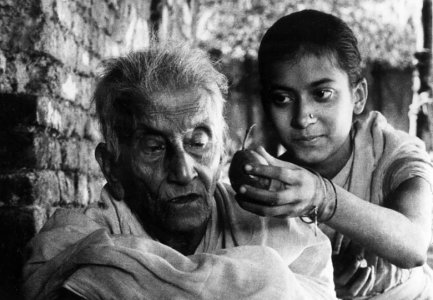
The story of a very poor family struggling to make ends meet in a Bengali village in the 1920s. Harihar (Kanu Bannerjee) must cope with looking after an elderly relative, kleptomaniacal daughter, carefree infant son and her clueless husband as he does his best to provide for a family that never seems to catch any breaks.


There are many films in the 1001 list that, when watching, I can’t really see why they’ve been included, and it isn’t until afterwards (or during, if it’s really boring) when I read up on the film a little, that I discover there is some cultural significance or historical context within which the film can usually be appreciated as an achievement, but not necessarily enjoyed. Such is the case with Pather Panchali, for as I now know it is the first film of director Satyajit Ray, who would go on to direct various other films also included within the 1001 book: The Music Room, Aparajito and The World of Apu, with the latter two completing the Apu Trilogy, begun with this film. Pather Panchali also marks the first independent Indian film to garner international acclaim, so that at least answers the question of why it was in here.

So what was wrong with it? Well, nothing really, it just didn’t really feature a great deal in terms of plot or anything to engage my attention. Its just a rather plodding depiction of an Indian family’s life, and the sporadic ups amidst mostly downs that they endure. There are some nice moments – the joy cracking across the wizened face of the elderly relative when Harihar’s daughter Durga gives her a guava stolen from the neighbour’s orchard, Durga and her younger brother Apu encountering a train – but once again I’m getting rather tired of watching depressing films. As such, I really don’t have that much to discuss about the film.

The most annoying aspect of this film is that its the start of a trilogy, all of which appear on the 1001 list (and the Empire 5-star 500 List, for reasons that will hopefully become clear once I’ve seen the rest of the trilogy). Before watching, all I knew about Pather Panchali was that it was the start of this trilogy, titled the Apu Trilogy, so I was expecting it to be about someone called Apu. Therefore, once he was born, I expected him to be the central figure of the story, but was surprised when he was kept mostly to the sidelines. I’m sure he’ll become more prominent in the later films, but I’ll try not to anticipate that, just in case he doesn’t and I become even more disappointed later. Aparajito and The World of Apu are the next two films in my LoveFilm queue, so I should be getting to them fairly soon, as long as I can bring myself to actually watch them.

In short, I’m chalking this film up alongside the likes of The Jazz Singer, Battleship Potemkin and Olympia as being a historical moment in cinema, but one that I’m not keen to repeat, and definitely cannot recommend.

Choose life 5/10