Vagabond

A farmer finds a woman frozen to death in a ditch one morning, her face blue and her body curled up and contorted, and appearing to the police as if she has been swimming in a vat of wine. Nobody knows where she came from, but the narrator of this film, director Agnes Varda, provides a series of mock-interviews and flashbacks through which the last few months of the girl’s life are shown, primarily through the eyes of the many and various people she encountered along the way.


This is not my kind of film. I haven’t seen a lot of French new wave, but what I have I’ve not been much of a fan of. There’s always too much gratuitous nudity and too little plot, and they without fail all suffer from a severe case of style over substance. Varda, a new wave graduate, ticks off this checklist with flair and aplomb in this rather tedious and pointless affair.

The girl’s name is Mona Bergeron (Sandrine Bonnaire), a woman who chose to throw away her life amidst civilisation because she was tired of being bossed around at work, and instead wanders the land in search of the next packet of cigarettes. Mona is deeply unlikable and does herself no favours in terms of looking for help. She has no qualms whatsoever about leeching off the kindness of strangers, be it for housing, care or sustenance, and I’m fairly sure the phrase “Thank you” has never once departed from her lips. Uncouth and unclean, with an odour you can almost smell through the DVD, it is a wonder anyone has ever stopped to help. At one point, a man spontaneously buys her a sandwich when she looks longingly at his, after which she never even looks at the guy again, let alone talks to or thanks. 

This film succeeded in making me increasingly annoyed at this person who, even when offered the chance to start a new life for herself, retaining her freedom and living out one of her dreams, she still shows no signs of wanting to and is inevitably kicked out and sent on her way. By the end, I wasn’t exactly happy about the direction she was taking, but I didn’t mind too much either. There are some people the world is probably better without.

I approved of the fact that everyone who Mona encountered saw her differently. She is described as a hippy, a dreamer, a dropout, a cautionary tale, a drinking buddy and an object of desire – though how anyone finds her attractive is beyond me, I’m nothing but repulsed by every inch of her. One girl, Yolande, a caretaker for an elderly woman, only briefly catches a glimpse of Mona as she lays in the arms of a random boy – who is the kind of insufferable twit who wears a locked padlock as a necklace, to which he has purposefully thrown away the key to. Yolande sees this vision of undying love and seems to base the rest of her life on it, as she re-evaluates her own romance-free relationship with her partner, completely oblivious of the fact that not two days later Mona has left her man and headed on her way, never to see him again. Apparently she only liked him for his weed.

As you’ve probably ascertained, this is a film I’m unlikely to ever re-visit. It’s meandering, directionless style and horrendously unlikable lead are enough to put anyone off, and the random nature of it’s subplots – at one point using a spontaneous electrocution to move the ‘plot’ along – is occasionally jarring but always tedious.

Choose life 3/10
Guaranteed Happiness: Amelie

As I mentioned recently, I came 2nd in the Lamb’s So You Think You Can Review tournament. This was one of the films I reviewed for that competition, but as it was on the List as well I figureed I’d use it here too. All praise recycling!In 1997, after having made two successful, distinctly stylised French films with his co-director Marc Caro, Jean-Pierre Jeunet popped over to Hollywood to make Alien: Resurrection, a film widely regarded as one of the worst sequels ever to appear on the big screen. You’d have to go a long way to find someone who liked it, and I’d suggest you don’t start with me. Upon returning to his home town of Paris, Jeunet found himself seeing the once-familiar city with fresh eyes, and set out to make a film that would reflect the magic and beauty he had rediscovered. That film is Amélie.

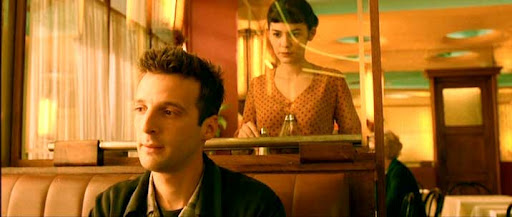
Telling the story of Amélie Poulain (Audrey Tautou), a girl with an overactive imagination but an undernourished heart who develops a taste for bringing happiness into the lives of the people around her, this isa delightful, light-hearted chocolate-box fantasy romance that only occasionally threatens to choke you on its saccharine sweetness. Amélie herself is a wonderful creation, despite her less-than-wonderful upbringing. She was raised by a military physician father (Rufus) and schoolmistress mother (Lorella Cravotta). Her only physical contact with another life form was the annual check-up provided by her father. Such unaccustomed moments of intimacy caused her heart to beat faster, which her Dad diagnosed as being a heart defect, so kept his daughter at home, away from the other children. This, along with a suicidal goldfish and a childhood tragedy, gave Amélie a unique perspective on life that she would carry on into adulthood, where she works as a waitress in a corner cafe in Montmartre alongside its rogues’ gallery of eccentric staff and clientele.
A chance reaction to the death of Princess Diana leads Amélie to discover a treasure trove left by her apartment’s previous inhabitants, so she sets about planning to return the childhood trinkets. She revels in the feeling of harmony she gets from helping others, be they strangers or regular players within her life – though she isn’t close enough to anyone to really call them a friend. Along the way she crosses paths with Nino Quincampoix (Mattieu Kassovitz, director of the seminal La Haine), and finds herself falling in love with this fellow outcast who skips in time to her own offbeat pace, yet her life so far – devoid of affection, interaction and intimacy – ensures that theirs will not be the smoothest of romantic relationships.
From the opening credits – featuring a young Amélie (Flora Guiet) engaging in a variety of nostalgia-inducing childhood antics including peeling dried glue from her fingers and making her hand into a puppet – it is clear this film is a genuine heart-warmer, yet imbued with a tinge of sadness. For all of Amélie’s boundless levels of enjoyment, you can’t help but notice that as a child she was always alone. The film delights in making the ordinary extraordinary, for example by looking at the events occurring simultaneously with Amélie’s birth – a fly being run over, two wine glasses dancing on a wind-buoying tablecloth, a man erasing his deceased friend’s name from his phonebook. Alone, these individual events are almost mundane, but together they contain every aspect of life, from the tender to the tragic.
Though it was released six years before the term was coined, this film displays a unique perspective on the manic pixie dream girl mythology, as we see the film almost entirely from the point of view of said fantastical creature. In more traditional films, the character of Amélie would be the love interest in Nino’s story, and not the other way around, and she’d be played by Zooey Deschanel. If anything, he is a typical leading man archetype, an eccentric loner, working a job he hates to fund an obscure passion project, just waiting for the girl of his dreams to stumble into his life and turn it upside down, yet thankfully this is not his story, he is the supporting player and it is with his influence that Amélie finds her life being disrupted, just as she disrupts those around her.
Tautou is absolutely perfect as the eponymous mirth-maker. Gifted with the role of a title character and appearing in almost every scene yet with barely any dialogue, Tautou manages to express every emotion going through her exceptionally beautiful brown eyes, body language and face framed with a Louise Brooks bob. Interestingly, the role was originally written with Emily Watson in mind, but I think even she would have struggled to match Tautou’s blend of purity, yearning and a rare, beguiling charm. Be it when she is skimming stones, cracking a crème brulee or suppressing laughter during an early attempt at intercourse, Tautou is exquisite in the role she will probably always be best known for. Her delivery of the line “I am nobody’s little weasel” almost brings me to tears.
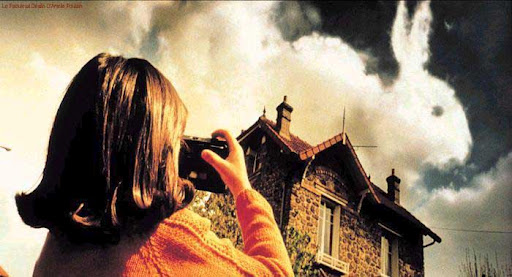
As usual with any Jeunet picture, the cinematography is beautiful. The colour scheme is heavily influenced by Brazilian artist Juarez Machado, particularly the use of rich browns, oranges and reds for the interior shots. A glowing orange outline will reveal a hidden key, or a glowing heart, and Jeunet’s elaborate camerawork lovingly follows faces, feet and hands as they go about their day, picking up stones and placing them in pockets for future skimming sessions. Some have shunned Jeunet’s debris-free vision of Paris, devoid of litter, ethnic diversity and graffiti, but at heart this is a whimsical fairytale, seen through the filter of its titular pixie’s naive, twee imagination, within which the harshest crimes are committed verbally, and easily remedied with Amélie’s own brand of karmic vengeance. In this world, garden gnomes can travel the world, lamps have nocturnal discussions with photographs of dogs and beggars refuse to accept money on a Sunday, as they are taking the day off.
Though the overarching narrative is one of romance, it is the comedy of the film that really shines through, predominantly from the cast of quirky characters that litter the screen, most of whom are played by actors from other Jeunet works. Be it the bathroom encounter of the hypochondriac Georgette (Isabelle Nanty) and the embittered Joseph (Dominique Pinon), the comeuppance of the bullish greengrocer Collignon (Urbain Cancelier) or a mistaken phonecall to an adult store during which our heroine is informed that “Fur pie doesn’t sell,” the comedic moments are many and varied. Yann Tiersen’s accordion-rich score is ever-so-French (I’m listening to it as I write, my feet have yet to stop tapping) and the occasional use of offbeat instrumentation such as a typewriter and bicycle chains further increases the levels of whimsy, as if that were even possible.
In my opinion, the best kind of film is one that leaves the viewer wanting to be a better person, and that is certainly the case here. The morals of Amélie are clear: be kind to others, be yourself, and enjoy the little things.
Choose film 10/10

Silver Lode

You ever have one of those mornings when you’re on holiday, you’ve woken up a few hours before your other half is likely to surface from the depths of slumber and you can’t go anywhere? Well, this happened to me recently, but fortunately I had my laptop and a copy of Silver Lode, yet I knew absolutely nothing of the film (save for it’s 81-minute runtime) so I settled down to watch it. I like watching films with o prior knowledge, and it happens less and less these days, so this was a nice surprise. In the opening credits though, I second-guessed the film completely incorrectly. You see, I could tell from the title that it was likely to be a western, and it stars a man called John Payne, who I’d previously never heard of, so I assumed it was a western spoof, and they’d tried to be funny by subbing the lead actor’s name with one comically similar to John Wayne. Nope, it turns out there’s an actor called John Payne who, according to IMDb, has 73 acting credits to his name, including this definitely-not-a-parody-or-even-a-comedy film.


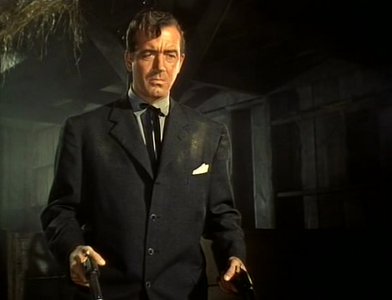
Payne stars as Dan Ballard, a man who seems to only ever be referred to by his full name. On his wedding day, on the 4th of July, four U.S. Marshals, led by the greasy Ned McCarty (Dan Duryea), arrive in the town of Silver Lode and set about arresting Dan for a crime committed two years previously, just prior to his arrival in the town. Dan, who has become something of a pillar within the town’s community, initially has the support of his friend and neighbours, and especially his bride-to-be Rose (Lizabeth Scott), but it’s not long before the marshal’s story seems to make sense, and Dan is given two hours to put his affairs in order before he is to be arrested.

Surprisingly for a film released in 1954, I was bowled over by the cinematography in this movie. There is one shot in particular, which sees Ballard running for four blocks, dodging people, horses and gunshots, which has the camera following him the entire way. I’d even go so far as to call this the Children of Men of the 50s, so stunning is the shot. The actual story plays out in real time, from the moment the marshals arrive in town until the story reaches it’s conclusion, so in that way it was reminiscent of another classic western, High Noon, and in fact featured similar plot elements. Just as Gary Cooper’s Marshal Will Kane had to plead with all of his friends to help him out, so too eventually does Ballard, and with similar results. If you liked High Noon, I’m fairly sure you’ll get on well with Silver Lode.

Some of the scenes have become almost cliches today, for example the opening-a-door-on-an-innocent-man-holding-a-gun-over-a-corpse trick, yet they remain effective if only a little eye-roll-worthy. The characters have become stock western tropes too – the tart with a heart of gold, grumpy magistrate, naive farmhand etc. They do spit out some wonderful, and occasionally cringe-inducing lines, with a young man, who I could have sworn was Ron Howard but apparently isn’t, telling Dan that he’ll never trust anyone again if he’s lied.

I approved of the way that initially the audience is kept as much in the dark as the townspeople, until around the halfway mark we’re put into Ballard’s shoes and shown what is really going on. This increased my empathy towards Dan, as it wasn’t until then that I knew what he was up against. Payne plays the man well, hinting at the possibility of a shady past, even though he  could be Cary Grant’s brother – in both speech pattern and the way he fills out a suit. The portrayal of Duryea’s McCarty was a little too on the nose as being the obvious villain of the piece. He definitely comes off as evil early on and not simply an antagonist for Ballard to overcome, which made some of the later reveals a tad unsurprising, but all in all I thoroughly enjoyed this film, and would recommend it to anyone else stuck for a couple of hours with nothing else they can possibly do.

Choose film 8/10

Broken Blossoms

“This strangely beautiful silent film from D.W. Griffith is also one of his more grim efforts; an indictment of child abuse and the violence of western society.” – So reads the LoveFilm blurb for this 1919 silent picture, and should justify why it took me a little while to get around to watching: it sounds bloody depressing. More so, in fact, than it turned out to be, as the horrendous racism, when seen from a modern perspective, overshadowed the more soul-crushing elements of the plot.
Continue reading

Heavenly Creatures

Christchurch, New Zealand, the mid-1950s. Two girls, Pauline (Melanie Lynskey) and Juliet (Kate Winslet) run terrified through the dense forest, the air streaked with their screams and their faces streaked with blood. They burst through the bushes and emerge to the concerned face of a passer-by with the words “It’s Mummy! She’s terribly hurt!”So begins Peter Jackson’s Heavenly Creatures, the true story of two schoolgirls whose problematic home lives forge a bridge between them, a bridge that leads to a fantasy world of princes and princesses, giant butterflies, murder, topiary and unicorns. But when their parents strive to separate the two, the girls hatch a plan to remain together by taking drastic actions.

Rabbit-Proof Fence

Three mixed race aboriginal girls – fourteen year old Molly Craig (Everlyn Sampi), her younger sister Daisy (Tianna Sansbury) and their cousing Gracie (Laura Monaghan) are taken from their home in the Australian outback and forced to train as serving staff at a settlement 1200 miles away. The three manage to escape, and set out to trek the arduous journey back home, but are being hunted by the camp’s tracker (David Gulpilil) and the government’s Chief Protector of Aboriginees, Mr. A. O. Neville (Kenneth Branagh).

This is one of those films that is supposed to make you angry and upset at the injustices and hardships endured by the protagonists. The three girls, and indeed all the other girls kidnapped and taken to the Moore River camp, have been captured in an attempt to prevent the creation of an ‘unwanted third race.’ The girls, you see, are all the product of white men sleeping with their aboriginal mothers, and the government believed that this ‘new race’ would cause problems, predominantly for those within the race. Once within the camp, the girls would only be able to breed with white males, and their offspring would in turn breed with white people, until the ‘aboriginal gene’ was all but eradicated. So yes, to this extent I felt sorry for the girls, as their capture was essentially an attempt to wipe them out. However, their escape attempt is supposed to be exceedingly difficult and deadly, yet this never really came through.
Whilst the concept of three pre-pubescent girls navigate across 1200 miles of unforgiving outback obviously sounds not only impossible, but so ridiculous its out of a comic book, the film depicts it as the girls drifting from one helping hand to the next, rarely encountering any obstacles that cannot be easily resolved. Even when, at one point, the three are separated, it is not long before they are reunited, despite the great distance that must have been covered. Even though it’s based on a true story, I still felt at times that it was either thoroughly unbelievable, or that major leaps were taken in the timeline. Granted, there’s probably only so much trudging through a bleached desert landscape that I can handle watching at any one time, but still.
The three leads perform well, especially given this was their first acting role, though only Sampi has worked since. Branagh, on the other hand, seems delighted to sink his teeth into a proper villain role (one that he would reprise again in all but name for The Boat That Rocked seven years later). Known to the girls as Mr. Devil, Neville is deeply hatable at every turn, even though he is working to what he believes to be the best intentions, doing what he things is right and indeed beneficial for the girls.
There are some nice burueacratic red-tape scenes, with the government debating who should pay for the country’s hunt for the girls, but the ending, which all the way through seemed a foregone conclusion, takes a little wind from the film’s sails with a “well what was the point of all that then” attitude. All-in-all, though I was impressed with the performances, there was a missed potential in what could have been a more harrowing and intense picture.
Choose life 5/10

Guaranteed Happiness: Wall-E

Welcome to the first post in my new semi-regular feature, Guaranteed Happiness. I’ve discovered that a lot of the films I’ve watched recently haven’t necessarily dealt with very happy subjects, and this has been getting me down a bit. Now and then, I’d quite like to watch a happy film, or one that’s uplifting and ensures that I’ll have a big stupid grin on my face for at least 80% of it, and definitely at the end. After all, I’d much rather write about a film I’m passionate about, and I tend to have more to say about films that make me smile than those that make me suicidal. Praise should be aimed squarely between the shoulders of my girlfriend then, for sticking on Pixar’s gem Wall-E when I was in a decidedly cranky mood a little while ago. The aim was for me to sit down and write some posts, which to be honest I was in no mood to do after a fairly crappy day at work and having to shell out over a considerable amount of cash to fix my bike, yet as soon as the film began all thoughts of blogging and even glancing at my laptop screen were out the window.So, why do I love Wall-E? The simple answer is robots. It’ll come as no surprise to regular readers that a film featuring robots (or dinosaurs, time travel or Stephen Tobolowsky) will immediately be watched with heightened levels of glee. And the fact that it’s made by Pixar, a company that has made some of my favourite films to date, and is where I’d be willing to sell several members of my immediate family to work at, then so much the better.This is my favourite Pixar film, which is definitely saying something. I adore the Toy Story trilogy (especially, predictably, Rex), but there’s something about Wall-E‘s simplicity, its pared down scope and focus on telling a straightforward story in new, interesting, and above all, beautiful ways.

The plot is basic: in the not-too-distant future, the human race has polluted and destroyed the world so much that life has become unsustainable, and the only hope lies in the Axiom, a titanic spaceship resplendent with every luxurious convenience to fulfil any desire. Earth has been abandoned and left to the robots, who spend the next few hundred years tidying the place up. Wall-E, our intrepid hero, is the last surviving ‘bot, and he spends his days making and stacking little cubes of garbage into towering skyscrapers of trash, accompanied by his only friend, a cockroach. One day, a ship descends from the heavens, carrying EVE, a futuristic, high tech reconnaissance droid, and Wall-E is instantly smitten.

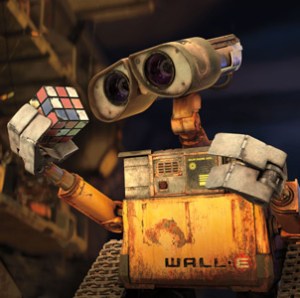
The tale of a schlubby, down-on-his-luck guy falling in love with an out-of-his-league wonder girl is hardly new, but as far as I know this is the first time it’s been told almost entirely wordlessly, and about mechanical beings. A certain amount of disbelief needs to be suspended to watch the film – the robots seem to have far more personality than they should have been implanted with in the factory – but this results in one of the most well-rounded characters in all of Pixar’s history. Wall-E (which stands for Waste Allocated Load Lifter – Earth Class, something I know from memory) has a love for all things quirky, unusual or fascinating, be it a Rubik’s cube, egg whisk or an old VHS of Hello Dolly!, and watching him investigate the functions of each item – wearing a bra like sunglasses, accidentally erupting a fire extinguisher – are a joy to behold. As are his attempts to woo the evidently disinterest EVE (whose acronym would be a spoiler). The couple’s dates are more moving and say far more than any scene of dialogue could.

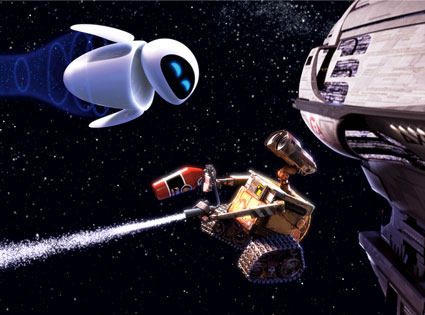
It’s almost impossible to narrow the film down to my favourite scene, but I’d probably say EVE and Wall-E’s space flight. It’s nothing short of a work of art, as the two bots fly a merry courtship dance around one another, set to Thomas Newman’s beautiful score. In fact, every scene between just those two, all almost entirely devoid of dialogue, are so very easily lost in. Their relationship feels natural and real, and if anything the films is at a detriment as the plot moves away from Earth, and the story looks past our central couple.

There’s a few messages hidden not too deeply in the film – stop fucking up the Earth, grow your own food, get off your arse and exercise – but to be fair these are all fairly good messages, when compared to the standard Disney fare of wait for a handsome prince to come and rescue you. Wall-E’s messages are ones I personally agree with (“even if I don’t necessarily live by them,” he says, patting the spare tyre around his midriff) so I don’t really mind such unsubtle preaching in a film, especially one as entertaining as this.

I’ve made no secret of the fact that I’d have loved nothing more than to have been part of the character design team on this film. Wall-E himself has been so carefully thought out with regard to how he works and fits together. I may have appreciated this more than most, being a mechanical engineer by trade, but I think everyone should be impressed by the level of detail. Apparently the design team at Pixar meticulously analysed various machines, working out which ones were ‘male’ and which were ‘female’, and what characteristics defined these genders. Wall-E has clearly been inspired by more clunkier, mechanical machinery, as seen in factories and assembly lines, whilst the sleek, white plastic of EVE is straight out of an Apple store.

As you’ve probably realised, I love this film. The Wall-E poster, a giant pair of his eyes looking inquisitively out of the frame, justifiably hangs in in my lounge, yet I think it almost qualifies as one of the ‘other’ Pixar films that isn’t about toys, fish or superheroes. From the small details – sci-fi queen Sigourney Weaver voicing the Axiom’s tannoy – to the fully realised plot and the brilliance of casting Ben Burtt, the voice of R2D2, as Wall-E, I cannot fault this film in the least, and nor would I want to. And I’d still be trying to get Randy Newman’s closing credits song out of my head if it wasn’t so bloody good.

Choose film 10/10

The Descendants

I’ve had The Descendants, currently the only Blu-Ray I own, sat on my shelf for a few weeks now, ever since I won it from the Empire Podcast, by answering a question about E.R., even though I’ve never seen a single episode. All praise IMDb. I’m something of a fan of Alexander Payne, and both Sideways and Election are just wonderful, so I’d been looking forward to sitting down and watching this, especially with all the Oscar buzz it had garnered earlier this year. The Descendants was nominated for five awards in all, including Best Picture, Director, Editing and Actor, and eventually won for Adapted Screenplay.

George Clooney, the aforementioned acting nominee, is Matt King, a wealthy landowner living in Hawaii,  and on the brink of a massive retail deal, in which his family’s historic heritage is to be sold, as requested by many of Matt’s less wealthy cousins. As if life weren’t stressful enough, Matt’s sporty wife Elizabeth (Patricia Hastie) suffers a horrific speedboat accident, leaving her in a coma, and Matt boosted from his former role as ‘back-up parent’ to the sole guardian of their two children, 10-year old Scottie (Amara Miller) and 17-year old Alexandra (Shailene Woodley), and soon becomes lumbered with Alexandra’s lunkheaded friend Sid (Nick Krause).
There’s a certain level of expectation for an Alexander Payne movie. The ones I’ve seen (not including Citizen Ruth or Inside Out 1 and 3) have all dealt with a story with dour aspects – be it failure, adultery, fraud, unhappiness or Kathy Bates’ backside – yet the sadness has been all but shrouded in comedy, yet here Payne’s reputable light touch is fighting against a brick wall of melancholy with the probable impending death of a spouse and mother. Such a morbid topic is no match for any level of wit, and the film almost always retains a depressing tone. This isn’t to say its a bad film, far from it in fact, its just that I was expecting a much more enjoyable watching experience that didn’t leave me deeply moved and my girlfriend literally in tears.
Payne made exactly the right casting decision in Clooney as Matt. The character is, let’s be honest, a bit of a dick. Yes, he’s a hard worker with a balanced head on his shoulders (he believes in giving his children enough money to do something, not so much that they’ll do nothing) yet he is practically absent when it comes to being a father and husband. Frequently away on business, he has little-to-no knowledge of his daughter’s lives, and it comes as no surprise to learn that prior to her accident, his wife was having an affair. It’d be a heartbreaking moment in most other actor’s hands, but Clooney breaks the tension with a ridiculously stone-faced flip-flop run. Under his command Matt is almost likable, and definitely relatable, even though he’s obscenely wealthy. Clooney is, in my opinion, a thoroughly under-rated comedic actor, and in one memorable scene (pictured) he has some genuinely hilarious eyebrows. Matt always seems to do the right thing and have the best of intentions at heart, yet his methodology and timing aren’t necessarily sound.
The revelatory performance of the film however is Shailene Woodley as Matt’s eldest daughter Alex, who lives on a different island to her father both literally and figuratively. Woodley is perfect in the role, her first in a film after appearing regularly on television since 1999, aged 8. Here she captures the exact transition from petulant teenager to woman-of-the-house, becoming a surrogate mother to her younger sister and a confidante to her father. Nick Krause is also great as Sid, a cliched dumbass who still gets to set up some of the film’s funniest moments. His first interaction with Matt’s father-in-law is just genius.
Beau Bridges and Judy Greer crop up in small roles, and Matthew Lillard does surprisingly well as a guy you really should hate deeply. The script has subtlety – offhand remarks to Elizabeth’s alcoholism and Alex’s drug taking – and definitely deserved at least the Oscar nomination, and whilst much of the action is fairly predictable, there are still a few unexpected turns along the way. This is still probably the least enjoyable of Payne’s films that I’ve seen – mostly due to the subject matter – but it’s still moving, well acted and performed, and all the locations are stunning.
Choose Film 8/10

Doctor Zhivago

One of those Sunday afternoon sweeping epics that never seems to be off the TV schedule but before the List I’d never seen before (see also The Sound of Music, Gone With the Wind, The Ten Commandments), Doctor Zhivago was a bit of a disappointment.
For starters, it’s well over 3 hours long, but very little of that mammoth runtime left any kind of impression. Other than some striking imagery – a splash of blood in freshly fallen snow, a burst of yellow sunflowers against a dull, beige hallway – and a few admittedly impressive set pieces, there’s very little from this film that’s been committed to my memory banks.

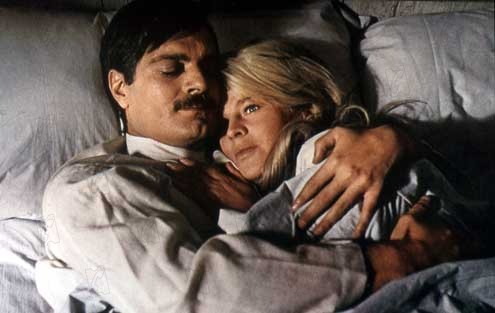
Given there’s so much time to handle, the characters don’t receive much characterisation. This is a real shame, particularly for Omar Sharif as the titular medical man, who gives an engaging a bright-eyes performance, but of a character I still know very little about. His Sharif is born into a wealthy family in Russia, a little before the Bolshevik Revolution, and the film tells of his many and varied troubles throughout his, and Russia’s, history. On many occasions the history overshadows his life, as well it should, but the focus of the film is instead on him and his loves, for his childhood sweetheart Tonya (Geraldine Chaplin), whom he marries, is forcibly separated from Zhivago, forming a love triangle when he works closely with Julie Christie’s Lara.
At times the film reminded me of – whisper it – Pearl Harbour, particularly when I was asked to try and forget about the major historical event taking place in the background of a scene, and instead focus on the trivialities of the relationships of the leads, but just like Michael Bay’s explosion-fest, the grand scale of the set pieces was very impressive. Be it the hundreds of singing extras at a rally that becomes a battleground against an army of sword-wielding Cossacks, or the miles-long trudge Zhivago sets out on to return home through the snow, there is little shortage of spectacle.
Look out for Klaus Kinski on a train, and listen as your cries for more Alec Guinness – as Zhivago’s brother Yevgraf – go unheard. Whilst the film is certainly at times impressive, especially for its time, today it doesn’t really hold up, though it is certainly better than Pearl Harbour.
Choose life 6/10

Memento

Christopher Nolan’s first major picture (after 1998’s Following, which is interesting but a tad too confusing, and really for completists only) is at first glance nothing but a gimmick, using a reverse-narrative to tell the detective noir of Guy Pearce’s Leonard Shelby as he hunts for the man who raped and killed his wife whilst suffering with a rare condition that prevents him from making new memories. However it turns out that telling the story backwards, scene by scene and with an expositionary telephone conversation spliced in between, is the only way to give the story justice.
Famously, there is an easter egg on the Memento DVD that plays the film in chronological order, and I’ve discovered that in that orientation the film just doesn’t work. It’s not just because the last few seconds of every scene are replayed again moments later at the start of the next one (surely that wouldn’t have taken much to edit out?) but it’s also because the film is completely lacking in tension or pacing when that way round. Which just goes to show that Nolan was able to use a plot technique to it’s fullest advantage, which in the hands of a lesser director could have proved disastrous.
Pearce is excellent in an unforgiving role, especially given that Leonard has no character arc longer than a scene. He’s always been a brilliant actor, and often hides his Brad Pitt-esque looks behind obscuring facial furniture or heavy make-up – see Ed Exley’s glasses in L.A. Confidential, or large amounts of Play-doh in Prometheus – and here is no exception, with Shelby’s body plastered with tattoos and a shock of peroxide blonde hair to distract from those razor-sharp cheekbones. Pearce is ably supported by Carrie-Anne Moss and Joe Pantoliano as Natalie and Teddy, people who may or may not be out to help Leonard on his quest.We discover elements of the story as Leonard does, and the true meaning of almost every scene is altered by the one that immediately precedes/follows it. Surprisingly, a scene can hold just as many surprises, and just as much tension, if you know how it ends but not how it begins. You can’t help but feel sorry for Leonard, in a situation that would drive most of us insane – as long as we could remember the insanity long enough – and his life would be hard enough without everyone screwing with him. Even the clerk at his motel (Batman Begins‘ Mark Boone Junior) charges him for two different rooms, and doesn’t even hide it from Leonard, as there’s no chance he’ll remember.

There’s more comedic moments than you might remember, and some darkly so, for example the conversation where Leonard reveals to Natalie that the last thing he remembers is his wife. She says that’s sweet, before Leonard concludes “…dying.” I probably shouldn’t have, but this got a start of laughter from me.

I remember that my first viewing of this movie was ruined when I borrowed it from a housemate some years ago. He basically told me the ending, and that the film was crap, but I watched it anyway and remained intrigued and fascinated by how the plot would tie together – which it does nicely. Rest assured I never took that housemates movie advice again.

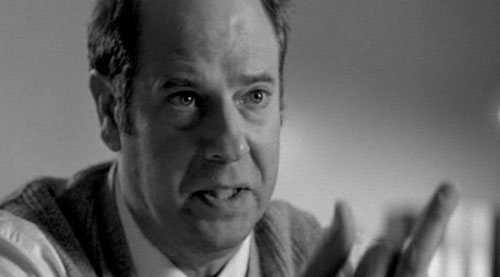
If Stephen Tobolowsky is in a film, then I’m legally obliged to mention him in a review, and here he crops up in grainy, black and white flashback as Sammy Jankis, a case Leonard looked into as an insurance claims investigator before his memory loss. Jankis suffered from a similar condition as Leonard, and Tobolowsky’s wonderfully big blank face is perfect for the look of someone not recognising anything new in the world around him, and his bursts of anger at annoyance – at an elctro-shock test and not understanding TV shows – is also great.

The story, written by Christopher Nolan’s brother Jonathan, is well thought out and takes into account the minutiae of Leonard’s predicament. Such a high concept (though scientifically possible) film could have left many annoyances at skipped over details, loose plot strands or inconsistencies, but by the end/beginning no such problems are left.

Choose film 9/10