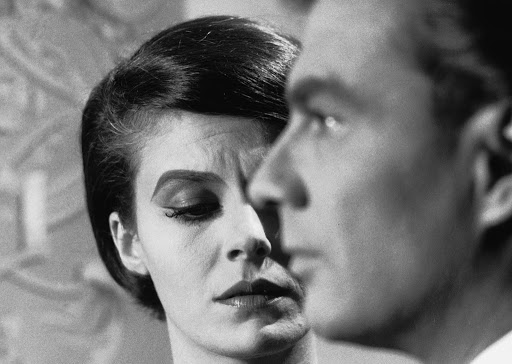
I don’t know where to begin. Normally in my opening paragraph I give a brief synopsis of the film, y’know, “an eccentric old man invites his grandchildren, some paleontologists, a chaotician and a lawyer to try out his new dinosaur-filled theme park” that kind of thing, but the trouble with Last Year at Marienbad is that there is nowhere near enough plot to even begin a paragraph. Essentially, there’s some kind of swanky soiree at a swish estate that I think is somewhere in the Czech Republic. At said event, there is a man (Giorgio Albertazzi) who is resolute that he met a woman (Delphine Seyrig) attending the party a year ago at Marienbad. Meanwhile the woman’s male friend (Sacha Pitoeff) plays a game with cards, matchsticks and dominos called Nim, at which he seems unbeatable. This plays out for 90-odd minutes, until the film ends, with no foreseeable additions to anything approaching a story.
Continue reading
Category Archives: 5-Star 500
Citizen Kane
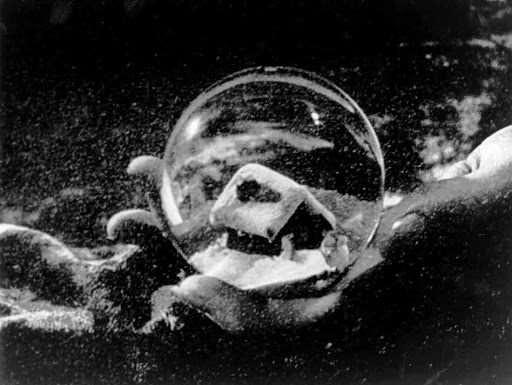
Charles Foster Kane (Orson Welles), an unimaginably wealthy publishing kingpin, drops his snowglobe and dies alone in his bed. His last dying word, “Rosebud,” sends the national newspaper journalists into a frenzy, all eager to discover it’s true meaning, in the hope of shedding some light onto the tycoon. Led by Jerry Thompson (William Alland), the reporters speak with Kane’s former wife, friends, employees, business partner and butler on their search for the truth. Could it be the name of a girl? A dog? A boat? Or just the rambling ravings of an insane old man?
Up until last year, Citizen Kane has topped Sight and Sound magazine’s Greatest Film Of All Time list, but was recently toppled by Vertigo. It’s been a little while since I’ve seen Hitchcock’s classic, so I can’t vouch for whether the change is correct or not, but I can say that I have no problem with Citizen Kane having been up there for quite so long. This film actually appears on all four of the lists I’m currently working through, and so great is its reputation that I can’t imagine a respected film list denying it a place. I mean, it spawned the prefix “It’s the Citizen Kane of…” as a way of saying a film is the greatest of a specific type. And heads up, this isn’t going to be the Citizen Kane of Citizen Kane reviews. So what makes it so important? Why is it revered by so many people? Will every paragraph in this review end in a question mark?
The Day The Earth Stood Still
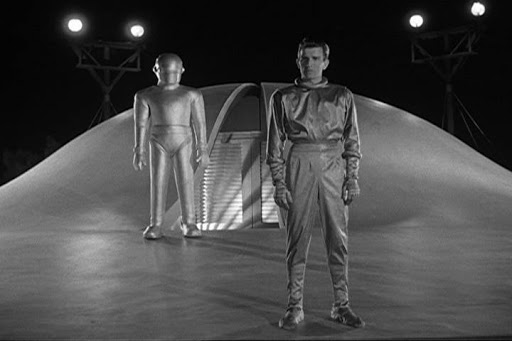
An alien ship lands in Washington D.C., and from it emerges Klaatu (Michael Rennie), a humanoid from a neighbouring planet, who brings with him a message he wishes to convey to the various leaders of Earth. When they squabble pettily over where the meeting should be held, Klaatu instead decides to meet with the general public, so he rents a room in a boarding house, under the name Mr. Carpenter. There he meets the other lodgers, including Helen (Patricia Neal) and her young space-obsessed son Bobby (Billy Gray), and eventually he meets with Professor Barnhardt (Sam Jaffe), a learned scientist, in the hopes of discovering something worthwhile about Earth and mankind. Oh, and one other thing. Klaatu has a giant, omnipotent robot guardian called Gort, who has an eye-laser capable of disintegrating anything.
As a nerd, I like my science fiction, but I’ve never obsessed over it. I’m a fan of Star Wars, but I’m not a super fan, and the only Star Trek-related media I’ve seen is J. J. Abrams recent film. To be honest, Firefly has always been more my cup of tea, and that’s only science fiction in that its set in space, and that’s a similar situation here. The actual science fiction elements of The Day The Earth Stood Still are mere background details for a large section of the film, as it becomes almost a fish out of water tale of a man unfamiliar with his new surroundings, learning about a new culture, its eccentricities and foibles. Obviously there is still a great deal of the otherworldy – Klaatu is an alien after all, and there’s the robot capable of destroying worlds who is controlled by words and flashing lights – but the more memorable aspect is the social indictment; the message that we, as a civilisation, need to get our act together or suffer the consequences. It comes as no surprise that the film was remade in 2008 (though I’ve not yet seen it), as clearly had the events of this film actually taken place in 1951, then we certainly didn’t listen, as can be seen by the state of the world today. But I don’t want to get too political, so I’ll just say that message from the film back in the 50s, just six years after the end of the Second World War, is possibly just as relevant today.
Anyway, the film. Seeing as it was made over 60 years ago, its no real shock to find that the special effects for the most part don’t really stand up. Gort is quite blatantly a man in a suit (Lock Martin, of whose nine screen roles six were uncredited and one was deleted), wires are fairly visible in some scenes and footage is clearly sped up to indicate people running away. The laser and disintegration scenes are ropey at best, but I was thoroughly captivated by the shots of the spacecraft opening, with a doorway appearing on its seamless surface, and disappearing again just as effortlessly.
Michael Rennie seems perfectly cast as a creature not off this world, with his angular features, harsh cheekbones and a deliberate, considered approach to movement and speech making him seem passable for a human, but one who’s definitely a little… off. Which makes it something of a surprise when Helen has no qualms about leaving her son Bobby with this strange man she’s known for only a matter of hours as she goes gallanting off with her beau. There was a very high possibility of the kid becoming excruciatingly annoying – my girlfriend certainly thought he was – but I found his naivety endearing, even if he seemed far too respectful of his elders, in a manner unheard of today.
The film’s cinematography was brilliant, especially the use of shadows and silhouettes, and the imagery of Gort carrying the figure of Helen, as made famous by the poster. Bernard Herrmann’s score is also suitable sweeping and atmospheric. It’s no surprise that this film has become an integral part of classic science fiction, with the phrase “Klaatu, barada, nichto” (or is it necktie?) going down in history as one of the greatest quotes in cinema. I’m intrigued to now see the remake (if only for John Cleese, an idol of mine), but public opinion has left it not very high on my to-watch list.
Choose film 8/10
Pather Panchali
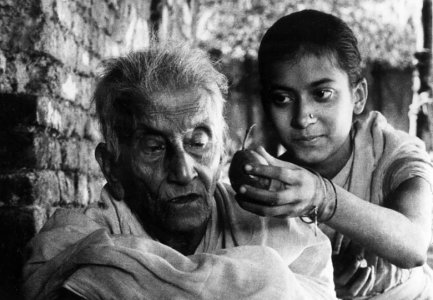
The story of a very poor family struggling to make ends meet in a Bengali village in the 1920s. Harihar (Kanu Bannerjee) must cope with looking after an elderly relative, kleptomaniacal daughter, carefree infant son and her clueless husband as he does his best to provide for a family that never seems to catch any breaks.
There are many films in the 1001 list that, when watching, I can’t really see why they’ve been included, and it isn’t until afterwards (or during, if it’s really boring) when I read up on the film a little, that I discover there is some cultural significance or historical context within which the film can usually be appreciated as an achievement, but not necessarily enjoyed. Such is the case with Pather Panchali, for as I now know it is the first film of director Satyajit Ray, who would go on to direct various other films also included within the 1001 book: The Music Room, Aparajito and The World of Apu, with the latter two completing the Apu Trilogy, begun with this film. Pather Panchali also marks the first independent Indian film to garner international acclaim, so that at least answers the question of why it was in here.
So what was wrong with it? Well, nothing really, it just didn’t really feature a great deal in terms of plot or anything to engage my attention. Its just a rather plodding depiction of an Indian family’s life, and the sporadic ups amidst mostly downs that they endure. There are some nice moments – the joy cracking across the wizened face of the elderly relative when Harihar’s daughter Durga gives her a guava stolen from the neighbour’s orchard, Durga and her younger brother Apu encountering a train – but once again I’m getting rather tired of watching depressing films. As such, I really don’t have that much to discuss about the film.
The most annoying aspect of this film is that its the start of a trilogy, all of which appear on the 1001 list (and the Empire 5-star 500 List, for reasons that will hopefully become clear once I’ve seen the rest of the trilogy). Before watching, all I knew about Pather Panchali was that it was the start of this trilogy, titled the Apu Trilogy, so I was expecting it to be about someone called Apu. Therefore, once he was born, I expected him to be the central figure of the story, but was surprised when he was kept mostly to the sidelines. I’m sure he’ll become more prominent in the later films, but I’ll try not to anticipate that, just in case he doesn’t and I become even more disappointed later. Aparajito and The World of Apu are the next two films in my LoveFilm queue, so I should be getting to them fairly soon, as long as I can bring myself to actually watch them.
In short, I’m chalking this film up alongside the likes of The Jazz Singer, Battleship Potemkin and Olympia as being a historical moment in cinema, but one that I’m not keen to repeat, and definitely cannot recommend.
Choose life 5/10
The Wicker Man
Devout Christian police officer Sergeant Howie (Edward Woodward) receives an anonymous letter telling him that a young girl, 12 year old Rowan Morrison, went missing a year ago and hasn’t been seen since. Armed only with the letter, a photo and his unbreakable religious beliefs, Howie sets out to the secluded island of Summerisle, where he is met by hostility from the locals, who do not approve of a mainlander on their soil, and all deny any knowledge of Rowan’s existence. As Howie investigates further, he is met by obstructions at every turn, and discovers the islands inhabitant’s rituals and ideology may have a more sinister cause for Rowan’s disappearance than the policeman could ever have imagined.
First things first, I’ve not seen the 2006 Nicolas Cage remake, so I can’t really discuss that film here, which is fine, because this post isn’t about that film, it’s about the 1973 original. I have seen a few of Cage’s clips online, and I was glad to see that at no point did Edward Woodward (who, by the way, has the greatest name ever, I can’t stop saying it) explode into a torrent of “How’d it get burned?!?”, have a cage of bees strapped to his head, or perform a running punch whilst dressed as a bear. I had, however, seen this version before, but I now realise it was a heavily edited-for-TV cut, as although I watched it some years ago, I cannot remember nearly as much of the frankly disturbing goings-on that occurred in this film.
Even though it is essentially about a cult, and it’s seen through the eyes of an outsider, there is a lot of this film that’s difficult to fully come to terms with, particularly the downright infuriating manner in which the children of the island are taught. For example, with their forthcoming May Day celebrations, the lessons focus on the maypole, and how it symbolises the penis. Strips of flesh are hung by gravestones, one of which reads ‘Protected by the Ejaculation of Serpents’. Oh, and graveyards are apparently appropriate places to breastfeed children. The children are also encouraged to sing, which I’ve got no problem with, unless the lyrics contain such gems as “On that bed, there was a girl. And on that girl, there was a man. And from that man, there was a seed. And from that seed, there was a boy.” Bear in mind these children are all pre-teen, maybe even by a fair few years in some cases.
Oh yes, the singing. I’ve decided that if I ever revisit my Top 5 Films That Should Be Musicals, this film is a prime candidate for the sub-list of ones that already pretty much are ones. There are far more songs here than I had expected, and their diversity was something of a surprise. You’ve got a group of naked women prancing around a stone circle singing about pregnancy, and elsewhere there’s an impressively impromptu pub-wide rendition of The Landlord’s Daughter, which must have taken rather a lot of choreographing, seeing as no-one steps on anyone else’s lines. Britt Ekland, who plays Willow, the aforementioned innkeeper’s spawn, even gets her own solo (though I think she was dubbed by someone). Her song, creatively named Willow’s Song on the soundtrack, plays out like a pornographic music video, as Ekland, naked of course, sings directly to the camera as she gyrates ferociously around her room, slapping herself and beating on the wall in an effort to entice the neighbouring Howie to come and attend to her. Understandably, this is one of the more memorable of the film’s scenes, but the breaking of the fourth wall was distracting, and it felt like it went on for far too long.
I very much approved of how we as the audience are kept as much in the dark as Howie is as he goes about his quest, only realising something’s up when he does, at which point of course it’s too late. Woodward also does a good job with Howie’s character, establishing a hero who is something of a dick, and definitely not a people person. I don’t want to get into a debate about religion (in short, it’s not for me), but I’m glad that I’ve never met someone who is quite so steadfast in their beliefs as Howie, who is utterly appalled when he discovers the island education system doesn’t contain anything to do with the teachings of Jesus, as the only religion he even acknowledges the existence of is Christianity, proving he is possibly just as obsessed or bigotted as the islanders themselves.
Even with so many distubing aspects – the thought of the beetle slowly crawling around the desk until it strangles itself still upsets me a little – I can’t help but appreciate this film as being a thoroughly engaging mystery, with an enrapturing plot that, even though I had an inkling of a memory as to what the ending was, I couldn’t wait to see pan out to find out exactly what was going on. Also, Christopher Lee is generally brilliant in anything, here appearing as the charming Lord Summerisle. I’d have appreciated a little less music and a lot less insanity, but I’m still very pleased to have seen it again. Oh, and I’m fairly sure the Salmon of Knowledge was from a lost Monty Python sketch.
Choose film 7/10
Sullivan’s Travels
John Lloyd Sullivan (Joel McCrea) is a big time director of screwball Hollywood comedies, but wants to make something real. Something with a message. Something for the common man. The only problem is Sullivan has never experienced life amongst the common men, so he sets out, against the wishes of his producers, disguised as a hobo and with nothing but 10 cents in his pocket, to see how the other half survives.
I like films with good dialogue. If it’s been written by Aaron Sorkin or the Coen brothers, then chances are I’m a fan of it, so it may come as a surprise to discover that this is the first film I’ve seen from Preston Sturges, widely regarded as one of the finest writer/directors of screwball comedies. Although, to be fair, I’ve not seen other such screwball classics as His Girl Friday or Bringing Up Baby yet either (even though I’ve got both on DVD), so maybe it’s not too much of a surprise that I’ve yet to delve into Sturges’ work either. Now that I’ve seen a Preston Sturges film and know the kind of thing that I’m in for, I look forward to tracking down some of his other work, because this film is quite brilliant. And fortunately some of his other work – Unfaithfully Yours, The Lady Eve, The Palm Beach Story – are also on my various film lists, so all being well I’ll be getting to them soon.
Sullivan’s Travels also marks my first viewing of Veronica Lake, previously only known to me as the girl Kim Basinger supposedly looks like in L.A. Confidential. Here, in her first major role, she plays Sullivan’s travelling companion, charitably credited as ‘The Girl’. When she is supposed to, she looks great (she spends a portion of the film disguised as a fellow hobo), and her chemistry with McCrea is good, if not amazing. McCrea, too, is great, thoroughly convincing as the idealistic yet out of touch director, and the supporting cast all left something of a mark, even if many of them weren’t around for as long as I’d have liked, particularly the snooty, disapproving butlers.
The first third of the film is certainly the best, and the most comedic, and provides the majority of the most quotable lines (“If they know what they like, they wouldn’t live in Pittsburgh.”), and the film takes a more preachy, dramatic turn once Sullivan sets out on his mission. This is a bit of a shame, as had the film retained the breakneck pace and quality of script as that opening half hour (no-one talks any slower than Steve Buscemi in Miller’s Crossing), this film would be a guaranteed 9/10 (I never award a 10/10 on a first viewing, that score has to be earned after many watches). As it is, the film remains very good, but the plot becomes annoyingly circular, as Sullivan seems unable to escape his own wealthy lifestyle, whether through his own fault or general circumstances. The final third becomes overwhelmingly message-y, when Sullivan learns that making comedies can actually be worthwhile (hence why Sturges dedicated this film to the mirth-makers of the world), and it’s all handled disappointingly heavily.
I think I went a bit negative there for a moment, because I really did like this film. The scene where Sullivan goes to the cinema was brilliant, showing that even back in the 1940s it was occasionally impossible to hear the film over the sounds of screaming children, rustling sweet packets and incessant chomping, crunching and the smacking of jowls. Some moments got a bit farcical – Sullivan attempting to outrun the entourage his producers supply him with by utilising a souped-up boxcar with a chalked-on speedometer, and the amount of people who fall into water throughout this film is simply ridiculous, but it never got too silly for me.
There were some issues with the pacing, as just as the story looked like it was all wrapped up, Sullivan heads out on a new adventure completely different to the rest of the film that felt out of place and a bit too serious, drifting too far from what should have been a straight comedy, that seemed to miss the very point that the film was making.
If you are going to watch this film, and if you’re a fan of the older Hollywood pictures, then I suggest you do, I recommend at least once skipping the film back a chapter or two and watching the film on fast-forward, as listening to the already rapid dialogue even faster is downright hilarious. Small things, I know.
Choose film 7/10
Superman Returns
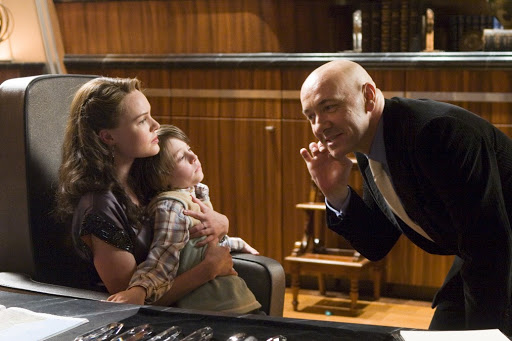
Superman, the last surviving alien from the planet Krypton with god-like powers, has left the city of Metropolis that he has protected for decades to return to the last known whereabouts of his destroyed planet. Upon discovering nothing to be found where his planet used to be, he returns back to Earth, and re-assumes his alter ego of Clark Kent, a mild-mannered journalist for The Daily Planet. He attempts to rebuild his relationship with Pulitzer-prize winning co-journo Lois Lane (Kate Bosworth), but is annoyed to discover that not only is she engaged to their boss’ nephew (James Marsden), but she has a son, Jason (Tristan Lake Leabu). Meanwhile, having recently been released from prison, Superman’s former nemesis Lex Luthor (Kevin Spacey) is busy hatching a plan involving crystals found in Supe’s mysterious Fortress of Solitude.
I’m not a fan of Superman. There, I said it. I remember half-watching the 1978 Christopher Reeve version when I was younger, but I can tell you literally nothing about it, and I remember watching Superman Returns a few years ago, but I couldn’t remember too much about that either, other than the shot of Bosworth’s Lois ascending in an elevator, Spacey’s Lex Luthor being near water at some point and the shot of Superman being shot in the eye that was in the trailers. To be fair, that viewing was overshadowed by a rather eventful mid-film pee break.
I remember the rest of the day clearly. It was pretty much the first time I’d tried Pick’n’Mix sweets (I was aged 19 I think), and all I’d consumed so far that day was strawberries with orange juice for breakfast, a couple of glasses of Coca Cola, and several fistfuls of Pick’n’Mix. My student days were not necessarily the healthiest of times. About halfway through the film, buoyed by the saccharine high of the tooth-rotting goodies I’d consumed, I desperately need a wee. So i nipped to the loo, and mid-stream I passed out, and woke up face down on the toilet bowl. This is a very unusual place to regain consciousness, and needless to say, once I re-entered the lounge and joined my housemates watching the film, I didn’t take too much of the rest of the film in, hence why I remembered so little. I promise that I don’t make a habit of passing out during films, although later that day something similar occurred during an advert break in The Long Kiss Goodnight, this times resulting in my collapsing face-up (again mid-urination), still clutching the 2″ thick acrylic shower rail I’d previously been using to steady myself, that had now been sheared from the wall. Don’t worry, other than my recent Looper adventures, the only other time I’ve passed out was last year, again during a period of relieving myself, but was not halfway through a film. It did require the purchasing of a new toilet brush holder, as apparently the one we used to own wasn’t designed to withstand 15 stone of unconscious man falling onto it.
Anyway, me fainting halfway through the first time I watched the film has nothing to do with whether I like it or not, I just enjoy retelling overly personal stories from my life that are at best tangentially related to the film I’m reviewing. No, what I don’t really like about Superman is that he’s just too powerful. His powers are seemingly beyond limit, with the only things he cannot do being the ones he hasn’t tried yet. He has flight, x-ray vision, super speed, strength, laser-eyes, time-travel, advanced hearing, super-whistling, fucking everything. And he only really has one weakness; Kryptonite; an extremely rare green rock. Which basically means that if people don’t know about this weakness, or there isn’t any of the super-scarce emerald stone around, there’s pretty much nothing in the way of Superman saving the day. I never really got into Smallville, even though I was pretty much slap-bang in the target demographic when it came out, and I can’t even get excited about next year’s Man Of Steel, even with Zack Snyder directing and Christopher Nolan producing. Needless to say, this film was going to have it’s work cut out if I was going to be impressed by the end of the viewing.
Initially I was intrigued by the film, as it has an interesting and somewhat eclectic cast. Kevin Spacey is perfect as Luthor, taking over from Gene Hackman. Spacey is his usual dependable self, and it at his best when in full-on bad guy mode, which is most certainly the case here. Elsewhere, Eva Marie Saint was a nice touch as Martha, Clarke’s adoptive mother, though disappointingly she doesn’t really get a lot to do, as is also the case with Frank Langella’s Perry White, Clarke and Lois’ boss. James Marsden once again plays a man caught on the cold side of a love triangle between the film’s hero and heroine (see also The X-Men trilogy, The Notebook, Enchanted), and Parker Posey is always a welcome addition to any cast, here playing Luthor’s sidekick/partner/main source of annoyance. Oh, and Kal Penn’s there too, but I’m fairly sure he never actually says anything, and [TINY SPOILER] is given a terrible cop out death with Luthor’s other two goons at the end [END OF TINY SPOILER].
Where the casting really falls down though is with the leads. Kate Bosworth, aged 23 when the film was released, looks far too young to play a Pulitzer Prize winning journalist, and seems dwarfed even by her own clothes. She also displays practically no likable qualities – she frequently dissolves into childish hissy-fits and strops whenever she (justifiably) doesn’t get her way. Brandon Routh, on the other hand, looks the part of both Superman and his public identity, but whenever he tries to act he appears to be made more of wood than the steel of his nickname. And in the many, many CGI shots of him flying or in danger, the film seems to become a late 90s video game, so terrible are the graphics. Most egregiously, the film’s final shot is one such diabolically bad render. Even in some of the non-CG shots Routh appears to have a plastic-like finish, possibly to make him look more similar to the computer generated bits.
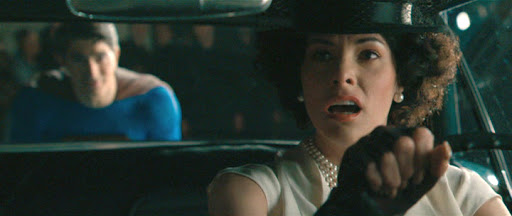
Another part that really bothered me was that the film is clearly set in modern times, with space shuttles, airplanes, videocameras etc. all being integral to the plot, but the architecture and fashions all seem to be stuck in the 1920s, up to the point of large sections seeming like they were shot in sepia. This is none more clear than in Parker Posey’s outfit in the car sequence. Adding the newspaper-room setting reminded me heavily of The Hudsucker Proxy, a film I liked a great deal more than this one, and which inspired me to suggest Jennifer Jason Leigh as Lois, although Amy Adams’ casting is possibly the only thing I approve of for the next film. I can see where director Bryan Singer was coming from with the mix of old and new styles, but it never really worked for me, and I found the whole thing very jarring. The overall plot was mostly just silly too, and various minor plotlines – the one involving Lois’ son for instance – felt unsatisfying and, at times, just plain stupid. The first 60% of the film seemed to drag too, as Lex’s plot is kept a mystery, and there doesn’t seem to be too much for Superman to really fight against. And part of the finale, in which lives hang in the balance of a fax machine’s volume, is not quite dated yet, but will be very soon. And who the hell puts a snooker table on a boat? Seriously.
There were some nice touches though. I approved of the little in-jokes for superhero fans (a news reporter mentions that they’ve received a message from Gotham), and the moment where Clarke pretends to be a bit confused and muddled to but Lois off the scent was good. The shoehorning-in of the “It’s a bird, it’s a plane…” line was clumsy, but still managed to raise a smile from me, even if it was accompanied with an eye-roll. The destruction of a model railway town may not sound like the grandest action set-piece in a film, but for me it was the highlight here, with it being shot in a similar fashion to a Roland Emmerich film. That one short sequence was more entertaining than the entirety of 2012, I can tell you.Elsewhere, some camerawork really disappointed me – a shot heading over a balcony and down, to focus on Lex reading a newspaper felt clunky and jerky – but this was more than made up for by the visually stunning space-set opening.
The viewing of the film was worth it to finally discover the origin of two Adam Carolla Show sound effects (“Wrong!” and “You’re losing your hair,” for fellow regular listeners), but sadly other than this point I was thoroughly underwhelmed by the whole thing. All being well, my low hopes for the upcoming Man of Steel may result in me being pleasantly surprise. Here’s hoping.
Choose life 4/10
The Shining
Jack Torrance (Jack Nicholson) is a writer suffering from writer’s block. He takes a job as an off-season caretaker at the Overlook Hotel, deep in the Colorado Rockies, where he will stay for five months with just his wife Wendy (Shelley Duvall) and their son, Jake (Danny Lloyd). Whilst at the hotel, all three members of the Torrance family experience otherworldly visions that slowly send Jack insane. Meanwhile, Danny’s ‘gift’ of the shining – the ability to see and hear things that haven’t happened yet or that happened a long time ago – grows stronger.
The Shining is widely regarded as a terrifying film, one of the best horror films made in the past 40 years, but to me it holds a deeper terror, not just because it’s the first truly scary film I can remember watching (and being far too young to watch it when I did). You see, I’ve seen The Shining twice, and both times I’ve watched it have been shrouded in a very real death of someone I know. The first time I saw it my best friend’s brother’s best friend was found dead the next morning. This time, I was interrupted about halfway through the film with a phone call from a friend, informing me that a mutual friend of ours, who neither of us had seen for a while, had been killed in a motorcycle crash. Basically, this is possibly the scariest film I know of, because I can never watch it again for fear of someone I know dying. This adds a whole new dimension to a film that’s scary enough to begin with.
On the surface, there isn’t a lot of traditionally scary elements to The Shining, especially not by modern horror standards. Instead, there’s more of an increasing sense of unease and mental disturbance as Jack descends into the horrors of his own mind, assisted by the various terrifying images thrown up by the hotel. Like the young twin girls Danny sees around the hotel, the elevator erupting with an ocean of blood, or the beautiful naked woman in room 237, who becomes a scabbed and putrid hag in Jack’s arms. And of course there’s the questionable shot of the man in a business suit, probably receiving a favour from a man dressed as a bear, that I’m sure his wife and kids would not be too happy to find out about.
As horror films go, this is impressively effective without having to resort to cheap jump-scares or a monstrous killer on the loose. I’m not often scared by films, but this one has left me a little off ever since, and not just for the personal reasons mentioned earlier. I’m a big fan of how the original protagonist – Jack – eventually becomes the antagonist once perspective focuses more on Jake and Wendy. If I were to pick a fault though, it might be that there’s a few too many elements taking place simultaneously. Firstly, the hotel was apparently built on an Indian burial ground, thereby adding an explanation to the ghostly goings on. This should have been enough, but there’s also Danny’s psychic abilities, which he shares with the hotel’s chef, Dick Hallorann (Scatman Cruthers), who has the most absurd pictures on his bedroom wall. Then there’s the mysterious suicide of the former caretaker, who killed himself with a shotgun after axing his family in the winter of 1970. And Danny’s finger is his imaginary friend, Tony, who talks to him and tells him what to do. Personally, I think Jack would have gone insane with just the intense writer’s block and having to be locked up with Shelley Duvall and an insane child for 5 months.
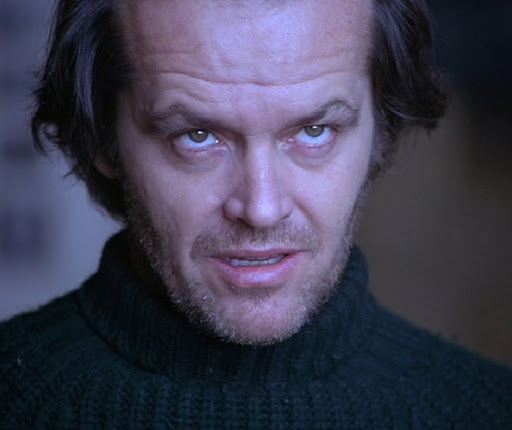
The film is pretty much perfectly cast, and Nicholson gives one of the most defining performances of his career. He shows real potential here for his future role as the Joker in Batman, especially once the madness sets in and his maniacal grin and eyebrows take over his face. Elsewhere his prominent brow and bright, glaring eyes are well used to strike fear into all who watch. Duvall is well cast too, though this isn’t a compliment as I think her character is supposed to be supremely annoying, and she succeeds in spades. It’s not often that you root for the axe-wielding psychopath over the innocent damsel in distress in a film, but I have absolutely no qualms about doing so here.
This being a Kubrick film, it’s a given that a certain amount of flair has been utilised in the cinematography. The most famous example, and my personal favourite, is the long tracking shot following Danny as he wheels around the hotel on his tricycle. Infamously the camera was turned upside down to get it closer to the ground, offering a lower-than-child’s-eye perspective that really adds to the sense of dread, as does the incessant squeaking of the wheels as Danny follows an impossibly labyrinthine path around the hotel, a theme that recurs throughout the film.
The film is rife with too many unanswered questions and unquestioned answers, but due to Kubrick’s meticulous nature these can be assumed as being deliberate, present not only to infuriate the audience, but to keep them discussing the film forever more. Add to this some great quotable lines (“I’m not gonna hurt you, I’m just gonna bash your brains in.”), some of the most famous scenes in cinema (“Heeeeeeere’s Johnny!”), stellar performances, stunning visuals and a truly haunting score, and you’ve got not just a great horror film, but a great film in any genre. It’s just a shame I can’t watch it ever again.
Choose film 9/10
North By Northwest
This is the last review I’ve got left unposted from the recent reviewing competition at the Lamb, I hope you enjoy it.Is it really possible for North by Northwest to live up to its hype? It’s rare to find a Top Films list deprived of its inclusion, it features scenes that have become the stuff of legend, that also tend to top Best Scene lists, and it’s one of the greatest movies ever made by one of the greatest directors who ever lived.
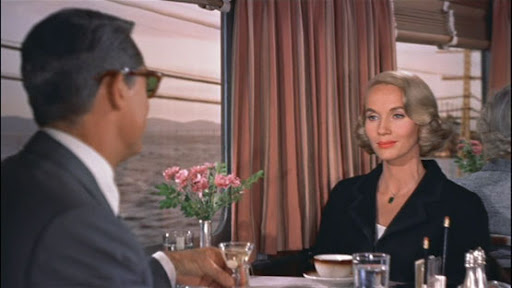
Such a masculine protagonist would be lost without a suitably feminine love interest, and Eva Marie Saint fits that job nicely as Eve Kendall, a typically beautiful Hitchcock blonde whose porcelain doll exterior hides her ability to use sex like some people do a flyswatter, and she holds her own against the likes of Psycho’s Janet Leigh, Rear Window’s Grace Kelly and Vertigo’s Kim Novak as she dabbles in some of the most forward repartee since Bacall taught Bogart how to whistle. Hitch always preferred the more beautiful but subtly sexy female leads, as he took great pleasure in uncovering their more alluring qualities than he would have with the more self-promoting individuals like Monroe. As with all of Hitchcock’s birds (pun intended) Saint is meticulously and beautifully dressed in every scene. Legend has it that the great director paid her wardrobe so much attention that Grant petulantly demanded advice on what he should be wearing, and was simply told to “Dress like Cary Grant.”
It isn’t just the dialogue though; the scenes without any discussions are often just as amazing, if not more so. Early on, after being forcibly imbibed with the best part of a bottle of bourbon, Thornhill is unleashed behind the wheel of a car, in an attempt to instigate his demise. Upon realising what’s going on he awakes in a drunken stupor and does his utmost to keep his car on the increasingly blurred and merging roads in front of him. Grant makes for an amusingly intense drunk, persistently blinking, squinting and staring bug-eyed at the cars he races past, made all the more dramatic by Bernard Herrmann’s stupendously engaging score. Of course, there’s also the hallowed cropduster chase, as Thornhill, having been lured to the middle of nowhere to meet the man he’s been accused of being, finds himself battling the more painful end of a plane’s propeller. One of the few scenes not set to music – to better emphasise the relentless whirring of the plane and the lack of assistance Thornhill is likely to receive with the matter at hand – the scene is worth watching as a standalone segment. Equal parts exhilarating, terrifying and fun, it’s made all the more hilarious for the entire time Grant dives through dirt and hides amongst crops he is wearing his increasingly worn yet perfectly tailored grey flannel suit, clean shaven and with immaculate hair.The Magnificent Seven
A small farming community is being terrorised by a band of thieves and murderers, led by the charismatic but ruthless Calvera (Eli Wallach, previously only known to my girlfriend as the elderly neighbour in The Holiday). He and his gang steal almost everything worth taking from the villagers, leaving them just enough to carry on farming for another year, at which point Calvera will return and repeat the process over again. Sick of this injustice, three villagers head to the nearest saloon and recruit someone to either train or protect them, finding Yul Brynner’s Chris as the perfect fit for the role after he volunteers for something that could get him killed, and offers no reward – a situation very similar to that of defending the village. Chris then goes about assembling a team – you can probably guess how many – of similarly minded men based on Chris’ previous dealings with them or their reputations.
The line-up has since become a member of the great pantheon of Pub Quiz Questions – I can never remember Brad Dexter or Horst Buchholz, but I’ve won a DVD by naming James Coburn before. The remaining members are Charles Bronson, Robert Vaughn and, of course, Steve McQueen, who all have various reasons for signing up, be it running from the law, spotting a money-making opportunity or just plain boredom.
This is one of those films that I remembered through a rose-tinted haze as being a far greater film than it turned out to be. It’s not a bad film, not at all, it’s just not the stone-cold classic I had remembered. My main problem was in the amount of time it took for the Seven to assemble, and the attempts to shed doubt on whether certain members will join or not. It’s clear from the very title of the film that there will be a group of seven defending the village, but the group isn’t together until about halfway through the film! Also, I felt that for the most part enough screentime was given to each of the seven, except for Buchholz’s Chico being given far too much time as the young rookie looking to prove himself, and Coburn’s stoic knife-throwing Britt barely getting a look in after receiving the best introduction of the guys. I’m especially sore about Coburn because he’s my favourite character (and accent) in The Great Escape (coming soon), and he voiced Waternoose in Monsters, Inc. Most of the seven are given some kind of arc of character trait, but Britt’s appears to be just falling asleep under any available tree, and being completely unable to hide behind cover whilst shooting.
Based on The Seven Samurai, I had hoped to watch Akira Kurosawa’s classic epic before seeing The Magnificent Seven again, but alas my Steve McQueen adventures and requests from my weekly movie night made this impossible, but hopefully I’ll get to it soon. What I hadn’t realised is that this film was also remade (not as Battle Beyond The Stars, I haven’t seen that yet), but as A Bug’s Life. Granted, the plots aren’t identical, but there are some startling similarities. I’m not entirely sure how happy Charles Bronson would be to know he’d been recast as a ladybird.
There are some gloriously over the top death sequences, and the finale is a great shoot out, though it doesn’t compare to some other classic ones. It’s a very enjoyable film, but alas it’s not the one I remembered. Still the best Steve McQueen film I’ve seen so far on this journey.
Choose film 7/10