I’ve made no secret that I dislike the films of Spanish surrealist/Mexican politicist Luis Bunuel. I find his work arduous, unpleasantly illogical and disconcerting, so I thought it would be a good idea to remove the remainder from the list in quick succession, allowing for 8 films to be bundled together in another overlong post that no-one with a modicum of sense will ever read.
Our first is Belle de Jour, a senseless, semi-plotless effort typical of Bunuel, following Severine (the beautiful Catherine Deneuve) who behaves frigidly towards her husband of one year, but finds herself stepping out to work at a brothel without his knowing. What little plot there is is predictable – inevitably a lecherous friend of Severine’s husband visits the brothel and propositions her, with only Deneuve’s performance is worth watching. Mercifully, little intercourse is shown.
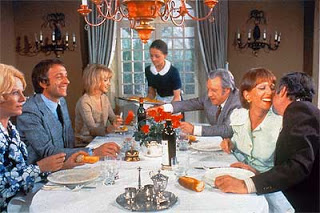 In the Discreet Charm of the Bourgeoisie, I was shocked to find an almost coherent story running throughout, as six upper crust respectable people – drug dealers, no less – struggle to all come together for a meal, but are denied the chance at every turn, be it from confused calendars, a dead restaurant manager, a bout of pre-lunch nooky, a shortage of tea and the unexpected arrival of a branch of the military. There is indeed a certain charm to the story, nicely balancing the ludicrous dining catastrophes with the concern that the drug pedallers are being tracked by terrorists, but alas all this is blown to bits with interruptions from a tragic Lieutenant, telling of how his mother’s ghost told him as a child to poison his father, or a dream he had meeting dead people on a street. The bishop is also an unnecessary distraction, and the Inception-like dream within a dream finale adds nothing but disappointment.
It’s Catherine Deneuve again, this time playing Tristana, a woman in mourning for her recently deceased mother, who goes to stay with the lecherous yet refined Don Lupe. He spouts bizarre philosophies (“a woman only stays honest with a broken leg – and at home!”) which begin to rub off on Tristana as he makes several advances towards her yet she does not seem to object. She makes a point of always choosing between two things, so it’s safe to assume she will eventually be called upon to choose between two men, and she suffers from the kinds of bizarre, unexplained dreams that are Bunuel’s bread and butter. There’s a fair stab at an actual plot, but bland or irrational characters, large periods of time passing with little acknowledgement and an unsatisfactory, inconclusive ending mars the film.
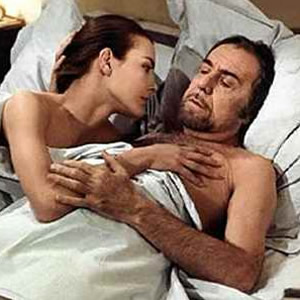 After an unexpected yet poorly edited explosive opening that had to be rewound to work out who it happened to, That Obscure Object of Desire heads downhill. Using an annoying and repeatedly referred to narrative device of a man telling his story to other passengers in his train carriage, we hear of the events that led up to him pouring water over a woman on the train platform. The other passengers continually tell the man that his story is fascinating and remarkable, but it is nothing of the sort, concerning a duplicitous young women employed as a maid by the man, who leaves when he shows her affection, and bear in mind that the positive adjectives used to compliment the man’s story were written by the same person who wrote the story he is telling, making them nothing more than egotistical propaganda.
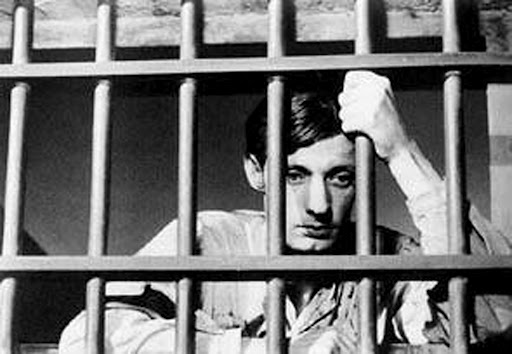
Los Olvidados began positively, but I’m sure not in a way hoped by those involved in its production. Expecting a 95 minute film, the DVD clocked in at a much more tolerable 76 minutes, so I settled down with a grin on my face at the extra 19 minutes I could spend asleep that evening. Having just escaped from prison, young gang leader Jaibo rejoins a band of youths and sets them up to rob a blind busker. The plan fails and one of their number is stabbed, so later the gang pelt the busker with mud and stones, destroying his instruments. All the gang members look at least a little alike and are hard to distinguish from one another, and there are few genuinely likeable characters in the cast. One young hoodlum steals food from his own mother, but to be fair, when asked if she loves him, the mother replies “Why should I love him? I don’t even know who his father is.” The film shows a mildly interesting look at those trying to escape a life they’ve been born into, but not a lot happens, and when it does it isn’t terribly interesting.
 Inconclusive and pointless, Viridiana sees a nun visiting her sick uncle, only to find she is eerily identical to her deceased aunt. Her uncle, Don Jaime, is willing to do anything to prevent Viridiana from returning to the nunnery, though drugging her and pretending to rape her is a little extreme, as is hanging himself when his plan fails. Believing herself to be deflowered and therefore unable to return to her calling, Viridiana brings in some homeless people to help out around her late uncle’s house – much to the chagrin of her uncle’s other relatives – and the previously homeless do a less than acceptable job of helping out. Long periods of silence make it easy to drift off, as does the boring story with little to retain interest.
To begin with in Land Without Bread, I thought the worst part of this half hour documentary about an obscure poverty-stricken Spanish village in 1932 was going to be the production values, with a poor quality transfer resplendent with cracks and scratches, terrible sound and mistakes in the subtitles, bit it turns out I was quite wrong. The film is horrific in its depiction of a town where the only water source is a muddy stream running through it, children’s parents steal the bread their offspring bring home from the school and almost everyone is diseased in some way – a 32 years old woman looks at least 55, with a revoltingly bulbous goitre on her neck. We see a child with inflamed gums, and two days later she is dead. The only milk available is from the goats that thrive on the barren, rocky landscape, and is reserved only for the very sick, and goats are only used for their meat when they die of natural causes. At this point the film takes a turn. We see a goat fall from the rocks to demonstrate the previous point, and also a donkey being stung to death when a bee hive it is carrying falls off. After watching the film, I later discovered both events, each ending in the very real death of an animal, were both staged, with Bunuel even smearing the donkey with honey. Words fail me for home disgusting this is. A group of dwarfs are filmed as though the focus of a nature documentary (“Some are dangerous. They flee from people or attack them with stones. They are found at nightfall as they return to their village. We found it very hard to film them.”) There are repeated shots of a dead baby. This is a thoroughly depressing film that does not broach the subject of why the village’s inhabitants remain there, and it’s only redeeming feature is making the viewer grateful for what they have.
 And finally, The Young One. Racism runs rampantly throughout this tale of a black man fleeing the accused rape of a white woman, and discovering an island inhabited only by a young girl and her abusive guardian. It’s a fairly straightforward plot, with the accused criminal attempting to leave the island, but there are bizarre and inappropriate sexual overtones between the girl and both men, especially because she is clearly underage, though no-one, not even the girl herself, knows how old she is. There isn’t as much wrong with this film as in most of Bunuel’s, but also nothing really noteworthy.
Belle de Jour: Choose life 5/10
The Discreet Charm of the Bourgeoisie: Choose life 6/10
Tristana: Choose life 4/10
That Obscure Object of Desire: Choose life 3/10
Los Olvidados: Choose life 5/10
Viridiana: Choose life 4/10
Land Without Bread: Choose life 1/10
The Young One: Choose life 6/10





 Life Vs Film