Sullivan’s Travels

John Lloyd Sullivan (Joel McCrea) is a big time director of screwball Hollywood comedies, but wants to make something real. Something with a message. Something for the common man. The only problem is Sullivan has never experienced life amongst the common men, so he sets out, against the wishes of his producers, disguised as a hobo and with nothing but 10 cents in his pocket, to see how the other half survives.

I like films with good dialogue. If it’s been written by Aaron Sorkin or the Coen brothers, then chances are I’m a fan of it, so it may come as a surprise to discover that this is the first film I’ve seen from Preston Sturges, widely regarded as one of the finest writer/directors of screwball comedies. Although, to be fair, I’ve not seen other such screwball classics as His Girl Friday or Bringing Up Baby yet either (even though I’ve got both on DVD), so maybe it’s not too much of a surprise that I’ve yet to delve into Sturges’ work either. Now that I’ve seen a Preston Sturges film and know the kind of thing that I’m in for, I look forward to tracking down some of his other work, because this film is quite brilliant. And fortunately some of his other work – Unfaithfully Yours, The Lady Eve, The Palm Beach Story – are also on my various film lists, so all being well I’ll be getting to them soon.

Sullivan’s Travels also marks my first viewing of Veronica Lake, previously only known to me as the girl Kim Basinger supposedly looks like in L.A. Confidential. Here, in her first major role, she plays Sullivan’s travelling companion, charitably credited as ‘The Girl’. When she is supposed to, she looks great (she spends a portion of the film disguised as a fellow hobo), and her chemistry with McCrea is good, if not amazing. McCrea, too, is great, thoroughly convincing as the idealistic yet out of touch director, and the supporting cast all left something of a mark, even if many of them weren’t around for as long as I’d have liked, particularly the snooty, disapproving butlers. 

The first third of the film is certainly the best, and the most comedic, and provides the majority of the most quotable lines (“If they know what they like, they wouldn’t live in Pittsburgh.”), and the film takes a more preachy, dramatic turn once Sullivan sets out on his mission. This is a bit of a shame, as had the film retained the breakneck pace and quality of script as that opening half hour (no-one talks any slower than Steve Buscemi in Miller’s Crossing), this film would be a guaranteed 9/10 (I never award a 10/10 on a first viewing, that score has to be earned after many watches). As it is, the film remains very good, but the plot becomes annoyingly circular, as Sullivan seems unable to escape his own wealthy lifestyle, whether through his own fault or general circumstances. The final third becomes overwhelmingly message-y, when Sullivan learns that making comedies can actually be worthwhile (hence why Sturges dedicated this film to the mirth-makers of the world), and it’s all handled disappointingly heavily.

I think I went a bit negative there for a moment, because I really did like this film. The scene where Sullivan goes to the cinema was brilliant, showing that even back in the 1940s it was occasionally impossible to hear the film over the sounds of screaming children, rustling sweet packets and incessant chomping, crunching and the smacking of jowls. Some moments got a bit farcical – Sullivan attempting to outrun the entourage his producers supply him with by utilising a souped-up boxcar with a chalked-on speedometer, and the amount of people who fall into water throughout this film is simply ridiculous, but it never got too silly for me.

There were some issues with the pacing, as just as the story looked like it was all wrapped up, Sullivan heads out on a new adventure completely different to the rest of the film that felt out of place and a bit too serious, drifting too far from what should have been a straight comedy, that seemed to miss the very point that the film was making. 

If you are going to watch this film, and if you’re a fan of the older Hollywood pictures, then I suggest you do, I recommend at least once skipping the film back a chapter or two and watching the film on fast-forward, as listening to the already rapid dialogue even faster is downright hilarious. Small things, I know.

Choose film 7/10

Skyfall

A hard drive containing the identities of MI6 undercover agents is at risk of going missing, so James Bond (Daniel Craig) is trying to catch the thief in Istanbul, with the assistance of field agent Eve (Naomie Harris). When Bond is shot and presumed dead, his superior, M (Judi Dench), takes the blame, but when Bond returns from the grave, he must track down the files to save not only his country, but his boss.
Continue reading

Hugo

Hugo Cabret (Asa Butterfield, one of the kids from Nanny McPhee and the Big Bang) lives inside the clockwork at a train station in 1930s Paris. He spends his days maintaining and fixing the clocks, stealing only the pastries and milk that he needs to survive and avoiding the child-hunting station inspector (Sacha Baron Cohen). A run-in with station shop-worker Georges (Sir Ben Kinglsey) results in Hugo having to work for the toymaker, all the while building a bond between Jugo and Georges god-daughter, Isabelle (Chloe Grace Moretz). 

On the surface, this doesn’t appear to be a typical Martin Scorses project. For starters, it’s a kid’s film, not something you’d generally associate with the director of Goodfellas, Mean Streets and Taxi Driver. There’s nary a gangster to be found, nor a grisly death or vicious killer. Hell, it’s not even set anywhere near New York. But once you get past the halfway point of the film, and the story switches from that of a young boy trying to eke out an existence on his own to a tale about the history of the beginnings of cinema, it becomes clear just what Scorsese saw in this story. It’s no secret that the great director is a passionate man, especially when it comes to the medium of movies, so seeing an opportunity to make a film dedicated to films themselves would have been an opportunity he jumped at. Fortunately, it helps that it’s a captivating story, filled with vibrant characters and plenty of heart, without too much schmaltz. Wihtout the secondary cinematic storyline, this would have felt far more like a Spielberg picture than a Scorsese.
I didn’t have the opportunity to see this film in 3D, but I get the feeling that if you are able to, you should give it a shot. This may come as a surprise to many of you, given my usual stance on the current trend of shamelessly, and often needlessly, opting to add a third dimension to films that really don’t benefit from it, but there are many scenes here where it would probably not only have fit, but benefitted the viewing experience. 3D works best when there’s lots of little things flying in the air, for example the dandelion-thing scene in Avatar, or the lantern scene in Tangled, and in Hugo we get at least two opportunities for this, first with snow and then later with flying pieces of paper, both of which I’m sure would have looked fantastic in 3D. There’s also a lot of forced deep perspective and carefully considered samera angles, making this possibly the first film I’ve seen where the 3D was probably justified.

There’s great camerawork elsewhere too, particularly in a Goodfellas-esque extended tracking shot through the inner-workings of the train station that is positively mesmerising. It’s clear that almost every shot has been digitally enhanced to make it look older and more French – the colour scheme is rich and everything has a sepia tone, seemingly even the air. At times this felt a bit too stylised, and often took me out of the film with how fake everything looked, but it’s nowhere near as bad as many of the films that use so much CGI that they may as well be videogames. 

The kids aren’t bad, but they are overshadowed the tremendous supporting cast, including the likes of Jude Law, Ray Winstone, Christopher Lee, Emily Mortimer and Richard Griffiths in relatively miniscule parts around the train station (I was half expecting them to break into a rendition of ‘Who Will Buy?’ from Oliver). Kingsley is superb in a role that requires moments of seriousness, compassion, pity and wonder, but Sacha Baron Cohen does have a tendency to over-act now and then, presumably a result of his more comedic past. He is by no means bad, but reigning his performance in a little, to be less of a caricature, would have been better in my eyes.

I think the people that will get the most out of this movie are film fans, especially those with an interest in the beginnings of cinema. Fortunately I am such a person, and I also appreciated Michael Stuhlbarg’s character, as one of history’s first film nerds. There are many references to classic early and silent films like La Voyage Dans La Lune, L’arrivee and Safety Last, featuring the classic image of Harold Lloyd dangling from the clock face, eventually recreated by young Hugo himself, and I was engrossed at the details of how effects were created before more traditional editing processes were invented, with actors remaining frozen in place whilst explosive charges were set around them. The old technology and equipment was fascinating to me too, appealing not only to my love of cinema but my mechanical background, with a hand-cranked projector required to watch something now available on YouTube.

Scorsese has created that most marvellous of films, a successful, inventive children’s picture, that just happens to have an informative and educational semi-biopic of one of cinema’s founders wrapped up inside it. It’s beautiful, engrossing, perfectly cast and just plain delightful. And there’s a robot!

Choose film 9/10

The Shining

Jack Torrance (Jack Nicholson) is a writer suffering from writer’s block. He takes a job as an off-season caretaker at the Overlook Hotel, deep in the Colorado Rockies, where he will stay for five months with just his wife Wendy (Shelley Duvall) and their son, Jake (Danny Lloyd). Whilst at the hotel, all three members of the Torrance family experience otherworldly visions that slowly send Jack insane. Meanwhile, Danny’s ‘gift’ of the shining – the ability to see and hear things that haven’t happened yet or that happened a long time ago – grows stronger.

The Shining is widely regarded as a terrifying film, one of the best horror films made in the past 40 years, but to me it holds a deeper terror, not just because it’s the first truly scary film I can remember watching (and being far too young to watch it when I did). You see, I’ve seen The Shining twice, and both times I’ve watched it have been shrouded in a very real death of someone I know. The first time I saw it my best friend’s brother’s best friend was found dead the next morning. This time, I was interrupted about halfway through the film with a phone call from a friend, informing me that a mutual friend of ours, who neither of us had seen for a while, had been killed in a motorcycle crash. Basically, this is possibly the scariest film I know of, because I can never watch it again for fear of someone I know dying. This adds a whole new dimension to a film that’s scary enough to begin with.

On the surface, there isn’t a lot of traditionally scary elements to The Shining, especially not by modern horror standards. Instead, there’s more of an increasing sense of unease and mental disturbance as Jack descends into the horrors of his own mind, assisted by the various terrifying images thrown up by the hotel. Like the young twin girls Danny sees around the hotel, the elevator erupting with an ocean of blood, or the beautiful naked woman in room 237, who becomes a scabbed and putrid hag in Jack’s arms. And of course there’s the questionable shot of the man in a business suit, probably receiving a favour from a man dressed as a bear, that I’m sure his wife and kids would not be too happy to find out about.

As horror films go, this is impressively effective without having to resort to cheap jump-scares or a monstrous killer on the loose. I’m not often scared by films, but this one has left me a little off ever since, and not just for the personal reasons mentioned earlier. I’m a big fan of how the original protagonist – Jack – eventually becomes the antagonist once perspective focuses more on Jake and Wendy. If I were to pick a fault though, it might be that there’s a few too many elements taking place simultaneously. Firstly, the hotel was apparently built on an Indian burial ground, thereby adding an explanation to the ghostly goings on. This should have been enough, but there’s also Danny’s psychic abilities, which he shares with the hotel’s chef, Dick Hallorann (Scatman Cruthers), who has the most absurd pictures on his bedroom wall. Then there’s the mysterious suicide of the former caretaker, who killed himself with a shotgun after axing his family in the winter of 1970. And Danny’s finger is his imaginary friend, Tony, who talks to him and tells him what to do. Personally, I think Jack would have gone insane with just the intense writer’s block and having to be locked up with Shelley Duvall and an insane child for 5 months.

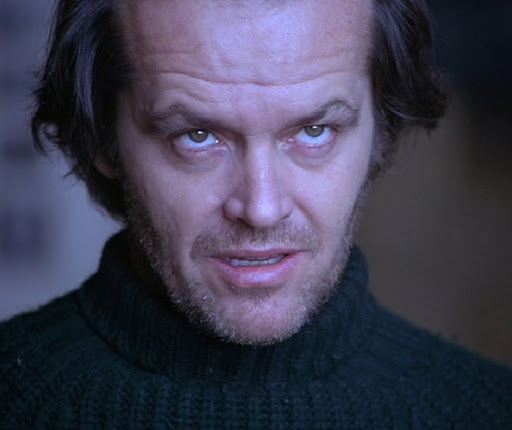
The film is pretty much perfectly cast, and Nicholson gives one of the most defining performances of his career. He shows real potential here for his future role as the Joker in Batman, especially once the madness sets in and his maniacal grin and eyebrows take over his face. Elsewhere his prominent brow and bright, glaring eyes are well used to strike fear into all who watch. Duvall is well cast too, though this isn’t a compliment as I think her character is supposed to be supremely annoying, and she succeeds in spades. It’s not often that you root for the axe-wielding psychopath over the innocent damsel in distress in a film, but I have absolutely no qualms about doing so here. 

This being a Kubrick film, it’s a given that a certain amount of flair has been utilised in the cinematography. The most famous example, and my personal favourite, is the long tracking shot following Danny as he wheels around the hotel on his tricycle. Infamously the camera was turned upside down to get it closer to the ground, offering a lower-than-child’s-eye perspective that really adds to the sense of dread, as does the incessant squeaking of the wheels as Danny follows an impossibly labyrinthine path around the hotel, a theme that recurs throughout the film.

The film is rife with too many unanswered questions and unquestioned answers, but due to Kubrick’s meticulous nature these can be assumed as being deliberate, present not only to infuriate the audience, but to keep them discussing the film forever more. Add to this some great quotable lines (“I’m not gonna hurt you, I’m just gonna bash your brains in.”), some of the most famous scenes in cinema (“Heeeeeeere’s Johnny!”), stellar performances, stunning visuals and a truly haunting score, and you’ve got not just a great horror film, but a great film in any genre. It’s just a shame I can’t watch it ever again.

Choose film 9/10

Nosferatu: Phantom der Nacht

As opening shots go, footage of dead, decomposed babies and children, their faces contorted into richtuses of terror and howls of pain is probably one of the clearest projections for the tone of the ensuing film that I’ve ever come across. Couple this with slow motion shots of bats flying in the dark (used repeatedly throughout the entire film whenever director Werner Herzog takes his fancy, regardless of it’s relevance to the plot) and a woman (Isabelle Adjani) waking up screaming to said bat flying around her window and you’re left with no uncertainty that this isn’t quite your average vampire film.

And that’s OK, because as I’ve discussed before, the tale of Dracula is fairly well known, even if you’ve never seen any of the many, many adaptations. This is my fourth Herzog film. I liked but was relatively underwhelmed by Rescue Dawn, couldn’t get my head around Aguirre and thought Bad Lieutenant was a good fit for Nicolas Cage’s own brand of insanity, but I understand that he has a reputation for being, well, a nutbag. That’s exactly the kind of approach you need to take with such a well versed story, and I approved of the inclusion of some new material. 

The story, in case you’ve been living in a soil-filled coffin for several centuries, concerns Jonathan Harker (Bruno Ganz), who is sent to Transylvania to organise a land deal with Count Dracula (Klaus Kinski), a mysterious recluse who terrifies the locals and has an obsession with the neck of Jonathan’s fiance, Lucy (Adjani). Kinski’s Dracula is a wonderful creation, far more haunted than haunting. He is a very pitiable creature, paper-white with deformed ears, needle-sharp teeth, a bulbous bald head and rat-like claws, as much tormented by his curse as he is a danger to others. His face is often all that can be seen, with his body and black silk robe shrouded in complete darkness. During dinner, when Jonathan cuts his thumb, Dracula is unable to stop himself from stalking over and sucking upon it. The scene is rivetting and unbelievably tense, with utter terror in the eyes of Jonathan. Similarly, Jonathan waking to Dracula in his doorway, slowly advancing upon him, is downright horrifying. Kinski may not be as effective a Dracula as Max Schreck, but he’s still bloody good.

I especially appreciated the switch in focus upon Dracula’s inevitable arrival at Jonathan’s hometown of Wismar. Instead of centring merely on the havoc caused by the presence of a vampire in their society, the attention is paid more to the rats he brought with him aboard his boat, and the plague that lays the town low. I think this is new to the story, and was a nice addition in my opinion, although the group of people enjoying a meal in the village square, over-run by rats to which they are oblivious because they’ve caught the plague but are planning to enjoy themselves regardless was perhaps a bit much.

The role of Van Helsing (Walter Landengast) has been severely reduced from what I expected, but his final moments are genius, plot-wise. The best shot, however, has to be the creative use of a vampire’s innability to appear in mirrors, as Lucy sits brushing her hair, gazing at her reflection. We see in the mirror a door behind her open and close – with the obligatory ominous creak – and a bald, taloned shadow creeping up on her, until claws appear beside her face. It’s brilliant. Roland Topor is also good as Harker’s boss Renfield, doing an impression of both Peter Lorre and Pee-Wee Herman simultaneously.

Something did feel a little off with the setting though, as if the people were walking around the modern day (or the 1970s, at least) and just happened to be wearing period garb. It was a while before I could shake this feeling, and I still can’t put my finger on where it came from. Maybe the locations, especially of Wismar, felt a bit too modern in comparison to the costumes and dialects. My favourite thing about the film? The assistant director is called Remmelt Remmelts.

Choose film 7/10

North By Northwest

This is the last review I’ve got left unposted from the recent reviewing competition at the Lamb, I hope you enjoy it.Is it really possible for North by Northwest to live up to its hype? It’s rare to find a Top Films list deprived of its inclusion, it features scenes that have become the stuff of legend, that also tend to top Best Scene lists, and it’s one of the greatest movies ever made by one of the greatest directors who ever lived.

If you haven’t seen it yet, then I strongly advise you to stop reading anything about it and go and watch it now, for North by Northwest is truly a tremendous film that is best enjoyed with as little outside knowledge as possible. When Cary Grant’s Roger O. Thornhill quips shortly after being kidnapped into the back of a car, “Don’t tell me where we’re going, surprise me,” this is not merely Hitchcock’s intentions for Thornhill, but for all of us watching as well.

There’s really no weak link in the film. From the opening Saul Bass title sequence, utilising the receding parallel lines of a Madison Avenue skyscraper’s windows to perch the credits atop as they rush off into the distance, down to the ever so cheeky closing train tunnel metaphor, every second oozes entertainment. Alfred Hitchcock’s longest film, and his fourth and final with fellow English-born collaborator Cary Grant, is also his most unashamedly fun. There are many people who have an issue with some of the more fantastical elements of the plot – to be fair, a cropduster is hardly the most effective method of assassination – but these people are preventing themselves from what is a truly thrilling experience. And after all, who is watching Hitchcock for realism? The master has always admitted that, whilst some films are a slice of life, his tend to be a slice of cake, and this one has the richest, creamiest filling, not to mention icing, a cherry and some rainbow-coloured sprinkles to boot.
Cary Grant is on his finest, suavest form as New York ad man Roger O. Thornhill, stepping straight from Mad Men into a classic Hitchcock mistaken identity caper. Thornhill is an egotistical chauvinist, totally in control of his superficial advertising world, yet within Grant’s capable hands he remains not simply likable, but enviable. Who wouldn’t want to fill out a suit like that, and have such a wide and successful array of quips and zingers at their disposal? For though he is constantly befuddled and bemused by the adventure he has innocently become swept along in, there is no circumstance that leaves him wanting for a one-liner. Here, Grant perfects the art of the stern expression and the furrowed brow, eternally caught between confusion and frustration, with merely a hint of excitement as his journey takes him across America in the effort to clear his name of a wrongfully accused murder. The role was originally offered to Hitch’s other great collaborator, James Stewart, after the two did such sterling work on Vertigo together, but as soon as Grant became available Stewart was dropped, in favour of a man Hitch believed would not be dwarfed by the extraordinary events going on around him. Whilst Stewart has often been remarkable in his everyman roles, it’s fair to say that Thornhill would not have been the right fit for him.
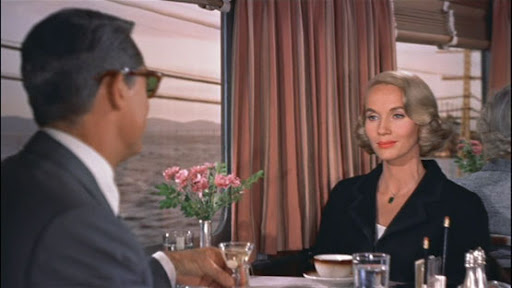
Such a masculine protagonist would be lost without a suitably feminine love interest, and Eva Marie Saint fits that job nicely as Eve Kendall, a typically beautiful Hitchcock blonde whose porcelain doll exterior hides her ability to use sex like some people do a flyswatter, and she holds her own against the likes of Psycho’s Janet Leigh, Rear Window’s Grace Kelly and Vertigo’s Kim Novak as she dabbles in some of the most forward repartee since Bacall taught Bogart how to whistle. Hitch always preferred the more beautiful but subtly sexy female leads, as he took great pleasure in uncovering their more alluring qualities than he would have with the more self-promoting individuals like Monroe. As with all of Hitchcock’s birds (pun intended) Saint is meticulously and beautifully dressed in every scene. Legend has it that the great director paid her wardrobe so much attention that Grant petulantly demanded advice on what he should be wearing, and was simply told to “Dress like Cary Grant.”
Released three years before Dr. No, this film clearly set the template for almost every Bond movie. With its dashing, smooth talking hero with an easily recognisable voice, the woman who falls for him within seconds of meeting, a villain’s lair in an impressive yet remote location (here James Mason’s Vandamm lives in a condo atop Mount Rushmore), an evil sidekick (Martin Landau, with a severe case of Henchman’s Eyebrow) and a fast-paced, stunt-riddled adventure taking in major cities around the world (or at least central and north-east USA). Thornhill even has the ability to make perfect strangers throw themselves at him; just wait for the reaction from the woman in his neighbouring hospital room. It’s no surprise to learn that Grant himself was an original candidate for what was to eventually become Sean Connery’s Bond.
Even from the trailer, this is one of the most comical of Hitchcock’s endeavours. Speaking directly to the audience, Hitch himself appears, advising the viewers on how to take the perfect vacation without leaving the cinema, keeping his tongue firmly planted in his cheek throughout (“You don’t find a tasteful murder on every guided tour, do you?”). It’s on Youtube, go check it out. Ernest Lehman’s Oscar-nominated script (tragically losing out to Pillow Talk) is full of far too many quotable lines to give justice to here, but it contains more than enough for even three films. My personal favourite? Saint declaring she’s a big girl, followed by Grant’s perfectly timed, effortless rebuttal of “and in all the right places.” The police station phone call is yet another example of solid gold. Occasionally the steady slew of insinuations and double entendres becomes a little cringeworthy, especially when Grant tells Saint he likes her flavour, but that’s a rare misstep for a script that otherwise never puts a foot wrong. There’s far too much excellence on hand to make you forget these, and the film will never fail to raise a smile with every viewing.
It isn’t just the dialogue though; the scenes without any discussions are often just as amazing, if not more so. Early on, after being forcibly imbibed with the best part of a bottle of bourbon, Thornhill is unleashed behind the wheel of a car, in an attempt to instigate his demise. Upon realising what’s going on he awakes in a drunken stupor and does his utmost to keep his car on the increasingly blurred and merging roads in front of him. Grant makes for an amusingly intense drunk, persistently blinking, squinting and staring bug-eyed at the cars he races past, made all the more dramatic by Bernard Herrmann’s  stupendously engaging score. Of course, there’s also the hallowed cropduster chase, as Thornhill, having been lured to the middle of nowhere to meet the man he’s been accused of being, finds himself battling the more painful end of a plane’s propeller. One of the few scenes not set to music – to better emphasise the relentless whirring of the plane and the lack of assistance Thornhill is likely to receive with the matter at hand – the scene is worth watching as a standalone segment. Equal parts exhilarating, terrifying and fun, it’s made all the more hilarious for the entire time Grant dives through dirt and hides amongst crops he is wearing his increasingly worn yet perfectly tailored grey flannel suit, clean shaven and with immaculate hair.
Hitchcock’s regular cinematographer, Robert Burks, excels himself in a manner that by this film is surely only to be expected. The shot of Thornhill fleeing the UN building to a waiting cab is stunning, captured from high above and angled down the side of a skyscraper, a shot I’d happily have framed on my wall, and the revealing shot of a gun hidden in a purse is sly enough to almost go unnoticed, but is sure to pay off later. Hitch ticks off almost all of his standard tropes – a wrongfully accused man on the run, maternal issues (Jessie Royce Landis, who plays Thornhill’s mother, was in real life only 8 years older than Grant), spies, deception, train journeys, height-based peril, an all-but-unnecessary MacGuffin (a statue full of microfilm), bumbling policemen, a tense finale set atop a famous landmark and, of course, an icy blonde. All that’s missing is a self-deprecating scene in a cinema.
When compared to modern day blockbusters, this picture more than holds up. Its unstoppable, kinetic nature will keep fans of both classic cinema and present day fare glued to the screen and on the edge of their seats for the entire 136 minute runtime. Filled with glamour, wit, excitement and big scenes on a large canvas, there’s something here to please everyone, as long as they like really great films. Does it live up to the hype? Yes, and more so.
Choose film 10/10

Looper

Regular readers will know I’ve had a tumultuous relationship with Looper, the third film from writer/director Rian Johnson. I loved Brick, and even wrote a post expressing my excitement and fears for the upcoming film, but alas when I went to see the film the first time around I passed out half an hour in, for reasons as yet undetermined. There’s an entire team of doctors and medical students currently scratching each others heads just trying to work out what – or rather, how many things – are wrong with me. But failing to fully see the film first time around gave me an opportunity to see The Brothers Bloom, Johnson’s second film, before watching the rest of his third. I have now managed to successfully see the entire film, in one sitting, having paid for a total of four cinema tickets (me + girlfriend first time around, me + friend second time around, Aisha didn’t want to see it again). And, personally, I think it was worth it.
Continue reading

The Magnificent Seven

A small farming community is being terrorised by a band of thieves and murderers, led by the charismatic but ruthless Calvera (Eli Wallach, previously only known to my girlfriend as the elderly neighbour in The Holiday). He and his gang steal almost everything worth taking from the villagers, leaving them just enough to carry on farming for another year, at which point Calvera will return and repeat the process over again. Sick of this injustice, three villagers head to the nearest saloon and recruit someone to either train or protect them, finding Yul Brynner’s Chris as the perfect fit for the role after he volunteers for something that could get him killed, and offers no reward – a situation very similar to that of defending the village. Chris then goes about assembling a team – you can probably guess how many – of similarly minded men based on Chris’ previous dealings with them or their reputations. 

The line-up has since become a member of the great pantheon of Pub Quiz Questions – I can never remember Brad Dexter or Horst Buchholz, but I’ve won a DVD by naming James Coburn before. The remaining members are Charles Bronson, Robert Vaughn and, of course, Steve McQueen, who all have various reasons for signing up, be it running from the law, spotting a money-making opportunity or just plain boredom.

This is one of those films that I remembered through a rose-tinted haze as being a far greater film than it turned out to be. It’s not a bad film, not at all, it’s just not the stone-cold classic I had remembered. My main problem was in the amount of time it took for the Seven to assemble, and the attempts to shed doubt on whether certain members will join or not. It’s clear from the very title of the film that there will be a group of seven defending the village, but the group isn’t together until about halfway through the film! Also, I felt that for the most part enough screentime was given to each of the seven, except for Buchholz’s Chico being given far too much time as the young rookie looking to prove himself, and Coburn’s stoic knife-throwing Britt barely getting a look in after receiving the best introduction of the guys. I’m especially sore about Coburn because he’s my favourite character (and accent) in The Great Escape (coming soon), and he voiced Waternoose in Monsters, Inc. Most of the seven are given some kind of arc of character trait, but Britt’s appears to be just falling asleep under any available tree, and being completely unable to hide behind cover whilst shooting.

Based on The Seven Samurai, I had hoped to watch Akira Kurosawa’s classic epic before seeing The Magnificent Seven again, but alas my Steve McQueen adventures and requests from my weekly movie night made this impossible, but hopefully I’ll get to it soon. What I hadn’t realised is that this film was also remade (not as Battle Beyond The Stars, I haven’t seen that yet), but as A Bug’s Life. Granted, the plots aren’t identical, but there are some startling similarities. I’m not entirely sure how happy Charles Bronson would be to know he’d been recast as a ladybird.

There are some gloriously over the top death sequences, and the finale is a great shoot out, though it doesn’t compare to some other classic ones. It’s a very enjoyable film, but alas it’s not the one I remembered. Still the best Steve McQueen film I’ve seen so far on this journey.


Choose film 7/10

Guaranteed Happiness: Kiss Kiss Bang Bang

Kiss Kiss Bang Bang is a film I’ve loved since the fist time I watched it, and always proves to be an enjoyable experience, yet I fear that from now on I won’t enjoy it any more, because I will have horrific, Vietnam-style flashbacks to my latest viewing, or rather the repercussions from it. You see, I volunteered to appear on The Lamb‘s weekly podcast, The Lambcast, for their Movie Of The Month segment, and I was overjoyed to discover that said movie was Kiss Kiss Bang Bang. Granted, I may have voted 7 or 8 times for it and hoped that one of the primaries would drop out so I could discuss such a great film with some similarly-minded individuals, so I can’t say I was overly surprised when it won. However, this was my first ever podcast (recorded last Sunday), and I was so horrifically bad in it that I’m not sure I’ll ever be able to enjoy said film again. The episode has now dropped, and is available on iTunes (search Lambcast in podcasts) or via this link. I urge you to listen to it more for the scintillating discussion between Dan Heaton, Justin Gott, Kristen Lopez and Nick Jobe  than for my dismal contribution, however if I’ve ever wronged you in the past (a list longer than I’d like), then you may also enjoy the podcast, for different reasons. If you could just ignore my horribly grating, nasally drone whenever it aggravates your eardrums and pretend instead it was just a four-way chat then I’d appreciate it.
Maybe it was because I’m a first timer and everyone else there seemed far more experienced at it than I, probably because they are and some of them regularly hold podcasts of their own, or maybe it’s that I’m genuinely not very good at talking about films with real live actual people without using a keyboard (it doesn’t happen very often), but I’d like to issue an apology to Dan, Justin, Kristen and Nick for lowering the quality of the podcast, and for relentlessly interrupting and talking over them when I had nothing very interesting to say. I was nervous, and it’s never been more abundantly clear that when talking about films, I truly do not know what I’m talking about. Also, I hate public speaking, so signing up for a podcast was probably a pretty dumb thing to do. Don’t worry, I won’t do it again.
Continue reading

Blackmail

Hitchcock, now with added sound! Yes, we’ve moved on from Hitch’s silent pictures (until I can find the ones I’ve had to skip) and onto his first to use audible dialogue, as well as the first I’ve seen that doesn’t appear to have been filmed entirely on a set, although knowing the director built the entire apartment block set of Rear Window inside a studio, you never can tell with Hitchcock.

Blackmail focuses on a young couple, John Longden’s Frank, a Scotland Yard detective, and Anny Ondra (yep, her again) as Alice, the daughter of a shop owner. Alice has become bored of Frank’s obsession with his career, and has eyes for another man, the irrationally posh artist Mr. Crewe (Cyril Ritchard). Crewe invites Alice back to his studio apartment one evening, and things don’t necessarily plan out how either of them would have expected, so Frank gets involved to try and help Alice out of the sticky situation she finds herself in.
Continue reading