Brave

Brave marks something of unchartered territory for animation powerhouse Pixar. It’s their first fairytale,, the first set in the past, the first to use magic, and the first to feature a female lead, in Kelly Macdonald’s Princess Merida. It’s also the Pixar film that I’ve waited the longest to see since it’s cinema release, seeing as it came out here over a month ago, but I only saw it yesterday because of the frankly outrageous 3D scheduling of my cinema (as always, fuck 3D). 

The long delay has added to my already high level of anticipation for the film, seeing as I started reading reviews of my American and New Zealander counterparts months ago when the film was released over there (seriously, why such a long wait for us Brits? Sort it out), and my deep love of most things Pixar (Cars? meh) meant that this film was going to have to do a lot to satisfy me. And unfortunately, it didn’t.
Continue reading

Silver Lode

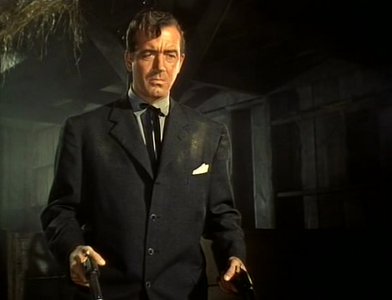
You ever have one of those mornings when you’re on holiday, you’ve woken up a few hours before your other half is likely to surface from the depths of slumber and you can’t go anywhere? Well, this happened to me recently, but fortunately I had my laptop and a copy of Silver Lode, yet I knew absolutely nothing of the film (save for it’s 81-minute runtime) so I settled down to watch it. I like watching films with o prior knowledge, and it happens less and less these days, so this was a nice surprise. In the opening credits though, I second-guessed the film completely incorrectly. You see, I could tell from the title that it was likely to be a western, and it stars a man called John Payne, who I’d previously never heard of, so I assumed it was a western spoof, and they’d tried to be funny by subbing the lead actor’s name with one comically similar to John Wayne. Nope, it turns out there’s an actor called John Payne who, according to IMDb, has 73 acting credits to his name, including this definitely-not-a-parody-or-even-a-comedy film.


Payne stars as Dan Ballard, a man who seems to only ever be referred to by his full name. On his wedding day, on the 4th of July, four U.S. Marshals, led by the greasy Ned McCarty (Dan Duryea), arrive in the town of Silver Lode and set about arresting Dan for a crime committed two years previously, just prior to his arrival in the town. Dan, who has become something of a pillar within the town’s community, initially has the support of his friend and neighbours, and especially his bride-to-be Rose (Lizabeth Scott), but it’s not long before the marshal’s story seems to make sense, and Dan is given two hours to put his affairs in order before he is to be arrested.

Surprisingly for a film released in 1954, I was bowled over by the cinematography in this movie. There is one shot in particular, which sees Ballard running for four blocks, dodging people, horses and gunshots, which has the camera following him the entire way. I’d even go so far as to call this the Children of Men of the 50s, so stunning is the shot. The actual story plays out in real time, from the moment the marshals arrive in town until the story reaches it’s conclusion, so in that way it was reminiscent of another classic western, High Noon, and in fact featured similar plot elements. Just as Gary Cooper’s Marshal Will Kane had to plead with all of his friends to help him out, so too eventually does Ballard, and with similar results. If you liked High Noon, I’m fairly sure you’ll get on well with Silver Lode.

Some of the scenes have become almost cliches today, for example the opening-a-door-on-an-innocent-man-holding-a-gun-over-a-corpse trick, yet they remain effective if only a little eye-roll-worthy. The characters have become stock western tropes too – the tart with a heart of gold, grumpy magistrate, naive farmhand etc. They do spit out some wonderful, and occasionally cringe-inducing lines, with a young man, who I could have sworn was Ron Howard but apparently isn’t, telling Dan that he’ll never trust anyone again if he’s lied.

I approved of the way that initially the audience is kept as much in the dark as the townspeople, until around the halfway mark we’re put into Ballard’s shoes and shown what is really going on. This increased my empathy towards Dan, as it wasn’t until then that I knew what he was up against. Payne plays the man well, hinting at the possibility of a shady past, even though he  could be Cary Grant’s brother – in both speech pattern and the way he fills out a suit. The portrayal of Duryea’s McCarty was a little too on the nose as being the obvious villain of the piece. He definitely comes off as evil early on and not simply an antagonist for Ballard to overcome, which made some of the later reveals a tad unsurprising, but all in all I thoroughly enjoyed this film, and would recommend it to anyone else stuck for a couple of hours with nothing else they can possibly do.

Choose film 8/10

The Farmer’s Wife

In the late 1920s, having just wedded Alma Reville, marriage was clearly at the forefront of Alfred Hitchcock’s mind as he adapted this play be Eden Phillpotts about a farmer who, after the passing of his wife and the marriage of his daughter, seeks to find a new wife within the small group of eligible women within his village. Farmer Samuel Sweetland (Jameson Thomas) is by and large a good man, though he has difficulty in expressing himself, often fails to see what is directly in front of him and has a heightened ego. Still, he means well. After his wife’s death, in which her last words are reminding the maid (Lillian Hall-Davis, returning from The Ring) to air out her master’s pants, Minta the maid takes over all of the wife’s duties as well as her own. Once the farmer’s daughter has been given away, Minta is given one more job to do, help Sweetland find a wife, so the two of them sit down and make a list of the four potential candidates.

This being a comedy, things inevitably do not go to plan, mainly due to Sweetland’s pomposity and the various faults of the women. It probably didn’t help that his first proposal attempt involved calling his prospective fiance a fat hen, and that he announces that he is getting married, before actually asking if she is OK with the situation. The script is full of mild – and not so mild – put downs, largely aimed at the women (“Her back view’s not a day over 30.” “But you have to live with her front view.” “I don’t mind pillowy women, so long as they be pillowy in the right places.”). Elsewhere, the film featured possibly my favourite title card from a silent film ever, with the completely unexpected line “You are the first man who has accepted my sex challenge,” made all the more hilarious by the frail, demure woman who utters it.

As the farmer, Jameson Thomas has mastered the art of looking flustered with wide-eyed rage and exasperation, although at times I felt he was just as likely to strangle some of the women as propose to them, not helped by his Snidely Whiplash moustache and sneer. I can’t help thinking the women who turned him down were lucky not to wake up tied to the train tracks. I felt the film seemed to lose it’s way a little later on, and the ending is clearly signposted within the first 15 minutes, but is done so sweetly that you really don’t mind, and the overall theme of the plot reminded me of Keaton’s Seven Chances, which similarly involves a largely unsuccessful attempt at finding a wife, but for different reasons entirely. The handyman, Mr. Ash (Gordon Harker) gets the short end of the stick comedically, having to endure a series of pratfalls, mostly involving oversized trousers, but this doesn’t detract from the film too much. These may have been an attempt to distance the film from the largely dialogue-based play, as is the case with a climactic fox hunt that would have been almost impossible to perform on a stage.

This was far more enjoyable, and funnier, than I was expecting. If you don’t mind silent comedies, and I’m learning that I don’t, then this isn’t a must-see, but is enjoyable if you can find it.

Choose film 7/10

The Virgin Suicides

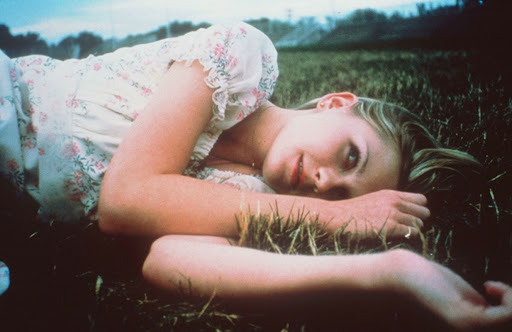
Completely unintentionally, this was the second film in a row I watched where a young girl burns her own record collection (after Heavenly Creatures), and also the second in not too long a time in which Kirsten Dunst has sex in a field (after Melancholia a few months ago). With a title like The Virgin Suicides, I wasn’t exactly looking forward to watching this film, as it seemed like it was going to be joining the ranks of those thoroughly depressing films I’d been trying to avoid lately, and the fact that it was directed by Sofia Coppola, whose Lost in Translation I wasn’t overly fond of the last time I watched it, and who I still haven’t completely forgiven for The Godfather Part III, made me even less excited. Plus, its a story of the multiple suicides of a clan of teenage sisters, which always leads to a laugh riot in my books.

The girls in question are the Lisbons, five sisters aged 13 to 17, who are kept under the watchful eyes of their strictly religious parents, Kathleen Turner and James Woods. The girls are largely kept under lock and key, only allowed out to go to school, where they are lusted over by the local boys, as that which you cannot have will always be that which you want the most. Cecilia (Hannah Hall, Forrest Gump‘s young Jenny), the youngest girl at just thirteen years old, attempts to kill herself in the bathtub. After she survives and recovers, her parents throw a party for the girls and some of the local boys, during which Cecilia excuses herself, goes upstairs and jumps out of the window, impaling herself upon the railings in their front garden. Hey, I warned you, this ain’t the happiest of films. The death of their youngest sibling seems to have little effect upon the sisters, though their parents ratchet up the levels of over-protectiveness, coming to a head when eventually the girls are taken completely out of school, never being let out of their parents’ sight.Kirsten Dunst is a revelation in this film, and I’m not normally her biggest fan. She displays a confidence on screen that’s almost otherworldly. At the time of making this film, aged just seventeen (though playing the second-youngest Lisbon, 14-year old Lux) she had appeared in no less than fourteen films, including Jumanji, Interview with the Vampire and Small Soldiers, and her level of experience is clear as she is this picture’s main focus. Even as the youngest, after Cecilia’s demise, Lux appears more world-weary and equipped with a greater level of confidence and intelligence than her oldest sisters (Chelse Swain, A. J. Cook and Leslie Hayman), so much so that the sisters all seem to merge together in a largely forgettable blur. The adults are all impressive, particularly Woods in an unusually repressed role, but be prepared to be taken out of the film when Danny DeVito pops in for one scene as the psychiatrist Cecilia is sent to after her first suicide attempt.

The film has been shot with an air of beauty and nostalgia –  opening with an upbeat yet mellow soundtrack of a bright sunny days, the light dappling through the trees of a suburban Michigan town – but this is immediately contrasted to the stark sterile blue of Cecilia lying in a bathtub, being carted away by the paramedics. This jarring emotional toggle switch occurs a couple more times throughout the picture, and each time it is effective. The narration, by one of the boys waiting outside each day just to catch a glimpse of the girls, is largely unemotional and distanced from events, as though bored of a story told many times before.

From what I know the 1970s was recreated well, particularly in the fashions and vile interior design. Every shot was reminiscent of an old photograph, saturated and hazy, almost sepia and fading at the edges. Unusually, a lot of the scenes didn’t play out as I originally expected, even more of a surprise when you consider they have such standard high school movie tropes as a prom, featuring parents enthusiastic at their daughters’ dates, fumbled first dances and peach schnappes under the podium (“Babes love it.”) The script is at times comic, and occasionally blackly so, with my favourite moment being when, after awaking in the hospital, her doctor tells Cecilia she shouldn’t have tried to kill herself because she’s “not even old enough to know how bad life gets,” which is a pretty terrible way of convincing someone not to try and kill themselves again, but her response is perfect, “You’ve never been a 13-year old girl.”

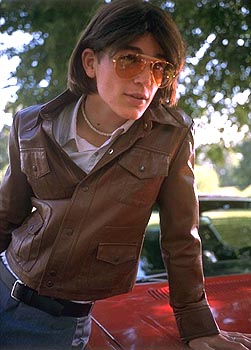
I suppose I should mention Josh Hartnett, who appears as the local dreamboat, Trip Fontaine, adored by students, parents and teachers alike, all except Dunst’s Lux, which only makes him want her more. Hartnett is his usual self, and I’m not too much of a fan (his only good films in my opinion are Sin City, The Faculty and Black Hawk Down, which surprise surprise don’t feature him all too heavily), and his abominable curtains-style haircut almost ruined the film for me. It was nice to see him playing such a prick though. Hayden Christensen is also in there somewhere, which is never a good thing.

So, whilst it’s not really going to cheer you up after a long day’s work, this is still a very well made and easily appreciated film, far better than I was expecting from Coppola. The ending in particular left me reeling for days afterwards.

Choose film 8/10

Blood Simple

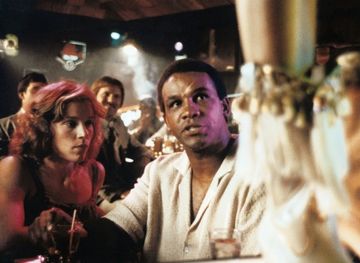
Blood Simple, the directorial/writing debut of the Coen brothers Joel and Ethan, is a sticky, sweaty, clammy picture about deceit and confusion, set in the heart of Texas. Marty (Dan Hedaya) runs a bar, and is the boss of Ray (John Getz) and Meurice (Samm-Art Williams). Distrustful of his wife Abby (Frances McDormand), Dan has hired private investigator Loren Visser (M. Emmet Walsh) to look into what she does with her time. It transpires that Abby is sleeping with Ray, so Marty hires Loren to kill them both whilst he is away on a fishing trip. What with this being a Coen film, things don’t necessarily go to plan, but it is the direction the events took, and the motives involved that I found both interesting and compelling.

Tonally, this is probably most similar to Fargo or No Country For Old Men amongst the Coens’ oeuvre. There’s not a great deal of humour surrounding the violence and devious plotting going on, and the location of Texas adds a great deal to the setting, just as Minnesota did for Fargo and Texas again for No Country. I found this lack of comedy to be a bit jarring – there are some moments of Coen-esque quirkiness certainly, and a couple of jokes in the script, but for the most part this is played dead seriously. The brothers can do serious very well, but personally I prefer their lighter efforts.
Had I not known this was a Coen film (and had it not starred Frances McDormand) then I don’t think I’d have immediately associated it with them. If anything, the structure of the narrative felt far too linear and ordinary, with the exception of perhaps missing an opening and closing scene most directors would have felt obliged to leave in. We’re fed the plot in dribs and drabs, discovering who each of the characters is and their relationships to one another just a couple of minutes after we need to.
Though he isn’t necessarily amongst the lead trio of the film, I would class Walsh’s performance as the greatest in the movie. His Visser is the human embodiment of a lizard, a slimy, oily gumshoe with a malicious streak and a rasping laugh that still haunts my dreams. He plays the part so well that I can’t believe I haven’t come across the actor in much else. For my sins I only really know him from Wild Wild West (he was the train driver). Can anyone recommend any of his other work?
I loved the musical choices in the film, especially Ray mopping up blood to the sounds of The Four Tops’ It’s the Same Old Song, an almost Tarantino-like retro song choice. The camerawork too was at times inspired; the marriage of lighting and camera movement revealing Visser’s cigarette lighter on a table, and the oppressive close shots inside the bar intensifying the humid atmosphere.
I can’t imagine this film cost very much to make – the biggest set pieces involve a car and a shovel, and a gun, knife and a window – yet it’s easily as gripping as many other big budget blockbusters. It reminded me of the likes of Glengarry Glen Ross or Reservoir Dogs, neither one which involves a lot of spectacle, but they have great characters and dialogue, which really is in my opinion more important. I’d have liked a last shot of Meurice – one of the coolest characters in film, check out his bar-top shuffle – but other than that the ending was pretty well contained and executed. Whilst by no means the Coens’ best, this is still definitely worth a watch.
Choose film 8/10

Heavenly Creatures

Christchurch, New Zealand, the mid-1950s. Two girls, Pauline (Melanie Lynskey) and Juliet (Kate Winslet) run terrified through the dense forest, the air streaked with their screams and their faces streaked with blood. They burst through the bushes and emerge to the concerned face of a passer-by with the words “It’s Mummy! She’s terribly hurt!”So begins Peter Jackson’s Heavenly Creatures, the true story of two schoolgirls whose problematic home lives forge a bridge between them, a bridge that leads to a fantasy world of princes and princesses, giant butterflies, murder, topiary and unicorns. But when their parents strive to separate the two, the girls hatch a plan to remain together by taking drastic actions.

The Dark Knight Rises

Just to let you know, like the rest of the world, I have seen The Dark Knight Rises. I saw it opening night, over two weeks ago, but haven’t written a review yet for two reasons: 1, I haven’t had time, and 2, I didn’t really have anything to say that everyone else hasn’t already said. So, I’m not going to review it yet. What I am going to do is wait until it comes out on DVD, buy it, watch it again, and then review it. Simple. Hopefully by then everyone will be over the inundation of Batman reviews. In the meantime, here’s my quick thoughts on the film:

Continue reading

Guaranteed Happiness: Wall-E

Welcome to the first post in my new semi-regular feature, Guaranteed Happiness. I’ve discovered that a lot of the films I’ve watched recently haven’t necessarily dealt with very happy subjects, and this has been getting me down a bit. Now and then, I’d quite like to watch a happy film, or one that’s uplifting and ensures that I’ll have a big stupid grin on my face for at least 80% of it, and definitely at the end. After all, I’d much rather write about a film I’m passionate about, and I tend to have more to say about films that make me smile than those that make me suicidal. Praise should be aimed squarely between the shoulders of my girlfriend then, for sticking on Pixar’s gem Wall-E when I was in a decidedly cranky mood a little while ago. The aim was for me to sit down and write some posts, which to be honest I was in no mood to do after a fairly crappy day at work and having to shell out over a considerable amount of cash to fix my bike, yet as soon as the film began all thoughts of blogging and even glancing at my laptop screen were out the window.So, why do I love Wall-E? The simple answer is robots. It’ll come as no surprise to regular readers that a film featuring robots (or dinosaurs, time travel or Stephen Tobolowsky) will immediately be watched with heightened levels of glee. And the fact that it’s made by Pixar, a company that has made some of my favourite films to date, and is where I’d be willing to sell several members of my immediate family to work at, then so much the better.This is my favourite Pixar film, which is definitely saying something. I adore the Toy Story trilogy (especially, predictably, Rex), but there’s something about Wall-E‘s simplicity, its pared down scope and focus on telling a straightforward story in new, interesting, and above all, beautiful ways.

The plot is basic: in the not-too-distant future, the human race has polluted and destroyed the world so much that life has become unsustainable, and the only hope lies in the Axiom, a titanic spaceship resplendent with every luxurious convenience to fulfil any desire. Earth has been abandoned and left to the robots, who spend the next few hundred years tidying the place up. Wall-E, our intrepid hero, is the last surviving ‘bot, and he spends his days making and stacking little cubes of garbage into towering skyscrapers of trash, accompanied by his only friend, a cockroach. One day, a ship descends from the heavens, carrying EVE, a futuristic, high tech reconnaissance droid, and Wall-E is instantly smitten.

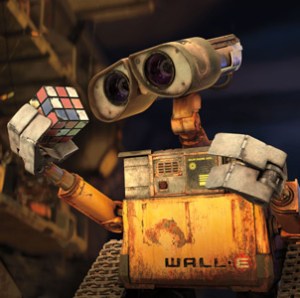
The tale of a schlubby, down-on-his-luck guy falling in love with an out-of-his-league wonder girl is hardly new, but as far as I know this is the first time it’s been told almost entirely wordlessly, and about mechanical beings. A certain amount of disbelief needs to be suspended to watch the film – the robots seem to have far more personality than they should have been implanted with in the factory – but this results in one of the most well-rounded characters in all of Pixar’s history. Wall-E (which stands for Waste Allocated Load Lifter – Earth Class, something I know from memory) has a love for all things quirky, unusual or fascinating, be it a Rubik’s cube, egg whisk or an old VHS of Hello Dolly!, and watching him investigate the functions of each item – wearing a bra like sunglasses, accidentally erupting a fire extinguisher – are a joy to behold. As are his attempts to woo the evidently disinterest EVE (whose acronym would be a spoiler). The couple’s dates are more moving and say far more than any scene of dialogue could.

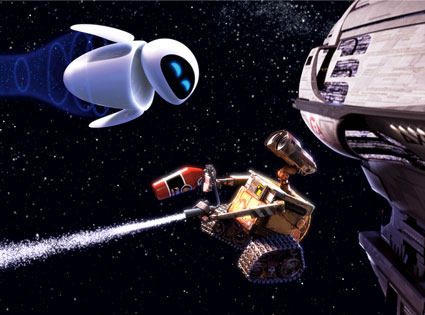
It’s almost impossible to narrow the film down to my favourite scene, but I’d probably say EVE and Wall-E’s space flight. It’s nothing short of a work of art, as the two bots fly a merry courtship dance around one another, set to Thomas Newman’s beautiful score. In fact, every scene between just those two, all almost entirely devoid of dialogue, are so very easily lost in. Their relationship feels natural and real, and if anything the films is at a detriment as the plot moves away from Earth, and the story looks past our central couple.

There’s a few messages hidden not too deeply in the film – stop fucking up the Earth, grow your own food, get off your arse and exercise – but to be fair these are all fairly good messages, when compared to the standard Disney fare of wait for a handsome prince to come and rescue you. Wall-E’s messages are ones I personally agree with (“even if I don’t necessarily live by them,” he says, patting the spare tyre around his midriff) so I don’t really mind such unsubtle preaching in a film, especially one as entertaining as this.

I’ve made no secret of the fact that I’d have loved nothing more than to have been part of the character design team on this film. Wall-E himself has been so carefully thought out with regard to how he works and fits together. I may have appreciated this more than most, being a mechanical engineer by trade, but I think everyone should be impressed by the level of detail. Apparently the design team at Pixar meticulously analysed various machines, working out which ones were ‘male’ and which were ‘female’, and what characteristics defined these genders. Wall-E has clearly been inspired by more clunkier, mechanical machinery, as seen in factories and assembly lines, whilst the sleek, white plastic of EVE is straight out of an Apple store.

As you’ve probably realised, I love this film. The Wall-E poster, a giant pair of his eyes looking inquisitively out of the frame, justifiably hangs in in my lounge, yet I think it almost qualifies as one of the ‘other’ Pixar films that isn’t about toys, fish or superheroes. From the small details – sci-fi queen Sigourney Weaver voicing the Axiom’s tannoy – to the fully realised plot and the brilliance of casting Ben Burtt, the voice of R2D2, as Wall-E, I cannot fault this film in the least, and nor would I want to. And I’d still be trying to get Randy Newman’s closing credits song out of my head if it wasn’t so bloody good.

Choose film 10/10
The Descendants

I’ve had The Descendants, currently the only Blu-Ray I own, sat on my shelf for a few weeks now, ever since I won it from the Empire Podcast, by answering a question about E.R., even though I’ve never seen a single episode. All praise IMDb. I’m something of a fan of Alexander Payne, and both Sideways and Election are just wonderful, so I’d been looking forward to sitting down and watching this, especially with all the Oscar buzz it had garnered earlier this year. The Descendants was nominated for five awards in all, including Best Picture, Director, Editing and Actor, and eventually won for Adapted Screenplay.

George Clooney, the aforementioned acting nominee, is Matt King, a wealthy landowner living in Hawaii,  and on the brink of a massive retail deal, in which his family’s historic heritage is to be sold, as requested by many of Matt’s less wealthy cousins. As if life weren’t stressful enough, Matt’s sporty wife Elizabeth (Patricia Hastie) suffers a horrific speedboat accident, leaving her in a coma, and Matt boosted from his former role as ‘back-up parent’ to the sole guardian of their two children, 10-year old Scottie (Amara Miller) and 17-year old Alexandra (Shailene Woodley), and soon becomes lumbered with Alexandra’s lunkheaded friend Sid (Nick Krause).
There’s a certain level of expectation for an Alexander Payne movie. The ones I’ve seen (not including Citizen Ruth or Inside Out 1 and 3) have all dealt with a story with dour aspects – be it failure, adultery, fraud, unhappiness or Kathy Bates’ backside – yet the sadness has been all but shrouded in comedy, yet here Payne’s reputable light touch is fighting against a brick wall of melancholy with the probable impending death of a spouse and mother. Such a morbid topic is no match for any level of wit, and the film almost always retains a depressing tone. This isn’t to say its a bad film, far from it in fact, its just that I was expecting a much more enjoyable watching experience that didn’t leave me deeply moved and my girlfriend literally in tears.
Payne made exactly the right casting decision in Clooney as Matt. The character is, let’s be honest, a bit of a dick. Yes, he’s a hard worker with a balanced head on his shoulders (he believes in giving his children enough money to do something, not so much that they’ll do nothing) yet he is practically absent when it comes to being a father and husband. Frequently away on business, he has little-to-no knowledge of his daughter’s lives, and it comes as no surprise to learn that prior to her accident, his wife was having an affair. It’d be a heartbreaking moment in most other actor’s hands, but Clooney breaks the tension with a ridiculously stone-faced flip-flop run. Under his command Matt is almost likable, and definitely relatable, even though he’s obscenely wealthy. Clooney is, in my opinion, a thoroughly under-rated comedic actor, and in one memorable scene (pictured) he has some genuinely hilarious eyebrows. Matt always seems to do the right thing and have the best of intentions at heart, yet his methodology and timing aren’t necessarily sound.
The revelatory performance of the film however is Shailene Woodley as Matt’s eldest daughter Alex, who lives on a different island to her father both literally and figuratively. Woodley is perfect in the role, her first in a film after appearing regularly on television since 1999, aged 8. Here she captures the exact transition from petulant teenager to woman-of-the-house, becoming a surrogate mother to her younger sister and a confidante to her father. Nick Krause is also great as Sid, a cliched dumbass who still gets to set up some of the film’s funniest moments. His first interaction with Matt’s father-in-law is just genius.
Beau Bridges and Judy Greer crop up in small roles, and Matthew Lillard does surprisingly well as a guy you really should hate deeply. The script has subtlety – offhand remarks to Elizabeth’s alcoholism and Alex’s drug taking – and definitely deserved at least the Oscar nomination, and whilst much of the action is fairly predictable, there are still a few unexpected turns along the way. This is still probably the least enjoyable of Payne’s films that I’ve seen – mostly due to the subject matter – but it’s still moving, well acted and performed, and all the locations are stunning.
Choose Film 8/10

Memento

Christopher Nolan’s first major picture (after 1998’s Following, which is interesting but a tad too confusing, and really for completists only) is at first glance nothing but a gimmick, using a reverse-narrative to tell the detective noir of Guy Pearce’s Leonard Shelby as he hunts for the man who raped and killed his wife whilst suffering with a rare condition that prevents him from making new memories. However it turns out that telling the story backwards, scene by scene and with an expositionary telephone conversation spliced in between, is the only way to give the story justice.
Famously, there is an easter egg on the Memento DVD that plays the film in chronological order, and I’ve discovered that in that orientation the film just doesn’t work. It’s not just because the last few seconds of every scene are replayed again moments later at the start of the next one (surely that wouldn’t have taken much to edit out?) but it’s also because the film is completely lacking in tension or pacing when that way round. Which just goes to show that Nolan was able to use a plot technique to it’s fullest advantage, which in the hands of a lesser director could have proved disastrous.
Pearce is excellent in an unforgiving role, especially given that Leonard has no character arc longer than a scene. He’s always been a brilliant actor, and often hides his Brad Pitt-esque looks behind obscuring facial furniture or heavy make-up – see Ed Exley’s glasses in L.A. Confidential, or large amounts of Play-doh in Prometheus – and here is no exception, with Shelby’s body plastered with tattoos and a shock of peroxide blonde hair to distract from those razor-sharp cheekbones. Pearce is ably supported by Carrie-Anne Moss and Joe Pantoliano as Natalie and Teddy, people who may or may not be out to help Leonard on his quest.We discover elements of the story as Leonard does, and the true meaning of almost every scene is altered by the one that immediately precedes/follows it. Surprisingly, a scene can hold just as many surprises, and just as much tension, if you know how it ends but not how it begins. You can’t help but feel sorry for Leonard, in a situation that would drive most of us insane – as long as we could remember the insanity long enough – and his life would be hard enough without everyone screwing with him. Even the clerk at his motel (Batman Begins‘ Mark Boone Junior) charges him for two different rooms, and doesn’t even hide it from Leonard, as there’s no chance he’ll remember.

There’s more comedic moments than you might remember, and some darkly so, for example the conversation where Leonard reveals to Natalie that the last thing he remembers is his wife. She says that’s sweet, before Leonard concludes “…dying.” I probably shouldn’t have, but this got a start of laughter from me.

I remember that my first viewing of this movie was ruined when I borrowed it from a housemate some years ago. He basically told me the ending, and that the film was crap, but I watched it anyway and remained intrigued and fascinated by how the plot would tie together – which it does nicely. Rest assured I never took that housemates movie advice again.

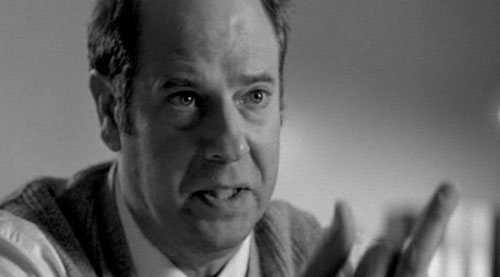
If Stephen Tobolowsky is in a film, then I’m legally obliged to mention him in a review, and here he crops up in grainy, black and white flashback as Sammy Jankis, a case Leonard looked into as an insurance claims investigator before his memory loss. Jankis suffered from a similar condition as Leonard, and Tobolowsky’s wonderfully big blank face is perfect for the look of someone not recognising anything new in the world around him, and his bursts of anger at annoyance – at an elctro-shock test and not understanding TV shows – is also great.

The story, written by Christopher Nolan’s brother Jonathan, is well thought out and takes into account the minutiae of Leonard’s predicament. Such a high concept (though scientifically possible) film could have left many annoyances at skipped over details, loose plot strands or inconsistencies, but by the end/beginning no such problems are left.

Choose film 9/10