Seven Brides For Seven Brothers

I’m not normally a huge fan of classic musicals. I quite liked West Side Story, but couldn’t abide The Sound Of Music, so my hopes weren’ exactly high for this 1954 classic of which I knew very little, other than there were presumably at least fourteen characters. I’m relieved to tell you that not only did I not find this film terrible, I frickin’ loved it.Set in 1850’s Oregon, the film predominantly follows Adam Pontipee, the eldest of seven brothers (duh) who all live away from society in a secluded shack, as woodsmen. Whilst visiting town to trade, Adam sets out to find a wife, and somewhat surprisingly the local cook Milly agrees to take the position, and they marry as soon as she finished her chores, before heading back to his house. Once home, Milly discovers the rest of her new husband’s clan, whom he’d neglected to tell her about before, and soon finds herself playing Snow White for these seven giants, doing all the cooking and cleaning in their initially disgusting hovel. When the other boys decide they too would like a wife, Milly steps in to see if she can teach them to be gentlemen.

The plot is, frankly, ridiculous, and full of so full of sexism its funny. Adam (Howard Keel) is chauvinistic, slovenly and completely tactless (“What do I need manners for? Already got me a wife.”) and he has absolutely no qualms about essentially conning a woman into being a slave for him and his six siblings. His proposal to Milly (Jane Powell) will probably go down in history as the most romantic in cinematic history. Sidling up to Milly whilst she milks a cow he proclaims “Ain’t got a woman, how ’bout it?” Clearly, back in the 1850s romance was far from dead.

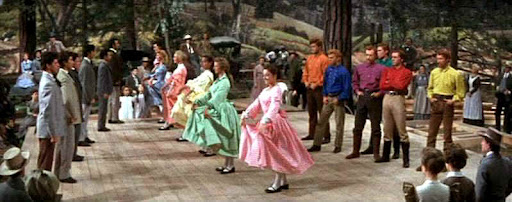
Unusually for a musical, I actually approved of the music, and even the dancing. Some of the songs weren’t terribly memorable, but others are still stuck in my head, most notably “Bless Yore Beautiful Hide” (again with the romance), “Goin’ Courtin'” and “sobbin’ Women.” The dancing too is very impressive, probably because most of the eponymous brides and brothers are professional dancers. The barn-raising sequence is great even though it’s very long, with the brothers competing for the affections of the locals girls against the men that brought them there. A prime opportunity was missed for some colour-coordinated dancing though. Some of the later axe-dancing is a little silly, but it does fit in with the overall tone of the film.

The plot is based on Stephen Vincent Benet’s short story The Sobbin’ Women, itself influenced by the Roman legend of The Rape of the Sabine Women (back then rape meant abduct, this film isn’t that dark). The script takes some interesting turns and has a great, if a little predictable, ending. The brides being just as willing to resort to fisticuffs as the men was a nice touch.

At times the film gets a bit sombre, when various groups become lovesick and lonely, but there’s always an upbeat musical number not too far away, and unlike most classic musicals, this one isn’t unbearably long. I’d quite like to see a remake, with an allstar ensemble cast in the lead fourteen roles, but I get the feeling it would be terrible.

Choose film 7/10

Sense and Sensibility

 Lord Dashwood (Tom Wilkinson) passes away and, unable to split his vast estate between his two families, his wife and three daughters are ousted from their palatial mansion by their half-brother John (James Fleet) and his vile wife Fanny (Harriet Walter), and are forced to considerably downsize their opulent lifestyles. Hope, it seems, arrives in the forms of Fanny’s reserved brother Edward (Hugh Grant) and the dashing Mr. Willoughby (Greg Wise), who each take a shining to two of the Dashwood sisters (Emma Thompson and Kate Winslet).

Continue reading

The Ghost and Mrs. Muir

One of the most unusual romantic stories I’ve ever heard, Joseph L. Mankiewicz’s film sees the widowed Mrs. Lucy Muir (the achingly beautiful Gene Tierney) fleeing her haughty, oppressive in-laws and moving to the seaside with her daughter Anna (a young Natalie Wood) and their maid, Martha (Edna Best). Upon arriving at Whitecliff-by-the-Sea, Lucy seeks the assistance of estate agent Mr. Coombe (Robert Coote) in finding a suitable property. She is immediately taken by Gull Cottage, despite the disapproval of Coombe and the warning that no other resident has managed to stay there for even a night. This probably has something to do with Captain Gregg (Rex Harrison), the former owner who passed away there some time ago, and whose spirit still haunts the house. In spite of all this Lucy moves in, and she and the ghost of Gregg form an unusual bond.

This could quite easily have gone two ways. Firstly, it could have been a horror, as a family moving into a haunted house is the setup for countless creepy films, yet Lucy’s obstinate refusal to be even the least bit scared of a ghost prevents this territory from being breached. Secondly, it could have gone down the Casper/Beetlejuice route and become a saccharine-sweet, child-friendly and frankly silly comedy-romp as Gregg attempts to scare his latest houseguests away. Both of these options are occasionally dallied with – Lucy’s first encounter with Gregg is all candle-lit shadows, and there is some prank-pulling when Lucy’s in-laws come to visit and drag her back home, but for the most part the fact that Gregg is deceased is all but ignored. He acts more as a confidant and adviser to Lucy, becoming something of a catalyst to changing her life.
The casting is spot-on, and no more so than with Harrison. He is the epitome of a salty sea dog, with a rasping, salt-ravaged bark, though his overuse of nautical terms in day-to-day conversation becomes jarring after a while. Tierney is good, and George Sanders is wonderfully sleazy as a suave suitor wooed by Lucy’s beauty. Gregg is a brilliant creation – a man out of his time, especially when it comes to women. His dialogue is peppered with sexism, but it’s delivered in such a way that it’d be difficult to take offence: “You’re a woman, I suppose you can’t help it,” / “Help what?” / “Making a fool of yourself.” Though at times he does come off as more than a little creepy, even for a ghost, when he remarks that Lucy is not a bad looking women (“confoundedly attractive”) even when she’s asleep.
The relationship between Lucy and Gregg is well formed and evolves naturally, as she begins to pick up some of his coarse seahand terms that she previously disapproved of (in this world, “Blast” seems to be the worst word imaginable), and they find a way to make the best of their current situation. Like many films it does seem to imply that the only way a woman can make something of herself is if she receives the help of a man. After her husband dies, Lucy has been left just to live off his funds, and had she not encountered Gregg, all would have been lost had she not married some other man, but this notion could be a product of the times when the film was made (1947).
If I have one major flaw with the film, it’s that we’re never really made privy to the limitations and frustrations of being dead. At no point does anyone ask Gregg what it’s like to die or be dead, and there seems to be little he could do in life that he cannot do in death. He is not bound to his house, and can willingly interact with people and inanimate objects. In most instances it appears to be better to be deceased, as you are able to only appear to the people you wish to, leading to what I can assume would be much hilarity. The characters too seem unsure of Gregg’s abilities, as shown when Lucy feels embarrassed getting undressed in front of his portrait and covers it with a sheet.
 Also, many elements of the plot were quite predictable, but overall this is an original and well told story full of lightness and likable characters, even if the ending seems to forget that she was ever married.
Choose film 7/10

A Nightmare on Elm Street

I can only imagine Hallowe’en parties in 1984, but I’m guessing quite a lot of people were dressed up in a battered fedora, red and green striped sweater, poorly applied ‘burned’ make-up and a glove with cardboard blades glued on, for if anything has endured from Wes Craven’s multiple-sequel spawner, it’s Robert Englund’s nightmare-stalker Freddy Krueger.

If it’s true that a horror movie lives or dies (generally by running upstairs instead of out the front door) by it’s killer, then there’s no surprise that this franchise is still going. I haven’t seen the 2010 reboot and I’ve only heard bad things, but I’m intrigued to see Jackie Earle Haley’s take on the former child murder released from prison on a technicality but burned alive by the parents of Elm Street. Krueger is an icon from horror history, up there with Michael Myers, Jason Voorhees and the Guy in the Scream mask, making up the B-team behind the likes of Frankenstein, Dracula and the Wolfman. For Krueger, you see, is unstoppable. He’s risen from the dead to take the children of those that murdered him, but he does his killing in the one place he cannot be caught; the children’s dreams. This is a genius conceit, but also the film’s biggest let down.
If you want to terrify your audience and instill in them genuine fright once they have stopped the film and gone about their daily lives, you scare them with something ordinary. A situation they themselves will find themselves in on a regular basis. Hitchcock did it in Psycho with having a shower. Craven did it with going to sleep. There’s nothing you can do about it, eventually you’ll have to go to sleep; quite often it happens without you even planning to. And once your head is resting gently on your pillow, all you can think about is that maniacal laugh echoing around the walls. That tapping at the window, surely that’s just the branch of a tree blowing in the wind, it couldn’t possibly be the knifed glove of the man out to rip you to shreds? When asleep you’re at your most vulnerable. It can happen anywhere – at home, school, prison, hospital, and there’s no way to defend yourself (short of Inception-style techniques, crossover anyone?) and Craven knows this. In his world, a glass of warm milk is as deadly as any conventional weapon.
But the fact that Freddy exists in dreams, can defy physics by being everywhere at once and can take on any form he chooses to terrify you the most, makes him almost less scary. There’s a sense of inevitability. Much like in Ring, once you watch the tape, you’re going to die. There’s not a whole lot you can do about it. You can’t kill Freddy in a dream, you can’t stay awake forever, there’s really only one possible outcome. Yes, in this film and the ever diminishing sequels they find loopholes to temporarily get around the issue, but I’ve always found these to be annoyances and cop outs from the original story. I’d forgotten the ending of this film when I saw it, and I was almost incredibly annoyed at the backdoor excuse they try to use.
It’s a good, solid horror film, and is much more effective if you never, ever watch the sequels. Whilst they have some inventive kills (hearing aid? genius) and increase the comedy quotient, Freddy becomes a watered down pantomime villain, whose incessant survival becomes more grating the more films you watch. But here his terrorising of four teens (including a 21-year old Johnny Depp in his movie debut) is played largely for tension and scares, though there’s a few lull-in-the-score moments that are clear setups for something to jump out and grab our virginal heroine Nancy (Heather Langenkamp).
There are moments of black comedy – a cop telling a paramedic “you don’t need a stretched, you need a mop,” and the kills are satisfyingly gory. Nancy looking in the mirror got a laugh out of me, as at the time of the film’s release Langenkamp was, you guessed it, 20 years old. The image of Krueger’s hand emerging from between the legs of a girl asleep in the bath is more than a little terrifying.
Choose film 6/10

Midnight in Paris

Woody Allen continues his obsession with Europe (Vicky Cristina Barcelona, the upcoming To Rome With Love) and adds a little time travel into the mix with this delightful slice of whimsy. Owen Wilson picks up the Allen role as Gil, a writer tagging along with his fiance Inez (Rachel McAdams) visiting her parents as they embark on a business merger in Paris. Gil has made a name for himself writing not terribly good films for Hollywood, but has aspirations for writing novels, and dreams of moving back to Paris, whereas Inez and her disapproving parents seem far more level headed. On a late night drunken stroll Gil finds himself in the 1920s world he so wishes to live in, and gets to meet his idols from a time long passed.

It all sounds a little bit ridiculous – a Woody Allen time travel film – and my parents and girlfriend, with whom I watched the film, were expecting something quite different and tuned out quite early on – but I thought it was wonderful. Wilson is a perfect fit as the neurotic Gil, refusing to tolerate Inez’s pedantic know-it-all friend Paul (Michael Sheen, brilliantly punchable) and forever wishing he’d been born in a different time.
Many films would dumb down the references to the past, and I’ll admit there were many I didn’t get, but the characters portrayed are so rich and interesting that I’m encouraged to discover more about them on my own. I’m ashamed to say that I’m unfamiliar with the likes of F. Scott & Zelda Fitzgerald and Gertrude Stein, and have only a passing knowledge of Cole Porter, Ernest Hemingway, Picasso and T. S. Eliot, though I think I got most of the Bunuel and Dali references (I’ve even seen The Exterminating Angel, the film Gil proposes to Bunuel, and it’s not even on the List), and as for the others I’m now making an effort to better myself by looking into their works. This is exactly what a film should do, not work out what its audience already knows and repeat that to them, but provide an opportunity to further their own knowledge.
The supporting cast is incredible. Kathy Bates is Stein, Tom Hiddleston and Scott Pilgrim‘s drummer Alison Pill are the Fitzgeralds and Marion Cotillard is delightful as Gil’s 1920s love interest Adriana, but it is the brief appearance of Adrien Brody as a flamboyantly insane Dali that steals the show (“I see rhinoceroses!”). Rachel McAdams plays a fairly thin character in the almost-bitchy, not understanding fiance, and her parents (Kurt Fuller and Mimi Kennedy) begin to grate after a while as their characters refuse to develop throughout the film.
All the typical Parisian tourist attractions are acknowedged, and got out the way, early on in a brief montage. This is nice, as it’d be a shame to ignore them, for they aren’t part of the story, but they show perhaps the draw of the city to Inez and her family, whereas Gil prefers the layers of life and history underneath. The present day scenes are shot crisply, everything looking bright and new, whereas those set in the past are softer, slightly fuzzy around the edges, and with such a warm palette it’s no wonder Gil wants to live there. It has a more mysterious atmosphere full of soirees and flapper dresses.
 It’s not for everyone, and many may find it just too odd to come to grips with, but if you are a Woody Allen fan (and you should be), and have either a good knowledge of the 1920s or want a place to build yours from, check this out.
Choose film 8/10

Prometheus Plot Holes

Warning, this post is literally nothing but spoilers for Prometheus. I mentioned in my review that the script had numerous plot holes, and I really need to vent them out, so I’ve listed them below. Do not read this until you’ve watched the film, and if anyone can fill the holes in for me please go ahead. I repeat, do not read this post until you have seen the film.

1.    Why is David riding a bicycle and shooting hoops? Is he trying to impress someone? I understand why he’s developing language skills, as he’s researching things as yet undiscovered, but what’s with the sports? He’s a robot!
2.    When Holloway sees the lines on the planet that prove the alien presence, why does no-one suggest scoping the area out for a while? Even just a little fly around would have been nice.
3.    What exactly are the holograms for? David starts one in the caves and another on the Space Jockey deck, but who are they for? They’re useful for him and us, but who made them? They could be some kind of ship’s log, but if so couldn’t someone have said that in one line of dialogue?
4.    When Shaw, Holloway, David and Ford flee the caves, outside there’s two go-karts and a minibus. Two get on each of the karts, and no-one gets into the bus, yet they all drive off (at the time we assume Fifield and Millburn are in there). Who is driving it? You could argue that there’s a nameless crew member that stayed behind as a driver, and headed off to avoid the storm slightly too early for the others to get in, but there’s no proof of this.
5.    Once David has rescued Shaw and Holloway, Janek mentions they don’t know where Fifield and Millburn are, but there’s a map showing their position! He uses it in the next scene. Plus, Janek seems pretty lackadaisical about two members of the crew being stranded on an alien planet. He practically says LOL. Also, how convenient is it that everyone has a surname beginning with a different letter?
6.    Why does David cave in to Vickers’ threats? He’s a robot, there’s not a lot she could do to him.
7.    Millburn the biologist is supposedly cowardly, as he is easily convinced by Fifield to run away at the site of a decapitated body (understandable), and later when he hears there’s a lifeform somewhere nearby, he says he’s heading in the opposite direction. So why, when he and Fifield go to the vase chamber, does he suddenly want to make friends with the alien there? He can’t even see the entire creature, so for all he knows it’s some giant beasty with a strange proboscis. Why did they even decide to stay in the cave full of weird bubbling vases anyway? It’s the exact room, with the dead decapitated body outside of it, that they ran away from earlier.
8.    Millburn and Fifield die when no-one is watching the monitors, because Vickers and Janek are getting it on in her quarters, right? Firstly, how come Janek didn’t order someone else to watch the monitors, and secondly, even if no-one was there, don’t these guys have TiVo? Just rewind the feed and see what happened. We have it in 2012; I’m guessing it’s still around in 2094.
9.    Why did Janek, the captain and pilot of the ship, go to investigate the disappearance of Millburn and Fifield? Surely he’s pretty integral to the running of the ship.
10.What exactly was David’s plan with the black goo? He gave some to Holloway in his drink; did he know he would have sex with Shaw and impregnate her with an alien? If so, why did he do that too? Was he curious, or trying to kill Holloway? Why?
11.Why did the infected Fifield come back to the ship to try and kill everyone? He was the one character I really wanted to die, and he’s the only one who came back to life! Typical. I thought Millburn would have come back with a chest-burster in him, seeing as an alien went down his throat and Fifield had his face melted with acid. Also, why did they go out and investigate Fifield’s clearly dead body (the helmet is smashed with a deadly atmosphere, and his legs are bent over his shoulders) seeing as there’s no way he could have just turned up there on his own, being dead and all.
12.Why does David tell Shaw she is pregnant? If he wanted an alien specimen, surely telling her will just make her try and abort it, and if he wanted to kill her, then not telling her will result in the alien bursting through her stomach and killing her that way. Being pregnant with a baby alien was probably the last thing she was expecting, especially seeing as she was barren and had only had sex 10 hours ago and not before for 28 months.
13.After she wakes up from being sedated by David, Shaw finds it pretty easy to escape from the medics and run to Vickers’ quarters with no-one chasing her. No-one comes for the entire time she is in there.
14.After the impromptu caesarean I could have done with a scene of Shaw breaking down from the intensity of what she’d just gone through. In the past few hours she’d lost her husband, found out she was pregnant when she thought she was barren, discovered the ‘child’ was in fact a killer alien, had a caesarean whilst fully awake and watching it, had the cut literally stapled shut and then fought the creature that had just gestated inside her. I’d say that warrants a little exasperation.
15.Did I miss a scene where everyone on board found out about, and was cool with, Peter Weyland being on board the ship? After Shaw’s surgery the rest of the crew seems OK with him being there. It was pretty damn obvious he was going to be onboard too, seeing Guy Pearce was highly billed in the opening credits. Stop doing that kind of thing. And making Vickers his daughter is pointless, unsurprising and ridiculous.
16.Ripping David the android’s head off is a nice nod to Ash’s fate in Alien, but is it possible for a robot to survive one of these films? Please?
17.When Vickers and Shaw are running from the crashing spaceship, why in the name of LV426 do they not run sideways? I hate when films do this. There’s something rolling behind you in a relatively straight line, so instead of getting out of the way you decide to race it. Insane. Shaw only survives because she trips and rolls out the way. I did like that the last two alive were the two main women, just like in Alien, and similarly the blonde dies and the brunette survives.
18.Shaw’s air supply is supposedly running out at the end of the film, yet she’s barely been away from the ship. Earlier, Fifield and Millburn were away for longer, and were expected to survive overnight when they got stranded. Yes, they were in the chambers with breathable atmosphere, but they had to keep their helmets up because it was going to get cold, so they must have had to survive on their own air supplies.
19.The alien that Shaw had aborted grows pretty fucking huge seeing as it’s had no organic matter to feed on other than a little blood Shaw left behind.
20.At the end, Shaw is told that there are other ships. Does she check them all for surviving Engineers, or just leave in the first ship she finds? I’d have much preferred that the final shot be of her silhouette, with an axe in one hand and David decapitated head in the other, heading off to take out the surviving aliens.
Wow, I didn’t realise I had so many problems with the script. Am I being too harsh? Or stupid? Was a lot of this explained? Let me know.
*EDIT* Thanks to everyone for all the comments and page views so far, the response I’ve had from this is phenomenal. It turns out my list of plot holes wasn’t quite complete, and many of you have posed a few more. I’ve tried to give credit where it’s due, but apologies if I’ve left someone off. Also, some of these get a bit science-y, and I’ve not researched any of the theories, so please don’t shout at me if they’re wrong. Sections in brackets are from me.
21.   How exactly did they manage to reanimate a head that’d be dead for several thousand years? I’m pretty sure in 77 years time that technology isn’t going to be available. Also, why did it explode? – Anon
22.   Organic molecules do not form in oxygen-rich running water. – Anon
23.    It’d be nice if they’d clarified at some point why the Hell the Engineers wanted to kill humans, and why did they think that the black goo, which creates a completely different, far more dangerous race, would be the best way to do it? (Personally I think it was for sport.) – J/Michael Shaw
24.   The DNA was a perfect match, yet the Engineers are big, bald and pale. (My personal theory is that had the physical differences are due to environmental differences between Earth and LV-223 in terms of gravity, proximity to the Sun, etc.) – J
25.   If the Engineers created humans, did they also create all the other life on Earth? From what, and how are they all different? Did all the different species evolve from that one Engineer? If so, how are we all different? – J/areanimator
26.   The crew are really very unprofessional and lacking in protocol for such an important and well funded mission. (Perhaps these were the only people willing to sacrifice 5 years of their lives for a wild goose chase.) – Anon
27.   Could they not have detected the oncoming storm, seeing as they just arrived from space? And don’t they have larger versions of Fifield’s ‘puppies’ they could send down to scout out the terrain first? (Hell, can’t they send the ‘puppies’ into the caves from the safety of the ship? There could have been aliens waiting just inside the cave for them.) – Anon
28.   You can’t run around after having your body cut open to your uterus, even if the wound was closed with some stitches. Your body goes into complete shock, the stitches cannot make up for the fact tissue was cut and muscles were cut which are essential for your core, and by extension for your body to perform any kind of walking movement. – Anon
29.   The two co-pilots at the end didn’t really need to kill themselves. They say Janek is a bad pilot (really? Weyland paid a fortune for a crappy captain?) but he doesn’t really do a lot of piloting, in fact he even says “Hands off” of the steering to crash into the ship. There’s also apparently a member of Weyland’s security who doesn’t go down to the planet with Weyland and co, who Janek is essentially killing at that point too, but fair enough it’s for the good of humanity. – Anon
30.   Why do the cryo-beds have a function that allows David to see their dreams? (Possibly to see if they’re in distress or suffering some kind of psychological trauma from the cryo-sleep, but that’s a stretch). – Beta Max
31.   Why was the medical machine only male-calibrated? OK, it was probably there to operate on Weyland, but it makes little sense to make machinery just for men or women. – Anon
32.   How did the Engineer survive the toxic LV-223 atmosphere without a helmet when he attacks Shaw at the end? He must have needed the helmet to breathe, yet made it from the crashed ship to Vickers’ crashed pod pretty easily.  – Anon
33.   Why was it a secret that Weyland was on his ship, and why was it pegged as a surprise reveal that Vickers’ was his daughter? (Hollywood tension-generating bullshit.) – Anon
34.   Why did the Engineers point all the ancient civilisations towards a military installation? (My guess: the Engineers thought we might have come back all guns blazing, so sent us to a battle-ready moon/planet instead of their home world.) – Anon
35.   Once they discover that the Engineers have the same DNA as humans, they don’t make the logical connection that what killed the Engineers will probably kill the humans too, and no extra quarantine methods or safety precautions are put in place. – Areanimator
36.   The Engineers were running away from something, yet ran towards a room full of deadly black goo that presumably they manufactured. (The room had the giant stone head in, meaning it could be of religious importance, and they thought prayer was their only option at that point. Alternatively, they may have been running towards the room to trap the black goo inside.) – Areanimator
37.   The hologram of Earth resembles modern Earth, rather than how it looked at the damn of man. –The Movie Waffler
38.   Why did Weyland think he could just rock up to an alien moon, have a nice chat with the Engineers and that they could give him immortality? (He was nearly dead, so was probably grasping at whatever straws he could reach.) – Anon
39.   Apparently the Engineers were trying to leave LV-223 because it had all gone wrong, but how? There was no trace of active aliens on the planet. (They may have been trying to seal off the experiment going wrong into the cave with the vases, but one Engineer tripped and got decapitated by the door?) – Lisa
40.   After decapitation, David’s head manages to stay pretty damn close to his body, even after takeoff, crashing and rolling all over the place. Seems pretty unlikely unless the white ‘blood’ is a damn good glue. – Christophe Abi Akle

Oh, and for those of you looking for a more informed, science-based look at the gaping holes woven together to form the net of this film, check out Stephen Gaskell’s post over at Creepy Treehouse.
Prometheus

Don’t ask me how, but I managed to get a ticket to the Cast & Crew Premiere of Prometheus at the Empire Cinema in London’s Leicester Square last night. Though it was disappointing not to see director Ridley Scott or the cast, who are probably saving themselves for tomorrow’s red carpet Premiere (a part of me was hoping I’d get to sit next to Charlize Theron, you can probably guess which part), the experience of going to see a film with nothing but film fans and people who respect the art, in a stunning cinema, was amazing, even if there was a bit of a post-movie crowd crushing to retrieve handed-in phones afterwards. Plus, I saw it three days before the rest of the general public, which makes me feel special. 
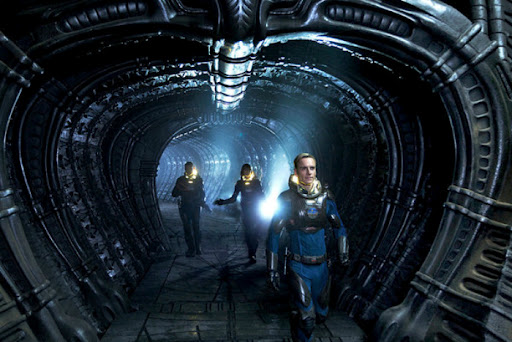
 In 2089 a group of scientists, led by Shaw and Holloway (Noomi Rapace and Logan Marshall-Green) discover ancient cave paintings on the Isle of Skye depicting giant humanoids reaching up to 6 orbs in the sky. The drawing matches others found all over the world, and point towards a distant planet that may hold some key to the origins of mankind. Four years later, the scientists arrive at the planet LV223 as part of a 17-man crew aboard the Peter Weyland-funded ship Prometheus. Once there, the crew find traces of alien life, but are the answers they receive the ones they were hoping for?

Million Dollar Baby

The second part of my Clint-Eastwood-directing-himself-and-Morgan-Freeman-in-a-supporting-role double bill see Clint take on a genre he’s never really (that I know of) looked at before, the sports movie (please feel free to let me know if he has, I’m often wrong about these things and he’s been working for an awfully long time).

If there’s two criticisms that can be lauded onto Eastwood, it’s that he doesn’t direct happy stories or portray more than one character. He’s not renowned for making lighter films with happy endings or playing people who aren’t grumpy, stoic curmudgeons with their trousers too high, and his streak continues here. I know he’s made a few lighter films (Paint Your Wagon, Every Which Way But Loose) but I haven’t seen them, and I’m guessing he plays the grumpy, stoic, possibly singing straightman to a comically messy primate who never stops annoying him. Again, please let me know if I’m wrong and recommend any films where he flashes a smile, once.

Here, Eastwood plays Frankie Dunn, a knowledgeable, best-there-is boxing trainer who can’t seem to get it together to be more than the owner of the run-down Hit Pit Gym. His latest fighter, Big Willie Little (Mike Colter) has a promising career ahead of him, with Frankie having gotten him almost to a title fight, but alas he leaves for a more prolific manager, leaving Frankie high and dry. Meanwhile, self-proclaimed white trash  Maggie Fitzgerald (Hilary Swank) has joined his gym and is looking for a trainer, though Dunn is adamant that he doesn’t train girls. Her pluck and commitment eventually wears down Dunn, assisted by persistent advice from his assistant, Morgan Freeman’s retired boxer and former recipient of Dunn’s training, Eddie ‘Scrap-Iron’ Dupris.


The story is a little corny and at times downright predictable. It’s clear that Maggie and Frankie will work together, each filling a void in the other’s life (Maggie’s father is dead, Frankie’s daughter has fled and refuses to acknowledge his efforts to contact her), and once they get going her rise through the ranks is unbelievable, especially as she never received any training until she was 31, but the delivery is spot-on. Heartstrings are at times shamelessly plucked, but justifiably so, and there’s a blindsided moment I genuinely didn’t see coming on first viewing. This isn’t your average rags-to-riches underdog sports movie, and it’s proud of this. There’s moments of humour, most noticeably from Dunn trying to talk to Maggie (“I’m going to try and forget the fact that you’re a girl”) and from Jay Baruchel’s simpleton wanna-be-but-never-gonna-be boxer ‘Danger’ Barch.


Swank is, expectedly, brilliant, earning her second Oscar as she all but becomes the downtrodden heroine. Her family has never stopped putting her down (look out for Garfunkel & Oates’ Riki Lindhome as her welfare-cheating sister!) but she retains a dogged sense of determination, saving up all her money from waitressing jobs where she has to steal half-eaten steaks to survive, just to buy a speedball for training. The outcome of her trying to do something nice for the family that’s never done anything for her is genuinely heartbreaking. Eastwood is good, but it’s well trodden ground for him, and Morgan Freeman is wonderfully understated – until he gets a chance to show off some moves later on.


There’s a lot to recommend about the film, but not a lot to bring you back. It’s certainly worth watching at least once, and I took a great deal away from it, but most of that was that I didn’t want to go through the harrowing gut-punch of an experience of watching it again any time soon.


Choose film 8/10

Unforgiven

The first part of my double bill of Clint-Eastwood-directing-himself-and-Morgan-Freeman-in-a-supporting-role sees the American icon define the genre that not only made him the prolific star he is, but that he has almost singlehandedly kept alive since it’s surge in popularity in the 60s and 70s; the western.
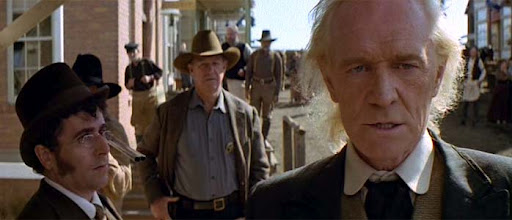
Unforgiven sees Eastwood as William Munny, a former hardened killer reformed by the love of a good women and the birth of his two children. With his wife dead and their herd of pigs stricken with fever, Munny accepts the offer from young upstart The Schofield Kid (Jaimz Woolvett) to kill two ruffians who cut up a whore after she laughed at one of them having a small penis. They team up with Munny’s former partner Ned Logan (Morgan Freeman) and head out to the town of Big Whiskey, lorded over by Gene Hackman’s occasionally violent ‘Little’ Bill Daggett, where other hired killers, including Richard Harris’ English Bob, are also heading to claim the bounty.
Eastwood’s Munny isn’t your typical western hero. In fact, no character in this can ever be truly classed as heroic. Munny has what could politely be called a sordid past, and his desperation to honour his late wife by not succumbing to his younger urges is evident. A self proclaimed no good son of a bitch, Munny is a shadow of his former self, unable to shoot straight or even mount a horse. Freeman’s Ned has a woman at home, yet has no qualms about visiting the whorehouse in town, Schofield has his own secrets and Bob is an outright liar, gambler and killer. At times it seems that Little Bill, supposedly the villain of the piece, is possibly the most moral character here, opting not to kill the prostitute abusers in favour of fining them horses instead, with the sins he commits in the present are nothing compared to those done by Munny in the past, and his intentions are only to keep his town free from guns and violence, except from his own. I found it odd though that nothing was made of Freeman’s race, as he and his partner are the only non-white characters in the film, yet there are no even passing references when the townsfolk describe him. I’ve just realised I’m annoyed that Morgan Freeman wasn’t racially abused in a film.
The script, which did the rounds in Hollywood for 20 years before Eastwood picked it up, is pocked with sharp humour and great lines (“If I see you again, I’m just gonna start shooting and consider it self defence.”) and works not just as a study and disassembly of the westerns that came before it, but as a damn good, prime example of one itself. Harris’ English Bob has his own biographer (Saul Rubinek), whose role is to take Bob’s stories and lyricise them a little; in essence creating the cowboy myths and legends that make up the staples of the genre. It’s a film about shattered dreams and fallen heroes – the actors as much as the characters – as it’s not often you see Eastwood rolling around in pig shit, Morgan Freeman asking someone if they sleep with prostitutes or just use their hand or Lex Luthor beating the crap out of Dumbledore. It’s clear that Munny could quite easily be any one of Eastwood’s previous stoic, bitter, hard as nails cowboys who’d let themselves go for a few years.
The film deals with the seriousness of death and murder, with no post-kill smart alec quips. One characters defiant “I’ll see you in Hell, Willaim Munny,” is met only with a considered, matter of fact “Yeah.” It’s almost as prolific as The Good, The Bad and The Ugly and Once Upon A Time in the West, and definitely ranks in the top 5 westerns.
Choose film 9/10

Seven

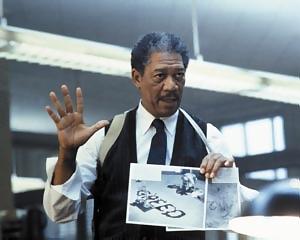
A buddy cop movie with a seasoned old hand so close to retirement they’re already scraping his name off the door and his hotshot, firebrand young replacement, this couldn’t be further from another Lethal Weapon. Yes, one’s a family man and the other’s a loner, one is prone to anger and the other a methodical, careful detective clearly too old for this shit, but where Richard Donner’s 80’s staple is an entertaining, action-packed romp, this is something much darker.After a disturbingly evocative opening credits sequence enriched with depth and meaning on repeated viewings, we meet Morgan Freeman’s detective Somerset, picking up his last case, a sickeningly masterful serial killer with a penchant for the seven deadly sins, the same day as Brad Pitt’s Detective Mills arrives to replace him. That’s as much setup as there is, as we follow the mismatched detectives from crime scene to crime scene, via their headquarters and areas of research, with Somerset whiling a night away poring over books in the library, whilst Mills take a brief glance at the Cliff notes.

The script is dotted with well balanced moments of humour – Somerset having dinner with Mills and his wife Tracey (Gwyneth Paltrow) – and some deep black humour: “this guy’s sat in his own piss and shit; if he wasn’t dead he’d’ve stood up by now,” plus R. Lee Ermey’s belligerent, furious Police Captain (“This is not even my desk” is one of my favourite film quotes, ever).

Crucially, we see none of the killer’s murders onscreen, merely their gruesome aftermaths. It’s not as gory as you might remember, but it evokes imagery and feelings that some may find disturbing, not least what happens to Leland Orser’s character, who probably has the worst memories of those who survive. It could be argues that this is a precursor to the Saw franchise, punishing those that seem to deserve it in creative, torturous ways, but at least here we are saved the nightmarish spectacles of witnessing the deaths.

At times the film feels a bit predictable, like a police procedural itself, but whenever this is about to happen the plot shifts direction, taking an unexpected twist to shake things up again. The colour palette of muted greys and browns, interspersed with deep reds amongst the incessant torrential downpour of the nameless city only adds to the feelings of despair.

There’s small roles for John C. McGinley and Richard Schiff in there as well, a nice surprise for me in the opening credits, but unfortunately at times the acting, especially Pitt during the final scenes, leaves something to be desired. The ending has become the stuff of legend, but I won’t reveal it just in case, save that Pitt’s gurning and crying are a bit over the top and take you out of the scene. This is another one of those films where knowing your actors may ruin the film too, as recognising a voice could cause annoyances later on, but not too badly.

Overall this is director David Fincher’s defining film (better than Fight Club in my opinion, though it’s been a while). The gritty tone is perfectly realised through every medium possible, the plot is gripping, the twists hold up and, though far from an enjoyable experience, it remains worthwhile.

Choose film 10/10