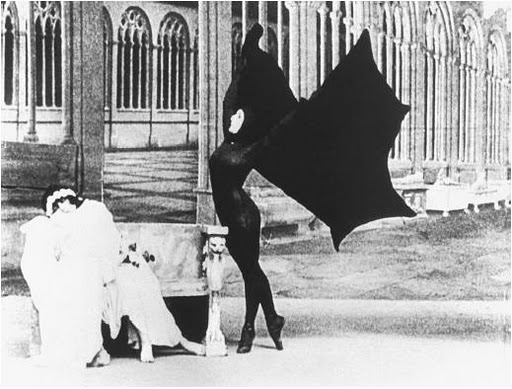
Les Vampires

If acclaimed surrealist master Luis Bunuel is a fan of your work, it’s fair to say it’s unlikely to be a straightforward police procedural picture. The likes of Zodiac and All the President’s Men are probably far too logical for him to have admired, with far too few poisonous rings, hidden cannons and magic anagrams for his liking. That, and they aren’t 10-part silent serials from 1915, as is the case with Louis Feuillade’s Les Vampires, following newspaper editor Philippe Guerande and his flamboyant sidekick Mazzamette as they attempt to track down the notorious criminal gang known only as the Vampires, led by an ever changing Grand Vampire and his muse, the most interesting character of the series, Irma Vep.
In this world nothing is ever as it seems, with walls and paintings sliding aside to reveal hidden compartments (occasionally containing cannons), Vampires revealing themselves to be policemen, figures of authority revealing themselves to be Vampires and the dead returning back to life. This does become irritating, as logical second-guessing of the plot becomes impossible when it makes up its own rules as it goes along, but the sense of ingenuity keeps things interesting throughout the almost 7 hours runtime. I’m grateful too that modern architecture has advanced to a stage where most exterior surfaces are now only scalable using a ladder, whereas here they seem designed by the people behind Assassin’s Creed.
Choose film 7/10

Run Lola Run

Has there ever been a more straightforward plot? Lola (a flame-haired Franka Potente) has 20 minutes to find 100,000 Deutsche Mark (about £33,670 back in 1998) to save her boyfriend’s life. That’s it. Yet director Tom Tykwer (Perfume) takes this core premise and from it creates a film so startlingly original and entertaining its a wonder Hollywood has yet to fully embrace his unique style. Employing all manner of cinematic devices, from splitscreen to monochrome, converting our heroine into animated form and revealing the lives of very minor characters in Polaroid form, the film moves at such a breakneck speed yet remains easy to follow and only occasionally exasperating. The nightclub soundtrack may fit the relentless pace but is a little headache inducing at times, as are the jarring changes in pace, from running full tilt to pontificating pillow talk on the nature of love, but with ideas this fresh even 13 years after its release, these flaws can be forgiven.
Choose film 8/10

Two Days in Paris

Jack and Marion (Adam Goldberg and writer/director Julie Delpy) are a typical couple in their mid-30s on a holiday in Europe, culminating with two days in Paris to visit the French Marion’s parents. Jack is an insecure, devious hypochondriac, paranoid of terrorist attacks and knows less French than your average American, whilst Marion’s parents (played by Delpy’s real life mother and father) know very little English, and Marion herself seems reluctant to act as translator, leading to various comic episodes, most notably with Marion’s father attempting to act out cunnilingus to Jack at an exhibition of his artwork. The film plays on both French and American stereotypes – the French are homophobic, xenophobic, inappropriately flirtatious wife beaters, all of whom have either gone out with or are trying to go out with Marion, whilst Americans are brash, ignorant tourists. The performances feel natural – up until the arrival of Daniel Bruhl’s self-proclaimed fairy, and the situations never feel overly contrived, just maybe a little exaggerated, and the cinema would be a better place if more romcoms were as insightful and humorous as this.
Choose film 7/10

Big

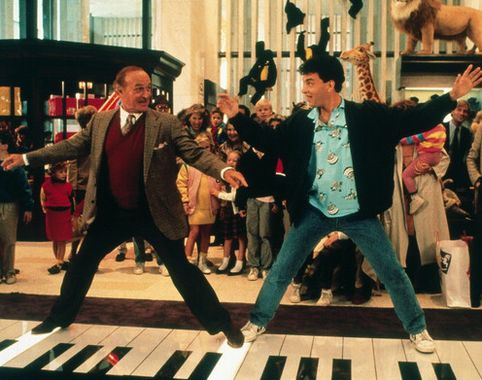
When 12-year old Josh Baskin is denied a ride on a roller coaster for being too short, and is therefore embarrassed in front of his dream girl, he wishes himself big at a fairground fortune booth. The next morning he awakes as a 30-year old Tom Hanks, complete with chest hair, deeper voice and a ripped pair of space pyjamas. So ensues a fish-out-of-water comedy, as Josh, having been chased from his house by his understandably terrified mother, must fend for himself in the big wide world.
Hanks is incredible as man-child Josh, in his first truly memorable role, utterly convincing in an underappreciated performance, arguably Hanks’ best, be it kneeling on a chair, eating Oreos or simply swinging his bag as he walks, every touch adds to the sense that this really is a 12-year old boy in a man’s body.
If there are any faults, they lie in the third act, when the clichés drop thick and fast into this previously original movie. Josh begins to realise his responsibilities and grows up, ditching his best friend for a girl and eventually, if a little suddenly, realising that he just wants to be a kid again. There is also one of the most uncomfortably wrong relationships ever seen in film between Josh and corporate climber Susan (Elizabeth Perkins), so squirm-inducing it probably would have been omitted today (that said, it’s just as bad as the centuries-old vampire/teenage girl romance from Twilight… not that I know anything about those films). But regardless of however many faults the film may have, one scene, featuring Hanks, his new boss (Robert Loggia) and a giant floor keyboard in a toy store, makes any film worth watching. This is the kind of scene that never fails to cheer me up.
Choose film 8/10

West Side Story

It’s easy to mock West Side Story, and incredibly hard not to let out a start of incredulity, disbelief and hilarity when the Jets, a New York street gang, begin clicking, walking and turning in sync, but this 60s retelling of Shakespeare’s Romeo and Juliet has a lot going for it. Yes, the two leads – Jet old hand Tony (Richard Beymer) and rival Shark’s head honcho’s sister Maria (Natalie Wood, not even close to being Puerto Rican) are lifeless, charisma free and unforgivably dubbed for their singing. And yes, the dialogue has not aged well in places, but the toe-tapping tunes, particularly I Feel Pretty, America and Gee, Officer Krupke and outstanding choreography, with dances staged as fights and fights staged as dances more than make up for its faults. Supporting players perform admirably, notably Russ Tamblyn as Jets leader Riff and George Chakiris as Shark leader Bernardo, making this a musical for people who don’t like musicals – people like me then.
Choose film 7/10

The Usual Suspects

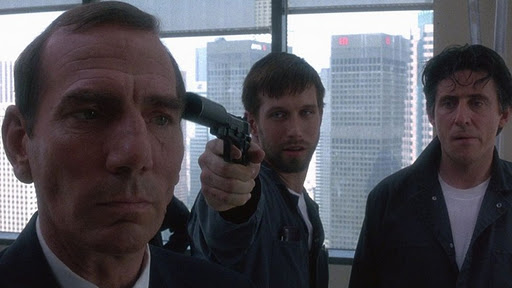
 Is it OK to ruin the Usual Suspects yet? Doesn’t anyone who cares who the ending already? Its 16 years old! Is it not another Sixth Sense or Empire Strikes Back, where the big reveal has either been witnessed firsthand or spoiled by someone else? Miraculously, my film watching companion had not seen or heard the ending to Bryan Singer’s sophomore film, and he’d have throttled me had I revealed it (Marcos hates spoilers, and will punch you in the head) so no, it would seem there are some out there yet to discover the fate of the five criminals bought in for a line-up, nor do they know the identity of their tormentor, the mythical Keyser Soze, so I’ll try and tread carefully. The cons in question – Stephen Baldwin, Kevin Pollak, Gabriel Byrne, Benicio del Toro and a career-launching, Oscar winning Kevin Spacey – have been brought together on a bogus line-up, and use their time in incarceration to plan a robbery, bus is it all a part of a bigger plan?
Told in flashback by Spacey’s weaselly over talkative ‘Verbal’ Kint, the tale begins with the death of Byrne’s Keaton, a crooked cop gone straight and the closest the gang has to a leader, after what appears to be a drug deal gone wrong. Chazz Palminteri, the cop to whom Kint tells his story, has his own theories as to what went wrong, but his opinions, and those of the viewer, get in the way of seeing the truth, ably assisted by Christopher McQuarrie’s deservedly Oscar winning ever twisting screenplay.
The cast are exceptional, particularly the scene stealing del Toro and Pete Postlethwaite at stoic lawyer Kobayashi, but it is the fine balance between tightly plotted twists and turns and sporadic bursts of action and violence that plants this firmly on the choose film list, regardless of whether you know the ending.
Choose film 9/10

Shoah

Without a doubt this 9 hour documentary about the holocaust, comprising entirely of original material with no archive footage, is worthy of a place on the list. Director Claude Lanzmann spent years interviewing historians, builders of the concentration camps, train drivers, camp survivors and even Nazi officials who ran the camps, and spent almost 5 years editing the hundreds of hours down to a four disc set. Viewing is a sobering experience, the very definition of hard to watch, but such insight of so important an event needs to be heard, with a barber tasked with shaving the Jews before they were gassed commenting that “people burn very well.” Yes, it could be shorter, as there is some repetition to hammer home the points, but anyone who felt they were only told a small portion of a much larger story in school history classes should consider this essential viewing.
Choose film 8/10

Public Enemies

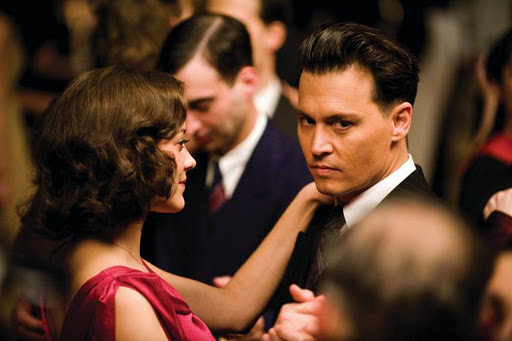
Michael Mann likes the central plot of Heat – expert cop and master thief and their teams on a destructive path towards one another with disregard for their personal lives – that this is the third time he’s made it, after the TV-movie L.A. Takedown, the DeNiro/Pacino classic and now this depression-era take, pitting Johnny Depp’s public enemy number one John Dillinger against Christian Bale’s FBI man Melvin Purvis (whose name is almost an anagram of Mr Evil Penis, but is one for vermin pelvis). (For all I know this is also the plot of Miami Vice and the Last of the Mohicans, I haven’t got round to watching them yet but it seems unlikely.)
The parallels with Heat run deep – the first criminal act, an opening prison break, is almost botched by a trigger happy accomplice soon removed from the group – but the key difference is the pivotal central scene where our two leads meet. In Heat, DeNiro’s thief McCauley and Pacino’s cop Hanna share a mutual respect, that they are dealing here with the other side of their own coin, a talented man with opposite morals. Here, Dillinger and Pervis despise one another, disgusted that they are within the other’s presence or mentioned in the same breath. This complex central relationship was key to the layered texture of Heat, and its absence is felt.
Depp has always been better at characters (Scissorhands, Sparrow) than he has emotions, and Dillinger is bland and lifeless in his hands, yet still more likeable than Bale’s cold, business-like Pervis. DiCaprio would probably have been a better fit for Dillinger, but as FBI director J. Edgar Hoover appears here as Billy Crudup this would have made DiCaprio and Clint Eastwood’s current biopic of the man problematic.
All this in account, this is still an entertaining action/crime movie, with plenty of period gun porn for those that way inclined. Mann’s attention to detail is perfect, and there is some of the best comedy ever seen in a 1930s set cop movie – see Dillinger wondering around the offices of the FBI department out to catch him, casually asking the score of a sports game. Smarter and more thought provoking than most gun-happy movies, this is definitely worth a watch.
Choose film 7/10

Braveheart

A young Scottish boy in the 13th Century is mentally scarred by the sight of dozens of his kinsmen slain and hanged. He is too young to fight the English, for it is those villainous scoundrels that are to blame, and when his father and brother do not return from battle he is sent to live with his scarred uncle Argyle (Brian Cox). Taught to use his brain before his sword, he grows up to become Mel Gibson, returns to his home village and falls in love, only for those Anglo-Saxon bastards to kill her too. Understandably, this sends Gibson’s William Wallace into a bit of a tizzy, so he sets about raising an army to thwart the tea-drinking tossers and their leader, evil Edward I. I’m no historian, but to say the film is blinkered by a love for the Celts is no exaggeration, with us Englanders shown creating laws where it is fine for us to sleep with a Scotsman’s wife on her wedding night, and banning the kilt-wearing types from brandishing so much as a stick. I’m not saying this didn’t happen, and I’m not going to burn any calories finding out, but I’m going to assume that something from the mind from Gibson can be taken with a rather hefty pinch of salt.
That being said, Gibbo gives good as the rabble rouser, hinting at the madness (and mullet) of Lethal Weapon, with an imposing presence and questionable accent. Much too can be said of Gibson the director and producer – roles for which he took home the Best Director and Best Picture Oscars in 1996. With an eye for locations and an ear for mixing the comic with the tragic, this is a well balanced film. Some of the fights and chases feel a little clunky, and the many brutal deaths – throats slit, fence post impalings, gouged eyes and mutilated horses – seem a tad gratuitous at times.
Choose film 7/10

Fish Tank

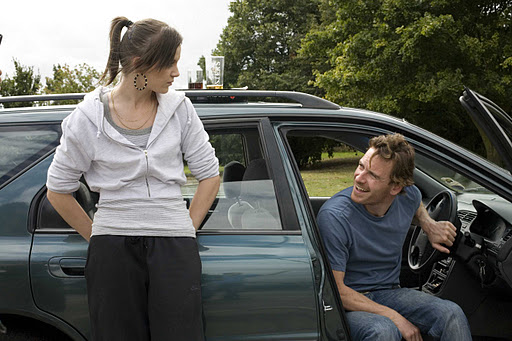
Just another Kidulthood? Not so fast. Where Noel Clarke’s debut was all teen speak, yoof culture and multi-stranded east London ghetto-cool, Andrea Arnold’s second film, after her Oscar winning 2003 short Wasp and Cannes’ Grand Prize of the Jury awarded debut Red Road tells of a 15 year old girls attempt to make something of herself, with people coming at her from all sides.
Katie Jarvis plays Mia, picking fights and sneaking away from her neglectful mother and foul mouthed little sister (“cuntface”) to score cider and practice dancing in an abandoned flat in her tower block home. Her life is nothing but insults, confrontations and disencouragement from her family and her peers, until her mother starts dating Michael Fassbender’s Connor, a positive influence with a steady job and encouraging guidance, helping Mia to take her dancing onto the next step (pun intended). With some very strong language, unexpected dark turns and a scene where we watch a girl squat and pee on the floor this is at times a difficult watch, and its overall message, that role models are not what they seem and all dreams will be crushed in obvious ways, is a little hard to take. Best watched as a double feature with Little Miss Sunshine for their exactly polar opposite climactic scenes.
Choose film 6/10