Bridesmaids

As usual, I’m a little late to the party with this review. I’ve heard a lot of good things about Bridesmaids, and as usual the great deal of hype has built up my expectations, so I’d anticipated a comedy that proved something I’ve always had my doubts about; that women could be just as funny as men. I don’t mean to be misogynistic, I’m just terribly good at it, but I’ve always preferred male comedians to female, and you’ve got to admit that there’s a hell of a lot more of them. Plus, my girlfriend (who also isn’t funny) watched this film last year and said she didn’t enjoy it, which is usually a sign that I would.
Many comparisons have been made to this being a female Hangover, which if anything lowered my expectations, as I found that film to be only mildly entertaining upon first viewing and more than a little puerile and nauseating on the second, and let’s not even discuss the sequel (word of advice, don’t make the mistake I did and watch it with your grandparents). There are similarities between the two films – they both feature a predominantly same-sex cast, are both revolved around wedding parties and at one point in Bridesmaids there’s even a trip to Vegas, and in my opinion Bridesmaids is just as good, and also just as bad.
Our heroine here is Kristen Wiig’s Annie, a baker whose life has hit several stumbling blocks, leaving her self-started career floundering as she shares an apartment with Gil (Matt Lucas) and his freeloading, dimwitted sister Brynn (Rebel Wilson). Annie’s best friend Lillian (Maya Rudolph) gets engaged, and Annie is her Maid of Honour, so cue ensuing hilarity as Annie attempts to wrangle the rest of the bridal party – Lillian’s cousin Rita, colleague Becca, future sister-in-law Megan and fiance’s boss’ wife Helen – through dress fitting, bridal shower, hen party and wedding, all while trying to stop her own life from continually spiralling downward.
The humour, and this being a comedy this should be the most important aspect, is well intentioned and has potential, but the scenes are almost always taken beyond the point at which they stopped being funny and started being awkward and uncomfortable to watch. Curb Your Enthusiasm is possibly the greatest example of humour that is almost cringeworthy but always funny, but here it never quite hits the mark. Take the speeches for example. At Lillian’s engagement party, Annie is asked to give a speech, only to be upstaged on ever account by Rose Byrne’s rich bitch Helen, who is desperate to steal the Maid of Honour title from Annie. This scene goes on for a good few rounds too many, and by the time Helen starts speaking perfect Thai, only for Annie to counter with broken Spanish I was checking my watch and rolling my eyes.
Much praise too has been lauded upon Melissa McCarthy, who plays Lillian’s future sister-in-law Megan trying too hard to do an impression of Zack Galifianakis in The Hangover. I’m still reeling from the fact she was nominated for an Oscar for her performance here and, whilst she is occasionally funny, many of her lines miss the mark.
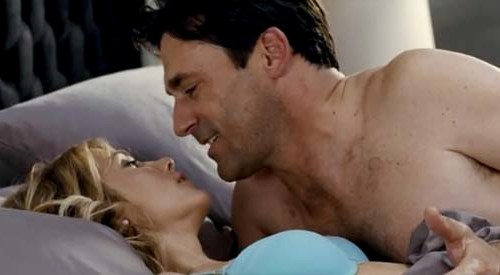
My misogyny may be seeping through again when I state that the best parts of this film are easily the men. The IT Crowd‘s Chris O’Dowd is a cop with whom Annie starts a faltering relationship, and John Hamm is the fuck-buddy she already has. Whenever these two are on screen, especially Hamm, we get some of the sweeter and downright hilarious moments from the film, with Hamm’s deliriously coarse womaniser outright telling Annie he only wants her for sex when he complains that she stayed the night. Kristen Wiig is OK, but she does a lot better in bit parts and supporting roles. She stole several scenes in the likes of Adventureland, Paul and Knocked Up, but again that was with the help of much funnier men, in the likes of Bill Hader, Simon Pegg and Alan Tudyk.
It also doesn’t help that this film can’t decide whether it wants to be a slightly off-kilter rom-com or a zany gross-out comedy, and ends up being a messy mashup of the two, so we end up with scenes involving copious amounts of bodily fluids, as well as a genuinely heart warming first-date gesture from O’Dowd’s Officer Rhodes.
The film isn’t terrible, there are some funny moments (the dress fitting is a highlight, as is Annie’s confrontation with a young girl in the jewellery shop she works for) and the core messages are true and conveyed well, but it’s nowhere near as funny as it needs to be, and those bridal shower party favours are incredible inconsiderate.
Choose life 5/10
Body Heat

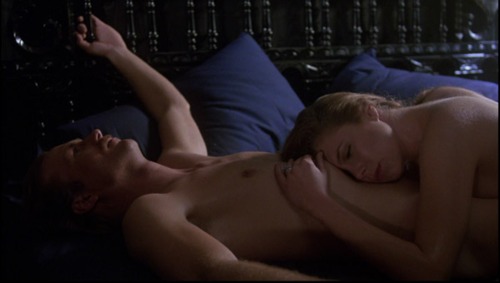
In a balmy summer heatwave in the American Deep South, the not-terribly-good defense lawyer Ned Racine (William Hurt with a 70s pornstar moustache) makes a random encounter with wealthy, sultry Matty Walker (Kathleen Turner), who is unhappily married to Edmund (Richard Crenna), a good man who is always away on business. Ned and Matty begin an illicit and steamy affair, and both decide that they’d be better off financially and romantically if Edmund were no longer around, so Ned, with the help of Mickey Rourke’s criminal consultant, sets out to murder him.
What sets this apart from the rest of the noir genre it draws obvious inspiration from is the copious nudity and sex scenes between the two leads, which are excessive even by today’s standards, as well as several shots of Richard Crenna in his underwear that I could have done without.
I was surprised that the plot didn’t contain more twists and turns, as in the end it was all fairly straightforward. For instance, I assumed early on that Matty’s husband Edmund would be in cahoots with either Ned or Matty, but in fact Edmund has very little to do in the story. In fact, his character arc is completed so early on that I was intrigued as to where the plot would go next. Also, some elements are set up with no eventual payoff – Matty’s niece catching Ned doing something he shouldn’t be doesn’t end up with her identifying him to the police – which led me to think that either we were deliberately fed loose threads to keep us guessing, or it’s just sloppy writing, though seeing as writer/director Lawrence Kasdan also wrote Star Wars Episodes V and VI, as well as Raiders of the Lost Ark and The Big Chill, it’s probably the former.
I was surprised to see just how attractive Kathleen Turner used to be, as other than her vocals in Who Framed Roger Rabbit, I’ve only ever known her as the dog trainer in Marley & Me (I have never willingly watched the film, it’s a favourite of the girlfriend) and as Chandler Bing’s drag-queen father in Friends, so I was rather confused that someone with such nice legs and skin could go on to be, well, Kathleen Turner.
There have been better noirs made before this (Double Indemnity) and after (Coen brothers’ debut Blood Simple), and if it weren’t for the aforementioned raunchiness there’s little chance of it being remembered today. The film isn’t necessarily bad, but its not revolutionary either.
Choose life 6/10

The Conformist

It’s probably not much of a recommendation to say that, only a month after having watched it and having read the notes I took at the time, I cannot remember much about this film. The plot was incomprehensible, mainly because the narrative was chopped up and flitted between with little to no acknowledgement, and if I hadn’t read that it was about a hitman I’d probably never have known.
Our protagonist is Clerici (Jean-Louis Trintignant), a fascism-supporting, recently engaged man with a sordid past, who desperately wants to fit in with society. So jumbled up is the structure of the film that I’m reluctant to say anything that happens, as I can’t be sure of the order shown during the runtime, so if there are spoilers within this review then I apologise.
We discover details of Clerici’s past from a forced confession he must make before his marriage, in which we are told that, as a lonely young schoolboy, his family driver molested him, until one day Clerici shot him in a scene where the squibs in the walls are distractingly visible long before they are used. His bride has similar stories of being raped in her youth, but the scene in which she describes the experience to Clerici is genuinely disturbing, as it seems to excite him, and he attempts to turn her on by almost enacting the molestation out upon her as she describes it.
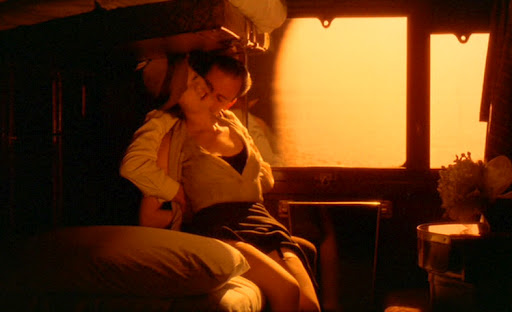
You probably won’t be surprised to find out that this film is Italian, so whilst interestingly shot – lots of angled cameras, leaves blowing at foot level and rays of sunlight through a forest of trees – there’s also a great deal of sporadic nudity and spontaneous sex scenes.
The impenetrable, David Lynch-like plot sees Clerici diverting from his Parisian honeymoon to assassinate his anti-fascist former lecturer, and also visit the man’s wife Anna, with whom Clerici probably used to know on a carnal level, but along the way many of the scenes have elements of strangeness – when Clerici buys a bouquet of flowers, the seller and her singing children proceed to follow him around, another time he manages to lead a decreasing conga spiral out from the inside. I found it incredibly difficult to commit to a film so nonsensical, as I always felt I was being left out of something.
Choose life 3/10

Time Regained

As much as I’d like the title of this post to actually be in reference to a blog update, whereby I’d allowed myself more time to watch these films than the allotted five years, alas it is in fact the title of a 1999 French film about the life of novelist Marcel Proust. The film is as thrilling as that sounds, and holds the position of the biography I’ve seen that, after having watched it, I know roughly the same amount about it’s subject as I did before watching, and all I knew beforehand was that at some point or other he’d written something.
Beginning with Proust (Marcello Mazzarella) on his death bed, dictating to an underling and going over old photographs with a magnifying glass, he then proceeds to remember his life, in whatever order he damn well pleases. Scenes are shown more than once, overlapping with similar yet different details, characters wander in and out freely, most with no introduction and some with several, and it’s difficult, if not impossible, to tell what is real and what isn’t. How much is memory? Is this his version of events or what really happened? With such little concrete fact to go on, nothing is learnt because nothing can be trusted.
Just as the opening credits show a stream washing over pebbles, so to did the entirety of this film wash over me. I was bored within the first 20 minutes, having nothing to affix my attention to but the sumptuous visuals and interesting uses of lighting, colour, focus and mirrors. At times it takes a meander into Bunuel territory, with rooms of upturned top hats lined on the floor, aristocratic party goers momentarily becoming mannequins and revolving audiences at a musical performance. At one point a woman visibly grows younger, then older, within a scene.
If the film was designed to be impenetrable, as I think is the case, then congratulations should go to director Raoul Ruiz, for this film is alienating if you have no knowledge of it’s central character. If you’re watching to try and discover details of the writer’s life, then flee, run full pelt in the opposite direction and head to the library instead, for there will be no assistance here. When party guests (there’s a lot of soirees in this film) complain at being confused at meeting so many new people, I can truly empathise.
Whilst the film looks astounding, it’s essentially pointless.
Choose life 3/10

Cowboys and Aliens

Apologies again for the lack of recent posts. I’ve been in hospital again for the past few days (where I managed to watch this film but do little else). All being well my extended medical excursions are now complete, and I can get back to watching films and writing posts. Hopefully there’ll be a steady slew of posts over the next week or so, as there’s about twenty from the List that I’ve watched recently and haven’t reviewed yet. Right, back to today’s feature:

With a title like Cowboys & Aliens, a certain level of expectation is accrued before watching. Along with approximately equal parts ranch hands and space travellers; their respective genres of horse opera and sci-fi melded neatly together, there surely must be a hefty dollop of fun, because the premise is more than a little ridiculous. Yes, it’s just as plausible as any other alien invasion flick, for why necessarily would beings from another planet arrive in present day, but the very notion of cowboys on horseback, with lassos and pistols, taking on intergalactic creatures capable of space travel and ray guns is just insane. So whilst I’d heard mediocre reviews elsewhere of this film, I at least expected to be entertained and amused throughout.

Chances are, this would have had a better chance of happening with a different cast. Though the film’s marketing and other reviewers have revelled in the idea of Bond and Indy together again (The Last Crusade famously saw Sean Connery, the one true Bond, playing Indiana Jones’ father) what director Jon Favreau doesn’t seem to realise is that an older, eye-twinkle-free Harrison Ford and a stoic, seldom talking Daniel Craig just aren’t funny, and have next to no chemistry together.

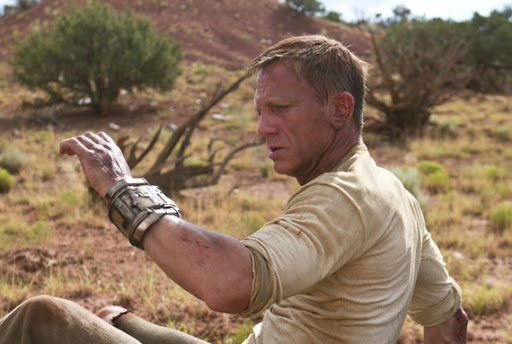
Craig’s Jake Lonergan awakes in the desert with nought but a photograph of a lady, a strange wound on his side and an even stranger chunky bracelet clamped to his arm. He can’t remember his name or anything else, so after seeing to a trio of miscreants, he heads into the nearby town of Absolution, terrorised by Ford’s bitter cattle baron Dolarhyde. The first half hour or so is easily the best in the film, setting up what looks like an interesting traditional western – albeit significantly more polished and brighter than others made recently, and even once the aliens attack, in a gripping sky-lasso sequence, it stays on the rails. Afterwards however, once every named character has either been snatched by the creatures or sets out after them, it loses it’s way.

Lonergan and Dolarhyde’s posse – for it is they that lead the hunt – is made up of some nameless alien-fodder, and is joined by a rag-tag bunch of townsfolk, including Sam Rockwell’s meek doctor-come-bartender and Olivia Wilde’s mysterious stranger. Wilde and Craig look entirely out of place in the Old West, their piercing eyes, clear skin and complete lack of cragginess juxtaposing with the entirety of the rest of the cast, including the likes of Ford, Keith Carradine and Clancy Brown, who appear to have been born to wear a stetson and chaps.

The best characters are easily Rockwell’s doc and Paul Dano’s Percy, Dolarhyde’s obnoxious son, so it’s puzzling just why they were sidelined quite so much. Had they been the central pairing, this could have been a far greater, more entertaining and interesting picture. The aliens, too, were disappointing. Their design isn’t anything overly creative – other than a chest cavity that opens up to reveal two small arms for delicate work – and they had a confusing blend of advanced weaponry and primitive pounce-and-flail combat techniques. They also had absolutely no characterisation, and quite frankly the notion that they invaded to steal gold is beyond ridiculous, and was the point at which I gave up on the film.

It’s my own fault for going in with high hopes after reading middling reviews, but I feel this is a great concept that was floundered on the wrong cast. Favreau as a director seemed a perfect choice, but he forgot to bring the funny. Yes, Craig’s impassiveness did cause humour at times, mainly when he caused people pain, but all-in-all this was a missed opportunity for a great film.

Choose life 5/10

Harry Potter and the Deathly Hallows Parts 1 & 2

I’m a strange breed of muggle. I’ve seen all the Harry Potter films, most in the cinema. I’ve read all the books. Hell, I own them. Double hell, I was first in line queueing up outside Morrison’s on the morning book 7 was released. But I wouldn’t call myself a Harry Potter fan. So why have I kept with it? I read the first book in school, and found the wizarding world to be quite wonderful, a dream of a place to escape to. Granted, by the time the much darker later books came along I became much happier that this world of dictatorial terrorists with almighty magical powers didn’t actually exist (or so I’m led to believe) but back then it was nothing short of fun, and the fact that I was of a similar age to the protagonist when the books were released made it all the more so.
The books were perfect for film adaptations, and the stylistic choices throughout the series have been close to faultless. Most of the negative aspects, other than the questionable acting abilities of the children early on in the franchise, can be blamed on the books being too labyrinthine to be condensed down into a 150-minute movie, and there are arguments to make as to whether each book would have been better off as a TV series, but it’s doubtful they’d have received such a hefty budget or impressive cast, or made nearly as much money.
Of the films, part 3, Prisoner of Azkaban, is widely regarded as the best, with director Alfonso Cuaron unleashing the franchise’s dark potential, redirecting away from Chris Columbus’ more child-friendly first parts, but personally I prefer part 4, Goblet of Fire, because it’s easily the most fun and structured, following the Tri-Wizard Tournament, and it has dragons in it, which are awesome. Parts 5 and 6 are, in my opinion, the weakest, with my reasoning being that I can barely remember anything that happens in them other than some character deaths and casting decisions, but the final films really kick things into gear.
Many have questioned the decision to split the final book into two halves, citing financial gain as being the true reason, but having seen the results I approve of the choice. Whilst the earlier books could stand to lose some of the lesser plot points without the plot suffering, the amount of closure given in the finale could not have been achieved with a similar level of editing. Whilst the total runtime for the final two films could have been a little shorter than the 4½ hours achieved here, getting it down to a length the core Potter audience would be willing to sit through without complaining would have resulted in almost catastrophic levels of cutting.
The most impressive aspect of the film franchise has always been the cast. Whilst the three leads, Daniel Radcliffe, Rupert Grint and Emma Watson, were never expected to be incredible actors (and, for the most part, lived up to this promise) the film studios ensured this wouldn’t be a problem by surrounding their stars with almost every British actor working today, with more added every film. To list them all would be senseless, but the fact that, Richard Harris’ untimely demise notwithstanding, every actor returned to their roles for every subsequent film shows that the films must have been great to work on too.The Deathly Hallows alone saw the inclusion of Bill Nighy, David O’Hara, Rhys Ifans, Ciarin Hinds and Nick Moran into a cast already including the likes of Ralph Fiennes, Robbie Coltrane, Julie Walters, Helena Bonham Carter, Alan Rickman, Jason Isaacs and Maggie Smith, and the fact that so many notable actors returned for such minuscule roles is incredible. Jim Broadbent, John Hurt and Emma Thompson are barely on screen, but the fact is they are.
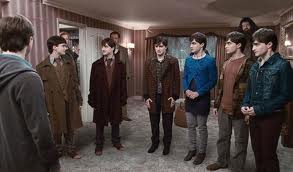
Part 7 is the only one of all eight films not to feature Hogwarts, the wizarding school where our young heroes are taught, and therefore doesn’t feel like part of the Potter pantheon. Freed from the structure of lessons, Quidditch matches and Harry being picked on by Slytherin, the film feels a little meandering, as Harry, Ron and Hermione scour the country looking for a series of magical Maguffins, horcruxes, that for one reason or another must be destroyed to help bring down the evil Lord Voldemort. The film opens strongly, with Harry’s escape from his home assisted by his wizarding friends transformed to be replicas of him, but it’s not until a later infiltration of the Ministry of Magic that any more excitement is had. There’s an awful lot of tension and relationship issues, exacerbated by a locket that builds negative feelings in whoever wears it (so… put it in a bag rather than wear it?) and a particularly cringeworthy scene wear Harry attempts to alleviate some tension by dancing with Hermione in a tent, but it feels empty without the action-balance provided by the second film. The brief animation, depicting the origins of the Deathly Hallows that grant the owner power over death, is easily the highlight of the series in total.
If watched as one long film, the two halves join together to form a perfectly balanced picture, with the final hour-long battle a rewarding epic culmination after a mammoth build-up, so if watching make sure to set aside the best part of an afternoon, however just watching part 8 alone is also acceptable. The infiltration of Bellatrix Lestrange’s Gringott’s vault, with Helena Bonham Carter gleefully impersonating Emma Watson, is tremendous fun (there’s another dragon!) and now they’ve got all the teenage angst and worrying out of the way it’s time for good and evil to get scrapping. The finale is equal parts devastating and spellbinding, as the regular cast is treated with a sporadic survival rate, literally anyone is up for the chop, up to and including Hogwarts itself, as various sets we’ve grown to feel at home in are burned to the ground. Some aspects of the battle feel crowbarred in – Mrs. Weasley’s showdown against Lestrange, Ron and Hermione’s inevitable kiss – but for the most part it’s a cinematic marvel that doesn’t disappoint.
Harry Potter and the Deathly Hallows Part 1: Choose life: 6/10
Harry Potter and the Deathly Hallows Part 2 : Choose film 7/10
Harry Potter and the Deathly Hallows Part 1 & 2: Choose film 8/10

Satantango

Aisha’s away for the weekend and I’ve got no other plans, the hotbed of social activity that I am, so I’ve made the most of a fairly sunny weekend by staying in and watching the longest film left on the list, Satantango. At 7 ½ hours long, it rounds out the top 5 longest films (though technically two are TV series and one is an eleven-part serial) on the List, which between them have taken up over 48 hours of my life that I’m never getting back. I doubt it’ll come as a surprise to many, but of the 14 films over four hours in length of the List, all of them are from Europe, and only one is in English (Kenneth Branagh’s Hamlet). More than half of them are French. America doesn’t start to get a look in until Sergio Leone’s Once Upon A Time in America (227 minutes), but it’s got a lot around the 3-hour mark instead. Also, of the 4-hour-plus films, three of them are Holocaust-related documentaries. Yay.
So, Satantango. I’m going to try and make this review be not entirely about the length of the film, but it is bloody long. And needlessly so. Many of the sequences involve nothing happening – the first 9 minutes follows cows wandering around in the mud, later a child walks purposefully towards the camera for what seems an eternity – so that whenever a conversation occurs – other than some sporadic narration, dialogue doesn’t kick in for about 15 minutes – it comes as a shock.
The film sees the inhabitants of a run-down Hungarian village. The villagers have a large sum of money they wish to share out, but some want to leave with more than their fair share, whilst others wish to wait for a man believed dead to arrive, with the possibility of making even more money with his help. This is only the central structure of the plot, for there are several detractions, but no real motives or details are ever expanded upon. We see the same events through different viewpoints, at one point witnessing a drunken dancing session (at least 10 minutes long) from the perspective of a young child outside the window, and then later we’re shown it again, longer this time, but from inside the room. This new vantage point offers nothing new, and just serves to make me wish to never hear an accordion ever again, for the same short tune segment is repeated over and over and over again for the entirety of the dance.
This is, however, a great achievement in terms of direction and cinematography. Much of the film takes place in long, unbroken shots, the aforementioned dancing, for example, which at times are truly breathtaking, and others thoroughly unimpressive due to the lack of anything happening onscreen (it’s a completely unbroken shot! Of someone sat down!).
Though I was never bored, and I was also far from entertained or engaged. The large gaps of nothingness allowed my mind to wander and expand upon what I was watching, and also gave me time to jot down the improvements I’m intending to make to the site over the next few weeks. It did, however, feel like an arduous watch, something I had to work at to pay attention, and after seven hours I’d hoped for a satisfying conclusion to make it all worthwhile, a reward for the patience and sacrifice of time, but alas I was left wanting.
Choose life 5/10

A.I.: Artifical Intelligence

Kubrick’s visionary ideas, social commentaries and moral dilemmas don’t quite gel with Spielberg’s family oriented sentimentality in this disjointed and overlong offering, conceived and planned by the former but implemented by the latter after his death in 1999.

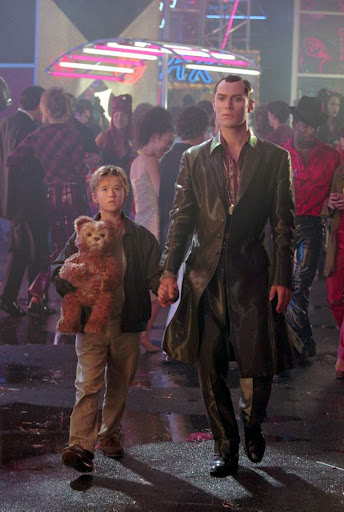
Now, I love me some robots. Whether they’re compacting waste into trash skyscrapers, travelling through time to save Sarah Connor or trying to kill Will Smith, you show me a film with robots in and I’ll watch the Hell out of it (though I’ve never actually seen the 20th Century Fox film Robots starring Ewan McGregor and Robin Williams, just never came around). There’s a robot clock watching me from atop a bookcase in the lounge, robot cushions on the sofa and a robot cookie jar whose head seems to rotate around and look at me wherever I am. But the key characteristic that joins these all together, is that they all look like robots, which is where A.I. looses my interest, for here they look like people. Yes, I know that’s the point. Haley Joel Osment’s mini-mecha David has been created to fill the hole left when his new parent’s son goes into a coma, and Jude Law’s robo-gigolo Joe (that’s fun to say) would be downright weird if he didn’t look a lot like a human, but that’s not what I want to see in a film about mechanical men. It isn’t until over half way through the film that we see some older models and exposed innards, and even then it’s far too briefly.

Osment is good, too good, as the automated child, and occasionally he passes for human, but for the most part he’s in full-tilt terrifyingly creepy mode, following his ‘mother’ Monica (Frances O’Connor) around the house all day, standing and watching her until she justifiably locks him in a cupboard. The first 45 minutes could quite easily be the start of a horror film, so disturbing is David: “I can never go to sleep, but I can lay quietly and not make a peep.” Nothing he does is endearing or even likable, but then I’ve always felt this way about children, but still the brief amount of time it takes for Monica to bond with this mechanised horror is jarring, especially given there seems to be no real scenario that draws them together. Also, David is only programmed to ‘love’ one parent, and his new ‘father’ Henry (Sam Robards) seems devoid of emotions, either for his comatose son or the new replacement, so that fits together nicely.

The movie is comprised of a series of episodes that, once passed, are all but forgotten. The story could have been interesting, and the world has potential for a more enthralling film within it, especially in the city scenes, and the brutal Flesh Fairs, where rogue ‘bots are hunted and tortured to a baying crowd’s delight, but over an hour of watching David desperately wanting to be a real boy becomes terminally dull. The future technology and gadgetry is generally good, subtle yet insightful, although the cars look a bit silly. And the ending is polarising, I found it terrible and unsatisfying, whilst Aisha thought that, whilst it seemed tacked on and unnecessary, it was still very moving.


Choose life 5/10

Unlisted: Iron Man 2

Yesterday I discussed the near flawlessness that is Iron Man, and whilst all these praises remain for the sequel, it suffered from having far greater levels of hype, anticipation and expectation. It seemed that all who had loved the first couldn’t wait for the second, everyone wanted more, and more was most certainly what they got, especially when it comes to an overabundance of supporting characters, superfluous plot strands and men in metal suits hitting each other. Where the original finale, with Stark and his business partner, Jeff Bridges Obediah Stane, knocking seven bells out of each other in their rocket-propelled armour, seemed fresh, new and exciting, in the sequel we get something similar not once, but three times, as well as two metal men fighting an army of remote-controlled drones and an early confrontation between Stark and new villain Ivan Vanko (Mickey Rourke) at the Monaco Grand Prix. Some of the action set pieces, like the aforementioned meeting, seem a little shoehorned in to put an action beat in place, but are still impressive, and the suiting-up sequences have also been greatly improved upon, especially the Suit-case.
All the supporting characters are back, but Don Cheadle has replaced Terrence Howard (Howard apparently wanted more money than Marvel thought he deserved, and seeing how little he brought to the table in the first film I’m inclined to agree with them) as Rhodes, and all the characters get an expanded upon arc, even director Jon Favreau’s background cameo as driver Hogan gets himself something to do. Gwyneth Paltrow’s Pepper Potts is the new Stark Industries CEO, Rhodes wants a suit to take back to the military, Scarlett Johansson is Tony’s new assistant/undercover S.H.I.E.L.D. agent (a welcome addition to the cast, if only for aesthetic reasons), Tony is in talks with Samuel L. Jackson’s one-eyed Nick Fury about his role in the Avengers, weapons rival Justin Hammer (Sam Rockwell) is desperate to better Stark and bird-obsessed Vanko aims to settle the score regarding his father working with Stark’s dear old Dad (Mad Men’s John Slattery). See, that’s a really long sentence. Far too much to take in. The first film was streamlined, with not much chaff around the wheat, but here there’s just too many strands. I didn’t even mention that the arc reactor keeping Stark alive is also killing him, a completely unnecessary plot point that adds nothing and is resolved by the end, so doesn’t affect the series, but takes up about 20 minutes of screen time. Even with so much going on, the film is 5 minutes shorter than the first, but feels half an hour longer, as boredom sets in from watching metal men punch each other repeatedly.
Even more so than in Iron Man, this feels like a prequel to the Avengers, especially with Johansson’s Black Widow, bigger roles for Nick Fury and Agent Coulson and references to Captain America and Thor. That, and the film’s finale feeling disappointing after a protracted build up leaves this film with all the entertaining pats of the first, but an unfulfilling sequel that doesn’t take them anywhere. Favreau has since dropped out of part three, but Kiss Kiss Bang Bang director Shane Black has stepped up instead. He’s worked with Downey Jr. on one of his best roles to date, so here’s hoping.
Choose life 6/10

Good Morning, Vietnam

Barry Levinson can’t work out whether he’s Oliver Stone or Jerry Zucker in this Vietnam-based Robin Williams vehicle. Heavy handed politics and imagery of riots, fire and explosions doesn’t tend to gel with zany antics and improv riffing from one of the world’s leading fast-talking funnymen, but fortunately Williams is on fine enough form to just about rescue the material from an uneven mess, as his radio DJ Adrian Cronauer is brought in to perk up the on-air talent of 1965 Saigon. The troops love him, but his superiors, including the late, great Bruno Kirby’s put upon aggressive peon Lt. Steve, are less keen on his refusal to play approved material and pre-programmed songs, opting for rock and roll over Perry Como. Some storylines seem forced and contrived – Cronauer repeatedly infiltrating an English class just to meet a girl, her entire family accompanying them on a date – and you get the feeling that this is only loosely based on a true story.
Where it shines though is the comedy. Though some of the references are now very dated and probably worked a lot better back in the States (Ethel Merman, Walter Cronkite, Mr. Ed), Williams knack for voices and repartee with a crowd is unparalleled, though a young Forest Whittaker as station lackey Edward Garlick gets his share of decent lines too: “A man does not refer to Pat Boone as a beautiful genius if things are alright.”
The film tries too hard to make a political statement where none is wanted, and the failed attempts at poignancy leave a bad taste in the mouth. Had the serious side been toned down – difficult, I know, given that it’s about war – and the directionless plot been reined in a little this could have been a classic.
Choose life 6/10