Double Indemnity

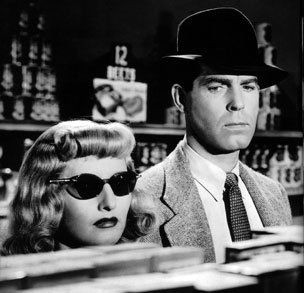
When a successful insurance salesman visits a client’s house to discuss the renewal of some expired car policies, the last thing he expected was to become embroiled in a plot involving murder and deception, yet that is exactly what happens when he meets his client’s beautiful yet scheming wife.double_sunglasses11 Continue reading

The Bridge on the River Kwai

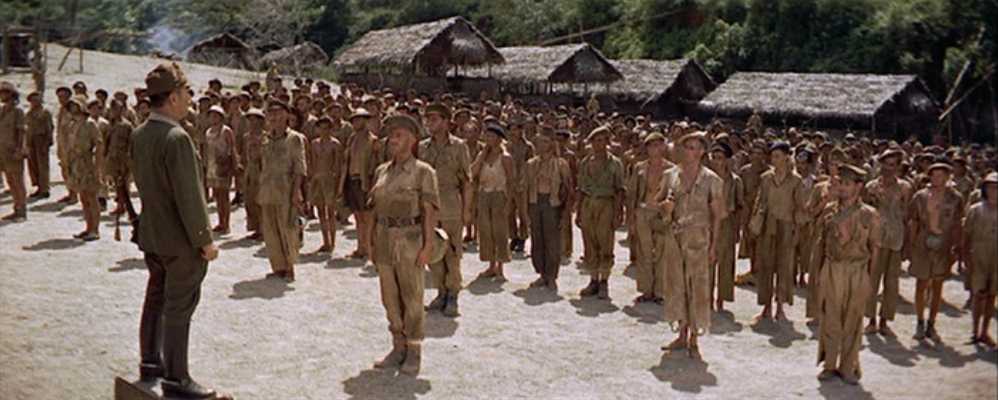
During World War 2, a squadron of British soldiers are ordered to surrender to the Japanese, and are taken to a prisoner-of-war camp in Thailand. There, they are instructed to assist in the building of a bridge (over the river Kwai), and every soldier must help, regardless of rank. The Geneva convention clearly states that officers are exempt from such duties, s when they are forced to work alongside the rest of the men, the officers are thrown into containment. Meanwhile, a small group of men outside of the camp are planning to make their way through the jungle to destroy the bridge.
bridge-on-the-river-kwai1 Continue reading

Vertigo

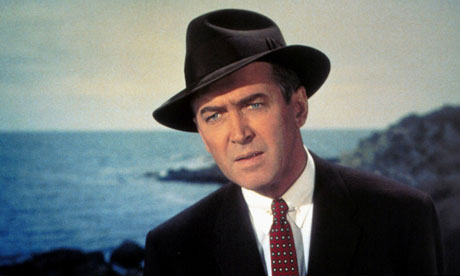
‘Scottie’ Ferguson (James Stewart) is a detective in San Fransisco who suffers from crippling vertigo, exacerbated by his most recent rooftop scuffle culminating in the death of a colleague and the escape of the perpetrator being pursued. He therefore retires, only to be called upon by an old college friend Gavin (Tom Helmore) who is concerned about his wife Madeleine (Kim Novak), who may or may not be occasionally under some form of supernatural possession from an ancestor who committed suicide at the same age Madeleine is now.
Continue reading

Psycho

On a bright December Friday afternoon, Marion Crane (Janet Leigh) returns to work after some afternoon delight with her similarly cash-strapped lover Sam (John Gavin). When her boss sends Marion to the bank to deposit a client’s $40,000 in cash, on a whim she hastily backs her bags and flees with the money, but draws the attention of a road cop during her escape. When darkness and an incessant downpour prove too much for Marion, she checks into the run down, deserted Bates Motel, where she meets motel manager Norman Bates (Anthony Perkins), a kind yet awkward young man, unfamiliar with pretty young women entering his life. Norman’s bedridden mother disproves of the presence of Marion, and refuses to let her into the house, but this is no concern of the girl’s as she still has to plan what to do with the money.
Continue reading

Safe

Carol (Julianne Moore) is a bored housewife, sorry, homemaker, in the San Fernando Valley. Her husband Greg (Xander Berkeley) is a successful businessman, and the pair live in a lavish home with Greg’s son Rory (Chauncey Leopardi). Carol has many friends and an active social life, attending various parties and gym classes. There’s nothing wrong in Carol’s life, other than her new sofa being delivered in black rather than teal, yet she suddenly finds herself becoming ill, which she soon believes to be caused by the “chemicals” found in modern life. But is she suffering from a real sickness, or is it all in her head? Maybe moving to the secluded, desert-based Wrenwood Centre, a “chemical-free facility”, will result in a cure.

Continue reading

Citizen Kane

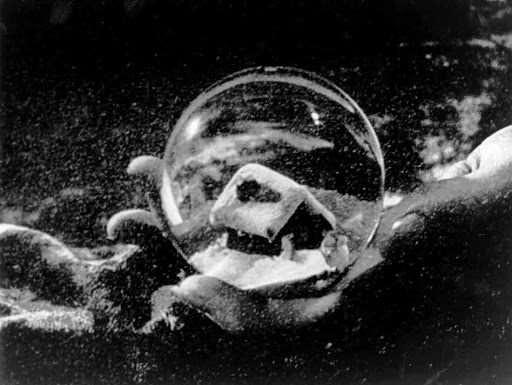
Charles Foster Kane (Orson Welles), an unimaginably wealthy publishing kingpin, drops his snowglobe and dies alone in his bed. His last dying word, “Rosebud,” sends the national newspaper journalists into a frenzy, all eager to discover it’s true meaning, in the hope of shedding some light onto the tycoon. Led by Jerry Thompson (William Alland), the reporters speak with Kane’s former wife, friends, employees, business partner and butler on their search for the truth. Could it be the name of a girl? A dog? A boat? Or just the rambling ravings of an insane old man?

Up until last year, Citizen Kane has topped Sight and Sound magazine’s Greatest Film Of All Time list, but was recently toppled by Vertigo. It’s been a little while since I’ve seen Hitchcock’s classic, so I can’t vouch for whether the change is correct or not, but I can say that I have no problem with Citizen Kane having been up there for quite so long. This film actually appears on all four of the lists I’m currently working through, and so great is its reputation that I can’t imagine a respected film list denying it a place. I mean, it spawned the prefix “It’s the Citizen Kane of…” as a way of saying a film is the greatest of a specific type. And heads up, this isn’t going to be the Citizen Kane of Citizen Kane reviews. So what makes it so important? Why is it revered by so many people? Will every paragraph in this review end in a question mark?

Continue reading

The Graduate

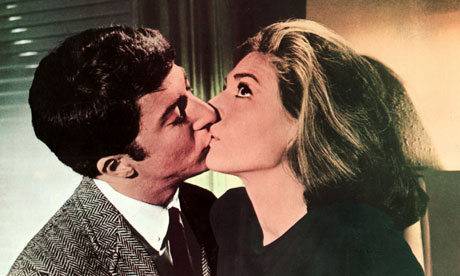
Ben Braddock (Dustin Hoffman) has returned home from university a star scholar, with his parents and all their friends keen to voice their high hopes for him and his future, but Ben is more uncertain with what he wants to do. Amidst this despondency, Ben finds himself the reluctant object of the affections of Mrs. Robinson (Anne Bancroft), the wife of his father’s business partner, and the pair begin a secret and sordid affair, which becomes complicated when Mrs. Robinson’s husband (Murray Hamilton) has plans to set Ben up with his daughter Elaine (Katharine Ross), obviously against the wishes of Mrs. Robinson.


This is one of those films that has become famous for a few significant moments that have become integral to pop culture. Moments like Anne Bancroft trying to seduce Dustin Hoffman, him framed in a doorway behind her strategically cocked legs in the foreground, or the ending, which gives way to one of my favourite final scenes in cinema (featuring the second time I’ve seen a crucifix being used as a weapon in recent times, after Liam Neeson cracked skulls with his in Gangs of New York). The first time I watched this film, as I’m discovering is the case with so many films, I didn’t understand it that much or in fact take any of it in, and the true meaning of the ending was lost on me. This time around I’m pretty sure I got it. Maybe I’m the right age now. Maybe it’s because I’ve now finished my studies and, only a few years ago, was briefly adrift in an ocean of directions I didn’t want to pursue. Or maybe it’s because I’ve seen (500) Days Of Summer, in which the ending is discussed and potentially ruined for anyone who hadn’t seen it or couldn’t remember it (like me, for example).

That’s the problem with such a culturally significant film; it’s been discussed and dissected not just on film blogs such as this one (and probably a few better ones too), but in many other areas of pop culture. The more famous sequences have been riffed on in the likes of
Starter For Ten, American Pie and several times in The Simpsons, whereas the overall plot can be heard in The Player (in which a sequel is pitched, set 25 years later), and in Rumor Has It (which I’ve not seen, but my knowledge of the plot led me to expect certain scenes in The Graduate that never actually came about). Fortunately, even though the basics of the plot have been in the public eye for some time now, there are a great many more charms which this film can rely upon.

Firstly, the acting. I’m starting to think that Dustin Hoffman could well be one of the most under-rated actors of his generation. Now, I know that he’s received two leading actor Oscars from seven nominations (the first of which came from this very film), but he’s always seemed overshadowed by the likes of Al Pacino and Robert DeNiro from actors of that age. It hasn’t been helped by his far-from-stellar later work, but then Pacino and DeNiro are hardly innocent of that either. You can pretty much guarantee Hoffman will be the focus of a future Film-Makers series. In The Graduate, Hoffman takes a character who should be sympathetic and runs in the opposite direction, making him quite unlikable; someone who’s been handed everything but couldn’t care less. The true genius of the performance shines when Ben is at his most nervous. His subconscious, subtle nod when Mrs. Robinson asks if he knew she was an alcoholic;
his unintentional little whinny and half-swallow whenever he’s put upon the spot or caught off guard. You completely believe, despite the ten year age difference between Hoffman and the character he was playing, that he could be this bright young scholar, the former big man on campus, who now finds himself in the submissive role of a relationship he has no control of. Anne Bancroft is also noteworthy as the woman Ben was completely unprepared for. She retains a steely demeanour, forever in control of every situation she is in, usually because she pulled the strings to instigate it in the first place. 


The cinematography and editing were surprisingly good too – surprisingly because I didn’t remember them being very memorable the first time around. The brilliant opening, following Ben as he glides down an airport’s moving walkway, has been shamelessly ripped off by Tarantino in Jackie Brown, but it’s the cuts that really impressed me. Whether it’s Ben getting dressed as he leaves the swimming pool and walks through a doorway cutting to him walking into a hotel room and being undressed by Mrs. Robinson, or his mounting a lilo cutting seamlessly to mounting her on a bed. The editing from In The Heat Of The Night must have been superb to have beaten this at the Oscars.


The main detracting factor is the soundtrack. I was pleasantly surprised when Simon and Garfunkel’s The Sound Of Silence opened the film, for it’s a song I’m happy to listen to. However, they perform the entirety of the soundtrack, which unfortunately is comprised of only about three of their songs, repeated over and over again, and I became truly sick of it all the second time Scarborough Fair was played in the space of a couple of minutes. I don’t normally mind the haunting, melancholic feel of their songs, but after too long I felt like I was drowning in cold syrup. The main problem is that they always sound bored of singing their own songs, and I’m certainly now bored of hearing them.


There were a couple of uncomfortable moments, but they were played out masterfully, particularly the initial encounter between Benjamin and Mrs. Robinson, who have known each other all of his life, just not in that present light. After giving her a lift home in his shiny new graduate-present car, Ben is requested to accompany Mrs. Robinson indoors, as she is frightened of entering an empty, dark house alone. He is plied with alcohol and music and led upstairs, torn between intense awkwardness and the desire to be polite and not offend his parents’ close friend. Just as you think things cannot possibly become any more excrutiating for Benjamin, after Mrs. Robinson has all but thrown her naked form at him, of course Mr. Robinson comes home and encourages young Ben to enjoy himself that summer, making sure he has a few flings. This is an embarrassing situation far beyond anything you will find on Curb Your Enthusiasm.


The script is also wonderful, and any film that can feature the lines “You’re the most attractive of all my parents’ friends” and “I don’t love your wife, I love your daughter sir,” can do no wrong by me.

Choose film 9/10

The Wicker Man

Devout Christian police officer Sergeant Howie (Edward Woodward) receives an anonymous letter telling him that a young girl, 12 year old Rowan Morrison, went missing a year ago and hasn’t been seen since. Armed only with the letter, a photo and his unbreakable religious beliefs, Howie sets out to the secluded island of Summerisle, where he is met by hostility from the locals, who do not approve of a mainlander on their soil, and all deny any knowledge of Rowan’s existence. As Howie investigates further, he is met by obstructions at every turn, and discovers the islands inhabitant’s rituals and ideology may have a more sinister cause for Rowan’s disappearance than the policeman could ever have imagined.

First things first, I’ve not seen the 2006 Nicolas Cage remake, so I can’t really discuss that film here, which is fine, because this post isn’t about that film, it’s about the 1973 original. I have seen a few of Cage’s clips online, and I was glad to see that at no point did Edward Woodward (who, by the way, has the greatest name ever, I can’t stop saying it) explode into a torrent of “How’d it get burned?!?”, have a cage of bees strapped to his head, or perform a running punch whilst dressed as a bear. I had, however, seen this version before, but I now realise it was a heavily edited-for-TV cut, as although I watched it some years ago, I cannot remember nearly as much of the frankly disturbing goings-on that occurred in this film.

Even though it is essentially about a cult, and it’s seen through the eyes of an outsider, there is a lot of this film that’s difficult to fully come to terms with, particularly the downright infuriating manner in which the children of the island are taught. For example, with their forthcoming May Day celebrations, the lessons focus on the maypole, and how it symbolises the penis. Strips of flesh are hung by gravestones, one of which reads ‘Protected by the Ejaculation of Serpents’. Oh, and graveyards are apparently appropriate places to breastfeed children. The children are also encouraged to sing, which I’ve got no problem with, unless the lyrics contain such gems as “On that bed, there was a girl. And on that girl, there was a man. And from that man, there was a seed. And from that seed, there was a boy.” Bear in mind these children are all pre-teen, maybe even by a fair few years in some cases. 

Oh yes, the singing. I’ve decided that if I ever revisit my Top 5 Films That Should Be Musicals, this film is a prime candidate for the sub-list of ones that already pretty much are ones. There are far more songs here than I had expected, and their diversity was something of a surprise. You’ve got a group of naked women prancing around a stone circle singing about pregnancy, and elsewhere there’s an impressively impromptu pub-wide rendition of The Landlord’s Daughter, which must have taken rather a lot of choreographing, seeing as no-one steps on anyone else’s lines. Britt Ekland, who plays Willow, the aforementioned innkeeper’s spawn, even gets her own solo (though I think she was dubbed by someone). Her song, creatively named Willow’s Song on the soundtrack, plays out like a pornographic music video, as Ekland, naked of course, sings directly to the camera as she gyrates ferociously around her room, slapping herself and beating on the wall in an effort to entice the neighbouring Howie to come and attend to her. Understandably, this is one of the more memorable of the film’s scenes, but the breaking of the fourth wall was distracting, and it felt like it went on for far too long.

I very much approved of how we as the audience are kept as much in the dark as Howie is as he goes about his quest, only realising something’s up when he does, at which point of course it’s too late. Woodward also does a good job with Howie’s character, establishing a hero who is something of a dick, and definitely not a people person. I don’t want to get into a debate about religion (in short, it’s not for me), but I’m glad that I’ve never met someone who is quite so steadfast in their beliefs as Howie, who is utterly appalled when he discovers the island education system doesn’t contain anything to do with the teachings of Jesus, as the only religion he even acknowledges the existence of is Christianity, proving he is possibly just as obsessed or bigotted as the islanders themselves.


Even with so many distubing aspects – the thought of the beetle slowly crawling around the desk until it strangles itself still upsets me a little – I can’t help but appreciate this film as being a thoroughly engaging mystery, with an enrapturing plot that, even though I had an inkling of a memory as to what the ending was, I couldn’t wait to see pan out to find out exactly what was going on. Also, Christopher Lee is generally brilliant in anything, here appearing as the charming Lord Summerisle. I’d have appreciated a little less music and a lot less insanity, but I’m still very pleased to have seen it again. Oh, and I’m fairly sure the Salmon of Knowledge was from a lost Monty Python sketch.

Choose film 7/10

Brief Encounter

Laura and Alec (Celia Johnson and Trevor Howard) meet every Thursday in town – he after work, and she to do the weekly grocery shopping. At first their regular meetings are nothing more than a newfound friendship, but it is not long before they fall for one another. The problem is, Alec will soon be leaving to work in Africa. Oh, and they’re both married, with families at home.


It’s a simple story, and therein lies the beauty. There’s no surprise ending, no unforeseen third act plot contrivance – in fact, the ending of the couple’s relationship is the first thing we see, but it isn’t until the end that we realise quite how devastating it is, as the events leading up to their separation are told chronologically through flashback, from their meeting when Alec assists Laura when she gets soot in her eye, through shared meals and cinema-goings, culminating in their final moments together, probably forever, in this day before social media and the ease of communicating with someone half the world away. 

Our focus is on Laura and Alec, and in a way there is nothing in this film but them. Their families are largely only hinted at, other than Laura’s dull husband Fred, but even with only mild insinuation and a well-implemented voiceover from Laura we are offered as much background information as we need to realise their situation and motivations. Neither were looking for someone else, and both believed they were content with the lives they were leading. Everything would have been perfectly fine if they’d just never met one another, but fate is a cruel mistress, and the couple’s momentary enjoyment cannot possibly last, and the sadness comes from their clear understanding of this fact.

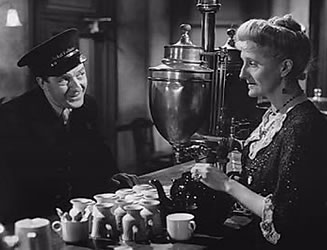
There are other marginal characters – the tempestuous relationship between the cafe owner and train conductor (who walks across the train tracks! It’s like a different world!) – but they are merely background, and serve to frame this story, rather than add to it. In fact, without their inclusion I got the feeling that Laura and Alec’s story would have struggled to breach feature-length, coming in at only 86 minutes. This length felt perfect for the story though. There’s nothing I could add, and nothing I’d take away, and if anything were to be added, it would be in the form of excess background – perhaps a love interest for Beryl, the tea room assistant, but there’s no need for it, and it’d just be padding.

I’m fairly sure this is the most British film ever made, and it’s popularity is probably the main reason behind the English stereotype of the stiff upper lip and clipped manner of speech that has become synonymous with my fellow Englishmen. The amount of scenes that involve the drinking of tea (something of which I’m fairly proud I’ve never done) are almost farcical, and everyone speaks as though they were born not with just a silver spoon in their mouth, but half the cutlery drawer rammed down their oesophagus. It’s this typically British sense of repressed feelings and not letting your guard down that really makes this film, as we see our two leads, particularly Laura, struggling to maintain their steely facades whilst underneath their hearts are being torn apart my these circumstances beyond their control. You can’t let these things be public knowledge, it’s just not how we do things around here.

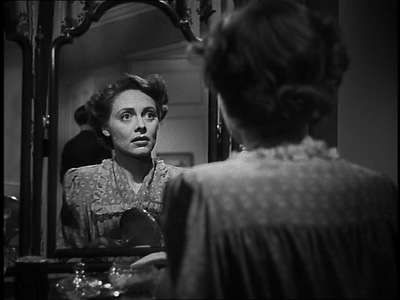
There are many moments of intense emotion and poignancy, but if I had to pick one, it would be the traumatised look Laura gives herself in the mirror after the first time she lies to her husband, followed by the internalised “It’s awfully easy to lie when you know that you’re trusted implicitly.” She knows that there is nothing more wrong than what she is currently doing, but that she has no choice to do it anyway, and is just going to have to live with herself. By today’s standards the romance is almost laughably timid – the most that happens between the two leads is the occasional kiss – but the reactions and implications from these events are just as bad to our leads as if they’d been knocking boots five days a week for several months, if not more so.

This is one of the first films I’ve fully appreciated that doesn’t have a lot going for it in terms of action, humour or a happy ending that makes me feel all warm inside. Instead, this is heartfelt, emotional film-making, that shows just how much can be done with very little.

Choose film 9/10

Superman Returns

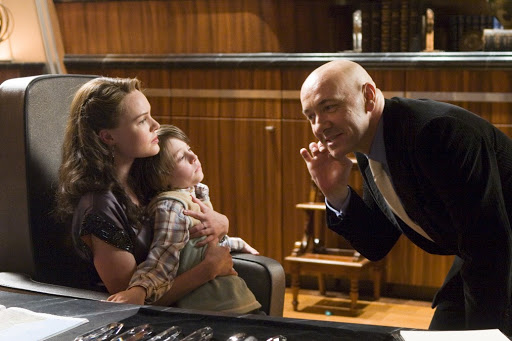
Superman, the last surviving alien from the planet Krypton with god-like powers, has left the city of Metropolis that he has protected for decades to return to the last known whereabouts of his destroyed planet. Upon discovering nothing to be found where his planet used to be, he returns back to Earth, and re-assumes his alter ego of Clark Kent, a mild-mannered journalist for The Daily Planet. He attempts to rebuild his relationship with Pulitzer-prize winning co-journo Lois Lane (Kate Bosworth), but is annoyed to discover that not only is she engaged to their boss’ nephew (James Marsden), but she has a son, Jason (Tristan Lake Leabu). Meanwhile, having recently been released from prison, Superman’s former nemesis Lex Luthor (Kevin Spacey) is busy hatching a plan involving crystals found in Supe’s mysterious Fortress of Solitude.

I’m not a fan of Superman. There, I said it. I remember half-watching the 1978 Christopher Reeve version when I was younger, but I can tell you literally nothing about it, and I remember watching Superman Returns a few years ago, but I couldn’t remember too much about that either, other than the shot of Bosworth’s Lois ascending in an elevator, Spacey’s Lex Luthor being near water at some point and the shot of Superman being shot in the eye that was in the trailers. To be fair, that viewing was overshadowed by a rather eventful mid-film pee break.
I remember the rest of the day clearly. It was pretty much the first time I’d tried Pick’n’Mix sweets (I was aged 19 I think), and all I’d consumed so far that day was strawberries with orange juice for breakfast, a couple of glasses of Coca Cola, and several fistfuls of Pick’n’Mix. My student days were not necessarily the healthiest of times. About halfway through the film, buoyed by the saccharine high of the tooth-rotting goodies  I’d consumed, I desperately need a wee. So i nipped to the loo, and mid-stream I passed out, and woke up face down on the toilet bowl. This is a very unusual place to regain consciousness, and needless to say, once I re-entered the lounge and joined my housemates watching the film, I didn’t take too much of the rest of the film in, hence why I remembered so little. I promise that I don’t make a habit of passing out during films, although later that day something similar occurred during an advert break in The Long Kiss Goodnight, this times resulting in my collapsing face-up (again mid-urination), still clutching the 2″ thick acrylic shower rail I’d previously been using to steady myself, that had now been sheared from the wall. Don’t worry, other than my recent Looper adventures, the only other time I’ve passed out was last year, again during a period of relieving myself, but was not halfway through a film. It did require the purchasing of a new toilet brush holder, as apparently the one we used to own wasn’t designed to withstand 15 stone of unconscious man falling onto it. 

Anyway, me fainting halfway through the first time I watched the film has nothing to do with whether I like it or not, I just enjoy retelling overly personal stories from my life that are at best tangentially related to the film I’m reviewing. No, what I don’t really like about Superman is that he’s just too powerful. His powers are seemingly beyond limit, with the only things he cannot do being the ones he hasn’t tried yet. He has flight, x-ray vision, super speed, strength, laser-eyes, time-travel, advanced hearing, super-whistling, fucking everything. And he only really has one weakness; Kryptonite; an extremely rare green rock. Which basically means that if people don’t know about this weakness, or there isn’t any of the super-scarce emerald stone around, there’s pretty much nothing in the way of Superman saving the day. I never really got into Smallville, even though I was pretty much slap-bang in the target demographic when it came out, and I can’t even get excited about next year’s Man Of Steel, even with Zack Snyder directing and Christopher Nolan producing. Needless to say, this film was going to have it’s work cut out if I was going to be impressed by the end of the viewing.
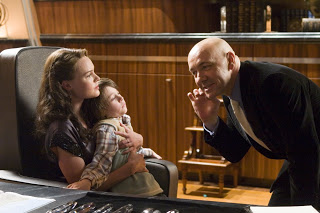
Initially I was intrigued by the film, as it has an interesting and somewhat eclectic cast. Kevin Spacey is perfect as Luthor, taking over from Gene Hackman. Spacey is his usual dependable self, and it at his best when in full-on bad guy mode, which is most certainly the case here. Elsewhere, Eva Marie Saint was a nice touch as Martha, Clarke’s adoptive mother, though disappointingly she doesn’t really get a lot to do, as is also the case with Frank Langella’s Perry White, Clarke and Lois’ boss. James Marsden once again plays a man caught on the cold side of a love triangle between the film’s hero and heroine (see also The X-Men trilogy, The Notebook, Enchanted), and Parker Posey is always a welcome addition to any cast, here playing Luthor’s sidekick/partner/main source of annoyance. Oh, and Kal Penn’s there too, but I’m fairly sure he never actually says anything, and [TINY SPOILER] is given a terrible cop out death with Luthor’s other two goons at the end [END OF TINY SPOILER].

Where the casting really falls down though is with the leads. Kate Bosworth, aged 23 when the film was released, looks far too young to play a Pulitzer Prize winning journalist, and seems dwarfed even by her own clothes. She also displays practically no likable qualities – she frequently dissolves into childish hissy-fits and strops whenever she (justifiably) doesn’t get her way. Brandon Routh, on the other hand, looks the part of both Superman and his public identity, but whenever he tries to act he appears to be made more of wood than the steel of his nickname. And in the many, many CGI shots of him flying or in danger, the film seems to become a late 90s video game, so terrible are the graphics. Most egregiously, the film’s final shot is one such diabolically bad render. Even in some of the non-CG shots Routh appears to have a plastic-like finish, possibly to make him look more similar to the computer generated bits.

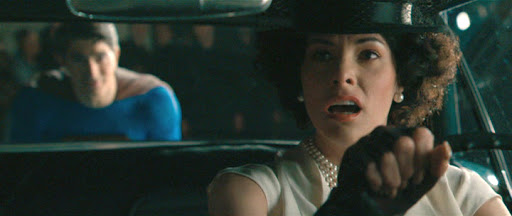
Another part that really bothered me was that the film is clearly set in modern times, with space shuttles, airplanes, videocameras etc. all being integral to the plot, but the architecture and fashions all seem to be stuck in the 1920s, up to the point of large sections seeming like they were shot in sepia. This is none more clear than in Parker Posey’s outfit in the car sequence. Adding the newspaper-room setting reminded me heavily of The Hudsucker Proxy, a film I liked a great deal more than this one, and which inspired me to suggest Jennifer Jason Leigh as Lois, although Amy Adams’ casting is possibly the only thing I approve of for the next film. I can see where director Bryan Singer was coming from with the mix of old and new styles, but it never really worked for me, and I found the whole thing very jarring. The overall plot was mostly just silly too, and various minor plotlines – the one involving Lois’ son for instance – felt unsatisfying and, at times, just plain stupid. The first 60% of the film seemed to drag too, as Lex’s plot is kept a mystery, and there doesn’t seem to be too much for Superman to really fight against. And part of the finale, in which lives hang in the balance of a fax machine’s volume, is not quite dated yet, but will be very soon. And who the hell puts a snooker table on a boat? Seriously.

There were some nice touches though. I approved of the little in-jokes for superhero fans (a news reporter mentions that they’ve received a message from Gotham), and the moment where Clarke pretends to be a bit confused and muddled to but Lois off the scent was good. The shoehorning-in of the “It’s a bird, it’s a plane…” line was clumsy, but still managed to raise a smile from me, even if it was accompanied with an eye-roll. The destruction of a model railway town may not sound like the grandest action set-piece in a film, but for me it was the highlight here, with it being shot in a similar fashion to a Roland Emmerich film. That one short sequence was more entertaining than the entirety of 2012, I can tell you.Elsewhere, some camerawork really disappointed me – a shot heading over a balcony and down, to focus on Lex reading a newspaper felt clunky and jerky – but this was more than made up for by the visually stunning space-set opening.

The viewing of the film was worth it to finally discover the origin of two Adam Carolla Show sound effects (“Wrong!” and “You’re losing your hair,” for fellow regular listeners), but sadly other than this point I was thoroughly underwhelmed by the whole thing. All being well, my low hopes for the upcoming Man of Steel may result in me being pleasantly surprise. Here’s hoping.

Choose life 4/10