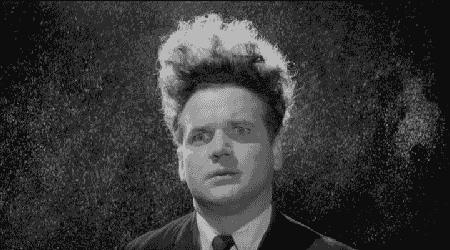
I think this is David Lynch’s idea of a romantic comedy. Shot in stark black and white and sounding like it was filmed underwater or near a busy factory, we follow the bizarrely coiffed Henry Spencer (Jack Nance) through the trials and tribulations of an average young man – meeting his girlfriends parents for dinner, encountering a beautiful woman living in the same apartment building, watching a woman with hideously deformed cheeks dancing deliriously on stage, you know, the usual.
Category Archives: Empire Top 500
The Star Wars Saga
I’ve already discussed my disliking of George Lucas’ recent decision to withdrawn from movie making, and my distaste for those who’ve lobbied against him for years here, so I’ll say no more about that at this time.I had a problem before even starting to watch these cultural milestones; in what order should they be seen? I’m one of those obscure creatures (also known as ‘young people’) who initially saw the Star Wars films chronologically, from Phantom to Return. My father was never an avid SW fan (to this day he still speaks of the films with a level of disdain and mockery usually reserved for discussing his son), so there were none of the Saturday afternoon viewing marathons subjected upon my friends, and I was left to discover the films by myself, with my first experience being Ewan McGregor and Liam Neeson kicking some robot butt, and I’ve seen all the major scenes more time in Lego format via the videogames than on DVD. So, to solve my chronological dilemma, I consulted some of the aforementioned friends, and after being beaten to within an inch of my life with plastic light sabres and busts of Darth Vader, I concluded that release date order was the wisest option (although alphabetically was also suggested, but 4-2-5-1-6-3 is just silly). I should also note that episode 2, Attack of the Clones, did not appear on the list, but is featured here so it doesn’t feel left out, and because there are some (admittedly few) bits I like in it. And yes, this review contains spoilers.
So just what is it that makes Star Wars so iconic? Other than an ever-growing army of fans, the answer lies in the creation of an entirely new universe, where seemingly every minute detail of life has been mapped out. From the robot-hoarding Jawas of Tatooine to repulsive slug-like space mobster Jabba the Hutt, each new and exciting world has its own rules regulations and customs, although most worlds seem to have only one characteristic, be it desert, ice, cloud-city, forest or lava. Throw into this vast cornucopia a story of bounty hunters, intergalactic warfare and a dying breed of oddly magical humans, as well as a buddy comedy about two bickering robots, and you’ve got a license to print money and flog a limitless amount of merchandise to people who really need to get out more (that said, last year my advent calendar may have been from the Lego Star Wars range).
I’m hardly breaking new ground when I say that however big a cult following this saga may have, it also owns a few slaws. The dialogue and mythology are often hokey and cringeworthy (“May the force be with you”) and when not are hardly original (“It’s them, blast them!”) and George Lucas shows a racism and sexism unseen since Disney was room temperature, with one black man in the original trilogy (not counting Vader’s voice), and he is an opportunistic traitor, and no other human races bar whites, and aside from Leia and one other woman in power, all of the female characters are strippers or dancers.
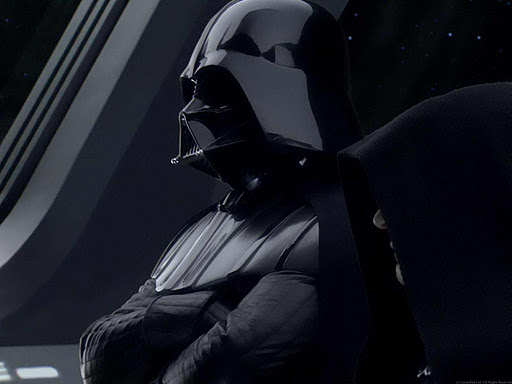
That said, the character designs are phenomenally memorable by being really quite simple – Chewbacca’s walking carpet, clean white stormtroopers and the perfect villain in the glossy helmeted, all black Darth Vader, employing both David Prowse’s imposing figure and James Earl Jones’ mellifluous tones, no other character has so richly deserved their own theme tune.hough the plot has many aspects to it you never lose track, and any scenes of dialogue and exposition are soon broken up with spaceship battles, light sabre action or new and interesting discoveries in the mythology. A New Hope is easily the most stand-alone film, with no initial setup required (other than rogue paragraphs travelling through space) and a satisfying ending only hinting at a sequel, but the Empire Strikes Back is widely regarded as the superior film, with the inclusion of diminutive Jedi master Yoda and jetpacking bounty hunter Boba Fett, two of the most enduring and iconic characters from the franchise, yet who only have a small fraction of the screen time between them. It also features that great twist ending, now sadly ruined by endless parodies and misquotes. Episode 6, the Return of the Jedi, is the weakest of the three, though there is no shortage of spectacle with the giant Rancor, the Sarlacc Pit and a landspeeder chase through the dense woodland of Endor. It is everything else of Endor that is the problem – the teddy-like Ewoks in particular – that explain the negativity, for if such crude creatures as these cuddly toys can take out the stormtroopers, why has everyone been so worried this whole time? That, and C3PO being heralded as a deity and the Emperor’s flawed plan to kill the rebels – if you’re leaking a plan to send the rebels somewhere deliberately so you can kill them, why not send them to a place where you don’t keep the shield generator for your new planet-destroying Death Star? – deters from the lofty levels of the earlier films.
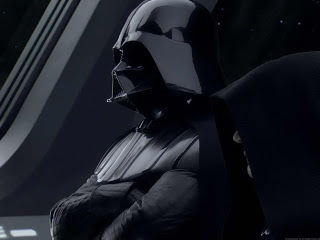
And so we arrive at the new trilogy. As a child of 12 I must admit I really enjoyed these films, so in some aspect George Lucas succeeded. The Phantom Menace was the most anticipated movie of all time, and there was no possible way it would ever live up to expectations (something I hope is not suffered by the Hobbit, the Dark Knight Rises or the Avengers later this year) so instead Lucas aimed the film not at the hoards of devoted fans he already had, but at newcomers and younglings. The fans would flock in anyway, their money was guaranteed, if not their approval, and which is more important to a movie studio? But, in a vain attempt to pander to the fans, attempts were made to tie the prequels in closely with the originals, and to expand upon the elements most popular in the older films. And so it is that we see Jake Lloyd’s infant Vader Anakin building C3PO and playing with a child alarmingly similar to Greedo, we discover the stormtroopers are all clones of Boba Ferr’s father Jango, Jabba starts the podrace and Chewbacca pops up with Yoda in Revenge of the Sith. It’s a wonder we aren’t shown Han and Chewie thrown into detention together at school.
Across the trilogy there are some astounding set pieces – the adrenaline fuelled, Greg Proops’ commentated pod race, Attack of the Clones’ gladiatorial battle and Obi-Wan’s light sabre battle with four-sabred robot General Grievous being particular highlights, but too much emphasis is placed on the politics of the Trade Federation and the soppy romance of Anakin and Padme that has no place in a Star Wars film. That, and too many mysteries are uncovered – no-one cared that the force comes from midichlorians in the blood stream and Vader’s rise and conversion to the dark side was more effective before every detail was explained and we weren’t shown him as an annoyingly precocious brat or lovesick teenager.
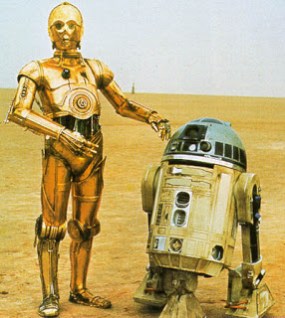
Some performances are terrible – both Lloyd and his grown up counterpart Hayden Christensen are wooden and aggravating, especially when placed alongside Liam Neeson, Ewan McGregor and Samuel L. Jackson, and even Natalie Portman gives an uncharacteristically poor performance. The final film, Revenge of the Sith, is also disappointingly, but inevitably, bleak, lumbered with having to set up the gloom and oppression at the start of A New Hope. This sense of inevitability ruins the final battles between Obi-Wan and Anakin and Yoda and the Emperor, for we know everyone involved will survive, as they all appear in the original trilogy.But however poor it seems in comparison, the new trilogy still contains films far superior, and more entertaining, than a lot else out there, and therefore should still be viewed, if a little less frequently.
This post could have gone on a lot longer – I haven’t even mentioned Jar Jar, Han shooting first, Luke Skywalker, Peter Cushing’s most evil face in the world™ or the glorious key to the series, R2D2, but I’m guessing no-one is actually still reading this, and I’ve still got over 30 posts to write, so I think I’ll call it a day.
A New Hope: Choose film 8/10
First Blood
The first time I watched this franchise kickstarter, as I’m sure was the case with most people who saw it after the release of the sequels, I was expecting a film more like Rambo 2-4, Stallone’s version of Red Dawn or Commando, charging around winning the Vietnam war singlehandedly, damming rivers with the sheer volume of machine gun shell casings left in his wake. But instead, First Blood follows Sly’s Vietnam vet John Rambo who, upon discovering he is the last surviving member of his crew, is run out of town by Brian Dennehy’s judgemental cop who doesn’t like the look of him. Refusing to leave, the cops – all of whom are either crooked, sadistic or offensively ginger – take him in and beat him around a bit, causing Rambo to snap and run off into the wood suffering ‘Nam flashbacks, with the cops hot on his tail and eager for revenge.A Canterbury Tale
If I’ve never heard of the film I’m watching, I usually assume it’s from the 1001 or 5-star lists, as though I’ve heard of a lot of films, these lists are peppered with some pretty obscure titles, so I was surprised to find this 1944 British film to be sitting at number 176 on Empire’s reader-voted top 500 and nowhere else.
Dog Day Afternoon
Based on a true story, Sidney Lumet’s tale of two inept criminals (Al Pacino and John Cazale reuniting after the Godfather 1 & 2) whose attempted robbery of a Brooklyn bank descends into chaos once the police, the media and the general public get wind of their plans. Pacino gives arguably one of his best performances – without resorting to ‘shouty Al’ – as he struggles to handle a situation completely out of his control, that is only ever going to become more so, and it’s refreshing to see a heist film with a couple of average Joes doing the robbing, as unlike Ocean’s Eleven or Inside Man, these guys have no plan, no masks, hell they even use their real names. Lumet excels when restricted to small locations (see 12 Angry Men), and here is no different, with almost the entire film taking place in and around the bank, as Pacino’s Sonny becomes a hit with the crowds gathering around the crime scene. Heading straight into the plot – Lumet rarely bothers with much initial back story – the direction is tight and entirely to the point, as every scene helps to progress the story further, or reveals a character detail previously unknown. There are some nice comedic touches – a bank teller hostage receives a call from her husband, asking what time she thinks she will be finished there, and when Sonny asks Cazale’s borderline psychotic Sal what country he wants to flee to, Sal replies “Wyoming,” and look out for Lance Henrikssen as FBI agent Murphy in one of his first film roles.
Frankenstein/Bride of Frankenstein
Although at times laughable now, back in 1931 James Whale’s adaptation of Mary Shelley’s classic horror may well have been truly terrifying. Everybody knows the story; a mad scientist and his hunchbacked assistant rob some graves and, with the aid of a handy lightning bolt, create life in a giant, shambling monster, who eventually escapes his castle prison and is hunted down by a screaming mob with pitchforks and torches. This sense of inevitability is what lets the film down, and the limited effects available 70 years ago makes the film pale in comparison to however you can picture it in your imagination. Boris Karloff (replaced with a large ‘?’ in the opening credits for maximum levels of mystery) is brilliant as the monster, displaying childlike innocence in a giant, rigid, wordless performance that sees him throwing a young girl into a river to see if she’ll float, yet remains the victim in this tale.The Dollars Trilogy
Widely regarded as the first spaghetti western (actually 1959s Il Terrore dell’Olkahoma), Sergio Leone’s A Fistful of Dollars is at least the first important one, birthing the greatest western icon since John Wayne in Clint Eastwood’s drifter, immortalised by a hat, beard, poncho and a squint. Before Leone, Eastwood was known best for his TV western Rawhide (the theme tune of which is sung at the country and western bar in the Blues Brothers) , but this shot him into not just the Hollywood A-List, but into the pantheon of American icons as the nameless cowboy out to make a profit from a small town heading into ruin. Run by two warring families, the Baxters and the Rojos, Eastwood sees a unique opportunity (unique that is unless you’ve seen Yojimbo, from which this borrows heavily) and sets about pitting the two families against one another. Leone’s direction, only cutting a shot when he has to, combined with Ennio Morricone’s whistling score and the spectacular cinematography of a barren, bleached landscape under a harsh, unforgiving sun makes for a spectacular western steeped in both American characters and European style.
The closer to this trilogy is widely regarded as one of the best films in the world, and currently holds the number 4 spot of IMDb’s top 250. From the opening score, undoubtedly one of the greatest in cinematic history that would be my ringtone were it not Reservoir Dogs’ Little Green Bag, you can tell you’re in for something special. The Good, the Bad and the Ugly follows, as the title suggests, three men, whose lives converge around a loot of gold buried in a grave. Eastwood’s Blondie is debatably the ‘Good’, a bounty hunter returning criminals for reward, then shooting the noose when they’re hanged so he can collect it again in the next town. Eli Wallach’s Tuco is the ‘Bad’, one such vagrant Blondie hands in, and Lee Van Cleef is given short shrift as the ‘Ugly’, as hired killer Angel Eyes, who always goes through with a job he’s been paid for. Unlike the previous two films, this is not the Clint Eastwood show, and if anything Wallach, the most interesting and entertaining character, is given the most screen time as the three set out to torture, beat and murder the others for a shot at the gold. Although the plot gets lost a little in the middle, when the US Civil War takes over, but by the three-way standoff at the end any flaws are forgiven. It’s the kind of scene that just doesn’t work on paper (shot of eyes, then a gun, then feet, eyes again, repeat for 5 minutes) but is unequalled on screen, and the ending is perfect. Cinematic Cure for the Common Cold
I have a cold, it’s quite possibly going to kill me. We’re not talking about some run-of-the-mill everyday man-flu here, this is like if Gwyneth Paltrow in Contagion screwed the monkey from Outbreak, then sneezed all over my Fruit & Fibre. My nose has become a sewer pipe for an over-producing factory of snot. And because of this ‘case of the sniffles’ (my mum’s words) I took a day off work (the first in living memory, save last year’s truck meets bike debacle) and whilst off I thought I’d endeavour to find the best kind of film to watch when you’re ill, and cross a few off the list whilst I was at it.First off, discount anything subtitled or 3D, you feel bad enough already, having to wear glasses or read isn’t going to make you feel any better. Amelie is a great feel- good film, but if your head feels like wool almost anything in English is going to be a better choice. The same can be said for anything too obscure. David Lynch, Luis Bunuel, Lars von Trier, sit back down. Terry Gilliam is just about acceptable, as most of his work tends to have a light-hearted edge to it, but the others are going to look especially trippy, depending on your medicine cocktail of choice. Probably best not to watch Brazil though.
I’ve followed five schools of thought here: 1. Watch a western. Real men working hard for a living, fighting, killing and sexing up whores like real men should do might just inspire you to man up and show those germs who’s boss. If you’re a girl substitute this for some period Jane Austen nonsense. Being ill in olden times was not deemed proper. 2. Watch a horror, in an attempt to scare yourself so much you forget you’re ill, or possibly scare the illness away. I’m not a doctor, but I think this is medically possible. 3. Watch a depressing film. Seeing people worse off than you should make you feel better about the situation, in a “yes I may be ill, but at least I haven’t been buried alive” kind of way. 4. Watch a kids film, definitely animated, preferably Pixar. Lighthearted, simple to follow and always has a happy ending, this is a traditional antidote to any problem I come across. 5. Die Hard. John McClane has never found a problem he can’t shoot through, and you’re namby-pamby congested sinuses aren’t about to stop his track record. Plus, it’s festive, and I’m not waiting another 11 months before I can watch it again.
1: Our western of choice is Red River, primarily because LoveFilm delivered it through my door the day before the sick day. This is a proper western, with John Wayne and everything. He plays Thomas Dunson, whose woman is killed by Indians and, instead of seeking revenge like any other John Wayne character, sets out to start a cattle herd with his best friend Groot and a young boy with a cow. The boy grows up to be Montgomery Clift fourteen years later, and the three men must head a cattle drive of 10,000 bovine 1,000 miles in 100 days. It’s the kind of film where as soon as a kindhearted, friendly young farm hand expresses his intentions of spending his share of the pay for the drive on a pair of shoes for his beloved young wife, in the very next scene he is trampled to death in a stampede. Wayne gives one of his best performances as one of his most layered characters, and the film soon becomes less about the drive and more about the fate of Dunson and Clift’s Matthew Garth, as the two have different beliefs as to the correct destination for the drive, how to get there and how the men working under them should be treated. It’s a little long for the story it tells – in the third act diverting to assist a wagon train set upon by Indians just to add a romantic edge to the story, developing the script into a sub-screwball comedy, and I was a little disappointed by the surprisingly upbeat ending. That said, it was a good watch for a sick day, kept me engrossed and I genuinely cared about the characters come the close.
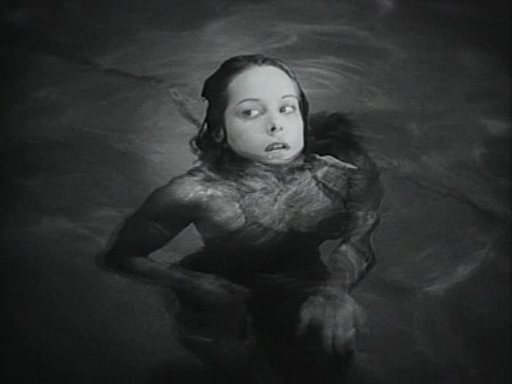
2: BBC iPlayer very kindly showed 1940s classic horror films Cat People and its sequel, the Curse of the Cat People recently, and having not got around to them yet, this was a perfect opportunity. Both films follow the life of Oliver, a 30-something New Yorker, who has apparently never been unhappy before, who falls in love with and marries a beautiful woman and has another, equally beautiful, intelligent and kind woman in love with him. Am I supposed to care about this guy or wish him dead? Anyway, the blurb for the film told me that Irena, the woman he falls for, is haunted by a past which threatens those around her with death and destruction. Couple this with a title like Cat People and I’m expecting either at some point she’s going to turn into a more feline werewolf than is traditionally expected, one side of her family are freakish upright-walking cat/human hybrids, anyone she loves will turn into a cat or at some point 50-foot long cats will drop from the sky and crush everyone she’s met. Disappointingly the first option is chosen, and the limited effects available in 1942 prevent a Rick Baker-esque transformation from being shown. There was an annoying lack of horror in both this and the sequel, which shows Oliver a few years older with a 6 year old outcast daughter, who is given a magic ring with which she wishes for a friend, only for that friend to be the spirit of a figure from Oliver’s past. Only a couple of scenes across the two films offer the slightest amount of tension and none are even the slightest bit scary, so I’m afraid cold theory number two remains untested. The characters are underwritten or superfluous, particularly the sequel’s Jamaican houseservant Edward, whose chief role is to spout dialogue the audience has already assumed or flat out knows, and I’ve have preferred more attention to have been spent on how stupid the woman is who, when she believes herself to be cornered by an attacker, jumps into a brightly lit swimming pool and splashes around for a bit.
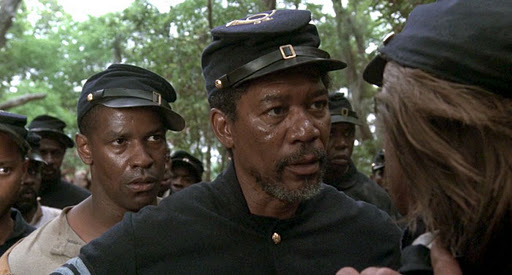
3: If you’re going to watch a depressing film, it has to be a true story, as no-one has ever made something up that’s worse than something you hear on the evening news. And so is the case with Glory, Edward Zwick’s tale of the first all black infantry regiment of the Federal Army during the US Civil War. It says something about late 80s/90s Hollywood that the only way we could be shown a story about black people is through the eyes of the white man brought in to lead them (Matthew Broderick). The movie is rife with clichés (the four privates we focus on all have memorable and recognisable character traits, and all share the same tent, including Morgan Freeman’s kindly old hand and Denzel Washington’s Oscar winning portrayal of the angry, rebellious ra1bble-rouser Trip) and guilty of using Matthew Broderick in a serious role, and too often dwells on sentimentality. It’s also an enraging film, watching the racism against the men denied uniforms and shoes because they are not believed to ever be used for warfare. As for good for illness, the schadenfreude aspect did make me feel a little better, but the severity of how much these guys had to go through just made me feel worse.
4: Here we go, the last Pixar film to be crossed off the list (A Bug’s Life, Cars and Up didn’t make it I’m afraid) tends to be one of the least remembered, though that may change once next year’s prequel Monsters University hits cinemas. This is the best kind of Pixar film, one set in a slight variation of the real world, showing a side of it previously unseen, yet whose origins exist as mythology in our world, in this case that there’s a monster hiding in your closet. The studio – the most consistently outstanding studio working today – takes this concept and forms not just a plot but an entire world around it, with the monsters working for a corporation collecting children’s screams to be used as power for their city. Somehow, who knows how, they manage to make two of these child-terrifying employees our heroes; Mike and Sully voiced perfectly by Billy Crystal and John Goodman), who must face the everyday woes of paperwork and fuel shortages like the rest of us office-ridden schmucks. I’ve mentioned it before, but the key to Pixar’s success is in the details. Mike uses a giant contact lens to cover the single eye that takes up most of his body, sprays on Wet Dog odourant before a date and takes his snake-haired girlfriend to the acclaimed restaurant Harryhausen’s. That, and top notch voice work from a cast including Steve Buscemi as dastardly reptile Randall, James Coburn as Monsters Inc. CEO Henry J. Waternoose and Yoda himself Frank Oz as Randall’s sidekick Fungus. Perfect viewing if infected or not.
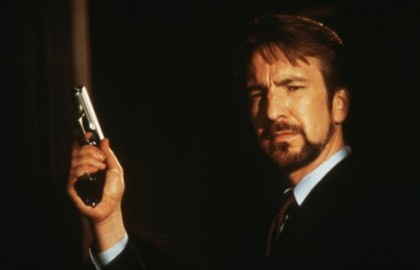
5: Ah, Die Hard. You revolutionised the world of action movies, encouraging studio execs all over Hollywood to green light Die Hard… in a submarine, on a bus, in space concepts left right and centre. You gave us Bruce Willis as a believable action hero without the need for bulging biceps and legs like tree trunks (he even name-checks Stallone and Schwarzenegger in the script). And you gave us Alan Rickman’s greatest role until Galaxy Quest as the refined, immaculately attired thief Hans Gruber (I don’t count Snape as a new character, as he’s basically Gruber with a cloak). The film is note perfect and barely puts a foot wrong, though some characters are broad stereotypes, especially the members of Gruber’s crew, and McClane’s wife’s sleazy co-worker Ellis, so much of a bastard whenever he’s onscreen you root for the terrorists. I tend to put this on as a background film when doing other things, but this is incredibly counter-productive, as I invariably end up engrossed as soon as McClane throws a corpse out of window and I join in with a “Welcome to the party pal!” This was definitely the film that made me feel the greatest, or was at least the one I watched with the moost narcotics inside me, so I’m going to conclude that the best film to watch when you’re ill is one you never forwards, backwards and thrown off a building. If it’s a seminal 80s action movie, so much the better, just make sure it’s one of your favourites. If only a cold were curable by making fists with your toes on carpet.Ghost World
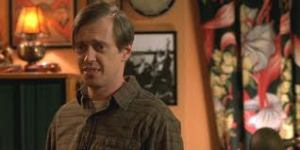
Enid and Rebecca (Thora Birch and Scarlett Johansson) have just graduated high school, and have no plans as to their future. They have no desire for college, careers or being members of society, are proud of their outcast status yet mock everyone else either for conforming to societies standards or differing from it. When they respond to a lonely guy’s missed connection in a newspaper, Birch’s Enid takes a shining to the shy, unassuming Seymour (Steve Buscemi). Enid is a destructive force, bringing down all those around her whilst she steadfastly refuses to grow up. Where consciously or not, everything she does prevents her life from progressing, be it dying her hair green before going apartment hunting with Rebecca or criticising the films at the cinema where she is hired. Understandably, everyone around her seems eager to develop their lives to a stage where she is no longer involved, be it her overly doting yet unattached father (Bob Balaban), her friends or Seymour, whom she helps to find a partner, only to be excluded from his life once three becomes a crowd. The movie fails the one-hour test; after 60 minutes I still didn’t care what happened to any of the characters, as watching Enid self-destructive cycle spin around again left me bored and disinterested. The only saving grace however is Buscemi, remaining just the right side of creepy, even with a horrendous side parting. His obsessed record collector struck a note with me, for if you replaced the music with books and DVDs, I’m fairly sure I’ll be him in 20 years should my girlfriend ever leave me.
Badlands
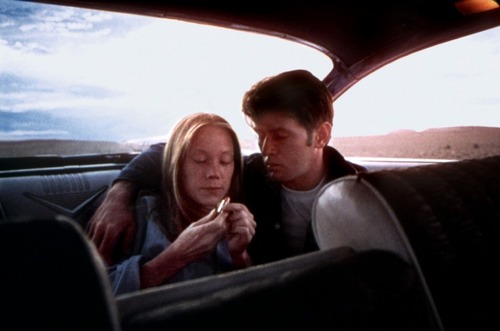
If Badlands is anything to go by, then Terrence Malick is one of the most overrated directors in cinema, having completed only five pictures, but with critical and cineaste acclaim deserved only of the likes of Scorsese, Spielberg and Hitchcock. Though I haven’t yet seen Days of Heaven, the New World or the Tree of Life (though Days is on the list, and I live in a great deal of hope that I am proved incorrect), from what I have seen of Badlands and the Thin Red Line, I’m guessing they are mostly comprised of a philosophical narration, ruminating on the nature of life, set over a thrown together, meandering plot shot almost entirely at sunset. Whilst I appreciate Line in spite of these things, it was more for the ensemble cast, wartime setting and stunning cinematography that I am willing to endure its occasional pontificating on the ways of the world. Badlands, however, has little to offer save excellent early performances from Sissy Spacek and the legendary Martin Sheen, playing characters based on 1950s killers Charles Starkweather and Carol Fugate, themselves inspired by Bonnie and Clyde. Sheen is Kit Carruthers, a garbage man with dreams of being a James Dean-lookalike outlaw. He meets Spacek’s Holly and, when her father shoots her dog when she lies to him, Kit kills him and hides him in the basement, which to be honest Holly takes rather well. This begins a killing spree as the pair run from the pursuing authorities and try to set up a life on their own, away from the world. Holly’s narration is infuriatingly sparse, as instead of detailing why they are doing what they are, we are simply told “The reasons are obvious, I don’t have time to go into them right now.” Much of the film is symbolic in a way that doesn’t hold up when you think about it – a man ringing a bell to call his deaf maid, a suicide message left on a record player next to a house fire that will undoubtedly engulf it – and I really cannot fathom why this film has garnered such a reputation as being more than a film, but a work of art. I’m not ashamed to admit that I much prefer Natural Born Killers, Oliver Stone’s take on a similar story with the same influence (also on the list), as that at least has identifiable characters, justified (if not condoned) actions and innovative style. Badlands seems just about a deluded man running away with a teenage girl, killing everyone they meet just so he can become famous and be shot down with a girl by his side to scream out his name.