Man on Wire

Another film I reviewed for the So You Think You Can Review tournament at the Lamb, this also sees the start of my attempting to review at least one documentary a month for this site.I’ve had the debate many times with various people as to whether a documentary can really be considered as a film. This usually happens when I use the phrase “I watched a great film last night; it was a documentary about…” The conversation’s other participant invariably glazes over at the ‘D’ word, as how could anything compiled entirely from archive footage and talking-head interviews be seen as entertaining? After all, there’s the danger they might actually learn something. I feel that if there was ever going to be a documentary that could sway the naysayers, then that film is Man on Wire. Even though it is very much a true story, told by those involved with the aid of photographs, footage and re-enactments, this tale of a man attempting to infiltrate the World Trade Centre and walk a tightrope between the towers is compelling, nail-biting stuff, and for the most part feels like a work of fiction.
Continue reading

Tinker Tailor Soldier Spy

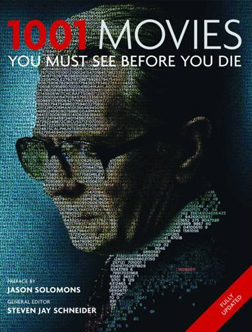
Seeing as the cover of the next edition of the 1001 Movies You Must See Before You Die has been announced (the book is due to be released next month), I thought it’d be a good time to review the film on said cover, as it’s a certainty to become a member of the hallowed list in the imminent future. So, without further ado, I present Tinker Tailor Soldier Spy, a film that I was very surprised to see on the cover, as personally I don’t think I’d have included it in the book at all, giving the cover space instead to probably The Artist, even if the Tinker Tailor poster is better.


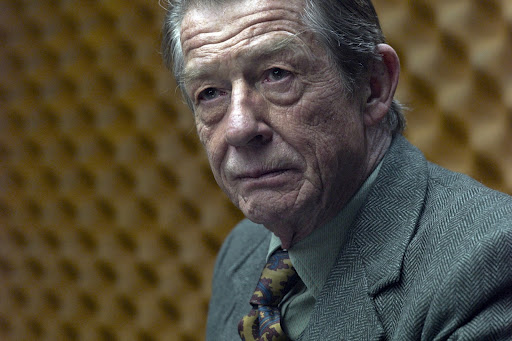
It’s only fitting that such a muddled up film should have a relatively incoherent review, so I’m going to jump in randomly and start with the cast. It’s pretty goddamn incredible that such a stellar cast, comprising of some of the best British actors from varying generations working today, could be assembled for one film. You’ve got the likes of John Hurt amongst the more senior players, Toby Jones, Colin Firth, Mark Strong, Ciarin Hinds and Kathy Burke as the seasoned actors as well as up-and-comers like Benedict Cumberbatch and Tom Hardy, not to mention bit roles for Stephen Graham, Roger Lloyd-Pack and Christian McKay. And, of course, Gary Oldman. It just goes to show the strength of the source material that such a great cast, and director Tomas Alfredson, straight from his similarly bravura Let The Right One In, would flock to it. Even Colin Firth was willing to take what is essentially a tangential role after just having won a Best Acting Oscar for The King’s Speech.

It takes a brilliant actor to not only attempt to replace the likes of Alec Guinness, James Mason and Dunholm Elliot – all of whom have played the character of George Smiley before – but to in fact outshine them as arguably the definitive screen version of Smiley. Oldman is magnificent in a pared down, stripped back performance almost entirely devoid of movement, yet the cogs behind his eyes are just about audibly whirring away as he sits and watched, drinking everything in and analysing the situation. Smiley rarely utters a word or makes an extraneous movement – his first utterance is a good 16 minutes in, after having appeared in several scenes already. He shines even beneath the massive glasses and dour overcoat that would envelop a lesser actor.

Remarkably, Tinker Tailor marks Oldman’s first ever Oscar nomination, for Best Actor, naturally, which he justifiably lost to Jean Dujardin for the aforementioned The Artist, but I believe Oldman came a close second. I myself was shocked to find he’s never even be nominated, but when you look back through his body of work there aren’t many roles that you could argue he should have been awarded for. Perhaps Sid and Nancy, but that wasn’t terribly well received I think, and doesn’t really fit in with the kinds of films that the Oscar board tend to take notice of, and in everything else he’s either been the bad guy – rarely awarded by the academy (at least until The Dark Knight) – or performs well in a small role, lost amongst an ensemble cast of similar abilities to himself – see True Romance, Harry Potter and Batman. You’ve also got to take into account some of the more questionable roles in his career – playing a dwarf in Tiptoes anyone? So it’s nice to think that, with so many outlandish, extravagant roles under his belt – The Fifth Element, Leon – it is Oldman’s most quiet, restrained and subdued performance that earned him the Oscar nod.

 I’m not even going to try and explain the plot of this film as, after having watched it and read John Le Carre’s book upon which it is rigidly based I could still only pin point the major issues. Basically, Smiley has been brought back into The Circus – the nickname for the British Intelligence – to try and find a mole from within a small group of higher ups – a group that used to contain him. His boss is/was John Hurt’s Control, and the suspects are the shifty Toby Estergase (David Dencik, a Swedish actor I’ve not come across before, but who played different roles in the two versions of The Girl with the Dragon Tattoo, and is suitably engaging here), the suave, womanising Bill Haydon (Colin Firth), “poison dwarf” head honcho Percy Alleline (Toby Jones) and his right-hand man Roy Bland (Ciarin Hinds). We are also shown, in parallel, the story of field agent Jim Prideaux (Mark Strong, in a rare and disorientating non-bad-guy role), whose shooting on assignment may have caused the suspicion back at headquarters. Assisting Smiley is Peter Guillam (Benedict Cumberbatch), a trustworthy up-and-comer with a way with the ladies, and Tom Hardy plays Ricki Tarr, the unreliable young firebrand whom Smiley introduced to the industry, and who may hold the key to the mystery.

Everyone is perfectly cast, and there isn’t a weak link amongst them. Similarly, the mood of the film is spot-on, and there is never so much as a red or a green on screen at any point, everything is in varying shades of grey, brown and taupe, from the sky to the clothes, the walls to the cars. The entire thing may as well have been shot in sepia, as it’s apparently been set in a time before colour was invented. The many conversations throughout mostly take places in dusty, dingy rooms yellowing with tobacco. It’s unusual for a film that some of the flashback sequences are actually more vibrant and brightly lit than those set in the film’s present, which could be read as an indication that perhaps those sunnier days were better for everyone involved, with less conspiracies and deception. Or at least, less in the current direction.

So, why did I have such a problem with this film? Well, mainly it’s because it’s so damn confusing. I understand that that’s entirely the point, and that some elements of the plot – when which bits are set in relation to others – are only roughly clarified towards the end to aide this sense of confuddlement, but even having read the book I still couldn’t tell what everyone was doing and why. This could also be because I didn’t really care. None of the characters are particularly likable, with the possible exception of Guillam and Prideaux at times, and even knowing who the final reveals didn’t help me very much. That’s something to praise, I suppose, that knowing the ending doesn’t lessen my appreciation for the film, but that’s a little bit of damning with faint praise if you ask me.

The most fun thing I found about this film is playing ‘Spot the Harry Potter Actor’ during it (Can anyone beat my six?). Though the performances are all impeccable and the atmosphere is both what was aimed for and what it should be, I cannot recommend this film on the basis that I didn’t enjoy it, and I’m still not sure what it was about – yet I don’t really mind.

Choose life 8/10

Champagne

There are some films that are just difficult to like, mainly because the lead is so detestable. Recent examples I’ve seen include Napoleon Dynamite, Vagabond and Transformers, and Champagne joins that far from hallowed list, although this time I feel that the lead, Betty Balfour’s simply named The Girl, is meant to be unlikable as she’s a spoilt little brat who only comes to realise she can be a good person when her father (Gordon Harker, Hitchcock alumnus from The Ring and The Farmer’s Wife) loses all his money and she is forced to take care of him.


The Girl, who at one point is referred to as Betty, so I’ll call her as such, is the kind of poor little rich girl who is accustomed to the world bending to suit her every whim. When Jean Bradin’s ‘The Boy’, her lover, is on a cruise liner from America to France, she commandeers a plane to land in the sea nearby, knowing a rescue boat will be sent out to save her and bring her aboard, and she doesn’t even thank the men who come to her aid. Whilst aboard said boat, she also catches the eye of the wealthy yet clearly sinister (he has a moustache and everything) ‘The Man’ (Ferdinand von Alten), and the two men then spend the rest of the film making awkward looks at one another as their affections for Betty wax and wane with such rapidity I’m surprised neither of them has whiplash. 

The overall story is fairly simple: Betty has done far too little with her life to justify the amount of her father’s money she is spending. When he comes to France to tell her he’s lost everything and they are ruined, she takes care of him in a tiny apartment, cleaning and cooking abysmally for him, but she learns to be a better person because of it. Except that she doesn’t, and the decisions she makes after this point are only made out of spite or for her own personal gain, so I can’t really see what the overall message is. The last minute reveals, of which there are a couple too many, are all fairly well signposted too, so didn’t come as much of a surprise, except for the final shots which added another layer of intrigue and deception into the mix, as to a character’s true intentions, which were basically the intentions we assumed he had before an earlier reveal, making that reveal a little bit pointless anyway.

If it all sounds confusing, it only slightly is, but there’s not a lot of point trying to wrap your head around it as this is definitely a lesser Hitchcock (as I fear most of his silents are going to be), so personally I’m not going to recommend it. Some of the messages and parallels are handled with too heavy a hand – Betty gets a job as a flower-girl at a swanky club where she looks longingly at the wealthy clientele, but still feels the need to underline that she used to pay to go to places like that, and now they pay her, which was pretty much the whole point of those scenes, so didn’t really need to be explained quite so succinctly. 

There are some nice moments of comedy – Betty giving her flowers out to the band because her boss told her to give them to men wearing eveningwear – meaning of course only the customers – but elsewhere it often goes too far, for example when she tries to make the bed by dragging the mattress over her father who is doing push-ups nearby. Before losing the money her fashion taste is also diabolical, with her dresses being far too elaborate and are frankly horrible, though that could be a product of the times more than anything, and I’ve never been too up on even today’s styles, so what do I know?

There’s good use of a swaying camera and actors to mimic seasickness – though I wouldn’t be too surprised to see Hitchcock utilising a swaying set instead – after all he built the entire apartment block from Rear Window inside a soundstage – but though the swaying wasn’t convincing it was at least a good touch. The early lifeboat rescue however looks like it was performed on a set previously used for a school play – even in 1928 – and I’m fairly sure in the first couple of takes the plane probably fell over.

Overall, not a lot to recommend here. A simple story unnecessarily overcomplicated and with terrible effects.

Choose life 3/10

Winchester ’73

The first things I have to say about this film are that it features one of the earliest credits for Tony Curtis, and that Rock Hudson is buried in the cast, and he plays an Indian. Right, now that’s out of the way, let’s talk about the film.

I like this kind of film. Now, that statement’s not much good to you without knowing what kind of film it is, but regardless of that I like it anyway. It’s the kind of film where several smaller stories are all tied together through coincidence, or an object being passed from one to another, as is the case here. There are some exceptions – I wasn’t wild about Au Hasard Balthazar or Babel – but these types of collective narratives, like Magnolia, Short Cuts, Crash and Traffic, usually appeal to me, and having a great ensemble cast never hurts either. Here, the element that ties the stories together is a rifle.

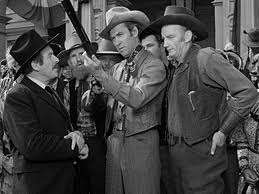
Our introduction to the eponymous weapon is through James Stewart’s Lin McAdam, a cowboy on the trail of Dutch Henry Brown (Stephen McNally), a dangerous man with whom the two share a bitter past. When Lin rocks up in the town of Dodge City, presided over by Will Geer’s Wyatt Earp, he finds Dutch has entered into a shooting competition to win the rifle, so enters as well, mainly to stop his foe from winning the gun that won the West. After the competition, which also sees lookalikes of Davy Crockett and Colonel Sanders, so feels a bit like a western parody, the gun is passed from one person to the next, either by honest trade or dishonest force, and not always with it’s ammunition present. We follow the gun through the film until a fairly obvious and clearly signposted finale, where Lin eventually catches up to the on-the-run Dutch.

This film felt incredibly stagey and unnatural, so I rarely felt engrossed with the movie. For example, there’s an indoor scuffle early on that in which, mid-fight, someone draws the blinds to make the fight look more dramatic. Granted, this was also to try and hide the fisticuffs from those outside the window, but seeing as they were on the first storey I don’t think there was too much danger of that, and it’s clear it was done entirely to increase the dramatic tension. Also, a moment where Shelley Winters, who is great as the film’s predominant female presence, is sat tossing a coin up and down is just waiting for someone to come along and catch it mid-throw, and it just appears as if that’s the very reason shes sat there throwing it in the first place, which is just silly.

Stewart is good in the lead role, and he must have gotten on well with director Anthony Mann, as this is the first of 8 collaborations the pair shared, including The Naked Spur and The Man From Laramie, both of which also appear on the List. Some of the supporting cast are terrible though, particularly every bartender in the film, and there’s a moment where a man tries to hit on the girl whose fiance he just shot, which is bad form in my books.

If, like me, you love the sound of a bullet’s ricochet, then you’ll adore the final showdown, however I feel that there isn’t much here to hold the attention of people who don’t really like westerns. Now, I quite like them, so I thought the film was pretty good, though more could definitely have been done with the central premise, and the film peaks too early with the opening shooting competition. 

Choose film 6/10

The Great St. Louis Bank Robbery

The second film in my travels through Steve McQueen’s career is actually his fifth movie, as I’ve yet to come in contact with a copy of Girl on the Run, Never Love a Stranger or The Blob, and is the second film in which he plays the lead (after The Blob, which I really want to see am annoyed I can’t find).

Here, McQueen plays George Fowler, a man in need of some funds to pay his way through college after being kicked out years ago. He accepts the job of driver for a bank robbery being conducted by his friend Gino (David Clarke) and two others, John and Willie (Crahan Denton and James Dukas), neither of whom trust George, as he’s lived a clean life and hasn’t even been to prison. Meanwhile, George meets up with Gino’s sister Ann (Molly McCarthy), an old flame of his, and complications arise when she works out the real reason George is in town.


Or rather, they don’t. I fully intend to spoil certain aspects of this film that I don’t recommend watching, so I’d advise the spoiler-wary to either skip to the end of the review or stop reading, but regardless you shouldn’t watch the film. You see, my first issue with the film was that halfway through the film there is a pivotal moment in the plot where, having discovered George and Gino are planning to rob a bank, Ann writes on the side of said bank that they are going to be robbed. Understandably, John and Willie are none too pleased about this and, upon discovering Ann is the culprit, kill her. Yet, after this happens, there are no further ramifications on the actual heist of the bank receiving a warning. So in effect Ann is killed for really no reason, as her actions had zero impact on anything that happened.

Secondly, in the film’s opening there is a brief intro stating that the parts of police officers have been performed by the real officers during the real life robbery upon which this story is based, however the police have yet to show up anywhere in the film even before the heist has begun, so it is obvious that something is going to go wrong, the alarm will go off and the police will arrive, else there’d have been no point to the intro. Also, it’s quite clear why the policemen have opted for careers in law enforcement rather than a more thespian path, as though only a couple get actual lines, they are all delivered rather forcefully.

Not that the rest of the cast fares much better, as even McQueen has his wooden moments, and the various conversations within the film, especially those between George and Ann, all feel stilted and awkward, even when they aren’t supposed to be. It’s no great surprise to find that McCarthy hasn’t really done much since. 

My main problem though? The story is dull. Now normally I love a good heist flick. There’s something about the meticulous planning of a con, the recruiting of the team, pulling it off, working around unforeseen obstacles and either seeing the criminals being brought to justice or fleeing with the loot that I find fascinating and immensely watchable, be it the star-studded, glossy likes of the Ocean’s trilogy or Inside Man, or something a bit more noir-y and stripped back like Rififi. Dog Day Afternoon, The Taking of Pelham 123, Out of Sight – these are all amazing films that I don’t hear talked about nearly as often as I feel that I should. And The Great St. Louis Bank Robbery is deservedly not amongst this hallowed list, because it’s just dull.

The robbery itself is completely straightforward, with no clever tricks or any kind of skill involved. The plan is simply to go in, rob the bank and leave before the cops arrive. There’s about as much of a plan as Gale and Evelle had in Raising Arizona, yet this is after a solid 75 minutes of planning shown on screen, that actually took place over at least five days during the film. And the great thing is that nothing goes wrong – the alarm is triggered, as the thieves had expected, but the cops arrived sooner than anticipated, descending into a hail of gunfire. Other than the last minute shoot-out and McQueen going insane, there’s little of any worth that I think I’ll remember. McQueen’s final scenes are worth mentioning in that they are the only time I’ve seen so far where he has played anything other than a by-the-numbers hero character. When he finds himself alone in the bank with the hostages and a gun, he breaks down and goes a bit loopy, which was interesting to watch, but was unconvincing because it’s Steve McQueen, and he just doesn’t do that.

One interesting part of the film was that it showed how a good, clean man – in this case George – can become embroiled in the seedier underbelly of a nation, and how if he’s not careful he could quite easily become stuck within it forever.

Also, when the film opens they wisely removed the ‘Great’ from the title, as neither the film nor the factual account are anything even close to resembling great. And is it too much to ask for a little note at the end saying what happened to those that survived?

So, this isn’t a great film, mainly because the story is boring – the heist doesn’t even begin until 15 minutes before the end – the acting is poor, the soundtrack has been taken from a fairground ghost train and pretty much the whole thing is in shadow and impossible to make out.

Choose life 2/10

Departures

Once again I find myself writing under the influence of various prescription narcotics as I recover from my latest malady, so please accept the usual apologies for any slurred typing or off kilter ramblings. Well, any more than usual, anyway.

Departures is a film I feel I should have heard more about. I don’t stay abreast of foreign features as much as I’d like, but I feel that whenever any that are widely deemed great come along, then the chances are that I’ve at least heard of them, yet ‘s slow, personal, moving story of an unemployed cellist discovering self confidence in the most unlikeliest of places has completely passed me by, despite winning the Best Foreign Language Oscar in 2009, beating out the likes of Waltz With Bashir, The Baader Meinhof Complex and The Class, all of which I’ve heard of and two of which I’ve seen. I can’t really explain why I’ve not heard of it, though I’m certain it was never released in any cinemas near me, hardly surprising, considering how many screens were booked up for Twilight: New Moon, released one week previously.

The aforementioned cellist is Daigo Kobayashi (Masahiro Motoki), a possible relation to Pete Postlethwaite’s character in the Usual Suspects. His Tokyo orchestra plays for more-than-half empty audiences, so the owner dissolves the group and Daigo, lacking the self confidence the seek employment elsewhere, sells his cello and moves back with his wife, Mika (Ryoko Hirosue) to the house his mother left him when she passed away. Daigo’s search for employment leads him to a vague newspaper advertisement and a nondescript building. Without even fully realising the job he has unwittingly applied for, Daigo is hired. The career path he has just found himself travelling along? Preparing the dead for their funerals.

Now to me, this job doesn’t sound quite as disgusting as is made out in the film, as similarly to Daigo I’ve never seen a corpse or even a coffin. Yet Daigo’s initial reaction is shame and repulsion – he tells his wife that his job is doing ‘ceremonies’ which, although technically correct, is probably not what she was thinking. His first encounter with a member of the deceased results in a trip to the baths probably longer than advised (though in all fairness the corpse in question had been left to fester for two weeks, and there were maggots crawling around on the nearby plates of food), and when the people around him begin to realise the nature of his profession, he is soon told to get a ‘proper’ job, or be shamed forever. I don’t think it’s racist to say that this may have something to do with the greater focus on dignity and shame in the Japanese culture, in fact I consider it an admirable quality, and one that we could indeed use more of in the West, but I find the extreme nature of the reactions Daigo’s career choice receives to be more exaggerated than I was expecting.

The film is beautifully shot, and though I’ve only seen one of his films. I can see a clear influence from Yasujiro Ozu, especially in the limited camera movements, with most of the scenes imbued with a quiet stillness, shot with the same level of calmness and precision with which Daigo attends to his clients. Although music played a large part in the film, I cannot for the life of me remember it having a great effect upon me, which I find especially surprising considering the amount of praise other reviews have lauded upon that aspect. From what I can remember, the occasional cello performances were beautiful, but I’m afraid my personal knowledge of classical music is far from extensive, so the overall effect was a little lost on me. It did add to the serene nature of the film though.

I’ve been known to at times criticise a film for being too slow, but here I felt the more lethargic pace was very fitting, and I rarely felt the need to glance at my watch even at 130 minutes long. However, there are only so many scenes of someone breaking into tears at a funeral that I can take, and seeing as the film takes place at a lot of different ceremonies, this took up a larger portion of the film than was strictly necessary. 

Plot-wise, there were a couple of elements that I was certain were going to result in an annoying third-act twist, but I’m grateful this wasn’t the case, and the story played out entirely straight, yet wasn’t necessarily predictable. There was a great deal more comedy than expected – Daigo’s first ceremony, and the role he plays on his first day of the job in a marketing video – which definitely helped to alleviate what would have otherwise been a very sombre affair.

Though initially I had put off watching this film, for fear of an overly morbid subject matter, I was left not necessarily bounding with joy, but satisfied, and content.

Choose film 8/10

Napoleon Dynamite

I watched and reviewed this film – begrudgingly – for the recent So You Think You Can Review tournament, the only downside to the competition. Here is my less-than-praising review of the film.

It’s been a long time since I saw this film upon its initial release back in 2004, and I swear the film has changed an awful lot in those brief 8 years, as the last time I watched it I’m sure it was a comedy. In fact, what we have here is a character study of a mentally ill teenager from a broken home, who has grown up the best he could in a world that clearly has no place for him, and that he seems to want to be no part of.
Continue reading

Yojimbo

Another film I reviewed for the recent So You Think You Can Review tournament over at the Lamb that’s also on the List.

Akira Kurosawa has never denied the fact that he was heavily influenced by the western genre, citing John Ford, amongst others, as something of an idol. It’s fitting then that at least two of the Japanese director’s most prominent works, this and Seven Samurai, would go on to be remade, unofficially yet almost shot-for-shot in Yojimbo’s case, as two of the definitive classics of the western genre. Though I’ve seen Seven Samurai once before, and The Magnificent Seven and Sergio Leone’s Dollars trilogy a fistful of times each, this was my first viewing of Kurosawa’s classic. Yojimbo sees a lone, nameless samurai wander into a town divided by two warring gangs. Seeing an opportunity to rectify the situation, and possibly pocket a little something along the way, the ronin stays in town and pits the two rival factions against one another.

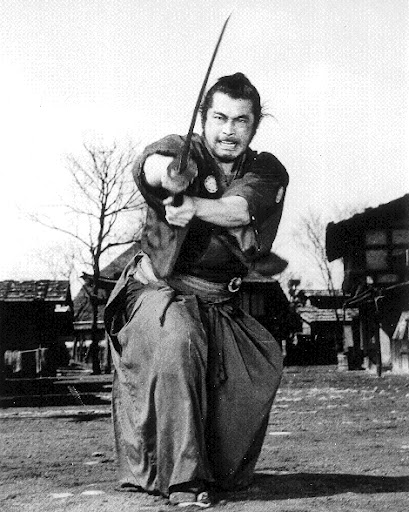
The solitary sword swinger is Toshiro Mifune, with whom Kurosawa had a similar relationship as Ford did with John Wayne, working together on 16 pictures in total. Upon his arrival into the one-road town, the samurai – who later calls himself Kuwabatake Sanjiro (meaning Mulberry Thirty), though he freely admits this is a sudonym – hires himself out to both gang lords. Neither the henpecked, frustrated Seibei nor his foe and former right hand man Ushi-tora outright trust this professional blade-for-hire, yet his opponent accepting the fighter’s offer would guarantee their victory. When everything seems to be going according to Sanjiro’s plans, with the two tribes threatening to wipe one another out, complications arise with the arrival of Ushi-tora’s brother Unosuke, brandishing a pistol.
The gun clearly poses quite a threat to our heroic samurai, as now the skill has been removed from the kill. Previously, Sanjiro had no great challenge within the town – other than maybe the lumbering giant with the comically oversized mallet – but now Unosuke, despite his arrogance, ridiculous posturing and insistence on carrying the gun inside his kimono – looking like he’s wearing a sling and hiding a pot belly – has taken the upper hand. No longer is the killer simply the smarter, faster, more skilled competitor; now it is the man with his finger on the trigger.
Throughout the film, Sanjiro’s motives are never clarified. Is he out for payment? Justice? Peace? Or is he simply seeking entertainment, something he clearly achieves as the two clans fight for his allegiance and to pay for his sake. His allegiance changes as often as the direction of the wind, and one of the most memorable scenes occurs as Sanjiro opts out of a confrontation he himself instigated, yet had no intention of taking part in. Instead, he heads atop a vantage point to watch as the two gangs reluctantly face off against one another, faux-lunging and backing away until only a few feet apart. Were it not for the arrival of a town inspector checking up on them, it’s likely this stalemate could have lasted forever.
Inspired by two of Dashiell Hammett’s film noirs, Red Harvest and The Glass Key, the film has a far greater comedic tone than I was expecting. Be it the odd-couple relationship between the tavern keeper and the persistently noisy coffin maker next door (the only townsperson making a profit from the constant fighting), the boorish stupidity of Ushi-tora’s other brother Inokichi as he struggles to work out that four dead enemies is better than two dead allies, or the belittling wife of his rival, there is much here to gain amusement from. Even serious moments, such as Sanjiro overhearing a plot to double cross and murder him, are juxtaposed by the man waggling both tongue and eyebrow at the young harem girls eavesdropping with him.
The film’s western influence isn’t merely seen in its lone ‘gun’-man story. From wide shots with a character stood alone in the distance, to high noon showdowns with gangs positioned at either end of a one-road town, it seems every shot, character and plot point is a loving homage to the director’s favourite genre. The wind even rustles leaves around in place of rolling tumbleweeds. Exposition is handled swiftly and elegantly via the tavern keeper who takes the samurai in and feeds him, regardless of his lack of funds. Sliding screen panels transform what would otherwise be a static, uneventful dialogue scene into an almost comic-book like affair, with each window shifting aside to reveal the disparate groups at either end of the town. The sliding panel is a recurring theme throughout the film, with many shots taking place inside buildings looking out, and later using the more traditional screen-wipe edit.
If I had to pick some minor flaws with the film, I’d mention that the all-too-brief combat scenes don’t quite live up to their pulse-quickening build ups, and that some of the more minor characters come off as little more than caricatures, instead of fully rounded individuals, but this is nit-picking more than anything else. I’d also heard that there were some intense and gory bursts of violence, and although there are certainly small explosions of slice’n’dice fury, fortunately they weren’t as gruesome as I was led to believe – and of course my expectations are no fault of the film’s.
For the most part the acting is stellar, particularly from Mifune, who plays the wandering samurai with a confident swagger, a sly smirk and an imposing stance. Every inch the typical lone ‘gunslinger’, Mifune is incomparable as the professional killer, his only master the fate that led him to the village; via the direction a falling stick pointed towards. Like a coiled spring, he is able to dish out far more than you might expect, and though it is clearly signposted by the rousing score and natural progression of the scenes, his swordsmanship often comes as much of a shock to us as those on the more uncomfortable end of his blade. Upon first entering the town, the man is greeted by a small dog scampering past, clutching a severed human hand in its mouth. At a sight like this, any other man would have had the sense to turn tail and flee, but Sanjiro – with a look of hilarious incredulity creeping across his face – nonetheless ventures on, possibly in search of the one-armed man this appendage-gnawing mutt has left behind.
The final showdown – because it’s a western, so there has to be a final showdown – has a setup shot of such simple elegance it’d be beautiful, were it not for the haggard, near-dead old man trussed up and dangling at the front of the frame. The ability to pan the camera around the decrepit victim, always keeping him in frame whilst progressing the scene, is a masterful stroke, assisted by Mifune’s Sanjiro stalking ever-closer towards the finale – a ten against one fight to the death – as a tornado of dust swirls up around him. What follows, alas, fails to match that establishing shot for artistry and effect, and also features an almost ridiculously drawn out death, but is nonetheless riveting and satisfying.
Whilst it’s not quite as good as Kurosawa’s other great remade eastern-western, Seven Samurai, Yojimbo is at least shorter, making it the perfect choice for a samurai fix if you’ve got two hours rather than three and a half.
Choose film 8/10

Mother and Son

This is another of those films that I knew absolutely nothing about before watching – even the language or year it was made (Russian, 1997). Sometimes, this strategy works – see Silver Lode – but other times, like now for example, I wind up confused and ill at ease with my surroundings. I think this is the kind of film you need to be in a specific mood for watching, where you’re more open and receptive to what is a deeply emotional and solemn journey taken by two people who barely speak to one another because there’s just nothing to say, and when they do it doesn’t always make a lot of sense. Not, as was the case with me, fitting it in early on a Saturday morning before heading out for a picnic and a day of shopping.


Mother and Son, somewhat bluntly, is about a mother and, you guessed it, her son (Gudrun Geyer and Aleksei Ananishnov). She is evidently not well, and he spends his days looking after her in a secluded, ramshackle cottage. They are the only two people who appear on the screen throughout the film (other than a distant hiker walking up a hill at one point that I’m fairly sure was missed in the edit), and it is clear that they are the only person in each others life. The story doesn’t have much of a plot, although there is an ending, it simply details  the son caring for, and carrying around, his mother, and the hardships they go through. She is unable to walk, with even being carried for a short period wearing her out enough to fall asleep on a park bench. The most energetic action available to her is straining to raise a handle to tousle her son’s hair whilst he reads postcards to her.

The cinematography choices in the film are bold, in that the picture is often skewed, stretched and distorted, which often makes the backgrounds difficult to establish. A storm that builds whilst the mother’s condition worsens is clearly a smudge on the camera lens, and the soundtrack is predominantly howling winds and inaudible whispers, with the occasional quiet hymn or subtle orchestra to fill the void. On several occasions I though the DVD had stopped, as the actors will freeze in place, not making a sound for what seems like hours (but is probably only a few seconds). One such example is the aforementioned park nap, when the son heads back to the house to retrieve the postcards, the camera remains with the mother, in real time, whilst she lays there sleeping, for a good few minutes. It felt very much like an experimental student film where they hadn’t quite worked out how to use the camera or edit properly, let alone use a script.

A couple of moments lost me completely in terms of making sense. At one point, the mother’s pain becomes too much for her and she feebly repeats “Get me out” to her son, who replies with the mantra “Yourself” over and over again, until she finally announces “You got me out.” Later, when the mother is particularly depressed, the son simply tells her “Don’t die then. Who’s making you die?” Her reply? A passionate “You! You!” This made me think that, seeing as the son is the predominant instigator in all the travelling that occurs in the movie (“Well, let’s go” he says at least twice), that perhaps he was trying to aid his mother in her shuffle from the mortal coil, so he could be free of the burden and move on with his life, though I fear this gives a deeper insight into my own relationship than perhaps I intended.

 The reversal of the parent/child characters and relationship was an interesting dynamic, up to the point where when he prepared a drink for her I was expecting him to test the liquid’s temperature on his forearm before giving it to her. The notion that the son will have to go through all the hardship the mother has, as we discover late into the film (I don’t mind giving spoilers for films where nothing much really happens) leads me to believe that whatever it is that ails her is most likely to be genetic, but that perhaps the son will have no-one to care for him as he does for his mother.

Don’t get me wrong, I’m sure that director Aleksandr Sokurov was not aiming to make a film that could be described as entertaining, but those are the kinds of films I prefer watching, so I can’t really recommend watching this film. Even at a scant 68 minutes long I found myself willing the mother to pass away – peacefully, of course, I don’t want any further suffering – and if possible could she find a way to take her son with her? 

Choose life 3/10

Raising Arizona

It’s hard to imagine a sharper left turn taken by a director than from the Coen brother’s debut, Blood Simple, to their sophomore picture, Raising Arizona. Where Blood Simple was dark and mostly serious, Arizona is the closest a film has ever come to capturing a Tex Avery cartoon in live action – with the possible exception of some parts of The Mask.

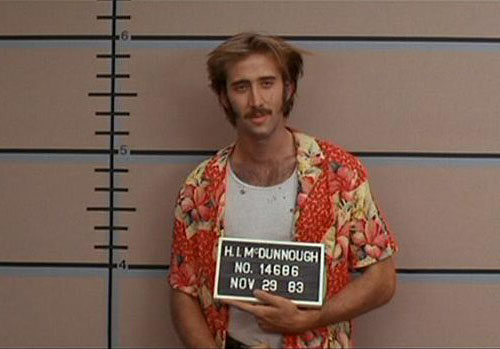
in the role that possibly best combines his often underrated acting ability, comedic potential and trademark brand of insanity, Nicolas Cage gives one of my favourite performances of his as H. I. McDunnough (‘Hi’ for short), a serial petty convict whose ineptitude at evading the law is only matched by his love for police photographer Ed (Holly Hunter). On at least the third time Hi is released from the prison where Ed works he proposes, and the two settle down for a life of happiness in a trailer park in Arizona. But all is not well in the McDunnough household. When Ed discovers she is unable to have children she falls apart, not helped by Hi’s criminal background leaving them unsuitable for adoption, so the only logical solution is, of course, to kidnap one of a famous batch of quintuplets born to a local unpainted furniture magnet, Nathan Arizona. To add to Hi’s woes, two of his former cellmates, Gale and Evelle Snoats (John Goodman and William Forsythe) escape from prison and attempt to crash on the couple’s sofa, Hi’s boss at the metalworks attempts to entice him into swinging, and there’s Leonard Smalls (Randall ‘Tex’ Cobb), a bounty hunter from Hell, on the path of the stolen baby.

This is a film with no intentions of meandering along at a gentle pace. The opening ten minutes or so, setting up the couple’s initial meetings, Hi’s triple incarcerations, their engagement and marriage, runs along at such a breakneck pace you’re liable to get whiplash once the credits roll and a more sedate step is taken. The change in speed is almost jarring, but is helped along with ample amounts of comedy and terrific, perfectly pitched performances, especially from Cage. His Hi, sporting a now standard ridiculous feathered hairdo, is a manic, OTT oddball with more Hawaiian shirts than sense. Hunter’s performance is good, but Ed doesn’t really get to do an awful lot other than reprimand Hi at every turn.


If the characters feel like exaggerated caricatures, then this is exactly the point. This film doesn’t take place in any kind of recognisable reality as much as it does in the heightened, prison-crazed mind of the lead. At times though I felt it went a little too far. The two escaped convicts are maybe a little too stupid – though often to hilarious results, as in their ill-planned bank robbery – and their incessant screaming throughout the entire film became beyond grating. No-one can yell like John Goodman. Leonard Smalls, on the other hand, wasn’t enough of a badass. I couldn’t quite put my finger on it, but I always felt that he was a guy pretending, Cobb never inhabited the role quite as fully as I’d have liked, so his presence was very much under felt. It’s a shame, as the Coens can do great work with the right actors in the antagonist roles – check out Javier Bardem as Anton Chigurh in No Country For Old Men, or Paul Newman’s Sidney J. Mussburger in The Hudsucker Proxy. Smalls should have been larger than life, and could have been the best part of the film, but remains sadly forgettable. Which in itself is impressive seeing as he is a guy who will happily grenade a fluffy bunny just for being alive.

The fight scenes are tremendously enjoyable, and really cement home the cartoonish nature of the film. Most of the characters involved would have received serious, possibly fatal injuries several times throughout the film – particularly Hi – yet they mostly just walk it off with little more than a plaster stuck to their face. And the film’s solitary death scene is so ridiculously over the top and insane that it is very much a moment of explosive comedy, regardless of whether you can see it coming or not.

I think that one of the overall messages from the film is that Hi and Ed, though they seem incredibly unsuitable to take on the task, are possibly the best parents of all the film’s characters. Of the various people who assume the role of the kidnapped baby’s guardian throughout the story, Hi and Ed are the only ones to not immediately name the baby after themselves. Granted, they name him after each  other instead, but at least they’re thinking about someone else, not just themselves.

Whilst this is in no way one of the best Coen brothers film, it is still hugely entertaining and definitely worth a watch, if only to see some classic comic Cage before he went off the rails.

Choose film 8/10