
This is the last review I’ve got left unposted from the recent reviewing competition at the Lamb, I hope you enjoy it.Is it really possible for
North by Northwest to live up to its hype? It’s rare to find a Top Films list deprived of its inclusion, it features scenes that have become the stuff of legend, that also tend to top Best Scene lists, and it’s one of the greatest movies ever made by one of the greatest directors who ever lived.
If you haven’t seen it yet, then I strongly advise you to stop reading anything about it and go and watch it now, for North by Northwest is truly a tremendous film that is best enjoyed with as little outside knowledge as possible. When Cary Grant’s Roger O. Thornhill quips shortly after being kidnapped into the back of a car, “Don’t tell me where we’re going, surprise me,” this is not merely Hitchcock’s intentions for Thornhill, but for all of us watching as well.
There’s really no weak link in the film. From the opening Saul Bass title sequence, utilising the receding parallel lines of a Madison Avenue skyscraper’s windows to perch the credits atop as they rush off into the distance, down to the ever so cheeky closing train tunnel metaphor, every second oozes entertainment. Alfred Hitchcock’s longest film, and his fourth and final with fellow English-born collaborator Cary Grant, is also his most unashamedly fun. There are many people who have an issue with some of the more fantastical elements of the plot – to be fair, a cropduster is hardly the most effective method of assassination – but these people are preventing themselves from what is a truly thrilling experience. And after all, who is watching Hitchcock for realism? The master has always admitted that, whilst some films are a slice of life, his tend to be a slice of cake, and this one has the richest, creamiest filling, not to mention icing, a cherry and some rainbow-coloured sprinkles to boot.
Cary Grant is on his finest, suavest form as New York ad man Roger O. Thornhill, stepping straight from Mad Men into a classic Hitchcock mistaken identity caper. Thornhill is an egotistical chauvinist, totally in control of his superficial advertising world, yet within Grant’s capable hands he remains not simply likable, but enviable. Who wouldn’t want to fill out a suit like that, and have such a wide and successful array of quips and zingers at their disposal? For though he is constantly befuddled and bemused by the adventure he has innocently become swept along in, there is no circumstance that leaves him wanting for a one-liner. Here, Grant perfects the art of the stern expression and the furrowed brow, eternally caught between confusion and frustration, with merely a hint of excitement as his journey takes him across America in the effort to clear his name of a wrongfully accused murder. The role was originally offered to Hitch’s other great collaborator, James Stewart, after the two did such sterling work on Vertigo together, but as soon as Grant became available Stewart was dropped, in favour of a man Hitch believed would not be dwarfed by the extraordinary events going on around him. Whilst Stewart has often been remarkable in his everyman roles, it’s fair to say that Thornhill would not have been the right fit for him.

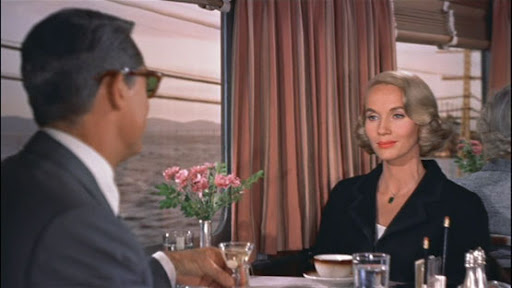
Such a masculine protagonist would be lost without a suitably feminine love interest, and Eva Marie Saint fits that job nicely as Eve Kendall, a typically beautiful Hitchcock blonde whose porcelain doll exterior hides her ability to use sex like some people do a flyswatter, and she holds her own against the likes of
Psycho’s Janet Leigh,
Rear Window’s Grace Kelly and
Vertigo’s Kim Novak as she dabbles in some of the most forward repartee since Bacall taught Bogart how to whistle. Hitch always preferred the more beautiful but subtly sexy female leads, as he took great pleasure in uncovering their more alluring qualities than he would have with the more self-promoting individuals like Monroe. As with all of Hitchcock’s birds (pun intended) Saint is meticulously and beautifully dressed in every scene. Legend has it that the great director paid her wardrobe so much attention that Grant petulantly demanded advice on what he should be wearing, and was simply told to “Dress like Cary Grant.”
Released three years before Dr. No, this film clearly set the template for almost every Bond movie. With its dashing, smooth talking hero with an easily recognisable voice, the woman who falls for him within seconds of meeting, a villain’s lair in an impressive yet remote location (here James Mason’s Vandamm lives in a condo atop Mount Rushmore), an evil sidekick (Martin Landau, with a severe case of Henchman’s Eyebrow) and a fast-paced, stunt-riddled adventure taking in major cities around the world (or at least central and north-east USA). Thornhill even has the ability to make perfect strangers throw themselves at him; just wait for the reaction from the woman in his neighbouring hospital room. It’s no surprise to learn that Grant himself was an original candidate for what was to eventually become Sean Connery’s Bond.
Even from the trailer, this is one of the most comical of Hitchcock’s endeavours. Speaking directly to the audience, Hitch himself appears, advising the viewers on how to take the perfect vacation without leaving the cinema, keeping his tongue firmly planted in his cheek throughout (“You don’t find a tasteful murder on every guided tour, do you?”). It’s on Youtube, go check it out. Ernest Lehman’s Oscar-nominated script (tragically losing out to Pillow Talk) is full of far too many quotable lines to give justice to here, but it contains more than enough for even three films. My personal favourite? Saint declaring she’s a big girl, followed by Grant’s perfectly timed, effortless rebuttal of “and in all the right places.” The police station phone call is yet another example of solid gold. Occasionally the steady slew of insinuations and double entendres becomes a little cringeworthy, especially when Grant tells Saint he likes her flavour, but that’s a rare misstep for a script that otherwise never puts a foot wrong. There’s far too much excellence on hand to make you forget these, and the film will never fail to raise a smile with every viewing.

It isn’t just the dialogue though; the scenes without any discussions are often just as amazing, if not more so. Early on, after being forcibly imbibed with the best part of a bottle of bourbon, Thornhill is unleashed behind the wheel of a car, in an attempt to instigate his demise. Upon realising what’s going on he awakes in a drunken stupor and does his utmost to keep his car on the increasingly blurred and merging roads in front of him. Grant makes for an amusingly intense drunk, persistently blinking, squinting and staring bug-eyed at the cars he races past, made all the more dramatic by Bernard Herrmann’s stupendously engaging score. Of course, there’s also the hallowed cropduster chase, as Thornhill, having been lured to the middle of nowhere to meet the man he’s been accused of being, finds himself battling the more painful end of a plane’s propeller. One of the few scenes not set to music – to better emphasise the relentless whirring of the plane and the lack of assistance Thornhill is likely to receive with the matter at hand – the scene is worth watching as a standalone segment. Equal parts exhilarating, terrifying and fun, it’s made all the more hilarious for the entire time Grant dives through dirt and hides amongst crops he is wearing his increasingly worn yet perfectly tailored grey flannel suit, clean shaven and with immaculate hair.
Hitchcock’s regular cinematographer, Robert Burks, excels himself in a manner that by this film is surely only to be expected. The shot of Thornhill fleeing the UN building to a waiting cab is stunning, captured from high above and angled down the side of a skyscraper, a shot I’d happily have framed on my wall, and the revealing shot of a gun hidden in a purse is sly enough to almost go unnoticed, but is sure to pay off later. Hitch ticks off almost all of his standard tropes – a wrongfully accused man on the run, maternal issues (Jessie Royce Landis, who plays Thornhill’s mother, was in real life only 8 years older than Grant), spies, deception, train journeys, height-based peril, an all-but-unnecessary MacGuffin (a statue full of microfilm), bumbling policemen, a tense finale set atop a famous landmark and, of course, an icy blonde. All that’s missing is a self-deprecating scene in a cinema.
When compared to modern day blockbusters, this picture more than holds up. Its unstoppable, kinetic nature will keep fans of both classic cinema and present day fare glued to the screen and on the edge of their seats for the entire 136 minute runtime. Filled with glamour, wit, excitement and big scenes on a large canvas, there’s something here to please everyone, as long as they like really great films. Does it live up to the hype? Yes, and more so.
Choose film 10/10

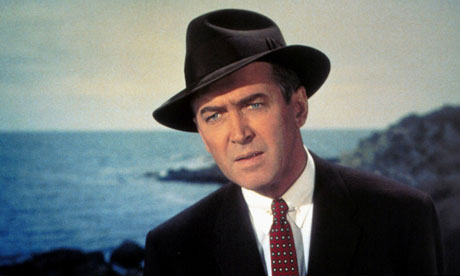 ‘Scottie’ Ferguson (James Stewart) is a detective in San Fransisco who suffers from crippling vertigo, exacerbated by his most recent rooftop scuffle culminating in the death of a colleague and the escape of the perpetrator being pursued. He therefore retires, only to be called upon by an old college friend Gavin (Tom Helmore) who is concerned about his wife Madeleine (Kim Novak), who may or may not be occasionally under some form of supernatural possession from an ancestor who committed suicide at the same age Madeleine is now.






 Life Vs Film