Voyage Dans la Lune

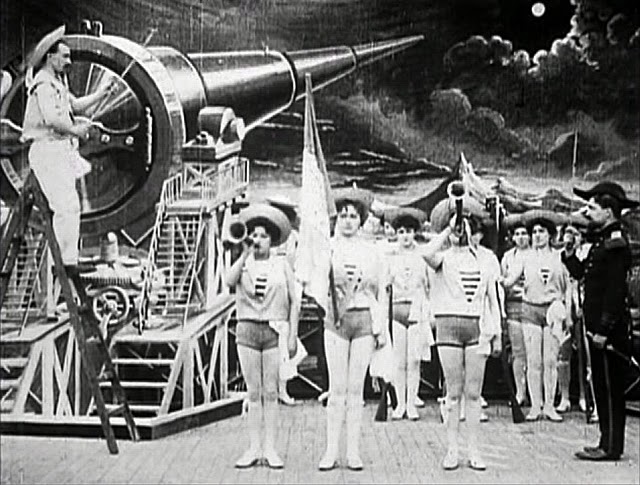
Professor Barbenfouillis (thank you IMDb) has a plan. He wants to visit the moon, and he wants to take his esteemed friends and colleagues with him. So, the professor has built a rocket and a giant cannon with which to launch it, and he – along with five others – gamely climb aboard and set off on their voyage of discovery.

Trip_03 Continue reading

The Hobbit: An Unexpected Journey

Bear with me here, this may sound a little strange. There’s these things called hobbits, which are basically people, but they’re quite a bit shorter than humans, with big hairy feet, and they live in the ground in houses with big round doors, and they have a penchant for pipes. One of these hobbits, Bilbo Baggins, is paid a visit by a wizard – stay with me – called Gandalf, who arranges for said hobbit to go on a quest with thirteen dwarfs – kind of like hobbits, but a little taller, bulkier, hairier and grumpier – to travel a really long way in order to break into a locked mountain and kill the giant dragon that’s sleeping on a huge pile of gold that rightfully belongs to the dwarves. Oh, and one of the dwarfs, Thorin (their king), chopped off the hand of a giant pale orc (a kind of, um, ogre?) after the orc (called Asok the Defiler, of course) killed Thorin’s grandfather, and understandably Asok is out for revenge. Oh, and there’s a mass of caves full of goblins, some giant wolf-creatures called Wargs, great big problem-solving eagles and another wizard called Radagast the Brown who keeps birds under his hat, their faeces in his hair and rides a sleigh pulled by big rabbits. Actually, now I think about it, there’s nothing all that weird about any of this.
Continue reading

Pather Panchali

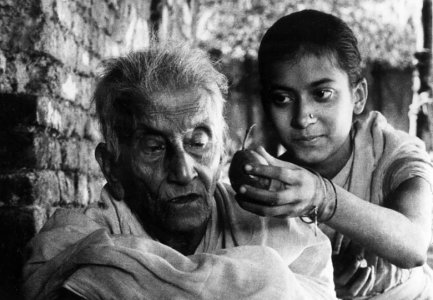
The story of a very poor family struggling to make ends meet in a Bengali village in the 1920s. Harihar (Kanu Bannerjee) must cope with looking after an elderly relative, kleptomaniacal daughter, carefree infant son and her clueless husband as he does his best to provide for a family that never seems to catch any breaks.


There are many films in the 1001 list that, when watching, I can’t really see why they’ve been included, and it isn’t until afterwards (or during, if it’s really boring) when I read up on the film a little, that I discover there is some cultural significance or historical context within which the film can usually be appreciated as an achievement, but not necessarily enjoyed. Such is the case with Pather Panchali, for as I now know it is the first film of director Satyajit Ray, who would go on to direct various other films also included within the 1001 book: The Music Room, Aparajito and The World of Apu, with the latter two completing the Apu Trilogy, begun with this film. Pather Panchali also marks the first independent Indian film to garner international acclaim, so that at least answers the question of why it was in here.

So what was wrong with it? Well, nothing really, it just didn’t really feature a great deal in terms of plot or anything to engage my attention. Its just a rather plodding depiction of an Indian family’s life, and the sporadic ups amidst mostly downs that they endure. There are some nice moments – the joy cracking across the wizened face of the elderly relative when Harihar’s daughter Durga gives her a guava stolen from the neighbour’s orchard, Durga and her younger brother Apu encountering a train – but once again I’m getting rather tired of watching depressing films. As such, I really don’t have that much to discuss about the film.

The most annoying aspect of this film is that its the start of a trilogy, all of which appear on the 1001 list (and the Empire 5-star 500 List, for reasons that will hopefully become clear once I’ve seen the rest of the trilogy). Before watching, all I knew about Pather Panchali was that it was the start of this trilogy, titled the Apu Trilogy, so I was expecting it to be about someone called Apu. Therefore, once he was born, I expected him to be the central figure of the story, but was surprised when he was kept mostly to the sidelines. I’m sure he’ll become more prominent in the later films, but I’ll try not to anticipate that, just in case he doesn’t and I become even more disappointed later. Aparajito and The World of Apu are the next two films in my LoveFilm queue, so I should be getting to them fairly soon, as long as I can bring myself to actually watch them.

In short, I’m chalking this film up alongside the likes of The Jazz Singer, Battleship Potemkin and Olympia as being a historical moment in cinema, but one that I’m not keen to repeat, and definitely cannot recommend.

Choose life 5/10

The Graduate

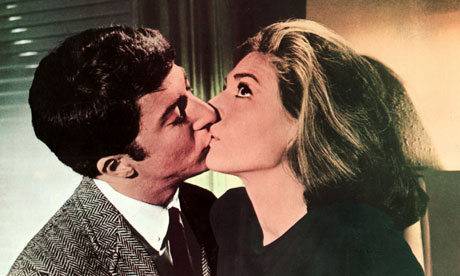
Ben Braddock (Dustin Hoffman) has returned home from university a star scholar, with his parents and all their friends keen to voice their high hopes for him and his future, but Ben is more uncertain with what he wants to do. Amidst this despondency, Ben finds himself the reluctant object of the affections of Mrs. Robinson (Anne Bancroft), the wife of his father’s business partner, and the pair begin a secret and sordid affair, which becomes complicated when Mrs. Robinson’s husband (Murray Hamilton) has plans to set Ben up with his daughter Elaine (Katharine Ross), obviously against the wishes of Mrs. Robinson.


This is one of those films that has become famous for a few significant moments that have become integral to pop culture. Moments like Anne Bancroft trying to seduce Dustin Hoffman, him framed in a doorway behind her strategically cocked legs in the foreground, or the ending, which gives way to one of my favourite final scenes in cinema (featuring the second time I’ve seen a crucifix being used as a weapon in recent times, after Liam Neeson cracked skulls with his in Gangs of New York). The first time I watched this film, as I’m discovering is the case with so many films, I didn’t understand it that much or in fact take any of it in, and the true meaning of the ending was lost on me. This time around I’m pretty sure I got it. Maybe I’m the right age now. Maybe it’s because I’ve now finished my studies and, only a few years ago, was briefly adrift in an ocean of directions I didn’t want to pursue. Or maybe it’s because I’ve seen (500) Days Of Summer, in which the ending is discussed and potentially ruined for anyone who hadn’t seen it or couldn’t remember it (like me, for example).

That’s the problem with such a culturally significant film; it’s been discussed and dissected not just on film blogs such as this one (and probably a few better ones too), but in many other areas of pop culture. The more famous sequences have been riffed on in the likes of
Starter For Ten, American Pie and several times in The Simpsons, whereas the overall plot can be heard in The Player (in which a sequel is pitched, set 25 years later), and in Rumor Has It (which I’ve not seen, but my knowledge of the plot led me to expect certain scenes in The Graduate that never actually came about). Fortunately, even though the basics of the plot have been in the public eye for some time now, there are a great many more charms which this film can rely upon.

Firstly, the acting. I’m starting to think that Dustin Hoffman could well be one of the most under-rated actors of his generation. Now, I know that he’s received two leading actor Oscars from seven nominations (the first of which came from this very film), but he’s always seemed overshadowed by the likes of Al Pacino and Robert DeNiro from actors of that age. It hasn’t been helped by his far-from-stellar later work, but then Pacino and DeNiro are hardly innocent of that either. You can pretty much guarantee Hoffman will be the focus of a future Film-Makers series. In The Graduate, Hoffman takes a character who should be sympathetic and runs in the opposite direction, making him quite unlikable; someone who’s been handed everything but couldn’t care less. The true genius of the performance shines when Ben is at his most nervous. His subconscious, subtle nod when Mrs. Robinson asks if he knew she was an alcoholic;
his unintentional little whinny and half-swallow whenever he’s put upon the spot or caught off guard. You completely believe, despite the ten year age difference between Hoffman and the character he was playing, that he could be this bright young scholar, the former big man on campus, who now finds himself in the submissive role of a relationship he has no control of. Anne Bancroft is also noteworthy as the woman Ben was completely unprepared for. She retains a steely demeanour, forever in control of every situation she is in, usually because she pulled the strings to instigate it in the first place. 


The cinematography and editing were surprisingly good too – surprisingly because I didn’t remember them being very memorable the first time around. The brilliant opening, following Ben as he glides down an airport’s moving walkway, has been shamelessly ripped off by Tarantino in Jackie Brown, but it’s the cuts that really impressed me. Whether it’s Ben getting dressed as he leaves the swimming pool and walks through a doorway cutting to him walking into a hotel room and being undressed by Mrs. Robinson, or his mounting a lilo cutting seamlessly to mounting her on a bed. The editing from In The Heat Of The Night must have been superb to have beaten this at the Oscars.


The main detracting factor is the soundtrack. I was pleasantly surprised when Simon and Garfunkel’s The Sound Of Silence opened the film, for it’s a song I’m happy to listen to. However, they perform the entirety of the soundtrack, which unfortunately is comprised of only about three of their songs, repeated over and over again, and I became truly sick of it all the second time Scarborough Fair was played in the space of a couple of minutes. I don’t normally mind the haunting, melancholic feel of their songs, but after too long I felt like I was drowning in cold syrup. The main problem is that they always sound bored of singing their own songs, and I’m certainly now bored of hearing them.


There were a couple of uncomfortable moments, but they were played out masterfully, particularly the initial encounter between Benjamin and Mrs. Robinson, who have known each other all of his life, just not in that present light. After giving her a lift home in his shiny new graduate-present car, Ben is requested to accompany Mrs. Robinson indoors, as she is frightened of entering an empty, dark house alone. He is plied with alcohol and music and led upstairs, torn between intense awkwardness and the desire to be polite and not offend his parents’ close friend. Just as you think things cannot possibly become any more excrutiating for Benjamin, after Mrs. Robinson has all but thrown her naked form at him, of course Mr. Robinson comes home and encourages young Ben to enjoy himself that summer, making sure he has a few flings. This is an embarrassing situation far beyond anything you will find on Curb Your Enthusiasm.


The script is also wonderful, and any film that can feature the lines “You’re the most attractive of all my parents’ friends” and “I don’t love your wife, I love your daughter sir,” can do no wrong by me.

Choose film 9/10

Gangs of New York

New York, 1846. Priest Vallon (Liam Neeson), the leader of a group of Irishmen going by the name of the Dead Rabbits, has roused other rival gangs to join together and fight Bill ‘The Butcher’ Cutting (Daniel Day-Lewis), the leader of the tyrannical New York Natives, over ownership of the Five Points. When Neeson is slain, his son escapes and leaves the city, returning sixteen years later as Leonardo DiCaprio, who understandably has a score to settle with Bill over his father’s murder.

I can see what Martin Scorsese was trying to do here, basically a mid-19th century Goodfellas, but if Henry Hill had a vendetta against Paulie, but unfortunately he was quite a way off the mark. Whilst Gangs of New York isn’t a bad film, it’s no match for Goodfellas in terms of story and generally being awesome. What Gangs does have, though, is a lot more violence, and of course Daniel Day-Lewis in full on mental mode. His Bill Cutting is easily the best and most memorable aspect of the film, with his hair plastered immobile to his scalp, with his fringe greased down and intimidating moustache twisted up. As always, Day-Lewis gives an intense, extreme yet believable performance as the film’s most rounded character, and the fact that he lost to Adrien Brody for The Pianist (one of ten Oscar nominations the film failed to pick up trophies for) is beyond me, though Brody should definitely have been nominated. Bill is, at times, downright terrifying, most notably during the knife-throwing scene, where his “Whoopsy-daisy!” sends a shiver down my spine, and waking up to see Daniel Day-Lewis, draped in the American flag, may well soon be a recurring nightmare of mine.

By comparison, DiCaprio’s Amsterdam is something of a disappointing hero, dithering about with Cameron Diaz’s petty thief Jenny, who also happens to have a connection with Bill, as he quickly rises through the ranks of New York’s gang culture. He’s a bit bland to be honest, although really who wouldn’t be when compared to Bill the Butcher? and the dance scene he and Diaz share is insipid and awkward, far more than I feel it should be. The supporting cast fares better, comprised of the likes of Jim Broadbent, John C. Reilly and Brendan Gleeson, as well as Henry Thomas (Elliot from E.T.!), Stephen Graham and Eddie Marsan making up the lower ranks, but all making their marks. 

The script is largely good and often quotable, with such gems as “You see this knife? I’m going to teach you to speak English with this f**king knife!”, “She’s a prim-looking star-gazer,” and my personal favourite, “I don’t give a tuppenny f**k about your moral conundrum you meat-headed sh*t sack!” The occasional black comedy was nice – the town has 37 individually run fire departments, who spend more time brawling over who gets to fight the fires than they do actually putting the fires out, and Broadbent’s politician’s solution to people hassling him is to hang some people – but no-one important of course. And there’s so much floor-spitting it’s a wonder everyone doesn’t have to walk around in wellington boots.

I feel I must mention the violence in this film, as there’s an awful lot more than I was expecting. At times it’s fairly comical – Neeson’s priest setting bludgeoning people about the heads with his cross – but elsewhere it’s less appreciated, for example a woman who rips off ears (she then uses them as a form of payment at the local bar), and there are far more animal carcasses than I really wanted to see. This is only to be expected – Bill is a butcher, after all, but we see more here than during a Rocky training montage. Along with the violence and dead pigs, there’s also enough racism to make even Prince Philip blush. No racial slur goes uncussed.

My main problem with this film is the lack of subtlety. There’s a pretty blatant metaphor spelled out in the opening scene, as Neeson recounts to his son the tale of St. Michael, who cast Satan out of paradise. It becomes pretty clear than in this parable, DiCaprio is to play the part of the saint, Cutting is Satan (his main office is referred to as Satan’s Circus) and paradise is New York, more specifically Paradise Square, the centre of the Five Points. This metaphor is handled pretty heavily, and flashing back to this opening scene every time Amsterdam encounters someone from his childhood really doesn’t help. I approved of the parallels between the two warring sides – they both pray to the same God, as do the law enforcement out to stop them, all believing they are on the side of justice and their Lord. The politics wasn’t bad either, though again it was less subtle than it could have been, with conscripts to the civil war boarding onto a boat as coffins are simultaneously unloaded from it directly in front of them.

The scale of the scenes is very impressive, with hundreds of extras across multiple storeys of buildings and far into the distance, occasionally pyrotechnics and a hell of a lot going on. This, along with Daniel Day-Lewis, is the only part of the film really worth watching for, so I can’t recommend it all that much.

Choose life 6/10

Brief Encounter

Laura and Alec (Celia Johnson and Trevor Howard) meet every Thursday in town – he after work, and she to do the weekly grocery shopping. At first their regular meetings are nothing more than a newfound friendship, but it is not long before they fall for one another. The problem is, Alec will soon be leaving to work in Africa. Oh, and they’re both married, with families at home.


It’s a simple story, and therein lies the beauty. There’s no surprise ending, no unforeseen third act plot contrivance – in fact, the ending of the couple’s relationship is the first thing we see, but it isn’t until the end that we realise quite how devastating it is, as the events leading up to their separation are told chronologically through flashback, from their meeting when Alec assists Laura when she gets soot in her eye, through shared meals and cinema-goings, culminating in their final moments together, probably forever, in this day before social media and the ease of communicating with someone half the world away. 

Our focus is on Laura and Alec, and in a way there is nothing in this film but them. Their families are largely only hinted at, other than Laura’s dull husband Fred, but even with only mild insinuation and a well-implemented voiceover from Laura we are offered as much background information as we need to realise their situation and motivations. Neither were looking for someone else, and both believed they were content with the lives they were leading. Everything would have been perfectly fine if they’d just never met one another, but fate is a cruel mistress, and the couple’s momentary enjoyment cannot possibly last, and the sadness comes from their clear understanding of this fact.

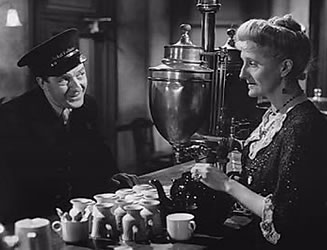
There are other marginal characters – the tempestuous relationship between the cafe owner and train conductor (who walks across the train tracks! It’s like a different world!) – but they are merely background, and serve to frame this story, rather than add to it. In fact, without their inclusion I got the feeling that Laura and Alec’s story would have struggled to breach feature-length, coming in at only 86 minutes. This length felt perfect for the story though. There’s nothing I could add, and nothing I’d take away, and if anything were to be added, it would be in the form of excess background – perhaps a love interest for Beryl, the tea room assistant, but there’s no need for it, and it’d just be padding.

I’m fairly sure this is the most British film ever made, and it’s popularity is probably the main reason behind the English stereotype of the stiff upper lip and clipped manner of speech that has become synonymous with my fellow Englishmen. The amount of scenes that involve the drinking of tea (something of which I’m fairly proud I’ve never done) are almost farcical, and everyone speaks as though they were born not with just a silver spoon in their mouth, but half the cutlery drawer rammed down their oesophagus. It’s this typically British sense of repressed feelings and not letting your guard down that really makes this film, as we see our two leads, particularly Laura, struggling to maintain their steely facades whilst underneath their hearts are being torn apart my these circumstances beyond their control. You can’t let these things be public knowledge, it’s just not how we do things around here.

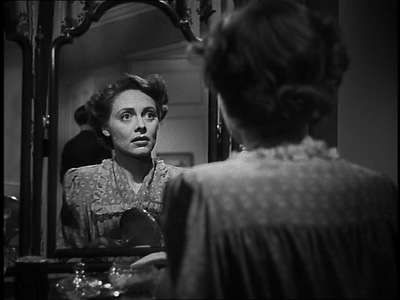
There are many moments of intense emotion and poignancy, but if I had to pick one, it would be the traumatised look Laura gives herself in the mirror after the first time she lies to her husband, followed by the internalised “It’s awfully easy to lie when you know that you’re trusted implicitly.” She knows that there is nothing more wrong than what she is currently doing, but that she has no choice to do it anyway, and is just going to have to live with herself. By today’s standards the romance is almost laughably timid – the most that happens between the two leads is the occasional kiss – but the reactions and implications from these events are just as bad to our leads as if they’d been knocking boots five days a week for several months, if not more so.

This is one of the first films I’ve fully appreciated that doesn’t have a lot going for it in terms of action, humour or a happy ending that makes me feel all warm inside. Instead, this is heartfelt, emotional film-making, that shows just how much can be done with very little.

Choose film 9/10

Hugo

Hugo Cabret (Asa Butterfield, one of the kids from Nanny McPhee and the Big Bang) lives inside the clockwork at a train station in 1930s Paris. He spends his days maintaining and fixing the clocks, stealing only the pastries and milk that he needs to survive and avoiding the child-hunting station inspector (Sacha Baron Cohen). A run-in with station shop-worker Georges (Sir Ben Kinglsey) results in Hugo having to work for the toymaker, all the while building a bond between Jugo and Georges god-daughter, Isabelle (Chloe Grace Moretz). 

On the surface, this doesn’t appear to be a typical Martin Scorses project. For starters, it’s a kid’s film, not something you’d generally associate with the director of Goodfellas, Mean Streets and Taxi Driver. There’s nary a gangster to be found, nor a grisly death or vicious killer. Hell, it’s not even set anywhere near New York. But once you get past the halfway point of the film, and the story switches from that of a young boy trying to eke out an existence on his own to a tale about the history of the beginnings of cinema, it becomes clear just what Scorsese saw in this story. It’s no secret that the great director is a passionate man, especially when it comes to the medium of movies, so seeing an opportunity to make a film dedicated to films themselves would have been an opportunity he jumped at. Fortunately, it helps that it’s a captivating story, filled with vibrant characters and plenty of heart, without too much schmaltz. Wihtout the secondary cinematic storyline, this would have felt far more like a Spielberg picture than a Scorsese.
I didn’t have the opportunity to see this film in 3D, but I get the feeling that if you are able to, you should give it a shot. This may come as a surprise to many of you, given my usual stance on the current trend of shamelessly, and often needlessly, opting to add a third dimension to films that really don’t benefit from it, but there are many scenes here where it would probably not only have fit, but benefitted the viewing experience. 3D works best when there’s lots of little things flying in the air, for example the dandelion-thing scene in Avatar, or the lantern scene in Tangled, and in Hugo we get at least two opportunities for this, first with snow and then later with flying pieces of paper, both of which I’m sure would have looked fantastic in 3D. There’s also a lot of forced deep perspective and carefully considered samera angles, making this possibly the first film I’ve seen where the 3D was probably justified.

There’s great camerawork elsewhere too, particularly in a Goodfellas-esque extended tracking shot through the inner-workings of the train station that is positively mesmerising. It’s clear that almost every shot has been digitally enhanced to make it look older and more French – the colour scheme is rich and everything has a sepia tone, seemingly even the air. At times this felt a bit too stylised, and often took me out of the film with how fake everything looked, but it’s nowhere near as bad as many of the films that use so much CGI that they may as well be videogames. 

The kids aren’t bad, but they are overshadowed the tremendous supporting cast, including the likes of Jude Law, Ray Winstone, Christopher Lee, Emily Mortimer and Richard Griffiths in relatively miniscule parts around the train station (I was half expecting them to break into a rendition of ‘Who Will Buy?’ from Oliver). Kingsley is superb in a role that requires moments of seriousness, compassion, pity and wonder, but Sacha Baron Cohen does have a tendency to over-act now and then, presumably a result of his more comedic past. He is by no means bad, but reigning his performance in a little, to be less of a caricature, would have been better in my eyes.

I think the people that will get the most out of this movie are film fans, especially those with an interest in the beginnings of cinema. Fortunately I am such a person, and I also appreciated Michael Stuhlbarg’s character, as one of history’s first film nerds. There are many references to classic early and silent films like La Voyage Dans La Lune, L’arrivee and Safety Last, featuring the classic image of Harold Lloyd dangling from the clock face, eventually recreated by young Hugo himself, and I was engrossed at the details of how effects were created before more traditional editing processes were invented, with actors remaining frozen in place whilst explosive charges were set around them. The old technology and equipment was fascinating to me too, appealing not only to my love of cinema but my mechanical background, with a hand-cranked projector required to watch something now available on YouTube.

Scorsese has created that most marvellous of films, a successful, inventive children’s picture, that just happens to have an informative and educational semi-biopic of one of cinema’s founders wrapped up inside it. It’s beautiful, engrossing, perfectly cast and just plain delightful. And there’s a robot!

Choose film 9/10

The Shining

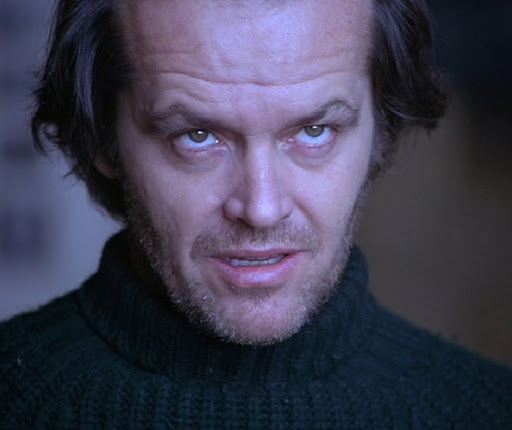
Jack Torrance (Jack Nicholson) is a writer suffering from writer’s block. He takes a job as an off-season caretaker at the Overlook Hotel, deep in the Colorado Rockies, where he will stay for five months with just his wife Wendy (Shelley Duvall) and their son, Jake (Danny Lloyd). Whilst at the hotel, all three members of the Torrance family experience otherworldly visions that slowly send Jack insane. Meanwhile, Danny’s ‘gift’ of the shining – the ability to see and hear things that haven’t happened yet or that happened a long time ago – grows stronger.

The Shining is widely regarded as a terrifying film, one of the best horror films made in the past 40 years, but to me it holds a deeper terror, not just because it’s the first truly scary film I can remember watching (and being far too young to watch it when I did). You see, I’ve seen The Shining twice, and both times I’ve watched it have been shrouded in a very real death of someone I know. The first time I saw it my best friend’s brother’s best friend was found dead the next morning. This time, I was interrupted about halfway through the film with a phone call from a friend, informing me that a mutual friend of ours, who neither of us had seen for a while, had been killed in a motorcycle crash. Basically, this is possibly the scariest film I know of, because I can never watch it again for fear of someone I know dying. This adds a whole new dimension to a film that’s scary enough to begin with.

On the surface, there isn’t a lot of traditionally scary elements to The Shining, especially not by modern horror standards. Instead, there’s more of an increasing sense of unease and mental disturbance as Jack descends into the horrors of his own mind, assisted by the various terrifying images thrown up by the hotel. Like the young twin girls Danny sees around the hotel, the elevator erupting with an ocean of blood, or the beautiful naked woman in room 237, who becomes a scabbed and putrid hag in Jack’s arms. And of course there’s the questionable shot of the man in a business suit, probably receiving a favour from a man dressed as a bear, that I’m sure his wife and kids would not be too happy to find out about.

As horror films go, this is impressively effective without having to resort to cheap jump-scares or a monstrous killer on the loose. I’m not often scared by films, but this one has left me a little off ever since, and not just for the personal reasons mentioned earlier. I’m a big fan of how the original protagonist – Jack – eventually becomes the antagonist once perspective focuses more on Jake and Wendy. If I were to pick a fault though, it might be that there’s a few too many elements taking place simultaneously. Firstly, the hotel was apparently built on an Indian burial ground, thereby adding an explanation to the ghostly goings on. This should have been enough, but there’s also Danny’s psychic abilities, which he shares with the hotel’s chef, Dick Hallorann (Scatman Cruthers), who has the most absurd pictures on his bedroom wall. Then there’s the mysterious suicide of the former caretaker, who killed himself with a shotgun after axing his family in the winter of 1970. And Danny’s finger is his imaginary friend, Tony, who talks to him and tells him what to do. Personally, I think Jack would have gone insane with just the intense writer’s block and having to be locked up with Shelley Duvall and an insane child for 5 months.

The film is pretty much perfectly cast, and Nicholson gives one of the most defining performances of his career. He shows real potential here for his future role as the Joker in Batman, especially once the madness sets in and his maniacal grin and eyebrows take over his face. Elsewhere his prominent brow and bright, glaring eyes are well used to strike fear into all who watch. Duvall is well cast too, though this isn’t a compliment as I think her character is supposed to be supremely annoying, and she succeeds in spades. It’s not often that you root for the axe-wielding psychopath over the innocent damsel in distress in a film, but I have absolutely no qualms about doing so here. 

This being a Kubrick film, it’s a given that a certain amount of flair has been utilised in the cinematography. The most famous example, and my personal favourite, is the long tracking shot following Danny as he wheels around the hotel on his tricycle. Infamously the camera was turned upside down to get it closer to the ground, offering a lower-than-child’s-eye perspective that really adds to the sense of dread, as does the incessant squeaking of the wheels as Danny follows an impossibly labyrinthine path around the hotel, a theme that recurs throughout the film.

The film is rife with too many unanswered questions and unquestioned answers, but due to Kubrick’s meticulous nature these can be assumed as being deliberate, present not only to infuriate the audience, but to keep them discussing the film forever more. Add to this some great quotable lines (“I’m not gonna hurt you, I’m just gonna bash your brains in.”), some of the most famous scenes in cinema (“Heeeeeeere’s Johnny!”), stellar performances, stunning visuals and a truly haunting score, and you’ve got not just a great horror film, but a great film in any genre. It’s just a shame I can’t watch it ever again.

Choose film 9/10

North By Northwest

This is the last review I’ve got left unposted from the recent reviewing competition at the Lamb, I hope you enjoy it.Is it really possible for North by Northwest to live up to its hype? It’s rare to find a Top Films list deprived of its inclusion, it features scenes that have become the stuff of legend, that also tend to top Best Scene lists, and it’s one of the greatest movies ever made by one of the greatest directors who ever lived.

If you haven’t seen it yet, then I strongly advise you to stop reading anything about it and go and watch it now, for North by Northwest is truly a tremendous film that is best enjoyed with as little outside knowledge as possible. When Cary Grant’s Roger O. Thornhill quips shortly after being kidnapped into the back of a car, “Don’t tell me where we’re going, surprise me,” this is not merely Hitchcock’s intentions for Thornhill, but for all of us watching as well.

There’s really no weak link in the film. From the opening Saul Bass title sequence, utilising the receding parallel lines of a Madison Avenue skyscraper’s windows to perch the credits atop as they rush off into the distance, down to the ever so cheeky closing train tunnel metaphor, every second oozes entertainment. Alfred Hitchcock’s longest film, and his fourth and final with fellow English-born collaborator Cary Grant, is also his most unashamedly fun. There are many people who have an issue with some of the more fantastical elements of the plot – to be fair, a cropduster is hardly the most effective method of assassination – but these people are preventing themselves from what is a truly thrilling experience. And after all, who is watching Hitchcock for realism? The master has always admitted that, whilst some films are a slice of life, his tend to be a slice of cake, and this one has the richest, creamiest filling, not to mention icing, a cherry and some rainbow-coloured sprinkles to boot.
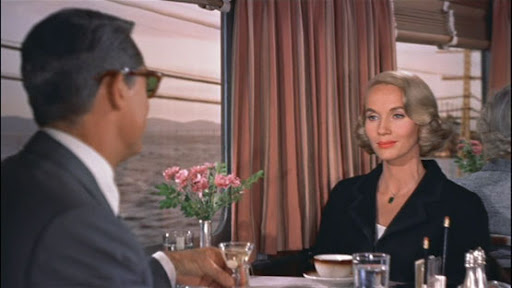
Cary Grant is on his finest, suavest form as New York ad man Roger O. Thornhill, stepping straight from Mad Men into a classic Hitchcock mistaken identity caper. Thornhill is an egotistical chauvinist, totally in control of his superficial advertising world, yet within Grant’s capable hands he remains not simply likable, but enviable. Who wouldn’t want to fill out a suit like that, and have such a wide and successful array of quips and zingers at their disposal? For though he is constantly befuddled and bemused by the adventure he has innocently become swept along in, there is no circumstance that leaves him wanting for a one-liner. Here, Grant perfects the art of the stern expression and the furrowed brow, eternally caught between confusion and frustration, with merely a hint of excitement as his journey takes him across America in the effort to clear his name of a wrongfully accused murder. The role was originally offered to Hitch’s other great collaborator, James Stewart, after the two did such sterling work on Vertigo together, but as soon as Grant became available Stewart was dropped, in favour of a man Hitch believed would not be dwarfed by the extraordinary events going on around him. Whilst Stewart has often been remarkable in his everyman roles, it’s fair to say that Thornhill would not have been the right fit for him.
Such a masculine protagonist would be lost without a suitably feminine love interest, and Eva Marie Saint fits that job nicely as Eve Kendall, a typically beautiful Hitchcock blonde whose porcelain doll exterior hides her ability to use sex like some people do a flyswatter, and she holds her own against the likes of Psycho’s Janet Leigh, Rear Window’s Grace Kelly and Vertigo’s Kim Novak as she dabbles in some of the most forward repartee since Bacall taught Bogart how to whistle. Hitch always preferred the more beautiful but subtly sexy female leads, as he took great pleasure in uncovering their more alluring qualities than he would have with the more self-promoting individuals like Monroe. As with all of Hitchcock’s birds (pun intended) Saint is meticulously and beautifully dressed in every scene. Legend has it that the great director paid her wardrobe so much attention that Grant petulantly demanded advice on what he should be wearing, and was simply told to “Dress like Cary Grant.”
Released three years before Dr. No, this film clearly set the template for almost every Bond movie. With its dashing, smooth talking hero with an easily recognisable voice, the woman who falls for him within seconds of meeting, a villain’s lair in an impressive yet remote location (here James Mason’s Vandamm lives in a condo atop Mount Rushmore), an evil sidekick (Martin Landau, with a severe case of Henchman’s Eyebrow) and a fast-paced, stunt-riddled adventure taking in major cities around the world (or at least central and north-east USA). Thornhill even has the ability to make perfect strangers throw themselves at him; just wait for the reaction from the woman in his neighbouring hospital room. It’s no surprise to learn that Grant himself was an original candidate for what was to eventually become Sean Connery’s Bond.
Even from the trailer, this is one of the most comical of Hitchcock’s endeavours. Speaking directly to the audience, Hitch himself appears, advising the viewers on how to take the perfect vacation without leaving the cinema, keeping his tongue firmly planted in his cheek throughout (“You don’t find a tasteful murder on every guided tour, do you?”). It’s on Youtube, go check it out. Ernest Lehman’s Oscar-nominated script (tragically losing out to Pillow Talk) is full of far too many quotable lines to give justice to here, but it contains more than enough for even three films. My personal favourite? Saint declaring she’s a big girl, followed by Grant’s perfectly timed, effortless rebuttal of “and in all the right places.” The police station phone call is yet another example of solid gold. Occasionally the steady slew of insinuations and double entendres becomes a little cringeworthy, especially when Grant tells Saint he likes her flavour, but that’s a rare misstep for a script that otherwise never puts a foot wrong. There’s far too much excellence on hand to make you forget these, and the film will never fail to raise a smile with every viewing.
It isn’t just the dialogue though; the scenes without any discussions are often just as amazing, if not more so. Early on, after being forcibly imbibed with the best part of a bottle of bourbon, Thornhill is unleashed behind the wheel of a car, in an attempt to instigate his demise. Upon realising what’s going on he awakes in a drunken stupor and does his utmost to keep his car on the increasingly blurred and merging roads in front of him. Grant makes for an amusingly intense drunk, persistently blinking, squinting and staring bug-eyed at the cars he races past, made all the more dramatic by Bernard Herrmann’s  stupendously engaging score. Of course, there’s also the hallowed cropduster chase, as Thornhill, having been lured to the middle of nowhere to meet the man he’s been accused of being, finds himself battling the more painful end of a plane’s propeller. One of the few scenes not set to music – to better emphasise the relentless whirring of the plane and the lack of assistance Thornhill is likely to receive with the matter at hand – the scene is worth watching as a standalone segment. Equal parts exhilarating, terrifying and fun, it’s made all the more hilarious for the entire time Grant dives through dirt and hides amongst crops he is wearing his increasingly worn yet perfectly tailored grey flannel suit, clean shaven and with immaculate hair.
Hitchcock’s regular cinematographer, Robert Burks, excels himself in a manner that by this film is surely only to be expected. The shot of Thornhill fleeing the UN building to a waiting cab is stunning, captured from high above and angled down the side of a skyscraper, a shot I’d happily have framed on my wall, and the revealing shot of a gun hidden in a purse is sly enough to almost go unnoticed, but is sure to pay off later. Hitch ticks off almost all of his standard tropes – a wrongfully accused man on the run, maternal issues (Jessie Royce Landis, who plays Thornhill’s mother, was in real life only 8 years older than Grant), spies, deception, train journeys, height-based peril, an all-but-unnecessary MacGuffin (a statue full of microfilm), bumbling policemen, a tense finale set atop a famous landmark and, of course, an icy blonde. All that’s missing is a self-deprecating scene in a cinema.
When compared to modern day blockbusters, this picture more than holds up. Its unstoppable, kinetic nature will keep fans of both classic cinema and present day fare glued to the screen and on the edge of their seats for the entire 136 minute runtime. Filled with glamour, wit, excitement and big scenes on a large canvas, there’s something here to please everyone, as long as they like really great films. Does it live up to the hype? Yes, and more so.
Choose film 10/10

Top Gun

There are some films out there that seem to be universally adored, so much so that were someone to come along and start slagging them off they’d automatically be written off as hipsterring, pretending not to like something incredibly popular to appear cool or ironic. Now, I’m fairly sure I’m not a hipster, even though I ride a bike and own a scarf (that I very rarely wear, and even then when its freezing), but I just can’t get behind Top Gun, a film that as far as I can tell everyone else seems to generally love.
It does have some very enjoyable aspects, most notably the score, with Kenny Loggins’ Danger Zone being a clear favourite, the script is full of zingers (“Your ego is writing cheques your body can’t cash.”) and a brilliant cast all on top form, but it can’t get around just how boring most of the film is. Now, this may have something to do with my opinion on aircraft. Every year for at least the past four years, Bournemouth (the town I live in) has held an air festival down on the beach. I live less than ten minutes walk away from said beach, yet I do not join the literally thousands of people who flock to this event on an annual basis. That doesn’t sound too surprising, until you discover that other patrons to this event include many of my close friends, colleagues, and of course my parents. This year was the second time I’ve actually headed away from the city during the long weekend, just to escape the planes and their incessant noise. I’m fine flying in planes, and generally find the flights to be one of the more enjoyable aspects of holidays (I get to sit and watch films for six hours straight!?!?!?!), but I really don’t care about watching planes fly, how they work, what model they are etc. And unfortunately, that plays a large part in Top Gun, a film about the top 1% of Navy pilots being trained to be the best that they can be.
It’s clear during the making of the film that two different markets were established – men and women – and a very broad sense of their tastes was estimated. Two different films were then thrown together to attempt to please both groups, and so it is that we have a film about jet fighter pilots in which half the time is spent on an insipid romance plot between Tom Cruise’s cocky pilot Lt. Pete ‘Maverick’ Mitchell and one of his civilian teachers, Kelly McGillis’ Charlie. It doesn’t really help that both halves of the film don’t fit together well, and are for the most part dull. The flying scenes, especially the training exercises, are devoid of either tension or excitement, and the romance is surprisingly more cheesey than the half-naked, oiled up volleyball scene set to Playing With The Boys. Each scene type goes on far too long as well. I can’t imagine the plane-heads remaining fully engaged through the love scenes, and likewise the romance junkies are unlikely to really care about the flying bits.

So why does it have such a reputation? Well, there’s enough to keep your attention on a Friday night post-pub outing, full of kebabs and an impending hangover, and of course there’s Tom Cruise. After sliding across the floor in a shirt and socks in Risky Business, this is probably the early defining movie for Cruise, and none more so than his seducing of Charlie by serenading her, with the help of an entire bar, to The Righteous Brothers’ You’ve Lost That Lovin’ Feeling. I’ve always questioned the choice of this song, as it’s supposed to be a song everyone in the bar knows the words to, yet I’ve never heard it outside of this film. Maybe it’s more popular in the States. This could also be the film that turned a lot of the public opinion against Cruise (not me personally, I’ve got no issues with the guy), as Maverick is an immensely arrogant, cocky dick, but he plays it so well. Anthony Edwards is also great as Maverick’s married-with-kids partner Goose (he’s married to Meg Ryan?!?), but the film is completely stolen by Val Kilmer, who manages to out-cockiness Cruise as rival pilot Iceman.

This is one of the few films that I think could be possibly improved with the use of 3D, normally something I’m deeply opposed to, but I think an added sense of depth perception could help clarify and enliven the aerial combat scenes, which otherwise feel flat and lifeless. I hate to say it, but this feels almost more like a Michael Bay film than a Tony Scott one, and if it wasn’t for the acting and the soundtrack, there’d be no reason to watch it whatsoever.

Choose life 5/10