Murder!

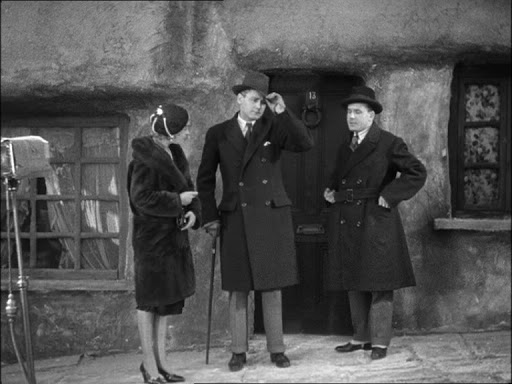
A member of a travelling theatre company has been murdered in the lounge of the guesthouse in which she is staying, with only a fellow company-member, a discarded poker and an absence of brandy nearby. The trial is quickly over, with the jury swung by the overwhelming evidence pointing towards the defendant’s guilt, but after the verdict has been cast and death has been sentenced, one of the jury members begins to have doubts over their decision.

12 Angry Men is one of my favourite films, and Alfred Hitchcock is one of my favourite directors, so when I discovered this film, I was half expecting to find Hitchcock’s version of 12 Angry Men would rapidly be topping my favourite films list. Alas, this is not the film I’d hoped for, as in fact the jury and trial scenes take up a very small portion of this film, with most of the focus instead going to the investigation held by Sir John Menier (Herbert Marshall), one of the jury members who also has strong connections to the theatre business, in which both the deceased and defendant were employed. Once I was past my initial disappointment, I settled down to watch what turned out to be a fairly standard, by-the-numbers procedural picture, whose only difference from the norm was the general lack of police, detectives or journalists doing the crime-solving.

Before the trial the film has quite a comedic tone, which is odd, seeing as it’s immediately after a murder. The very opening involves two of the theatre company’s members, Mr. and Mrs. Markham (Edward Chapman and Phyllis Konstam) attempting to uncover the source of the recent scream from down the road, only to be prevented from doing so by a window refusing to remain open whilst their heads are protruding from it. A policeman trying to ascertain the events of the evening finds his work cut out for him when he attempts to question the theatre company during a performance, so must fit his interrogations between the sound effects and actors heading on and off stage. Once the trial begins the comedy is still around, but it’s much sparser and broader, for example the dim-witted juror.

The main problem with this film is the story, which although having been based on the play Enter Sir John by Clemence Dane and Helen Simpson, seems to have been written hurriedly and not thought through all that well. It may be due to the large number of whodunnits that I’ve seen, but I’d sussed the plot fairly early on after a piece of evidence the cast seemed fairly unimportant, but clearly left the whole thing wrapped up. Also, the whole thing seems to rely upon the fact that sticking one’s fingers into one’s ears and shutting one’s eyes can prevent a person from sensing absolutely anything that happens directly around them. Sir John’s method of achieving a confession from his assumed culprit is also frankly ridiculous, but does at least comply with his being a theatre producer.

The poor audio of the film didn’t increase my enjoyment of the film either, and the various scenes of characters talking over one another didn’t help either. The most egregious case of this was a fairly superfluous scene of Sir John receiving a cup of tea in bed from his landlady. Their entire conversation could have been vitally integral to the plot, however I didn’t catch a word of it due to her detestable brood of children harassing John and running around screaming. I get enough of that just listening to my neighbours two kids through the wall, thank you very much. The overzealous, unfitting score didn’t help either. What finished everything off was the final shot, which was only recently defeated for audacity and sense of ego by Tarantino in Inglourious Basterds.

Hitchcock may well have a fascination with murder and intrigue, but he also likes to focus on the aftermath of the deed, rather than the actual offence itself, as he also does in Rope and The Trouble With Harry. Unfortunately it didn’t pay off here as much of it did in those other pictures, so I’m afraid I can’t really recommend this film.

Choose life 5/10

Sullivan’s Travels

John Lloyd Sullivan (Joel McCrea) is a big time director of screwball Hollywood comedies, but wants to make something real. Something with a message. Something for the common man. The only problem is Sullivan has never experienced life amongst the common men, so he sets out, against the wishes of his producers, disguised as a hobo and with nothing but 10 cents in his pocket, to see how the other half survives.

I like films with good dialogue. If it’s been written by Aaron Sorkin or the Coen brothers, then chances are I’m a fan of it, so it may come as a surprise to discover that this is the first film I’ve seen from Preston Sturges, widely regarded as one of the finest writer/directors of screwball comedies. Although, to be fair, I’ve not seen other such screwball classics as His Girl Friday or Bringing Up Baby yet either (even though I’ve got both on DVD), so maybe it’s not too much of a surprise that I’ve yet to delve into Sturges’ work either. Now that I’ve seen a Preston Sturges film and know the kind of thing that I’m in for, I look forward to tracking down some of his other work, because this film is quite brilliant. And fortunately some of his other work – Unfaithfully Yours, The Lady Eve, The Palm Beach Story – are also on my various film lists, so all being well I’ll be getting to them soon.

Sullivan’s Travels also marks my first viewing of Veronica Lake, previously only known to me as the girl Kim Basinger supposedly looks like in L.A. Confidential. Here, in her first major role, she plays Sullivan’s travelling companion, charitably credited as ‘The Girl’. When she is supposed to, she looks great (she spends a portion of the film disguised as a fellow hobo), and her chemistry with McCrea is good, if not amazing. McCrea, too, is great, thoroughly convincing as the idealistic yet out of touch director, and the supporting cast all left something of a mark, even if many of them weren’t around for as long as I’d have liked, particularly the snooty, disapproving butlers. 

The first third of the film is certainly the best, and the most comedic, and provides the majority of the most quotable lines (“If they know what they like, they wouldn’t live in Pittsburgh.”), and the film takes a more preachy, dramatic turn once Sullivan sets out on his mission. This is a bit of a shame, as had the film retained the breakneck pace and quality of script as that opening half hour (no-one talks any slower than Steve Buscemi in Miller’s Crossing), this film would be a guaranteed 9/10 (I never award a 10/10 on a first viewing, that score has to be earned after many watches). As it is, the film remains very good, but the plot becomes annoyingly circular, as Sullivan seems unable to escape his own wealthy lifestyle, whether through his own fault or general circumstances. The final third becomes overwhelmingly message-y, when Sullivan learns that making comedies can actually be worthwhile (hence why Sturges dedicated this film to the mirth-makers of the world), and it’s all handled disappointingly heavily.

I think I went a bit negative there for a moment, because I really did like this film. The scene where Sullivan goes to the cinema was brilliant, showing that even back in the 1940s it was occasionally impossible to hear the film over the sounds of screaming children, rustling sweet packets and incessant chomping, crunching and the smacking of jowls. Some moments got a bit farcical – Sullivan attempting to outrun the entourage his producers supply him with by utilising a souped-up boxcar with a chalked-on speedometer, and the amount of people who fall into water throughout this film is simply ridiculous, but it never got too silly for me.

There were some issues with the pacing, as just as the story looked like it was all wrapped up, Sullivan heads out on a new adventure completely different to the rest of the film that felt out of place and a bit too serious, drifting too far from what should have been a straight comedy, that seemed to miss the very point that the film was making. 

If you are going to watch this film, and if you’re a fan of the older Hollywood pictures, then I suggest you do, I recommend at least once skipping the film back a chapter or two and watching the film on fast-forward, as listening to the already rapid dialogue even faster is downright hilarious. Small things, I know.

Choose film 7/10

Skyfall

A hard drive containing the identities of MI6 undercover agents is at risk of going missing, so James Bond (Daniel Craig) is trying to catch the thief in Istanbul, with the assistance of field agent Eve (Naomie Harris). When Bond is shot and presumed dead, his superior, M (Judi Dench), takes the blame, but when Bond returns from the grave, he must track down the files to save not only his country, but his boss.
Continue reading →

Hugo

Hugo Cabret (Asa Butterfield, one of the kids from Nanny McPhee and the Big Bang) lives inside the clockwork at a train station in 1930s Paris. He spends his days maintaining and fixing the clocks, stealing only the pastries and milk that he needs to survive and avoiding the child-hunting station inspector (Sacha Baron Cohen). A run-in with station shop-worker Georges (Sir Ben Kinglsey) results in Hugo having to work for the toymaker, all the while building a bond between Jugo and Georges god-daughter, Isabelle (Chloe Grace Moretz). 

On the surface, this doesn’t appear to be a typical Martin Scorses project. For starters, it’s a kid’s film, not something you’d generally associate with the director of Goodfellas, Mean Streets and Taxi Driver. There’s nary a gangster to be found, nor a grisly death or vicious killer. Hell, it’s not even set anywhere near New York. But once you get past the halfway point of the film, and the story switches from that of a young boy trying to eke out an existence on his own to a tale about the history of the beginnings of cinema, it becomes clear just what Scorsese saw in this story. It’s no secret that the great director is a passionate man, especially when it comes to the medium of movies, so seeing an opportunity to make a film dedicated to films themselves would have been an opportunity he jumped at. Fortunately, it helps that it’s a captivating story, filled with vibrant characters and plenty of heart, without too much schmaltz. Wihtout the secondary cinematic storyline, this would have felt far more like a Spielberg picture than a Scorsese.
I didn’t have the opportunity to see this film in 3D, but I get the feeling that if you are able to, you should give it a shot. This may come as a surprise to many of you, given my usual stance on the current trend of shamelessly, and often needlessly, opting to add a third dimension to films that really don’t benefit from it, but there are many scenes here where it would probably not only have fit, but benefitted the viewing experience. 3D works best when there’s lots of little things flying in the air, for example the dandelion-thing scene in Avatar, or the lantern scene in Tangled, and in Hugo we get at least two opportunities for this, first with snow and then later with flying pieces of paper, both of which I’m sure would have looked fantastic in 3D. There’s also a lot of forced deep perspective and carefully considered samera angles, making this possibly the first film I’ve seen where the 3D was probably justified.

There’s great camerawork elsewhere too, particularly in a Goodfellas-esque extended tracking shot through the inner-workings of the train station that is positively mesmerising. It’s clear that almost every shot has been digitally enhanced to make it look older and more French – the colour scheme is rich and everything has a sepia tone, seemingly even the air. At times this felt a bit too stylised, and often took me out of the film with how fake everything looked, but it’s nowhere near as bad as many of the films that use so much CGI that they may as well be videogames. 

The kids aren’t bad, but they are overshadowed the tremendous supporting cast, including the likes of Jude Law, Ray Winstone, Christopher Lee, Emily Mortimer and Richard Griffiths in relatively miniscule parts around the train station (I was half expecting them to break into a rendition of ‘Who Will Buy?’ from Oliver). Kingsley is superb in a role that requires moments of seriousness, compassion, pity and wonder, but Sacha Baron Cohen does have a tendency to over-act now and then, presumably a result of his more comedic past. He is by no means bad, but reigning his performance in a little, to be less of a caricature, would have been better in my eyes.

I think the people that will get the most out of this movie are film fans, especially those with an interest in the beginnings of cinema. Fortunately I am such a person, and I also appreciated Michael Stuhlbarg’s character, as one of history’s first film nerds. There are many references to classic early and silent films like La Voyage Dans La Lune, L’arrivee and Safety Last, featuring the classic image of Harold Lloyd dangling from the clock face, eventually recreated by young Hugo himself, and I was engrossed at the details of how effects were created before more traditional editing processes were invented, with actors remaining frozen in place whilst explosive charges were set around them. The old technology and equipment was fascinating to me too, appealing not only to my love of cinema but my mechanical background, with a hand-cranked projector required to watch something now available on YouTube.

Scorsese has created that most marvellous of films, a successful, inventive children’s picture, that just happens to have an informative and educational semi-biopic of one of cinema’s founders wrapped up inside it. It’s beautiful, engrossing, perfectly cast and just plain delightful. And there’s a robot!

Choose film 9/10

Top 5… ‘Friends’ Movies

It’s David Schwimmer’s birthday today, and with the imminent release of the complete Friends boxset on Blu-Ray (available in the UK on November 12th), this seemed to be the perfect time to have a look through the filmographies of the six leads of that great show. That is, until I got severely depressed by just how bad most of the films they’d made were. So bad, in fact, that amongst six successful actors, I could barely find 20 films that I’d willingly sat down and watched. This was a tough list to find five good films from.5. Lost in Space
I’m fully aware that this is a terrible film, but it belongs on a list with the likes of Godzilla, Deep Blue Sea and The Day After Tomorrow as films that don’t really have a lot going for them other than being largely entertaining. Lost in Space features a fairly terrible performance from Matt LeBlanc as Major Don West, the captain of a spaceship transporting the Robinson family to a new colony in an attempt to begin the salvation of humanity, but of course problems arise, most notably a hoard of alien spiders that eat through the ship’s hull. Is there anything worth watching about the film? Yes. Gary Oldman is terrific as the evil Dr. Zachary Smith (and a slightly more spidery version later on). The rest of the Robinsons are OK too, particularly William Hurt as the father. And there’s a robot! Now, I’ve never seen the 60s TV show on which this is based, but I’m pretty sure that if they had implemented a weird sucker-fingered alien monkey, the CGI may have looked slightly better than in this film , made 30 years later.
Continue reading →

November 2012 Update

Welcome to November everyone! Unfortunately, October was not as successful post-wise as September, as my write-a-post-a-day plan stumbled and fell, but I did managed to put up 18 reviews and 4 top 5s, so it wasn’t too bad I suppose.


List-wise, I reviewed Blackmail, The Shining, North By Northwest, Top Gun, Nosferatu: Phantom der Nacht, Gimme Shelter, Hamlet, The Magnificent Seven, Superman Returns, Casino Royale and Songs From The Second Floor.

That’s 6 from 1001, 6 from the Empire Top 500, 4 from the Empire 5-Star 500 and 2 from the Total Film Top 100. I’d hoped to cross off more from 1001, seeing as that’s the most I still have to go through, but hey ho.

As for my Film-Makers, I crossed off Kate Winslet’s Hamlet and Holy Smoke, Steve McQueen’s The Magnificent Seven and Hell Is For Heroes, Alfred Hitchcock’s The Manxman, Blackmail and North By Northwest, and George Clooney’s Red Surf. I’ve decided to hold fire on Clooney and the Coen brothers for now, so I’m not spinning too many plates simultaneously, but they’ll be the next people I go through once I’ve finished McQueen and Hitchcock.

Off the lists, I watched The Brothers Bloom and Looper, and saw Kiss Kiss Bang Bang for the episode of the Lambcast I appeared on.


And for my Top 100 films reviewed, Silver Lode, Mad Max, Harry Potter and the Prisoner of Azkaban, Babel, Ring, Iron Man 2, Good Morning, Vietnam were knocked off by Casino Royale, The Magnificent Seven, The Brothers Bloom, The Shining, Looper, Kiss Kiss Bang Bang and North By Northwest.

Superman Returns

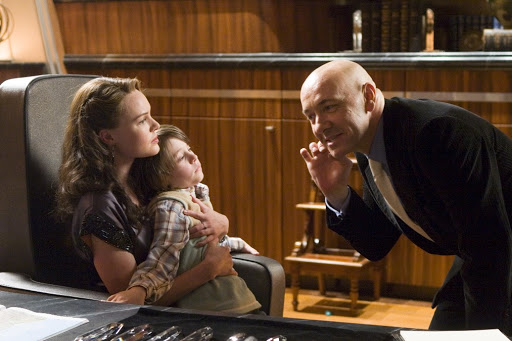
Superman, the last surviving alien from the planet Krypton with god-like powers, has left the city of Metropolis that he has protected for decades to return to the last known whereabouts of his destroyed planet. Upon discovering nothing to be found where his planet used to be, he returns back to Earth, and re-assumes his alter ego of Clark Kent, a mild-mannered journalist for The Daily Planet. He attempts to rebuild his relationship with Pulitzer-prize winning co-journo Lois Lane (Kate Bosworth), but is annoyed to discover that not only is she engaged to their boss’ nephew (James Marsden), but she has a son, Jason (Tristan Lake Leabu). Meanwhile, having recently been released from prison, Superman’s former nemesis Lex Luthor (Kevin Spacey) is busy hatching a plan involving crystals found in Supe’s mysterious Fortress of Solitude.

I’m not a fan of Superman. There, I said it. I remember half-watching the 1978 Christopher Reeve version when I was younger, but I can tell you literally nothing about it, and I remember watching Superman Returns a few years ago, but I couldn’t remember too much about that either, other than the shot of Bosworth’s Lois ascending in an elevator, Spacey’s Lex Luthor being near water at some point and the shot of Superman being shot in the eye that was in the trailers. To be fair, that viewing was overshadowed by a rather eventful mid-film pee break.
I remember the rest of the day clearly. It was pretty much the first time I’d tried Pick’n’Mix sweets (I was aged 19 I think), and all I’d consumed so far that day was strawberries with orange juice for breakfast, a couple of glasses of Coca Cola, and several fistfuls of Pick’n’Mix. My student days were not necessarily the healthiest of times. About halfway through the film, buoyed by the saccharine high of the tooth-rotting goodies  I’d consumed, I desperately need a wee. So i nipped to the loo, and mid-stream I passed out, and woke up face down on the toilet bowl. This is a very unusual place to regain consciousness, and needless to say, once I re-entered the lounge and joined my housemates watching the film, I didn’t take too much of the rest of the film in, hence why I remembered so little. I promise that I don’t make a habit of passing out during films, although later that day something similar occurred during an advert break in The Long Kiss Goodnight, this times resulting in my collapsing face-up (again mid-urination), still clutching the 2″ thick acrylic shower rail I’d previously been using to steady myself, that had now been sheared from the wall. Don’t worry, other than my recent Looper adventures, the only other time I’ve passed out was last year, again during a period of relieving myself, but was not halfway through a film. It did require the purchasing of a new toilet brush holder, as apparently the one we used to own wasn’t designed to withstand 15 stone of unconscious man falling onto it. 

Anyway, me fainting halfway through the first time I watched the film has nothing to do with whether I like it or not, I just enjoy retelling overly personal stories from my life that are at best tangentially related to the film I’m reviewing. No, what I don’t really like about Superman is that he’s just too powerful. His powers are seemingly beyond limit, with the only things he cannot do being the ones he hasn’t tried yet. He has flight, x-ray vision, super speed, strength, laser-eyes, time-travel, advanced hearing, super-whistling, fucking everything. And he only really has one weakness; Kryptonite; an extremely rare green rock. Which basically means that if people don’t know about this weakness, or there isn’t any of the super-scarce emerald stone around, there’s pretty much nothing in the way of Superman saving the day. I never really got into Smallville, even though I was pretty much slap-bang in the target demographic when it came out, and I can’t even get excited about next year’s Man Of Steel, even with Zack Snyder directing and Christopher Nolan producing. Needless to say, this film was going to have it’s work cut out if I was going to be impressed by the end of the viewing.
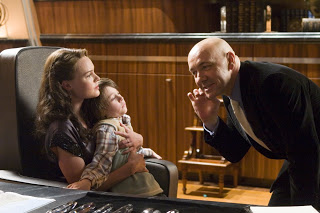
Initially I was intrigued by the film, as it has an interesting and somewhat eclectic cast. Kevin Spacey is perfect as Luthor, taking over from Gene Hackman. Spacey is his usual dependable self, and it at his best when in full-on bad guy mode, which is most certainly the case here. Elsewhere, Eva Marie Saint was a nice touch as Martha, Clarke’s adoptive mother, though disappointingly she doesn’t really get a lot to do, as is also the case with Frank Langella’s Perry White, Clarke and Lois’ boss. James Marsden once again plays a man caught on the cold side of a love triangle between the film’s hero and heroine (see also The X-Men trilogy, The Notebook, Enchanted), and Parker Posey is always a welcome addition to any cast, here playing Luthor’s sidekick/partner/main source of annoyance. Oh, and Kal Penn’s there too, but I’m fairly sure he never actually says anything, and [TINY SPOILER] is given a terrible cop out death with Luthor’s other two goons at the end [END OF TINY SPOILER].

Where the casting really falls down though is with the leads. Kate Bosworth, aged 23 when the film was released, looks far too young to play a Pulitzer Prize winning journalist, and seems dwarfed even by her own clothes. She also displays practically no likable qualities – she frequently dissolves into childish hissy-fits and strops whenever she (justifiably) doesn’t get her way. Brandon Routh, on the other hand, looks the part of both Superman and his public identity, but whenever he tries to act he appears to be made more of wood than the steel of his nickname. And in the many, many CGI shots of him flying or in danger, the film seems to become a late 90s video game, so terrible are the graphics. Most egregiously, the film’s final shot is one such diabolically bad render. Even in some of the non-CG shots Routh appears to have a plastic-like finish, possibly to make him look more similar to the computer generated bits.
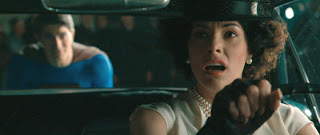
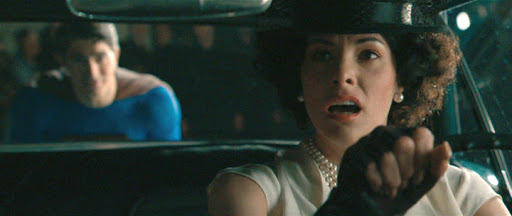
Another part that really bothered me was that the film is clearly set in modern times, with space shuttles, airplanes, videocameras etc. all being integral to the plot, but the architecture and fashions all seem to be stuck in the 1920s, up to the point of large sections seeming like they were shot in sepia. This is none more clear than in Parker Posey’s outfit in the car sequence. Adding the newspaper-room setting reminded me heavily of The Hudsucker Proxy, a film I liked a great deal more than this one, and which inspired me to suggest Jennifer Jason Leigh as Lois, although Amy Adams’ casting is possibly the only thing I approve of for the next film. I can see where director Bryan Singer was coming from with the mix of old and new styles, but it never really worked for me, and I found the whole thing very jarring. The overall plot was mostly just silly too, and various minor plotlines – the one involving Lois’ son for instance – felt unsatisfying and, at times, just plain stupid. The first 60% of the film seemed to drag too, as Lex’s plot is kept a mystery, and there doesn’t seem to be too much for Superman to really fight against. And part of the finale, in which lives hang in the balance of a fax machine’s volume, is not quite dated yet, but will be very soon. And who the hell puts a snooker table on a boat? Seriously.

There were some nice touches though. I approved of the little in-jokes for superhero fans (a news reporter mentions that they’ve received a message from Gotham), and the moment where Clarke pretends to be a bit confused and muddled to but Lois off the scent was good. The shoehorning-in of the “It’s a bird, it’s a plane…” line was clumsy, but still managed to raise a smile from me, even if it was accompanied with an eye-roll. The destruction of a model railway town may not sound like the grandest action set-piece in a film, but for me it was the highlight here, with it being shot in a similar fashion to a Roland Emmerich film. That one short sequence was more entertaining than the entirety of 2012, I can tell you.Elsewhere, some camerawork really disappointed me – a shot heading over a balcony and down, to focus on Lex reading a newspaper felt clunky and jerky – but this was more than made up for by the visually stunning space-set opening.

The viewing of the film was worth it to finally discover the origin of two Adam Carolla Show sound effects (“Wrong!” and “You’re losing your hair,” for fellow regular listeners), but sadly other than this point I was thoroughly underwhelmed by the whole thing. All being well, my low hopes for the upcoming Man of Steel may result in me being pleasantly surprise. Here’s hoping.

Choose life 4/10

Gimme Shelter

I was quite looking forward to this film. Although I’m not a massive Rolling Stones fan, I can often be found listening to their greatest hits, amongst which there are many songs I’m rather partial to, in particular Paint It Black, You Can’t Always Get What You Want and Honky Tonk Women, and I haven’t heard too many of their songs that I’ve particularly disliked. Also, the only music documentary I’d seen prior to this was Anvil, which is pretty good if you ask me. 

The film follows the Rolling Stones on their 1969 US tour, culminating in a massive free show at Altamont Speedway, San Fransisco. The events of that show have gone down in history, remembered as the moment the 60s ended when a concert-goer was stabbed and killed by the Hell’s Angels, who were hired as security for the event. Many other audience members were beaten or injured during the concert, which was rife with drug abuse, nudity and people giving birth, making me all the more grateful to have been born long after all that free thinking and spirituality was around.  

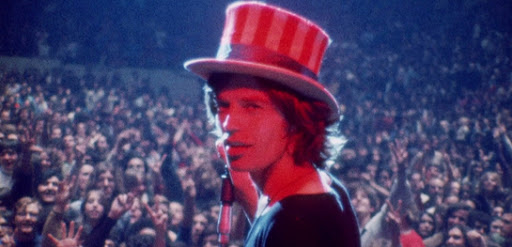
Before getting to the Altamont, we see various other performances throughout the tour, including a terrific rendition of Jumpin’ Jack Flash at Madison Square Garden, and footage of the band listening to their music in hotel rooms, and watching the editing process of this very film in the editing bay. We are given a bit of an insight into the band’s personalities (Mick Jagger comments that “It’s nice to have a chick [perform with them] occasionally” after Tina Turner belts out I’ve Been Loving You Too Long), but for the most part I was sadly bored, despite Jagger’s relatively engaging presence. He always seemed fairly unsure of where he was or what he was doing (can’t think why), and he had an air of someone who couldn’t quite understand exactly how he’d gotten to where he was, and just generally dicked about on stage whilst the other band members were concentrating on getting the job done. What I expect from music may not be the same as other people – I tend to prefer a good quality recording rather than atmosphere and ambiance, hence why I rarely go to musical events – and I imagine I’d have been severely disappointed had I attended any of the gigs on the Stones’ tour.

The only interesting segments were about the organising of the free concert, having to arrange a venue to accommodate the hundreds of thousands of audience members, but this was overshadowed by the impending on-camera death of Meredith Hunter, an audience member who attempted to mount the stage. I do not relish the opportunity to watch an actual death on screen, and I did not feel comfortable watching what is essentially a scene from a snuff film. I get the feeling that had this event not taken place on film, then this documentary would probably not appear on the 1001 list. It’s only really worth watching for the stellar soundtrack.

I get the feeling I’ll track down Martin Scorsese’s Shine A Light documentary eventually, because, y’know, it’s Scorsese; but sadly all this film left me with was an increased desire to re-watch Spinal Tap.

Choose life 5/10

The Shining

Jack Torrance (Jack Nicholson) is a writer suffering from writer’s block. He takes a job as an off-season caretaker at the Overlook Hotel, deep in the Colorado Rockies, where he will stay for five months with just his wife Wendy (Shelley Duvall) and their son, Jake (Danny Lloyd). Whilst at the hotel, all three members of the Torrance family experience otherworldly visions that slowly send Jack insane. Meanwhile, Danny’s ‘gift’ of the shining – the ability to see and hear things that haven’t happened yet or that happened a long time ago – grows stronger.

The Shining is widely regarded as a terrifying film, one of the best horror films made in the past 40 years, but to me it holds a deeper terror, not just because it’s the first truly scary film I can remember watching (and being far too young to watch it when I did). You see, I’ve seen The Shining twice, and both times I’ve watched it have been shrouded in a very real death of someone I know. The first time I saw it my best friend’s brother’s best friend was found dead the next morning. This time, I was interrupted about halfway through the film with a phone call from a friend, informing me that a mutual friend of ours, who neither of us had seen for a while, had been killed in a motorcycle crash. Basically, this is possibly the scariest film I know of, because I can never watch it again for fear of someone I know dying. This adds a whole new dimension to a film that’s scary enough to begin with.

On the surface, there isn’t a lot of traditionally scary elements to The Shining, especially not by modern horror standards. Instead, there’s more of an increasing sense of unease and mental disturbance as Jack descends into the horrors of his own mind, assisted by the various terrifying images thrown up by the hotel. Like the young twin girls Danny sees around the hotel, the elevator erupting with an ocean of blood, or the beautiful naked woman in room 237, who becomes a scabbed and putrid hag in Jack’s arms. And of course there’s the questionable shot of the man in a business suit, probably receiving a favour from a man dressed as a bear, that I’m sure his wife and kids would not be too happy to find out about.

As horror films go, this is impressively effective without having to resort to cheap jump-scares or a monstrous killer on the loose. I’m not often scared by films, but this one has left me a little off ever since, and not just for the personal reasons mentioned earlier. I’m a big fan of how the original protagonist – Jack – eventually becomes the antagonist once perspective focuses more on Jake and Wendy. If I were to pick a fault though, it might be that there’s a few too many elements taking place simultaneously. Firstly, the hotel was apparently built on an Indian burial ground, thereby adding an explanation to the ghostly goings on. This should have been enough, but there’s also Danny’s psychic abilities, which he shares with the hotel’s chef, Dick Hallorann (Scatman Cruthers), who has the most absurd pictures on his bedroom wall. Then there’s the mysterious suicide of the former caretaker, who killed himself with a shotgun after axing his family in the winter of 1970. And Danny’s finger is his imaginary friend, Tony, who talks to him and tells him what to do. Personally, I think Jack would have gone insane with just the intense writer’s block and having to be locked up with Shelley Duvall and an insane child for 5 months.

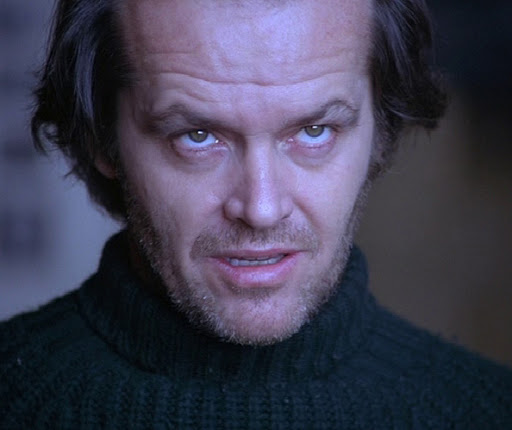
The film is pretty much perfectly cast, and Nicholson gives one of the most defining performances of his career. He shows real potential here for his future role as the Joker in Batman, especially once the madness sets in and his maniacal grin and eyebrows take over his face. Elsewhere his prominent brow and bright, glaring eyes are well used to strike fear into all who watch. Duvall is well cast too, though this isn’t a compliment as I think her character is supposed to be supremely annoying, and she succeeds in spades. It’s not often that you root for the axe-wielding psychopath over the innocent damsel in distress in a film, but I have absolutely no qualms about doing so here. 

This being a Kubrick film, it’s a given that a certain amount of flair has been utilised in the cinematography. The most famous example, and my personal favourite, is the long tracking shot following Danny as he wheels around the hotel on his tricycle. Infamously the camera was turned upside down to get it closer to the ground, offering a lower-than-child’s-eye perspective that really adds to the sense of dread, as does the incessant squeaking of the wheels as Danny follows an impossibly labyrinthine path around the hotel, a theme that recurs throughout the film.

The film is rife with too many unanswered questions and unquestioned answers, but due to Kubrick’s meticulous nature these can be assumed as being deliberate, present not only to infuriate the audience, but to keep them discussing the film forever more. Add to this some great quotable lines (“I’m not gonna hurt you, I’m just gonna bash your brains in.”), some of the most famous scenes in cinema (“Heeeeeeere’s Johnny!”), stellar performances, stunning visuals and a truly haunting score, and you’ve got not just a great horror film, but a great film in any genre. It’s just a shame I can’t watch it ever again.

Choose film 9/10

Nosferatu: Phantom der Nacht

As opening shots go, footage of dead, decomposed babies and children, their faces contorted into richtuses of terror and howls of pain is probably one of the clearest projections for the tone of the ensuing film that I’ve ever come across. Couple this with slow motion shots of bats flying in the dark (used repeatedly throughout the entire film whenever director Werner Herzog takes his fancy, regardless of it’s relevance to the plot) and a woman (Isabelle Adjani) waking up screaming to said bat flying around her window and you’re left with no uncertainty that this isn’t quite your average vampire film.

And that’s OK, because as I’ve discussed before, the tale of Dracula is fairly well known, even if you’ve never seen any of the many, many adaptations. This is my fourth Herzog film. I liked but was relatively underwhelmed by Rescue Dawn, couldn’t get my head around Aguirre and thought Bad Lieutenant was a good fit for Nicolas Cage’s own brand of insanity, but I understand that he has a reputation for being, well, a nutbag. That’s exactly the kind of approach you need to take with such a well versed story, and I approved of the inclusion of some new material. 

The story, in case you’ve been living in a soil-filled coffin for several centuries, concerns Jonathan Harker (Bruno Ganz), who is sent to Transylvania to organise a land deal with Count Dracula (Klaus Kinski), a mysterious recluse who terrifies the locals and has an obsession with the neck of Jonathan’s fiance, Lucy (Adjani). Kinski’s Dracula is a wonderful creation, far more haunted than haunting. He is a very pitiable creature, paper-white with deformed ears, needle-sharp teeth, a bulbous bald head and rat-like claws, as much tormented by his curse as he is a danger to others. His face is often all that can be seen, with his body and black silk robe shrouded in complete darkness. During dinner, when Jonathan cuts his thumb, Dracula is unable to stop himself from stalking over and sucking upon it. The scene is rivetting and unbelievably tense, with utter terror in the eyes of Jonathan. Similarly, Jonathan waking to Dracula in his doorway, slowly advancing upon him, is downright horrifying. Kinski may not be as effective a Dracula as Max Schreck, but he’s still bloody good.

I especially appreciated the switch in focus upon Dracula’s inevitable arrival at Jonathan’s hometown of Wismar. Instead of centring merely on the havoc caused by the presence of a vampire in their society, the attention is paid more to the rats he brought with him aboard his boat, and the plague that lays the town low. I think this is new to the story, and was a nice addition in my opinion, although the group of people enjoying a meal in the village square, over-run by rats to which they are oblivious because they’ve caught the plague but are planning to enjoy themselves regardless was perhaps a bit much.

The role of Van Helsing (Walter Landengast) has been severely reduced from what I expected, but his final moments are genius, plot-wise. The best shot, however, has to be the creative use of a vampire’s innability to appear in mirrors, as Lucy sits brushing her hair, gazing at her reflection. We see in the mirror a door behind her open and close – with the obligatory ominous creak – and a bald, taloned shadow creeping up on her, until claws appear beside her face. It’s brilliant. Roland Topor is also good as Harker’s boss Renfield, doing an impression of both Peter Lorre and Pee-Wee Herman simultaneously.

Something did feel a little off with the setting though, as if the people were walking around the modern day (or the 1970s, at least) and just happened to be wearing period garb. It was a while before I could shake this feeling, and I still can’t put my finger on where it came from. Maybe the locations, especially of Wismar, felt a bit too modern in comparison to the costumes and dialects. My favourite thing about the film? The assistant director is called Remmelt Remmelts.

Choose film 7/10