First Blood

The first time I watched this franchise kickstarter, as I’m sure was the case with most people who saw it after the release of the sequels, I was expecting a film more like Rambo 2-4, Stallone’s version of Red Dawn or Commando, charging around winning the Vietnam war singlehandedly, damming rivers with the sheer volume of machine gun shell casings left in his wake. But instead, First Blood follows Sly’s Vietnam vet John Rambo who, upon discovering he is the last surviving member of his crew, is run out of town by Brian Dennehy’s judgemental cop who doesn’t like the look of him. Refusing to leave, the cops – all of whom are either crooked, sadistic or offensively ginger – take him in and beat him around a bit, causing Rambo to snap and run off into the wood suffering ‘Nam flashbacks, with the cops hot on his tail and eager for revenge.
Seen from a different viewpoint, it would be easy to retell this as a horror film from the perspective of the police, with a plucky young David Caruso as the potential hero, as the small town police are taken out one by one by a sack cloth tunic wearing lunatic and an array of ingenious yet brutal traps, but this is Stallone’s show, and he puts in a committed, almost wordless performance.
Choose film 7/10
War Horse

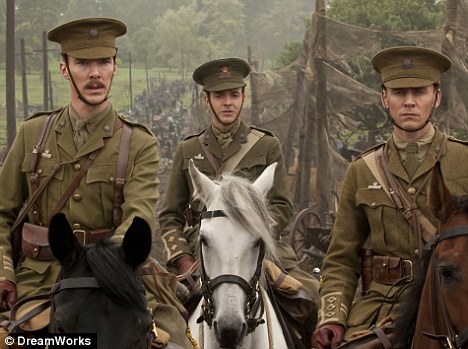
Went to see War Horse last night, and to be honest I wasn’t expecting that much, a kind of Au Hasard Balthazar combined with a WWI Band of Brothers, following the exploits of a boy and his horse as they navigate the major events of the first world war trying to find one another. But what I found was an uplifting, beautifully shot old fashioned film that was far more entertaining than I could have hoped.
Though at times the plot gave way for nosebags of sentimentality (this is a Spielberg film, after all), and few of the characters are onscreen enough to leave a resounding impression, though their parts of the story are some of the most touching (hello, Tom Hiddleston, Benedict Cumberbatch, Toby Kebbell and Eddie Marsan) every second of footage used is shot so perfectly, by Spielberg’s regular director of photography Janusz Kamisnki, who will surely receive an Oscar nod, if not a statue. The most beautiful moments are those in a far from beautiful setting, with Joey, the horse, jumping over and through trenches on No Man’s Land, only to be ensnared in barbed wire, or a sunset-backlit ride up a distant hill, and the sheer scale of some scenes, with hundreds of extras running from trenches or preparing for war. John Williams’ sweeping score is good but forgettable, and this is hardly one of Spielberg’s best (it isn’t quite the Saving Private Equine I was hoping for), with perhaps not quite enough time focussed on those fighting the war (it’s a good 45 minutes or so before the horse and boy, played by OK newcomer Jeremy Irvine, are separated), this is still a very entertaining watch. I think it’s better if you don’t really care about horses, as I enjoyed it immensely, but my horse-obsessed girlfriend spent at least a quarter of the two and a half hour run time watching through her fingers, so desperate was she not to see anything bad happen to a horse. It’s also remarkable that they made a film whose central character is a horse, yet at no point did I think it would be better if the horse could talk, or had an internal dialogue, even when he makes friends with another horse.
Choose film 7/10

The White Ribbon

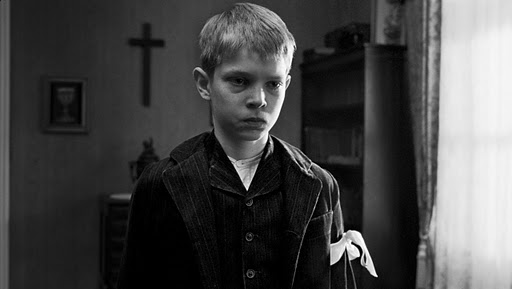
One cannot deny that this is an excellent, well made film by director Michael Haneke about a pre WW1 German village suffering from seemingly random acts of terrorism – the doctor’s horse is tripped on his way home from work, a barn is burned down, a woman dies when some rotten floorboards give way beneath her. Yet viewing is not a satisfying experience, as our narrator, speaking from the future about years long past, seems reluctant to release all the details of his story. The children of the village are severely mistreated by the pillars of their community, namely the pastor, doctor and baron. The pastor labels them with the titular white ribbon for the smallest offence, and when his pubescent son admits to self gratification; his hands are tied to the posts of the bed when he sleeps, to prevent any further sinning. It is obvious from the start that the children are behind the village’s incidents, having formed a kind of gang, yet these suspicions are never fully confirmed, with the most validation provided by a character approaching a bird’s cage holding a blade, and then the bird later found dead. Though Haneke has made a living from ambiguous works, some of his other features – Hidden or Funny Games for example – are superior to this in that you feel you have been told at least most of a story, rather than excerpts from a couple of chapters.

Choose life 7/10

The Wrestler

Has there ever been a character so seemingly written for a specific actor than Randy ‘the Ram’ Johnson, so perfect a fit for Mickey Rourke it’s impossible to imagine anyone else play him. Both were big in the 80s, Rourke at the peak of his game in Diner, 9 ½ Weeks and Barfly, Randy a top billing wrestler, but then saw their popularity wane and the roles dry up, before a comeback arrived, in the shape of Sin City for Rourke, as heavily scarred behemoth with a heart of goldie Marv, and a reunion battle with former nemesis the Ayatollah for the Ram. Rourke’s face, a battleground of botched plastic surgery and his four year stint of boxing in the early 90s looks like it’s been pummelled in the ring for years, and he nails every note of Ram’s trajectory, as a particularly brutal weapons match – in which a disabled spectator offers Randy his prosthetic leg to use as a club – causes the Ram to suffer a heart attack, and his wrestling days are over. Whilst struggling to adapt to a life without his one true love, he attempts to form a relationship with similarly aging, but still smoking at 45, stripper Cassidy (Oscar-winning Marisa Tomei) and reconnect with his estranged daughter Stephanie (Evan Rachel Wood). The flinch levels are unexpectedly high for a character piece, with incidents involving a deli-counter meat slicer and a staple gun proving the most worthy of a glance away from the screen. Director Darren Aronofsky – more known for deeper, more obscure work like Pi, the Fountain and more recently Black Swan, employs great cinematography, shooting everything on location with no sets and as many long tracking shots as he can, but this is Rourke’s game through and through, and though he wasn’t robbed of the Oscar (Sean Penn’s Milk was more deserving , in my opinion), I hope he doesn’t throw everything away with support roles in entertaining but cringeworthy fare like the Expendables and Immortals. He needs some more layered, meaty roles, I’m just not sure anything will ever be such a good fit.

Choose film 7/10

Saw

Launching a new sub-genre, in this case the US branch of torture porn, is a difficult task, but can pay off in spades if done well. James Wan, writer/director of Saw, knows this, for although on the surface his creation looks like just another horror franchise kick-starter, scratch the skin and you’ll find an intelligent, tightly plotted thriller that just happens to be sick and grotesque enough to stay with you for days, if not years later.
A serial killer going by the nickname Jigsaw has been trapping people who he deems worthy of needing to re-evaluate their lives. His traps are deadly, but can be survived if the victims are willing to suffer physical and mental scarring, and abide by his rules. Awakening in a disgusting, windowless bathroom, Dr. Gordon and Adam (Cary Elwes and fellow writer Leigh Whannell) find themselves in such a predicament, each chained by the leg to opposite corners of the room, equipped with a tape recorder, a gun, a saw apiece and a corpse in a pool of blood, with the only way out looking to be losing a foot. Meanwhile, cops Danny Glover and Ken Leung are closing in on the criminal mastermind. The plot remains just on the right side of ingenious, with some of the best twists seen in horror, and the psychological scares do greater work on the psyche than any sudden jumps although a couple are thrown in to please those unable to fully grasp a new kind of horror film.
The sequels took a great premise too far, making the plot far too convoluted and the reasons for participants being tested too obscure and mundane – undoubtedly Jigsaw would find me worthy of testing for spending too much time watching films – so go no further along the Saw blade than this fresh cut.
Choose film 7/10

Les Vampires

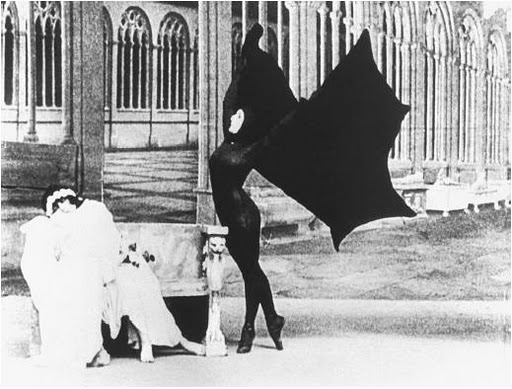
If acclaimed surrealist master Luis Bunuel is a fan of your work, it’s fair to say it’s unlikely to be a straightforward police procedural picture. The likes of Zodiac and All the President’s Men are probably far too logical for him to have admired, with far too few poisonous rings, hidden cannons and magic anagrams for his liking. That, and they aren’t 10-part silent serials from 1915, as is the case with Louis Feuillade’s Les Vampires, following newspaper editor Philippe Guerande and his flamboyant sidekick Mazzamette as they attempt to track down the notorious criminal gang known only as the Vampires, led by an ever changing Grand Vampire and his muse, the most interesting character of the series, Irma Vep.
In this world nothing is ever as it seems, with walls and paintings sliding aside to reveal hidden compartments (occasionally containing cannons), Vampires revealing themselves to be policemen, figures of authority revealing themselves to be Vampires and the dead returning back to life. This does become irritating, as logical second-guessing of the plot becomes impossible when it makes up its own rules as it goes along, but the sense of ingenuity keeps things interesting throughout the almost 7 hours runtime. I’m grateful too that modern architecture has advanced to a stage where most exterior surfaces are now only scalable using a ladder, whereas here they seem designed by the people behind Assassin’s Creed.
Choose film 7/10

Two Days in Paris

Jack and Marion (Adam Goldberg and writer/director Julie Delpy) are a typical couple in their mid-30s on a holiday in Europe, culminating with two days in Paris to visit the French Marion’s parents. Jack is an insecure, devious hypochondriac, paranoid of terrorist attacks and knows less French than your average American, whilst Marion’s parents (played by Delpy’s real life mother and father) know very little English, and Marion herself seems reluctant to act as translator, leading to various comic episodes, most notably with Marion’s father attempting to act out cunnilingus to Jack at an exhibition of his artwork. The film plays on both French and American stereotypes – the French are homophobic, xenophobic, inappropriately flirtatious wife beaters, all of whom have either gone out with or are trying to go out with Marion, whilst Americans are brash, ignorant tourists. The performances feel natural – up until the arrival of Daniel Bruhl’s self-proclaimed fairy, and the situations never feel overly contrived, just maybe a little exaggerated, and the cinema would be a better place if more romcoms were as insightful and humorous as this.
Choose film 7/10

The Girl with the Dragon Tattoo (2009)

6 years ago Stieg Larsson’s Millennium trilogy took the world by storm, so it was only a matter of time before movies were made, and even less before Hollywood came a-knocking with a US remake, due to hit cinemas this Boxing Day. David Fincher is a perfect fit for the source material, as he revels in the darkness and shadows of those living on societies outskirts, so hopefully he’ll do a better job of it than Niels Arden Oplev in this Swedish original. Understandably when transferring a book to the screen, especially one as dense as this, some omissions will need to be made; plot points will be skipped over, characters written out and those remaining will be trimmed down to a fraction of their former selves, how else will it all fit into a two hour time slot whilst not alienating newcomers by cutting vital exposition? But when the central storyline is a whodunit case of a 16-year old girl vanishing from a closed off island 40 years previously and only one possible suspect is given any level of character depth, it removes any sense of mystery as to who the culprit is.
That being said, the performances are exceptional, especially Noomi Rapace (currently seen in an underused role in the Sherlock sequel, and soon to be in Ridley Scott’s Alien sequel/prequel/equal Prometheus) as the rake-thin, leather-clad, eponymously inked super hacker Lisbeth Salander, but the overall feel seems rushed. Given the choice, opt instead for the six-part extended TV series version recently released on DVD, or read the books if that way inclined, as some of the grislier scenes – the anal rape, for example – are far easier to read about than they are to watch.
Choose life 7/10

West Side Story

It’s easy to mock West Side Story, and incredibly hard not to let out a start of incredulity, disbelief and hilarity when the Jets, a New York street gang, begin clicking, walking and turning in sync, but this 60s retelling of Shakespeare’s Romeo and Juliet has a lot going for it. Yes, the two leads – Jet old hand Tony (Richard Beymer) and rival Shark’s head honcho’s sister Maria (Natalie Wood, not even close to being Puerto Rican) are lifeless, charisma free and unforgivably dubbed for their singing. And yes, the dialogue has not aged well in places, but the toe-tapping tunes, particularly I Feel Pretty, America and Gee, Officer Krupke and outstanding choreography, with dances staged as fights and fights staged as dances more than make up for its faults. Supporting players perform admirably, notably Russ Tamblyn as Jets leader Riff and George Chakiris as Shark leader Bernardo, making this a musical for people who don’t like musicals – people like me then.
Choose film 7/10

Public Enemies

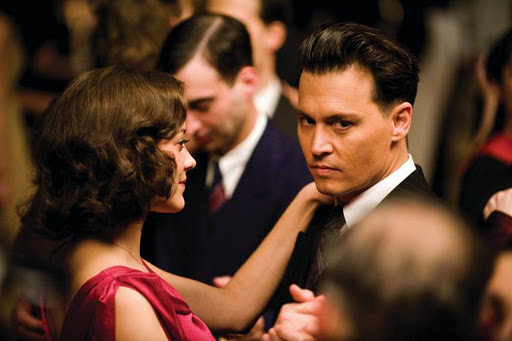
Michael Mann likes the central plot of Heat – expert cop and master thief and their teams on a destructive path towards one another with disregard for their personal lives – that this is the third time he’s made it, after the TV-movie L.A. Takedown, the DeNiro/Pacino classic and now this depression-era take, pitting Johnny Depp’s public enemy number one John Dillinger against Christian Bale’s FBI man Melvin Purvis (whose name is almost an anagram of Mr Evil Penis, but is one for vermin pelvis). (For all I know this is also the plot of Miami Vice and the Last of the Mohicans, I haven’t got round to watching them yet but it seems unlikely.)
The parallels with Heat run deep – the first criminal act, an opening prison break, is almost botched by a trigger happy accomplice soon removed from the group – but the key difference is the pivotal central scene where our two leads meet. In Heat, DeNiro’s thief McCauley and Pacino’s cop Hanna share a mutual respect, that they are dealing here with the other side of their own coin, a talented man with opposite morals. Here, Dillinger and Pervis despise one another, disgusted that they are within the other’s presence or mentioned in the same breath. This complex central relationship was key to the layered texture of Heat, and its absence is felt.
Depp has always been better at characters (Scissorhands, Sparrow) than he has emotions, and Dillinger is bland and lifeless in his hands, yet still more likeable than Bale’s cold, business-like Pervis. DiCaprio would probably have been a better fit for Dillinger, but as FBI director J. Edgar Hoover appears here as Billy Crudup this would have made DiCaprio and Clint Eastwood’s current biopic of the man problematic.
All this in account, this is still an entertaining action/crime movie, with plenty of period gun porn for those that way inclined. Mann’s attention to detail is perfect, and there is some of the best comedy ever seen in a 1930s set cop movie – see Dillinger wondering around the offices of the FBI department out to catch him, casually asking the score of a sports game. Smarter and more thought provoking than most gun-happy movies, this is definitely worth a watch.
Choose film 7/10