
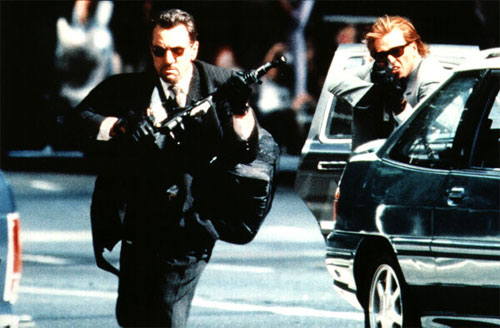
Heat

Most crime films tend to pick a side early on, focusing on a ‘means to an end’ band of criminals thieving because they have to, or a team of patriotic, all-American supercops able to match their never-ending machine gun clips with a limitless supply of one liners, but Michael Mann’s Heat, a remake of his own 1989 made for TV movie L.A. Takedown, takes a different path, giving Robert De Niro’s gang of seasoned thieved and Al Pacino’s police squad equal screen time, equal motivation and similar levels of compassion, so you get to decide who you want to win. Though the two main characters; De Niro’s master thief Neil McCauley and Pacino’s dogged detective Vincent Hanna are sworn enemies, they are still two sides of the same coin, separated by their own opinions of the law, but brought together by a deep mutual respect. Neither one is the villain of the film, there are more than enough scumbags among the supporting player to take that role, yet neither is necessarily the hero, although in the end it’s Pacino who grabs the most heroic moments.
Surrounded by an incredible ensemble cast (deep breath: Val Kilmer, Tom Sizemore, Danny Trejo, Dennis Haysbert, Natalie Portman, Xander Berkeley, Hank Azaria, Jon Voight, Jeremy Piven, Mykelti Williamson, William Fichtner, Tom Noonan, Ted Levine, Ashley Judd), some perfectly choreographed set pieces (the opening truck heist and mid film bank robbery/street shootout) and ability to show the effect their chosen lifestyles has had on these characters and their personal lives, or lack thereof, this is a tremendous film, even if it does give in to the occasional cliché, but these can be forgiven for the fact that they use weapons that actually, from time to time, need reloading.
Choose film 9/10
Tokyo Story

Unlike this film, life is nothing but disappointment. This is the discovery made by an elderly middle class Japanese couple as they visit Tokyo for the first time to see their children and grandchildren, only to find they do not have room in their busy lives to send time with their parents.
Shot with an unmoving camera set at sitting height from the floor, this largely encompasses the family’s conversations, discussing everyday life, but it is often the occasional periods without dialogue that are more moving, and say more than any could.
There is a sense of finality throughout, as though the couple know they are unlikely to see their children again, and it is difficult after watching this film not to pick up the phone and call your own parents. Surely a film that makes us want to at least try to be better people, and live up to the expectations of others cannot be a bad thing?
Choose life 9/10

The Bourne Trilogy

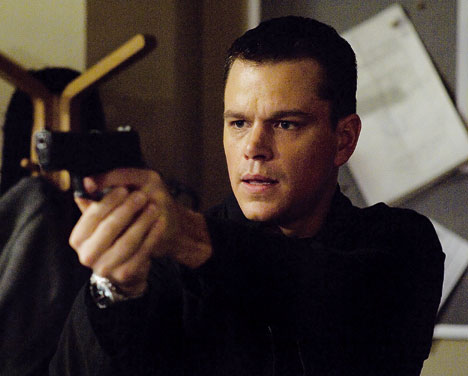
Back in 2002, the espionage genre must have felt a little like Matt Damon’s Jason Bourne at the start of this trilogy, floating unconscious in the Mediterranean Sea with a bullet in the back after the abysmal CGI tsunami of Die Another Day and the shallow, clichéd hotchpotch of Mission Impossible 2, although they may have envied Bourne’s lack of memory. Thank the heavens then for the metaphorical fishing vessel of star Damon, director Doug Liman and writer Tony Gilroy for bringing this energetic affair to the screen, both setting up Damon as a bona fide action star and throwing the gauntlet at the feet of Bond and Ethan Hunt to step it up a gear (both of whom willingly accepting the challenge with Casino Royale’s gritty realism and MI3’s intelligent action).

One Flew Over the Cuckoo’s Nest

Jack Nicholson, in an arguably career best (so far) performance, is R.P. McMurphy, hopes to complete a short prison sentence without resorting to hard labour, and therefore pleads insanity and is transferred to a psychiatric hospital run by the steely Nurse Ratched (Louise Fletcher).  Ratched’s treatment methods, including humiliation and a mind-numbing daily routine appall McMurphy, as he realises the other patients are more focused on their fear of her than of functioning in the outside world. Although the main two performances are excellent, both winning well deserved Oscars, the film remains memorable more for the supporting cast that makes up the other inmates. Each has a specific and instantly recognisable personality, be it Brad Dourif’s stutteringly naive suicide risk Billy, Danny DeVito’s childlike Martini or Christopher Lloyd’s crazed loose cannon Taber, used whenever anyone is required to awake to a surprise situation, as Lloyd owns the greatest instant ‘what the Hell’ face on the planet.

The film is remarkable, not only for the acting but also the depths to which the story plunges, with an ending both horrific and genuinely surprising. Throughout the film it is obvious that McMurphy will be discovered as a fraud (something never actually stated during the film), and will of course be sent back to prison where he belongs (the sentence he is attempting to avoid is the statutory rape of a 15-year old girl), but the fate in store for him is far worse than could possibly be imagined. It also features possibly the most elaborate plan to have sex ever, hijacking a busload of patients, commandeering a boat and teaching said loons how to fish.

Choose film 9/10

Butch Cassidy and the Sundance Kid

They actually got Robert Redford to run along the top of a moving train. How amazing is that? Yes I’m sure these days there are some actors willing to do their own stunts (and by stunts, they are probably referring to such extreme activities as riding a horse) but running along a moving train? Redford probably needs a wheelbarrow with him at all times to carry those balls of his in. It’s this devil-may-care, balls to the wall sensibility that shines through in Butch and Sundance, throwing in any number of cinematic tricks and keeping what stuck, from showing a road trip taking in destinations including New York and South America entirely in photographic stills, to probably the most famous and iconic freeze-frame ending in history. It is this, combined with Redford and Paul Newman’s co-dependent relationship and easy banter, even in the tightest of situations, that makes the film still a genre classic to this day.
Choose film 9/10

Alien

One of my favourite movie subgenres is the limited cast, limited locations films, where, for whatever reason, only a handful of characters are involved, and are confined to a small number, preferably one or two, of areas. This is best seen in 12 Angry Men, as previously discussed, where the principle cast are the 12 jurors on a case, and the principle sets are the jury room and its adjacent restroom. Similarly, Alien sees the seven crew members of the mining spaceship Nostromo largely confined to the ship and a planet it docks at in response to a distress signal. Things take a turn for the worse when, upon docking, the ship picks up an alien lifeform (later known as a Xenomorph), whose main ambition in life seems to be removing it from other creatures.
The film shows an interesting depiction of the future far removed from the more utopian worlds of more classic science fiction. Here, men seem to have retained dominance (shown by the exclusion of women from any decision making), and where class separation is still rife (the two engineers, Parker and Brett, are paid half as much as everyone else on board). The ship’s design is a far cry from the gleaming visuals of, say, 2001: A Space Odyssey. The Nostromo is, after all, a mining craft, so the ship’s functional, mechanical nature is only to be expected, although the overly futuristic sleeping pods do jar with the rest of the ship.
Aside from the infamous ‘chestburster’ scene (of which you can now by lifesize plush toys!), I couldn’t remember most of the film, although in my memory it does tend to blend with the other films from the franchise, as my only previous viewing was in marathon format. That said, there is much that sticks in the mind now, from Hurt’s descent into the alien nest, littered with giant eggs covered in a mysterious fog, or Ripley (Sigourney Weaver) seeing off an 8 ft alien with molecular acid for blood and far too many sets of teeth dressed only in vest and knickers (Ripley’s wearing the knickers, not the alien).
Having seen many survival films, where the cast is slowly whittled down one by one until the final confrontation, I noticed that with Alien it is not immediately obvious who the main character, and therefore the final survivor, is. Most of the characters are given fairly equal screen time, characterisation and dialogue, so it is not until the numbers start to dwindle that it is clear Ripley is the heroine, as earlier in the film she seemed to be the more heartless, professional crewmember, condemning Hurt’s Kane to death by refusing him entry onto the ship without a proper scan. That being said, she does become stupid later on, stopping to put two suffering crewmembers out of their misery minutes before the entire ship, them included, will be blown up (I’ve never understood this, why do ships have self-destruct mechanisms? Were they expecting an alien lifeform to come aboard, and the only way to kill it would be to blow the whole ship up? If so, surely some other defence mechanisms could be implemented instead?), and then she goes back for the cat, kept on board purely to jump out at random moments to scare the bejesus out of anyone in the vicinity.
Choose film 9/10

The Shawshank Redemption

This is one of the films I’ve seen more times than any other, up there with Armageddon and Die Hard with a Vengeance (criminally, neither of which appear on the list). Shawshank tells the story of Andy Dufresne (Tim Robbins), wrongly convicted of the murder of his wife and her lover. Really though, the film is about friendship, with Dufresne meeting Morgan Freeman’s Red, a man known to locate certain items from time to time, and the two form a firm bond. The film also shows how to make the best of a bad situation, as before imprisonment Andy was in a relationship with an unfaithful women, a successful but passion-less job as a banker and had few, if any, friends (none seem to visit him throughout his sentence), yet in prison he thrives, providing sound financial advice to the guards, making friends and finding peace within himself with the aid of a newfound routine and meaning. Andy never knew that all he wanted was freedom, until what little he had was taken away from him.

Choose film 9/10

Terminator 2: Judgement Day

How do you make a sequel to Terminator? It seems like the perfect movie to create a franchise with, featuring the possibilities for labyrinthine time-travel plotting, self referencing paradoxes and a villain who can be killed, but can also always return, but therein lays the biggest stumbling block. The villain from the original, Schwarzenegger’s unstoppable mechanical monster, the main draw of the first film, surely must return for the second, especially seeing as, in 1991, he was one of the biggest stars in the world. But how could the same robot come back as the villain? The sequel must somehow build upon the original, develop it further, else why bother? Having the same villain, with essentially the same plot, would seem a waste of time. So, proving that necessity is indeed the mother of invention, director James Cameron pulled a full character flip on not just Arnie’s T-800, now here as protector rather than foe, but also of Linda Hamilton’s Sarah Connor, discarding the ditzy 80s hairdo for some badass fighting skills, tank tops and a permanent ticket to the gun show. The introduction of John Connor (Edward Furlong) as a ridiculously irritating teenager spouting laughable phrases (Asta-la-vista, baby? Seriously?) is also a diversion from the expected, as he’s the so-called saviour of mankind, but he’s so goddamn annoying that whenever he was onscreen I found myself rooting for the bad guy.

Pixar Day

Had a bit of an accident this morning, got knocked off my bike on the way to work. I’m fine, but my bike’s wrecked, and I was confined to the sofa for the day, and couldn’t think of a better way to cheer myself up than watching nothing but Pixar films, and all off the list!
Continue reading

The Terminator

Film night strikes again with the Terminator. This is a film that is so deeply ingrained within popular culture that I cannot remember the first time that I saw it, and probably did not even realise it was my first time then, as the character is so well known, from the way he moves to his handful of lines of dialogue, but I tried to watch it afresh, as though it was 1984 and I’d wandered blindly into a cinema and sat down. The most surprising thing I found was that there is no indication that Schwarzenegger is a cyborg until about 45 minutes into the films, though it is now the most famous aspect of the film. Up until Kyle Reese (Michael Biehn) tells Sarah Connor (Linda Hamilton) that he is a robot sent from the future to kill her, preventing the birth of her son and therefore the revolution against the cyborgs that he will eventually cause, we only assume that Schwarzenegger is just a specially trained, seemingly unstoppable killer, possibly a soldier or hitman of some kind. Yes there are some hints; his stiff-legged walking and even stiffer speech mannerisms, but at the time no-one would have been expecting anything more acting-wise from the former bodybuilder.