Edward Scissorhands

First off, apologies for the lack of posts recently, I’ve been in hospital for an operation on my nose (inspiring this Top 5). Also, apologies if the posts over the next few days are a little off, I’m on a veritable Pan Galactic Gargle Blaster of meds, but I’ll try and keep everything as on topic as possible.
Johnny Depp successfully accomplished the transition from TV heart throb to serious movie actor with this, Tim Burton’s fourth directorial outing, leading to at present a further seven collaborations between the two bizarelly-haired gentlemen. Depp stars as Edward, the creation of a reclusive inventor (the legendary Vincent Price, in an all too brief cameo in his final film role) who remains incomplete after the inventor passes away. Edward looks human enough, but where five-fingered appendages should be on the ends of his arms, there are instead a multitude of blades, knives and scissors. After being discovered living alone by Dianne Wiest’s kindly Avon lady Peg, Edward is brought into the ‘normal’ world of 1950s suburban American.
As much comedy is made from Edward’s physical impairment as possible, with his blades coming into contact with waterbeds and hindering his ability to get dressed, pick up a glass, open a door or touch his face, but he shows an aptitude for carving meat, topiary, hairdressing, dog grooming, paperchain-cutting and being used as a kebab skewer. This does bring up the subject of exactly how Edward had survived alone in the castle before his ‘rescue,’ but as this is essentially a fairytale, minor plot details can be smoothed over.
As ever, Burton shows a deft hand with his casting. Depp is wonderful as Edward, showing childlike wonder at the new world around him, and expressing true depth of emotion from behind a stark appearance, all pale face, scars, bedraggled mop of hair and tight plastic and leather bondage-inspired clothing, and with minimal dialogue. Winona Ryder is cast against type (in that she wears colourful clothing and has blonde hair) as Peg’s cheerleader daughter Kim, and Alan Arkin and Wiest are wonderful as the parents welcoming Edward into their home. Anthony Michael Hall as Kim’s brutish boyfriend is more of a stretch though; the nerdy Breakfast Club star cannot be taken seriously in a bad guy role.
The film is lighthearted and entertaining, and has some genuine comic moments. The bookends of a clearly aged Winona Ryder are more obvious than the supposed narration reveal of the Notebook, but this features one of the greatest and most memorable character creations of cinema, and some fine acting too.
Choose film 7/10

Satantango

Aisha’s away for the weekend and I’ve got no other plans, the hotbed of social activity that I am, so I’ve made the most of a fairly sunny weekend by staying in and watching the longest film left on the list, Satantango. At 7 ½ hours long, it rounds out the top 5 longest films (though technically two are TV series and one is an eleven-part serial) on the List, which between them have taken up over 48 hours of my life that I’m never getting back. I doubt it’ll come as a surprise to many, but of the 14 films over four hours in length of the List, all of them are from Europe, and only one is in English (Kenneth Branagh’s Hamlet). More than half of them are French. America doesn’t start to get a look in until Sergio Leone’s Once Upon A Time in America (227 minutes), but it’s got a lot around the 3-hour mark instead. Also, of the 4-hour-plus films, three of them are Holocaust-related documentaries. Yay.
So, Satantango. I’m going to try and make this review be not entirely about the length of the film, but it is bloody long. And needlessly so. Many of the sequences involve nothing happening – the first 9 minutes follows cows wandering around in the mud, later a child walks purposefully towards the camera for what seems an eternity – so that whenever a conversation occurs – other than some sporadic narration, dialogue doesn’t kick in for about 15 minutes – it comes as a shock.
The film sees the inhabitants of a run-down Hungarian village. The villagers have a large sum of money they wish to share out, but some want to leave with more than their fair share, whilst others wish to wait for a man believed dead to arrive, with the possibility of making even more money with his help. This is only the central structure of the plot, for there are several detractions, but no real motives or details are ever expanded upon. We see the same events through different viewpoints, at one point witnessing a drunken dancing session (at least 10 minutes long) from the perspective of a young child outside the window, and then later we’re shown it again, longer this time, but from inside the room. This new vantage point offers nothing new, and just serves to make me wish to never hear an accordion ever again, for the same short tune segment is repeated over and over and over again for the entirety of the dance.
This is, however, a great achievement in terms of direction and cinematography. Much of the film takes place in long, unbroken shots, the aforementioned dancing, for example, which at times are truly breathtaking, and others thoroughly unimpressive due to the lack of anything happening onscreen (it’s a completely unbroken shot! Of someone sat down!).
Though I was never bored, and I was also far from entertained or engaged. The large gaps of nothingness allowed my mind to wander and expand upon what I was watching, and also gave me time to jot down the improvements I’m intending to make to the site over the next few weeks. It did, however, feel like an arduous watch, something I had to work at to pay attention, and after seven hours I’d hoped for a satisfying conclusion to make it all worthwhile, a reward for the patience and sacrifice of time, but alas I was left wanting.
Choose life 5/10

The Dark Knight

What can I say about the Dark Knight that a thousand others before me haven’t? Of all modern films, this seems to be the one pored over most closely and often, heralded as the saviour of the summer blockbuster, superhero movie and crime thriller, all rolled up in the tightest of scripts. So, to take a fresh perspective, I sought out some people who didn’t like the film (thank the lord for the Internet, it makes people who don’t like something so easy to find) and found myself furious after reading just one and a half 1/10 reviews on IMDb. The sheer level of nitpicking and miniscule plot-hole unravelling proves just how far people are willing to go to disagree with the masses and stand out from the crowd, even when the crowd is so undeniably correct.
Not that this is a perfect film. There are flaws, including the Joker’s plan being at times a tad too pre-emptive, some ominous camera angles and music cues hinting unsubtly a character’s true motives earlier than should have been done, and the bit with the cellphones, which is a bit silly, but is that really enough to warrant a 1-star rating? The fact that these reviewers (I won’t give them the satisfaction of names or links, only seek them out to feel the rage bubble inside you) fail to note even one positive point in a movie overflowing with brilliance negates any opinion they deem worthy of sharing. I personally find it impossible to find nothing good in a movie – The Adventures of Pluto Nash is an abomination unto film, yet Randy Quaid is a delight as Nash’s robotic assistant; Big Trouble in Little China is easily one of the worst films I’ve reviewed from the list so far, but it has imaginative (if insane) monsters and mythology, some dialogue that surpasses cheesy to being inspired, and features Kim Cattrall back when she was attractive. Therefore, with such damning reviews as these ‘people’ have offered, they are in fact unwittingly proving how good a film it is.
Leaping from the tantalising springboard ending of BatmanBegins – Gary Oldman’s Jim Gordon showing Batman a playing card left as the mark of a new criminal, calling himself The Joker, we dive headlong into a wonderfully executed bank heist, as six masked goons effortlessly separate mob money from the vaults it was stored in. Director Chris Nolan has made no secret that Heat, Michael Mann’s superb DeNiro/Pacino cat and mouse crime epic, was a huge influence on the Dark Knight, and it shows, from a William Fichtner cameo to a central meeting of the hero and villain, even mentioning a cup of coffee.
Nolan wisely improved upon some mild mis-steps made in Batman Begins here, replacing Katie Holmes with Maggie Gyllenhall as love interest Rachel Dawes, giving Batman’s mask a cowl so he can turn his head, and giving Batman himself (Christian Bale, good but no Adam West) a little less screen time, allowing alter ego Bruce Wayne and his various accomplices and nemeses some breathing room. Aaron Eckhart is spot-on as Harvey Dent, Gotham’s shining hope against the mob, and Morgan Freeman and Michael Caine remain on hand to add a touch of old school class and grandeur as Wayne’s dependable CEO nad curmudgeonly butler/moral compass, but justifiably most of the praise has been directed at the late Heath Ledger’s Joker. A creation for the ages, his layered performance of a truly maniacal genius reveals more with each viewing, and it is unfortunate that the role showcased the true acting abilities of a man previously thought of merely as a rom-com heartthrob only after he had passed. Plus, it gave us all another Hallowe’en costume to use.
Unusually for Nolan, the film is actually quite funny. It’s not exactly laugh-a-minute (there’s certainly less than 152 jokes here), the script is still a lot more humorous than you might remember. There’s also absolutely no filler, with every strand being integral to the plot; a true achievement when you consider just how engaging the story is, even when new elements are being added right up until the last few scenes.
As always with Nolan’s films, there’s a couple of cinematography moments that I’d have tried differently (see Inception), most notably the scene where the Joker leaves a hospital, which could have looked truly tremendous had it been one unbroken shot, without needlessly cutting away to some pedestrians nearby, but this is a small matter that is more of a personal niggle than a criticism.
Anyway, for those wondering if they should watch the film again before the upcoming trilogy closer The Dark Knight Risesthis summer, the answer is a resounding yes. Even if you don’t intend to see part 3 (I assume you’re planning on gouging out your own eyeballs, just in case it isn’t any good, there’s no other reason not to see it) you should watch The Dark Knight again, just because it’s probably the best film to have been released in the last 5 years, if not more.
Choose film 9/10

A.I.: Artifical Intelligence

Kubrick’s visionary ideas, social commentaries and moral dilemmas don’t quite gel with Spielberg’s family oriented sentimentality in this disjointed and overlong offering, conceived and planned by the former but implemented by the latter after his death in 1999.

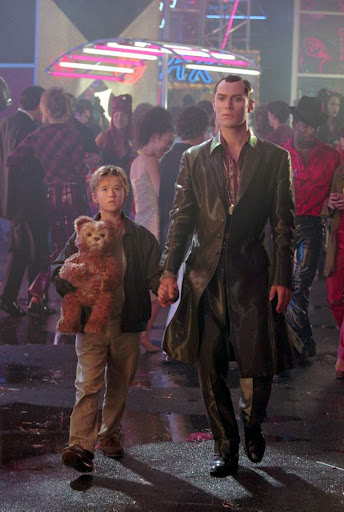
Now, I love me some robots. Whether they’re compacting waste into trash skyscrapers, travelling through time to save Sarah Connor or trying to kill Will Smith, you show me a film with robots in and I’ll watch the Hell out of it (though I’ve never actually seen the 20th Century Fox film Robots starring Ewan McGregor and Robin Williams, just never came around). There’s a robot clock watching me from atop a bookcase in the lounge, robot cushions on the sofa and a robot cookie jar whose head seems to rotate around and look at me wherever I am. But the key characteristic that joins these all together, is that they all look like robots, which is where A.I. looses my interest, for here they look like people. Yes, I know that’s the point. Haley Joel Osment’s mini-mecha David has been created to fill the hole left when his new parent’s son goes into a coma, and Jude Law’s robo-gigolo Joe (that’s fun to say) would be downright weird if he didn’t look a lot like a human, but that’s not what I want to see in a film about mechanical men. It isn’t until over half way through the film that we see some older models and exposed innards, and even then it’s far too briefly.

Osment is good, too good, as the automated child, and occasionally he passes for human, but for the most part he’s in full-tilt terrifyingly creepy mode, following his ‘mother’ Monica (Frances O’Connor) around the house all day, standing and watching her until she justifiably locks him in a cupboard. The first 45 minutes could quite easily be the start of a horror film, so disturbing is David: “I can never go to sleep, but I can lay quietly and not make a peep.” Nothing he does is endearing or even likable, but then I’ve always felt this way about children, but still the brief amount of time it takes for Monica to bond with this mechanised horror is jarring, especially given there seems to be no real scenario that draws them together. Also, David is only programmed to ‘love’ one parent, and his new ‘father’ Henry (Sam Robards) seems devoid of emotions, either for his comatose son or the new replacement, so that fits together nicely.

The movie is comprised of a series of episodes that, once passed, are all but forgotten. The story could have been interesting, and the world has potential for a more enthralling film within it, especially in the city scenes, and the brutal Flesh Fairs, where rogue ‘bots are hunted and tortured to a baying crowd’s delight, but over an hour of watching David desperately wanting to be a real boy becomes terminally dull. The future technology and gadgetry is generally good, subtle yet insightful, although the cars look a bit silly. And the ending is polarising, I found it terrible and unsatisfying, whilst Aisha thought that, whilst it seemed tacked on and unnecessary, it was still very moving.


Choose life 5/10

Chicago

Last Monday I was not having a good day. I don’t remember having a particularly good day at work, and when I came home the LoveFilm disc of The Class (review coming soon) infected my PlayStation 3, my primary film-watching paraphernalia, with an incurable bout of Yellow Light of Death. Fortunately, after a quick 20-minutes of mucking around with SCART leads and speakers, the back-up DVD player was up and running, but alas The Class had no intentions of playing, and to be honest I was in no mood to read subtitles after that debacle, so instead we settled down for a much more easy to watch and far more enjoyable evening of Chicago.
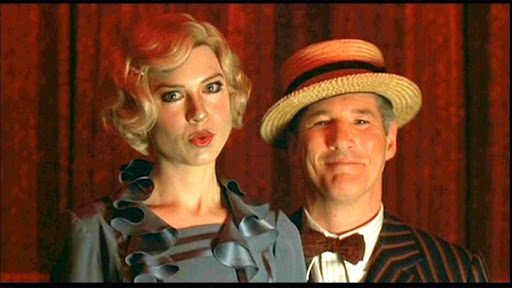
I’ve seen the story twice before, once on film and once on stage, and I think I preferred the small screen to the grand spectacle, though I think on second viewing it isn’t as good as I remembered. Renee Zellweger is as annoying as ever as the naive, waif-like Roxie Hart, incarcerated after killing the man she was sleeping around with (The Wire’s Dominic West). Whilst inside, she meets Catherine Zeta-Jones’ performer Velma Kelly, herself accused of murdering her sister and husband. The two compete for the favours of Matron Mama (Queen Latifah) and super smooth, silver-tongued lawyer Billy Flynn (Richard Gere).
Gere and Latifah seem to be the only ones enjoying themselves, and why Latifah was nominated for Best Supporting Actress I’ll never know, as her performance doesn’t compare to the award winning Zeta-Jones. There’s far too much of Zellweger simpering around the stage, and she seems to have forgotten to tell her face that she’s acting for much of her performance. Her singing is fine, but she is a thoroughly over-rated actress, who in this film is also far too skinny (but then so are all the girls in this film, Latifah aside). More of Gere’s incredibly entertaining Flynn would have gone a long way, as would more screen time for John C. Reilly as Roxie’s cuckolded husband Amos, who’s solo performance of Mr. Cellophane is my personal favourite, along with the wonderfully choreographed Cell Block Tango and Flynn’s marionette manipulation of a gaggle of reporters.
So, whilst it’s not perfect and a recasting of the lead would have been greatly appreciated (though to be honest, I’m not sure who I’d cast in her place) many of the musical numbers are still great fun. Six Oscars and thirteen nominations though? Seems a little excessive.
Choose film 7/10

Good Morning, Vietnam

Barry Levinson can’t work out whether he’s Oliver Stone or Jerry Zucker in this Vietnam-based Robin Williams vehicle. Heavy handed politics and imagery of riots, fire and explosions doesn’t tend to gel with zany antics and improv riffing from one of the world’s leading fast-talking funnymen, but fortunately Williams is on fine enough form to just about rescue the material from an uneven mess, as his radio DJ Adrian Cronauer is brought in to perk up the on-air talent of 1965 Saigon. The troops love him, but his superiors, including the late, great Bruno Kirby’s put upon aggressive peon Lt. Steve, are less keen on his refusal to play approved material and pre-programmed songs, opting for rock and roll over Perry Como. Some storylines seem forced and contrived – Cronauer repeatedly infiltrating an English class just to meet a girl, her entire family accompanying them on a date – and you get the feeling that this is only loosely based on a true story.
Where it shines though is the comedy. Though some of the references are now very dated and probably worked a lot better back in the States (Ethel Merman, Walter Cronkite, Mr. Ed), Williams knack for voices and repartee with a crowd is unparalleled, though a young Forest Whittaker as station lackey Edward Garlick gets his share of decent lines too: “A man does not refer to Pat Boone as a beautiful genius if things are alright.”
The film tries too hard to make a political statement where none is wanted, and the failed attempts at poignancy leave a bad taste in the mouth. Had the serious side been toned down – difficult, I know, given that it’s about war – and the directionless plot been reined in a little this could have been a classic.
Choose life 6/10

Of Gods and Men

Based on the true story of Cistercian monks in Algeria in 1996 (stay with me) this film is the very definition of slow, but there is no other way it could be told. Had I watched it after a long day at work or a particularly stodgy meal (my favourite kind), then odds are I ‘d have drifted off into an unbroken slumber until the next morning at around twenty minutes in, but the elegiac pace, mostly following the monks everyday lives as they become gradually more effected by the increasing terrorist presence as their government deteriorates is beautiful and engrossing.
Long shots of prayer, studying, tending to the garden, cleaning the monastery, more prayer, ploughing the fields, singing hymns and praying again, largely showing little more than the backs of people’s heads doesn’t sound particularly enthralling, and it’s not, but the camera’s obsession with these monk’s defiance and dependency in the face of violence is just gripping, made all the more effective by the sheer lack of action preceding. The best scenes involve nought but dialogue – the monks refusing to allow their doctor and his medicine to be taken from them forcefully, monastery meetings discussing whether desertion is a viable option, or no dialogue whatsoever, with a piece of classical music and a glass of wine reducing the men to tears – and I previously wasn’t aware how fulfilling an experience could be achieved with so little happening on screen. 
This won’t appeal to the Friday night crowd after a little bang for their buck, a crowd I’ll admit to joining regularly, but for a thought-provoking watch with plenty of room to think and absorb the atmosphere, you could do a lot worse.
Choose film 8/10

Precious (based on the novel Push by Sapphire)

I knew what I was expecting when I sat down to watch Precious: being depressed, angered and infuriated by the action on screen, but doubtlessly impressed by the acting on display. Shockingly, I was correct, though thankfully most of the abuse was verbal.
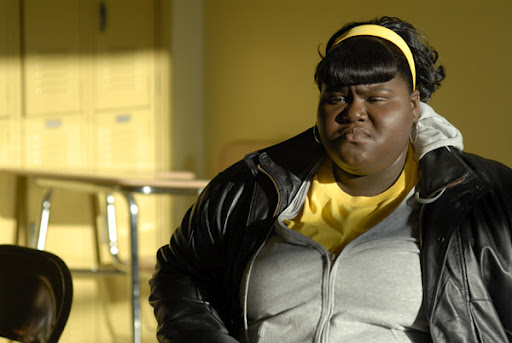
Gabourey Sidibe (more recently seen in Tower Heist and The Big C, where I’m guessing everyone else on set spends most of their time working out how to pronounce her name) is Clarice ‘Precious’ Jones, a severely obese sixteen year old, pregnant with her second child as a result of being raped by her father again. She lives in a cramped apartment with her volatile, welfare-abusing mother (Oscar-winning Mo’nique, a revelation from a woman exclusively known for comedy until this point) in Harlem in 1987. Oh, and her first child has been nicknamed Mongo for suffering Down’s Syndrome. See, told you it was depressing.
Precious’ mother is a monster of Hannibal Lecter proportions, with every word calculated to bring the most destruction to her child. We hear such gems as “School ain’t gonna help none, take your fat ass down to the welfare,” “You will never know shit, don’t nobody want you,” and “I should have aborted your fat fuckin’ ass.” Charming. Many scenes are beyond difficult to watch, from the furious tirade aimed at Precious when her headmistress (“white bitch”) drops round after school, to the fantasies of red carpets and photo shoots that make up the only escape Precious has from her unbearable existence.
It’s not all crushing depression. Mostly, but not all, for Precious seeks to improve her situation, enrolling in an alternative school for kids who’ve fallen through the cracks, so there is light at the end of the tunnel, shone from three supporting adults, her teacher Ms. Rain (Paula Patton), the nurse’s assistant who helps delivers her baby (Lenny Kravitz) and her social worker (Mariah Carey). These last two choices seem like some fairly risky stunt casting, but it pays off, as though the singers aren’t likely to be bothering the Academy any time soon, they perform ably and selflessly in places you wouldn’t normally expect them.
Though well made, directed and shot, the subject matter at times feels like a particularly sobering episode of Jerry Springer, interspersed with some truly shocking moments that generally involve potential harm to Precious baby. But it’s not as miserable as first thought, and the performances on display are worth watching.
Choose film 7/10

An American Werewolf in London

After being attacked on the Moors in rural northern England, a young backpacking American (David Naughton) awakes in a London hospital and falls for his nurse, Walkabout’s Jenny Agutter. This leads to some romcom hijinks, mostly involving Agutter’s Alex not being allowed to sleep with patients, and the vacationing David bored and alone in her apartment all day with no money and no where to go, trying to amuse himself. Oh, one last thing, David’s a werewolf being stalked by the ever-decaying remains of his zombie best friend. Sorry, forgot that bit.
This film is great, mostly memorable for Rick Baker’s stunning effects, featuring a transformation entirely CGI free that looks and feels unbearably painful and has yet to be equalled over thirty years later. There are some good jump scares and creative cinematography, with even a stationery phone box call shot seemingly on a circling bicycle. The subway sequence is particularly exhilarating, and the film is a lot funnier than you might remember, especially the scene in the porn theatre, with various undead suggesting the best ways for David to kill himself (we finally get to see director John Landis’ in-joke movie See You Next Wednesday, referenced in all his films, that turns out to not be that recommendable).
Unfortunately Landis doesn’t follow Spielberg’s rule of not showing too much monster, as the later scenes, before an overly abrupt ending, reveal the creature too clearly, gnawing away at some of the mystery. Frank Oz’s cameo as an American embassy official is also offputting, as I can’t take him seriously when he’s doing a voice that sounds exactly like the one he uses for Fozzie Bear in the Muppets. The most unbelievable part though? It’s possible to get a taxi far in London for £1.50. Ridiculous.
Still, thoroughly enjoyable and worth watching for Baker’s Oscar-winning make-up and effects.
Choose film 7/10

Collateral

Michael Mann takes a break from shootouts and dogged cops hunting master criminals in favour of a more laidback, narrative-driven movie about Jamie Foxx’s ambitious yet stunted taxi driver Max carries his fares around the neon-lit streets of L.A. That is, until he picks up Tom Cruise’s hitman Vincent, and Max’s night, and his dreams, are thrown into turmoil as the body count rises.
Cruise seems like an odd choice to play a fairly villainous guys, but he proves spot-on, retaining his usual casual charm but with a steely glint and wolfish menace to go with his salt and pepper hair, leaving Foxx to submit lie in his shadow.
The script relies too much on luck and coincidence, and leaves some pretty gaping plot holes you could drive a cab through, plus those paying attention should see that there’s really only one way the film can end, with a last act twist clearly signposted in seemingly throwaway lines. The writer even resorts to a low cell phone signal and battery as a means of moving the plot along; generally the laziest idea anyone could use.
The film evokes memories of much better films – Leon’s hitman, Taxi Driver, The French Connection’s subway stand-off, every buddy movie ever made – reminding you that there’s little original here. So whilst it’s watchable, it’s by no means worthy of a place on the list, and was wisely cut from the 1001 book some years ago.
Choose life 5/10