Unforgiven

The first part of my double bill of Clint-Eastwood-directing-himself-and-Morgan-Freeman-in-a-supporting-role sees the American icon define the genre that not only made him the prolific star he is, but that he has almost singlehandedly kept alive since it’s surge in popularity in the 60s and 70s; the western.
Unforgiven sees Eastwood as William Munny, a former hardened killer reformed by the love of a good women and the birth of his two children. With his wife dead and their herd of pigs stricken with fever, Munny accepts the offer from young upstart The Schofield Kid (Jaimz Woolvett) to kill two ruffians who cut up a whore after she laughed at one of them having a small penis. They team up with Munny’s former partner Ned Logan (Morgan Freeman) and head out to the town of Big Whiskey, lorded over by Gene Hackman’s occasionally violent ‘Little’ Bill Daggett, where other hired killers, including Richard Harris’ English Bob, are also heading to claim the bounty.
Eastwood’s Munny isn’t your typical western hero. In fact, no character in this can ever be truly classed as heroic. Munny has what could politely be called a sordid past, and his desperation to honour his late wife by not succumbing to his younger urges is evident. A self proclaimed no good son of a bitch, Munny is a shadow of his former self, unable to shoot straight or even mount a horse. Freeman’s Ned has a woman at home, yet has no qualms about visiting the whorehouse in town, Schofield has his own secrets and Bob is an outright liar, gambler and killer. At times it seems that Little Bill, supposedly the villain of the piece, is possibly the most moral character here, opting not to kill the prostitute abusers in favour of fining them horses instead, with the sins he commits in the present are nothing compared to those done by Munny in the past, and his intentions are only to keep his town free from guns and violence, except from his own. I found it odd though that nothing was made of Freeman’s race, as he and his partner are the only non-white characters in the film, yet there are no even passing references when the townsfolk describe him. I’ve just realised I’m annoyed that Morgan Freeman wasn’t racially abused in a film.
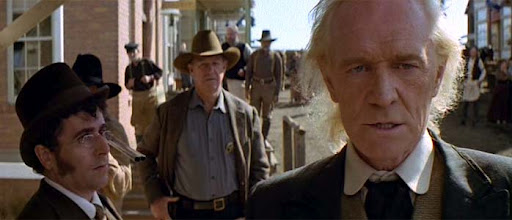
The script, which did the rounds in Hollywood for 20 years before Eastwood picked it up, is pocked with sharp humour and great lines (“If I see you again, I’m just gonna start shooting and consider it self defence.”) and works not just as a study and disassembly of the westerns that came before it, but as a damn good, prime example of one itself. Harris’ English Bob has his own biographer (Saul Rubinek), whose role is to take Bob’s stories and lyricise them a little; in essence creating the cowboy myths and legends that make up the staples of the genre. It’s a film about shattered dreams and fallen heroes – the actors as much as the characters – as it’s not often you see Eastwood rolling around in pig shit, Morgan Freeman asking someone if they sleep with prostitutes or just use their hand or Lex Luthor beating the crap out of Dumbledore. It’s clear that Munny could quite easily be any one of Eastwood’s previous stoic, bitter, hard as nails cowboys who’d let themselves go for a few years.
The film deals with the seriousness of death and murder, with no post-kill smart alec quips. One characters defiant “I’ll see you in Hell, Willaim Munny,” is met only with a considered, matter of fact “Yeah.” It’s almost as prolific as The Good, The Bad and The Ugly and Once Upon A Time in the West, and definitely ranks in the top 5 westerns.
Choose film 9/10
The Conformist

It’s probably not much of a recommendation to say that, only a month after having watched it and having read the notes I took at the time, I cannot remember much about this film. The plot was incomprehensible, mainly because the narrative was chopped up and flitted between with little to no acknowledgement, and if I hadn’t read that it was about a hitman I’d probably never have known.
Our protagonist is Clerici (Jean-Louis Trintignant), a fascism-supporting, recently engaged man with a sordid past, who desperately wants to fit in with society. So jumbled up is the structure of the film that I’m reluctant to say anything that happens, as I can’t be sure of the order shown during the runtime, so if there are spoilers within this review then I apologise.
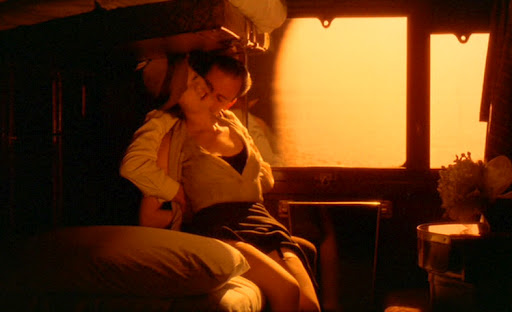
We discover details of Clerici’s past from a forced confession he must make before his marriage, in which we are told that, as a lonely young schoolboy, his family driver molested him, until one day Clerici shot him in a scene where the squibs in the walls are distractingly visible long before they are used. His bride has similar stories of being raped in her youth, but the scene in which she describes the experience to Clerici is genuinely disturbing, as it seems to excite him, and he attempts to turn her on by almost enacting the molestation out upon her as she describes it.
You probably won’t be surprised to find out that this film is Italian, so whilst interestingly shot – lots of angled cameras, leaves blowing at foot level and rays of sunlight through a forest of trees – there’s also a great deal of sporadic nudity and spontaneous sex scenes.
The impenetrable, David Lynch-like plot sees Clerici diverting from his Parisian honeymoon to assassinate his anti-fascist former lecturer, and also visit the man’s wife Anna, with whom Clerici probably used to know on a carnal level, but along the way many of the scenes have elements of strangeness – when Clerici buys a bouquet of flowers, the seller and her singing children proceed to follow him around, another time he manages to lead a decreasing conga spiral out from the inside. I found it incredibly difficult to commit to a film so nonsensical, as I always felt I was being left out of something.
Choose life 3/10

Seven

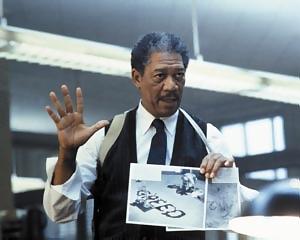
A buddy cop movie with a seasoned old hand so close to retirement they’re already scraping his name off the door and his hotshot, firebrand young replacement, this couldn’t be further from another Lethal Weapon. Yes, one’s a family man and the other’s a loner, one is prone to anger and the other a methodical, careful detective clearly too old for this shit, but where Richard Donner’s 80’s staple is an entertaining, action-packed romp, this is something much darker.After a disturbingly evocative opening credits sequence enriched with depth and meaning on repeated viewings, we meet Morgan Freeman’s detective Somerset, picking up his last case, a sickeningly masterful serial killer with a penchant for the seven deadly sins, the same day as Brad Pitt’s Detective Mills arrives to replace him. That’s as much setup as there is, as we follow the mismatched detectives from crime scene to crime scene, via their headquarters and areas of research, with Somerset whiling a night away poring over books in the library, whilst Mills take a brief glance at the Cliff notes.

The script is dotted with well balanced moments of humour – Somerset having dinner with Mills and his wife Tracey (Gwyneth Paltrow) – and some deep black humour: “this guy’s sat in his own piss and shit; if he wasn’t dead he’d’ve stood up by now,” plus R. Lee Ermey’s belligerent, furious Police Captain (“This is not even my desk” is one of my favourite film quotes, ever).

Crucially, we see none of the killer’s murders onscreen, merely their gruesome aftermaths. It’s not as gory as you might remember, but it evokes imagery and feelings that some may find disturbing, not least what happens to Leland Orser’s character, who probably has the worst memories of those who survive. It could be argues that this is a precursor to the Saw franchise, punishing those that seem to deserve it in creative, torturous ways, but at least here we are saved the nightmarish spectacles of witnessing the deaths.

At times the film feels a bit predictable, like a police procedural itself, but whenever this is about to happen the plot shifts direction, taking an unexpected twist to shake things up again. The colour palette of muted greys and browns, interspersed with deep reds amongst the incessant torrential downpour of the nameless city only adds to the feelings of despair.

There’s small roles for John C. McGinley and Richard Schiff in there as well, a nice surprise for me in the opening credits, but unfortunately at times the acting, especially Pitt during the final scenes, leaves something to be desired. The ending has become the stuff of legend, but I won’t reveal it just in case, save that Pitt’s gurning and crying are a bit over the top and take you out of the scene. This is another one of those films where knowing your actors may ruin the film too, as recognising a voice could cause annoyances later on, but not too badly.

Overall this is director David Fincher’s defining film (better than Fight Club in my opinion, though it’s been a while). The gritty tone is perfectly realised through every medium possible, the plot is gripping, the twists hold up and, though far from an enjoyable experience, it remains worthwhile.

Choose film 10/10

Mad Max 2 The Road Warrior

If the recent UK petrol strikes had gone on a little longer, chances are we’d have seen something not too dissimilar to the events here, in George Miller’s 1981 sequel to 1979’s Mad Max. Mel Gibson reprises his role of Australian cop Max Rockatansky, but the world he lives in is now a barren, chaotic land left ravaged by a worldwide war, leaving the survivors desperate for any fuel they can find.
Max and his dog roam the landscape looking for gasoline, eventually hearing about an enormous stash not too far away, and so with the guidance of a deranged nutcase with a flying machine (“It’s my snake, I trained it and I’m gonna eat it.”), set out to find it, but alas the compound within which the gasoline is kept is not only heavily guarded, but is also being laid siege to by a ruthless gang of miscreants.
Whilst this is certainly an improvement on the original movie, there are still a lot of things here that don’t make sense. For starters, the motivation for every character is to end up with more fuel, yet all seem to expend an awful lot more than they need to in order to get any. Whole fleets of cars and motorbikes are sent out on scouting missions, showboating and jumping as they go, and even the compound uses a bus as a gate. If fuel is so very precious, why are they all so eager to waste it?
The costume design has progressed from the previous film, and now the rebel gang has an even greater passion for leather, bondage and ass-less chaps than Max himself. The depiction of a lawless, structureless society is well done – one of the gang’s cars is a cop car, suggesting that it’s not just the general population that has lost it’s mind – and Max readily eats cold dog food, straight from the tin. There’s better characters too, including a feral kid with a deadly boomerang (played by the brilliantly named Emil Minty), and there’s some decent action and chase sequences. The epic finale, with the gang attempting to seize a petrol tanker trying to travel 2,000 miles to paradise, does get a little samey after a while, but is impressive nonetheless. The arm-mounted crossbow though is probably the least threatening weapon I’ve ever seen.
Fortunately, Mad Max 3: Beyond Thunderdome isn’t on the list, but this one is deserving of it’s place. It’s by no means the greatest dystopian future survival movie, but it’s still an enjoyable watch, and certainly has it’s moments.
Choose film 7/10

Up in the Air

Jason Reitman’s third directorial outing, after the stellar Thank You For Smoking and the good-the-first-time-you-watch-it Juno takes two done-to-death plot conceits – the business-set rom-com and road movie odd-couple – and reinvigorates them to be not only modern, but impressively timely.
Up in the Air is much more in keeping with the structure of Smoking, as we follow a successful, charming but morally dubious and emotionally detached businessman discovering that his perfect life may not be as ideal as it seems once women step a little too far into it. Previously it was Aaron Eckhart’s fast-talking cigarette peddler Nick Naylor, here it’s George Clooney’s professional corporate downsizer Ryan Bingham, jetting around the country to fire people when their own superiors don’t quite have the balls. And with the economic climate and unemployment rates where they are now, no other film could be quite so prescient.
But it isn’t just that this film rings true with modern times. Clooney channels his inner Cary Grant in the role he was seemingly born to play, whilst Vera Farmiga is wonderful as his female equivalent, Alex. The real surprise though is Anna Vendrick. Formerly most famous as Bella’s best friend in Twilight, here she shows real comic ability and acting prowess as Natalie, the bright young whippersnapper brought in to downsize the downsizers, aiming to revolutionise the business by doing it all online.
The cast is rounded out by some Reitman regulars, including Jason Bateman, J. K. Simmons and Sam Elliott, as well as Danny McBride, Melanie Lynskey and Zack Galifianakis, and a gaggle of non-actors portraying essentially themselves when they were fired, with Reitman instructing them to dwell on their own experiences in some moving moments.
The best scenes involve the principals just sitting down and talking. Be it Ryan and Alex comparing the weight of their loyalty cards, or Natalie learning that, as you get older, your expectations of life lessen to more realistic goals, the script is insightful, sparky and above all else funny. I was a little annoyed at seeing Sam Elliott in the opening credits, and seeing his cardboard-cutout as the Chief Pilot in an airport signposting that, at some point, his character was going to crop up somewhere, but that’s another of those things that only really hurts the film nerds.  Some of the metaphors are a little heavy-handed (at one point Ryan’s family literally doesn’t fit into his suitcase) and the ending feels like a series of devastating gut-punches that kind of spoils the mood, but each one feels perfectly justified and necessary.
If you don’t settle too deeply into the subject matter this is a fun comedy with a great script, and even if you do it’s still thought-provoking and entertaining stuff. I await tracking down Reitman’s latest offering, the Charlize Theron starring Young Adult, with anticipation.
Choose film 8/10

Thelma and Louise

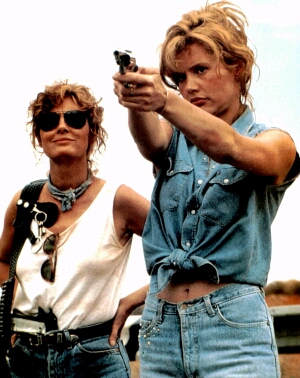
Two girls, a turquoise 1966 T-Bird convertible, a weekend vacation at a friend’s cabin up in the mountains, what could go wrong? Well, in Ridley Scott’s feminist road movie, a heck of a lot, as henpecked housewife Thelma (Geena Davis) and her world-weary waitress best friend Louise (Susan Sarandon) head out from their humdrum lives on more of an adventure than they bargained for, after a run-in with a would-be rapist at a country bar of ill repute.
The titular roles could not be more different, yet both remain well rounded characters, thanks in part to the able performances by the two leads. Though it is the men that seem to shepherd our heroines on the run, they always find a way of fighting back or turning the tables, be it on Harvey Keitel’s cop on their trail (assisted by Stephen Tobolowsky!), Michael Madsen as Louise’s boyfriend Jimmy, Brad Pitt’s first major film role as clothes-shedding hitchhiker J.D. or Christopher McDonald as Thelma’s boorish husband Darryl, eager to get his wife back so she can start making his dinner again.
There’s some great comedy – Darryl unable to watch his beloved football because the cops tapping his phone are too engrossed with Cary Grant in Penny Serenade – and though the story and ending may have been ruined by an overabundance of pop-culture spoofs and references, it is still a very good story. The accents begin to grate after a while, particularly Davis’ pronunciation of Loo-eese, but try to look beyond that at a journey that starts with an accident, and builds to become two strong female characters exploring their own limits, surprising themselves and everyone else.
Choose film 7/10

Far From Heaven

Hertford, Connecticut; 1957. Cathy Whitaker (Julianne Moore) is at the heart of her picket-fenced community, her husband Frank (Dennis Quaid) is a successful businessman and her two young children are little bundles of perfection, with her daughter wishing to one day grow up to be just like her mother, though her son is a little foul-mouthed (“Ah jeez” is not the kind of language Cathy tolerates).  But beneath the surface of floating dresses and pristine curls, all is not well. It’s clear from Cathy’s expression that, though her friends must all put up with their husbands’ occasional demands for intercourse, Cathy has no such problems, for Frank hides a secret; whenever he is ‘working late’ he tends to be frequenting a bar aimed only at male patrons that want to get to know each other a little better.
Todd Haynes’ movie lovingly recreates an idealised vision of 1950s suburban middle America (“Aw shucks” is uttered in the first four lines, and “jeepers” and “swell” aren’t too far behind) although the rampant sexism and racism would be more than frowned upon today. When Cathy shows sympathetic tendencies towards her black gardener Raymond (Dennis Haysbert, 24‘s President Palmer) she is the subject of mild ridicule and is frowned upon by the society that used to hold her dear. Haysbert is good in another of his solid, decent, all-round nice guy roles, but Dennis Quaid continues his run of being the worst thing about a film. I’m sure in his youth he must have done something to earn a reputation as an actor, but I can’t for the life of me think what it is, I’ve only ever known him as the worst thing in bad films (Flight of the Phoenix, Smart People, The Day After Tomorrow, Vantage Point).
The era is seamlessly recreated, to a point where the film could easily have been made in the 50’s – in which case it would probably be hailed today as a classic. Moore is the best thing in it, so much so that at times she barely seems to be acting, so great is the level of repression she must convey. She received an Oscar nomination for her troubles – Nicole Kidman must have been really great in the Hours to beat her.
Though at times it feels like nothing really happens, that is surely the point. This is more a study of the prejudices of the era – Frank’s grand social indiscretions can be brushed under the carpet or cured (a doctor has a 5-30% success rate for curing homosexual urges) whilst Cathy’s much lesser faux pas sees her outcast from all around her. The plot and script are a little hokey, but the performances and overall feel stay with you after watching this subtle piece.
Choose film 6/10

Edward Scissorhands

First off, apologies for the lack of posts recently, I’ve been in hospital for an operation on my nose (inspiring this Top 5). Also, apologies if the posts over the next few days are a little off, I’m on a veritable Pan Galactic Gargle Blaster of meds, but I’ll try and keep everything as on topic as possible.
Johnny Depp successfully accomplished the transition from TV heart throb to serious movie actor with this, Tim Burton’s fourth directorial outing, leading to at present a further seven collaborations between the two bizarelly-haired gentlemen. Depp stars as Edward, the creation of a reclusive inventor (the legendary Vincent Price, in an all too brief cameo in his final film role) who remains incomplete after the inventor passes away. Edward looks human enough, but where five-fingered appendages should be on the ends of his arms, there are instead a multitude of blades, knives and scissors. After being discovered living alone by Dianne Wiest’s kindly Avon lady Peg, Edward is brought into the ‘normal’ world of 1950s suburban American.
As much comedy is made from Edward’s physical impairment as possible, with his blades coming into contact with waterbeds and hindering his ability to get dressed, pick up a glass, open a door or touch his face, but he shows an aptitude for carving meat, topiary, hairdressing, dog grooming, paperchain-cutting and being used as a kebab skewer. This does bring up the subject of exactly how Edward had survived alone in the castle before his ‘rescue,’ but as this is essentially a fairytale, minor plot details can be smoothed over.
As ever, Burton shows a deft hand with his casting. Depp is wonderful as Edward, showing childlike wonder at the new world around him, and expressing true depth of emotion from behind a stark appearance, all pale face, scars, bedraggled mop of hair and tight plastic and leather bondage-inspired clothing, and with minimal dialogue. Winona Ryder is cast against type (in that she wears colourful clothing and has blonde hair) as Peg’s cheerleader daughter Kim, and Alan Arkin and Wiest are wonderful as the parents welcoming Edward into their home. Anthony Michael Hall as Kim’s brutish boyfriend is more of a stretch though; the nerdy Breakfast Club star cannot be taken seriously in a bad guy role.
The film is lighthearted and entertaining, and has some genuine comic moments. The bookends of a clearly aged Winona Ryder are more obvious than the supposed narration reveal of the Notebook, but this features one of the greatest and most memorable character creations of cinema, and some fine acting too.
Choose film 7/10

The Dark Knight

What can I say about the Dark Knight that a thousand others before me haven’t? Of all modern films, this seems to be the one pored over most closely and often, heralded as the saviour of the summer blockbuster, superhero movie and crime thriller, all rolled up in the tightest of scripts. So, to take a fresh perspective, I sought out some people who didn’t like the film (thank the lord for the Internet, it makes people who don’t like something so easy to find) and found myself furious after reading just one and a half 1/10 reviews on IMDb. The sheer level of nitpicking and miniscule plot-hole unravelling proves just how far people are willing to go to disagree with the masses and stand out from the crowd, even when the crowd is so undeniably correct.
Not that this is a perfect film. There are flaws, including the Joker’s plan being at times a tad too pre-emptive, some ominous camera angles and music cues hinting unsubtly a character’s true motives earlier than should have been done, and the bit with the cellphones, which is a bit silly, but is that really enough to warrant a 1-star rating? The fact that these reviewers (I won’t give them the satisfaction of names or links, only seek them out to feel the rage bubble inside you) fail to note even one positive point in a movie overflowing with brilliance negates any opinion they deem worthy of sharing. I personally find it impossible to find nothing good in a movie – The Adventures of Pluto Nash is an abomination unto film, yet Randy Quaid is a delight as Nash’s robotic assistant; Big Trouble in Little China is easily one of the worst films I’ve reviewed from the list so far, but it has imaginative (if insane) monsters and mythology, some dialogue that surpasses cheesy to being inspired, and features Kim Cattrall back when she was attractive. Therefore, with such damning reviews as these ‘people’ have offered, they are in fact unwittingly proving how good a film it is.
Leaping from the tantalising springboard ending of BatmanBegins – Gary Oldman’s Jim Gordon showing Batman a playing card left as the mark of a new criminal, calling himself The Joker, we dive headlong into a wonderfully executed bank heist, as six masked goons effortlessly separate mob money from the vaults it was stored in. Director Chris Nolan has made no secret that Heat, Michael Mann’s superb DeNiro/Pacino cat and mouse crime epic, was a huge influence on the Dark Knight, and it shows, from a William Fichtner cameo to a central meeting of the hero and villain, even mentioning a cup of coffee.
Nolan wisely improved upon some mild mis-steps made in Batman Begins here, replacing Katie Holmes with Maggie Gyllenhall as love interest Rachel Dawes, giving Batman’s mask a cowl so he can turn his head, and giving Batman himself (Christian Bale, good but no Adam West) a little less screen time, allowing alter ego Bruce Wayne and his various accomplices and nemeses some breathing room. Aaron Eckhart is spot-on as Harvey Dent, Gotham’s shining hope against the mob, and Morgan Freeman and Michael Caine remain on hand to add a touch of old school class and grandeur as Wayne’s dependable CEO nad curmudgeonly butler/moral compass, but justifiably most of the praise has been directed at the late Heath Ledger’s Joker. A creation for the ages, his layered performance of a truly maniacal genius reveals more with each viewing, and it is unfortunate that the role showcased the true acting abilities of a man previously thought of merely as a rom-com heartthrob only after he had passed. Plus, it gave us all another Hallowe’en costume to use.
Unusually for Nolan, the film is actually quite funny. It’s not exactly laugh-a-minute (there’s certainly less than 152 jokes here), the script is still a lot more humorous than you might remember. There’s also absolutely no filler, with every strand being integral to the plot; a true achievement when you consider just how engaging the story is, even when new elements are being added right up until the last few scenes.
As always with Nolan’s films, there’s a couple of cinematography moments that I’d have tried differently (see Inception), most notably the scene where the Joker leaves a hospital, which could have looked truly tremendous had it been one unbroken shot, without needlessly cutting away to some pedestrians nearby, but this is a small matter that is more of a personal niggle than a criticism.
Anyway, for those wondering if they should watch the film again before the upcoming trilogy closer The Dark Knight Risesthis summer, the answer is a resounding yes. Even if you don’t intend to see part 3 (I assume you’re planning on gouging out your own eyeballs, just in case it isn’t any good, there’s no other reason not to see it) you should watch The Dark Knight again, just because it’s probably the best film to have been released in the last 5 years, if not more.
Choose film 9/10

A.I.: Artifical Intelligence

Kubrick’s visionary ideas, social commentaries and moral dilemmas don’t quite gel with Spielberg’s family oriented sentimentality in this disjointed and overlong offering, conceived and planned by the former but implemented by the latter after his death in 1999.

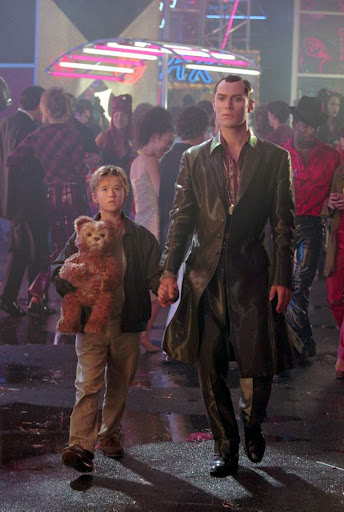
Now, I love me some robots. Whether they’re compacting waste into trash skyscrapers, travelling through time to save Sarah Connor or trying to kill Will Smith, you show me a film with robots in and I’ll watch the Hell out of it (though I’ve never actually seen the 20th Century Fox film Robots starring Ewan McGregor and Robin Williams, just never came around). There’s a robot clock watching me from atop a bookcase in the lounge, robot cushions on the sofa and a robot cookie jar whose head seems to rotate around and look at me wherever I am. But the key characteristic that joins these all together, is that they all look like robots, which is where A.I. looses my interest, for here they look like people. Yes, I know that’s the point. Haley Joel Osment’s mini-mecha David has been created to fill the hole left when his new parent’s son goes into a coma, and Jude Law’s robo-gigolo Joe (that’s fun to say) would be downright weird if he didn’t look a lot like a human, but that’s not what I want to see in a film about mechanical men. It isn’t until over half way through the film that we see some older models and exposed innards, and even then it’s far too briefly.

Osment is good, too good, as the automated child, and occasionally he passes for human, but for the most part he’s in full-tilt terrifyingly creepy mode, following his ‘mother’ Monica (Frances O’Connor) around the house all day, standing and watching her until she justifiably locks him in a cupboard. The first 45 minutes could quite easily be the start of a horror film, so disturbing is David: “I can never go to sleep, but I can lay quietly and not make a peep.” Nothing he does is endearing or even likable, but then I’ve always felt this way about children, but still the brief amount of time it takes for Monica to bond with this mechanised horror is jarring, especially given there seems to be no real scenario that draws them together. Also, David is only programmed to ‘love’ one parent, and his new ‘father’ Henry (Sam Robards) seems devoid of emotions, either for his comatose son or the new replacement, so that fits together nicely.

The movie is comprised of a series of episodes that, once passed, are all but forgotten. The story could have been interesting, and the world has potential for a more enthralling film within it, especially in the city scenes, and the brutal Flesh Fairs, where rogue ‘bots are hunted and tortured to a baying crowd’s delight, but over an hour of watching David desperately wanting to be a real boy becomes terminally dull. The future technology and gadgetry is generally good, subtle yet insightful, although the cars look a bit silly. And the ending is polarising, I found it terrible and unsatisfying, whilst Aisha thought that, whilst it seemed tacked on and unnecessary, it was still very moving.


Choose life 5/10